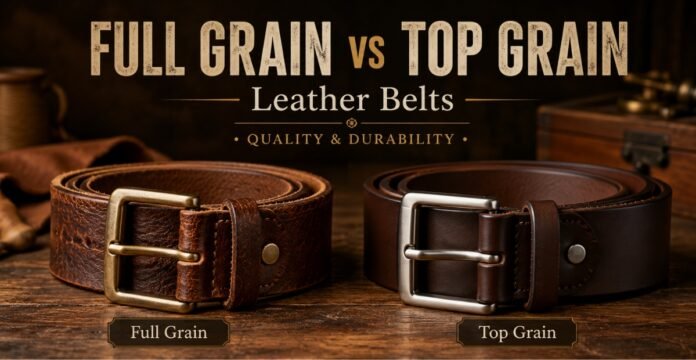
Choosing a leather belt may seem easy, but the type of leather and how it has been processed can affect the comfort, durability, and the style of the finished belt. With full grain vs top grain leather belts, they both use real leather, but the processing is different. With full-grain leather, less of the surface of the leather is removed. Top-grain leather is leather which has been sanded or corrected, and in turn, has a more smooth and even appearance. Understanding full grain vs top grain leather belts will help you decide on a belt depending on comfort, durability, style, and future value, rather than appearance.
What Are Full-Grain Leather Belts?
Full grain vs top grain leather belts are made from the outer layer of an animal hide with most of its natural grain still present. The leather is normally not heavily sanded to remove natural marks. Small scars, wrinkles, grain patterns, and color differences may remain visible, which gives every belt its own character. In the full grain vs top grain leather belts comparison, full-grain leather is generally valued for its natural surface and strong fiber structure. Buyers looking for this construction can explore a full-grain leather belt as an example of how the material can be used in everyday belt designs.
What Are Top-Grain Leather Belts?
Leather grades are based on which part of the animal’s hide is used. The higher the grade, the more of the hide is used. At the highest level, you have top-grain leather. These belts are made from the top layer of the animal’s hide, but the top layer is treated with finishing touches. In order to prepare the leather, the top layer may be lightly sanded to remove marks and give an even grain. Color and finish are then added. Sanding the top layer results in top-grain leather belts that have a uniform look. In most cases, top grain leather has less of the natural grain when compared to full-grain leather.
Full Grain vs Top Grain Leather Belts
Full grain vs top grain leather belts differ in how much of the natural surface of the hide is altered during the manufacturing process. Full-grain leather belts retain the natural surface, and top-grain belts are typically sanded and/or corrected. The grains of full grain leather and top grain leather age differently, and so do their finishes. There are maintenance and price differences as well. All types of leather belts (when made of good quality material) will perform as expected on a daily basis.
Which Leather Belt Is More Durable?
The question most asked in thefull grain vs top grain leather belts debate is typically about durability. With full grain, to an extent, the dense outer fibers of the animal skin are left more intact, and it is shown to hold up to daily wear better, and even repetitive bending. Yes, top grain leather can last for years, but so much of surface layer is removed by grain correction or sanding that it substantially diminishes its original state. The thickness of the leather, the tanning, the stitching, the finishing of the edge, how the buckle attaches, how much moisture it is exposed to, and how it is taken care.
How Their Appearance Changes With Use
Appearance is another important part of comparing full grain vs top grain leather belts. Full-grain leather usually shows natural pores, grain differences, and small markings from the hide. These features can become more noticeable and attractive as the leather develops patina through handling, sunlight, movement, and contact with natural oils. Top-grain leather usually begins with a smoother and more controlled appearance because the surface has been corrected. Both can look attractive, but they suit different preferences. Shoppers looking at leather belts for men may notice that material choice works together with buckle shape, belt width, stitching, color, and finish to create the final style.
Important Points When Comparing the Two
When studying full grain vs top grain leather belts, a few simple points can make the difference easier to understand:
- Natural grain: Full-grain leather keeps more of the original grain surface.
- Surface correction: Top-grain leather is usually sanded or corrected for a smoother finish.
- Aging: Full-grain leather often develops a stronger and more visible patina.
- Consistency: Top-grain leather normally provides more even color and texture.
- Durability: Both can last well, but full-grain leather generally keeps more of the hide’s natural fiber structure.
- Care: Both types should be protected from long periods of moisture, strong heat, and harsh cleaning chemicals.
- Style: Full-grain leather often gives a natural or heritage look, while top-grain leather can provide a cleaner modern appearance.
Comfort and Flexibility in Everyday Wear
Comfort is sometimes overlooked when discussing full grain vs top grain leather belts, but it matters when a belt is worn for many hours. A new full-grain belt can initially feel firm because the leather has not yet flexed around the body. With regular use, good leather normally becomes more comfortable and starts following the wearer’s movement. Top-grain belts can sometimes feel smoother from the beginning because the surface has received additional processing and finishing. Still, comfort in full grain vs top grain leather belts depends heavily on leather thickness, belt width, lining, edge construction, buckle weight, and correct sizing. A high-quality belt should provide support without feeling excessively stiff around the waist.
Performance for Work and Heavy Use
For workshops, construction, outdoor work, and other demanding uses, the full grain vs top grain leather belts comparison becomes more about performance than appearance. A work belt may need to hold tools, pouches, equipment, or extra weight during long working hours. A properly designed leather tool belt shows why construction should be considered together with the leather type. Full-grain leather is often attractive for demanding applications because of its strong natural structure, although a well-made top-grain product can also provide dependable service when it uses suitable leather thickness and quality hardware.
Price and Long-Term Value
Full grain vs top grain leather belts can have widely varying prices because material cost is only a part of the manufacturing cost. Top-grain leather allows manufacturers to be much more flexible with imperfections and marks which allows them to achieve a much more consistent finish, whereas full-grain leather belts require a hide that has a good enough quality surface so that it can remain visible. Just because a belt is full-grain or top-grain does not necessarily mean it is good or bad in that order.
How to Choose the Right Leather Belt
If you want a belt for everyday use, choose between full grain vs top grain leather belts and top grain leather by how you plan to use the belt. Full-grain leather is more rugged, preserves natural character, shows signs of wear well, and gets even better looking the older it gets. Top-grain leather has a more controlled and uniform appearance that is better suited when paired with a more conservative, formal look. Other factors to consider when choosing a leather belt are the overall thickness, buckle attachment, hole finishing, edge finishing, stitching, how it fits, and flexibility.
Conclusion
Full grain and top grain leathers both have different pros and cons and determining which is best suited by the end user is more complicated than branding one better than the other. Full grain vs top grain leather belts retains the hides as is and has a rugged, unrestrained look which is preferred when the goal is aesthetic with an emphasis on character and the effects of passing time. Good leather, as well as good construction of all the other components of the belt, will enhance the value and appeal of any leather belt regardless of whether it is full-grain or top-grain.
FAQs
Which is better, full-grain or top-grain leather for belts?
Full-grain leather is usually preferred for natural character and long-term aging, while top-grain leather is useful when a smoother, more uniform appearance is wanted.
Do full-grain leather belts last longer?
A well-made full-grain leather belt can last many years because much of the natural grain structure remains intact. Actual lifespan also depends on thickness, tanning, hardware, construction, and care.
Does top-grain leather mean poor-quality leather?
No. Top-grain leather is genuine leather from the upper portion of the hide. Its surface is simply corrected or sanded more than full-grain leather to produce a cleaner appearance.