Two belts made from the same high-grade leather can cost the same to produce, but look completely different when paired with the wrong ensemble. When it comes to leather belts, there are several elements that lend themselves toward formality. Customers typically subconsciously interpret these differences.
When it comes to menswear, an understanding of formal vs casual leather belts can help clothing brands and retailers cultivate a selection of accessories that meets customer demands based on the occasion. This sourcing guide brings out the specific elements that formally and casually separate the two categories of belts, with emphasis on what buyers should look out for when browsing the two sub-categories.
Why Formal vs. Casual Leather Belts Differ So Clearly
Belts occupy a unique place in both menswear and womenswear as one of the last remaining areas of fashion that uphold a strong standard of formality where the casual-to-formal design hierarchy has relaxed most elsewhere. Formal vs. casual leather belts clearly demonstrate this trend, as each category is built around a set of very different, often disparate, visual and functional goals rather than falling on a gradient design scale.
When looking at belts specifically, there are visual cues throughout the design that are firmly entrenched in an all-or-nothing system of design hierarchy, formal versus casual. Understanding this will help you develop a stronger, more differentiated selection based on their intended purpose.
Brands who market a single ‘versatile’ belt as design that is appropriate for every occasion, are in fact creating a product that is appropriate for neither. Understanding where formal and casual wear meet helps buyers select inventory that consumers will confidently select for each individual occasion.
Width: The First Visual Signal
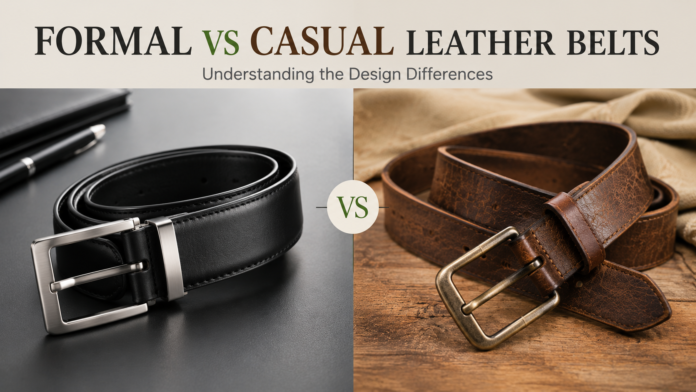
Formality is signaled instantly with belt width, displaying the most clear divide between formal and leather belts. Formal belts are characterized the most by their narrow width, usually a maximum of 1.5 inches in order to appear neat under a jacket and suit.
Casual leather belts can be twice as wide at 2 inches or more. An Eco Jersey full grain leather belt can totally fit within either width, depending on the particulars of the finish and cut.
Buckle Style and Hardware Finish
Buckle selection adds to the formality of a belt, and often where the formal and the casual divide the most. Formal leather belts go with minimal, no-frills designs in brushed silver or shiny gold, often with a frame buckle that has no decoration or brand.
Lower formality leather belts in contrast can have a range of designs with playful details and accents.
Casual belts offer many design possibilities. Their manufacturing hardware also includes large buckles, visible branding, antique or distressed metal, and decorative stitching. All of which would be out of place in the context of formal design. Whether in formal or casual design, men’s leather belts need to have clear distinctions in buckle design. Customers usually pay more attention to buckle design than the leather used.
Leather Finish and Texture
The other significant difference between casual and formal leather belts lies in the surface of both linings used in the laminated construction of the belt. In the finish for formal belts, there is a preference for sleek polished leather, with little to no visible grain, while in the case of casual belts there is a preference for a finish that captures more grain, may contain a hand-hewn patina, and in general is less finished. This also applies to women’s leather belts.
Color Range and Versatility Expectations
Regarding color range, formal belts focus on a narrow color palette of core colors such as brown and black, knowing that these colors can be easily matched to footwear and clothing. This is not a color palette restriction, but a requirement of formal dressing. In general, formal dressing maintains consistency over variety.
Casual belts allow for more versatility in color use, with styles such as distressed finishes and leather belts in lighter shades of tan. Buyers that carry both formal and casual belts should avoid using casual belts with color variety across their formal belts. Formal belts rely on color consistency to have functionality in their proper context, and mixing casual belts with formal belts in this way damages the functionality of formal belts.
Where Utility Belts Fit Into This Comparison
Utility belts are an entirely individual class from formal and casual belts. Utility belts prioritize function over formality. A leather tool belt, for example, is constructed with heavy-duty leather and reinforced stitching that is designed to carry tools. With these design choices, a tool belt is not intended to be formal, and considerations of formality are largely irrelevant to the tool belt’s functionality.
Utility belts are not more casual than casual belts. Utility belts are intended to have functionality and no consideration for formality whatsoever; this separates the class of utility belts from casual belts. It is then easier for a catalog to show utility belts to customers, compared to placing utility belts in an extreme casual position.
Key Features That Distinguish Each Category
When deciding between formal or casual leather belts for their catalog, brands must look for the following distinctions in each style:
- Width consistency with formal styles being no more than 1 1/2” and casual styles being wider
- Restraint and expression of Buckles by matching the style and visibility of the hardware to the intended formality
- Formal lines favoring polished smoothness and casual lines favoring natural texture
- A focus on black and deep browns for formal styles
- Proportionate formal distinctions for men’s and women’s styles
- Presentation of each style to help customers identify which belt is appropriate for the occasion
How to Present This Comparison to Customers
For retailers, it’s beneficial to have a separate section for both formal and casual styles instead of mixing the two styles and making customers analyze product photos to determine the relative formality of offerings. A formal designation along with a short description explaining why each style is appropriate for a particular occasion, is helpful for customers to make a selection.
Analyzing the leather belts catalog, along with customer demand for formal and casual styles, helps buyers correct the imbalance of each style offered in the catalog.
Final Thoughts
Customers can easily tell when belts are distinguished by width, finish, and style with respect for the context and they are customer driven to how they dress to fill a need.
Retailers who describe categories more clearly rather than blurring them serve customers to shop with more confidence rather than guessing.
Eco-Jersey manufactures leather belts divided into distinct formal, casual and utility categories for men and women. Leather belts can be found in our leather belts catalog or go ahead and request a sourcing consultation to help you focus on the right formality mix for your buyers.
Frequently Asked Questions
Can a casual belt ever work for a formal occasion?
Not reliably. In formal situations, width, finish, and styling of buckles are usually noticeable enough to be distracting and look mismatched.
What is the biggest difference between formal and casual belts?
The width and styling of buckles are the biggest difference with more formal styles and a stronger finish and range of colors would be considered more casual.
Does a utility belt fall into the category of a casual belt?
Not really. Utility belts are heavily utilized, and have a lot more of a casual, work oriented focus, and therefore fit more in a third, distinct category.
Do formal and casual belts need to have different quality leathers?
The quality of the leather can be comparable since the distinction is more in width and styling of the buckle and finish and not the leather itself.