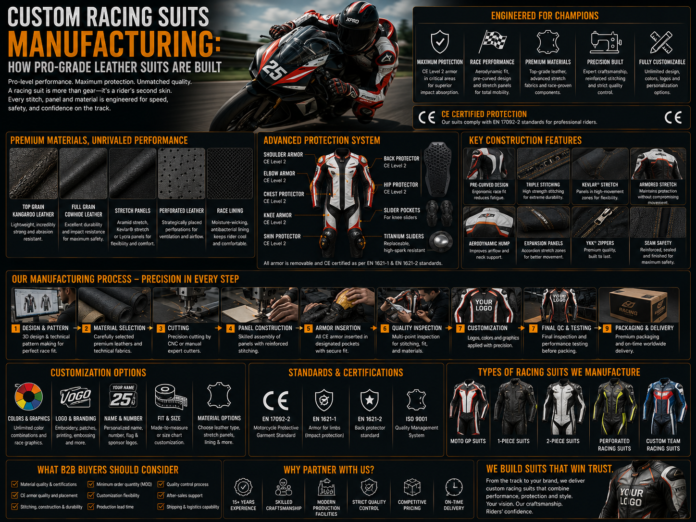
A top-tier racing suit combines state-of-the-art materials, the highest levels of precision in the construction, and the most advanced protective engineering found in motorcycle apparel. When creating racing suits, brands should know how every custom racing suits manufacturing element correlates. This will help them know what they see, pick out which suppliers best fit their needs, and create suits that will be trusted by pro and serious amateur athletes. This guide will give brands and B2B buyers the information to create pro-grade suits with confidence. It will walk through every detail of the custom racing suit creation process, from the raw leather selection through the final quality control.
Why Custom Racing Suit Manufacturing is the Most Complex Area of Motorcycle Apparel
Custom racing suits are more complex to design and manufacture than other motorcycle apparel. This is because as a one-piece or two-piece suit, a racing suit simultaneously has to integrate CE armor and a back protector hump, as well as fit the rider’s body in an aerodynamic manner, be comfortable for multi-hour rides, and provide maximum abrasion resistance. Racing suits also have to comply with homologation, which are FIM-sanctioned standards that necessitate certain levels of CE certification and suit construction that are not required for adventure motorcycle apparel meant for the street.
Choosing Leather for Custom Racing Suits
Of all the materials that go into the construction of a custom racing suit, the leather that is used is the most important as it covers the suit’s core protective functionality.
Hide Grade and Thickness Specification
Top-tier racing suits are constructed using either full-grain kangaroo leather or cowhide. The cowhide is selected for its suitability for motorcycle racing. Kangaroo leather is more lightweight, and more resistant to abrasion than cowhide, due to its unique fiber structure, despite needing to be thinner to achieve that level of resistance. Racing suits crafted from kangaroo leather are therefore more ideal at providing protection while reducing weight. If weight is not a primary consideration, racing-grade cowhide provides excellent protection at a lower cost compared to kangaroo leather, which is why it is the more popular choice in custom racing suits for serious amateur competition and track day outfits.
Panel Leather Selection
Different leather grades are used for different panels on custom made racing suits. Tailored suits made for racing are made from many hides, as different areas of a suit require different demands for protection. The most thick and abrasion resistant leathers are used at the most impacted areas on a racing suit, leaving less thick leathers for parts on a suit that don’t receive impacts. The leather used for racing suits is chosen to keep the suit as lightweight as possible. Leather panel stretch inserts leave the integrity of the suit intact by placing them in areas that aren’t as impacted.
Leather Pre-Treatment and Conditioning
The manufacturing of custom racing suits requires the pre-treatment of leather before the start of the construction. Leather used in custom racing suits needs to be pliable and maintain this quality in high abrasion areas. Leather used in custom racing suits is often treated before the start of manufacturing to maintain its quality. Integrating leather for venting areas needs specific care to keep leather strong enough to maintain its structural integrity, while allowing enough airflow for thermal comfort.
CE Armor Integration in Custom Racing Suits Manufacturing
CE armor integration in racing suits is undertaken at a more advanced level than in road-going motorcycle apparel. Racing creates exposure to greater-impact-severity situations. Also, racing bodies have a different level of certification requirements because of the higher-risk exposure.
CE Armor Level 2
Professional racing suits require CE Level 2 armor for the shoulders, elbows, knees, and hips. This is because armor at Level 2 absorbs significantly more impact energy than the Level 1 standard, which is the minimum for road-going apparel. Also, racing suits require the integration of a back protector. For an FIM-homologated racing suit, this back protector must also be at least CE Level 2. This is indicative of the high-risk exposure to severe spinal injuries from motorcycle racing crash situations. Therefore, custom racing suits manufacturers must ensure that their manufacturing partners provide CE Level 2 armor from certified suppliers and provide the necessary documentation for homologation.
Hump Back Protector Integration
Many racing suits, especially those in circuit motorcycle racing, have a hump back protector that combines a back hump used for aerodynamics and extra spinal protection. The hump structure must integrate with the back panel of the racing suit in a way that sustains the suit’s aerodynamics even at racing speeds. It also must position the protector in the anatomical position during the dynamic motion that occurs during race-pace riding. The hump attachment systems must also allow the protector to be quickly removed for off-the-bike use. Most motorcycle apparel manufacturers do not have the systems to allow hump back protectors to be securely positioned within racing suits.
Chest Armor Development
Modern professional racing suits contain chest and rib armor systems and help prevent rib and thorax injuries that may occur during high-speed collisions. In the past, racing suits only provided chest, back, and shoulder protection. Chest armor systems that are integrated into racing suits must be positioned in front of the chest and ribs no matter what position the rider assumes during race-pace riding. They also must not allow racing suits to become bulky. Because of this, armor systems and racing suits must be designed together and cannot be based on systems that are commercially available.
Pattern Development for Custom Racing Suit Manufacturing
Of all the aspects involved in the custom racing suit manufacturing process, pattern making is the most challenging. This is because patterns must provide the perfect fit for the racing position, while also allowing maximum movement, and body-mapping tailoring that is aerodynamic, along with alignment of body armor in all positions.
Racing Position Ergonomic Design
Patterns for racing suits are developed with the racing position in mind, which is the forward crouched position. This position differs greatly from positions associated with road riding and touring, and therefore greatly impacts the proportions of the garment. The back panel, for example, is extended, while the sleeve is pitched forward to eliminate tension across the shoulder in the riding position. The rise of the trouser is adjusted in order to provide full coverage of the hip and lumbar areas without restriction.
Stretch Panel Engineering
Racing suits must move with the body during rapid weight shifts that occur during cornering. To facilitate this, stretch panels are placed on the spine, the inner knees, inner thighs and underarms. These panels are designed using materials that provide the required stretch to body positions during racing while being compatible with adjoining leather panels. These panels are designed using stretchable materials that can be constructed through strong seams to withstand the forces encountered during a high-speed slide. Panels that are flat and stretchable may perform well during static positions, however, may create distortion when the body is in a dynamic position.
Construction Standards in Custom Racing Suits Manufacturing
The quality of construction used in the fabric of the racing suits should be far superior to standard motorcycle apparel fabric. This is due to the fact that standard motorcycle apparel is designed to withstand road riding scenarios, while racing suits are constructed to withstand high-impact forces that occur during a crash.
Seam Construction Requirements
The seams of racing suits must be constructed using double or triple stitching as a minimum requirement. Such stitching must be made of a critical thread selection designed to be resistant to the stitching being pulled apart during a high-speed slide. Bartack stitching must also be used to reinforce critical openings of armor pockets, openings at the base of a zipper, seams, panels, and other connections and systems that would be the most critical points of failure to the protective performance of a racing suit. These seams are also critical due to failure during a crash.
Zipper and Connection System Standards
The zipper system that connects the jacket and trouser panels in a two-piece racing suit must maintain a secure connection throughout the full range of motion and be designed such that it can be easily operated by a rider wearing racing gloves. Each component of the zipper system must also be of quality leather construction to ensure performance. Wrist, ankle, and collar closure systems must be of quality construction and design to withstand the same forces and repeated interactions throughout a competition season.
External Reinforcement and Slider Systems
Racing suits with integrated slider systems use pre-attached sliders on shoulders, elbows and knees to avoid the racing suit gripping the circuit and rotating the rider’s body in an injury increasing manner during a crash. The systems used to attach slider systems must hold the sliders in place during a crash while not concentrating stress in the leather beneath the attachment point. Because of this, integrated sliders rely on specialized construction techniques that separate skilled manufacturers of custom racing suits from standard leather suit manufacturers.
Considerations for Brands Using Custom Racing Suit Suppliers
When custom racing suit manufacturing is utilized by a brand, the following are the critical determinants that separate professional grade Custom Racing Suit manufacturers from those that fail significantly and at important performance indicators.
- Homologation experience: Manufacturers must provide suits with a certification of homologation or equivalent for the FIM and be able to document and test supports for the concerns of the racing categories engaged.
- Leather sourcing transparency: Custom racing suit manufacturers must provide detailed descriptions of leather, including grade, hides, thickness, etc. for each panel and not provide a generic description of leather.
- CE Level 2 armor sourcing: Manufacturers must provide evidence of the CE Level 2 armor and not assume armor of equivalent level and grade is provided by a general supply chain.
- Riding position pattern validation: On-bike testing with riders of legal racing stature to support development of a racing position pattern must be used, rather than a static test of a dress form of legal stature.
- Crash slide testing: Identify if suits undergo slider system testing and seam strength assessment prior to final bulk production authorization.
- Production capacity at specification: Assess if manufacturer is capable of delivering suits at the required production volume while maintaining the same quality of construction at the professional level, as opposed to simply delivering specification-compliant suits at extremely low prototype/production quantities.
Racing Suit Product Range Extensions
Brands engaged in manufacturing custom racing suits often extend their product offerings to other protective and performance categories that serve the same racing clientele. Racing motorcycle apparel includes suits, protective motorbike gloves, motorcycle base layers designed to quickly wick moisture away from the skin and be worn under the racing suit, and protective riding gear that completes the protection system for the rider.
Additionally, brands that cater to other segments of the motorcycle market in addition to racing can look at the complete motorcycle suits range along with leather motorcycle jackets and custom motorbike jackets, to find manufacturers who can cover multiple product areas. For the full range of motorcycle apparel, brands can look at the complete motorcycle apparel site to see manufacturers who can cover multiple sports
Partner with a Trusted Manufacturer for Custom Racing Suits
A manufacturing partner who specializes in high level leather craftsmanship along with CE Level 2 armor and homologation compliance is needed to develop pro-grade racing suits that will be trusted by competitive riders. Maybe your brand is developing FIM-eligible suits, or maybe you are developing track day suits for amateur riders, or a racing suit line for retail. We work with manufacturers who cater to the needs and performance demands of circuit racing, and give you results that no motorcycle apparel supplier is able to give you.
Conclusion
Manufacturing custom racing suits requires the highest level of expertise. It covers everything from the selection of leather, integration of CE Level 2 armor, to the engineering of ergonomic racing position patterns, and exceeding construction standards compared to any other categories of motorcycle apparel. It involves the integration of a hump back protector, stretching engineering, reinforced seams, and external slider systems. Custom racing suits are designed to offer riders complete protection when racing, as well as an aerodynamic fit that allows full range of motion for optimal performance when racing. Further, compliance with homologation requirements for professional racing is a hurdle that only custom racing suit manufacturers can clear.
FAQs
What leather is used in pro-grade custom racing suits manufacturing?
Full-grain kangaroo leather or racing-spec cowhide that are selected for their high strength and abrasion resistance are used to manufacture pro-grade racing suits.
What level of CE armor is in custom racing suits?
Pro-grade racing suits require CE Level 2 armor for shoulders, elbows, knees, hips, and backs. Level 2 armor absorbs impacts to a higher degree than Level 1 armor, which is the minimum requirement for road-going motorcycle apparel.
In what ways are racing suits patterns different from motorcycle jackets?
Racing suits have patterns made for the forward, and more aggressive, racing posture. Road riding puts the rider in a more upright position. Because of this, racing suits have a more pronounced fit for the back, change in position for sleeves, a lower rise in the trousers, and greater stretch panels, to name a few.