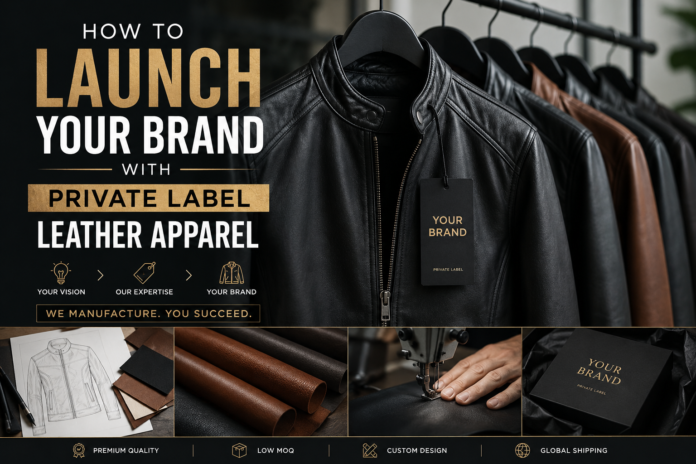
It seems like building a leather apparel line is expensive and labour-intensive, and it is when you start fully custom. Luckily, a fully custom line is not the only option. Private label leather apparel is a great way to enter the market. You collaborate with a brand to promote its existing products. This allows you to bring a professional product to market with less time and upfront costs.
This guide walks you through how to do this, step by step.
What Is Private Label Leather Apparel?
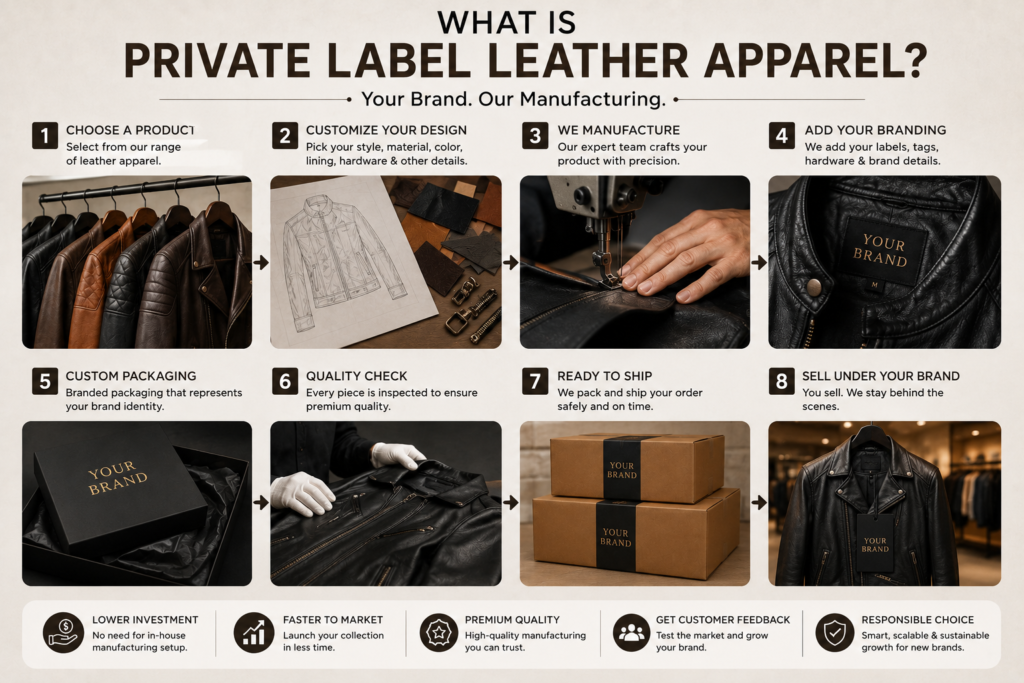
Private label means you take a garment from a manufacturer (a jacket, a vest, a skirt, etc.) and sell it under your brand. The manufacturer builds the design and the garment, and you select from options and customisations. You finish your product with branded labels, hardware, and packaging.
This option requires far less investment and skill for the initial development and allows you to distribute a product and receive feedback from your consumers.
If you are a new brand looking to enter the premium product market, this option is the most responsible choice.
Choose the Correct Manufacturer for Private Label
Not every leather manufacturer offers a private label. Some only work with fully custom contracts. Others will have a private label, but will have a limited offer for customisations.
Start by identifying manufacturers who specifically offer private label leather production — and whose existing product range aligns with what your brand wants to sell. A manufacturer with strong experience across leather jackets, leather coats, and leather vests gives you a broader range of base products to work with.
Be sure to ask about what you can get personalised in their private label options. You can usually choose the hardware colour, lining, label, and packaging. The silhouette and leather grade tend to be fixed. However, this can be more flexible for some manufacturers than for others.
Select Your Products and Customisation Options
When you’ve found a manufacturer, you’ll need to choose the products to launch as well as the ways you will use branding and customisation to set them apart.
For your first private label leather collection, it is always better to limit yourself to one or two ‘hero products’ as opposed to launching too many items. A great leather jacket or coat is much more effective and sellable as the foundation of your brand than ten products that are of lesser quality spread across multiple categories.
Think about the different customisation options that you have and choose the ones that you think will accomplish your goal of making your product feel unique and of your brand. Some of these options include your own woven labels, zipper pulls, your signature print for lining, or unique boxes. These options will elevate the base product to a level of quality that your brand will represent.
A manufacturer who also produces leather bags and leather belts alongside apparel can often supply coordinating accessories — giving your brand a cohesive range from launch without the complexity of managing multiple suppliers.
Develop Your Brand Identity Around the Product
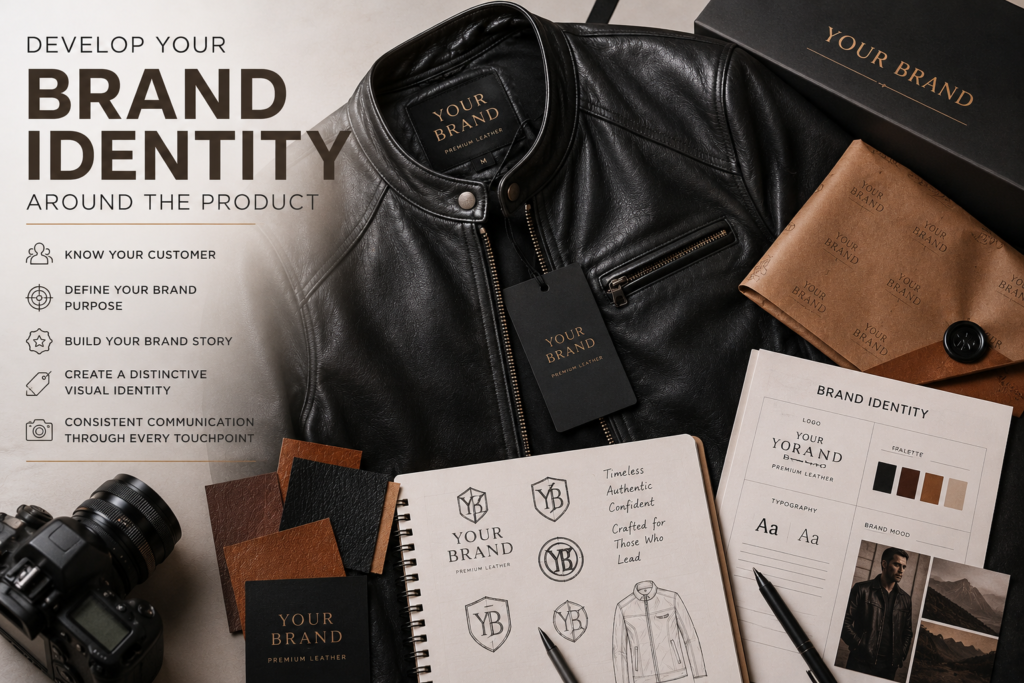
Private labels provide products. The brand, however, is completely yours to create. In your case, with leather apparel, where the market has a large number of competitors, and the customers are picky, brand identity is the element which distinguishes a successful product launch from a product launch which has no impact.
Before you hit the market, you need to have a good grasp of brand name, the brand visuals, the brand story, and the brand for product communication. Who is your customer? What does your brand stand for? Why should they invest money in your product when there are other products that serve the same purpose? What differentiates your product?
Your answers to the above questions determine your logo, your label, the type of photography, and the tones used in your product descriptions. A private label product with a strong brand built around it competes very differently from a private label product with no brand.
Order Samples and Evaluate Thoroughly
Before you decide to place an order to manufacture your products, sample every product you intend to launch, with every customisation you intend to apply. This is now your chance to evaluate the standards of construction of the garment, the quality of leather, and the branding of the garment.
Assess the leather surface carefully. Check the quality of stitching at seams and stress points. Evaluate all hardware – zips, snaps, and buckles – for a test of smooth function. Assess the garment for fit across the range of sizes.
Don’t approve any product for production until you’re genuinely satisfied with every detail. A leather aprons manufacturer or accessories producer with rigorous sampling standards applies the same approach to garment production — and it’s a sign of a manufacturer who takes quality seriously across everything they make.
Plan Your Launch and Scale Thoughtfully
Once your samples are approved, production begins. For a private label launch, keeping your first order conservative is usually the right call. It’s better to sell out and reorder than to sit on unsold stock.
Plan your launch around your strongest hero product. Build anticipation before launch. Use your sample garments for photography and content creation well in advance. And have your reorder timeline agreed with your manufacturer before you sell a single unit — so you’re not scrambling if demand moves faster than expected.
As your brand grows, you can expand into additional product categories — leather pants, leather skirts, leather gloves — and eventually transition into custom development for your hero pieces as your volume justifies the investment.
Here are the key things to have in place before launch day:
- Sample approved for all launch items
- Establish time frames for production and delivery
- Final samples for use in professional photography
- Updated material and precise product description
- Agreed to reorder the schedule with the manufacturer
Conclusion
Fast manufacturing of private-label leather clothes gives novices in the apparel business a fast and inexpensive start with much less risk than designing a custom product. When the product is done, the customer is unable to tell if the product is custom or a private label since it is uniquely branded, packaged, and marketed.
Select the right manufacturer. Be deliberate with product choice. Consider brand identity. After determining the preferences of the target customer, the brand confident growth.
When you’re ready to take the first step, explore the full range of leather apparel manufacturing options and find the right partner for your brand launch.
FAQs
What is private label leather apparel?
It’s a manufacturing arrangement where you brand an existing leather garment from a manufacturer’s range as your own — applying your logo, labels, and packaging to a pre-developed base product.
Is private label cheaper than custom leather production?
Yes — significantly. Private label eliminates the cost of pattern development, sampling multiple rounds from scratch, and the higher per-unit costs that come with small custom production runs.
What can I customise on a private label leather garment?
Typically: labels, hardware colour, lining fabric, hang tags, and packaging. Silhouette and leather grade are often fixed, though this varies by manufacturer.
How do I make a private-label leather product feel unique to my brand?
Through strong branding — a distinctive label, branded hardware, a signature lining, thoughtful packaging, and a compelling brand story that gives the product context and meaning.