Divisions for types of hijab can be based on design, coverage, styling, culture, and occasion. Hijabs can be more than style and head coverings. Many women wear hijabs to reflect to their identity and sense of comfort and modesty. Hijabs can also simplify daily routines, while others can be designed to be more sophisticated and stylish for events, work and travel and formal outfits.
Choosing the right hijab style depends on your face shape, outfit, weather, fabric comfort, and how much coverage you want. Some women prefer a soft everyday hijab, while others like a structured style that stays in place all day. If you want to explore more modest outfit ideas, you can check different Islamic fashion styles and understand how hijab works with abayas, dresses, and other modest clothing.
Types of Hijab
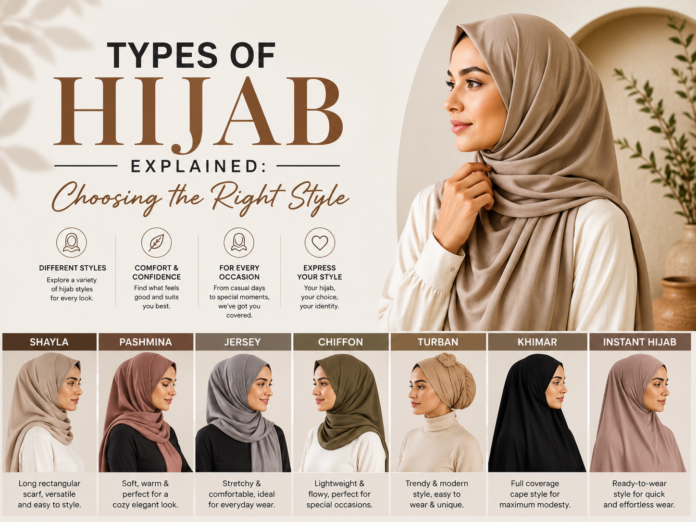
Types of hijab can be designed to be square, rectangular, instant, layered, turkish, satin, chiffon, and jersey hijabs, to name a few. Each hijab can be designed to be more sophisticated and stylish for formal outfits and travel. Some can also be designed to be more comfortable. Some hijabs can also be designed to be more beginner-friendly, while others are more advanced and require practice to style them.
Think about your daily routines and how your hijab is meant to fit into your daily tasks. For a hijab that is meant to fit and simplify your daily routine, an instant hijab would be a better choice. For a hijab that is meant to be flexible and fit your daily routines, a jersey hijab would also be a good option.
When choosing from different types of hijab, think about your daily routine first. If you need something quick, an instant hijab may be best. If you want a soft and flexible style, a jersey hijab can work well. If you want a formal and elegant look, chiffon or satin may be better. A good Islamic women hijab should feel comfortable, breathable, and easy to match with your outfit.
Square Hijab
The square hijab is one of the traditional, classic hijabs. Generally, this hijab is folded into a triangle and pinned beneath the chin, or it can be styled around the head. This style is liked because it has a traditional, neat appearance. It can be worn with modest dresses, abayas, long coats, and is also suitable for everyday outfits.
The square hijab is ideal for women who prefer a structured style that frames the face. This hijab can be made from cotton, chiffon, silk, satin, or blended fabrics. The square hijab is easy to carry and has a variety of styles. Because of this, it is suitable for everyday wear, school, work, and religious gatherings.
Rectangular Hijab
The rectangular hijab is one of the most versatile hijabs. This style is popular because it has a longer length than the square hijab. This hijab offers a variety of coverage, layering, and draping, and can be styled for both a casual or formal outfit.
A rectangular hijab is a good option if you want more styling control. You can wrap it loosely for a soft look or pin it neatly for a more polished style. It pairs well with an abaya for women because the long fabric can create graceful coverage and elegant movement.
Instant Hijab
The main selling point of the instant hijab is how easy it is to put on. It’s pre-formed and/or stitched, which means you won’t need to do any styling or use an abundance of pins. This is the perfect type of hijab for students, busy women, women who travel, and anyone who wants to look nice and tidy while being on the go. There is no reason to spend a lot of time putting on this type of hijab. Instant hijabs can be done on the go.
Instant hijabs are very comfortable and stay in place thanks to the use of jersey, cotton, or stretch fabric. This type of hijab is very useful for women who want to save time and not spend too much time fixing or adjusting their hijab. Instant hijabs are a great option for work, school runs, shopping, and everyday errands.
Jersey Hijab
Jersey hijab lies on the more comfortable end of the hijab spectrum. It is soft, stretchy, and very easy to wrap. Because of these factors, it often stays in place and requires very few pins, making it a popular hijab for everyday use, travel, work, and long days out. Hijabs made of jersey fabric are very easy to pull off and let you achieve a very smooth and relaxed look.
Because jersey hijabs are very easy to style, they’re best for women who want to dress and move easily and with comfort. Jersey hijabs are also not too slippery and are more manageable than hijabs made of shiny fabrics. They go well with casual modest outfits, abayas, long tunics, and dresses.
Chiffon Hijab
Chiffon hijabs are light and flowy while also being very elegant.
It’s one of the preferred hijabs for formal outfits. Styled the right way, chiffon has a soft drape and looks graceful. With so many color options, it can be matched with many outfits.
Chiffon can be a little difficult to work with because it is somewhat slippery, so it often requires pins, an undercap, or a magnet to hold it in place. It may be a little tricky for a beginner to work with, but a styled chiffon hijab can be gorgeous paired with an abaya, maxi dress, or any formal modest outfit with a soft layered finish.
Cotton Hijab
Cotton hijabs are comfortable, soft, and breathable, especially in the heat. For casual and even travel, cotton hijabs are perfect because they are easy to maintain and wash. Work, home, and even school become good places to wear a cotton hijab.
Compared to satin or chiffon, cotton hijabs are easier to style and are less slippery. Because they allow good airflow, they especially become a comfortable choice if you live in a hot climate. For an everyday modest look, cotton hijabs, with their simple and natural appearance, are a great choice.
Satin and Silk Hijab
A satin or silk hijab will give a luxury look to a simple outfit because these hijabs are smooth and shiny. Because of their elegance, they are a great choice for dressy abaya outfits and evening outfits, but, like satin, they can be slippery and tricky to style.
Usually jabs require a fabric undercap and careful pinning. Careful washing is required. Satin or silk hijabs provide a premium look, but cotton or jersey fabric hijabs require less upkeep and are better suited for everyday use.
Khimar Hijab
For more full coverage, khimars extend downwards and provide coverage of the back, shoulders, and chest. Khimars provide one of the more modest hijab styles. Khimars can be designed to be short and simple or long and super flowing.
Khimars are designed to be worn with abayas and other modest dress. Khimars provide comfort to those women who prefer to dress graceful and covered. Some khimars come pre-designed, while others require hair and some undercaps to be styled. Khimars are preferred for everyday modest dress, prayer, and religious functions.
Turkish Hijab Style
Neat and structured best describes the look of the Turkish hijab style. The hijabs tend to be constructed out of square shaped silk or satin hijab fabric. The hijab fabric is folded and pinned around the face in a structured manner. This style works best with long, modest, and elegantly designed dresses and coats.
The Turkish hijab style provides a frame around the face and is best for professional and formal occasions.
However, smooth fabrics may require an undercap and are more difficult to manipulate and keep in place with pins.
Layered Hijab Style
Layered hijab style involves the use of multiple layers of fabric or folds and drapes to add volume and dimension. This can be achieved using chiffon, jersey, or lightweight cotton. Layered styles are ideal for events as they add dimension. Layered styles bring additional elements to more plain or basic outfits, such as an abaya.
Layered hijab styles should be balanced and maintained. Having an excess amount of volume can appear bulky and overwhelming, or heavy at best. For everyday styles, aim to maintain softness with less volume, while allowance for more drape and volume is permitted for styles meant for less casual events. Layered hijab styles are among the best of hijab styles for more dressed-up appearances.
Choosing Hijab by Face Shape
The best hijab styles can also be determined by face shapes. Round faces are more balanced with styles that are moderately loose around the cheeks. Most hijab styles are complimentary of oval face shapes. For square face shapes, styles that incorporate drapes can diminish the effects of sharper angles. Hijab styles that add height should be avoided for long face shapes.
The intent is not to conceal your face shape, but to achieve a soft frame and provide comfort. Experiment with different hijab styles to find your most preferred style. Draping, folding, and pinning techniques with hijabs can greatly impact the overall look and feel of the hijab.
Best Hijab Style Checklist
Here’s a straightforward guide to help you pick the right hijab:
- Cotton hijabs are soft and good for everyday wear.
- Jersey hijabs are nice for an easy wrap.
- For fancy looks, fun chiffon hijabs work well.
- For formal events, satin and silk hijabs work nicely.
- Instant hijabs are great for a quick throw on throughout the day.
- Khimars give a full coverage option.
- Square hijabs are good for a classic style.
- Rectangular hijabs are good for a versatile style.
- Slippery hijabs need an undercap.
- Consider the weather when choosing your hijab style.
Common Mistakes to Avoid
Picking a hijab based only on color is a common mistake. While we can’t deny that some colors are just so beautiful, we should consider more than just the aesthetic. A hijab that is just pretty, but slips and feels too hot is not worth it. Choose your hijabs based on your needs and the current weather.
Using a ton of pins to make an uncomfortable hijab style is another common mistake. While a hijab needs to be secure, it shouldn’t be painful to wear. Lightweight hijabs are your best bet for hot weather and good for quick styles. The perfect hijab is the one that looks nice and feels nice.
Conclusion
There are a variety of hijabs as women have different needs and styles. Some hijabs are easy and practical, while others are elegant and formal. Cotton hijabs, rectangular hijabs, satin hijabs, instant hijabs, square hijabs, chiffon hijabs, jersey hijabs, and khimars serve different needs.
The hijab style that best matches your lifestyle is the best style. Instant and jersey hijabs are best for your day to day, satin or chiffon hijabs are best for your formal events, and khimars are best for full coverage hijabs. Knowing the different types of hijabs really helps you know what hijabs to pick for what events.
FAQs
What are the most common types of hijab?
The most common types of hijab include square hijab, rectangular hijab, instant hijab, jersey hijab, chiffon hijab, cotton hijab, satin hijab, and khimar.
Which hijab is best for beginners?
Instant hijab and jersey hijab are best for beginners because they are easy to wear and stay in place well.
Which hijab fabric is best for daily wear?
Cotton and jersey are best for daily wear because they are soft, comfortable, and easy to style.
What hijab gives the most coverage?
Khimar usually gives more coverage because it covers the head, shoulders, chest, and sometimes the back.