Traditional Islamic clothing encompasses a variety of clothing styles worn by Muslim men and women across the world. It signifies more than just covering the body. It signifies identity and comfort. It encompasses faith and culture, and daily life. Traditional Islamic clothing varies from one country to another. Each country is affected by its own climate, history, and has access to its own particular set of fabrics and styles. In arid, hot, dry and desert countries, construction of clothing and fabrics is more loose and breathable. In the colder regions of the world, thicker fabrics and layered clothing are more common
Why Traditional Islamic Clothing Is Different Around the World
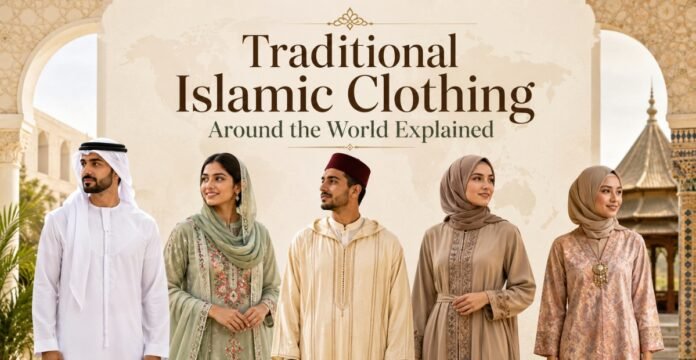
Traditional Islamic clothing is different in different parts of the world because Islam is not practiced in one single country, but in many countries such as: Saudi Arabia, Pakistan, Indonesia, Turkey, Morocco, Malaysia, the UAE, and many parts of Africa. This is why custom Islamic clothing in Pakistan is different from that in Saudi Arabia, as each region infuses its own culture to Islam. For example, in Saudi Arabia, a woman may wear an abaya, a long tunic with trousers in South Asia, or a loose kaftan in North Africa. For men in North Africa, they may wear a kandura, thobe, shalwar kameez, jubba, or long robe.
Traditional Islamic Clothing for Women
Typical Islamic women’s clothing consists of long robes, long tunics, loose dresses, scarves, hijabs, abayas, jilbabs, khimars, and tunics. Traditional women’s Islamic clothing is designed to provide full body coverage while still presenting a graceful silhouette. The abaya is a long, loose robe, worn above daily attire, that is easy and elegant. As a result, it is one of the most common modest clothing choices across Gulf countries. Women use a variety of abaya styles for work, prayer, travel, and social gatherings. If you want to explore modern modest options, you can see this collection of abaya for women as a natural example of how traditional islamic clothing can stay modest while still looking clean and stylish.
Traditional Islamic Clothing for Men
Modesty is the main characteristic of Islamic men’s clothing from a traditional, cultural, and comfortable perspective. In Arab countries, the thobe or kandura is the most common choice. It presents a neat appearance and helps keep the body cool. In South Asia, shalwar kameez is the most common choice, as it is comfortable and appropriate for warm weather. In parts of Africa, a flowing robe with a cap or turban is common. Long coats, tunics, and caps are common to traditional dress in Turkey and Central Asia. Islamic men’s clothing is practical and elegant, making it a great choice for everyday activities, business, and social gatherings, as well as family events and prayer.
The Abaya and Its Cultural Importance
Abayas are one of the most recognized types of women’s traditional Islamic clothing. An abaya is a long, loose outer garment worn from the shoulders to the feet. Abayas were often plain black in the past, particularly in the Gulf countries. There is a wide variety of styles, including embroidered, open-front, and closed-front, as well as simple, formal, and casual abayas. Abayas are popular for their versatility, ease, and elegance. Abayas can be used to cover everyday clothing, which makes them practical for use in travel, shopping, and going to work and religious gatherings.
Hijab in Traditional Islamic Clothing
Like the abaya, the hijab also plays an important role in traditional Islamic clothing. A hijab is a head cover that many Muslim women wear to express modesty and faith, and to make a personal choice. Hijab styles vary throughout the world. While some women may wear simple, square scarves, others may prefer to wear long shawls, jersey hijabs, chiffon hijabs, instant hijabs, or layered hijab styles. A breathable and soft hijab can make daily dressing easier, and you can explore examples of Islamic women hijab to understand how hijab fits naturally into traditional islamic clothing.
Kandura, Thobe, and Long Robes
In the Middle East, long, ankle-length, and long-sleeved robes that are loose and breathable are typical for men, as are the kandura and thobe. Because air can flow throughout the body, robes can be suitable for hot climates. Traditionally, men wear white in the summer to reflect the sun’s rays, while in the winter the color can change to black, as that can be used in formal settings. As shown, modest dressing is practical by the long-sleeved, long-legged, loose, and knee-length Islamic clothing that protects the body as the sun shines, and stays comfortable.
Shemagh, Kufiya, and Head Coverings
Traditional Islamic clothing includes head coverings, as well. The shemagh and kufiya are popular in Arab countries. As these can provide protection from the sun, dust, and wind, they can also be used to show regional style and cultural identity. For example, a shemagh kufiya can be used as both a practical accessory and a cultural symbol. This shows that traditional islamic clothing is not only about garments, but also about useful details that match daily life.
Key Features of Traditional Islamic Clothing
Traditional islamic clothing is usually loose and comfortable.
It is designed to support modest dressing.
It changes according to culture and region.
It often uses breathable fabrics for hot climates.
It may include robes, scarves, tunics, trousers, caps, and outerwear.
It can be simple for daily life or detailed for special occasions.
It gives importance to dignity, comfort, and respectful appearance.
It can be worn by men, women, and children in different styles.
Fabrics Used in Traditional Islamic Clothing
When it comes to traditional Islamic clothing, the choice of fabric is essential. Islamic clothing in warm climates often uses cotton or linen since they are both light, breathable, and easy to wear. Cotton or linen blends with polyester may also be used for easy care and longer lasting clothing. Wool blends may also be used in colder climates. Heavier fabrics may also be worse for modest clothing because it makes the clothing hotter. On the other hand, if the fabric is too thin, the outfit may not be modest enough. This is why the fabric used for traditional Islamic clothing is very important.
Conclusion
Everywhere you look at traditional Islamic attire, you are able to see a synthesis of culture, Islam, modesty, and comfort. There are many forms of dress such as abayas, hijabs, kanduras, thobes, shalwar kameez, kaftans, kufiyas, long robes, etc. Traditional Islamic clothing varies in many different countries, but the purpose remains relatively the same: to present oneself with dignity, respect and comfort. Most people would think that Islamic clothing revolves around styles of the past; however, they would be wrong. Traditional clothing today has modern styles, flattering cuts, color, and is much more contemporary while still maintaining the quality of modesty.
FAQs
What is traditional Islamic clothing?
Traditional Islamic clothing means modest clothing worn by Muslim men and women in different cultures. It includes garments like abayas, hijabs, thobes, kanduras, kaftans, and shalwar kameez.
Is traditional Islamic clothing the same in every country?
No, traditional Islamic clothing is different in every country. The main idea is modesty, but the style changes because of culture, weather, fabric, and local traditions.
What do Muslim women commonly wear as traditional Islamic clothing?
Muslim women may wear abayas, hijabs, jilbabs, khimars, long dresses, tunics, and modest two-piece outfits depending on their country and personal choice.