Home Blog Page 25

Leather Vest vs Other Outerwear Styles: Key Differences

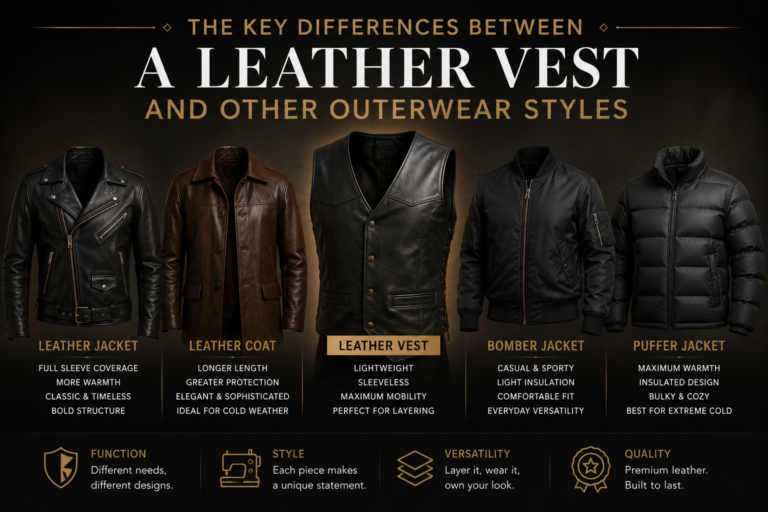
They say a picture is worth a thousand words, and that still holds true today. When most people are asked to describe a leather vest, the image is often compared to a leather jacket or coat. Understanding Leather Vest vs Other Outerwear Styles helps explain these distinctions more clearly.

How is a leather vest different from a leather jacket or a coat? Most people first notice the absence of sleeves, but the differences in Leather Vest vs Other Outerwear Styles go far beyond appearance. Construction, layering versatility, wardrobe fit, brand positioning, functionality, and overall styling all play an important role in setting leather vests apart from other outerwear options.

The function of a leather vest compared to other outerwear ranges from design, tactical, construction, and function, which is what differentiates a leather vest from a jacket or coat.

What Characterises a Leather Vest?

The most obvious differentiating quality of a leather vest is that leather vests have no sleeves.

The absence of sleeves in design gives a vest a function of layering outerwear. Unlike jackets, vests, with a design that is primarily outerwear, give structure and weight to an outfit.

Vests, in the layering department, can be worn over a t-shirt, long-sleeves, or even a hoodie, unlike jackets. This flexibility of layering is what makes vests the most commercially successful of outerwear.. It works across a wider temperature range than most outerwear. It suits more styling contexts. And it appeals to customers who want the leather aesthetic without the full commitment — in terms of both price and wearability — of a jacket or coat.

A leather vests manufacturer who specialises in this category understands these dynamics — and builds the vest’s cut, proportion, and construction specifically around how it will actually be worn.


Leather Vest vs Leather Jacket
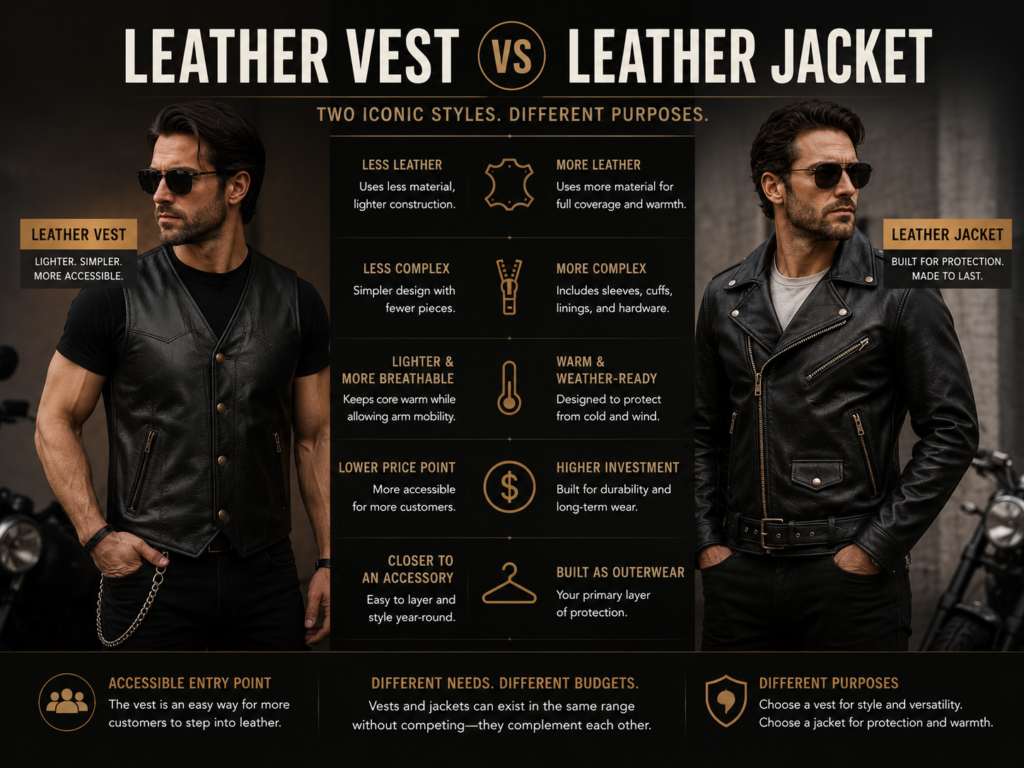
Side-by-side comparison of a leather vest and leather jacket highlighting differences in warmth, complexity, durability, and price point.
Leather jackets provide full outerwear protection, while leather vests offer a lighter and more accessible entry into leather fashion.

This is maybe the most important comparison for brands developing a leather offering.

A leather jacket is designed to be outerwear and offer protection from the elements. Jackets are built to keep you warm and protect your arms. Outerwear is built to be durable and have complexity to its construction like sleeve heads, cuffs, linings, and hardware. This complexity and durability make it more expensive.

A leather vest has less leather. It is built to be less complex. Because of this, price point and construction are lighter. It is closer to an accessory than an outerwear piece.

That difference in price and wearability makes the vest an accessible entry point into the leather category. Many customers who wouldn’t invest in a leather jacket will readily buy a leather vest. For brands, that means the vest and jacket can sit in the same range without cannibalising each other — they serve different needs and different budgets.


Leather Vest vs Leather Coat

If the jacket is the closest comparison, the coat sits at the opposite end of the outerwear spectrum entirely.

A leather coat is designed for maximum coverage and warmth. It’s longer in length, heavier in construction, and requires substantially more leather than either a vest or a jacket. The pattern grading is more complex. The lining is more substantial. And the production cost is significantly higher, which is why leather coats sit at a premium price point in most collections.

A leather vest, by contrast, is the most accessible and casual piece in the leather outerwear family. It’s lighter, simpler, and far more versatile across seasons. A coat is a cold-weather investment piece. A vest is something a customer can reach for across much of the year.

For brands building a leather range, a vest and coat can coexist comfortably at very different price tiers — giving customers a clear upgrade path as their confidence in the brand grows.


Leather Vest vs Leather Gilet
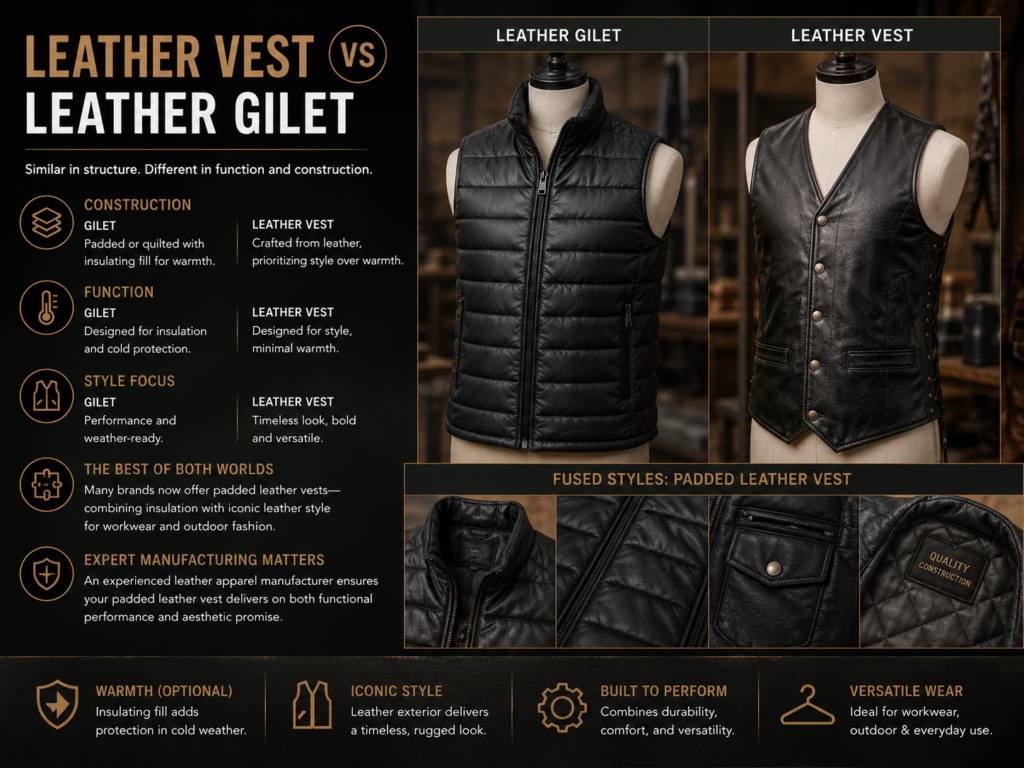
Comparison between a padded leather gilet and a classic leather vest showing differences in insulation, construction, and style.
Leather gilets focus on insulation and performance, while leather vests prioritize lightweight construction and timeless styling.

Gilets and leather vests are both sleeveless and therefore structurally quite similar. Yet, with respect to function and construction, they diverge significantly.

Gilets use either padded or quilted fabric with an outer layer that is of little concern. The fill and insulation is where the construction of a gilet is carefully considered. In contrast, leather vests prioritize style with little concern for warmth.

Some companies have created bridged the difference between these products and made both padded leather vests and leather vests with insulating fill. Gilets and leather vests share construction and style, and this fused style has increasingly been found in workwear and outdoor fashion.

A leather apparel manufacturer experienced in both leather construction and padded garments can guide brands through the technical requirements of producing a padded leather vest that delivers on both the functional and aesthetic promise.


Leather Vest vs Leather Skirt and Pants

This comparison might seem unexpected — but it’s relevant for brands building a full leather collection. Vests, leather skirts, and leather pants often share a collection — and understanding how they relate to each other helps brands build a cohesive range rather than disconnected individual pieces.

A vest paired with a leather skirt or pants can work together with the same leather type, color, and finish. Because of this, they can create a complete leather look.

The construction of these two items are very different. A vest is built around covering the upper body, while a skirt or pants are meant to fit around the lower body and allow movement and comfort. Each requires different types of pattern-making skills, which is why it’s best to have a manufacturer who is experienced in this field.


How Construction Differs Across Each Style

The construction differences between Leather Vests and Other Outerwear Styles go beyond just appreciating their particular details.

Other outerwear styles require a sleeve head, which involves more complicated construction techniques. This makes other outerwear styles more complex and leather vests cheaper. Although the construction of leather vests is simpler, it is not necessarily easy. There will still need to be some careful armhole shaping to avoid gaping. In addition, the vest closure must align and hang properly, no matter the size, and the closure must remain balanced and not distort the overall design of the vest.

A leather bags manufacturer or accessories specialist who works alongside a leather apparel operation often brings valuable skills to vest construction — because the edge finishing, hardware attachment, and panel construction disciplines that bags demand are directly relevant to quality vest production.


Conclusion

The differences in Leather Vest vs Other Outerwear Styles go well beyond the presence or absence of sleeves. They cover function, construction complexity, commercial positioning, and how each piece serves a different customer need.

Understanding Leather Vest vs Other Outerwear Styles helps brands make smarter decisions about their leather range — choosing the right styles for the right customer, at the right price point, with the right manufacturing approach behind them.

When you’re ready to develop your leather outerwear range, explore the full range of leather apparel manufacturing options and find the right partner for your collection.


FAQs

What is the main difference between a leather vest and a leather jacket?

A leather vest has no sleeves — making it a layering piece rather than full outerwear. A jacket provides arm coverage and significantly more warmth and construction complexity.

Is a leather vest considered outerwear?

Yes — but it functions more as a layering piece than primary outerwear. It adds visual structure without the full warmth protection of a jacket or coat.

Why is a leather vest less expensive than a leather jacket?

It requires less Classic Field Leather Jacket fewer panels, and simpler construction — no sleeve head, no cuff detail, and less complex lining. These factors reduce both material and production costs significantly.

What is the difference between a leather vest and a gilet?

A gilet is typically padded fabric designed primarily for warmth. A leather vest is made for style — the leather surface is the statement, not insulation.

Can a leather vest coordinate with other leather pieces in a collection?

Yes — a vest pairs naturally with leather pants, skirts, and jackets in the same grade and colour. Together, they create a cohesive full leather collection proposition.
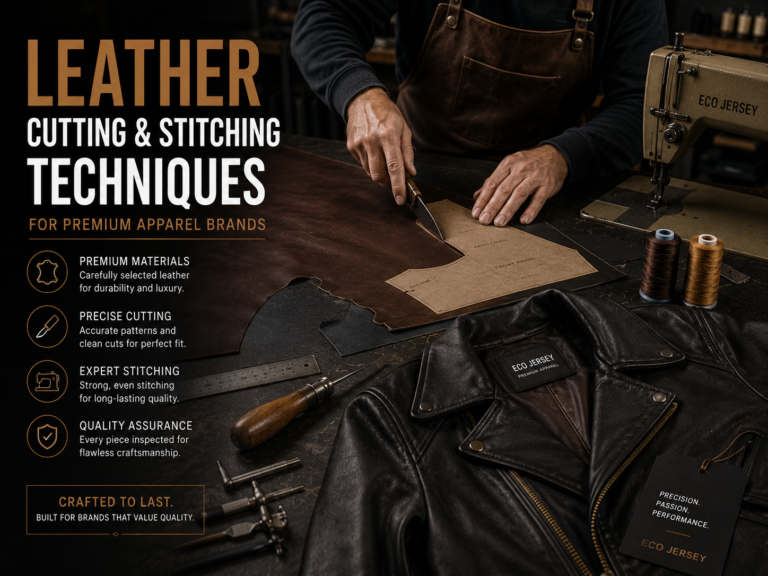
Leather Cutting &Stitching Techniques for Premium Apparel Brands

In premium apparel manufacturing, the techniques of leather cutting &stitching is significant to the quality, durability, and overall finish of the garment. In contrast to woven fabrics, leather will not fray or stretch unevenly; hence, each cut must be done with purpose and each seam strong and tidy. A mastery of these leather cutting and stitching techniques is crucial for apparel brands to manufacture high-quality, durable apparel that the discerning customer will be proud to wear.

Why Leather Cutting and Stitching Matter

Leather is unyielding. Once you’ve cut it, there’s no going back. And seams that are done poorly will not only lose their integrity but can also shape the garment. Given the points mentioned, attention to detail, skill, and experience are all crucial in the execution of each and every step of the leather cutting and stitching process. This will invariably be the case when we consider premium apparel manufacturing and how a premium brand’s reputation depends on consistency and quality throughout every batch.

Nail down cutting and expert stitching are part of our complete apparel manufacturing services. Not only are our leather garments beautiful; they are also made to last.

Leather Cutting Techniques Every Manufacturer Should Know

There is more to cutting leather than “trace and cut.” Different styles and functions of garments (biker jackets vs vests vs premium pants) require different techniques.

Hand Cutting Techniques

Using scissors, knives, or blades to individually cut pieces is the hand cutting technique. It is great for small runs and bespoke pieces.

Die Cutting Techniques

For larger runs, die cutting is efficient and accurate. A shaped metal die and a press are used to quickly cut multiple pieces. This technique is excellent when consistency and uniformity across multiple sizes and repetitions is necessary.

Automated Techniques

Using CNC or a computerized laser can lead to great precision especially for patterns or curves. This advanced technique can also minimize waste by optimizing the arrangement of the pieces on the leather hide.

Skiving and Edge Preparation

Skiving is the term used for the flattening of leather edges prior to stitching to help reduce the thickness of the seams. This technique becomes very important in leather constructions which help to promote the function of the garment while improving the aesthetics and comfort of the garment.

Stitching Techniques That Build Strength and Style

After cutting leather pieces, the joining process by stitching requires considering the balance of strength, flexibility, and appearance of leather.

Saddle Stitch

This is one of the most traditional ways of hand stitching. This is done using two needles and one thread. Each side of the stitching crosses one half of the thread. This creates a clear advantage in that it is still secure in case one half of the thread or one side of the stitching fails. This is important in leather products as durability is very important and this is mainly why this stitching method is used in this category.

Machine Stitching

In mass production of leather products, machines are used to help streamline the process. Heavy duty leather stitching machines use lockstitch to help stream line the stitching process and maintain high performance levels.

Pre-Stitch Guidelines

Before stitching, uniform stitch placement can be accomplished by either grooving or dying holes in the leather; this relieves stress on the leather and improves the seam’s appearance and durability.

Strategies to Construct Quality Leather Clothing

These strategies can create clothing that is durable and elegant:

  • Use the correct tools for the material: Stronger blades and specialized needles are essential for thicker leather.
  • Use tools that are in good condition: Uneven edges or tearing can be a result of using a dull blade.
  • Use the appropriate resin: A resin that is waxed or a thicker polyester will be stronger.
  • Consider the direction of the grain: The placement of the panels can be done in such a way that the natural grain adds to style and longevity.
  • Finish the edges: Burnishing the edges protects the seams and adds an elevated appearance to the clothing.

How Eco Jersey Aids Creation of Quality Leather Garments

If you are creating leather clothing and need skilled production assistance from beginning to end, Eco Jersey can offer a broad production capability guarantee on leather cutting, sewing and final finishes of your clothing.

Lets start with us today

Knowing the appropriate leather cutting and stitching techniques is imperative for either enhancing a current leather product or creating a new quality line. To help you achieve your desired product, we have created a simple process to make high quality custom apparel a reality; simply Get Quote Now and begin your journey with us, or Contact Us Now for specialty production assistance.

Conclusion

Taking care and attention to detail with leather apparel should not be mistaken as sewing, but as creation. Each step from the cutting to the stitching should be carefully considered as it improves the feel and comfort of the garment. With the knowledge of the best quality cutting and stitching methods, your leather apparel is sure to emerge as the best choice for customers — durable, consistent and most importantly, appreciated.

FAQs

What should I consider before cutting leather for garments?

When making the decision to cut leather, the grain direction, the quality of the hide, and panel positioning should be all be factored in as once cut, leather cannot be repositioned as fabric can.

Is hand stitching always better than machine stitching?

Saddle stitched hand stitching is durable and adds to the overall quality of the craftsmanship, however, for bigger runs, machine stitching is best for quality and consistency.

Can automated cutting replace all traditional methods?

Laser and CNC cutting can reduce the time and effort with cutting, however for more complicated designs, the traditional cutting methods still hold their place in the bespoke production.

What Hardware and Button Styles Elevate a Premium Leather Coat Design

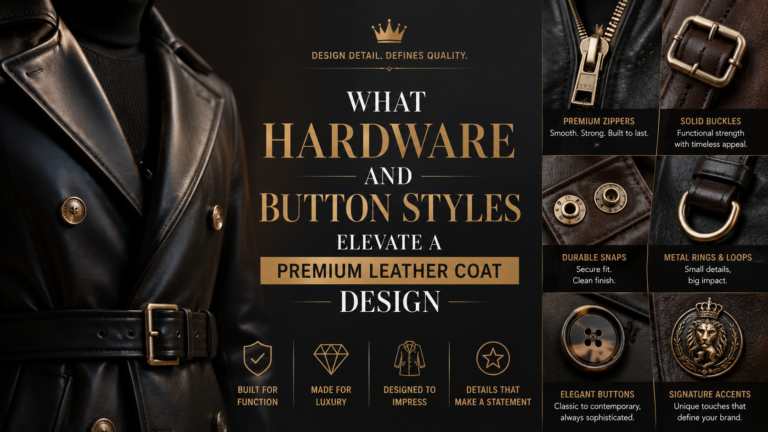
When you invest in a premium leather coat, every little detail matters — from the stitching to the lining, and especially the hardware. The buttons, zippers, buckles, and snaps on a leather coat are not just functional. They are the finishing touches that define whether a coat looks cheap or luxurious. If you are someone who cares about quality outerwear, understanding Hardware and Button Styles Leather Coat choices will completely change how you shop or design. Let’s walk through the key elements that take a leather coat from ordinary to exceptional.

Why Hardware and Button Styles Leather Coat Details Matter So Much

Most people focus on the leather itself when judging a coat’s quality. But experienced manufacturers and fashion buyers know that the hardware tells an equally important story. Poor-quality zippers can ruin an otherwise beautiful leather jacket. Cheap buttons that pop off after a few uses make even premium leather look bad. The right Hardware and Button Styles Leather Coat choices should feel solid in your hand, work smoothly every single time, and complement the overall aesthetic of the piece. Whether you prefer a minimalist clean look or a bold statement design, your hardware choices make all the difference.

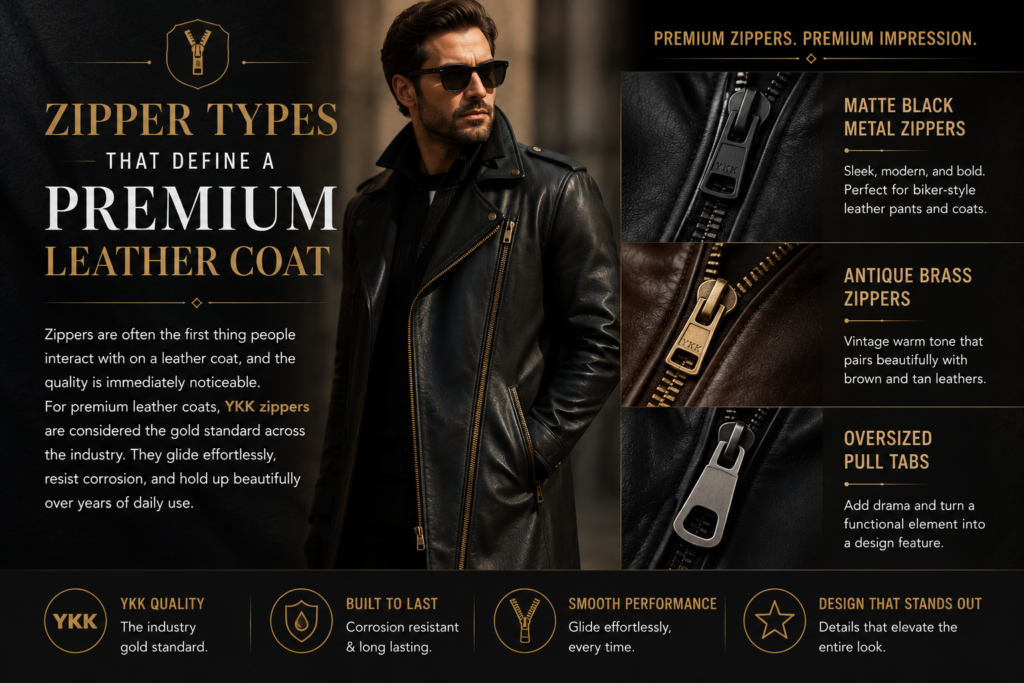
Zipper Types That Define a Premium Leather Coat

Premium leather coat zipper styles including matte black metal zippers, antique brass finishes, and oversized pull tabs.
High-quality zipper selection plays a major role in defining the functionality and visual character of premium leather outerwear.

Zippers are often the first thing people interact with on a leather coat, and the quality is immediately noticeable. For premium leather coats, YKK zippers are considered the gold standard across the industry. They glide effortlessly, resist corrosion, and hold up beautifully over years of daily use. Matte black metal zippers give a sleek, modern edge that works perfectly on biker-style leather pants and coats alike. Antique brass zippers, on the other hand, bring a vintage warm tone that pairs wonderfully with brown and tan leathers. Oversized pull tabs add drama and make a functional element into a design feature. The Hardware and Button Styles Leather Coat conversation almost always begins with zipper selection because it sets the entire tone for the garment.

Button Styles That Signal Quality and Craftsmanship

Buttons on leather outerwear come in a surprisingly wide variety, and each style communicates something different about the garment’s character. Horn buttons carry a natural, earthy elegance that speaks to traditional craftsmanship. Metal buttons — especially those with engraved logos or textured finishes — feel bold and premium. Snap buttons are popular for casual designs and work brilliantly on leather vests where quick access is important. For Hardware and Button Styles Leather Coat applications, the shank button is often preferred because it sits above the leather surface, reducing stress on the material and extending the garment’s lifespan. A hidden button placket with leather-covered buttons is the ultimate mark of tailored sophistication.

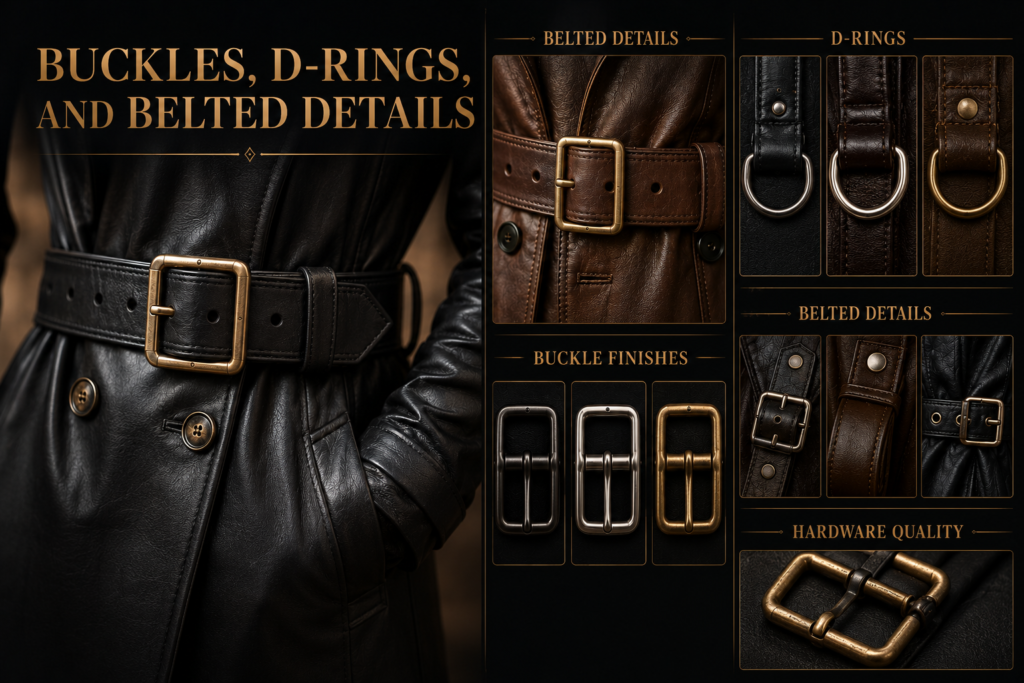
Buckles, D-Rings, and Belted Details

Leather coat with belted waist, metal buckles, D-rings, and premium hardware finishes in gunmetal, silver, and antique gold.
Buckles, D-rings, and belted hardware details add structure, durability, and a premium fashion look to leather coat designs.

Buckles add a functional yet striking element to leather coats. A wide leather belt with a solid metal buckle cinches the waist and instantly transforms the silhouette. D-rings are popular on military-inspired designs, adding both utility and visual interest. Gun-metal, polished silver, and antique gold are the most common buckle finishes for premium leather outerwear. These details are just as important in a leather skirt context as they are in coats. When discussing Hardware and Button Styles Leather Coat options with a manufacturer, always ask about the weight and thickness of buckle hardware — heavier hardware almost always signals better quality.

Rivets and Stud Detailing for Edge and Personality

Rivets and metal studs are a signature of rock-inspired and moto-style leather outerwear. When used with restraint, they add personality without overwhelming the design. Pyramid studs along shoulders or down pocket flaps give a coat an assertive, edgy character. Flat rivets used at stress points — like pocket corners and strap attachments — are both practical and decorative. The key is balance. Too many rivets can look overdone, but the right placement makes Hardware and Button Styles Leather Coat designs genuinely memorable. If you’re looking at bespoke leather apparel, rivet placement should always be intentional and proportional.

Snap Closures and Press Studs — Functional and Stylish

Snap closures have made a strong comeback in modern leather outerwear because they offer the perfect blend of ease and clean aesthetics. A double-cap snap in a matching metal finish creates a seamless, refined look when closed. For utility-style leather coats with multiple pockets, snaps work better than buttons because they lie flat and don’t create bulk. You’ll see this hardware used heavily in leather aprons too, where both durability and accessibility are essential. In the Hardware and Button Styles Leather Coat world, high-quality snaps are often nickel-plated or solid brass to resist tarnishing and breaking.

Eyelet and Lace-Up Details for a Custom Fit Look

Lace-up panels with metal eyelets are a bold design choice that references equestrian and vintage military styles. They allow the wearer to adjust fit across the torso or sleeves, which is both practical and visually striking. Brass and nickel eyelets are the most durable and look the most refined. These details are often seen alongside matching hardware on leather belts that accompany the coat as part of a complete outfit. Hardware and Button Styles Leather Coat designs with lace-up elements need careful finishing around each eyelet to prevent the leather from tearing over time — a detail that separates skilled manufacturers from average ones.

Hardware Finishes — Matching or Mixing Metals

One question that comes up often is whether all hardware on a leather coat should match. The traditional answer is yes — a consistent hardware finish creates cohesion and signals careful design. Polished silver hardware has a contemporary clean feel. Antique brass evokes heritage and vintage character. Matte black is bold and modern. However, deliberately mixing finishes — like pairing antique brass buttons with black zipper pulls — can create intentional contrast that feels artful. This principle applies across leather accessories too, from leather bags to coats. Whatever approach you choose, consistency within that choice is what makes Hardware and Button Styles Leather Coat design look intentional rather than accidental.

Functional Pocket Hardware That Enhances Design

Pockets on a premium leather coat are rarely just pockets. The flap button, the zipper pull, the snap closure — each is an opportunity to reinforce the coat’s overall hardware story. Welt pockets with a hidden magnetic closure look incredibly sleek on modern minimalist coats. Cargo-style patch pockets with contrast buckle straps add utility and visual weight. Even the way a pocket’s hardware lines up with the coat’s main closures tells you something about the quality of design thinking behind the garment. For those who also invest in quality leather gloves, matching the glove’s snap hardware to the coat’s hardware is a small but powerful styling detail. Hardware and Button Styles Leather Coat pocket detailing is where many mass-market coats cut corners — and where premium garments shine.

Choosing the Right Hardware When Ordering Custom Leather Coats

If you are working with a manufacturer to create custom leather outerwear, hardware selection is one of the most important conversations you will have. Always request physical samples of zipper pulls, buttons, and buckles before finalizing a design. Ask about the metal gauge, the plating process, and how the hardware is attached to the leather. Riveted hardware is almost always stronger than sewn-on hardware for high-stress areas. The Hardware and Button Styles Leather Coat choices you make at this stage will determine how the finished garment ages and performs. A great manufacturer will guide you through options and help you understand the tradeoffs between aesthetics and durability. Explore the full range of premium leather coats to see how thoughtful hardware choices elevate every design.

Conclusion

Ultimately, the Hardware and Button Styles Leather Coat choices you make are a direct reflection of your standards. Whether you are a brand building a collection or an individual commissioning a one-of-a-kind piece, paying close attention to zippers, buttons, buckles, snaps, and rivets will ensure your leather coat stands apart. Quality hardware is not just about looks — it’s about how a coat functions, how long it lasts, and the confidence it gives you every time you put it on. Invest in the details, and the details will reward you for years to come.

FAQs

What is the best zipper brand for a premium leather coat?

YKK zippers are widely considered the best choice for premium leather coats. They are durable, smooth, and available in multiple finishes like matte black, antique brass, and polished silver to match any design style.

What Hardware and Button Styles Leather Coat designs are most popular right now?

Currently, matte black metal hardware with oversized zipper pulls is very popular for modern and biker-style coats. Antique brass buttons and buckles are trending for vintage-inspired designs. Clean, minimal snap closures are also widely chosen for contemporary minimalist styles.

Should all hardware on a leather coat be the same finish?

Traditionally yes — matching hardware finishes create a cohesive, polished look. However, intentionally mixing finishes, such as brass buttons with black zippers, can look artful when done carefully. The key is to make it look deliberate, not accidental.

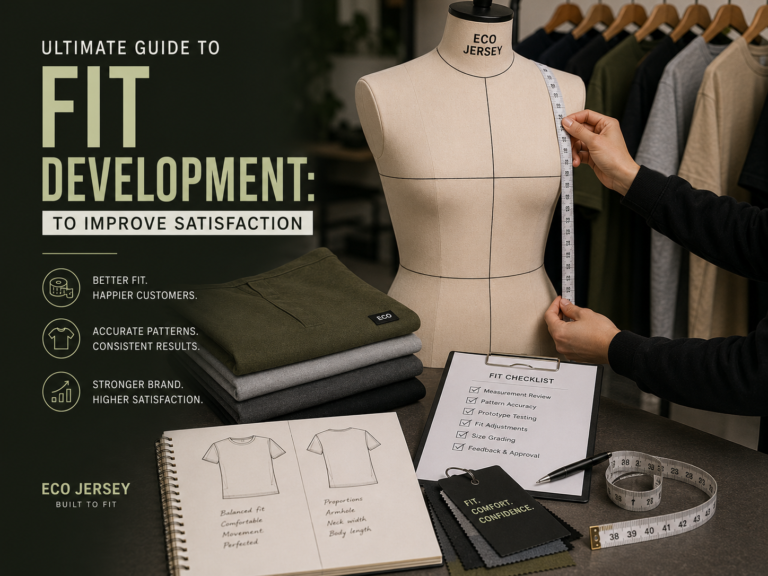
Ultimate Guide to Fit Development: to Improve Satisfaction

Delivering great‑looking apparel is only half the battle — the other half is ensuring that it fits well. When it comes to the apparel industry, the functionality of fit is a large driver behind customer satisfaction, whether you’re designing workplace uniforms, team gear, clothing for promotions, or corporate apparel. If the clothing does not deliver on fits, then the customer satisfaction will inevitably fail too. It is essential to know and understand the implications of fit development to increase satisfaction in a space where patrons are demanding more and more with clothing that enhances range of motion, promotes a sense of confidence and builds a strong level of affinity with the brand.

To achieve that, we will outline everything you need to know about fit development, its importance, and how you can integrate a successful fit development process for your apparel.


What is Fit Development, and its Importance?

Fit development is not defined by a size chart. It is a series of outlined steps that assists designers and patrons alike with the definition, development, and adjustment of the optimal fit of a garment that is to be marketed for multiple sizes. It is not simply a size chart, but an intentional design of apparel that delivers patron comfort along with a consistent and intended experience.

The implications of a successful fit development process are:

  • Greater Satisfied Customers It gives the customer a sense of confidence in the purchase.
  • Impactful Decrease in Returns and Exchanges Apparel that has a poor fit is one of the highest contributors to customer returns.
  • Visible Brand Trust Consistency in sizing builds trust.
  • Greater Positive Impact in Performance Apparel, especially team uniforms and activewear, perform better.

If you want customers to return, this process should be integrated into your product development strategies.


Core Factors Impacting Fit Development

Here’s what information is incorporated about making apparel that meets the needs of the wearer.

Set A Fit Vision From The Start

Determining what your final fit will look like early on is important so you can consider the numerous impacts of that decision.

What will they look like? Will your staff wear a relaxed fit uniform? Or perhaps the staff, or still the athletes, wear a uniform that is functional and fit for performance.

The customized clothing that a company offers will have a direct impact on what the staff will feel comfortable and happy to wear.

A thorough tech pack development will serve as your commitment to the clothing and how it should fit and flow, while offering the manufacturer the measurements and notes about fit and the style of the clothing.


Rightly Sized Independent Grading System

Grading is a system of used to adjust clothing from small, medium, and large in a way that maintains the same proportions. A system of measurement, but with a focus on aesthetics, and how the clothing will fit.

If done well, a design can be the same for someone wearing a size S, M, and L. Unfortunately, if a design does not have this a grading system, wearers will be thoroughly frustrated, as will the company, and will not have any trust in the system the company employs to size the clothing.

For quality clothing with only minor fit complaints, consider professional development and size grading services.


Build and Test Samples Early

Engineered fit development isn’t complete until the fit is tested. Once you’ve applied grading, you need to make samples and test them:

  • On different body types
  • Over the size range
  • In all the wear scenarios

Sampling provides the opportunity to see how the garment actually feels to be worn, rather than how it feels to be looked at. You will encounter issues, such as limited range of motion, uneven sleeve lengths, unexpected pulling, before major production runs.

This method of testing impacts the budget positively, as it will decrease the number of modifications required and improve the clarity of your expectations for your production partner.


Work With Manufacturers Who Understand Fit

Your production partner is important when you work on the translation of fit development into the end product. Manufacturing partners that maintain stringent fit, grading, and measurement requirements will allow you to achieve accurate fit to garments, consistently.

This is the benefit of working with a production partner that offers full cycle production capabilities, from sourcing your fabric to cut and sew.


Use Feedback to Refine and Improve

Fit development continues past the first production run. Improve your fit strategy by evaluating customer feedback and aspects that cause returns, and by observing fit comments in your products in the real world. This approach to feedback, and the desire to improve, builds confidence and achieves your sizing target.

When it comes to customers that are fulfilled, you will always gain a purchase and referral.

How Fit Development Improves Satisfaction

The following points show how well-thought-out fit development leads to happy customers:

  • Predictable sizing generates trust: Customers feel more confident and less hesitant when making apparel purchasing decisions with reliable size charts.
  • Reduced fit issues results in less hassle: Customers are less likely to return or exchange apparel that meets their expectations.
  • Increased loyalty: Customers are loyal to brands whose apparel fits well and delivers comfort and consistency.

Fit development helps you to differentiate your brand and grow customer loyalty in response to the high demand for apparel and costly return logistics.

Ready to Increase Your Fit Development Levels?

If you want to improve the fit and feel of how your brand delivers its uniforms, team kits, or industry apparel — we are with you for the whole journey. To develop consistency in your apparel, whether you are optimizing your fit strategy or moving into production, we offer flexible, goal-driven solutions. Get Quote Now to start your journey for custom apparel or Contact Us Now for advice and assistance from our experts.

Conclusion

Fit development is much more important than the process itself. It helps you with your customer satisfaction and lasting success. It is critical to developing apparel that always pleases customers to set your fit goals, enforce proper size grading, properly test samples, partner with the right manufacturing experts, and listen to feedback.

A great fit is more than just comfort. It is a memory, and memories create committed clients.


FAQs

What is fit development in apparel?

Fitting development is a way of gathering information to plan and analyze how to make a garment comfortable on the body and look appealing to the eye and the wearer.

How does size grading impact customer satisfaction?

Size grading directly affects customer satisfaction because customers are less likely to complain about fit when a garment’s size and proportion are maintained across all sizes.

Why is sample testing important before production?

Sample testing allows a brand to evaluate the fit on a body and find potential problems, and make improvements before the garment is produced in bulk.

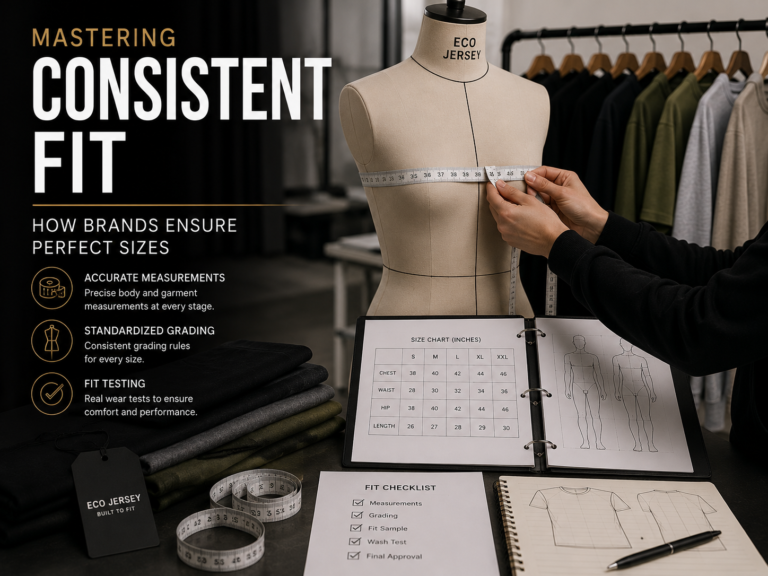
Mastering Consistent Fit: How Brands Ensure Perfect Sizes

Getting apparel to fit consistently across all sizes is one of the biggest challenges fashion startups face. It’s not just a technical detail — fit impacts how customers feel when they wear your product, how often they return items, and ultimately whether they trust your brand. Consistency in fit builds credibility, boosts confidence, and drives repeat purchases.

With the right approach, even a young brand can achieve a reliable and trustworthy size experience for every customer.

Why Consistent Fit Matters

Customers return products most often because the fit isn’t what they expected. If someone orders a medium and it’s too tight — or an XL that’s too loose — your brand reputation takes a hit. Consistent sizing builds confidence, reduces returns, and enhances loyalty.

Achieving this level of quality isn’t accidental — it’s about following a tested process from design to production.

Steps to Ensure Consistent Fit Across All Sizes

Here’s how startups and brands can make fit predictable and dependable:

1. Build a Clear Size Foundation

Start with a strong base pattern (often the middle size you intend to scale from). This foundation determines how each other size will grow or reduce proportionally. Instead of guessing or stretching shapes manually, using professional size grading ensures design proportions hold true as you move from size to size.

Use professional development and size grading services so every size stays true to your original design vision.

2. Create Detailed Tech Packs

Tech packs act like instruction manuals for production. They communicate fabric choice, measurements, trims, stitch type, and every minor detail manufacturers need to know. Creating precise tech packs helps reduce mistakes and misinterpretations.

Use tech pack development services to communicate your design to the production team clearly and efficiently.

3. Work with Experienced Manufacturers

Partnering with the right factory is essential. Experienced manufacturers understand how to interpret your specifications, work with different fabric behaviors, and build garments that fit consistently in all sizes. They also help troubleshoot fit issues fast.

Whether you need bulk apparel manufacturing or private‑label manufacturing, choosing a partner with proven quality systems makes a big difference.

4. Sample and Test for Accuracy

Sampling is where theory meets reality. Try on your garments in every size during the sample stage. Assess how fabrics drape, how seams lie, and whether silhouettes look balanced from XS through XL or larger.

If something feels off — whether it’s shoulder width or waist curve — refine the pattern and repeat the fitting process until you’re satisfied. This step minimizes costly mistakes later.

5. Gather Customer Feedback and Update Size Charts

Even after production begins, you can keep improving. Ask for reviews and returns data, and use insights to refine your size chart over time. Customers will appreciate the improved fit, and you’ll build strong trust in your brand.

Where to Add This Strategy Into Your Workflow

Fit consistency shouldn’t be an afterthought — it should be integrated into your workflow from design through production:

  • Before production, make sure your tech packs are accurate.
  • During development, use professional size grading, not guesswork.
  • During manufacturing, partner with a team that understands fit across sizes.

EcoJersey’s services can help you at every step of this process, from planning to finished product.

Make It Happen — Start Your Fit Journey Today

If you’re serious about consistent, quality fit across all sizes, now’s the time to take action. Start with a professional consultation and build a plan from concept to production.

Conclusion

Consistent fit across sizes isn’t luck — it’s strategy. With intentional size grading, accurate tech packs, and trusted manufacturing partners, startups and brands can deliver trustworthy fit experiences for every customer. By building a system that prioritizes fit from the start, you give your brand a competitive edge and a loyal customer base.

FAQs

What does consistent fit across all sizes really mean?

Consistent fit means that every size — from the smallest to the largest — follows the same design intention and proportions, so customers can expect similar comfort and style regardless of the size they choose.

How does a tech pack improve fit consistency?

A tech pack provides detailed instructions and measurements to the manufacturer. This clarity minimizes guesswork and errors, leading to more predictable fits across sizes.

Do I need multiple samples before bulk production?

Yes — multiple samples help you test and refine fit before final production. It’s better to make adjustments early than deal with costly returns later.


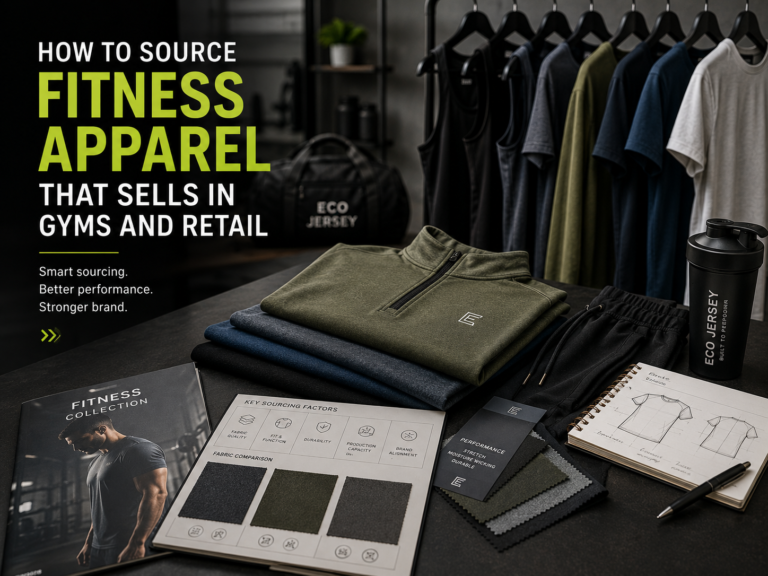
How to Source Fitness Apparel That Sells in Gyms and Retail

More than just a piece of clothing, fitness apparel represents a lifestyle. Whether you’re starting a brand or growing your retail collection, the right Sourcing Fitness Apparel could make or break your business. With many sourcing options, how can you get your products noticed in retail stores and gyms? Here’s a comprehensive sourcing guide on how to find fitness apparel that actually sells.

Understand Your Target Market

The first and most important step in sourcing fitness apparel is defining your audience. A customer who hits the gym everyday is going to be very different from someone who is trying to look good all the time. Performance, comfort and style may be important to the fitness customer, but to the retail customer, aesthetics may be all that is important, along with brand name, and functionality.

Yoga enthusiasts, for example, may want clothing that is stretchy or breathable and allows for a full range of motion; on the other hand, someone who goes to the gym regularly, may prefer a compression top or legging that is good for muscle recovery.

Choose the Right Manufacturer

Partnering with a reliable manufacturer is key. Look for manufacturers with a proven track record in producing high-quality Sourcing Fitness Apparel. Companies like Eco Jersey Activewear Manufacturer offer a range of solutions for private-label fitness brands, ensuring consistent quality and scalability.

If you specialize in yoga wear, consider working with a Yoga Wear Manufacturer that understands the nuances of fabric stretch, moisture-wicking materials, and comfortable fit. Similarly, for gym-focused lines, a Gym Wear Manufacturer can help you produce performance-driven apparel that meets the expectations of athletes and fitness enthusiasts.

Focus on Quality and Fabric

Quality matters. Sourcing Fitness Apparel is put through intense workouts, which means it needs to be durable, stretchable, and moisture-resistant. Fabrics like nylon, spandex, and polyester blends are popular choices. Compression wear, in particular, requires precise engineering to provide optimal muscle support, so collaborating with a Compression Wear Manufacturer ensures you deliver both performance and comfort.

Stay Updated With Trends

Fashion trends in fitness apparel evolve rapidly. Color schemes, patterns, and cuts can influence purchasing decisions, especially in retail settings. For instance, matching sets, eco-friendly fabrics, and high-waist leggings are currently popular among gym-goers and retail shoppers alike. A Fitness Apparel Manufacturer can provide insights into trending styles and help you stay ahead in the market.

Consider Private Label Options

Creating your own brand means you can look into private label options. These allow you to put your brand name on items or apparel that have already been designed and manufactured. This option saves time and helps you to get products to market quickly with the assurance that the product quality will not be compromised.

Test and Iterate

Before you release your apparel to the market, try to do a limited launch and sell your product in a couple of gyms or stores to gauge what people think. This will help you to know what improvements you can make to your design or apparel so that it fits what your audience will respond to.

Pricing and Profitability

A product will only be successful if it is sold at the right price. A price needs to be established that includes the cost to make the product, market it, ship it, and the desired profit. These need to be set, while also maintaining a price that is perceived as fair and affordable.

Build Relationships With Suppliers

Creating a long-lasting manufacturer and supplier relationship will help your business grow. Relationships with suppliers can lead to exclusive products at lower prices and faster delivery. By building a relationship, they will also understand your quality expectations and deadlines for the order.

Conclusion

Sourcing fitness apparel that sells in gyms and retail is both an art and a science. It requires understanding your target audience, selecting high-quality fabrics, staying updated with trends, and partnering with reliable manufacturers. Whether you focus on yoga wear, gym apparel, or compression clothing, working with trusted suppliers like Eco Jersey Activewear Manufacturer ensures your products meet performance, style, and durability standards. By testing, iterating, and building strong supplier relationships, you can launch a successful line that resonates with fitness enthusiasts and retail shoppers alike.

FAQs

What type of fitness apparel sells best in gyms?

Apparel that combines comfort, durability, and performance sells best in gyms. Items like leggings, compression wear, moisture-wicking tops, and matching sets are highly popular.

Is private labeling a good option for new brands?

Yes. Private labeling allows new brands to brand pre-made, high-quality apparel under their label, saving production time while ensuring quality.

What fabrics are best for fitness apparel?

Fabrics like nylon, polyester, and spandex blends are ideal due to their stretchability, durability, and moisture-wicking properties.

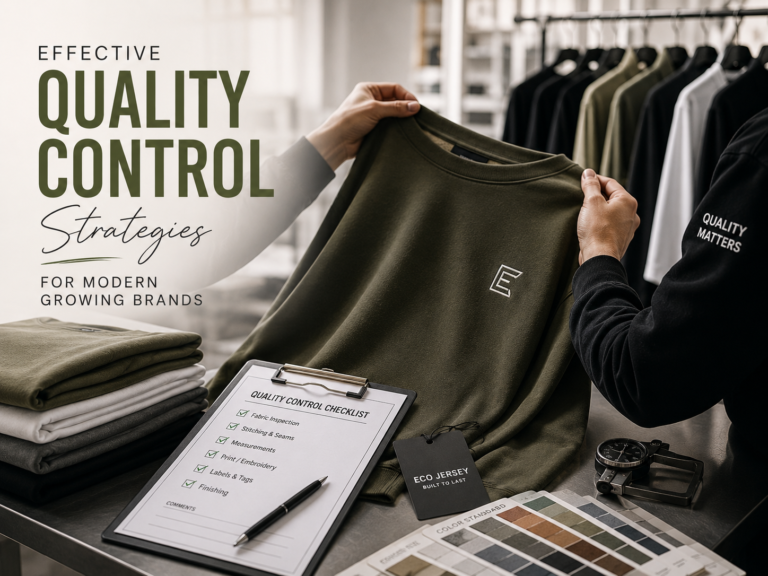
Effective Quality Control Strategies for Modern Growing Brands

Growing businesses face a major challenge: maintaining quality standards while expanding operations. Effective Quality Control Strategies important for any business, whether it manufactures products, provides services or manages its internal workflows. It directly impacts customer trust and success over the long term. Brands who fail to monitor their quality are often plagued by customer complaints, wasted resource and a declining reputation.

Effective quality control helps businesses develop reliable systems, which improve performance and minimize costly mistakes. Quality management is beneficial to all businesses, including startups, small teams and established brands. It improves both customer satisfaction and operational efficiency.

This guide will show you how to build practical quality control systems for your business, train your teams efficiently, and maintain high standards in a competitive market.

Why quality control is important for growing businesses

It is not just about checking the products before they are delivered. Quality control is a comprehensive process that ensures each stage of production and service meets standards. Businesses that place a high priority on quality have stronger relationships with their customers and increase long-term profitability.

Modern consumers expect consistency. Even small mistakes can quickly damage a business’s reputation through online reviews or customer feedback. Maintaining quality at the start is crucial for startups, as it creates a solid foundation for expansion.

Businesses that have strong quality control systems are more likely to:

  • Higher customer satisfaction
  • Brand reputation is important
  • Reduced production waste
  • Employee accountability can be improved
  • Reduced operational costs
  • Customer retention can be increased

Effective quality systems also help teams to identify problems early, before they grow into larger operational issues.

Quality Control Processes: How to Build a Strong Process

Planning, structure and regular monitoring are essential for a successful quality control procedure. Businesses should not rely on random inspections, as consistent systems will produce better results over the long term.

Clarify your quality standards

Each business should establish standards that are measurable for their products, services or internal operations. Teams cannot evaluate their performance without clear benchmarks.

Examples of quality standards include:

  • Material Quality Requirements
  • Packaging consistency
  • Customer service response times
  • Expectations for product durability
  • Tolerance limits for errors
  • Safety requirements

Employees perform better when standards are clearly documented. They understand what is expected of them and can be more consistent.

Create step-by-step inspection procedures

Inspection procedures are important for maintaining consistency in production and operation. Companies should not only check the final results but monitor quality during all stages of production.

Strong inspection systems usually include:

  • Inspection of raw materials
  • Quality checks during production
  • Final product testing
  • Packaging verification
  • Inspections of shipping

This multi-layered approach helps to reduce the likelihood of defective products being sold.

Improve accuracy with technology

Modern quality control systems are heavily reliant on technology. To improve their efficiency, many businesses use digital tracking software, automated inspection systems and reporting software.

Some of the best quality management techniques include:

  • Barcode tracking systems
  • Automated testing equipment
  • Inventory management software
  • Quality reporting dashboards
  • Monitoring tools for customer feedback

These systems improve data accuracy, while reducing human error.

Train Teams to Improve Quality Management

The best systems will fail without the proper training of employees. Teams must know why quality is important and how it affects business performance.

Encourage Accountability

Employees will perform better if their responsibilities are clearly defined. Managers must assign team members specific tasks related to quality and regularly monitor their progress.

Businesses can improve their accountability by:

  • Set measurable performance targets
  • Regular feedback
  • Routine evaluations
  • Rewarding consistent performance

Employees are more motivated to maintain company standards.

Create a company culture that is quality-focused

Businesses that are successful create cultures in which quality is part of the daily operations. Successful companies do not treat quality control as an independent department but instead involve all employees in maintaining standards.

Leaders should:

  • Open communication
  • Discussions on problem-solving
  • Continuous improvement
  • Employee suggestions
  • Collaboration between teams

Businesses adapt better to challenges when teams actively participate in improving quality.

Common quality control mistakes businesses should avoid

Many businesses implement their quality systems incorrectly. This leads to waste of time and inconsistent results. Understanding common errors helps organizations improve processes faster.

Ignoring customer feedback

Customer feedback is a valuable source of information about product performance and customer service. Businesses that ignore customer complaints are likely to repeat their mistakes.

Instead, businesses should instead analyze:

  • Returns for any reason
  • Customer complaints
  • Online Reviews
  • Support Requests
  • Satisfaction surveys

This information can help businesses to identify issues that recur and improve their operations.

Documentation that is inconsistent

A lack of documentation can lead to confusion and a reduction in accountability. Businesses should keep updated records of inspections, quality standards, and training.

Accurate documentation supports:

  • Improved process tracking
  • Employee training made easier
  • Issue resolution is faster
  • Compliance management improved

Businesses should therefore regularly update and review all records relating to quality.

Concentrating Only on Final Inspections

Some companies only check their products after the production is complete. This approach can increase costs, as errors are not detected until the end of production.

The effectiveness of preventive quality control is enhanced because it allows businesses to identify problems sooner in the process.

How startups can implement affordable quality control

Many startups believe that quality management is expensive. Small businesses can still create effective systems with minimal investment.

Quality control strategies that are affordable include:

  • Create simple checklists
  • Regularly train your employees
  • Using customer feedback forms
  • Monitoring supplier reliability
  • Random product inspections
  • Free project management tools

Consistently making small improvements can have a significant impact on the long term. Startups should also focus early on developing repeatable systems, as structured operations will support faster growth in the future.

Measuring quality control performance

Businesses should measure their quality performance regularly to identify opportunities for improvement. Team members can make better operational decisions by tracking performance indicators.

Important quality control metrics include:

MetricPurpose
Defect RateMeasures of production errors
Customer ComplaintsTracks customer satisfaction
Return PercentageEvaluates product reliability
Production EfficiencyMonitors the effectiveness of workflow
Inspection Pass RateMeasures quality consistency

By reviewing these metrics on a monthly basis, businesses can identify trends and continuously improve their performance.

Conclusion

Effective quality control helps brands, teams and startups to maintain consistency, increase customer trust and support growth over the long term. Businesses that invest into structured quality systems can reduce operational issues while building stronger brands in competitive markets.

It is important to not view quality control as an additional task. It should be integrated into the daily operations of businesses. When companies combine employee training, technology, customer feedback and clear standards, they create systems that are more reliable, which support sustainable success.

FAQs

What is Quality Control in Business?

The process of quality control ensures that products, services or operations are consistently up to standard.

Why is quality control so important for startups

Quality control can help startups to build customer trust and reduce errors, as well as create reliable systems of growth.

How can business improve quality control?

Employee training, regular inspections and technology can help businesses improve their quality control.

What are the common tools used for quality control?

Some of the most common tools are inspection checklists and inventory software.

How often should companies review their quality standards?

Businesses should regularly review their quality standards, particularly when services, products or customer expectations are changing.

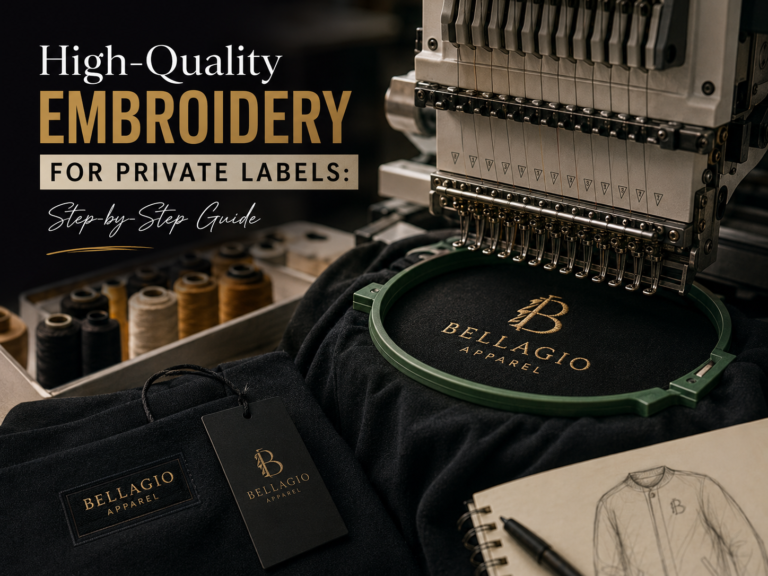
High-Quality Embroidery for Private Labels: Complete Guide

Embroidery adds a premium touch to private label products, enhancing both brand recognition and perceived value. we specialize in helping brands, startups, and sports teams create custom embroidered apparel that stands out. In this step-by-step guide, we’ll walk you through the process of achieving high-quality embroidery for private labels.

Designing Your Embroidery Artwork

The first step in high-quality embroidery is creating a precise design. Your artwork should consider:

  • Stitch type and density: Dense designs can cause puckering if not planned correctly.
  • Color matching: Choose thread colors that reflect your brand accurately.
  • Scalability: Ensure your logo or design is clear at different sizes.

our Tech Packs Development service helps translate your design into production-ready specifications, making the embroidery process smoother.

Choosing the Right Fabric

Embroidery works differently depending on the fabric type:

  • Cotton & denim: Easy to stitch and durable.
  • Performance fabrics & activewear: Require specialized stabilizers.
  • Leather or faux leather: Needs precision cutting and low-tension stitches.

our Fabric Sourcing & Development team helps brands select fabrics that best complement their embroidery designs.

Digitizing the Design

Digitization converts your logo into a stitch-ready format. This is critical for stitch accuracy and ensures the final product matches your brand vision. Key considerations:

  • Stitch type (satin, fill, or run stitches)
  • Stitch density and sequence
  • Thread color mapping

Our Embroidery Branding capabilities include expert digitization, ensuring every stitch is precise.

Sample Production & Testing

Before mass production, we create samples to test:

  • Stitch quality on different fabrics
  • Thread color accuracy
  • Design placement and alignment

This step reduces errors and ensures your products are ready for bulk orders. Our Sampling & Pattern Making process streamlines this stage.

Embroidery Production

Once samples are approved, production begins:

  • High-precision embroidery machines run designs at optimal speed
  • Quality threads and stabilizers prevent puckering
  • Skilled operators oversee each batch for consistency

Eco Jersey’s in-house embroidery ensures consistent quality, even for large orders, making it ideal for private labels and white-label brands.

Finishing & Quality Control

After stitching:

  • Excess threads are trimmed
  • Garments are pressed and checked for alignment
  • Final inspection ensures color, stitch density, and placement meet standards

Our Garment Finishing & Packaging team guarantees products are shipment-ready, maintaining your brand’s reputation.

Tips for Private Label Success

  • Keep logo designs simple for clarity in embroidery
  • Use high-quality threads for longevity
  • Align embroidery placement consistently across all garments
  • Work with a manufacturer who provides in-house embroidery capabilities

Conclusion

Creating high-quality embroidery for private labels requires expertise at every step—from design to finishing. By partnering with Eco Jersey, you gain access to in-house production, expert digitization, and rigorous quality control. Your brand gets professional, consistent, and durable embroidery every time

FAQs

What fabrics work best for embroidery?

Cotton, denim, and performance fabrics with stabilizers yield the best results. Leather requires special low-tension stitching.

How long does a typical embroidery sample take?

sample production usually takes 3–5 business days, depending on complexity.

Can I match my exact brand thread colors?

Yes. We offer Pantone color matching to maintain brand consistency across all embroidered garments.

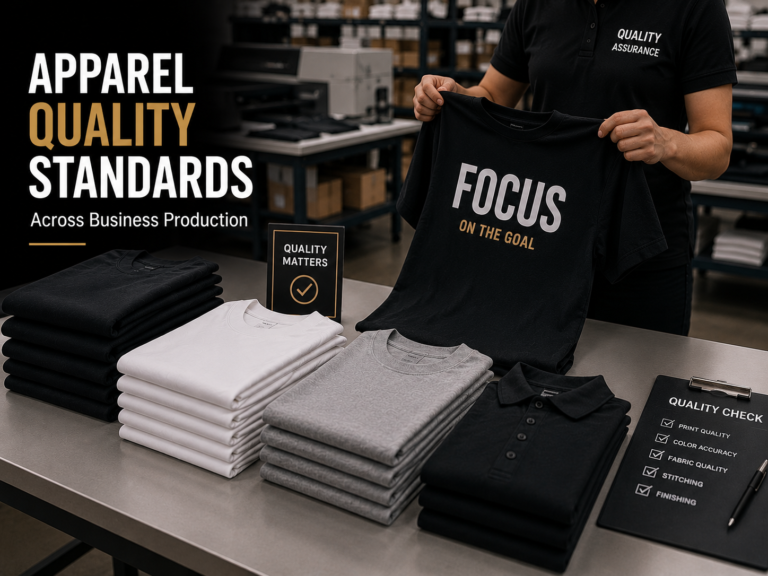
Apparel Quality Standards Across Business Production

Uniformity in upholding apparel quality standards is a requirement for every business. Whether the business produces team uniforms, company branded clothes, or fashion lines, a business must ensure every piece of apparel is consistent in professional standards in size, fit, color, stitching, and finishing.

Ensuring high quality apparel results in customer satisfaction, enhances a company’s brand reputation, and returns and defect rates of apparel decreases. It is achieved by embedding structured processes, employing experienced workforce, and utilizing the right tools at every stage of production.


How Businesses Maintain Consistency

Transparency in planning coupled with standard procedures is how a business achieves uniformity in apparel production.

  • Pre-Production: Materials such as fabrics and trims are inspected before the actual production is started.
  • During Production: Cutting and stitching processes are monitored as printing mistakes can be noted firstly.
  • Post-Production: Finished garments are inspected to ensure the color, logo placements, stitching, and finishing are all satisfactory.
  • Packaging: Garments are inspected for labels, and are prepared for delivery in a clean condition.

Businesses often rely on production capabilities to integrate these checks efficiently.


Tools and Techniques That Support Quality

In today’s world of apparel production, several tools and techniques are routinely employed to uphold standards:

  • Color-matching systems for prints consistency
  • Measuring tools for accurate sizes
  • Stitching templates for accurate seams
  • Checklists for embroidery, labeling, and packaging

Skilled contract clothing manufacturers ensure these tools are applied throughout production, even for large-scale orders.


The Role of Sampling and Pre-Production Checks

Checking quality and sampling throughout production are some of the techniques used to control the level of defects when:

  • Prototypes are produced prior to mass production
  • The design and placement of stitching and sizing is verified
  • The method for printing and the fabric are assessed
  • Check designs with logos and samples for finishes to guarantee standards are met.

Services like sampling and pattern-making allow businesses to spot potential issues early, saving time and cost during full production runs.


Getting Quality for Start Ups and Teams

With low MOQ manufacturing, precise sampling, and well-defined quality checks, startups and SME brands can uphold the highest standards. Flexible manufacturing lets teams and emerging brands offer professionally made apparel without having to deal with excess stock.


Professional Assistance for Quality

To have your brand or team apparel reach the best standards and to have it high quality for each apparel, being associated with a reputable manufacturer is a must. Our team ensures that every step, from pre-production to final dispatch, is controlled for quality.

Get Quotes Today, so your apparel have the professional quality it needs, or Contact Us for your brand or team specific expert advice.


Conclusion

Establishing apparel quality standards with structured QC methods, sampling, and the appropriate resources lets startups, teams, and even bigger companies professionally present offerings that align with their branding and fulfill the requirements and expectations of their clientele.


FAQs

Why are quality standards important in apparel production?

Quality standards ensure garments have the same dimensions, hues, and finishes. This minimizes returns and defects.

Can startups sustain professional quality standards?

Definitely. The use of structured QC methods, sampling, and manufacturing at low MOQ are highly effective.

What measures must be implemented to guarantee apparel quality standards?

Quality checks must be implemented before production, during production, after production, and at the time of packaging.

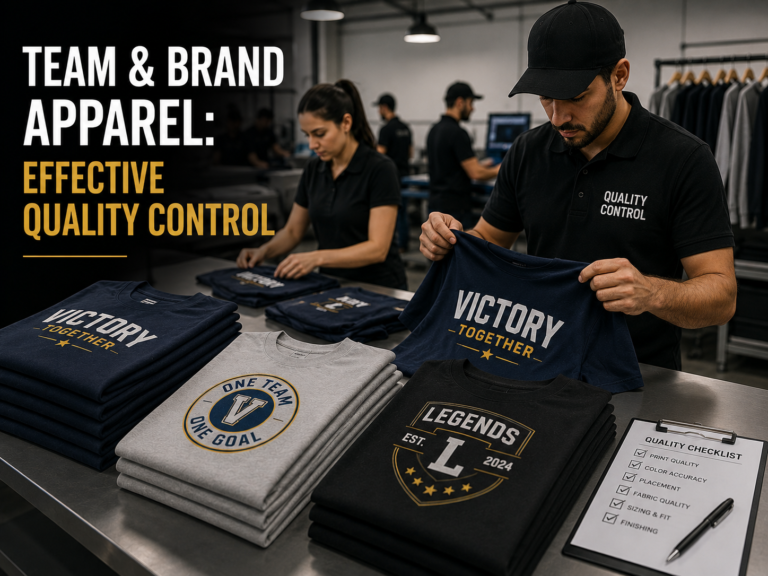
Team & Brand Apparel: Effective Quality Control

Sport teams, clubs, start-ups and brands, want a professional, consistent and durable product. This is all the more the case with Team & Brand Apparel. It is imperative to have good quality control for Team & Brand Apparel. Every garment needs to look good, fit good, and last.


Why Quality Control is Important for Teams and Brands

The importance of having quality control is:

  • Consistent sizing and fit across all garments
  • Correct logo placement and print quality
  • Strong stitching and finishes
  • Less fabrics and production wastage

Working with experienced manufacturers offering production capabilities helps maintain these standards across every batch.


Quality Control Process for Team & Brand Apparel

To have effective quality control, multiple inspections are imperative.

  • Pre-Production Inspections: Reviews trims, fabrics, and accessories Before production.
  • Mid-Production Inspections: Oversees cutting, stitching, and printing.
  • Post-Production Inspections: Reviews finished garments to ensure correct logos, finishing, color, and appropriate sizing.
  • Final Product Inspections: Apparel is checked for cleanliness, appropriate labeling, and packaging for delivery.

Using sampling and pattern-making services ensures designs are perfect before full-scale production.

Tools and Techniques to Maintain Consistency

To preserve the quality of their output, manufacturers use the following:

  • tools, used for measurement to ensure the right dimensions
  • devices that match colors for prints and fabrics
  • templates that guide the placement of stitches in sewing
  • a checklist for embroidery, labels, and packaging

Working with contract clothing manufacturers ensures consistent results for both small and large batches.

Benefits of Quality Control for Startups, Clubs, and Small Teams

For startups, clubs, and small teams, quality control leads to:

  • fewer returns and less rework
  • a more presentable image for players and staff
  • trust with customers and supporters builds
  • less waste of materials and lower production costs

Low MOQ solutions like low MOQ clothing manufacturing allow startups to implement quality control without large upfront investments.

Final Thoughts

Making sure that your team and brand apparel meets the standards of sizing consistency, print durability, and finishing professionalism is achieved with the proper purchase of quality control process.

For every size of startup to large teams, incorporating QC systems helps to build your brand and reputation with quality, efficient workflows.


FAQs

What is the significance of quality control on team and brand apparel?

Quality control guarantees the same measurement for every piece, the same prints, and the same finishing style.

Is quality control useful for startups?

Yes. Startups have the ability to control quality thanks to flexible manufacturing and low MOQ options.

What are the most important components of quality control in apparel?

The inspection of samples prior to production, monitoring production, inspection of finished goods, and checking the packaging.