Home Blog Page 24

What are the Best Denim Washes for Overalls Complete Guide

Denim overalls have, without question, stood the test of time with updated casual collections and streetwear outfits. Selecting the Best Denim Washes for Overalls can enhance the look, feel, and sell-ability of your offerings. Classic light washes to bold, deep colors all create unique personalities for the style preferences of your audience.

Fashion startups and established labels often work with professional partners like Eco Jersey Denim Apparel Manufacturer to develop high-quality denim collections that match current fashion trends and customer expectations.

Understanding the Best Denim Washes for Overalls

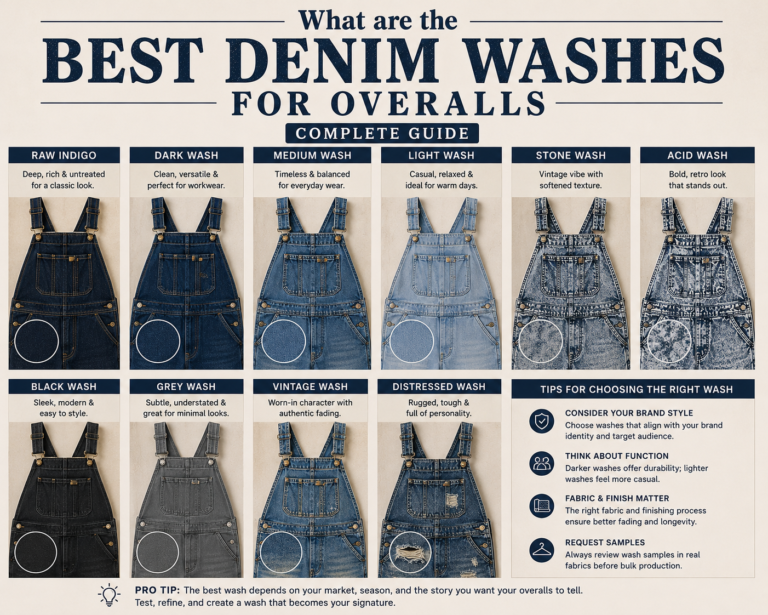
When deciding the Best Denim Washes for Overalls, it is essential to know how different washes affect the overall feel of the final piece and the look you are trying to present. Denim can be washed to create styles that range from vintage to rugged to minimalist and to streetwear.

Many premium fashion brands combine washed overalls with stylish bottoms from Denim Jeans Manufacturer to create a complete denim collection for retail and wholesale markets.

Light Wash Denim Overalls

Light wash denim is one of the most highly sought-after styles of the Best Denim Washes for Overalls list. This wash conveys a relaxed, casual feel and works well in summer collections and everyday fashion.

Light wash overalls pair naturally with trendy outerwear products from Denim Jacket Manufacturer because both styles deliver a modern and youthful streetwear look.

Dark Wash Denim Overalls

Dark washes are some of the Best Denim Washes for Overalls when targeting brands in the sophisticated and premium fashion marketing. Dark indigo tones create a clean, polished look that is appropriate for casual and even semi-formal attire.

Many brands combine dark wash overalls with products from Denim Shirts Manufacturer to create matching denim outfits that attract fashion-conscious customers.

Vintage and Stone Wash Styles

Vintage and stone wash styles are essential to the Best Denim Washes for Overalls conversation. They create a classic, worn-in feel of authentic denim and are commonly used in streetwear fashion and collections with a distinct retro feel.

Streetwear labels often match vintage overalls with pieces from Streetwear Denim Manufacturer to maintain a bold urban fashion identity.

Acid Wash and Distressed Denim

Past denim washes used on overalls include acid wash and distressed denim. This is because they offer the type of bold look that modern fashion demands. Younger consumers appreciate distressed denim, specifically in the context of streetwear.

Fashion brands usually expand these collections with trendy products from Denim Shorts Manufacturer to create seasonal fashion lines for spring and summer.

Sustainable Denim Washing Techniques

When looking for the best denim washes for overalls, sustainability is beginning to be important as well. This is due to the fact that the washing methods that provide top tier quality and appearance also use less water, chemicals, and other damaging substances.

Manufacturers producing products like Kids Denim Manufacturer often focus on softer and safer denim washing techniques suitable for children’s clothing collections.

Choosing the Right Wash for Your Brand

The Best Denim Wash for Overalls varies with your target market and brand. Clean dark denim washes are typically favored by minimal brands. On the other hand, vintage and streetwear brands are interested in faded and distressed denim, including acid washes.

Private-label fashion businesses frequently partner with Private Label Denim Manufacturer to customize washes, fabrics, and finishing details according to their branding strategy.

Styling Denim Overalls for Modern Fashion

The Best Denim Wash for Overalls allows modern fashion brands to create styles that cater to everyday wear, workwear, and street styles. Overalls are so easily styled that they can be layered with skirts, vests, and shorts for your more avant-garde seasonal lines.

Many designers also develop coordinated collections with products from Denim Skirts Manufacturer and Denim Vest Manufacturer to offer customers complete denim fashion solutions.

Conclusion

In constructing a marketable and comprehensive denim collection, brands must select the Best Denim Washes for Overalls. From classic dark washes to trendy distressed styles, each wash tells the brand’s story and appeals to a different audience. It is for that reason that brands select the right wash for denim based on consumer purchase behavior, seasonal trends, and brand identity. This is how brands create attractive, buy-ready denim collections.

FAQs

What are the Best Denim Washes for Overalls?

Light wash, dark wash, vintage wash, acid wash, and stone wash are among the most popular choices.

Which denim wash is best for streetwear overalls?

Vintage and distressed washes are highly preferred for modern streetwear collections.

Are dark wash overalls better for premium fashion?

Yes, dark wash overalls provide a cleaner and more luxurious appearance.
Custom Denim Skirts A Complete Guide to Bulk Production

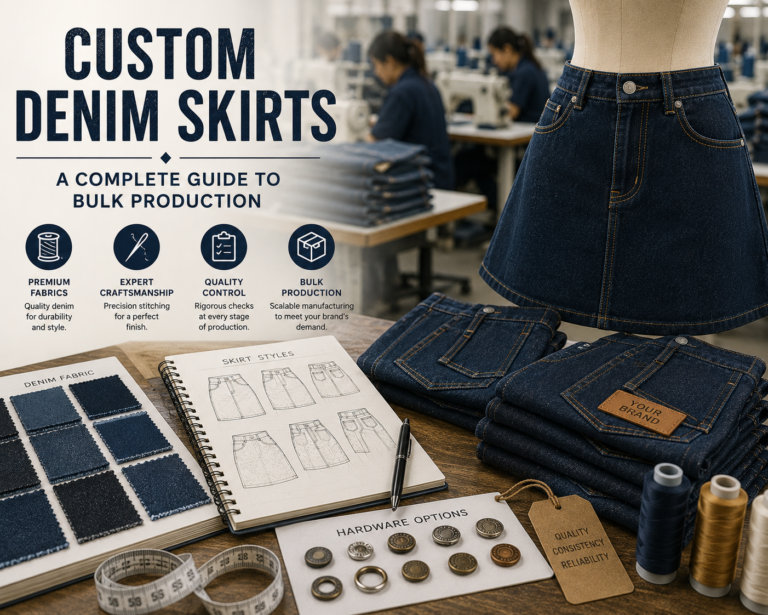
Fashion brands are always looking for products that are stylish, comfortable, long-lasting, and classic. Among these products, Custom Denim Skirts are becoming more and more popular. These skirts are versatile enough to be used in street style, fashionable casual, and trendy seasonal collections. For small businesses and big companies, when it comes to making Custom Denim Skirts, planning, sourcing, and picking the right manufacturer are all equally important.

Many apparel businesses begin their journey with experienced suppliers like Eco Jersey Denim Apparel Manufacturer because working with a professional denim manufacturer helps maintain consistent quality and smoother production management.

Why Brands Prefer Custom Denim Skirts

The fashion industry has a reputation for being creative and Custom Denim Skirts are no exception. Denim skirts are designed for collections that fall in the luxurious and the casual categories, as well as Vintage and Modern street style. With the different finishes, cuts, and wash, brands are able to design collections that are unique and meet the demands of the customers.

Many fashion companies also expand their denim collections through services like Denim Jeans Manufacturer to maintain consistency across multiple apparel categories.

Custom Denim Skirts for Bulk Production

Custom Denim Skirts are manufactured in bulk, the quality of denim plays a huge role in the finished product. When brands choose strong denim, the end product is a skirt that is comfortable, durable, and fulfills the requirements of the customer for a long time. Depending on who the target audience and what season it is, brands choose lightweight, midweight, or heavyweight denim.

Manufacturers that also produce products such as Denim Jacket Manufacturer often have better experience handling premium denim treatments, washes, and stitching techniques.

Choosing the Right Manufacturer

Making the right choice of supplier Custom Denim Skirts can make or break a company. Having a strong relationship with the manufacturer who is able to offer all the necessary services (from custom sizing to private label, fabric sourcing, sample production, and QC) is important. Also, good communication and the manufacturer being transparent about what they do are a must, especially with orders that are in bulk.

Brands looking for complete denim collections frequently work with companies offering Private Label Denim Manufacturer services because private labeling helps create stronger brand identity and professional market positioning.

Design and Customization Options

Custom denim skirts are one such product where a brand can justify a higher price value. Custom denim skirts can be decorated with branded patches or embroidery, custom buttons or branded labels, unique washes, etc. Additionally, skirts can have added distresses. Brands can use these additions to separate themselves from competitors to earn loyal customers.

Fashion businesses that focus on coordinated collections often combine denim skirts with products from Denim Shirts Manufacturer to create matching outfits and improve customer engagement.

Streetwear Trends and Denim Fashion

Streetwear has generated interest in Custom Denim Skirts for youth demographics. Currently, oversized designs featuring raw hems, cargo-style pockets and vintage washes are gaining popularity in various global fashion markets.

Many streetwear brands also partner with Streetwear Denim Manufacturer services to create trend-focused collections that attract fashion-conscious buyers.

Production Planning and Sizing

When developing Custom Denim Skirts for mass production, it is crucial to understand the scope and variation of measurements and production planning. Brands should take time to finalize details and specifications of the fabrics and the style constructions before the mass production run to avoid costly errors.

Manufacturers experienced in products like Denim Overalls Manufacturer usually have advanced production systems that improve consistency during large-scale manufacturing.

Expanding Your Denim Collection

Many brands integrate Custom Denim Skirts into their denim fashion products line. Creating products that complement each other will maximize the average order value and broaden the brand’s fashion range within a saturated market.

Businesses often expand into categories like Denim Vest Manufacturer and Kids Denim Manufacturer to target wider customer segments and create complete seasonal collections.

Quality Control in Custom Denim Skirts

When Custom Denim Skirts are manufactured in large volumes, quality control is mandatory. All the steps in the production process from Cutting, Stitching, Washing and Finishing to Packaging need to pass the inspection of the quality standards of the product.

Many manufacturers that produce items like Denim Shorts Manufacturer also provide professional quality assurance systems to ensure consistency across large orders.

Conclusion

Custom Denim Skirts are a relevant, profitable offering in the apparel space. Brands can partner with the right Manufacturer to add quality Custom Denim Skirts to their offering and truly innovate to add long-term value in the market. When adding your first line of quality denim to your Fashion brand or extending an existing line of quality denims, brands can expand strategically in a competitive market.

FAQs

Why are Custom Denim Skirts popular in fashion?

Custom Denim Skirts are stylish, versatile, durable, and suitable for both casual and streetwear fashion trends.

What is the best fabric for Custom Denim Skirts?

Midweight premium denim is commonly preferred because it offers both comfort and durability.

Can startups order Custom Denim Skirts in small quantities?

Yes, many manufacturers offer low MOQ options for startups and growing fashion brands.

Most Popular Types of Leather Skirts Trending in Fashion Right Now

Leather skirts are always at the front-runner status as mainstream style staples. Retailers have new design opportunities as clients have grown to favor now leather pieces that exude class and comfort.

Fashion has transcended types of leather skirts’ seasonal flexibility. Year round, leather skirts have proven to appeal to various markets as they encompass both street style and upscale designs.

Many fashion brands now collaborate with professional Leather Skirts Manufacturer services to create stylish and premium-quality collections for modern consumers.

Knowing the most recent types of leather skirts ensures brands remain relevant with shifting fashion trends.

Why Leather Skirts Remain Popular

The leather skirt is a staple incredibly versatile and aesthetically timeless. Customers enjoy all four styles, leather skirts can be worn casually, formally, luxuriously, and perhaps most importantly, as a wardrobe essential. This versatility contributes to their continued significant demand in a myriad of fashion genres.

Today’s customer has a preference for fashions that combine durability with a premium visual appeal. Leather apparel is all of these. As styles change, so do leather skirts able to reinvent themselves with innovative new cuts and finishes along with the most contemporary styling details.

Many growing fashion businesses work with experienced Leather Apparel Manufacturer services because premium craftsmanship plays a major role in customer satisfaction and brand reputation.

With better production quality, brands can now compete more effectively in the latest fashion markets.

Types of Leather Skirts Trending in Modern Fashion

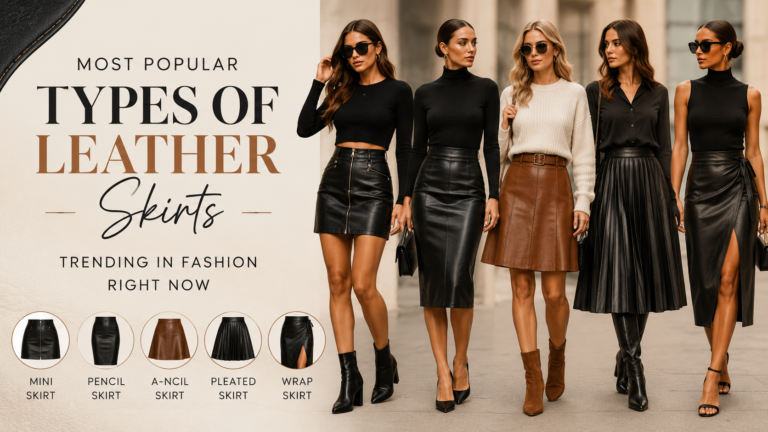
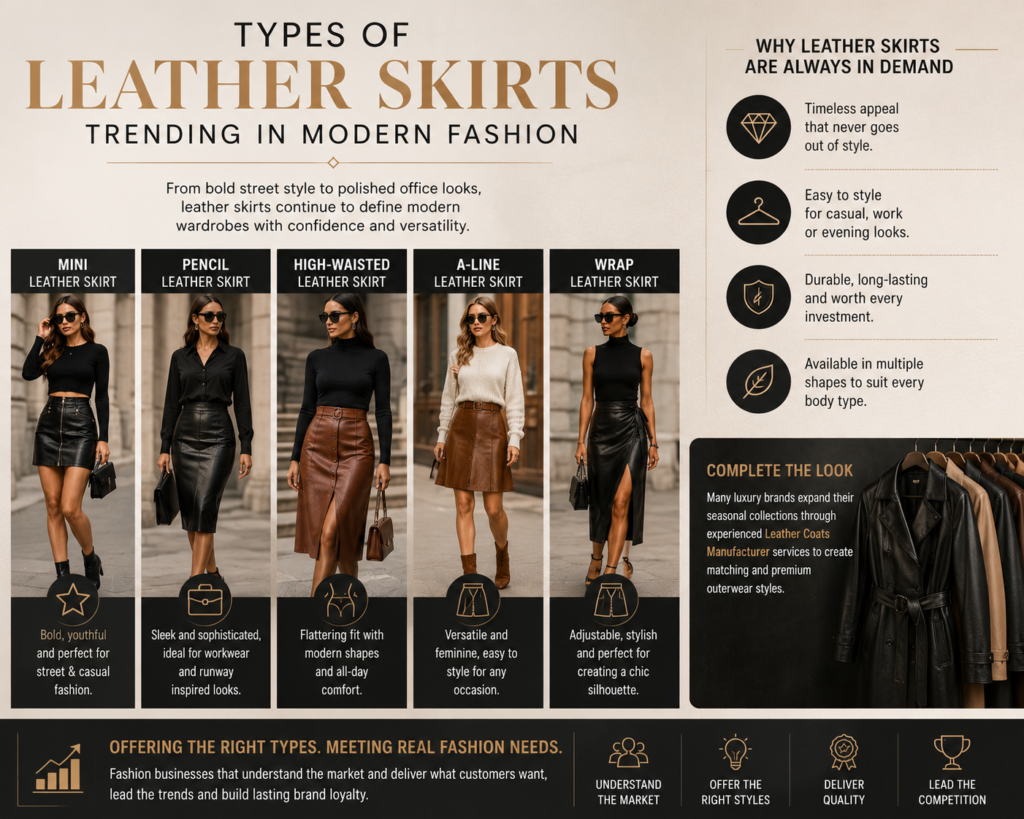
Modern leather skirt style guide featuring mini, pencil, high-waisted, A-line, and wrap leather skirts with fashion-focused outfit inspiration.
Different types of leather skirts trending in fashion, from bold mini skirts to elegant pencil and versatile A-line silhouettes.

Fashion trends come and go, but customers’ needs keep many options in demand, and skirts are no different.

Mini leather skirts do not seem to be going anywhere with their place in street and casual fashion. They are so bold and youthful. Pencil leather skirts are also popular, marrying the workplace and the runway.

High-waisted types of leather skirts are for those who prefer modern shapes and comfort. A-line leather skirts are also being recognized with their versatility.

Fashion companies that understand the needs of the industry and the types of leather skirts are the ones that garner the most customers in the competitive fashion market.

Many luxury brands also expand seasonal collections through experienced Leather Coats Manufacturer services to create matching outerwear styles.

Types of Leather Skirts Should Match Customer Preferences

Fashion trends are just one of the many aspects a brand must consider when designing a leather skirt. Brands must consider a customer’s lifestyle & understanding where comfort meets design.

There are customers that want a more minimalist design with leather, while others are looking for bold fashion with lots of details like zippers, belts, or textures. Knowing this sets businesses up for success in producing products that connect with their audience.

Many brands also create complete leather fashion collections through professional Leather Jackets Manufacturer services to maintain a consistent brand image.

Designing and Building with the customer in mind drives product demand and cultivates customer loyalty for the long term.

Customization Improves Fashion Appeal

The modern fashion industry requires customization. Customers are more likely to spend their money on products that are likely to be unique and personalized.

Brands are developing their leather skirt collections in line with customizable colors, stitching, hardware details, and private label branding.

Customization usually requires:

  • Custom zipper designs
  • Personalized labels
  • Unique leather textures
  • Premium finishing details

Those functions build product identity and visibility within the marketplace.

Many fashion brands also strengthen their accessory collections through professional Leather Belts Manufacturer services to create more complete fashion styling options.

Fashion Brands Are Expanding Into Complete Leather Collections

Instead of relying on one product line, many successful brands now design complete collections of leather fashion items. By diversifying their offerings, brands appeal to a wider range of customers and reinforce their brand identity.

For instance, some companies venture into lifestyle fashion with the aid of professional Leather Bags Manufacturer services.

Others create layered fashion collections with products from professional Leather Vests Manufacturer services.

Many fashion brands also introduce seasonal products through experienced Leather Gloves Manufacturer and Leather Pants Manufacturer services.

Expanding product lines helps businesses grow long-term.

Quality and Comfort Still Matter Most

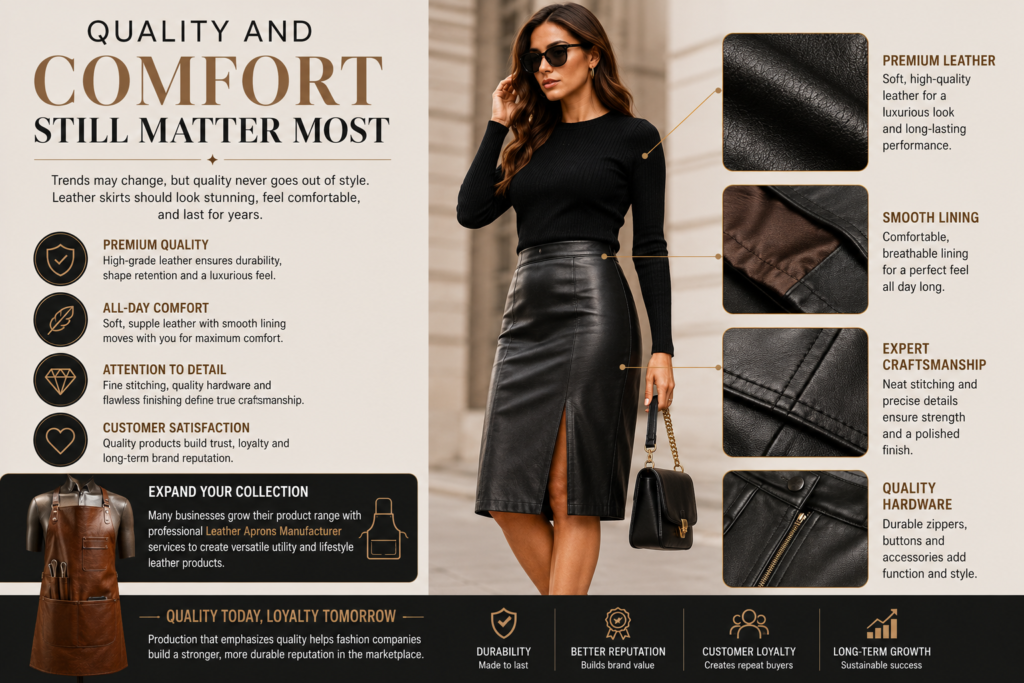
Premium leather skirt quality infographic showing soft leather texture, smooth lining, expert stitching, durable hardware, and comfortable modern fit.
High-quality leather skirts combine comfort, craftsmanship, durability, and premium finishing to improve customer satisfaction and brand value.

Though the latest trends in fashion have a tendency to change, one of the most reliable aspects of a business is customer satisfaction regarding product quality. When it comes to leather skirts, customers want a product that will look and last well, while also being comfortable.

The combination of attention to detail, soft materials, and a polished look improves a brand’s reputation and customer loyalty.

Many businesses also expand into utility and lifestyle collections through professional Leather Aprons Manufacturer services to create more versatile leather product lines.

Production that emphasizes quality enables fashion companies to develop a more durable reputation in the marketplace.

Conclusion

Like other designs, leather skirt styles are constantly improving with changing tastes and trends. Currently, mini, pencil, high waisted, and A-line skirts are staples in modern design.

However, trends are not the only things customers care about. Comfort and quality are a designer’s best accessory, but so is customization. Knowing customer lifestyles goes a long way in designing effective products and selling them.

Manufacturers and skilled partners broaden the range of possibilities for fashion companies. They make design and fashion demands relative to leather skirts. They help make timeless leather skirt collections.

FAQs

Why are leather skirts popular in modern fashion?

Leather skirts combine timeless style, versatility, and premium fashion appeal.

What types of leather skirts are trending today?

Mini skirts, pencil skirts, A-line styles, and high-waisted leather skirts are highly popular.

Why is customization important in leather fashion?

Customization helps brands create unique products and stronger brand identity.

Can brands expand beyond leather skirts?

Yes, many brands also offer jackets, bags, belts, gloves, and leather pants.

Why does product quality matter in leather apparel?

High-quality craftsmanship improves comfort, durability, and customer satisfaction.

How to Choose the Private Label Denim Apparel Manufacturer

More than just creative designs are needed to start or grow a successful denim clothing brand. One of the more difficult choices is selecting the right choosing denim apparel manufacturer services that can meet your standards of quality and budget for a production run. The right partner manufacturer can assist the business with even more growth, all while keeping the products the same and sustaining customer satisfaction.

Many fashion brands begin by exploring professional suppliers like Eco Jersey Denim Apparel Manufacturing because experienced manufacturers understand modern fashion trends, production timelines, and custom branding needs.

Why Choosing Denim Apparel Manufacturer Matters

When a proper choosing denim apparel manufacturer services are in place, production delays and quality issues can be almost 100% prevented. A proper manufacturer will source better quality fabrics, stitch better, and offer more options for the private label collections.

Brands that specialize in premium jeans often work with experienced partners such as Denim Jeans Manufacturer Services to ensure durability, modern fits, and high-quality finishing for customers.

Check Manufacturing Experience and Product Quality

One of the main things to watch for is what the level of experience of the choosing denim apparel manufacturer is. Manufacturers that have had many years in denim typically deal with washing, treatment of the fabrics, and even the current trends in fashion better than a brand new factory.

For outerwear collections, many brands rely on trusted suppliers like Denim Jacket Manufacturer because denim jackets require strong stitching, premium buttons, and detailed craftsmanship.

Review Product Variety and Customization

Finding the right partner to offer choosing denim apparel manufacturer services should include more variety per category of products and more options for customization. This also aids in offering a complete collection as opposed to numerous collections coming from numerous suppliers.

For example, businesses expanding casual fashion collections often use Denim Shirts Manufacturer to produce stylish and comfortable denim shirts with custom labels, washes, and fits.

Evaluate Production Capacity

Prior to making a final decision, ensure that the factory can meet the needed order size. While some of the manufacturers may be specialized in taking small orders from lean start up companies, others tend to focus more on mass production for the large global companies.

Summer fashion collections usually require manufacturers like Denim Shorts Manufacturer that can maintain quality while producing high-volume seasonal products on time.

Choosing Denim Apparel Manufacturer

Finding the right manufacturer is just as important as designing the product. When choosing a denim manufacturer, consider aspects like their design flexibility, the option for private labeling, and how they maintain their high standards with fabric quality.

Street-style brands often partner with Denim Vest Manufacturer to create trendy collections that match urban fashion trends and attract younger audiences.

Look for Trend Knowledge and Fashion Expertise

With how quickly the world shifts in terms of fashion, it is crucial to find a denim manufacturer that also stays on top of current trends in the market. They need to know the different cuts, washes, and settings. They should also have knowledge on sustainable methods for production.

Many modern brands also develop utility-inspired collections with Denim Overalls Manufacturer to attract customers looking for stylish yet functional fashion pieces.

Focus on Target Audience

Finding the correct denim manufacturer should be dependent on the niche market you are targeting. If you are a women’s brand in a market, you should look for the cuts and details.

Several brands expand their women’s collections through Denim Skirts Manufacturer to offer trendy and comfortable denim products for different seasons.

Kids and Streetwear Collections

If your brand is targeting children’s or streetwear apparel, focus on denim manufacturers that have experience with children’s apparel and streetwear manufacturing, as this can be a difficult niche.

Many businesses create youth-focused collections with Kids Denim Manufacturer because children’s denim requires comfort, flexibility, and durable fabrics.

Streetwear labels also prefer manufacturers like Streetwear Denim Manufacturer to develop oversized, distressed, and fashion-forward denim styles for modern consumers.

Private Label Services Matter

Private labeling helps you build your brand recognition. This is why many startups look for a denim manufacturer that has a strong value in branding, quality custom packaging, and control of labeling.

Growing brands often choose Private Label Denim Manufacturer for customized production solutions that help create a unique brand identity in competitive fashion markets.

Conclusion

For the growth of a denim fashion brand, the right partner matters. Denim apparel manufacturers differ on quality, control, variety of customizations, and even private labeling. They can be significant partners for your business, and especially so when building a brand with a positive reputation. When you get a quality denim partner, you improve your product and enhance your brand and value for your customers.

FAQs

Why is choosing the right denim manufacturer important?

The right manufacturer improves product quality, delivery speed, and customer satisfaction for your brand.

What should I check before hiring a denim manufacturer?

You should review experience, product quality, customization options, pricing, and production capacity.

Can private label denim manufacturers help startups?

Yes, many private label manufacturers offer flexible MOQs and branding solutions for startups.

How to Source High-Quality Custom Denim Overalls Manufacturer

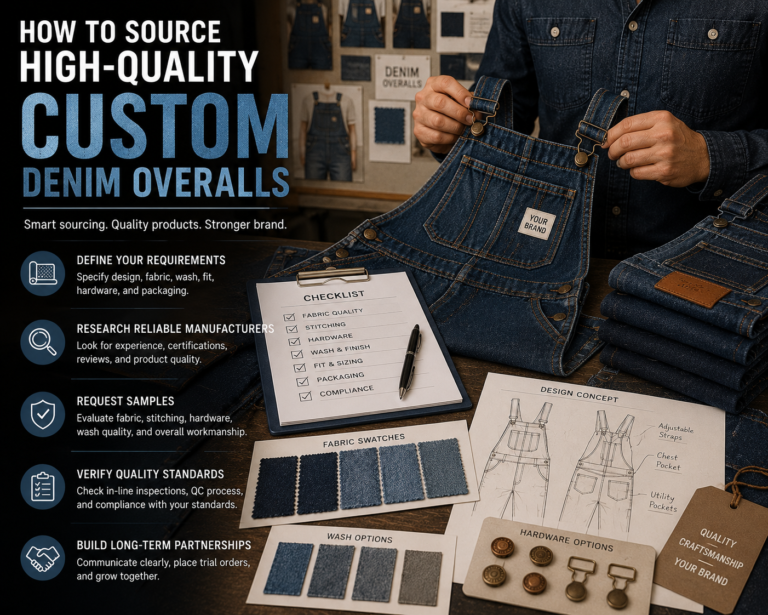
Finding a supplier for custom denim can be the most important step for a launching fashion brand. Over the years, I have learned that many fashion start-ups spend immeasurable amounts of time and effort trying to find suppliers who are reliable, offer quality fabrics, and employ consistent production methods. That said, if you seek out stylish and durable overalls for your line, then learning to source custom denim overalls will help you on your journey to establishing a robust clothing line.

Brands looking for premium denim production often begin with experienced suppliers like Eco Jersey Denim Apparel Manufacturer because they offer complete denim manufacturing solutions for modern clothing businesses.

How to Source Custom Denim Overalls

The first step to learning how to source custom denim overalls is to select your denim fabric. The quality of the fabric will influence the comfort, durability, and the overall look of your product. If you take a relaxed approach to your streetwear, then consider lightweight denim. However, if you are looking to create a line of overalls with streetwear workwear inspiration, then consider heavier weight denim.

Many brands also study other denim categories from experienced companies like Denim Jeans Manufacturer to better understand stitching quality, washes, and overall garment construction before starting overall production.

Choose a Manufacturer with Denim Experience

One of the best denim suppliers will understand denim fabric treatments, work with you on pattern development, and offer products with consistent sizing. They become important when you decide to source custom denim overalls. That said, you need to be able to rely on your supplier to create overalls that are fitted and durable.

Fashion businesses often explore related products from Denim Jacket Manufacturer to evaluate finishing quality, button installation, and denim detailing before selecting a supplier.

Focus on Fabric Quality and Washes

When sourcing custom denim overalls, you then have to consider the finish of your denim. You have the option for an acid or a stone wash. Combine these with quality fabric, and you can achieve the look you want with custom overall production.

Many brands compare denim finishing styles through suppliers such as Denim Shirts Manufacturer because shirt collections often showcase modern washes, stitching techniques, and soft fabric treatments.

Customization Makes Your Brand Unique

This is why many brands looking to source custom denim overalls spend so much time researching. You then have the ability to uniquely brand your denim with custom embroidery, buttons, and patches. This can help your brand gain recognition in the market.

Companies offering products like Denim Shorts Manufacturer often provide customization services that allow brands to create original fashion collections with a professional identity.

Check Product Samples Carefully

Never skip the sampling step. Before purchasing bulk amounts of anything, ask to see, or test, samples. This can be especially important in how to source custom denim overalls. It gives an idea of how the samples will hold up in stitching, how the fabric wears, the quality of the design, and provides insight on color options.

Some fashion businesses also review products from Denim Vest Manufacturer to inspect denim detailing and evaluate how manufacturers handle smaller structured garments.

Private Label Manufacturing for Growing Brands

As you learn how to source custom denim overalls, you will find that private label manufacturing is an ideal solution. This strategy allows your business to produce products, which can be sold at your own private label, and keeps your business in control of its packaging and brand identity.

Many startups choose experienced suppliers like Private Label Denim Manufacturer because they simplify branding, production, and product customization for growing fashion labels.

Understanding Market Trends

Today, consumers increasingly want comfortable and stylish apparel made of denim. Brands that are trying to learn how to source custom denim overalls should research how to use the most current customer market buying trends toward fashionable apparel, not to mention oversized, utility inspired streetwear.

Trend-focused businesses often work with Streetwear Denim Manufacturer to create fashion-forward collections designed for younger audiences and modern streetwear markets.

Expand Your Denim Collection

Once your overalls collection becomes successful, expanding into related categories can strengthen your brand. Businesses exploring How to Source Custom Denim Overalls often add matching products to create complete seasonal collections.

Many manufacturers also produce items like Kids Denim Manufacturer and Denim Skirts Manufacturer to help brands target multiple customer segments.

Conclusion

If you want your denim products to last and appeal to the market, you need to know how to source custom denim overalls. However, your product also needs to have quality materials and finishing touches. As you refine your brand, the design and your focus on quality will yield denim products that will last beyond the market trends.

FAQs

Why are custom denim overalls popular?

Custom denim overalls are popular because they combine comfort, durability, and modern streetwear fashion trends.

What fabric is best for denim overalls?

High-quality cotton denim with strong stitching is usually the best option for durable overalls.

Can I add my logo to custom denim overalls?

Yes, most manufacturers offer private labeling, embroidery, patches, and custom branding options.

Types of Denim Overalls: Bib, Shortalls, Jumpsuits & More Explained

Every year denim trends shift, but overalls remain classic staples. Knowing Types of Denim Overalls allows brands, designers, and retailers to create versatile offerings that are likely to resonate with different audiences. After all, denim overalls are a key part of modern streetwear and casual fashion. They have utility origins, but today can take many forms from summer-ready shortalls to trendy jumpsuits.

Modern apparel brands often partner with professional manufacturers like Eco Jersey Denim Apparel Manufacturer to develop high-quality denim collections with custom fits and premium finishing.

Types of Denim Overalls

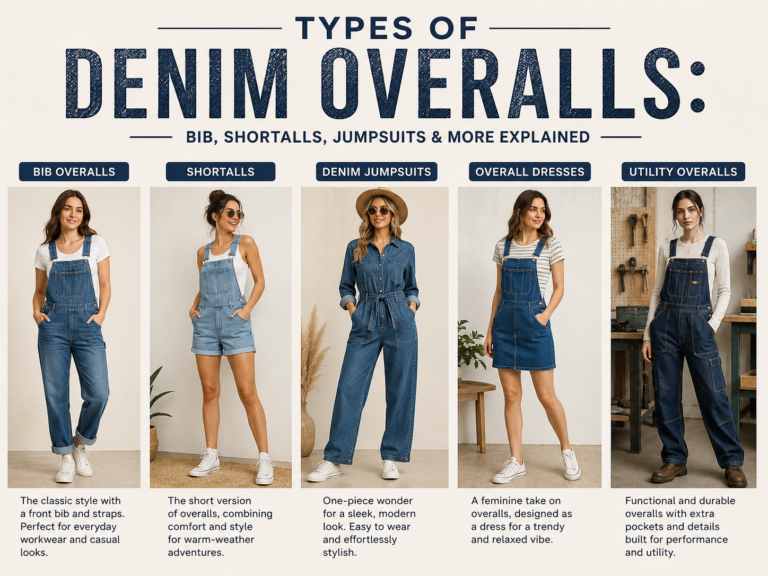
Denim overalls can take many forms. Popular options include bib overalls, shortalls, jumpsuits, skirt overalls, and streetwear inspired options. They all serve different needs and consumers. For example, some are made for comfort and utility, while others focus on seasonal trends and aesthetics.

Fashion brands looking to expand denim collections often work with experienced Denim Overalls Manufacturer services to create customized overall designs for men, women, and kids.

Bib Overalls

Bib overalls are a classic and recognizable option. They have a signature front bib and shoulder strap association with workwear. They are now widely accepted in casual fashion for their comfort and cool vintage style.

Many brands pair bib overalls with matching denim essentials produced by Denim Jeans Manufacturer to create complete denim collections for retail stores and online fashion businesses.

Shortalls

Shortalls are an ideal seasonal option with pant legs replaced by shorts. They are a popular choice in streetwear and for younger consumers for their modern style.

Street fashion brands often combine shortalls with seasonal pieces from Denim Shorts Manufacturer collections to offer comfortable warm-weather apparel options.

Denim Jumpsuits

Denim jumpsuits have become an even more modern and trendy option in overalls. Unlike their traditional counterpart, jumpsuits have a top that is fully connected to the bottom, giving a much more sleek and sophisticated overall style.

Many premium fashion labels also develop outerwear pieces through Denim Jacket Manufacturer services to complement jumpsuit collections and strengthen their denim identity.

Skirt Overalls

Skirt overalls are fashionable a Type of Denim Overalls for women. Instead of bibs attached to shorts or pants, these overalls have a bib attached to a denim skirt for a youthful, fashionable look.

Brands focused on women’s apparel often expand their collections with custom products from Denim Skirts Manufacturer to attract trend-conscious customers.

Streetwear Denim Overalls

Streetwear-inspired Types of Denim Overalls are gaining more popularity in the global fashion market. This design incorporates oversized, distressed, and bold over finished styles to create a new and modern look to the urban design.

Fashion startups and established labels frequently collaborate with Streetwear Denim Manufacturer partners to create unique and trend-driven streetwear collections.

Kids Denim Overalls

Many Types of creatively manufactured Denim Overalls are designed for children. Kids’ denim overalls are made with soft fabrics, easy fitting, and playful design styles that accommodate kids’ fast and active lifestyles.

Growing apparel businesses often source products from Kids Denim Manufacturer companies to build attractive children’s clothing lines with durable quality.

Custom and Private Label Overalls

To stand out in a more crowded market, many fashion brands use to invest in Types of Denim Overalls that are unique to their brand. This Private Label Construction of the business provides the option to design fabrics, washes, sizing, logos, and packaging according to the label structure.

Professional production partners such as Private Label Denim Manufacturer help brands create exclusive denim products with high-quality craftsmanship and scalable production.

Conclusion

To produce a denim collection that best meets the preferences of the clientele, it is vital to understand the Types of Denim Overalls. From a classic bib overall, baseball jumpsuit and modern streetwear, denim overalls are a mainstay in the world of modern design. Using the best style direction and the best manufacturer to provide quality denim in a crowded global market will give a brand the best leverage.

FAQs

What are the most popular Types of Denim Overalls?

The most popular styles include bib overalls, shortalls, jumpsuits, skirt overalls, and streetwear overalls.

Are denim overalls still in fashion?

Yes, denim overalls remain popular because they combine comfort, versatility, and timeless style.

Which Types of Denim Overalls are best for summer?

Shortalls are considered one of the best summer-friendly overall styles due to their lightweight and breathable design.

Understanding Materials Behind a High Quality Leather Vest

The average consumer will recognise a good quality leather vest, but many cannot explain what truly makes it premium. The materials behind a high quality leather vest are what separate a durable, well-crafted vest from a poor-quality one. Differentiating between good and bad materials is what makes a leather vest company reliable and trusted.

In this guide, we will walk you through the materials behind a high quality leather vest, including the outer leather, lining, hardware, thread, and edging that define durability, comfort, and craftsmanship.

The Outer Leather: Where Quality Starts

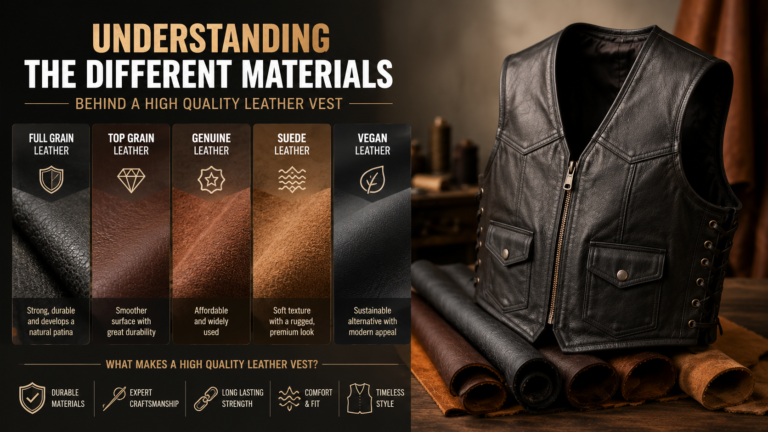
The outer leather is where quality starts. The most important part of the vest is the part that touches the hide. The outer leather is the most visible part of the vest. The outer leather grade determines the maximum grade of the vest.

When something is made of full-grain leather, it has the highest grade of all. Full-grain leather retains the entire hide and all of its markings. Full-grain leather is quality leather. Full-grain leather is made to be sold. Full-grain leather also becomes a very beautiful, very old leather. Full-grain leather, however, is expensive leather.

The next grade down is top grain leather. Top grain leather has had the surface sanded or buffed. This grade of leather, over time, will develop a good character.

Genuine leather is a much weaker product. It is used from the inner layers of the hide, after the higher quality grades are separated, so the durability is low and the product ages poorly. Therefore, for a brand that is selling a vest and positioning it at any level of quality, genuine leather is hard to use.

A specialist leather vests manufacturer will be transparent about which grade they source and why — and will provide hide samples so you can evaluate the quality before committing to production.


Tanning Method and Its Impact

A particular layer of hide is tanned in a way that impacts leather texture and the method’s effects on the environment. Two methods are worth reviewing.

Chrome tanning is the most popular method. This method is quick, low-cost, and leaves a soft leather that is even in colour and texture. Basically, every leather apparel in the world today is chrome tanned.

The slower method is called vegetable tanning, and it is relatively more expensive. Tannins are plant-based and not chemical-based. Leather produced by this method is firm and develops a patina over time. This method definitely has a more positive impact on the environment, and the leather retains its individuality.

For brands positioning a leather vest at the premium or sustainable end of the market, vegetable-tanned leather is a meaningful point of difference. A leather apparel manufacturer with access to vegetable-tanned hides can advise on which styles and constructions suit this material best.


The Lining: Comfort and Finish From the Inside

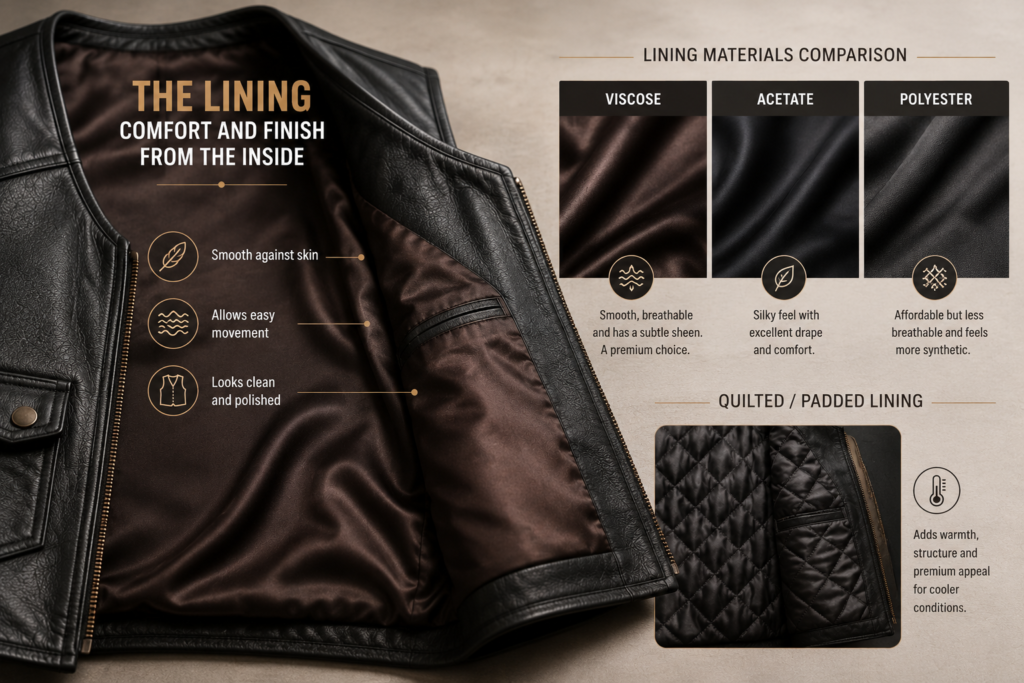
Comparison infographic showing leather vest lining materials including viscose, acetate, polyester, and quilted lining with interior leather vest details.
Different leather vest lining materials compared for comfort, breathability, movement, and premium interior finishing.

The lining is the material that sits directly against the wearer’s body and offers the brand an opportunity to compete against the best. A great outer leather instantly loses its value when paired with thin lining. Viscose and acetate linings are the most common in leather apparel. They are smooth against skin, allow the vest to slip on and off, and drape well. Quality viscose linings even have a slightly polished appearance and look clean when the vest is opened. Polyester linings are relatively cheaper, but feel a bit more synthetic to the skin, lack breathability, and feel a bit more affordable. In a vest, where the garment sits directly against a base layer, breathability is of importance compared to a jacket, which is fully covered by sleeves.

Some premium leather vests use quilted or padded lining — particularly in styles designed for cooler conditions. A leather jacket manufacturer with experience in quilted linings brings relevant construction knowledge to vest styles that incorporate this detail.


Hardware: Zippers, Snaps, and Rivets

Hardware is both functional and aesthetic — and it’s one of the most immediately visible quality indicators on any leather garment.

Zippers are the most critical hardware piece on most leather vests. YKK is the industry benchmark — their zippers move smoothly, stay aligned under tension, and last through years of regular use. A smooth-running YKK zip on a leather vest signals quality before the customer has even looked at the leather itself.

Snaps and press studs need to close firmly and open cleanly — with no wobble or resistance. Low-quality snaps that pop open under minimal tension are a common complaint in budget leather garments, and they undermine customer trust quickly.

Rivets and studs — used decoratively or structurally at pocket corners and stress points — should sit flush with the leather surface, with no sharp edges or movement. A leather bags manufacturer or accessories specialist with strong hardware sourcing brings relevant knowledge to apparel production — because bags demand the same hardware quality and consistency as garments.


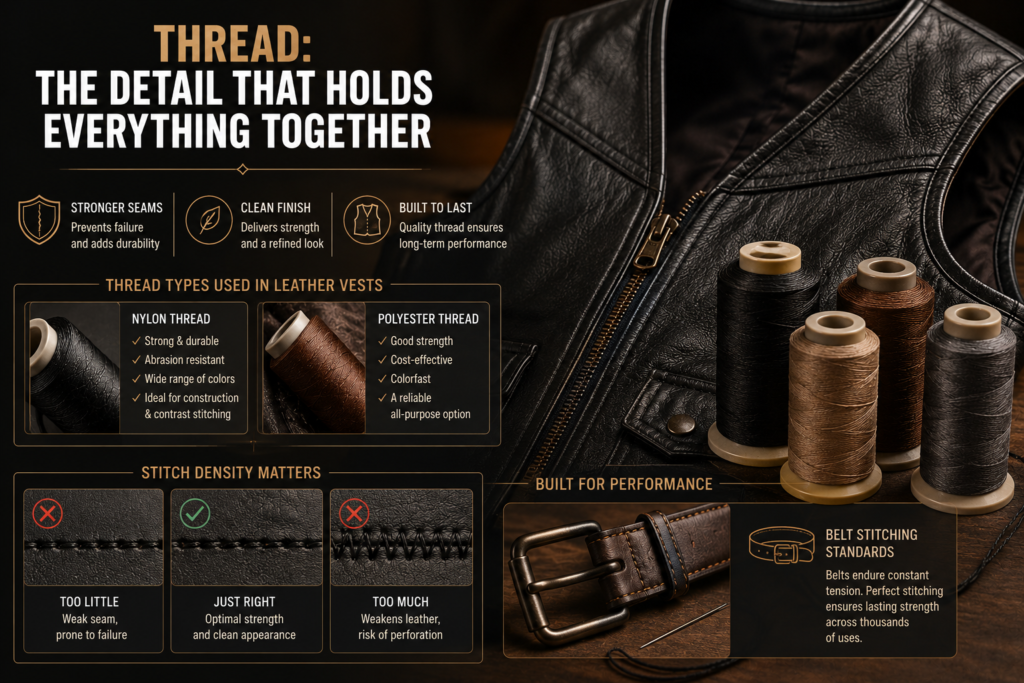
Thread: The Detail That Holds Everything Together

Infographic showing nylon and polyester threads, leather vest stitching quality, and stitch density comparison for leather construction.
Understanding thread quality and stitch density in leather vest manufacturing for durability, seam strength, and long-term performance.

Thread is the most ignored element in leather vest construction. It is literally what holds the garment together. The wrong thread causes a seam failure. The right thread gives the seam a strong finish and a positive aesthetic.

Nylon thread is the most common thread type used in leather construction. It is strong, resists abrasion, and comes in an extensive color collection useful for construction threads to match, or contrast, the beauty threads. A close second to nylon thread is a polyester thread.

The stitch density, or the number of stitches per unit length, determines the strength and the aesthetic of the seam. Too little stitch density creates a weak seam and, too much density, causes weakness to the leather. Perforation under tension may occur along the stitch line of the leather. It is the skill of the leather manufacturer to know the correct density for the weight of the specific leather used.

A leather belts manufacturer works with these thread and stitch considerations constantly — because belt stitching is under continuous tension and must perform perfectly across thousands of uses.


Edge Finishing: The Final Quality Indicator

The quality of leatherwork is often reflected in the craftsmanship of the edges. Raw edges of leather look unfinished, and as time passes, they deteriorate. Quality manufacturers are sure to finish every edge, and each method shows their craftsmanship.

The quality of edge painting is characterized by colored finishes along the cut edges to seal them, and finishes have a sharp, clean, defined look. A polished finish is characterized by a more natural edge that is smooth and compressed, and works particularly well on vegetable tanned leather. A more complex method characterized by wrapping the edge in a separate leather or fabric strip is used in premium garments, and is referred to as binding.

In a leather vest, where the edges of the armholes, hem, and pockets are frequently exposed and touched, shows of quality craftsmanship are most obvious in the craftsmanship of edge finishings.

A leather coats manufacturer with strong finishing capabilities applies the same edge quality to vests as to more complex outerwear — because the standard shouldn’t drop just because the garment is simpler.


Conclusion

The quality components of a premium leather vest aren’t hard to figure out, but they are exacting. Understanding the materials behind a high quality leather vest starts with selecting full grain or top grain leather, quality tanning, YKK hardware, strong high-density stitching, and polished edging. Every detail matters, and weakness in any one component can affect the overall durability, comfort, and appearance of the vest.

When brands carefully evaluate the materials behind a high quality leather vest, they can ask the right questions, assess samples properly, and make informed decisions based on true craftsmanship rather than superficial features.

When you’re ready to develop your leather vest with the right materials from the start, explore the full range of leather apparel manufacturing options and find the right partner for your project.


FAQs

What leather grade is best for a high-quality vest?

Full-grain leather is the highest quality — it’s the most durable, ages best, and has the most character. Top-grain is also suitable for premium vests. Avoid genuine leather for quality positioning.

What is the difference between chrome tanning and vegetable tanning?

Chrome tanning is faster and produces soft, consistent leather. Vegetable tanning is slower and more traditional — producing firmer leather with a deeper patina and better sustainability credentials.

Why does lining material matter in a leather vest?

The lining sits against the skin and affects comfort, breathability, and how easily the vest goes on and off. A quality viscose or acetate lining makes a significant difference to the wearing experience.

What thread is used for stitching leather garments?

Nylon thread is most common — it’s strong, abrasion-resistant, and available in colours for matching or contrast effects. Stitch density needs to match the leather weight to avoid seam weakness or perforation.

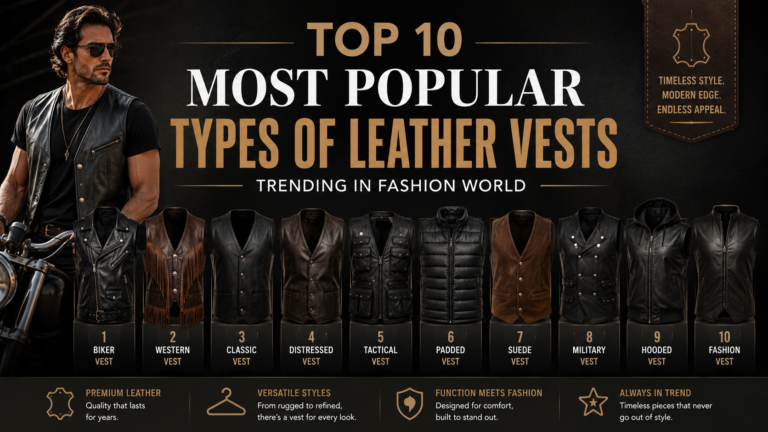
Top 10 Most Popular Types of Leather Vests in Fashion

Leather vests are arguably the most evergreen piece of fashion. However, not all leather vests are the same. From biker cuts to tailored pieces, the number of leather vests varies more than most would imagine.

When trying to design a more comprehensive leather collection or trying to keep track of very recent trends in the market, niche areas in design, like the classification of how many different types of leather vests exist, are going to be highly beneficial when explaining other market opportunities.

What follows is a brief explanation of the 10 most common types of leather vests and the distinguishing characteristics of each.

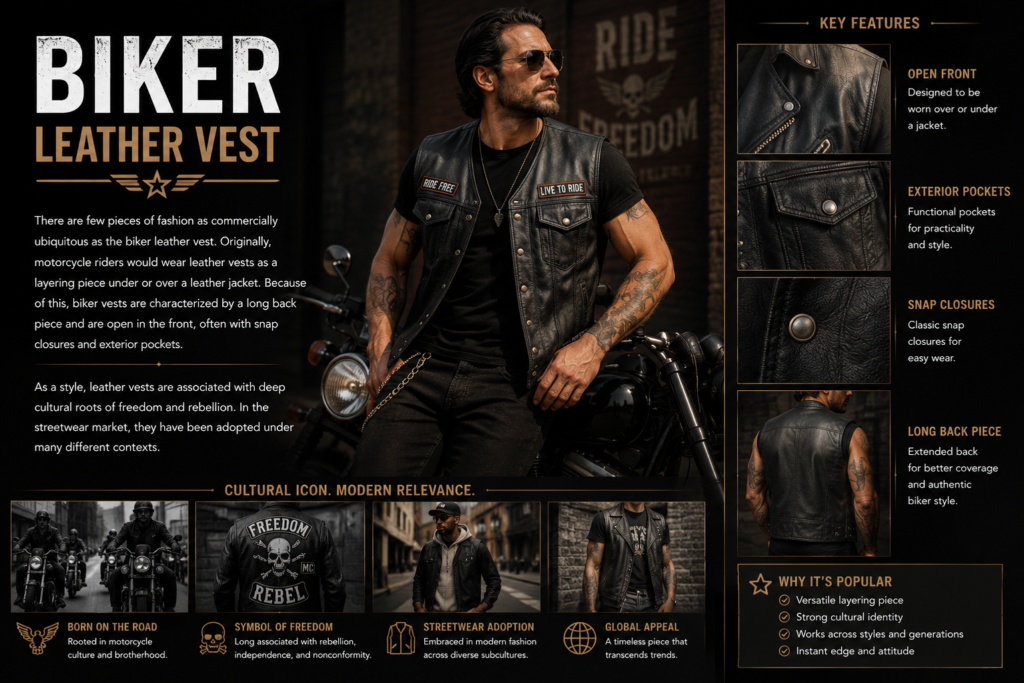
Biker Leather Vest

Classic biker leather vest with snap closures, exterior pockets, and long back panel styled with motorcycle fashion influence.
Biker leather vests combine rugged functionality with strong cultural roots inspired by motorcycle and streetwear fashion.

There are few pieces of fashion as commercially ubiqituous as the biker leather vest. Originally, motorcycle riders would wear leather vests as a layering piece under or over a leather jacket. Because of this, biker vests are characterized by a long back piece and are open in the front, often with snap closures and exterior pockets.

As a style, leather vests are associated with deep cultural roots of freedom and rebellion. In the streetwear market, they have been adopted under many different contexts.

A leather vest manufacturer with biker vest experience understands the specific construction details — the extended back, the pocket placement, the heavy-duty hardware — that make an authentic biker vest different from a fashion approximation.


Western Leather Vest

The origins of the western vest stem from the Wild West aesthetic. It draws features from the old cowboy vest. Common features include fringe detailing on the hem and chest, as well as decorative stitching. Decorations often have metal studs or concho placement. Western leather vests have a tailored front closure giving the vest a closer fit to the body unlike a biker vest.

The western leather vest is currently experiencing a cycler of revival due to trends on country music as well as western inspired runway styling.

Classic Zip-Front Leather Vest

The most commercially successful leather vest is the classic zip front leather vest. It has a simple design featuring no heavy hardware, loud fringe, or specific subculture designs. Rather, it is just a simple and clean leather vest featuring a center zip closure.

This vest can suit the widest range of consumers and styling. Very few garments are as versatile as this leather vest. This vest suits almost any layering, be it casual or formal. It appeals to consumers looking for a leather style, but with no loud or bold subculture associated with it.

For a leather range targeting commercial success, the classic zip front vest is an obvious choice for the starting point.

Button-Front Leather Vest

This style is very similar to the classic zip front style. However, instead of a zip, it utilizes button closures. This particular style tends to be more relaxed with a vintage aesthetic. That being said, this particular design features Americana as well as work-wear styling.

The quality of the buttons matters significantly in this style. Heavy brass or antique-finish buttons elevate the garment immediately. Cheap buttons undermine it just as quickly.

A leather apparel manufacturer with strong hardware sourcing can advise on button options that match the aesthetic and quality of the leather itself.


OPEN-FRONT LEATHER VEST

This vest is a totally open-front design with no closure, so layering is this vest’s only function. Besides being a bold layering design, this vest is popular in editorial and magazine pictures, and is not seen as a working piece of clothing.

A vest like this looks great when it’s longer, where it drapes open and flows along with fitted clothing underneath. If a brand’s focus is designing more with fashion and trends at the forefront, these types of vests are easy to design and very effective.

PADDED LEATHER VEST

This vest type combines the exposed leather aesthetic of a vest with the warm middle of a gilet. The popularity of this type of vest that combines a warm, expensive-looking function with leather on the outside is really growing.

The added function of warmth and a wider temperature range than a typical vest comes with the cost of a little more complex design. An inner layer to the vest is combined with a lining and outer leather quilted to hold the fill in place.

A leather jacket manufacturer with experience in padded outerwear construction understands how to balance leather surface integrity with the structural requirements of insulated fill.


Tailored Leather Vest

The tailored vest is inspired by formal suiting. It is more structured and fitted. It may have welt pockets, and a clean back, and it is not as long as a biker-style vest. It can be worn as a statement piece for smart-casual and some more avant-garde looks.

Tailored leather vests are more challenging to construct than a more casual vest. The fit needs to be strict across the chest, and the shoulders may require some consideration in the grading and sizing department.

For the menswear and advanced markets, the tailored vest functions to position the leather vest as a thoughtful, sophisticated part of a wardrobe, not as a relic of subculture.

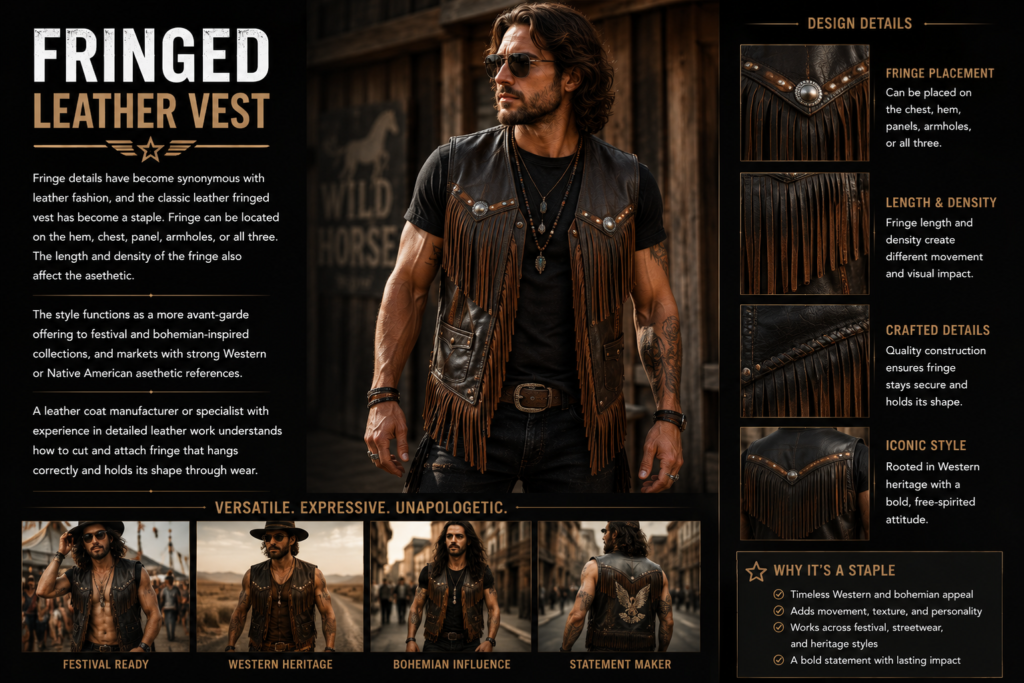
Fringed Leather Vest

Brown and black fringed leather vest featuring Western-inspired fringe details on chest panels and hem construction.
Fringed leather vests bring movement, texture, and bold Western-inspired styling to modern leather fashion collections.

Fringe details have become synonymous with leather fashion, and the classic leather fringed vest has become a staple. Fringe can be located on the hem, chest, panel, armholes, or all three. The length and density of the fringe also affect the aesthetic

The style functions as a more avant-garde offering to festival and bohemian-inspired leathers. fluenced collections, and markets with strong Western or Native American aesthetic references.

A leather coat manufacturer or specialist with experience in detailed leather work understands how to cut and attach fringe that hangs correctly and holds its shape through wear.


Studded Leather Vest

Studded vests have become a popular item in both rock and punk fashion. They have been studded with leather borders, making them bold and recognized in many subcultures.

Quality is crucial while making studded vests. Those wearing the vests do not want to be scratched by incorrect stud immplementation. They also do not want the studs to fall out and/or leave holes in the leather. This is a long, sophisticated process that makes it difficult to have many available.

The studded vest is a basic piece for brands that want to reach the markets of rock, metal, and alternative fashion. Quality and money spent reward those brands.

Workwear Leather Vest

Workwear leather vests are practical, and their origins are in the craft trades. They offer protection to the front of the body while leaving the arms unrestrained. They were originally used by blacksmiths, woodworkers, and other artisans.

Today, the workwear vest has been adopted by fashion, styled as a heritage-influenced layering piece with utilitarian detailing like D-rings, tool loops, and heavy-duty stitching. It sits alongside leather aprons in the workwear leather category and appeals strongly to brands with a craft, heritage, or maker aesthetic.


Conclusion

The types of leather vests available today cover an enormous range of styles, functions, and customer profiles. From the iconic biker cut to the tailored fashion piece, each style serves a specific market — and understanding those distinctions helps brands make smarter product decisions.

Whether you’re launching your first leather vest or expanding an existing range, working with the right manufacturer makes all the difference in execution.

When you’re ready to develop your leather vest collection, explore the full range of leather apparel manufacturing options and find the right partner for your project.


FAQs

What are the most popular types of leather vests?

Biker, western, zip-front, button-front, open-front, padded, tailored, fringed, studded, and workwear are the ten most popular and commercially relevant styles.

Which leather vest style is the most versatile?

The zip-front leather vest is the most commercially versatile — it works across the widest range of customers, styling contexts, and price points.

What is a biker leather vest?

A sleeveless leather garment with an extended back panel, open or snap front, and multiple pockets — originally worn by motorcycle riders and now adopted across fashion.

What makes a Western leather vest different from other styles?

Western vests typically feature fringe detailing, decorative stitching, and conchos or metal embellishments — drawing from American frontier and cowboy heritage.

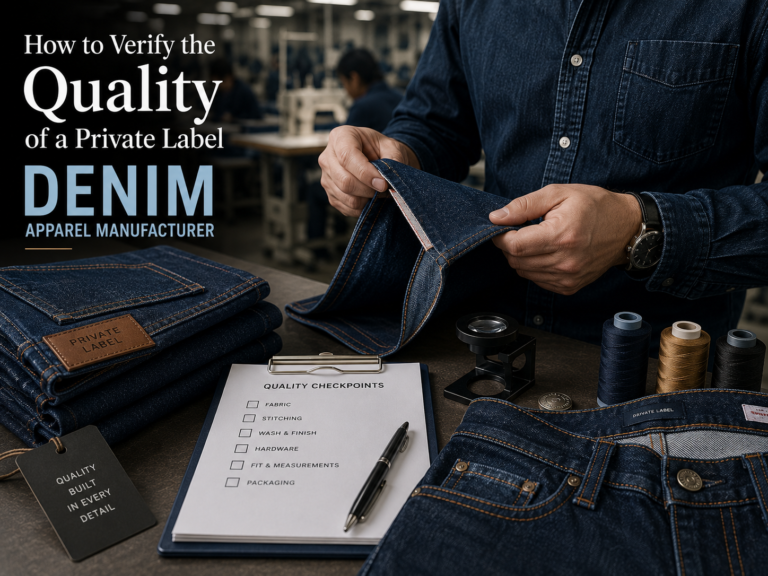
How to Verify the Quality of a Private Label Denim Apparel Manufacturer

Finding a quality denim apparel manufacturer is not as simple as browsing a supplier directory and picking the one with the best website. The denim category is technically demanding. Fabric construction, wash development, fit precision, and finishing consistency all require genuine expertise — and not every factory that claims expertise actually has it.

Therefore, before you commit to any private label denim manufacturing partner, you need a structured verification process. This guide gives you exactly that — a clear, practical framework for evaluating quality denim apparel manufacturer candidates before a single order is placed.

Why Verifying a Quality Denim Apparel Manufacturer Matters

Many brands skip rigorous manufacturer verification because it feels time-consuming. They request one sample; it looks reasonable, and they move straight into bulk production. That shortcut works occasionally. More often, it surfaces expensive problems — inconsistent wash treatments, poor seam construction, fabric substitutions — after bulk production is already underway.

Consequently, investing time in proper verification upfront saves significantly more time and money than fixing quality problems after the fact. A quality denim apparel manufacturer welcomes scrutiny. One that resists detailed evaluation is almost always hiding something worth finding.

Request a Full Production Portfolio

A manufacturer experienced across denim jeans, denim jackets, denim shirts, and denim shorts demonstrates broad construction capability. A factory that only produces one garment type well may struggle when your collection expands across multiple styles. Ask to see samples from multiple production batches of the same style. Quality denim apparel manufacturer partners produce consistent results across runs — not just on the first sample produced for a client presentation.

Furthermore, ask whether they have produced private label denim specifically — not just contract manufacturing for established brands. Private label production requires a different kind of manufacturer engagement, including tech pack interpretation, sampling initiative, and brand-specific quality standard management.

Evaluate Fabric Sourcing and Denim Construction Knowledge

A quality denim apparel manufacturer must demonstrate deep knowledge of denim fabric construction — not just general garment manufacturing capability. Denim is a technically specific fabric category. Selvedge denim, stretch denim, raw denim, and washed denim all behave differently during cutting, sewing, and finishing. A manufacturer unfamiliar with these differences will produce inconsistent results across your collection.

Which denim mills do you source from? Can you provide fabric certification documentation? How do you handle shrinkage pre-treatment before cutting? What stretch denim compositions do you work with regularly? A quality denim apparel manufacturer answers these questions with specifics — mill names, GSM ranges, certifications, and technical processes. Vague answers signal a factory that outsources fabric decisions rather than managing them knowledgeably in-house.

Additionally, verify whether they can support your full denim apparel range needs — including specialist categories like denim overalls, denim vests, and denim skirts — without needing to outsource production to subcontractors. Subcontracting introduces quality inconsistency that is very difficult to monitor and control from a distance.

Assess Wash Development Capability

Wash treatment is one of the most technically complex and brand-defining aspects of denim production. The right wash can make a denim garment look premium, authentic, and distinctive. The wrong wash — or an inconsistent wash — produces garments that look cheap, uneven, or completely different from the approved sample.

Therefore, verifying wash development capability is essential when evaluating a quality denim apparel manufacturer. Ask to see wash sample ranges across different techniques:

Stone washing. Enzyme washing. Acid washing. Sand blasting alternatives. Vintage and distressed treatments. Overdye and tint washes.

A quality denim apparel manufacturer either runs wash development in-house or maintains a closely managed relationship with a dedicated wash house. Either approach is acceptable — but the manufacturer must demonstrate they control the wash process, not simply send fabric to a third party and hope for the best.

Furthermore, ask specifically how they ensure wash consistency across bulk production runs. Color and texture variation between units — caused by inconsistent wash chemistry or machine loading — is one of the most common quality failures in denim manufacturing and one of the hardest to fix after bulk production is complete.

This matters especially for brands building collections that include streetwear denim styles, where distinctive wash treatments are often central to the brand’s visual identity and product differentiation.

Run a Structured Sampling Evaluation

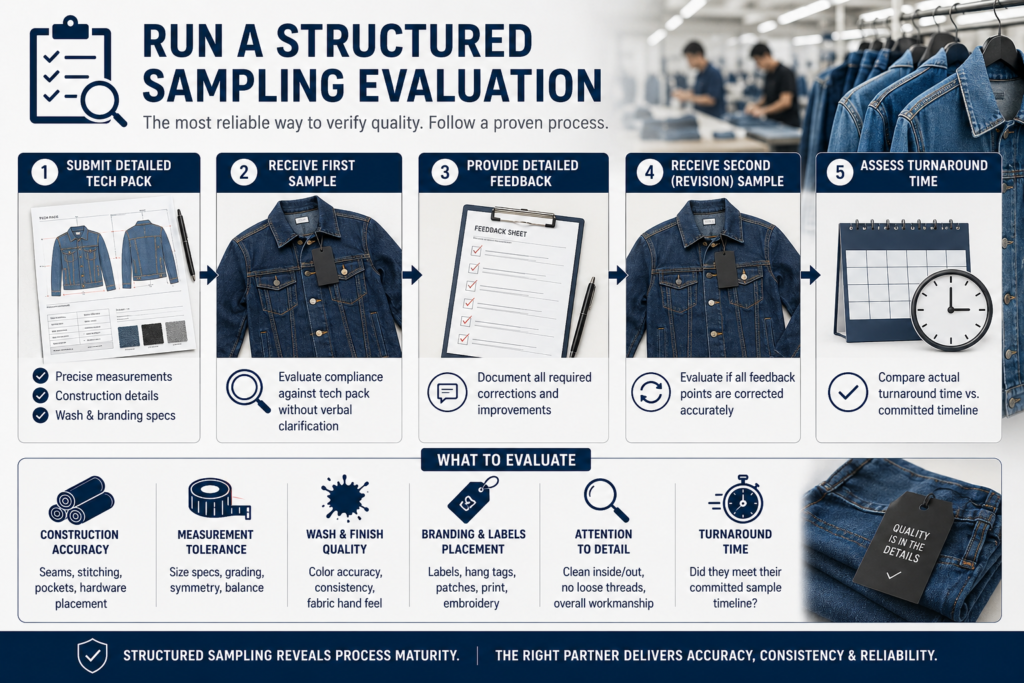
Structured denim sampling evaluation infographic showing tech pack review, sample revisions, feedback process, and production timeline verification for denim apparel manufacturing.
A structured sampling process helps brands verify denim apparel manufacturing accuracy, consistency, and production reliability before bulk orders.

Send your most technically demanding style as the first sampling request. Include precise measurements, construction specifications, wash references, and branding details. Then evaluate how closely the returned sample matches your specifications — without you providing verbal clarification during the process. A quality denim apparel manufacturer interprets tech packs accurately. One that requires constant hand-holding during sampling will require the same during bulk production.

After providing feedback on the first sample, request the revision and evaluate whether all noted issues are corrected accurately. The revision round tells you more about a manufacturer’s quality culture than the first sample does. A factory that corrects every point precisely demonstrates attention to detail. One that corrects some points but misses others — or introduces new problems — signals process weaknesses that scale badly into bulk production.

Verify Quality Control Systems

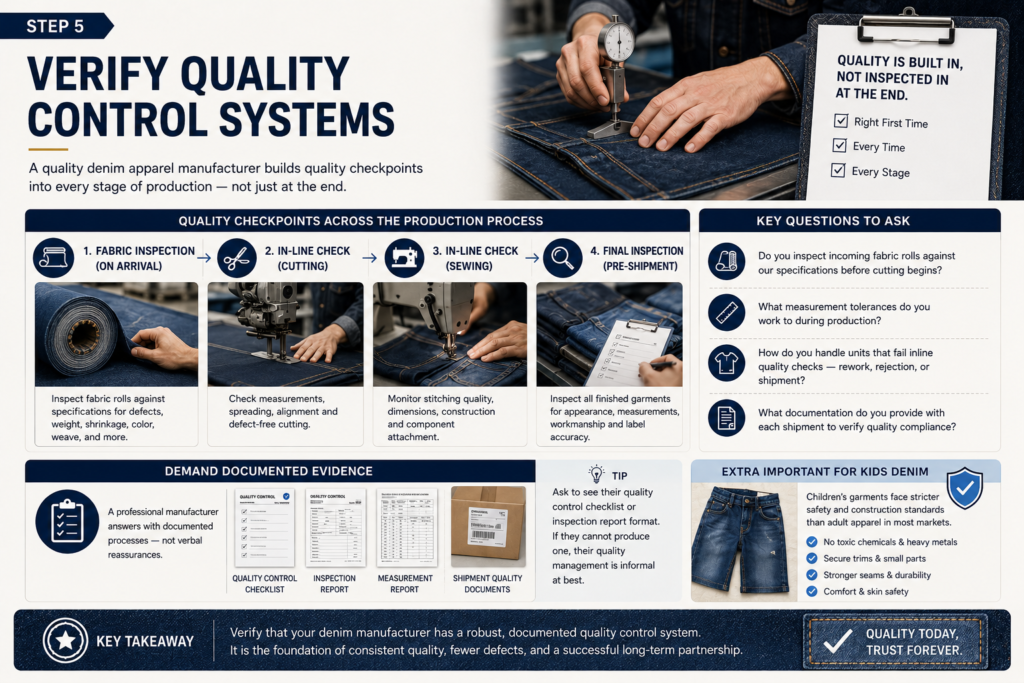
Denim apparel quality control infographic showing fabric inspection, inline sewing checks, final inspection stages, and documented quality management systems.
Professional denim manufacturers implement quality checkpoints throughout production to maintain consistent construction, measurements, and finishing standards.

A quality denim apparel manufacturer does not rely on end-of-line inspection alone. They build quality checkpoints into every stage of the production process — fabric inspection on arrival, in-line checks during cutting and sewing, and final inspection before shipment.

Ask your potential manufacturer to walk you through their quality control process in detail. Specifically, find out:

Do they inspect incoming fabric rolls against your specifications before cutting begins? What measurement tolerances do they work to during production? How do they handle units that fail inline quality checks — rework, rejection, or shipment? What documentation do they provide with each shipment to verify quality compliance?

A quality denim apparel manufacturer answers these questions with documented processes — not verbal reassurances. Ask to see their quality control checklist or inspection report format. If they cannot produce one, their quality management is informal at best.

Furthermore, for brands producing specialist categories like kids denim, quality control verification takes on additional importance because children’s garments face stricter safety and construction standards than adult apparel in most markets

Check References and Brand Relationships

Finally, a quality denim apparel manufacturer should be able to provide references from existing brand clients — or at minimum, demonstrate ongoing production relationships through portfolio evidence and communication transparency.

Ask whether they can connect you with existing clients willing to speak about their manufacturing experience. A confident, capable manufacturer welcomes this request. One that deflects or avoids it raises an immediate red flag.

Additionally, research the manufacturer independently. Look for their production facility online. Check whether their stated certifications are verifiable through the relevant certification bodies. Review any publicly available information about their production standards, labor practices, and environmental management.

A quality denim apparel manufacturer has nothing to hide and welcomes the scrutiny. That openness, combined with the technical verification steps above, gives you the confidence to commit to a production partnership that protects your brand and your customers.

Final Thoughts

Verifying a quality denim apparel manufacturer takes time and effort upfront. However, that investment pays back many times over in consistent product quality, reliable delivery, and a manufacturing relationship you can build a brand on.

Work through each step in this guide before committing to any private label denim partner. Evaluate portfolios, test fabric knowledge, run structured sampling, verify wash capability, and check quality control systems. The manufacturer that passes all of these checks is the one worth partnering with for the long term.

FAQs

How many sample rounds should I expect before approving bulk production?

A quality denim apparel manufacturer has specific expertise in denim fabric construction, wash development, and garment finishing that general clothing factories typically lack. Denim requires specialist knowledge at every production stage — from pre-shrinkage treatment to wash chemistry management.

How many sample rounds should I expect before approving bulk production?

Most private label denim developments require two to three sample rounds before bulk approval. A quality denim apparel manufacturer produces accurate first samples that need only minor adjustments — not fundamental reconstruction across multiple rounds.

What certifications should a quality denim apparel manufacturer hold?

Relevant certifications include OEKO-TEX Standard 100 for chemical safety, GOTS for organic fabric handling, and GRS for recycled content. Social compliance certifications such as BSCI or SA8000 are also important indicators of responsible manufacturing practice.

How do I verify wash consistency in denim manufacturing?

Request bulk wash samples from three separate production batches of the same style and wash treatment. Compare them side by side for color consistency, texture uniformity, and placement accuracy. Visible variation between batches indicates a wash process that lacks adequate chemistry control.

Is it worth visiting a denim manufacturer’s facility before placing an order?

Yes — whenever possible. A facility visit reveals production capacity, equipment condition, workforce skill level, and quality culture in ways that sample evaluation and video calls cannot. For significant first orders, a factory visit is one of the most valuable verification investments a brand can make.

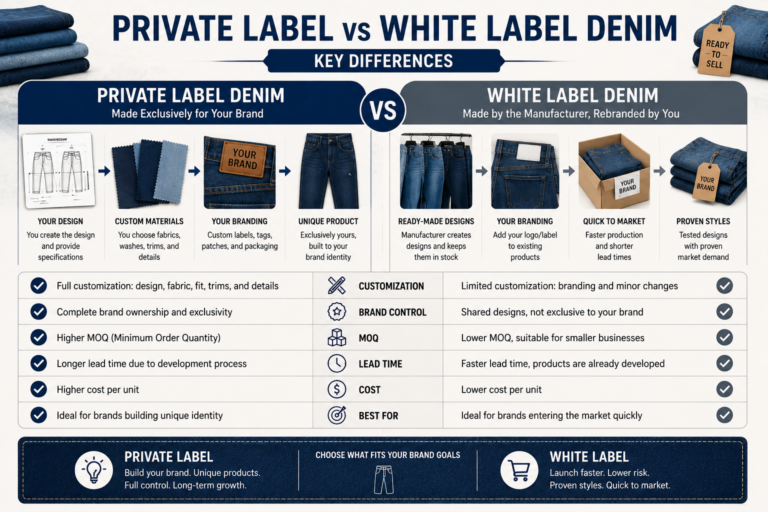
Private Label vs White Label Denim — Key Differences

Before launching or expanding a denim brand, consider private label vs white label denim. Both models can launch products, but are completely different, and can cost you time, money, and brand equity if the wrong one is chosen for the business stage.

Understanding the difference between private and white label denim is the goal of this guide. It outlines both models, and helps you choose the correct option for your brand.

What Is Private Label Denim?

Private label denim means that a brand collaborates directly with a manufacturer to make jeans to that brand’s full specifications. Full creative control from the brand means they get to decide everything from the type of fabric used, fit, wash, sewing construction, to labeling, including branding woven on labels and the lining of pockets.

Private label denim brands get all the design and sell all the production. No one but that brand sells the jeans. That brand’s label is the only one the manufacturer puts on it.

This is the model used by established denim labels, growing fashion brands, and any business that wants a product with genuine differentiation in the market. Working with a specialist private label denim manufacturer gives brands full creative and commercial control over every garment they put their name on.

What Is White Label Denim?

White label denim changes the rules. In this setup, a company designs and produces a basic piece of clothing like pants or shorts, and sells that same piece to different companies. Each of those companies can then place their own label and branding on the piece of clothing. Because of this, the clothing piece sold to each company is the same or only slightly altered from company to company.

White label denim is beneficial to companies looking to market clothing quickly, have tight budgets, or want to test the waters on selling a new clothing product, like a new clothing piece, without investing in making a totally custom product. It is fast and easy to implement, but significantly limits what a company can do. These limitations are necessary to understand before deciding to use this type of product.

Private Label vs White Label Denim — The Core Differences

Difference 1: Product Ownership and Exclusivity

This describes the most basic difference between private label and white label denim. Private label means that the product is yours and yours alone. The fit, the fabric, the wash, the construction; everything that goes into making that product is done specifically for the brand. No other company can purchase the same garment from the same manufacturer and simply place a different tag on it.

With white label denim, that exclusivity is not really guaranteed. Other brands can sell a garment that is structurally the same as yours. This is what makes it noticeably difficult to differentiate your product from that of your competitors.

So, for brands that want to build brand equity for the long-term, private label is the better option. For brands that want to enter a market quickly while making less of a financial investment in the initial product development, white label is the best choice.

Difference 2: Development Time and Cost

Private label versus white label denim differ greatly in dev time and initial investment.

Establishing a private label involves all the building blocks to create a complete product — tech packs, samples, fit testing, washes, and approvals. This process is costly and time consuming, spanning eight to sixteen weeks, and is only feasible with sampling. A well-crafted product is the payoff.

White label denim has you begin the process much further down the pipeline. Samples already exist for you to choose from, and you have the option to design your product and brand, before moving directly to production. For a brand needing to launch product quickly, this option accelerates time to market to four to six weeks.

Difference 3: Brand Differentiation Potential

The most noticeable difference between private label and white label denim is the ability to differentiate in the market. Private label denim allows brands to create their own signature fits, exclusive wash treatments, unique fabric constructions, and distinguishing design elements. These cannot be copied by competitors without undergoing the development process themselves.

For example, a brand building a denim jeans range with a proprietary mid-rise slim fit and a specific vintage wash treatment owns that product identity completely. Customers recognise it. Retailers value it. Competitors cannot copy it exactly.

White label denim cannot deliver that level of differentiation. The product is fundamentally generic — even with your branding applied.

Private Label vs White Label Denim — Pros and Cons

Understanding private label vs white label denim requires an honest look at both sides. Here are the key advantages and limitations of each model:

Private Label Denim:

  • Full product ownership and exclusivity: Your fit, your fabric, your wash, your brand. Nobody else sells the same garment. This builds genuine long-term brand equity and customer loyalty that white label simply cannot replicate.
  • Complete creative control across all categories: From denim jackets to denim shirts and denim overalls, every style in a private label range can carry distinctive design details that set your brand apart across the full collection — not just in a single hero product.

White Label Denim:

  • Faster time to market with lower upfront cost: No full development cycle means you can launch in weeks rather than months. This suits brands testing a new denim category, pop-up retail concepts, or businesses that need product quickly without heavy sampling investment.
  • Lower minimum order quantities in many cases: Because the base garment already exists, some white label suppliers offer lower MOQ entry points than private label manufacturers — making it more accessible for brands at the very early stage of building a denim range.

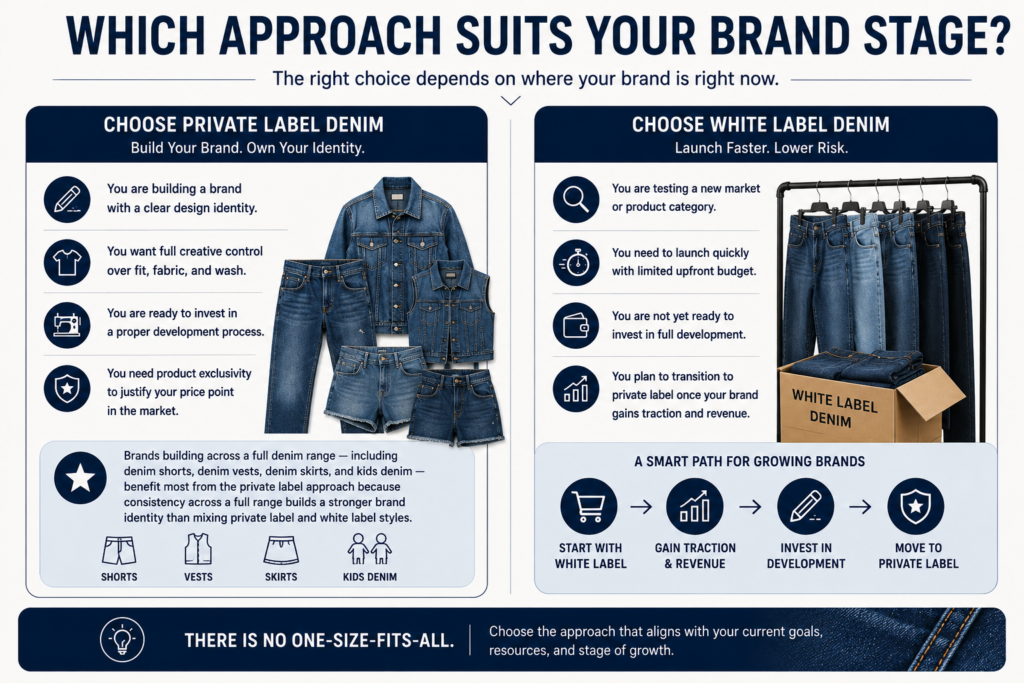
Which Approach Suits Your Brand Stage?

Brand growth infographic comparing private label and white label denim approaches based on business stage, budget, product development, and long-term brand strategy.
The right denim manufacturing approach depends on your current business stage, growth goals, budget, and level of product development readiness.

The private label vs white label denim decision depends heavily on where your brand is right now — not where you plan to be in five years.

Choose private label denim if: You are building a brand with a clear design identity. You want full creative control over fit, fabric, and wash. You are ready to invest in a proper development process. You need product exclusivity to justify your price point in the market.

Brands building across a full denim range — including denim shorts, denim vests, denim skirts, and kids denim — benefit most from the private label approach because consistency across a full range builds a stronger brand identity than mixing private label and white label styles.

Choose white label denim if: You are testing a new market or product category. You need to launch quickly with limited upfront budget. You are not yet ready to invest in full development. You plan to transition to private label once your brand gains traction and revenue.

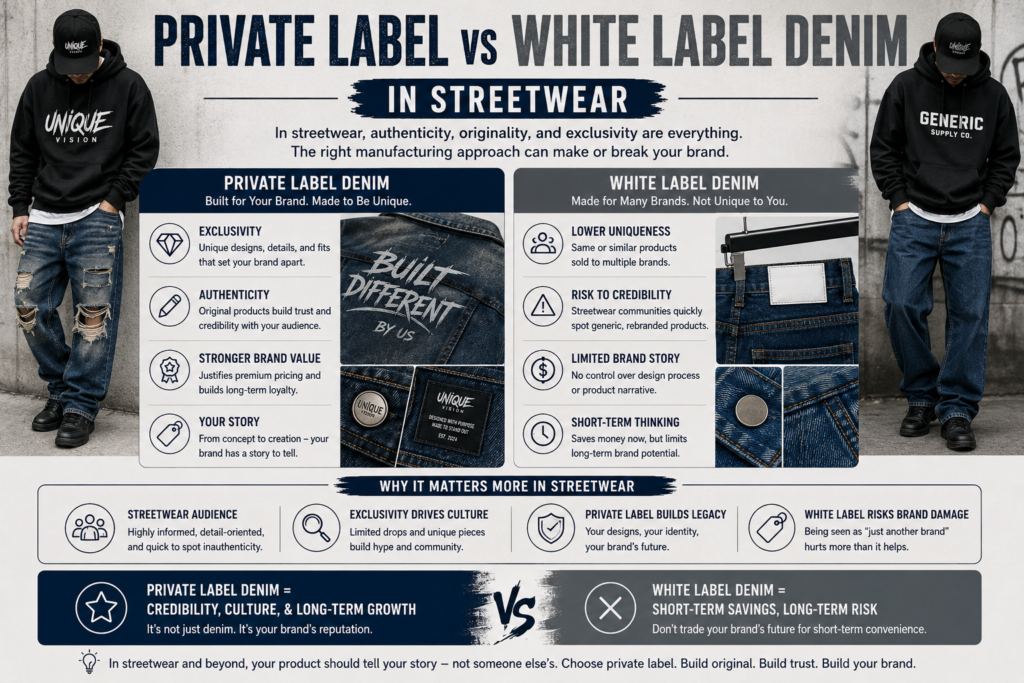
Private Label vs White Label Denim in Streetwear

Streetwear denim comparison infographic showing private label versus white label manufacturing, highlighting authenticity, exclusivity, originality, and long-term brand credibility in streetwear fashion.
Streetwear brands benefit more from private label denim manufacturing because originality, exclusivity, and authentic product identity strongly influence customer trust and brand perception.

The streetwear market presents a particularly interesting case in the private label vs white label denim debate. Streetwear consumers are highly attuned to authenticity and product originality. They research brands, recognise generic constructions, and value exclusivity strongly.

Therefore, brands building in the streetwear denim space almost always need private label production to build credibility with their audience. A streetwear brand selling white label denim with a different label applied risks immediate recognition from its core customer base — which damages brand perception far more than the money saved on development.

Furthermore, denim apparel brands across all categories — from premium fashion to everyday casualwear — increasingly find that consumers expect product stories. Private label manufacturing gives brands those stories. White label does not.

Final Thoughts

The difference between a private label denim brand and a white label denim brand is ultimately about the focus of your business and where you are at in your company’s development. White label denim brands allow you to get to the market the fastest with the least amount of risk. Private label brands are focused on creating brand loyalty and trust with a product that cannot be otherwise sourced.

Most premium denim brands launch on a white label and then transition to a private label once their product gains traction in the market to support the transition. The best approach is to make the transition consciously, understanding the tradeoff of each approach, instead of assuming the least costly approach is the best.

FAQs

What is the main difference between private label vs white label denim?

label denim is developed exclusively for one brand — with custom fit, fabric, wash, and branding. White label denim is a pre-made generic garment that multiple brands can purchase and apply their own label to.

Is private label denim more expensive than white label?

upfront development investment — sampling, tech packs, and fit testing. However, per-unit costs at scale are often comparable. The real difference is the development cost and timeline, not necessarily the bulk production price.

Can small brands access private label denim manufacturing?

Yes. Many manufacturers offer private label denim production at relatively accessible MOQs for brands at the early growth stage — particularly for brands with clear design specifications and a structured development process.

Does white label denim work for building a long-term brand?

It can work as a starting point. However, white label denim limits brand differentiation because other brands may sell identical products. Most brands building long-term market presence transition to private label production as they grow.

Which model is better for a streetwear denim brand?

Private label is strongly preferred for streetwear denim. Streetwear consumers value authenticity and product originality highly — which means a generic white label product is very difficult to position credibly in that market.