Appearances can be deceiving. A leather belt has numerous details and decisions that impact quality. Design begins when hides are cut into various shapes and sizes. Understanding the characteristics of different hide cuts for leather belts is as important as selecting the type of leather, thickness, finish, and buckles. Belts made with strong leather will remain more stable and will not lose their shape.
What Are Leather Hide Cuts for Belts?
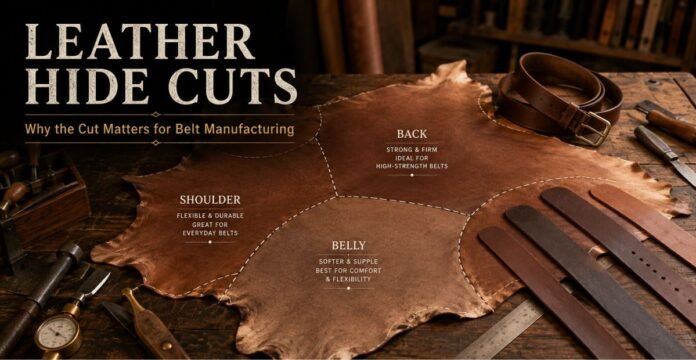
When a hide of animals is removed, it is referred to as leather hide. Different sections of these hides can be cut and made into long strips of belts. An animal hide is not the same from one end to the other. Some sections of the hide are stronger and more dense, while some sections are softer and more pliable. The harder, more firm sections of hides tend to be found near the back bone and spine areas. The belly of the animal tends to have more flexible fibers and more natural stretch.
Why the Cut Matters in Belt Manufacturing
The location of the leather strip on the hide affects how the belt performs after months or years of use. High-quality full-grain leather belts are often produced from stronger sections because full-grain leather keeps the natural grain surface and needs a stable base to perform well. Good leather hide cuts for belts resist stretching around the buckle holes, stay flatter around the waist, and develop a more even appearance over time.
The Double Butt Is One of the Best Areas for Belts
The double butt is located in the middle and rear area of the hide. For a long time, it has been known as one of the best areas to cut wide, strong leather straps. Because of this, the double butt is considered by many manufacturers to be one of the most reliable cutting areas for belts. The double butt is suitable for all styles of belts from dress belts to work belts or heavier designs. Appropriate thickness of leather belts cuts from the double butt provide a good balance in firmness and flexibility required for a belt to conform to the curvature of the waist.
The Bend Offers Strength and a Clean Surface
The bend is another premium area used when manufacturers need firm and stable leather. It comes from the central side section of the hide and usually has a cleaner, more consistent grain than areas close to the belly. This makes bend leather useful for leather belts for men where appearance, edge quality, and long-term shape are important. Leather hide cuts for belts taken from the bend can provide an attractive surface for natural, dyed, polished, embossed, or burnished finishes. These leather hide cuts for belts are also easier to cut into straight straps because they usually have less loose fiber than lower-quality sections.
Key Leather Hide Cuts Used by Belt Makers
Different leather hide cuts for belts give manufacturers different levels of strength, appearance, cost, and flexibility. A simple way to understand the main sections is:
- Double butt: Dense, firm, strong, and highly suitable for long-lasting belt straps.
- Bend: Stable, smooth, and useful for premium dress and casual belts.
- Shoulder: Strong but slightly more flexible, with more natural marks and grain variation.
- Side: Large and economical but includes areas with different fiber density.
- Belly: Soft and stretchy, making it less suitable for high-stress belt straps.
- Back: Strong along the center and useful when long, stable strips are required.
Choosing between these leather hide cuts for belts depends on the belt’s purpose, desired price, thickness, style, and expected level of daily wear.
Shoulder Leather Can Work Well for Casual Belts
Shoulder leather is sourced from the upper front portion of the hide. Shoulder leather tends to be stronger than other sections of the hide, though it will contain more wrinkles and natural grain movement. Because of the characteristics of shoulder leather, it makes a great choice for casual, rustic, vintage, and even some handmade belts. If used the right way, leather hide cuts sourced from shoulders should be strong enough for casual daily use. However, care must be taken when selecting sections of shoulder leather since some will stretch more than others.
Belly Leather Requires More Care
The belly is usually one of the softer and more flexible parts of the hide because the fiber structure is less compact. Although belly leather can be useful for small accessories, linings, decorative pieces, and some lightweight products, it is generally not the first choice for a belt that must carry weight or resist repeated pulling. A heavy-duty leather tool belt especially needs strong leather hide cuts for belts because tools place extra stress on the strap, stitching, buckle area, and attachment points. Belly-based leather hide cuts for belts may stretch too much under this kind of load unless they are reinforced or used only for less demanding components.
Hide Direction Also Changes Belt Performance
There are many variables associated with leather belt manufacturing, and direction of trim is another variable manufacturers must consider. The fibers of the leather run a given pattern in a consistent direction across the hide of the animal. Trimming all belts in one direction can mitigate stretch. Most leather manufacturers trim the belts in a consistent direction to avoid stretching. Belts should be manufactured cutting in a consistent relaxed area. This creates a well balanced and even feeling belt.
Thickness Must Match the Hide Cut
Thickness does play a role in the performance of a belt. Thinner belts are not always inferior. Thicker belts can, and more often than not, do stretch more. This is why manufacturers evaluate a hides thickness in reference to the leather hide cuts for belts. From the standpoint of a dress belt, clean lines and attention to detail are most important. For a work belt, strength and thickness become paramount to the manufacturing of the leather hide cut of a belt. A careful leveling of leather hide cuts for belts creates a uniform thickness for finishing the edges of belts and will improve the overall finish of the belt.
Grain Quality and Natural Marks Matter
Natural leather hide cuts for belts retains the marks and blemishes of an animal’s life, and that transparency is maintained in belt leather. There are variations in scarring, wrinkles, pores, and differences in color. These variations add to belt leather, as long as they fall in the right places. Belts are designed with a plan in mind to ensure that the major weakening marks do not fall in the buckle holes or in any high-stress areas. Leather is a product of the animal, and as such, a premise of designer belts is a strong structural design plan to ensure good character is not compromised.
Conclusion
Good manufacturing of leather hide cuts for belts requires understanding the belt hide cut. In these designs, the double butt and bend is usually chosen for strength and stability, but the shoulder is an even better choice since it maintains a balance of strength and charm. Conversely, belly leather is generally the poorest choice for holding highly stressed belt sections because it has a weaker fiber structure. There are many factors that contribute to the manufacture of a leather belt beyond the type of leather. The design of a belt depends on the direction of the fibers, the thickness of the leather, the grain, and what the belt is intended for.
FAQs
Which leather hide cut is best for making belts?
The double butt is often considered one of the best leather hide cuts for belts because it has dense fibers, good strength, and low stretch. Bend leather is also an excellent choice for premium belts.
Is belly leather suitable for belts?
Belly leather can be used for some lightweight or decorative applications, but it is usually not preferred for strong belt straps. Its looser fiber structure can stretch more during use.
Why do leather belts stretch over time?
Leather belts can stretch because of repeated tension, body movement, moisture, leather thickness, and fiber structure. Poor leather hide cuts for belts usually stretch more than dense sections such as the butt or bend.