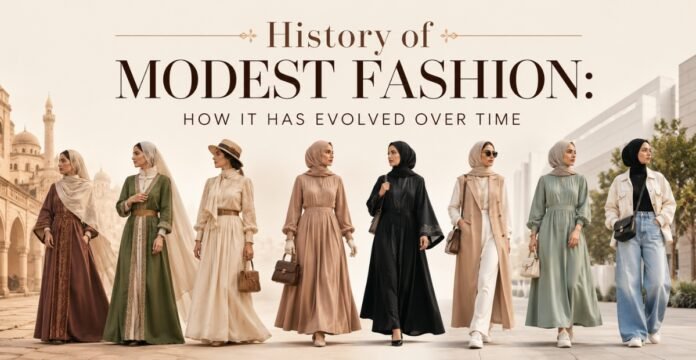
As clothing adapted to accommodate culture, religion, climate, comfort, and individual preference, so too did the aesthetic appreciation of clothing as a form of personal expression. History of Modest Fashion is the convergence of all of these elements. Modest fashion does not designate clothing as belonging to a particular country or religion. Rather, around the world, there exists a continuum of culturally respectful, protective, and aesthetically pleasing clothing that embodies a community’s identity. Through the ages, modest fashion illustrates a conscious articulation of personal and community values, lifestyle, and social significance. Presently, modest fashion encompasses abayas, hijabs, long dresses, loose shirts, maxi skirts, wide-leg trousers, tunics, kaftans, kanduras, and other styles of covered clothing.
Early Roots of Modest Clothing
The history of modest clothing began with long protective and dignified wraps and coverings. Loose clothing is also practical to hot climates and is easily constructed from basic fabric coverings. Long coverings also protect the skin from environmental elements. In many early societies, clothing that covered the body signaled respect and order. Furthermore, there is ample social, cultural, and environmental justification for dressing modestly. This initial period of modest dress demonstrates a practical solution before it became a style movement.
History of Modest Fashion in Religious and Cultural Dress
Faith and cultural practices have significantly impacted the evolution of modest fashion. Apparel regulations of many faiths, including Islam, Christianity, Judaism, and Hinduism, encourage followers to dress respectfully and to avoid dressing in a revealing manner. Modest Muslim dress may include the abaya, hijab, khimar, jilbab, kandura, and shemagh, among others. For readers who want to explore this clothing category, Eco Jersey’s Islamic fashion collection gives examples of traditional and modern modest styles in one place. This part of the history of modest fashion shows that modest dress is not only about covering the body. It is also about identity, respect, comfort, and belonging to a community.
Modest Fashion in the Middle Ages
During the Medieval Era, history documents modest fashion more prominently through long gowns and tunics, head coverings, cloaks, and layered clothing. Along with women, men’s clothing in Europe was also modest, and thus, covered the body. Long sleeves, high necks, and floor-length garments characterized this covered clothing. Head coverings and loose clothing were also modest, appropriate for the climate and the customs of the Middle East, North Africa, and Asia. Social class, profession, and family were all expressed and distinguished through clothing. The wealthy employed lace, embroidery, and fine fabrics and detailed designs, while the middle and lower classes used simple, everyday fabric.
Modest Fashion and Traditional Women’s Clothing
A portion of modest fashion history has allowed for garments that are known for coverage, comfort, and style. The abaya is a good example of this. The abaya is a full-body, loose, outer covering that offers coverage, and over time has offered many options in movement. The simplicity of the all black abaya has, over time, changed into abayas that have different cuts, and offer a variety of details and fabrics that are soft and embroidered. For many women, wearing the abaya now can relate to faith, comfort, style, and cultural ties. Eco Jersey’s abaya for women is a good example of how a traditional modest garment can still fit modern fashion needs.
Modest Fashion in the 19th and Early 20th Century
History of modest fashion is also described in this history at the turn of the 20th century by advances in education and industry travel, and also improved fabrics. Many women wore clothing completed by long skirts and high neck blouses, coats, shawls, and hats. Many men wore long coats and formal clothing, as well. For the most part, all clothing was still carefully covering, but due to the advances described above and the advent of the sewing machine and textile factories, modesty began to move with the times. During this time, clothing began to be more modest, with respectability in public being a strong public sentiment.
Modest Fashion After Globalization
Modest fashion has a unique story thanks to globalization. Styles could be shared internationally after globalization thanks to the exposure people had to different countries while travelling. integration of television systems around the world. magazine distribution and finally, the internet. A lady could have Turkish coat designs, Malaysian hijab designs, and Middle Eastern abayas in London. Men in Europe and Asia could have shemaghs as accessories and kandura robes. Modest clothing began to inspire fusion. Design and construction also improved. Fabric also became softer and modern colors were also incorporated.
The Hijab and Modern Modest Identity
The hijab has also been a significant part of history of modest fashion because many women view it as both a religious garment as well as a fashion statement. Hijabs were simple and functional. Hijabs of today come in a variety of fabrics, colors, designs and even cuts. Women now incorporate chiffon, jersey, cotton, silk, modal, and more depending on comfort, the weather and the styles of their outfits. The hijab is a great part of the internet’s modest fashion movement as many modest outfit bloggers and modest fashion influencers incorporate the hijab as a vital aspect of their modest outfit styles. Eco Jersey’s Islamic women hijab shows how a classic modest item can be part of everyday fashion.
Important Points in the History of Modest Fashion
The history of modest fashion can be understood better through a few simple points:
- Modest fashion started from practical clothing needs like weather protection and comfort.
- Many religions and cultures shaped modest dress codes over time.
- Loose garments, long robes, head coverings, and layers were common in many societies.
- The abaya, hijab, kandura, shemagh, kaftan, and jilbab became important modest garments.
- Industrial production helped modest fashion reach more people.
- Globalization made modest fashion more creative and diverse.
- Social media helped modest fashion become more visible worldwide.
- The history of modest fashion is not only about rules; it is also about identity and choice.
- Modern modest clothing can be elegant, casual, professional, sporty, or traditional.
- Today, modest fashion is a global market with strong cultural value.
Modest Fashion in Today’s World
The history of modest fashion has entered a new phase with the introduction of modest clothing into everyday clothing, luxury, and sport, as well as office, school, and occasion wear. Many women find modest clothing to be stylish, respectful, and comfortable, and many men wear modest clothing because they prefer traditional and/or Relaxed Fit clothing. Modest fashion offers long trousers, long tunics, long coats, maxi skirts, hijabs, abayas, and modest activewear. The history of modest fashion has moved from local culture and traditions to global fashion.
Why the History of Modest Fashion Still Matters
Studying the history of modest fashion teaches people that modest clothing has never restricted women. History has shown us that modest fashion comes from all ancient cultures, religious beliefs, royal courts and village living, as well as urban fashion, textile mills, world trade and the internet. Each of these areas added something to the world of modest fashion. Following one’s faith or embracing modest fashion for comfort or personal style is valid. Fashion also allows one to connect with their culture. Modest fashion allows people to show their identity and confidence while also allowing them to carry their own values and history.
Conclusion
The long history of modest fashion shows the evolution of modest clothing from basic protective coverings to the highly sophisticated clothing we have today. Religion, culture, climate and social values have influenced the evolution of modest clothing, as well as the style of the individual. The beauty of modest fashion is that it can be flexible. Fashion can still have an elegant style that is respectful of personal boundaries and still give one confidence. The evolution of modest fashion has shown that modest clothing is a fashion style that will never die. It is an ever-evolving fashion style that is here to stay.
FAQs
What is the history of modest fashion?
The history of modest fashion is the development of covered and respectful clothing through different cultures, religions, and time periods. It includes garments like robes, abayas, hijabs, tunics, kaftans, long dresses, and loose clothing.
When did modest fashion begin?
Modest fashion began thousands of years ago when people wore long and loose garments for protection, comfort, culture, and respect. Later, religion and social customs also shaped modest dressing.
Is modest fashion only Islamic fashion?
No, modest fashion is not only Islamic fashion. Islamic fashion is a major part of modest fashion, but many other cultures and religions also have modest clothing traditions.