Motorbike clothing is not only about looking stylish on the road. It creates an important layer between your body, the weather, the motorcycle, and the road surface. A normal shirt, fashion jacket, or pair of jeans may feel comfortable during a short ride, but these clothes are not designed to handle sliding, impact, wind, rain, or flying road dirt. Many riders spend a lot of money on their motorcycles but pay little attention to what they wear. This can lead to serious problems during a fall or even during normal riding.
Some common motorbike apparel mistakes include wearing loose clothing, choosing the wrong size, riding without protective armor, ignoring hot or cold weather, and using damaged gear. Even experienced riders can make these mistakes when they become too comfortable or rush to start a journey. Good riding apparel should cover the skin, stay firmly in place, allow easy movement, and support the body without causing pain. It should also match the weather and the type of riding. A person travelling slowly through a city may need different gear from someone riding at high speed on a motorway. Understanding common motorbike apparel mistakes helps riders make safer choices before they start the engine.
Common Motorbike Apparel Mistakes Riders Often Ignore
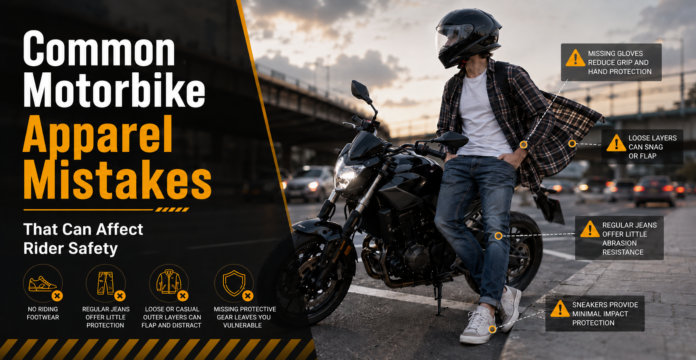
One of the biggest common motorbike apparel mistakes is believing that any thick clothing will provide enough protection. A heavy casual jacket may feel strong, but it can tear quickly when it touches the road. Normal denim can also wear through within a short slide. Protective motorbike apparel normally uses stronger materials, reinforced stitching, impact protectors, and panels placed in high-risk areas. Another mistake is wearing only some safety items while leaving other body parts exposed. A rider may wear a strong helmet and jacket but use normal trainers, thin trousers, or bare hands. Safety works better as a complete system.
The head, shoulders, elbows, back, hips, knees, hands, ankles, and feet all need suitable protection. Riders should also avoid buying apparel only because it looks fashionable. A good appearance is useful, but it should come after fit, strength, comfort, visibility, and protection. Some riders remove armor because it feels heavy or warm. Others keep using clothing after the fabric, seams, zippers, or protectors are damaged. These common motorbike apparel mistakes may not cause a problem on every journey, but they can make injuries worse when an accident happens. Riders should check their clothing before leaving, just as they check fuel, brakes, lights, and tyres.
Wearing Regular Clothing Instead of Proper Riding Apparel
Riding in everyday clothing is one of the most common motorbike apparel mistakes, especially during short city journeys. Riders may think they do not need protective apparel because they are only going to a nearby shop, workplace, or friend’s house. However, accidents can happen close to home and at low speeds. Regular hoodies, cotton T-shirts, fashion leather jackets, tracksuits, and casual jeans are made for comfort and style rather than road protection.
They may split at the seams, move up the body, or tear when they touch rough ground. Proper riding apparel is designed to remain more stable during movement and may include reinforced areas around the elbows, shoulders, back, hips, and knees. Riders exploring a complete clothing setup can view different types of motorbike apparel to understand how jackets, trousers, suits, and other items work together. The goal is not to wear the heaviest clothing possible. The goal is to choose apparel made for the riding environment. Lightweight protective clothing may be suitable for hot urban riding, while thicker layered gear may be needed for long-distance or cold-weather travel. Avoiding normal casual clothing helps reduce one of the most dangerous common motorbike apparel mistakes.
Choosing Apparel That Is Too Loose or Too Tight
Poor fit is another of the common motorbike apparel mistakes that riders often notice only after spending time on the road. Clothing that is too loose may flap strongly in the wind, distract the rider, create noise, and place pressure on the neck or shoulders. Loose sleeves and trouser legs may also move the armor away from the correct position. During a fall, a loose jacket can ride up and expose the lower back or stomach. Loose trousers may twist, leaving the knees or hips without proper coverage.
Clothing that is too tight creates different problems. It may restrict arm movement, make it difficult to turn the head, reduce comfort around the waist, or limit the ability to bend the knees. Tight clothing can also press armor painfully into the body and reduce space for base layers. A correct fit should feel close to the body without stopping normal movement. Riders should test apparel while sitting in a riding position because standing in a shop does not show how the garment will feel on a motorcycle. They should reach forward, bend their arms, raise their knees, turn their shoulders, and check whether any skin becomes exposed. Correct sizing prevents many common motorbike apparel mistakes and helps protective parts stay where they are needed.
Ignoring Protective Motorcycle Trousers
Many riders focus on jackets while giving less attention to the lower body. This is one of the most common motorbike apparel mistakes because the hips, knees, shins, and legs can easily strike the ground or motorcycle during an accident. Normal jeans may look thick, but standard denim is not made to resist long contact with the road. Casual trousers can tear at the knees, seat, hips, or seams, leaving the skin exposed. Proper riding trousers may use strong outer fabrics, reinforced panels, secure closures, and impact protectors around the knees and hips.
Riders comparing options can explore motorcycle pants designed for better coverage and movement. The trousers should connect well with the jacket or rise high enough to protect the waist and lower back. Knee protectors should sit over the knees while the rider is seated, not only while standing. Trouser legs should cover the ankles without becoming caught in the chain, foot controls, or other moving parts. Another mistake is removing knee or hip armor because it feels uncomfortable. In many cases, discomfort comes from the wrong size, poor adjustment, or badly shaped protectors. Correct trousers help riders avoid common motorbike apparel mistakes that leave half of the body poorly protected.
Removing or Misplacing Impact Armor
Protective armor is designed to reduce force around important body areas, but it can only help when it is present and correctly placed. Removing armor is one of the common motorbike apparel mistakes made by riders who feel too hot, restricted, or uncomfortable. Shoulder, elbow, back, hip, and knee protectors should sit securely over the body parts they are meant to protect. If the garment is too loose, the armor may slide to the side during riding or an accident.
If the clothing is too tight, the armor may press painfully against the skin and discourage the rider from wearing the gear. Some garments include thin foam pieces that mainly help the product keep its shape. Riders should not automatically assume every foam insert provides serious impact protection. They should check the garment information and understand what type of protection is fitted. Armor should also be inspected for cracks, deep cuts, permanent bending, or other damage. A strong impact may weaken a protector even when the outside looks normal. Riders should replace damaged protectors and use the correct size and shape for each pocket. Many common motorbike apparel mistakes happen because riders treat armor as an optional extra instead of an important part of the full clothing system.
Common Safety Checks Before Every Ride
The following quick checks can help riders avoid common motorbike apparel mistakes before starting a journey:
- Make sure the jacket closes fully and does not rise above the waist.
- Check that shoulder, elbow, back, hip, and knee armor is correctly positioned.
- Confirm that trouser legs do not interfere with the chain or foot controls.
- Wear gloves that cover the hands and wrists.
- Use boots or riding shoes that protect the ankles.
- Close every zipper, strap, snap, and adjustment point.
- Remove loose scarves, cords, or hanging accessories.
- Check the clothing for torn seams, holes, and damaged fabric.
- Choose layers that match the expected weather.
- Make sure reflective or bright areas are clean and visible.
- Test that you can turn, reach, bend, and move comfortably.
- Replace any garment that no longer fits or stays secure.
Wearing the Wrong Jacket for the Weather
Using one jacket in every season is another of the common motorbike apparel mistakes that can affect concentration and control. A heavy winter jacket in hot weather may cause sweating, tiredness, dehydration, and poor focus. A thin summer jacket in cold or wet conditions may cause shaking, numb hands, stiff muscles, and slower reactions. Riders should choose apparel according to temperature, wind speed, rain, journey length, and riding speed.
Wind can make the body feel much colder than the weather report suggests, especially on an open road. A suitable jacket should provide protection while helping the rider manage heat and moisture. Ventilation panels, removable liners, waterproof layers, insulated sections, and adjustable openings can improve comfort in changing conditions. Riders looking at different outerwear designs can review motorcycle jackets for examples of protective coverage and riding-focused construction. Weather protection should not block movement or force riders to open the jacket while moving. Leaving a jacket partly open is one of the common motorbike apparel mistakes because it can cause the garment to flap, reduce coverage, and increase the chance of it moving during a fall.
Forgetting About Visibility in Traffic
Low visibility is one of the common motorbike apparel mistakes that may increase the chance of another road user failing to notice a rider. Motorcycles have a smaller shape than cars, and riders can be hidden by vehicles, road signs, darkness, rain, fog, or bright sunlight. Black riding gear is popular, but an outfit made completely from dark material may be difficult to see at night or in bad weather. Riders can improve visibility by choosing apparel with bright panels, reflective details, or clear contrast between colours. Reflective material is most useful when it is placed where vehicle lights can reach it, such as the chest, back, arms, and lower legs. However, visibility features should not replace safe riding. Riders still need to use lights, maintain safe road position, avoid vehicle blind spots, and signal early. Dirty reflective panels may not work as well, so apparel should be kept clean. A high-visibility vest worn over a protective jacket may improve visibility, but it should fit securely and should not flap in the wind. Ignoring visibility is one of the easiest common motorbike apparel mistakes to fix because small clothing choices can help other road users notice the rider sooner.
Leaving Skin Exposed Between Garments
Gaps between garments are common motorbike apparel mistakes that can expose the waist, wrists, ankles, neck, or lower back. A jacket may seem long enough while standing but rise above the trousers when the rider leans forward. Short gloves may leave the wrists uncovered when the arms are stretched toward the handlebars. Low shoes can expose the ankles, while short trousers may rise above the boots. These small gaps can allow cold air, rain, dirt, insects, stones, and road dust to reach the skin. They can also leave important areas unprotected during a slide. Riders should check how all garments overlap in the normal riding position. The jacket and trousers should meet securely, and connected designs can help stop the jacket from rising. Gloves should fit over or under the jacket cuffs without leaving a gap. Trousers should overlap the boots while staying clear of moving motorcycle parts. Neck protection should remain comfortable and should not limit head movement. Avoiding these common motorbike apparel mistakes does not require expensive equipment. It mainly requires careful fitting and checking the full outfit as one connected system rather than treating every garment separately.
Using Loose Accessories and Unsecured Clothing
Loose clothing and accessories can distract the rider or become caught around the motorcycle. This includes open jacket straps, long hoodie cords, loose scarves, hanging belts, unsecured bag straps, and wide trouser legs. Wearing these items is one of the common motorbike apparel mistakes that may seem harmless until strong wind pulls them against the neck, face, helmet, handlebars, chain, or wheel area. Even when nothing becomes trapped, constant flapping can reduce focus and make a long ride uncomfortable. Riders should secure all straps and remove unnecessary hanging items before starting the motorcycle. Jacket adjustment tabs should sit flat against the garment. Backpack straps should be tightened so the bag does not move from side to side. Pockets should remain closed so keys, phones, or tools cannot fall out. Riders should also avoid carrying hard or sharp objects in chest or trouser pockets because these items may press into the body during an impact. Safe motorbike clothing should feel stable at speed. Reducing loose parts is one of the simplest ways to correct common motorbike apparel mistakes before they create a serious problem.
Failing to Clean, Inspect, and Replace Riding Gear
Poor maintenance is one of the common motorbike apparel mistakes that develops slowly. Dirt, sweat, road salt, oil, rain, sunlight, and repeated movement can weaken clothing over time. Riders should follow the care instructions provided with each garment because strong bleach, high heat, unsuitable washing products, or rough machine cycles may damage protective materials. Armor should normally be removed before washing when the garment instructions require it. Zippers should move smoothly, fasteners should close securely, and seams should not show broken threads. Riders should check high-wear areas such as elbows, shoulders, knees, seat panels, cuffs, and pocket edges. Waterproof clothing may need special cleaning or treatment to maintain water resistance. A garment involved in an accident should receive a careful inspection even when the damage looks small. Hidden seam weakness, stretched fabric, damaged armor, or worn fasteners may reduce future protection. Keeping very old gear only because it still looks acceptable is one of the common motorbike apparel mistakes riders should avoid. Apparel should be replaced when it cannot stay secure, cover the body correctly, or hold its protective parts in position.
Conclusion
Motorbike apparel cannot prevent every accident, but it can help reduce exposure to impact, sliding, wind, rain, cold, heat, and road dirt. The most common motorbike apparel mistakes usually come from poor fit, missing armor, exposed skin, weak casual clothing, unsuitable weather protection, low visibility, loose accessories, and damaged gear. Riders should choose clothing as a complete system rather than buying one strong item and ignoring the rest of the body. Every garment should remain secure while the rider is seated, moving, turning, and reaching. Good apparel should also be comfortable enough to wear correctly during the full journey. A rider who feels too hot, restricted, wet, or cold may lose focus or adjust clothing in an unsafe way. Regular checks can prevent small problems from becoming serious ones. Before each journey, riders should confirm that their jacket, trousers, gloves, boots, armor, closures, and layers are ready for the road. Correcting common motorbike apparel mistakes is a simple but important part of responsible riding.
FAQs
What motorbike clothing should a beginner buy first?
A beginner should start with a protective jacket, riding trousers, gloves, ankle-covering boots, and a correctly fitted helmet. The clothing should fit securely and include protection for major impact areas.
Are normal jeans safe for motorbike riding?
Normal jeans provide limited protection and may tear quickly during a road slide. Reinforced motorcycle trousers with knee and hip protection are usually a safer option for regular riding.
Should motorcycle apparel fit tightly?
Motorcycle apparel should fit closely without limiting movement or causing pain. Armor should remain over the correct body areas when the rider bends, reaches forward, and sits on the motorcycle.
How often should motorbike apparel be replaced?
There is no single replacement period for every garment. Riders should replace apparel after serious damage, a major accident, failed fasteners, torn seams, worn fabric, damaged armor, or a poor fit.