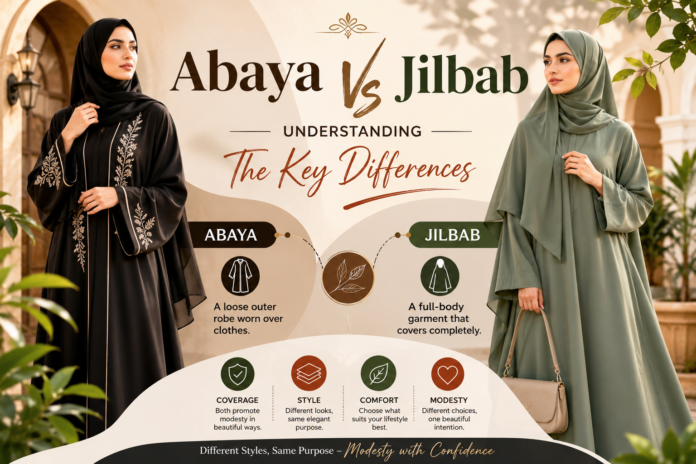
Coverage, comfort, and modesty are the three C’s that come to mind most when thinking of abayas and jilbabs. Many people thinking of starting their modest wardrobe will confuse them for being the same. The shape, structure, and styling of these two garments actually have a lot of differences. The right garment for you depends on your personal comfort, lifestyle, and how much coverage you want.
An abaya is usually a long, loose outer garment that looks like a flowing dress or robe. A jilbab is also a loose modest garment, but it often gives more structured full-body coverage and may include a hood or head-covering style depending on the design. If you want to explore more modest clothing, the full Islamic fashion collection can help you understand different modest styles.
Abaya vs Jilbab
The most simple way to answer abaya vs jilbab is that an abaya is a loosely styled robe type outerwear that is open or closed. A jilbab is a modest garment that covers the body much more completely than outer garments styled as robes. Both garments are worn by Muslim women to express their support of modesty in their dress, but also have their differences.
An abaya can also be styled with a hijab and can be casual or formal. Abayas can also be embroidered.
Jilbab is more shapely and practical. Some jilbab styles are head to foot covering, while others are paired with separate hijabs or khimars. This is the primary distinction in the abaya vs jilbab debate.
What Is an Abaya?
An abaya is a long, loose dress that is customary to wear in covering communities, especially in the Middle East, South Asia and other communities embracing covering fashion. Abayas can be plain or stylish depending on the fabric, cut, embroidery, buttons, sleeves and design.
A classic abaya for women is usually easy to wear and can be styled for daily life, prayer, work, travel, or formal events. Some abayas are made from crepe, nida, chiffon, jersey, satin, or cotton blends. The goal is to provide modest coverage while still keeping the outfit elegant and comfortable.
What Is a Jilbab?
Jilbab is a loose outer garment that offers modesty. It fully conceals body shape. In different cultures, a jilbab can look like a long dress, long coat, or one piece modest garment. Some jilbab styles have built in head covering while others are paired with a separate hijab.
Since jilbab offers fully modest and easy coverage, it is a popular choice among women. It is generally less stylish than some of the contemporary abayas, but can still be graceful.
In the abaya vs jilbab discourse, jilbabs are seen as more practical for full-bodied modest dressing, while abayas can be more versatile in styling.
Main Difference in Shape
The shape of jilbabs and abayas is quite different and is where they can be distinguished the most.
Abayas can be robe-like and potentially open at the front. Abayas can also be closed like a long dress. Abayas can have a variety of different features from buttons to wide sleeves. Even belts and embroidery can be incorporated.
Jilbabs typically have a simpler shape, and are designed to conceal the body outline. Jilbabs can be a two piece set that includes a long outer garment and a head covering, or a one piece set that covers the entire body from head to toe. In abaya vs jilbab, jilbabs focus on full coverage, while abayas focus on style.
Coverage Difference
While both jilbabs and abayas are modest, they cover the body differently. Most abayas are covered by a hijab that covers the hair and neck. Some abayas can even be opened and therefore requires more coverage to be modest.
A jilbab often provides more complete coverage by design. Many jilbabs are made to cover the body shape more clearly and may include extra fabric around the chest, shoulders, and head. If you wear either garment with an Islamic women hijab, the full modest look becomes more complete and balanced.
Style and Fashion Difference
Compared to other modest apparel, abayas lean more toward being fashionable. Modern abayas may feature embroidery, lace, and beads, and may have wide sleeves, kimono designs, front buttons, drapes, and may be made with luxury fabrics. Because of this, abayas are great options for events and gatherings, including Eid, weddings, and other formal occasions, as well as for daily wear.
Jilbabs tend to be more practical and are often designed for modesty before considering decoration. Modern jilbabs, however, may still be designed with attractive colors, fabrics, and cuts. In abaya vs jilbab styling, jilbabs are preferred for full coverage, while abayas are preferred for stylish self-expression.
Comfort and Daily Wear
Comfort is dependent on fit, fabric, and the weather. Because jilbabs are looser, they, too, can be comfortable. Many women even prefer jilbabs for daily modest dressing because they require minimal to no styling. This is especially true for jilabs with simple designs that are also one piece, because they can make dressing for the day feel secure.
Which One Is Better for Formal Occasions?
Abayas also typically have many designs that are elegant, making them the more popular option for formal occasions. There are many beautiful options for embellished abayas, as well as satin abayas and abayas with embroidered or lace detailing, which can be worn for special occasions and events, including family gatherings, weddings, and Eid.
They can be paired with coordinated hijabs, handbags, and tasteful jewelry.
Jilbabs can be worn to formal events, and even to dress up a bit, they tend to be simpler. A slightly more expensive jilbab in a darker hue and softer fabric can look classy and elegant without needing much. You can carry heavier fashion layers with an abaya. If you want simple modest elegance, a jilbab is best.
Which One Is Better for Everyday Modesty?
In terms of everyday modesty, both really work best. If you’re looking for something more flexible jilbabs are the way to go, as an abaya can be worn over clothing, styled with different hijabs, and paired with a variety of shoes from flats and sandals to heels. An abaya offers more freedom to be styled.
On the other hand, a jilbab offers simplicity. It can be easily worn to cover up fully to do things like run errands, go to prayer, and offers a more modest look with less thought about what you’re wearing and how you’re covered. If you’re comparing jilbab vs abaya for casual wear, jilbab can be more practical, whereas an abaya can be more flexible.
Abaya vs Jilbab Checklist
They’re pretty much the same in these regards:
- Elegant and versatile layering can be achieved with an abaya.
- A jilbab offers the most coverage, and simplest.
- Abayas look like long outer dresses or long robes.
- Jilbabs offer complete coverage.
- Abaya front can be either closed or opened.
- Jilbabs can be two or one piece modest garments.
- Abayas are great for formal as well as everyday wear.
- There is a practical purpose for jilbabs.
- Abayas and jilbabs alike should be loose, comfortable, and respectful.
- Both can be layered with hijab for a full modest appearance.
Common Mistakes to Avoid
Abayas and jilbabs are not the same. While they are both modest garments, they can be designed and constructed differently as far as coverage goes. Choosing a garment based solely on how it looks is also a mistake. While a garment may look beautiful, it should be comfortable and provide the coverage necessary.
Fabric should not be overlooked. A jilbab or abaya that is designed with fabric that is too heavy may be too hot and uncomfortable. On the other hand, a fabric that is too thin and requires layering to be opaque may also be uncomfortable. Choose the fabric based on the cover, the climate and the occasion. Modest fashion should be effortless, respectful, and should not be uncomfortable.
Conclusion
Abaya vs jilbab is more simple when you understand coverage and purpose. An abaya is a long and loose style of a robe which can be simple or fashionable. A jilbab is a more full and modest garment that is designed to cover the body more.
The best choice depends on your comfort and lifestyle. If you want more styling and outfit diversity then you should choose an abaya. If you prefer practical and fuller coverage choose a jilbab.
FAQs
What is the main difference between abaya and jilbab?
The main difference is that an abaya is usually a loose robe-style garment, while a jilbab often gives fuller and more complete body coverage.
Is an abaya the same as a jilbab?
No, they are similar modest garments, but they are not always the same in shape, coverage, and style.
Which is more modest, abaya or jilbab?
A jilbab usually gives more full-body coverage, but a properly styled abaya with hijab can also be very modest.
Can a jilbab be stylish?
Yes, modern jilbabs can be stylish with soft fabrics, clean cuts, beautiful colors, and simple details.