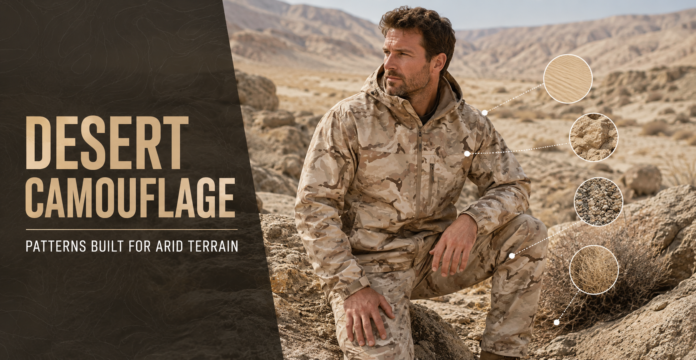
Stand at the edge of a desert landscape and observe what surrounds you. Pale tan soil stretching toward the horizon. Scattered brown rock formations. Sparse dry vegetation in dusty olive and grey-green. Bleached sandy surfaces reflecting harsh sunlight. Now imagine wearing dark woodland green camouflage in that environment — the visual contrast would make concealment completely impossible within seconds. This is precisely why desert camouflage clothing exists as a fundamentally distinct pattern category — arid environments demand specialized color palettes, pattern structures, and fabric performance properties that woodland and general-purpose alternatives cannot adequately provide.
The Visual Character of Desert Environments
Desert and semi-arid environments present a visual character that differs from forested terrain in almost every measurable way — and these differences drive every design decision in effective desert camouflage pattern development.
Dominant color palette — desert environments are defined by light, desaturated earth tones. Tan, sand, pale beige, light brown, dusty olive, and muted grey create the visual signature of arid terrain across global desert environments from North American Great Basin desert through Middle Eastern sand terrain to African Saharan landscapes. Dark colors create immediate, obvious contrast in these environments — making them counterproductive for concealment regardless of pattern design quality.
Minimal visual complexity — unlike forest environments with their layered texture and color complexity, open desert terrain presents simplified visual fields with fewer competing elements. This reduced complexity means human forms stand out more readily against desert backgrounds — requiring pattern designs that actively break up the human silhouette rather than simply blending individual colors with the surroundings.
High contrast lighting — intense direct sunlight in desert environments creates harsh shadows and bright highlights that shift dramatically throughout the day. Desert camouflage patterns must perform across the full range from early morning low-angle light through midday overhead illumination to late afternoon long shadow patterns — conditions that create fundamentally different visual environments across the same terrain within a single day.
Rock and ground texture variation — many desert environments include significant rock formations, gravel surfaces, and terrain texture variations that effective desert patterns incorporate alongside the dominant sandy base colors. Patterns that address only the sandy soil component perform poorly in rocky desert terrain where rock texture dominates the visual background.
How Desert Camouflage Patterns Are Developed
Color selection in desert pattern development starts with environmental spectrophotometric analysis — measuring the actual color values present in target desert environments across different lighting conditions and seasonal variations. Desert environments change their visual character significantly between wet and dry seasons, between dawn and midday, and between different geological zones within the same broad arid region.
Pattern element design for desert environments typically uses larger, softer elements than woodland alternatives — reflecting the simplified visual texture of open arid terrain where fine detail elements blend into the background at shorter observation distances than the visually complex forest environments where smaller pattern elements remain distinguishable.
Three-color and six-color approaches — classic desert pattern development explored both minimalist three-color palettes using tan, brown, and pale olive, and more complex six-color systems adding rock simulation elements through black and white spots overlaid on base color combinations. The six-color “chocolate chip” pattern used by US military forces in the Persian Gulf represented the most sophisticated attempt at comprehensive desert visual environment matching in early military desert camouflage development.
Understanding how to choose the right camouflage clothing type for specific environments — including desert applications — is covered comprehensively in this camouflage clothing guide — walking through the selection criteria that serious hunters and outdoor professionals apply when matching pattern to environment.
Major Desert Camouflage Pattern Types
Three-Color Desert (DCU) — the US military’s Desert Camouflage Uniform used dark brown, pale olive green, and beige across an irregular pattern designed for the lower-elevation sandy desert terrain where it was primarily deployed. Its wide international adoption following Gulf War-era visibility established three-color desert as the foundational commercial desert pattern reference across outdoor and tactical markets globally.
Six-Color Desert (Chocolate Chip) — the predecessor to DCU, using a more complex six-color system with rock simulation elements designed to replicate the higher-elevation, rockier desert terrain of the original design environment. Despite replacement by DCU in US military service, chocolate chip remains commercially popular and genuinely effective in rocky desert environments where its rock simulation elements add meaningful concealment value.
AOR1 (Area of Responsibility 1) — the US Navy SEALs’ desert digital pattern using pixel-based design principles applied to desert color palettes. AOR1 brings the multi-scale disruption advantages of digital pattern design to desert applications — providing more consistent concealment across varied observation distances than traditional analog desert patterns achieve.
MultiCam — while not exclusively a desert pattern, MultiCam’s multi-environment design philosophy performs meaningfully better in transitional desert environments than single-environment alternatives — making it commercially important for outdoor brands serving customers who operate across the full spectrum from semi-arid transitional terrain through true desert environments within the same hunting or tactical application.
Performance Requirements Beyond Pattern Design
Desert camouflage clothing must address the extreme environmental demands of arid outdoor use alongside visual concealment — and fabric performance requirements in desert environments differ significantly from the forest hunting and cold weather outdoor contexts where camouflage clothing more commonly appears.
Heat management is the most critical desert-specific performance requirement. Intense solar radiation in open desert terrain creates extreme heat exposure that inadequate clothing dramatically amplifies through heat-absorbing dark fabric colors and poor ventilation construction. Effective desert camouflage clothing uses light-colored palettes that reflect solar radiation, lightweight breathable fabric constructions that allow heat dissipation, and ventilation designs that maintain airflow across body surface areas where convective cooling provides meaningful temperature relief.
UV protection — extended desert sun exposure creates UV radiation demands that forest hunting environments rarely impose to the same intensity. Desert camouflage clothing with UPF-rated fabric construction provides the sun protection that extended arid environment exposure genuinely requires across full hunting and outdoor activity days where shade is minimal and UV intensity is highest.
Moisture management in desert environments addresses a different challenge than woodland applications — not the sustained perspiration of active forest movement but the rapid evaporation management that dry desert air creates. Fabrics that wick moisture quickly and release it for rapid evaporation in dry desert air maintain more comfortable skin environments than moisture-retentive constructions that perform adequately in humid forest environments.
Desert Camouflage for Hunting Applications
Desert environments support distinctive hunting opportunities — predator hunting across open range, antelope hunting on arid plains, mule deer hunting in canyon country, and chukar partridge hunting in rocky desert terrain — each creating specific concealment requirements that general woodland alternatives fail to address effectively.
Open country predator hunting — calling coyotes and other predators in open desert terrain requires concealment against the open background that no woodland pattern achieves. Desert tan and earth tone patterns that blend with sparse desert vegetation and sandy soil provide the concealment effectiveness that successful open country predator hunting demands.
Canyon and rocky terrain hunting — mule deer and other canyon country species navigate terrain that combines sandy soil with significant rock formations and sparse desert shrubs. Multi-element desert patterns incorporating both sandy base tones and rock simulation elements provide more comprehensive concealment across these visually varied canyon environments than single-element alternatives.
The comprehensive construction requirements for effective desert hunting clothing — beyond pattern selection alone — are explored in this hardshell jacket guide covering how outer layer selection in extreme outdoor environments applies the same technical thinking that effective desert camouflage garment selection demands across all clothing categories simultaneously.
Fabric Considerations Specific to Desert Use
The performance fabric requirements of desert camouflage clothing reflect the specific environmental demands of arid terrain use rather than simply applying woodland hunting fabric specifications to a different pattern colorway.
Lightweight ripstop nylon suits desert hunting and tactical applications — providing abrasion resistance for rock terrain contact and pack friction while minimizing the fabric weight that contributes to heat burden in desert conditions where every gram of clothing adds to the thermal load that extreme temperatures create.
Moisture-wicking polyester manages the perspiration that physical desert activity generates — maintaining skin surface dryness that the rapid evaporation desert environments enable more efficiently than humid forest alternatives. Quick-dry performance matters particularly in desert contexts where brief perspiration events should resolve rapidly rather than sustaining the prolonged wet fabric contact that slower-drying constructions create.
Our camouflage clothing manufacturer page covers the full range of desert and multi-environment camouflage clothing options available for brand development — including the specific fabric constructions, pattern printing capabilities, and construction quality standards that serious desert hunting and tactical outdoor applications demand.
These outdoor cargo pants demonstrate how performance fabric construction combines with practical field features in outdoor lower body garments — the same construction principles applying directly to desert camouflage pant development for hunting and tactical outdoor applications in arid terrain environments.
Conclusion
Desert camouflage clothing performs effectively in arid environments because it addresses the specific visual and environmental challenges that desert terrain creates — light earth tone color palettes matching sun-bleached landscapes, simplified pattern structures appropriate for reduced visual complexity backgrounds, and fabric constructions managing the heat, UV, and moisture demands of extreme arid environment outdoor use.
FAQs
Does desert camouflage work in all arid environments equally?
No — sandy desert, rocky canyon, and semi-arid shrubland environments each have distinct visual characters that benefit from pattern designs matched to their specific color and texture profiles. Multi-element patterns incorporating both soil and rock simulation elements perform most consistently across varied arid terrain types.
What colors define effective desert camouflage patterns?
Tan, sand, pale beige, light brown, dusty olive, and muted grey form the core desert color palette. Effective patterns use light, desaturated tones that reflect rather than absorb solar radiation — providing both concealment effectiveness and meaningful heat management in extreme desert sun exposure.
Is desert camouflage suitable for hot weather outdoor activities beyond hunting?
Yes — the light colors and heat-reflective properties of desert camouflage make it genuinely functional for any hot weather outdoor activity where sun protection and heat management matter alongside visual pattern aesthetics that outdoor lifestyle consumers increasingly appreciate.
Can desert camouflage clothing be produced under a private label?
Yes. Professional outdoor apparel manufacturers offer complete private label production with desert camouflage patterns — including both established pattern references and proprietary desert designs — with performance fabric constructions, heat management features, and full branding control giving outdoor brands complete creative and commercial authority over their desert camouflage collections.