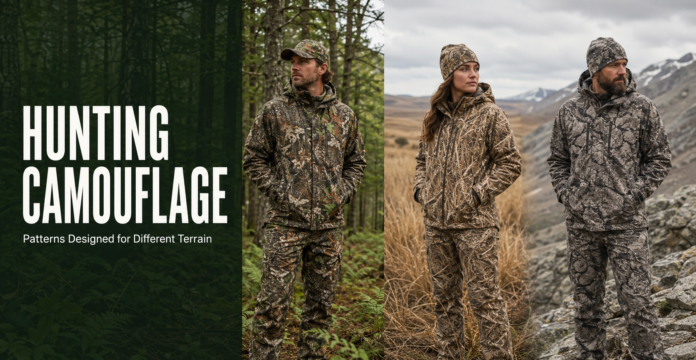
Serious hunters know that camouflage isn’t decoration — it’s functional equipment that directly impacts hunting success. But the most important camouflage decision isn’t which brand you choose or how expensive the pattern is. It’s whether the pattern genuinely matches the specific terrain where you hunt. Hunting camouflage clothing designed for forest environments fails visibly in open desert. Marsh patterns create obvious contrast in woodland. Understanding how different hunting camouflage patterns are designed for specific terrain types helps you choose correctly — and choose with confidence.
The Fundamental Principle Behind Hunting Camouflage Design
Effective hunting camouflage achieves concealment through two simultaneous mechanisms that pattern designers must address with equal attention — color matching to the dominant tones of the hunting environment and visual disruption of the human silhouette against that background.
Color matching alone is insufficient. A perfectly colored garment with no pattern disruption still presents the obvious human shape that game animals recognize instinctively as a predator threat. Silhouette disruption alone is insufficient. A visually complex pattern in the wrong color palette creates contrast against the hunting background that immediately destroys the concealment that disruption pattern complexity alone cannot save.
Both mechanisms must work together — and they must work specifically within the visual character of the terrain being hunted. This terrain specificity explains why hunting camouflage clothing exists across so many distinct pattern categories rather than any single universal pattern serving all hunting environments adequately.
Woodland and Forest Hunting Patterns
Forest hunting environments present the most visually complex backgrounds that hunting camouflage must work within — multiple simultaneous green tones, brown bark textures, filtered light contrast, shadow patterns, and organic irregular forms all creating a rich visual environment that effective woodland patterns replicate through careful color selection and element design.
Photorealistic woodland patterns — the Realtree and Mossy Oak pattern families — use actual photographic imagery of leaves, branches, bark, and natural debris to create visual matching with specific woodland environments that geometric pattern design cannot achieve through color and element abstraction alone. Realtree AP suits mixed hardwood forests across North America’s primary deer hunting regions. Mossy Oak Break-Up Country suits transitional woodland-agricultural fringe environments where late-season hunting frequently occurs after leaf drop exposes the mixed visual character of these boundary zones.
Seasonal woodland adaptation matters critically — early season full-foliage woodland patterns using deep green tones fail visibly in late season bare-branch environments where the same green creates obvious contrast against the grey-brown visual character that winter woodland hunting presents after leaf drop. Serious woodland hunters select patterns matched to the specific seasonal visual character of their hunting terrain rather than using a single pattern across the full hunting season.
Open Country and Prairie Patterns
Open country hunting — antelope, mule deer, coyote, and upland birds across plains, grassland, and agricultural environments — requires fundamentally different pattern design than woodland alternatives. These environments present simplified visual backgrounds with fewer competing elements — making human silhouette disruption even more critical than in woodland contexts where visual complexity provides some natural concealment assistance.
Open country patterns use mixed earth tone palettes — tan, brown, grey-green, and dried grass yellow — distributed across pattern constructions that break the human silhouette against sparse vegetation and soil backgrounds that woodland green patterns would stand out against immediately. The reduced visual complexity of open terrain means pattern elements must provide all the disruption that woodland visual complexity partially delivers naturally.
Marsh and Wetland Hunting Patterns
Waterfowl hunting in marsh and wetland environments creates the most demanding and specialized hunting camouflage requirements — because waterfowl approach from above with excellent visual acuity, observing concealed hunters from angles and distances that game animals in woodland environments rarely achieve.
Marsh patterns incorporate the specific visual elements of wetland environments — cattails, reeds, water reflection tones, mud browns, and the mixed grey-green-brown palette that wetland hunting environments present when observed from above during waterfowl approach. Pattern scale matters particularly in waterfowl hunting — elements must be visible and recognizable as marsh vegetation from the aerial approach angles that waterfowl take rather than the horizontal observation angles that ground-based game typically uses.
Mountain and High-Altitude Terrain Patterns
High-altitude hunting environments — elk in alpine terrain, bighorn sheep on rocky mountain faces, mountain goats across talus slopes — present visual characters that neither woodland nor open country patterns address effectively. Rock faces, sparse alpine vegetation, lichen-covered boulders, and high-altitude sparse growth create distinctive visual signatures requiring dedicated pattern development.
Mountain hunting patterns use grey, brown, tan, and muted olive tones that match rock and sparse vegetation — incorporating rocky texture simulation elements that the photorealistic pattern development approach excels at creating. These patterns must perform across the extreme lighting variation of mountain terrain where direct sun creates harsh contrast and shadow simultaneously on complex terrain features.
How Pattern Design Matches Terrain Visually
The actual design process for terrain-specific hunting camouflage clothing begins with environmental analysis — photographing, measuring, and analyzing the visual characteristics of target hunting environments across multiple lighting conditions, seasonal states, and observation angles simultaneously.
Color palette extraction identifies the dominant colors and their relative proportions across the target environment — creating the foundation color set that the pattern must incorporate to achieve meaningful visual matching. Color accuracy across different lighting conditions matters as much as the absolute color values — patterns that match woodland perfectly at midday may create contrast in low-angle morning light that early hunting hours create in practical field conditions.
Element scale and distribution determines how visual disruption elements are sized and arranged across the pattern — matching the scale of natural environment elements at the observation distances where game animals typically detect human presence during the hunting scenarios the pattern serves. For comprehensive understanding of how to select the right camouflage for specific hunting scenarios, this camouflage patterns guide covers the complete selection criteria across all major hunting environment types.
Beyond Pattern — Construction Requirements for Hunting Clothing
Pattern selection is the starting point — but hunting camouflage clothing construction requirements extend significantly beyond visual concealment into performance fabric properties that determine hunting success as directly as pattern effectiveness.
Silent fabric construction — game animals detect human presence through sound as reliably as visual detection. Standard synthetic outer fabrics create audible rustling during movement against vegetation that alerts game animals before visual detection occurs. Quality hunting garments use brushed fabric surfaces, fleece constructions, or specialized silent synthetic weaves that minimize noise signature during the movement through vegetation and terrain that hunting consistently demands.
Scent control — many serious hunters consider scent management more important than visual concealment for close-range hunting where wind carries human scent to game animals at distances that visual camouflage cannot compensate for. Activated carbon treatments, silver-ion antimicrobial finishes, and specific washing protocols all contribute to scent management that genuine hunting performance demands alongside visual concealment effectiveness.
Weather protection — hunting seasons extend across the full range of seasonal weather conditions that outdoor environments create — from early season heat through late season snow and cold. Hunting camouflage clothing must address the full range of weather protection requirements that hunting season duration creates alongside concealment performance across the changing visual environments that seasonal progression creates simultaneously. Understanding the modern performance fabric and construction standards that contemporary hunting apparel applies is explored in this modern hunting guide covering how hunting clothing has evolved beyond basic pattern application into comprehensive performance apparel systems.
Building a Hunting Camouflage Collection
For outdoor brands developing hunting camouflage collections, terrain-specific pattern coverage across the major hunting environment categories — woodland, open country, marsh, mountain, and snow — provides the commercial breadth to serve diverse hunting customer bases across different geographic regions and game species.
Our hunting apparel manufacturer page covers the complete range of hunting camouflage clothing options available for brand development — including terrain-specific pattern printing capabilities, silent fabric constructions, scent control treatments, and weather protection integration that serious hunting apparel demands across every garment in a commercially credible hunting collection.
These outdoor cargo pants demonstrate how performance fabric construction and practical field features combine in lower body outdoor garments — the same construction principles applying to hunting camouflage pant development where cargo storage, stretch performance, and quiet fabric operation all matter alongside the visual concealment that pattern selection provides.
Conclusion
Hunting camouflage clothing performs effectively only when pattern design genuinely addresses the specific visual character of the terrain where hunting occurs — matching dominant colors, replicating natural visual elements, and disrupting the human silhouette against backgrounds that vary fundamentally between forest, open country, marsh, mountain, and snow hunting environments. Combined with the silent fabric construction, scent control, and weather protection that serious hunting performance demands alongside visual concealment — effective terrain-specific hunting camouflage represents the most technically demanding specialized category within the broader outdoor apparel manufacturing landscape.
FAQs
How important is terrain matching in hunting camouflage pattern selection?
Extremely important — a pattern mismatched to the hunting terrain creates visual contrast that actively undermines concealment rather than simply providing inadequate camouflage. Correct terrain matching is the single most impactful camouflage selection decision a hunter makes.
Should hunters use the same camouflage pattern across the full hunting season?
Ideally no — seasonal changes alter the visual character of hunting environments significantly enough that patterns matched to early season full-foliage conditions create obvious contrast in late season bare-branch or snow-covered environments. Dedicated seasonal patterns or versatile transitional alternatives provide better year-round performance.
Is photorealistic or digital camouflage better for hunting?
Both serve different hunting applications effectively. Photorealistic patterns achieve superior visual matching in specific vegetation environments they were designed around. Digital patterns provide more consistent performance across varied observation distances. Terrain specificity matters more than design approach category for practical hunting concealment effectiveness.
Can hunting camouflage clothing be produced under a private label?
Yes. Professional outdoor apparel manufacturers offer complete private label production with terrain-specific hunting camouflage patterns — including licensed commercial patterns and proprietary designs — with silent fabric constructions, weather protection integration, and full branding control giving outdoor brands complete creative and commercial authority over their hunting camouflage collections.