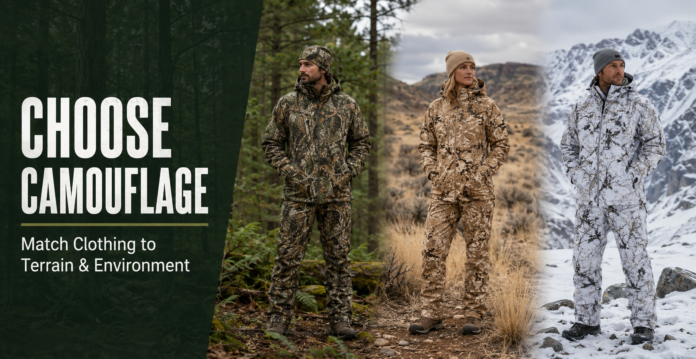
The most expensive camouflage pattern on the market provides zero concealment advantage if it doesn’t match your terrain. A hunter wearing marsh camouflage in dense woodland stands out as obviously as someone wearing no camouflage at all. Understanding how to choose camouflage clothing by terrain — matching pattern design, color palette, and construction to the specific visual character of your environment — is the most important camouflage decision you make before any outdoor activity where concealment genuinely matters.
Why Terrain Matching Is More Important Than Brand or Price
Walk into any hunting store and you’ll find premium camouflage patterns from multiple competing brands at a wide range of price points. The marketing emphasis falls heavily on brand heritage, pattern complexity, and photorealistic element detail. What matters far more than any of these factors is whether the pattern’s color palette and visual disruption elements genuinely match the terrain where you’ll be using it.
A budget woodland pattern correctly matched to your hunting forest outperforms a premium desert pattern in the same environment regardless of the technical sophistication invested in the more expensive option. Terrain matching is the foundation that every other camouflage selection decision builds on — and getting it right before evaluating brand, price, or construction quality saves both money and field disappointment.
Choosing Camouflage for Woodland and Forest Terrain
Forest environments present the most visually complex hunting backgrounds — layered green tones, brown bark textures, filtered light contrast, and organic irregular forms all creating environments that purpose-built woodland patterns replicate through careful multi-element design.
Early season woodland — full canopy coverage with dominant deep greens and limited visibility distances. Choose patterns with multiple green tones, brown shadow elements, and fine detail elements that match the visual density of summer and early fall foliage.
Late season woodland — leaf drop exposes bare branches and forest floor debris, dramatically shifting the forest’s visual character toward grey-brown tones with vertical branch elements. Patterns designed for full foliage create obvious green contrast in this changed visual environment — late season hunters benefit from patterns specifically developed around the bare branch and fallen leaf visual character of winter woodland.
Understanding how camo patterns integrate with winter outdoor styling beyond purely hunting contexts is explored in this camo wool coat guide — covering how camouflage aesthetics move between functional outdoor applications and lifestyle fashion across different terrain-inspired colorways.
Choosing Camouflage for Open Country and Prairie Terrain
Open country hunting environments — antelope, mule deer, coyote, and upland birds across plains, grassland, and agricultural settings — present simplified visual backgrounds where human silhouette disruption matters even more critically than in woodland contexts where environmental visual complexity provides partial natural assistance.
Choose patterns using:
- Tan, brown, dried grass yellow, and muted grey-green tones matching dominant earth and vegetation colors
- Larger pattern elements appropriate for the reduced visual complexity of open terrain
- Minimal dark tones that create obvious contrast against light-colored open country backgrounds
- Transitional color distributions that work across both grassy and bare soil zones within the same environment
Choosing Camouflage for Marsh and Wetland Terrain
Waterfowl hunting in marsh environments demands the most specialized pattern selection because approaching waterfowl observe from above — at angles and distances that ground-based game animals rarely achieve — with exceptional visual acuity that detects concealment failures immediately.
Choose marsh-specific patterns incorporating:
- Cattail, reed, and water reflection visual elements that match aerial observation of wetland environments
- Grey-green, brown, and pale blue tones matching marsh vegetation and water surface colors
- Pattern scales visible and recognizable as marsh vegetation from aerial approach angles rather than horizontal observation distances
Layout blind systems combined with marsh-pattern outer garments create the complete field concealment that serious waterfowl hunting demands — neither component working adequately without the other in open marsh environments where terrain itself provides minimal concealment assistance.
Choosing Camouflage for Desert and Arid Terrain
Desert hunting environments — predator hunting, open country big game, and upland birds across arid terrain — require light earth tone patterns that match the pale, desaturated visual character of sun-bleached arid landscapes where any dark or saturated color creates immediate, obvious contrast.
Choose patterns using light tan, sand, pale beige, dusty olive, and muted grey tones. Avoid patterns with significant dark elements that create contrast against the light-toned desert backgrounds they were never designed to match. For rocky desert terrain specifically, patterns incorporating rock simulation elements through grey and brown overlay tones provide more comprehensive concealment across the mixed rocky-sandy visual character of canyon and plateau hunting environments.
Choosing Camouflage for Snow and Winter Terrain
Snow environments demand the most obvious camouflage adaptation — any non-white color creates immediate, high-contrast visibility against the near-uniform white visual character that complete snow coverage creates. The choice between pure white overgarments and multi-element snow patterns with pale grey shadow tones depends on the specific snow coverage conditions of your hunting environment.
Complete snow coverage — pure white outer garments or predominantly white patterns with minimal grey shadow elements provide maximum concealment in full-coverage snow landscapes where any pattern complexity adds non-white elements that create detectable contrast.
Partial snow coverage — transitional snow patterns incorporating sparse non-white elements — bare branch simulation, rock tones, exposed vegetation stems — provide better performance in the mixed visual environments that partial snow coverage creates than pure white alternatives that create contrast against exposed non-snow elements.
Matching Camouflage to Game Species Vision
Effective camouflage clothing by terrain selection also accounts for how the specific game species you’re hunting perceives color and pattern — because different animals have fundamentally different visual systems that determine which camouflage properties matter most for concealment from each specific quarry.
Whitetail and mule deer — deer lack human red-green color discrimination but have excellent blue sensitivity and strong motion detection. Pattern color accuracy in the orange-red spectrum matters less for deer than human observers would predict — but silhouette disruption and movement minimization matter more than color precision for effective deer concealment.
Waterfowl — ducks and geese have four-color vision including UV sensitivity that humans lack — perceiving colors across a broader spectrum than human camouflage evaluation can fully account for. Waterfowl camouflage benefits from UV-treated fabrics that reduce the UV signature that standard fabrics present to bird vision even when color matching appears correct to human observers.
Predators — coyotes and other predators have limited color discrimination similar to deer but exceptional motion sensitivity and movement pattern recognition. Concealment from predators during calling sequences demands absolute stillness alongside appropriate terrain-matched pattern selection.
Our hunting apparel page covers the complete range of terrain-specific camouflage clothing options available for brand development — from woodland and marsh patterns through desert, snow, and transitional alternatives serving the full spectrum of hunting environment camouflage requirements.
Construction Requirements Beyond Pattern Selection
Selecting the right pattern for your terrain is the essential first step — but camouflage clothing by terrain selection extends into construction requirements that determine how effectively the pattern performs in actual field conditions.
Silent fabric construction — game animals detect sound before visual detection in most hunting scenarios. Silent fabric constructions that minimize noise during movement through vegetation matter as much as pattern accuracy for real-world hunting concealment across woodland, marsh, and mountain terrain types.
Weather protection matched to terrain — desert hunting demands lightweight heat management. Woodland hunting demands moisture management and moderate weather protection. Marsh hunting demands waterproof construction for water and mud contact. Snow hunting demands serious waterproof insulation for extreme cold exposure. The outer layer construction must address the specific weather demands of each terrain type alongside the visual concealment that pattern selection provides. Understanding the key construction features that distinguish high-performance outdoor clothing is covered in this outdoor jackets features guide — directly applicable to evaluating hunting camouflage outer layer construction quality across all terrain types.
These outdoor cargo pants demonstrate how performance construction principles — stretch, durability, cargo organization, and quiet operation — combine in lower body outdoor garments relevant to terrain-specific hunting clothing development across multiple camouflage environment categories.
Conclusion
Choosing camouflage clothing by terrain means making pattern selection decisions based on the specific visual character of your hunting or outdoor environment — not brand recognition, price point, or general camouflage aesthetic appeal. Woodland patterns for forest environments. Earth tones for open country. Marsh-specific elements for waterfowl. Light whites for snow. Terrain matching is where effective camouflage begins — and every other selection factor builds on that foundation. Get the terrain match right and you give every other camouflage investment the environment-appropriate context where it can genuinely perform.
FAQs
Can one camouflage pattern work across multiple terrain types?
Multi-environment patterns like MultiCam provide better cross-terrain performance than single-environment alternatives — but no single pattern optimally serves all terrain types. For hunters who hunt across genuinely different environments, dedicated terrain-specific patterns for each primary hunting environment consistently outperform universal alternatives.
How important is seasonal pattern selection within the same terrain type?
Very important — seasonal changes alter hunting terrain visual character significantly. Early and late season woodland require different pattern priorities. Partial and complete snow coverage demand different approaches. Matching pattern to current seasonal conditions within your terrain type improves concealment meaningfully beyond terrain category selection alone.
Does camouflage pattern affect waterfowl hunting more than deer hunting?
Waterfowl hunting places more demanding camouflage requirements because approaching birds observe from above at varied distances with exceptional color vision including UV sensitivity. Deer hunting benefits more from movement minimization and silhouette disruption than precise color matching — making pattern selection relatively less critical for deer than for waterfowl in terms of absolute concealment performance impact.
Can terrain-specific camouflage clothing be produced under a private label?
Yes. Professional outdoor apparel manufacturers offer complete private label production with terrain-specific camouflage patterns across woodland, desert, marsh, snow, and open country categories — with appropriate fabric constructions, weather protection, and full branding control giving outdoor brands complete creative authority over their terrain-matched camouflage collections.