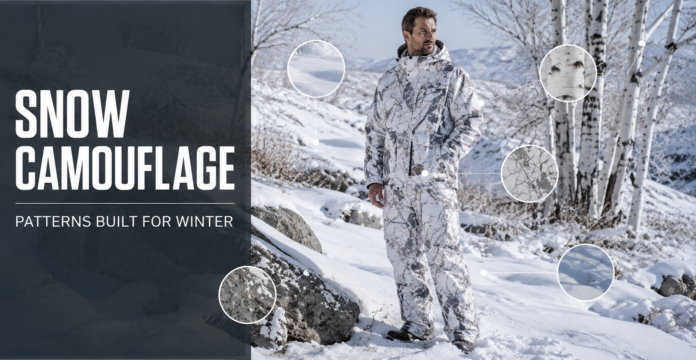
Nature figured out snow camouflage long before humans did. The arctic hare turns white in winter. The stoat’s coat shifts from brown to white as snow arrives. The ptarmigan becomes virtually invisible against snow-covered terrain through seasonal plumage change that evolution refined across millions of years. Human snow camouflage clothing applies the same fundamental principle — matching the dominant white visual character of snow-covered landscapes to achieve concealment that any other color makes immediately impossible.
Why Snow Environments Demand Dedicated Camouflage
Stand in an open snow-covered field while wearing woodland green or desert tan camouflage and you become the most visible object in the entire landscape. The white visual uniformity of snow-covered environments creates one of the highest contrast backgrounds in nature — any non-white color stands out with immediate, obvious clarity that makes concealment through pattern disruption alone completely inadequate.
Snow environments don’t offer the visual complexity of forest terrain where multiple competing colors and textures create backgrounds that careful pattern design can blend with. Snow presents a near-uniform high-brightness white background with shadow variations in pale blue-grey — and effective snow camouflage clothing must match this specific visual character almost completely rather than disrupting a complex visual background as woodland and desert patterns do.
This visual simplicity makes snow camouflage the most challenging pattern category to design effectively — because there is essentially nowhere to hide visual non-compliance that complex natural terrain backgrounds would absorb.
The Visual Character of Snow Environments
High-brightness white dominance — fresh snow reflects sunlight intensely, creating a near-white visual environment that requires predominantly white camouflage construction. Any substantial non-white color element creates contrast that human and animal vision detects immediately at observation distances far greater than equivalent contrast would be detectable in complex natural terrain backgrounds.
Shadow tone variation — snow shadows appear in pale blue-grey rather than the dark brown or black shadows of woodland environments. Effective snow camouflage incorporates this shadow tone alongside dominant white — creating depth and dimension that pure white patterns lack when shadow definition becomes an important visual detection element in specific lighting conditions.
Transition zone variation — snow environments include patches of exposed rock, bare branches, dried vegetation stems, and other non-white elements that create visual complexity in partially snow-covered landscapes. Late-season and transitional snow cover requires patterns that address this visual complexity rather than the near-pure-white character of complete deep-snow coverage.
Light reflection variation — different snow surface types reflect light very differently. Fresh powder scatters light uniformly. Frozen crust creates specular reflections. Wind-packed snow presents varied surface textures. Effective snow camouflage patterns work across these snow surface variations rather than matching any single snow surface character.
Major Snow Camouflage Pattern Approaches
Pure White Overgarments — the simplest and most immediately effective snow concealment approach uses pure white outer garments — snow smocks, overalls, and ghillie-style covers — worn over standard base camouflage patterns. This approach provides immediate effective concealment in complete snow coverage environments without requiring dedicated pattern printing — explaining its persistent military use across multiple national armed forces that prioritize simplicity and cost effectiveness over pattern sophistication.
White with Grey Shadow Elements — incorporating pale grey and blue-grey shadow tones into predominantly white patterns adds depth and dimension that pure white lacks during varying light conditions. These two-tone patterns perform more consistently across the lighting variation that outdoor winter use creates throughout the day — from flat grey overcast that reduces shadow definition through bright sunshine that creates sharp shadow contrasts across snow surface undulations.
White with Sparse Non-White Elements — some snow camouflage patterns incorporate sparse tree branch, bare vegetation, and exposed rock elements using grey and dark brown tones within a predominantly white background. These transitional patterns address the partial snow coverage environments where pure white creates obvious contrast against exposed non-snow elements while still providing effective concealment in full snow coverage areas.
Multicam Alpine and Modern Snow Variants — contemporary snow camouflage development applies digital pattern design principles to winter color palettes — using pixelated element distributions in white, pale grey, and subtle blue-grey tones to create multi-scale disruption that performs across varied observation distances in snow environments. These digitally designed snow variants demonstrate the same performance advantages over traditional analog snow patterns that digital woodland variants demonstrated over classic M81 construction.
Performance Fabric Requirements for Snow Camouflage Clothing
Snow camouflage clothing must address the extreme environmental demands of winter outdoor use alongside visual concealment — and cold weather fabric performance requirements are more demanding than any other outdoor application camouflage clothing regularly encounters.
Thermal insulation is the primary performance requirement distinguishing snow camouflage clothing from warm season alternatives. Winter hunting, military operations, and outdoor activities in snow environments create sustained cold exposure that requires serious insulation beneath or integrated with the concealment outer layer. Understanding how to build effective cold weather protection systems — including the insulation choices that extreme cold demands — is covered in detail in this Alaska winter jackets guide covering the most demanding cold weather outer layer requirements across serious winter outdoor applications.
Waterproof performance — snow contact creates sustained moisture exposure that inadequate waterproofing allows to penetrate the clothing system progressively throughout winter outdoor activity. Snow that accumulates on clothing surfaces melts through fabric contact with body warmth — creating the same penetration that rain creates in warmer season outdoor use. Quality snow camouflage outer garments require waterproof membrane construction that prevents this melt-through penetration across extended winter outdoor use.
Silent fabric construction — snow hunting applications demand the same noise signature management that woodland hunting requires. Fabric that rustles during movement creates sound that alerts game animals in the quiet winter environments where ambient noise reduction from snow coverage makes any fabric noise more detectable than equivalent noise in warmer season hunting contexts.
Breathability in cold conditions — physical winter outdoor activity generates significant perspiration that must escape the clothing system despite the insulation layers that cold conditions demand. Breathable waterproof membranes manage this requirement in outer layer construction — allowing moisture vapor transmission outward while preventing cold air and snow moisture entry inward simultaneously.
Snow Camouflage for Hunting Applications
Winter hunting creates the most commercially significant demand for snow camouflage clothing in civilian markets — with late-season deer hunting, snow goose hunting, coyote hunting in snow-covered terrain, and rabbit hunting all creating specific concealment requirements that non-snow-adapted camouflage completely fails to address.
Snow goose hunting represents perhaps the most demanding snow camouflage application in hunting contexts — requiring complete white concealment for hunters lying in snow-covered fields where snow geese approach at close range with exceptional visual acuity that detects any non-white contrast immediately. Layout blind systems combined with pure white outer garments create the complete field concealment that successful snow goose hunting demands.
Late-season deer hunting in snow-covered woodland creates different requirements — combining some tree and branch element visibility with dominant white background that pure white overgarments address less effectively than transitional snow patterns incorporating sparse non-white elements that match the partial snow coverage of woodland floor environments.
Coyote hunting in open snow terrain requires the same complete white concealment as snow goose hunting — because open snow-covered fields provide no vegetation or terrain concealment that hunters can use as an alternative to clothing-based concealment during calling sequences that bring coyotes within visual detection range.
Understanding how to match clothing choices to specific hunting environments and seasonal conditions — including winter snow hunting contexts — is explored in this hunting clothing guide covering the complete selection criteria that successful winter and snow hunting applications demand across all clothing categories simultaneously.
Layering Under Snow Camouflage Outer Garments
Effective snow camouflage clothing functions as a complete system rather than simply a concealment outer layer — requiring thoughtful layering beneath the visible camouflage construction to provide the thermal protection that winter outdoor use demands alongside the concealment that the outer pattern delivers.
Heavyweight merino or synthetic base layers provide the moisture management foundation that cold weather outdoor use depends on — keeping skin dry from perspiration during active movement that winter hunting and outdoor activity generates despite cold ambient temperatures. Mid-layer insulation provides the core warmth retention that exposure to cold air demands during the stationary waiting periods that hunting activity regularly creates between active movement sections.
The snow camouflage outer layer covers this complete inner system — providing both weather protection and visual concealment that the functional inner layers cannot address. Pattern effectiveness depends on this outer layer fitting correctly over the inner system without the tight restriction that would limit movement or the excess bulk that would create an obviously artificial silhouette against the snow background the pattern is designed to blend with.
Our camouflage clothing manufacturer page covers the full range of snow camouflage clothing options available for brand development — including the specific waterproof construction, insulation integration, and pattern printing capabilities that serious winter hunting and cold weather outdoor camouflage applications demand across every garment in a commercially credible snow camouflage collection.
These outdoor cargo pants demonstrate how performance fabric construction and practical field features combine in outdoor lower body garments — the same construction principles applying directly to snow camouflage pant development for winter hunting and cold weather outdoor applications.
Conclusion
Snow camouflage clothing addresses the most visually demanding concealment challenge in outdoor apparel — matching the near-uniform high-brightness white character of snow-covered environments where any color deviation creates immediately detectable contrast. White dominance, pale grey shadow tones, and sparse transitional elements together create pattern systems that achieve concealment in winter landscapes where non-adapted camouflage becomes completely counterproductive. Combined with the thermal insulation, waterproof construction, and silent fabric performance that winter outdoor use demands alongside visual concealment — effective snow camouflage clothing represents one of the most technically complete specialized categories in the entire outdoor apparel manufacturing landscape.
FAQs
Does pure white camouflage work in all snow environments?
Pure white suits complete deep-snow coverage environments effectively. Transitional and partial snow coverage environments — where exposed rock, bare branches, and soil patches break up the white background — benefit from patterns incorporating sparse non-white elements that address this visual complexity more effectively than pure white construction.
Can snow camouflage be layered over standard hunting clothing?
Yes — lightweight white snow overgarments worn over standard camouflage base clothing provide effective immediate snow concealment without requiring dedicated snow-specific base garments. This layering approach suits hunters who hunt across both snow and non-snow conditions throughout the same season.
What fabric weight is appropriate for snow camouflage outer garments?
Snow camouflage outer garments range from lightweight oversmocks for layering over insulated base clothing through heavyweight integrated insulated constructions for standalone cold weather use — fabric weight selection depending on whether thermal insulation is integrated within the camouflage outer layer or provided by separate inner system garments beneath it.
Can snow camouflage clothing be produced under a private label?
Yes. Professional outdoor apparel manufacturers offer complete private label production with snow camouflage patterns — incorporating waterproof construction, thermal insulation options, silent fabric treatments, and full branding control giving outdoor brands complete creative and commercial authority over their winter camouflage collections.