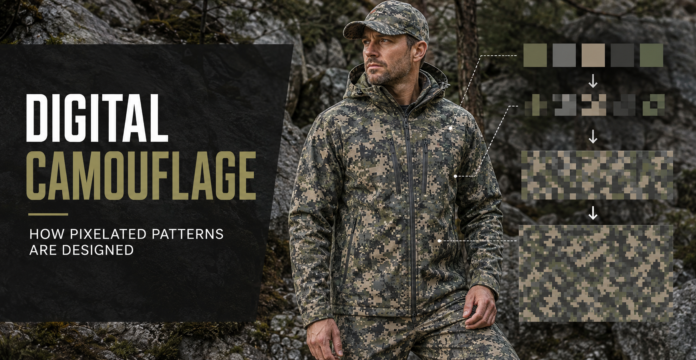
Walk into any serious outdoor, hunting, or tactical apparel store and you’ll see it everywhere — that distinctive pixelated pattern that looks almost like a computer glitch on fabric. Digital camouflage has transformed how military forces, hunters, and tactical professionals think about concealment. But understanding why pixels outperform the traditional brush strokes of classic camouflage — and how these patterns are scientifically designed — reveals a genuinely fascinating intersection of visual science, military engineering, and outdoor performance apparel.
What Makes Digital Camouflage Different
Traditional camouflage patterns — like the classic US military M81 woodland — use irregular shapes with blended edges that attempt to replicate the organic forms of natural environments through analog pattern design. These patterns work effectively at specific observation distances but lose their effectiveness outside their optimal range — appearing as obvious colored patches at close range and as uniform color blobs at long distances.
Digital camouflage replaces those blended organic shapes with precisely sized rectangular pixel elements arranged in mathematically calculated distributions. The key insight driving digital pattern development is that the human visual system processes images through multiple simultaneous spatial frequency channels — perceiving detail at different scales simultaneously. A pixelated pattern designed to disrupt multiple spatial frequency channels simultaneously remains effective across a much wider range of observation distances than analog patterns optimized for any single viewing distance.
This multi-scale disruption capability is why digital camouflage achieves superior concealment performance across varied observation distances — not despite its computer-generated appearance but specifically because of the mathematical precision that computational pattern design enables.
The Science Behind Pixel Pattern Design
Digital camouflage design begins with scientific analysis of the target environment’s visual characteristics — color distribution, contrast patterns, texture scales, and the specific spatial frequency content that constitutes that environment’s visual signature.
Color palette selection starts with digital photography and spectrophotometric analysis of the target environment across different lighting conditions, seasons, and weather states. The colors selected must match the environment across the full spectrum of conditions where the camouflage will be used — not just ideal midday lighting that analog pattern designers historically used as their primary reference condition.
Pixel element sizing is determined through scientific analysis of human visual system performance — specifically the spatial frequency ranges at which human vision most effectively detects patterns against environmental backgrounds. Pixel sizes that fall within or between human visual system detection channels create the most effective disruption across the widest observation distance range.
Pattern distribution algorithms arrange pixel elements across the fabric surface through mathematical processes that prevent the regular repetition that human pattern recognition detects easily. True randomness doesn’t exist in manufactured textiles — but pseudo-random mathematical distributions create pattern complexity that resists the automatic pattern completion that human vision applies to simple regular structures.
Color boundary management between adjacent pixel elements uses careful color transition design to prevent the sharp edges that would make individual pixels detectable at close range while maintaining the macro-scale pattern disruption that creates effective long-range concealment performance.
Major Digital Camouflage Patterns and Their Development
MARPAT (Marine Pattern) — the US Marine Corps digital camouflage pattern developed in the early 2000s was among the first large-scale military digital pattern adoptions. MARPAT uses woodland and desert variants — both built on the same pixel element architecture with different color palettes matched to their specific target environments. Its adoption validated digital pattern effectiveness through operational deployment across diverse global environments.
CADPAT (Canadian Disruptive Pattern) — the Canadian Forces digital pattern that preceded MARPAT in development — demonstrating that digital pattern development was a parallel international effort rather than a single military innovation. CADPAT’s development established many of the scientific principles that subsequent digital pattern programs built upon.
UCP (Universal Camouflage Pattern) — the US Army’s attempt at a single universal digital pattern that would serve across multiple environments simultaneously. UCP’s operational performance revealed the limitation of universal pattern approaches — patterns optimized across multiple environments simultaneously often perform inadequately in any specific environment compared to environment-specific alternatives.
MultiCam and its digital evolution — while not purely pixel-based in its original form, MultiCam’s development incorporated digital pattern design principles to create a pattern that performs meaningfully better across multiple environments than single-environment digital alternatives — demonstrating that digital design approaches extend beyond purely pixelated aesthetics.
Why Digital Camouflage Performs Better for Hunters and Tactical Users
Beyond its military origins, digital camouflage has proven commercially valuable across hunting and tactical outdoor applications for specific performance reasons that serious field users consistently report over traditional alternatives.
Consistent performance across distances — hunters operating in varied terrain encounter game at unpredictable distances. Digital patterns that perform across multiple observation distances provide consistent concealment whether deer approach at 20 meters or 200 meters — while traditional patterns optimized for specific distances can fail at ranges outside their design parameters.
Urban and mixed environment performance — tactical users operating across mixed natural and built environments benefit from digital patterns’ inherently more abstract visual character. The pixelated appearance reads as neither pure natural texture nor pure geometric structure — making it effective in environments where traditional nature-inspired patterns create obvious artificial contrast against built surfaces.
For comprehensive understanding of how camouflage fabric selection affects concealment performance across different pattern types, this camouflage fabrics guide covers the material performance requirements that different camouflage applications demand alongside pattern design considerations.
Digital Camouflage in Commercial Outdoor Apparel
The commercial outdoor apparel market has embraced digital camouflage across hunting, tactical, and lifestyle applications — with pattern licensing, proprietary digital pattern development, and fashion-influenced digital camo aesthetics all contributing to a diverse commercial landscape.
Licensed digital patterns from established military and commercial developers provide proven performance credentials alongside brand recognition that serious hunting and tactical consumers actively seek. Proprietary digital pattern development allows brands to create exclusive visual identities that differentiate their products from licensed pattern alternatives available across multiple competing brands simultaneously.
Fashion-influenced digital camo — using pixel pattern aesthetics without the scientific concealment engineering behind functional patterns — has expanded the commercial reach of digital camouflage into streetwear, urban fashion, and lifestyle markets where visual appeal rather than functional concealment drives purchasing decisions.
Understanding how to select the right camouflage pattern for specific hunting environments and applications is explored in this camouflage patterns guide — covering pattern selection criteria across woodland, desert, snow, and mixed environment applications where digital and traditional patterns compete for concealment effectiveness.
Building Digital Camouflage Into Your Outdoor Collection
For outdoor brands developing camouflage product lines, digital pattern options offer meaningful differentiation from the traditional analog alternatives that still dominate portions of the hunting and outdoor market. Working with a professional camouflage clothing manufacturer ensures pattern printing quality — color accuracy, registration precision, and wash fastness — meets the standards that serious tactical and hunting consumers evaluate through real field use rather than retail presentation alone.
For a practical product example of how digital camouflage construction translates into complete outdoor garments, these hunting pants demonstrate how performance fabric construction combines with camouflage pattern application in lower body outdoor garments built for serious field hunting and tactical outdoor applications.
Conclusion
Digital camouflage isn’t simply a stylistic evolution from traditional camouflage — it’s a scientifically grounded performance improvement that addresses specific limitations in analog pattern design through computational precision. Multi-scale disruption across observation distances, mathematically distributed pixel elements, and scientifically selected color palettes together create concealment performance that serious military, hunting, and tactical users recognize through real-world field experience. Understanding how digital patterns are designed helps outdoor brands make informed decisions about pattern selection, licensing, and development — and helps consumers choose camouflage that genuinely performs rather than simply appearing technical.
FAQs
Does digital camouflage actually perform better than traditional camo?
Yes — across varied observation distances. Digital patterns designed with proper spatial frequency disruption maintain concealment effectiveness across wider distance ranges than traditional patterns optimized for specific viewing distances. Performance advantage varies by specific pattern quality and target environment match.
Why do some military organizations still use traditional analog camouflage?
Legacy inventory, equipment compatibility, procurement cost, and ongoing performance evaluation all influence military camouflage adoption decisions. Some specific environments and applications where traditional patterns were specifically optimized still see comparable or superior performance from those established alternatives.
Can digital camouflage patterns be developed exclusively for a brand?
Yes — proprietary digital pattern development creates exclusive visual identities that differentiate brands from licensed pattern alternatives. Development requires significant investment in pattern design, testing, and print production setup but creates genuine brand differentiation in competitive camouflage markets.
Can digital camouflage outdoor clothing be produced under a private label?
Yes. Professional outdoor apparel manufacturers offer complete private label production with digital camouflage pattern options across licensed and proprietary designs — giving outdoor brands full creative and commercial control over their camouflage apparel collections.