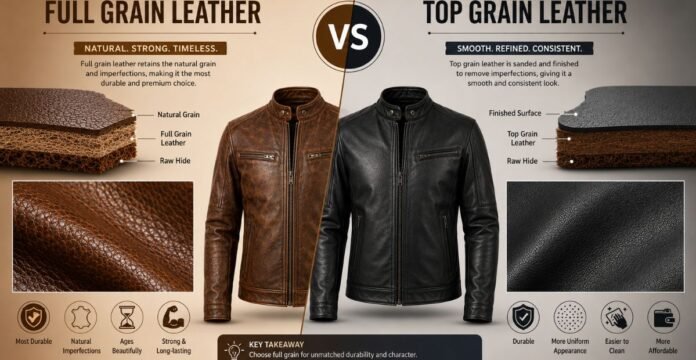
The debate between Full Grain and Top Grain Leather Apparel is a hot topic when shopping for leather clothing, such as jackets, vests, and workwear. And for good reason. The two highest grades of available leather perform differently when they are worn, cared-for, and broken-in over time.
The same layer of hide is used for both grades, but a single step in the processing process separates them. This step can have a significant impact on the strength, appearance and ageing of the leather. Understanding what happens to the leather during this step will help you understand why the one grade costs more and why it is not always the best choice for a garment.
This guide will help you understand the differences between these two leather grades and decide which is best for your next leather clothing purchase.
What is full grain leather?
Full grain leather is made by cutting directly through the outermost layer and leaving it unaltered. The surface is not sanded or buffed. This allows the pores and natural grain of the hide to be visible.
Full grain leather is the strongest, with the most interlocked fibers, because nothing has been removed. It is this that gives it its superior strength, breathability and ability to develop a rich and deepening patina over time as oils, sunlight and daily handling interacts with the surface.
What is top grain leather?
The top grain leather is also made from the uppermost layer of the hide. However, it undergoes an additional process: the surface will be lightly buffed or sanded to remove any imperfections. It is then coated with a protective finish for a more uniform, smoother look.
The top grain leather is more uniform in appearance from the beginning, and this is why it is so popular for clothing that requires a polished, clean finish. Sanding the leather removes the strongest fibers of the hide, affecting both its durability and the way it ages.
Comparing the durability of full grain and top grain leather for apparel
In the comparison of Full Grain and Top Grain leather for apparel, durability is the most important factor. Full grain leather retains its natural, dense fiber structure, giving it greater resistance to abrasion and tearing. With proper care, many well-made garments made from full grain leather can last up to 20 years.
Top grain leather can be a durable material that is suitable for daily use. However, because it has been sanded to remove the strongest outer fibers, its lifespan is usually shorter, around 10-15 years. Water resistance is also based on a similar pattern. Full grain leather has a dense, natural surface that repels water well. Top grain leather, on the other hand, relies heavily on its coating to keep moisture out.
This structural difference is more important than you might think, especially for apparel that will be used daily or in outdoor conditions.
Appearance and Aging How each leather changes over time
Both grades age differently. Over time, full grain leather develops an organic patina, which is a gradual darkening, richening, and aging of the surface due to oils, sunlight, or handling. This patina tends to hide scratches and marks, so they don’t stand out.
Top grain leather is designed for a cleaner, more consistent look, as the finish applied resists stains and has less natural variation. The leather will not develop the same character with time and the protective coating will wear down. This can lead to the leather surface cracking or peeling.
Comfort and Feel
Comfort is also another area in which these two grades differ. Full grain leather is initially firmer and more natural, but it needs to be broken in before it can mold perfectly to your body. This rougher texture is preferred by some people for its grip and structure, especially when it comes to heavier clothing like jackets or workwear.
Because of the sanding, finishing and blending process, top grain leather tends to be softer and suppler right from the start, making it a better option for garments that are meant to break-in after the first wear.
Full Grain and Top Grain: The Differences in a Glimpse
Here’s an overview of the differences between these two grades in terms of the most important qualities for clothing:
- Surface:Full grain is left untouched, and the top grain has been sanded to a smoother surface.
- Durability:Full grain lasts for 20+ years, top grain lasts 10-15 years.
- Patina:Full grain acquires a rich, natural patina. Top grain is resistant to visible aging.
- Appearance:Full-grain shows imperfections and natural texture; top-grain looks more uniform
- Comfort:Full-grain is stiffer and requires breaking in. Top grain feels softer instantly.
- Price:Full-grain hides are generally more expensive due to their lower yield and better quality.
Selecting the Right Grade of Industrial and Protective Apparel
Full Grain Leather vs Top Grain Leather in Apparel is a decision that matters in both industrial and fashion settings. Full grain leather is a popular choice for heavy-duty protective equipment like welding aprons and gloves. Its superior abrasion resistant makes it an ideal material to use in collections designed for daily, rugged wear.
Full grain leather is often used in oil-and-gas workwear for environments with higher risk. In these situations, durability takes precedence over aesthetics. Leather is often paired with weatherproof fabrics found in waterproof collections for outdoor roles which also require moisture protection.
Selecting the right grade for corporate and branded apparel
Top grain leather is a great choice for polished corporate uniforms that need a professional look across an entire team. Its uniform, clean finish makes it an ideal choice for polished uniforms which need to look professional across a team.
Many businesses use workwear that is industry specific. They can match the leather grade with the needs of the trade or brand.
What Grade Should I Choose?
The best choice for apparel depends on the use of the garment. Full grain leather is a better investment if durability, natural character and ability to age well are important.
Top grain leather is a good choice for those who want a polished, consistent appearance from the start and a soft feel. It also comes at an affordable price. When businesses are sourcing clothing in large quantities, working with a supplier who can source and manufacture either grade consistently will make it easier to achieve predictable results throughout an order.
The role of custom manufacturing in leather apparel
More businesses are turning to custom leather manufacturers to meet their needs for leather clothing. They can customize the leather to match their durability, appearance and branding requirements.
ECO-JERSEY manufactures and supplies custom apparel, including top grain and full grain leather workwear to businesses all over the world. Our team will work directly with our clients to create apparel that meets their exact specifications, whether they need rugged components for industrial protective equipment or refined top-grain accents for corporate clothing.
Conclusion
It is much easier to select a garment that meets your needs when you know the difference between Full Grain and Top Grain Apparel Leather. Full grain leather is more durable and has a richer patina with age. Top grain offers a smoother, more uniform finish for a lower price. The choice between the two grades is not based on objective superiority. It depends on the intended use of the garment and the expected lifespan.
If you are looking for reliable leather apparel, whether it is for protective workwear or branded Uniforms, working with a manufacturer with experience like ECO JERSEY will ensure that each garment is made with the best grade of leather.
What is the difference between full grain and top grain leather
Full grain leather retains the hide’s natural, unaltered surface, while top grain leather has been lightly sanded and coated for a smoother, more uniform finish, which affects both durability and appearance.
Which is more durable, full grain or top grain leather?
Full grain leather is more durable because it keeps the hide’s strongest, most tightly interlocked fibers intact, while top grain leather loses some of that strength during the sanding process.
Does top grain leather develop a patina like full grain leather?
No, top grain leather does not develop the same rich patina as full grain leather, since its protective coating limits how the surface absorbs oils and changes color over time.
Is full grain or top grain leather better for a jacket?
Full grain leather is generally better for jackets that need to last for years and develop character over time, while top grain leather suits buyers who want a softer feel and more consistent appearance from day one.