
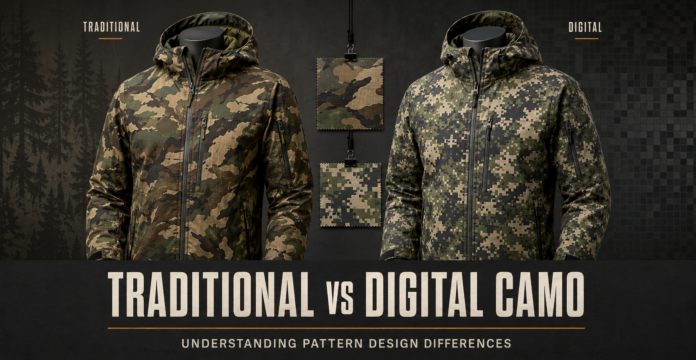
Two distinctly different design philosophies define the camouflage clothing market today. One uses organic, flowing brush strokes and blended color edges that replicate the visual character of natural environments through artistic interpretation. The other uses mathematically calculated rectangular pixel distributions that disrupt visual detection through computational precision. Understanding traditional vs digital camouflage — what each approach achieves, where each performs better, and why military organizations shifted from one to the other — gives outdoor brands and enthusiasts the knowledge to choose patterns based on genuine performance understanding rather than aesthetic preference alone.
Traditional Camouflage — Organic Design Philosophy
Traditional camouflage patterns use organic, irregular shapes with soft, blended edges — brush stroke-style elements in multiple colors arranged across the fabric surface to replicate the general visual character of natural environments. This design approach dominated military and civilian camouflage from the first World War through the end of the twentieth century — producing the classic patterns that generations of hunters and soldiers have worn across every major conflict and hunting tradition globally.
The design philosophy underlying traditional patterns is intuitive — study the visual character of the target environment, then reproduce that character through artistic pattern creation using colors, shapes, and element distributions that match what human observers see in that environment. US military M81 woodland, British DPM, German Flecktarn, and the Realtree and Mossy Oak photorealistic hunting pattern families all represent different expressions of this organic design approach — ranging from abstract color arrangement through highly detailed photorealistic environment reproduction.
Traditional patterns excel at:
- Photorealistic environment matching — Realtree and Mossy Oak achieve visual accuracy in their target environments that pixel patterns cannot replicate through abstract element distributions
- Close-range concealment — organic element shapes blend naturally with natural terrain at close observation distances where fine detail distinguishability is highest
- Aesthetic familiarity — traditional patterns carry decades of hunting and outdoor heritage credibility that many consumers associate strongly with authentic outdoor experience
Digital Camouflage — Computational Design Philosophy
Digital camouflage replaces traditional organic element design with mathematically calculated rectangular pixel distributions — using computational analysis of target environment visual characteristics to create pattern element arrangements that disrupt human visual detection through spatial frequency disruption rather than organic visual replication.
The fundamental design insight driving digital pattern development is that effective concealment doesn’t require visual replication of the environment — it requires disruption of the visual processing mechanisms that detect human presence against environmental backgrounds. By analyzing the spatial frequency content of target environments and designing pixel distributions that disrupt detection across multiple simultaneous spatial frequency scales, digital patterns achieve effective concealment at varied observation distances that traditional single-scale patterns cannot match.
Canadian CADPAT — developed in the 1990s — was among the first successful large-scale military digital pattern adoptions, followed by US Marine Corps MARPAT in the early 2000s. Their operational adoption validated digital pattern performance claims through genuine military field use across diverse global environments rather than laboratory testing alone.
Digital patterns excel at:
- Multi-distance performance — pixel distributions that disrupt multiple spatial frequency scales simultaneously maintain concealment effectiveness across a wider observation distance range than single-scale traditional patterns optimized for any specific viewing distance
- Consistency in production — pixel-based designs reproduce with consistent element placement and color accuracy across large production runs where organic pattern elements naturally vary between print batches
- Urban and transitional environment performance — the abstract geometric character of digital patterns performs better in built environments and transitional terrain where organic natural element replication creates obvious environmental mismatch
Traditional vs Digital: Direct Performance Comparison
| Feature | Traditional | Digital |
|---|---|---|
| Design Approach | Organic artistic | Mathematical computation |
| Close-Range Performance | Excellent | Good |
| Multi-Distance Performance | Moderate | Excellent |
| Environment Specificity | Very high | Moderate to high |
| Production Consistency | Variable | Excellent |
| Urban Environment | Poor to moderate | Good |
| Heritage Credibility | Very high | Growing |
| Photorealistic Accuracy | Excellent | Limited |
| Fashion Appeal | High | Strong in tactical markets |
Why Military Organizations Shifted to Digital
The shift from traditional to digital camouflage patterns across multiple national military organizations in the 2000s reflected genuine operational performance evaluation rather than simply technology adoption for its own sake. The specific performance advantages that digital patterns demonstrated in testing drove adoption decisions across diverse military organizations simultaneously.
Multi-distance detection avoidance was the primary performance driver. Traditional patterns optimized for specific observation distances became increasingly detectable outside their optimal range — appearing as obvious colored shapes at close range and blending into uniform color at long range while losing their disruptive character at medium ranges. Digital patterns designed to disrupt multiple spatial frequency channels simultaneously maintained meaningful disruption across wider distance ranges that military operational scenarios regularly created.
Reduced pattern recognition — human visual systems are specifically tuned to recognize familiar patterns including the organic shapes that traditional camouflage patterns incorporate. The abstract geometric character of digital pixel patterns is less familiar to trained pattern recognition — requiring longer detection times even when observers know they’re looking for camouflaged subjects.
Understanding how waterproof fabric performance interacts with camouflage clothing construction is explored in this waterproof jacket guide — covering the outer layer construction requirements that determine how effectively any camouflage pattern performs across the weather conditions that hunting and tactical outdoor applications regularly create.
The Commercial Landscape — Both Approaches Thrive
Despite the military shift toward digital patterns, traditional camouflage maintains dominant commercial position in civilian hunting markets — for reasons that performance data alone doesn’t fully explain.
Heritage and brand trust — Realtree and Mossy Oak have built decades of hunting market credibility that digital pattern alternatives struggle to displace among established hunting consumers who associate these pattern families with proven field success across generations of hunting experience.
Photorealistic accuracy — for specific environment matching in the target hunting terrain these patterns were designed around, photorealistic traditional patterns achieve visual accuracy that digital patterns cannot replicate through pixel abstraction. A dedicated turkey hunter in dense eastern hardwood forest may genuinely prefer the photorealistic leaf and branch detail of a Mossy Oak pattern over any digital alternative for their specific application.
Lifestyle and fashion crossover — traditional camouflage patterns, particularly the Realtree and Mossy Oak families, have achieved strong fashion adoption across lifestyle markets where their aesthetic associations with outdoor heritage create desirable brand imagery that digital patterns haven’t yet replicated commercially.
How construction quality and fabric performance choices affect the functional effectiveness of camouflage clothing in real weather conditions is covered in this waterproof vs water-resistant guide — directly applicable to understanding how outer layer construction choices affect camouflage clothing system performance across varied outdoor conditions.
Choosing Between Traditional and Digital for Your Collection
For outdoor brands developing camouflage collections, the traditional vs digital camouflage decision involves commercial positioning considerations alongside pure performance factors.
Choose traditional patterns for: Hunting-focused collections where photorealistic environment matching drives purchasing decisions, brands targeting established hunting consumer demographics with strong traditional pattern loyalty, and applications where close-range single-environment concealment accuracy matters more than multi-distance versatility.
Choose digital patterns for: Tactical and law enforcement-focused collections where military performance validation carries commercial credibility, brands targeting younger outdoor consumers who associate digital aesthetics with technical performance sophistication, and multi-environment applications where consistent performance across varied terrain and observation distances matters more than photorealistic accuracy in any specific environment.
Our camouflage clothing manufacturer page covers the complete range of both traditional and digital camouflage clothing options available for brand development — with pattern printing capabilities, fabric construction options, and quality standards that ensure both pattern approaches achieve their intended performance across real field applications.
These outdoor cargo pants demonstrate how performance fabric construction provides the foundation that both traditional and digital camouflage patterns require — stretch, durability, and practical field features combining with pattern printing quality in complete outdoor lower body garments built for serious field use.
Conclusion
Traditional vs digital camouflage represents two fundamentally different philosophical approaches to the same concealment challenge — organic artistic replication of environmental character versus mathematical disruption of visual detection mechanisms. Traditional patterns excel at photorealistic close-range environment matching and carry strong heritage commercial credibility. Digital patterns excel at multi-distance performance and production consistency. Neither approach is universally superior — and the most successful outdoor brands understand both well enough to choose each where it genuinely serves their specific market and application rather than adopting either approach as a default regardless of fit.
FAQs
Is digital camouflage actually more effective than traditional camouflage?
Digital patterns demonstrate performance advantages at varied observation distances through multi-scale spatial frequency disruption. Traditional photorealistic patterns can outperform digital alternatives at close range in their specific target environments. Neither approach is universally superior across all conditions and distances.
Why do hunters still prefer traditional camouflage over digital?
Heritage credibility, photorealistic environment matching in specific hunting terrains, and strong brand loyalty built across decades of successful field use all sustain traditional pattern preference among established hunting consumers — factors that pure performance testing doesn’t capture.
Can digital and traditional camouflage patterns be printed on the same fabric constructions?
Yes — both pattern types apply to the same fabric constructions through sublimation and screen printing processes. Fabric choice affects print quality for both approaches — smoother lightweight fabrics reproducing fine detail most accurately for both micro-element traditional designs and fine pixel digital patterns.
Can both traditional and digital camouflage clothing be produced under a private label?
Yes. Professional outdoor apparel manufacturers offer complete private label production with both traditional organic and digital pixel pattern options — including licensed commercial patterns and proprietary designs — giving outdoor brands full creative and commercial control over their camouflage clothing collections across both design philosophies.



