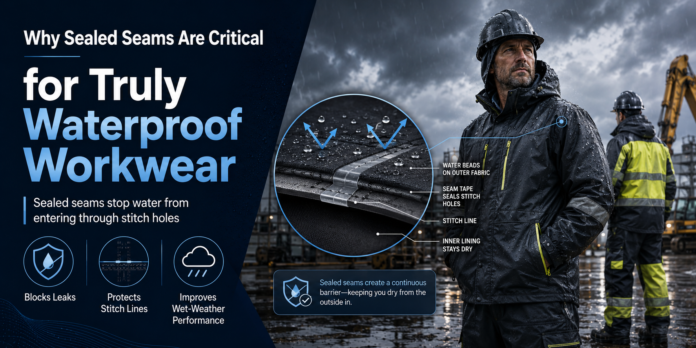
A jacket can be made from the most advanced waterproof fabric in the world — and still let water in. How? Through the seams. Every stitch creates a tiny hole in the fabric, and without proper sealing, those holes become entry points for water in wet and demanding outdoor conditions. That’s why sealed seams waterproof workwear is the standard that serious outdoor workwear must meet.
Understanding why sealed seams matter — and how they work — helps businesses make smarter decisions when outfitting workers who face rain, moisture, and harsh weather on the job. Let’s get into the details.
What Are Sealed Seams in Waterproof Workwear?
Sealed seams in waterproof workwear refer to the process of covering or bonding the stitched seams of a garment to prevent water from entering through the needle holes created during construction. Even the most waterproof fabric is compromised at every seam if those seams are left untreated.
Sealed seams waterproof workwear uses specific techniques — seam taping, seam welding, or seam sealing — to close these vulnerable points and create a continuous waterproof barrier across the entire garment. Without this step, no workwear garment can truly be called waterproof.
Why It Matters — Key Benefits
Sealed seams are essential for workwear that genuinely protects workers in wet conditions. Here’s why they matter so much:
- Complete waterproof protection — Sealed seams close every potential entry point for water, ensuring the garment performs as a true waterproof barrier.
- Worker safety in wet environments — Wet, cold workers are more prone to accidents and health issues. Sealed seams keep workers dry and focused.
- Extended garment lifespan — Properly sealed seams prevent water ingress that can degrade the fabric’s inner layers over time.
- Consistent protection throughout the shift — Sealed seams maintain their performance across an entire working day, regardless of rain intensity.
- Compliance with safety standards — Many industries require genuinely waterproof workwear, and sealed seams are a key requirement of that standard.
- Reduced replacement costs — Garments with properly sealed seams last longer, reducing the frequency and cost of workwear replacement.
- Worker confidence and comfort — Knowing the workwear truly keeps water out allows workers to focus entirely on the job at hand.
The Three Types of Seam Sealing
Not all sealed seams waterproof workwear is created equal. There are three main seam sealing methods, each offering a different level of protection. Fully taped seams cover every single seam in the garment with waterproof tape bonded over the stitching — providing the highest level of waterproof protection available and making the garment suitable for the most severe wet conditions.
Critically taped seams only seal the primary seams most likely to face direct water exposure — shoulders, chest, and back panels — while leaving secondary seams untreated. This approach provides strong protection at a more accessible price point. Finally, seam-sealed or glued seams use liquid sealant applied directly over the stitching. This method offers a basic level of water resistance but is generally less durable than taped or welded construction.
Seam Welding vs Seam Taping
Beyond the three main methods, sealed seams waterproof workwear can also be distinguished by the specific technique used. Seam taping applies a thin strip of waterproof film over the stitched seam using heat and pressure to bond it permanently to the fabric. This is the most common method in professional waterproof workwear and delivers excellent, long-lasting results.
Seam welding — also called ultrasonic welding — takes a different approach by using heat or sound waves to fuse fabric panels together without stitching at all. This eliminates the needle holes entirely, creating an even more seamless waterproof barrier. Seam welding is typically used in premium technical workwear for the most demanding outdoor environments, including waterproof workwear designed for extreme weather conditions.
Who Needs Sealed Seams Waterproof Workwear?
Sealed seams waterproof workwear is essential for any workforce operating in wet, outdoor, or unpredictable weather environments. Construction workers face rain and wet conditions on open sites with no shelter, making fully waterproof protection a daily necessity. Utilities and infrastructure workers also need reliable waterproof gear to stay safe and productive during outdoor maintenance and repair work.
Workers in the energy sector — including those on oil and gas installations — face some of the harshest outdoor conditions in any industry, making fully sealed workwear a critical safety requirement. Agriculture, logistics, and emergency services also rely heavily on properly sealed waterproof workwear to keep their teams protected in the field. Businesses operating in these sectors can explore the full range of protective options through a specialist workwear manufacturer.
Standards of Quality in Sealed Seams Waterproof Workwear
Quality in sealed seams waterproof workwear goes beyond simply applying tape over stitching. The tape itself must be made from a waterproof, breathable material that bonds permanently to the garment’s fabric without peeling or cracking under repeated use and washing.
Application precision matters equally — seam tape must be applied with complete coverage and consistent pressure across every sealed seam in the garment. Any gap or bubble in the tape creates a water entry point that compromises the entire garment’s waterproof claim. Businesses sourcing waterproof workwear should also verify that products meet the relevant workwear safety standards for their industry, ensuring sealed seam construction meets the required protective performance levels. For high-risk environments, look for workwear that combines sealed seams with high visibility workwear features for maximum protection.
How Sealed Seams Work Alongside Other Waterproof Features
Sealed seams don’t work in isolation — they’re one part of a complete waterproof workwear system. The outer fabric provides the primary water-repellent barrier, typically through a DWR coating or waterproof membrane. Sealed seams then close the gaps that stitching creates in that barrier.
Waterproof zips, storm flaps, and adjustable cuffs complete the system by closing other potential entry points for water. In truly high-performance sealed seams waterproof workwear, every element works together — fabric, seams, fastenings, and design — to create a garment that keeps water out comprehensively. This integrated approach is what separates genuinely waterproof workwear from products that only offer basic water resistance. Industrial workwear manufacturers who understand this system build workwear that truly delivers in the field.
Why Choose Eco Jersey for Sealed Seams Waterproof Workwear?
Eco Jersey is a specialist workwear manufacturer with deep expertise in producing sealed seams waterproof workwear built for real outdoor working conditions. We understand that genuine waterproof protection requires precision at every stage of construction — from fabric selection to seam sealing technique.
Our waterproof workwear range uses fully taped and welded seam construction across our premium lines, delivering the highest level of waterproof protection available. We work with businesses across construction, energy, utilities, and outdoor industries — offering full customization and flexible order quantities. We also manufacture corporate uniforms, high visibility workwear, and more — all under one roof.
Conclusion
Sealed seams waterproof workwear is not a premium extra — it’s a fundamental requirement for any garment that genuinely claims to be waterproof. Without properly sealed seams, even the best waterproof fabric fails when workers need it most.
At Eco Jersey, we build waterproof workwear the right way — with precision seam sealing techniques that deliver consistent, reliable protection through the toughest outdoor conditions. Ready to protect your workforce properly? Explore our waterproof workwear options and get in touch with our team today.
FAQs
What is the difference between fully taped and critically taped seams?
Fully taped seams cover every seam in the garment with waterproof tape, providing maximum protection suitable for severe wet conditions. Critically taped seams only seal the primary seams most exposed to direct rainfall, offering strong protection at a more accessible price point.
How long do sealed seams last in waterproof workwear?
With proper care and maintenance, sealed seams in quality waterproof workwear typically last the lifetime of the garment. Avoiding harsh detergents and following the manufacturer’s care instructions helps preserve seam tape integrity over time.
Can sealed seams be repaired if they start to peel or fail?
Yes. Seam sealing tape can be reapplied to failing seams using specialist repair tape and a heat source. However, widespread seam failure in an older garment is generally a sign that the workwear needs replacing rather than repairing.
Do all waterproof workwear garments have sealed seams?
No. Many garments marketed as water-resistant use only a DWR coating without any seam sealing. True waterproof workwear should always feature sealed seams — fully or critically taped — to provide genuine protection in wet working conditions.