If you’ve ever approached a clothing manufacturer and been told you need to order 500 units minimum, you’ve hit a bulk order minimums. And if you didn’t know that was coming, it probably stopped you in your tracks. Bulk order minimums are one of the most misunderstood parts of apparel manufacturing. They confuse new brands, frustrate small buyers, and often make the difference between a deal getting done or falling apart.
This guide explains exactly what bulk order minimums are, why they exist, and how to work with them — or around them — depending on where your brand is right now.
What Are Bulk Order Minimums?
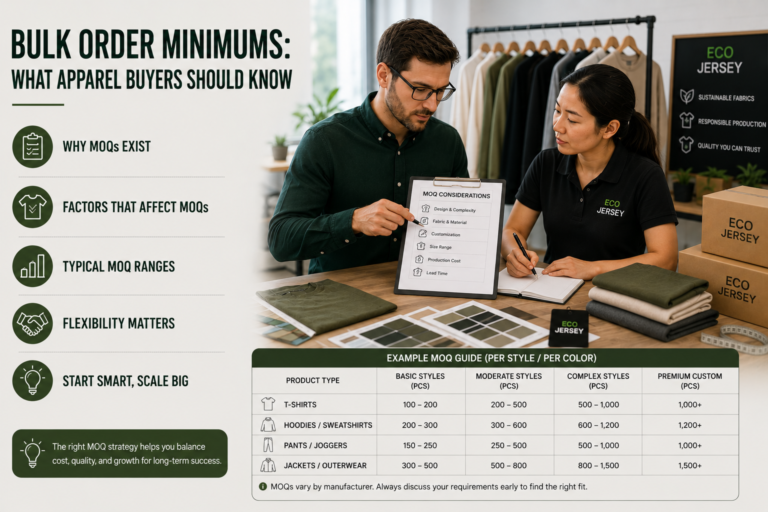
A bulk order minimums — also called a minimum order quantity or MOQ — is the smallest number of units a manufacturer will produce in a single order. Below that number, the factory simply won’t take the job.
Every manufacturer sets their own MOQ. Some require 1,000 units per style. Others work comfortably at 50 or 100. The number depends on the factory’s size, equipment, setup costs, and the type of garment being produced.
Understanding bulk order minimums before you approach any manufacturer saves you a lot of time. It also helps you shortlist the right factories for your current stage of growth — rather than pitching to factories that will never work at your volume.
Why Do Manufacturers Set Minimum Order Quantities?
This is the question most buyers want answered. And the honest answer is — it comes down to economics.
Every production run has fixed costs. Setting up the cutting machinery, preparing the fabric, calibrating the sewing lines, and running quality checks all take time and money — regardless of how many units you’re making. If a factory produces 50 units, those fixed costs get spread across 50 pieces. If they produce 1,000 units, those same costs spread across 1,000 pieces — making each unit far more cost-efficient.
Additionally, fabric is almost always purchased by the roll. A factory buying fabric for your order will have leftover material if your quantity is too small. That leftover represents a direct financial loss for the manufacturer.
So bulk order minimums are not arbitrary. They protect the factory’s margins while keeping your per-unit cost at a level that makes commercial sense.
Know Your Numbers Before You Approach Any Factory
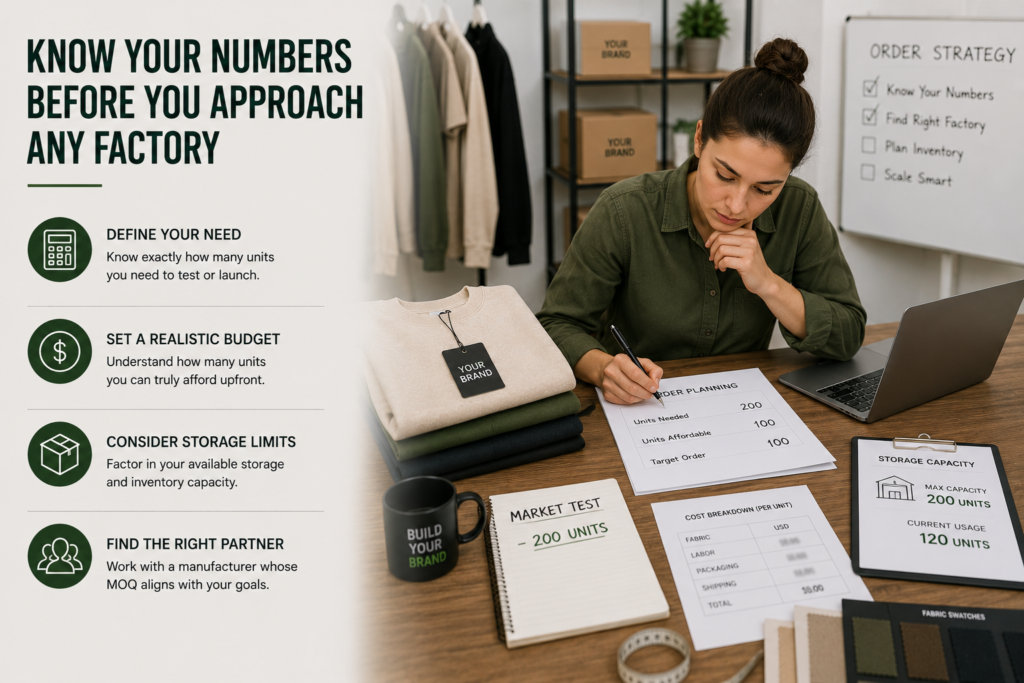
Knowing your production numbers, budget limits, and storage capacity before approaching a factory helps brands choose the right apparel manufacturing partner.
Before you contact a single manufacturer, get clear on how many units you actually need — and how many you can realistically afford to order.
These are often two very different numbers. A brand might need 200 units to test the market but can only afford 100 upfront. Or they might want 500 units but their storage capacity only handles 200 at a time.
Being honest with yourself about these numbers upfront saves you from entering conversations with factories that are the wrong fit. A bulk apparel manufacturer built for large volume runs is simply not the right partner for a brand testing a new product at 100 units.
Look for Low MOQ Options If You Are Starting Out
If your order volume is small, the good news is that low MOQ manufacturers exist specifically for brands at your stage. These factories are set up to handle smaller runs efficiently — without the financial pressure of committing to large quantities you’re not ready for.
A low MOQ clothing manufacturer allows you to start with manageable quantities, validate your product in the market, and scale your orders as demand grows. This is the smartest way to enter bulk production without overextending your budget.
The trade-off is that per-unit costs are typically higher at lower quantities. But that higher cost per unit is almost always worth it compared to the risk of sitting on 1,000 unsold garments.
Consider Made-to-Order Manufacturing for Maximum Flexibility
If unpredictable demand makes committing to fixed bulk quantities difficult, made-to-order manufacturing offers a practical alternative.
Rather than producing a large batch upfront and holding stock, a made-to-order apparel manufacturer produces garments only when an order is placed. This eliminates the risk of overproduction, reduces storage costs, and keeps your cash flow in much better shape.
Made to order works particularly well for brands with wide product ranges, seasonal collections, or highly customised products where holding pre-made stock simply isn’t practical.
Understand How MOQ Changes With Different Manufacturing Models
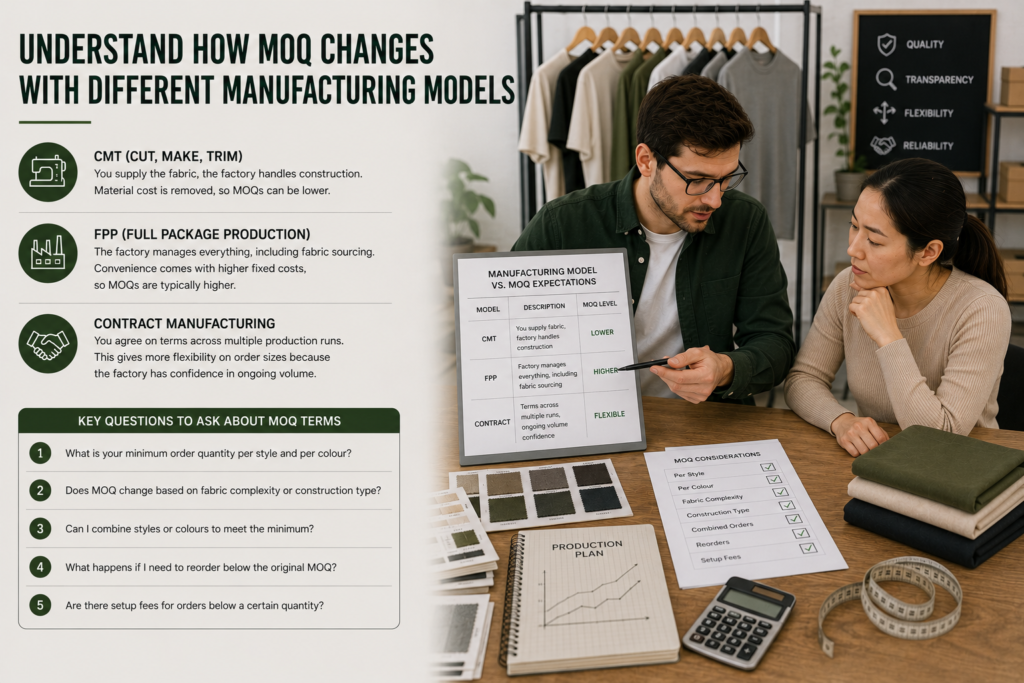
Different apparel manufacturing models come with different MOQ expectations, production flexibility, sourcing responsibilities, and long-term ordering advantages.
Bulk order minimums are not fixed across all manufacturing models. Different approaches to production come with different MOQ expectations — and understanding this helps you choose the right model for your situation.
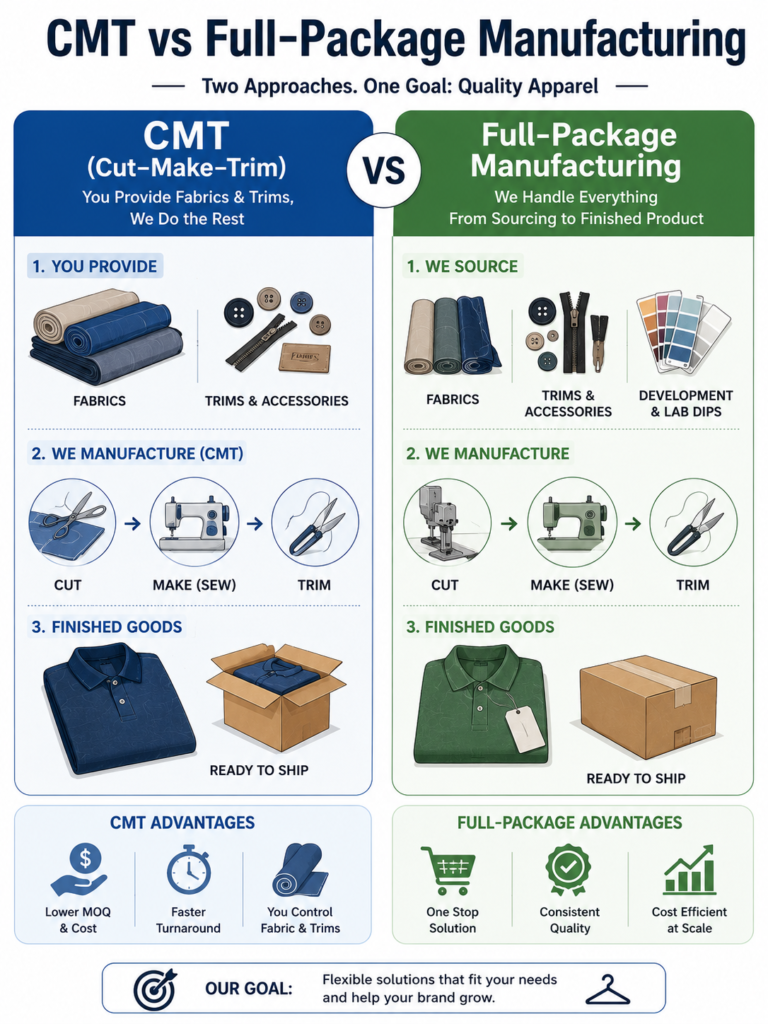
With a CMT clothing manufacturer, you supply the fabric and the factory handles construction. Because the factory’s material cost is removed from the equation, CMT arrangements can sometimes accommodate lower minimums than full-package production.
With a FPP apparel manufacturer, the factory manages everything — fabric sourcing included. The convenience comes with higher fixed costs, which typically means higher MOQs to make each run financially viable for the factory.
With a contract clothing manufacturer, you agree on terms across multiple production runs. This often gives you more flexibility on individual order sizes because the factory has confidence in ongoing volume over time.
Here are the key questions to ask any manufacturer about their MOQ terms:
What is your minimum order quantity per style and per colour?
Does MOQ change based on fabric complexity or construction type?
Can I combine styles or colours to meet the minimum?
What happens if I need to reorder below the original MOQ?
Are there setup fees for orders below a certain quantity?
Factor Sustainability Into Your Bulk Order Planning
As your brand grows and your order volumes increase, sustainability becomes an increasingly important part of your production planning. Larger bulk orders mean more fabric consumption, more energy use, and more waste — unless your manufacturer has responsible practices built into their process.
Working with a sustainable apparel manufacturer from early on means your production scales responsibly. They can advise on certified fabric options, responsible dyeing processes, and waste-reduction strategies to keep your bulk production aligned with your brand values as volumes grow.
Conclusion
Bulk order minimums are not a barrier — they are simply a reality of how manufacturing works. Once you understand why they exist and how different manufacturers approach them, you can confidently plan your production strategy around them.
Start with honest numbers. Find a manufacturer whose MOQ matches your current stage. And choose a production model that gives you the flexibility to scale as your brand grows.
When you’re ready to move forward, explore the full range of bulk apparel manufacturing options and find the right fit for your order volume and production goals.
FAQs
What is a bulk order minimums in apparel manufacturing?
It is the smallest number of units a manufacturer will produce in a single order — also known as a minimum order quantity or MOQ.
Why do manufacturers set minimum order quantities?
Because every production run has fixed setup costs. Spreading those costs across a larger number of units makes each unit more cost-efficient for both the factory and the buyer.
Can I negotiate a lower MOQ with a manufacturer?
Sometimes, especially if you commit to repeat orders or accept higher per-unit pricing. Always ask, but understand that very low quantities may simply not be viable for some factories.
What is the difference between low MOQ and made to order manufacturing?
Low MOQ means the factory produces small but fixed batches. Made-to-order means the factory produces only when a specific order is placed — eliminating the need to hold stock entirely.
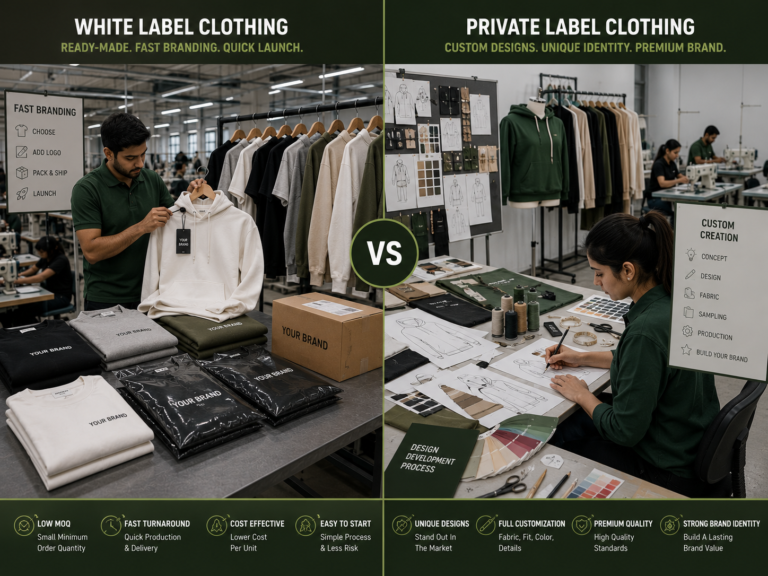
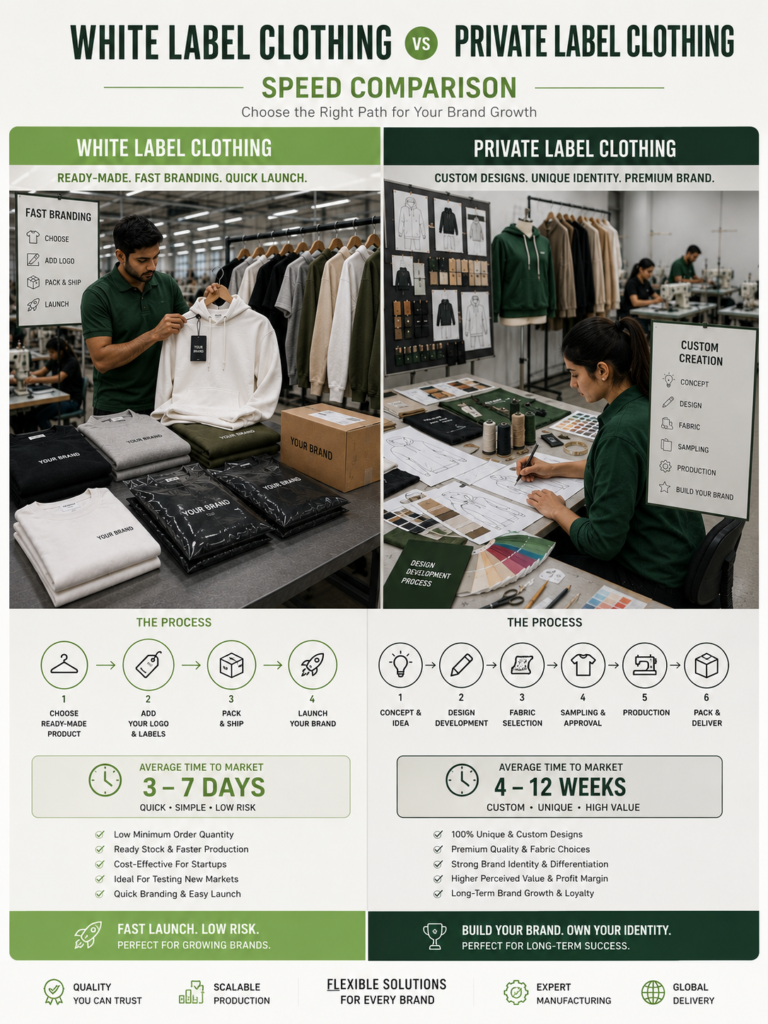
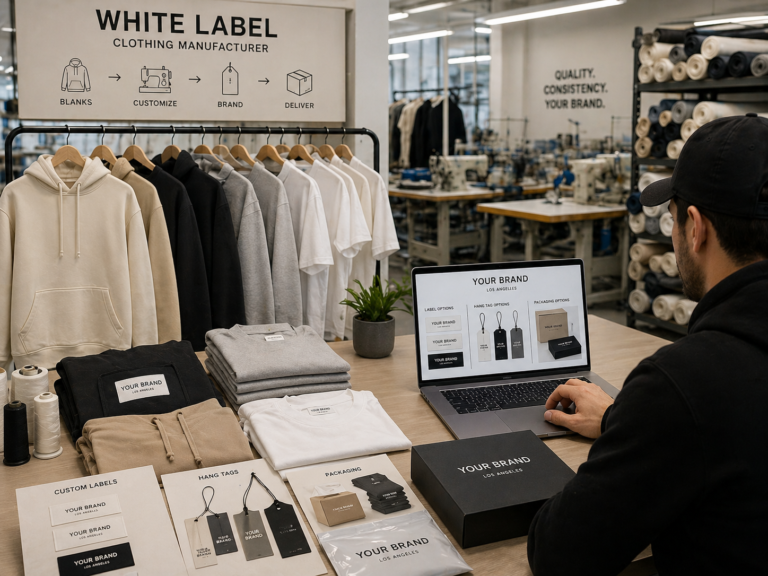
White Label vs Private Label Clothing explains two ways to create clothes for your own brand. White label is a quick way to brand ready-made products. Private label creates custom designs just for you. Businesses choose one over the others based on their needs and speed. Knowing these differences will help you make the right choice for your business.
What is White Label Clothing?
White label clothing is simply plain clothes that are made by factories first. Later, you can add your name, logo, and tags. ECO JERSEY, for example, offers ready-made t-shirts or hoodies. You can then print them quickly with your design. White Label vs private Label Clothing begins here with white-label speed. It costs less too because the items are already available.
What is private label clothing?
Private label clothing is a completely custom-made product. The factory will take your designs, fabrics and styles. The factory creates everything for you. You might want pants that are unique. Private Label Clothing vs White Label shows that private label takes more time. You can control each and every detail.
White Label Clothing vs Private Label Clothing: Speed Comparison
White label vs private label clothing manufacturing speed comparison.
Private Label vs White Label Clothing is most different in terms of speed. White label launches within weeks, because the clothes are ready. Branding is easy to add. Private label takes months to test and develop new designs. White label is more suitable for urgent trends. Plus, ECO JERSEY always ships white label orders quickly.
The cost differences between White Label and Private Label Clothing
The cost of Private Label vs White Label Clothing varies greatly. No design fees are charged for white label. Stock items are purchased in bulk at low prices. Private label is more expensive for samples and custom work. Private labeling requires large minimum orders before it can be used. White label is a good way to start saving money.
White Label Clothing vs Private Label Clothing: Control Level
Visual overview of customization and creative control in private label apparel.
Private Label Clothing vs White Label also shows control gaps. White label allows only basic changes, such as prints. Styles and sizes are pre-set. Private label allows you to change fabric, shape, and everything. More control, however, means more time and work. White label simplifies the process for new brands.
White Label Clothing vs Private Label Clothing: Risk Factors
Differences in risk between Private Label and White Label. Small test orders with White Label lowers the risk. Sales are visible before large purchases. Full custom runs are a high-risk option for private label. You lose money if designs do not work. White label allows you to easily switch styles if necessary.
White Label vs. Private Label Clothing: What are the Best Uses?
Private Label vs White Label Clothing is for different purposes. White label is great for quick launches and current trends. It’s a favorite of startups and online stores. Pick private label for unique products later. Special lines are used by big brands. ECO JERSEY, for example, is great at both but excels in white-label speed.
Features
White Label Clothing
Private Label Clothing
Launch Time
Weeks
Months
Cost
Low-cost
High-quality
Customization
Basic
Full-time
Minimum Order
Small
The Large
Risk
Low-cost
High-quality
Who should choose between white label and private label clothing?
White label is the preferred choice for new brands in Private Label vs. White Label. You can grow quickly without the stress of a factory. Smartly mix the two ways for growing shops. Private label is used by large companies only for their main lines. Influencers also test out white label merch before launching their own. Match your stage with the right choice.
Conclusion
White Label vs. Private Label Clothing will help you choose the best path to success. White label is the winner for its speed, low costs, and ease of use with ECO JERSEY. Private label is more expensive, but it allows for customization. You now know the main differences. Choose white label today to launch your brand tomorrow.
FAQs
What is the difference between Private Label and White Label?
White label is a quick way to get ready-made clothes. Private label creates custom clothing from scratch. They are distinguished by their speed and low cost.
What is the difference between Private Label and White Label Clothing in terms of price?
White label costs less. Small orders and no design fees save money.
Can startups use Private Label vs White Label Clothing?
White label is a great option for startups because it allows them to launch quickly and with low risk.
Why choose private label clothing over white labels in White Label or Private Label Clothing?
After your brand becomes strong, you can choose to have private designs or full-custom designs.
Does ECO JERSEY offer Private Label vs White Label clothing?
ECO JERSEY is a white label jersey that excels at speed, but also handles both options.
Most brands have a vision for the end result of their product. What is overlooked is the difficulty of taking that vision and consistently and effectively creating thousands of garments through an efficient use of time and money.
Each step of the complex process of turning an image into garments is made simple by Custom bulk apparel solutions.
The process of Custom bulk apparel solutions is made straightforward for you by this guide and the complexity is explained step-by-step.
What are Custom Bulk Apparel Solutions?
Everything that a client can modularly pick from a process designed to facilitate the bulk production of clothing is what we mean by Custom Bulk Apparel Solutions.
Mass wholesale solutions usually have little flexibility. This is not the case here. Clients can fully dictate all aspects of apparel production from design and construction to printing and artwork and even the construction and type of packaging.
Because of the tailor-made nature of these solutions, each client is responsible for every detail of the process. Clients must, therefore, have a reliable and quality manufacturing partner.
Start With a Clear Design Brief
Professional Custom Bulk Apparel Solutions begin with a clear design brief, accurate tech packs, fabric planning, and detailed product development specifications.
Every successful custom bulk order starts with a clear brief. Not a rough idea — a proper, detailed brief that covers everything your manufacturer needs to understand your product.
Your brief should include the garment type, target end use, fabric preferences, construction requirements, sizing range, branding details, and any specific performance requirements. The more detail you include at this stage, the fewer surprises you’ll encounter later.
This brief becomes the foundation for your tech pack — the document that turns your design into a manufacturable specification. A FPP apparel manufacturer can guide you through this process from the very beginning, handling fabric sourcing, development, and production under one roof.
Choose the Right Manufacturing Model for Your Brand
Custom bulk apparel solutions are not one size fits all. The manufacturing model you choose depends on how much of the process you want to manage yourself — and how much you want to hand off to your factory.
If you already have your fabric sourced and want the factory to handle construction only, a CMT clothing manufacturer gives you full material control while keeping production focused and cost-effective.
If you need a long-term production partner who manages your ongoing orders under a formal agreement, a contract clothing manufacturer provides reliability and pricing consistency across multiple runs.
If flexibility is your priority — producing only when orders come in without holding excess stock — a made-to-order apparel manufacturer keeps your operation lean and your cash flow healthy.
Choosing the right model before you start saves significant time and money later.
Compile and Confirm Your Samples
Once your brief and manufacturing model are finalized, your manufacturer can begin to develop your samples, bringing your design one step closer to reality. This step is crucial because your design will manifest for the first time as a physical garment.
At this step, your manufacturer will create a prototype, and you have the opportunity to test the fit, fabric, and nishing touches. If things are not as you envisioned, this step is crucial to fixing it as this is your last opportunity before production.
A good sample takes time, and it is not uncommon for a sample to go through two or three iterations before approval. This step is not one to rush as it is much more costly to the process to rush this step than to take a couple weeks to let everything progress.
When looking over samples, it is key to look for:
Measurements for your size samples
Fabric that matches your texture, weight, and stretch desires
Quality stitching
Placement and quality of branding
Fit across the full range of your size samples
Scale Into Bulk Production With the Right Partner
Once your sample is approved, bulk production begins. This is where the volume kicks in — and where having the right manufacturing partner makes all the difference.
A dedicated bulk apparel manufacturer has the capacity, the systems, and the trained workforce to maintain consistent output across large runs. They understand that unit 5,000 needs to look exactly like unit one — and they build their production process around that standard.
For brands starting out or testing a new product line, a low MOQ clothing manufacturer allows you to enter bulk production at a manageable scale — without the financial pressure of overcommitting to large quantities before you’ve validated demand.
Build Sustainability Into Your Production From the Start
More brands are building sustainability into their production — not as a marketing angle, but as a genuine operational standard. And the earlier you build it in, the easier it is to maintain at scale.
This means choosing certified sustainable fabrics, working with manufacturers who have responsible labour practices, and minimising waste throughout the production process.
A sustainable apparel manufacturer brings all of these standards into your custom bulk apparel solutions from day one. They can guide your fabric choices, advise on low-impact processes, and provide the documentation your retail partners and customers increasingly expect.
Manage Quality From Production to Delivery
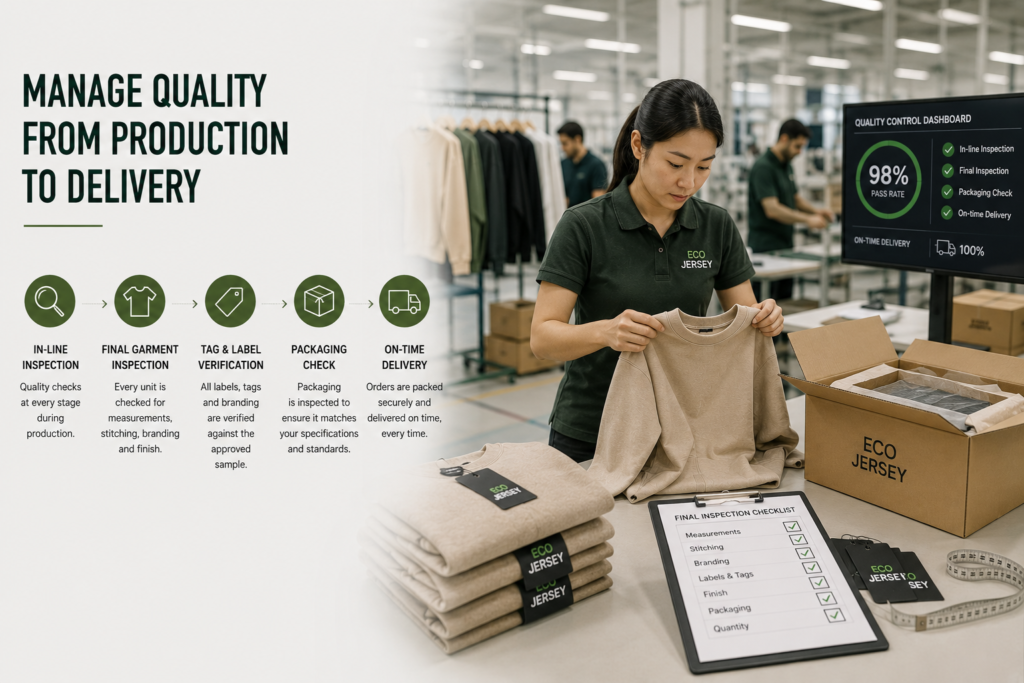
Reliable Custom Bulk Apparel Solutions include final quality control, branding verification, secure packaging, and on-time delivery management for bulk apparel orders.
Quality control doesn’t end when the garments come off the production line. It runs all the way through to final packaging and delivery.
Every unit needs to be checked before it’s folded, tagged, and packed. Measurements, stitching, branding, and finish — all verified against the approved sample. Packaging needs to match your specifications. And delivery needs to hit your timeline.
This final stage is where a lot of custom bulk orders lose consistency. Brands focus heavily on production quality but underestimate how much can go wrong in finishing and logistics. Work with a manufacturer who treats the last stage of the process with the same care as the first.
Conclusion
Custom bulk apparel solutions work best when every stage of the process is planned carefully — from the design brief to the final delivery. The brands that get this right consistently are the ones who invest time upfront, choose the right manufacturing model, and work with partners who take quality as seriously as they do.
If you’re ready to move forward, explore the full range of custom bulk apparel solutions and find the right approach for your brand.
FAQs
What are custom bulk apparel solutions?
They refer to the end-to-end process of designing, developing, and manufacturing garments in large quantities — built specifically to a brand’s requirements rather than using off-the-shelf wholesale options.
How many sample rounds should I expect before bulk production?
Most brands go through two to three sample rounds before final approval. Complex garments or technical fabrics sometimes require more.
What is the difference between CMT and FPP manufacturing?
CMT means you supply the fabric and the factory handles construction. FPP means the manufacturer manages everything — from fabric sourcing to finished garment.
How do I ensure quality consistency across a large bulk run?
Use a detailed tech pack, approve a sample before bulk begins, and work with a manufacturer who has clear in-line and final inspection processes throughout production.
Whether you’re starting a new fashion brand or an established brand, the benefits of working with a white label clothing manufacturer let you save on time, build your brand with less stress and more quickly, and focus on marketing and sales, which is why this business model is popular.
Launch Your Brand Faster
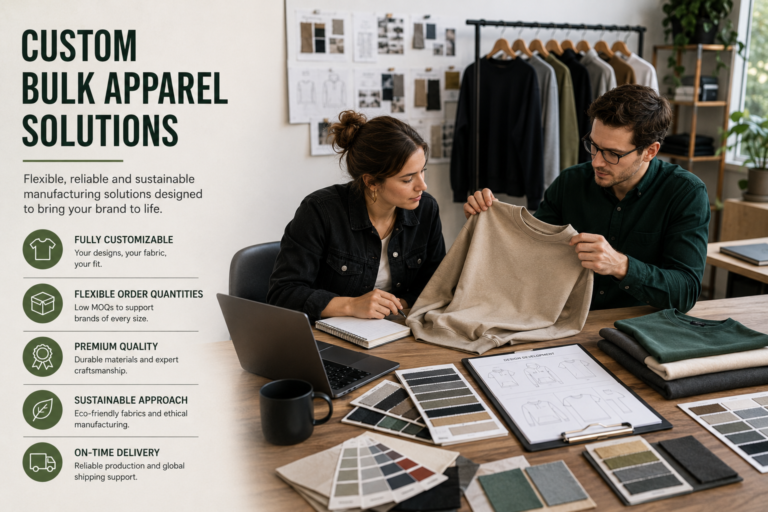
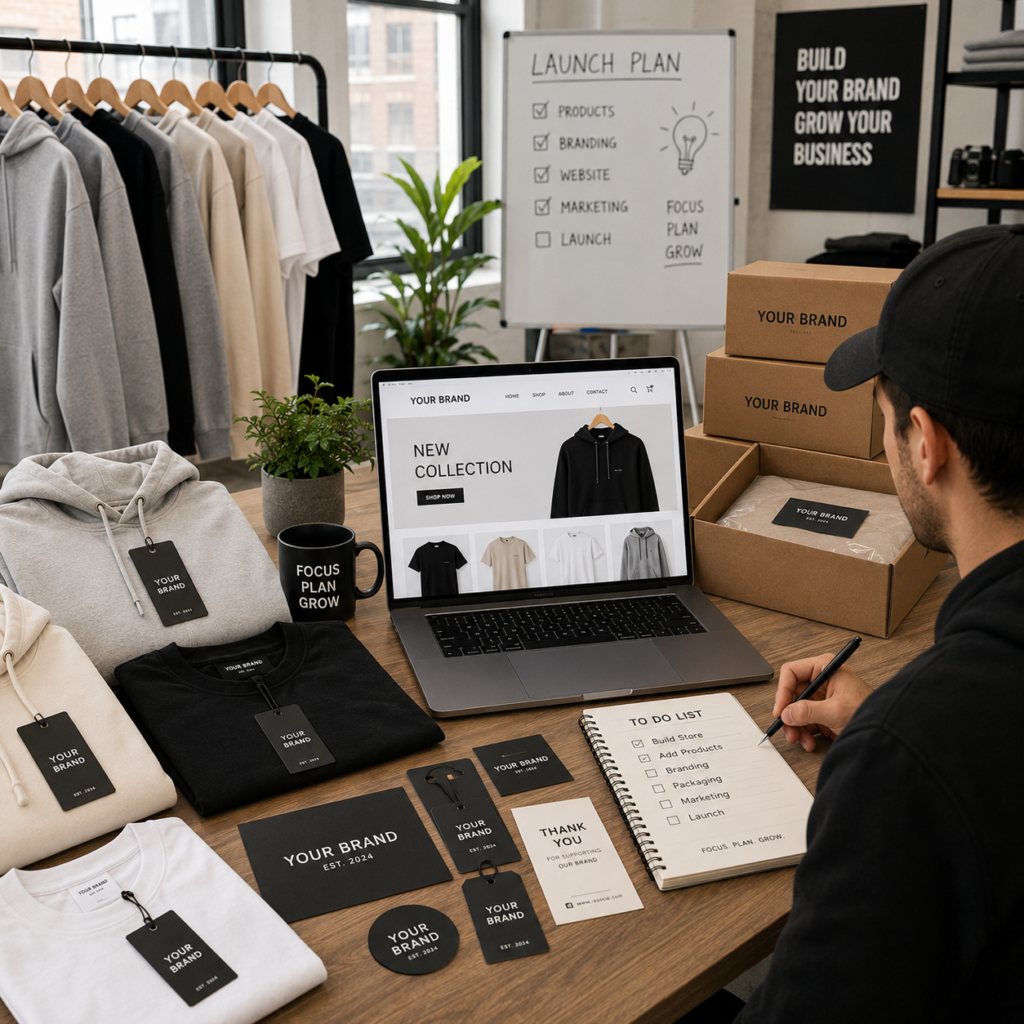
Modern workspace setup for creating a new apparel brand.
The benefits of partnering with a white-label clothing manufacturer give you the speed advantage. You no longer need to build a factory or create clothing from nothing. Instead, you have the clothing and simply add your brand. This allows you to launch your store faster, meaning you can start making sales while your competitors are still working on their plans.
Reduce Your Business Risk
The benefits of partnering with a white-label clothing manufacturer also help you to reduce the risk of starting a business. You no longer need to commit a significant amount of money to develop a product. You can also test your brand to see how potential customers react before you commit to a large order. This allows you to understand what drives customers, making the business safer and smarter.
Stronger Focus
One of the main Benefits of Working With a White Label Clothing Manufacturer is having the time to grow. Since your clothing manufacturer deals with the production of the apparel, you have more time to deal with the branding, advertisements, and customer service. This adds to the effectiveness and easiness of your work. Aside from this, you have the time to build a strong relationship with your buyers. The trust you build with your buyers grows your brand and gives it a strong foundation.
Seamless Scalability
One of the easiest Benefits of Working With a White Label Clothing Manufacturer is seamless scalability. An increase in sales means an increase in orders, and since a clothing manufacturer deals with production, they have the capacity to fill the orders. This allows your brand to grow. Moreover, they have the capacity to deal with the production of multiple designs and product lines. With a white label partner, growth becomes seamless and easy.
Consistent Quality
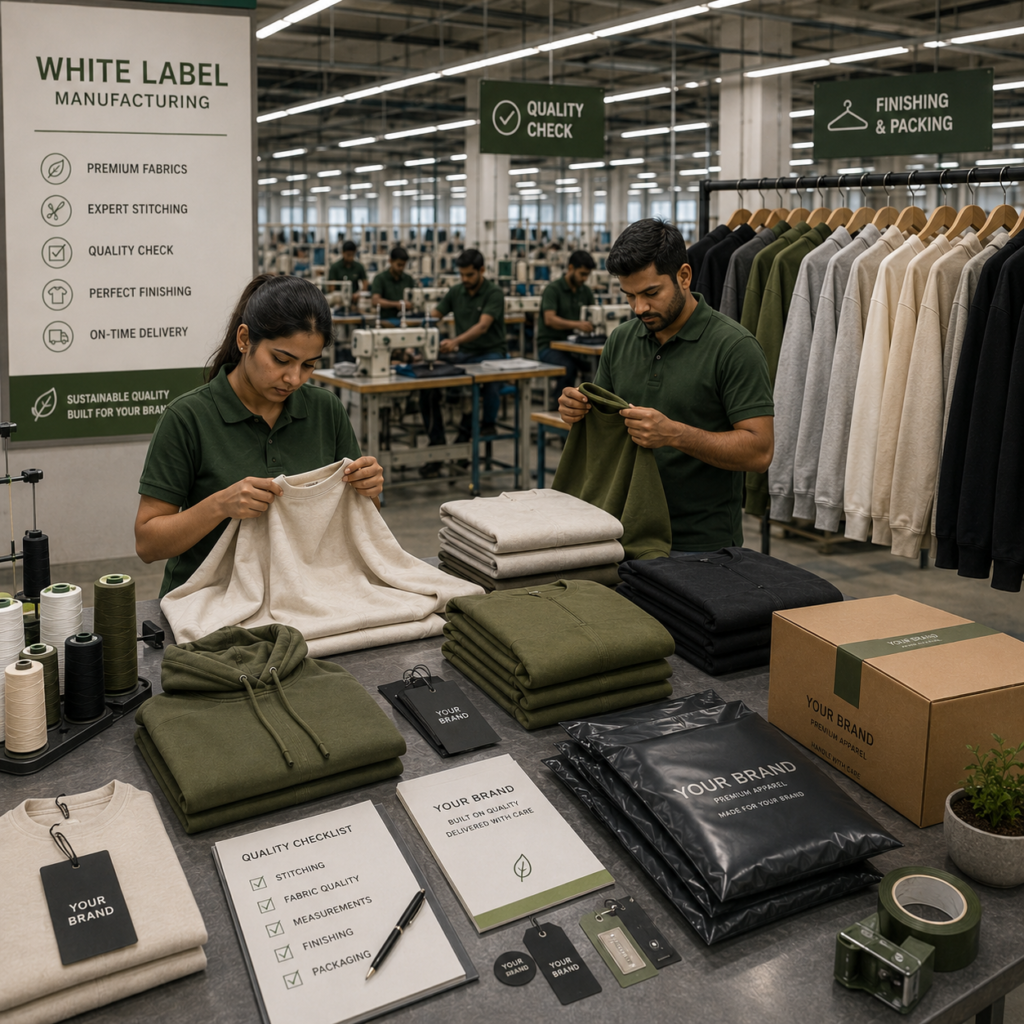
Quality control in garment manufacturing at a white label clothing factory.
One of the main Benefits of Working With a White Label Clothing Manufacturer is a quality partner gives you quality products. An established manufacturer has the skills and knowledge of all the things that involve apparel, from fabrics and stitching to fit and finishes. Therefore, your products look more professional and are more appealing to your customers. Quality products build a better brand and sales.
Brand Distinction
Creating your brand image is another advantage of Working With a White Label Clothing Manufacturer. This gives you the freedom to fully brand your products using your logo, labels, and packaging as well as your brand design. This freedom to brand and design gives your products a distinct look from all the other products on the market, which helps your brand be more memorable.
Conclusion
Unique brands that wish to expand quickly and remain adaptable should take note of the advantages of collaborating with a white-label manufacturer. They simplify the entire process, reduce the risk of starting something new, and allow you to concentrate on sales and branding with more time, effort, and risk. They even allow you to provide a quality product without all the necessary components, and it is a cost-efficient and practical option for small and new fashion businesses. Overall, it is a quick, easy, and simple manufacturing and supply solution for those starting out.
FAQs
What are the main benefits of working with a white label clothing manufacturer?
Some of the benefits of working with a white label clothing manufacturer are faster product launches, lower costs, and reduced risks that allow you to concentrate on sales and branding.
Is white label clothing good for small businesses?
Yes. There are lower start-up costs without the same level of risk compared to clothing manufacturing.
Can I build my own brand with white label clothing?
Yes, you build a brand with white label clothing by putting your logo on them, and also your labels and packaging.
Does a white label manufacturer help with product quality?
Yes, they help with product standards, fabric quality, stitching, and finishing.
Why do brands opt for white label clothing manufacturing?
They opt for white label clothing manufacturing as it saves time, helps with expansion, and simplifies the process of doing business.
As a brand owner, one of the most critical decisions you’ll have to make is choosing the right bulk apparel manufacturer. Making the right decision will make it easy to scale your business. If you make the wrong decision, late shipments, poor product quality, and financial losses will become part of your experience.
Unfortunately, most brands don’t know what to look for until they experience problems. This guide explains the factors you must think about before you partner with any manufacturer.
Why Choosing the Right Manufacturer Matters More Than Most Brands Consider
Making a bulk order requires a significant commitment. You make a large investment, and establishing a quality standard at volume becomes exceedingly difficult. You’re left with a lot of problems including, but not limited to, returns, reorders, an unhappy customer base, and lost opportunities to meet retail deadlines.
Selecting the right bulk apparel manufacturer means they will do more than just make clothes. They will become a partner in your production process, and they will be valuable for understanding your product, your quality control standards, and your production timelines.
Think About Your Production Needs Before You Start Shopping
Before you start checking out manufacturers, you need to understand your needs. How many pieces do you have to make? How will you construct the pieces, and what kind of fabrics do you need? When do you need the clothes by? What kind of customers do you have?
These factors will bring you to the right manufacturers. It will be evident that the manufacturer known for fast fashion basics will not be a good fit for the manufacturer that specializes in performance apparel.
If you need large volume with consistent output, a dedicated bulk apparel manufacturer with the capacity and systems for high-volume runs is exactly what you need. Knowing this upfront saves you from wasting time with factories that simply aren’t the right fit.
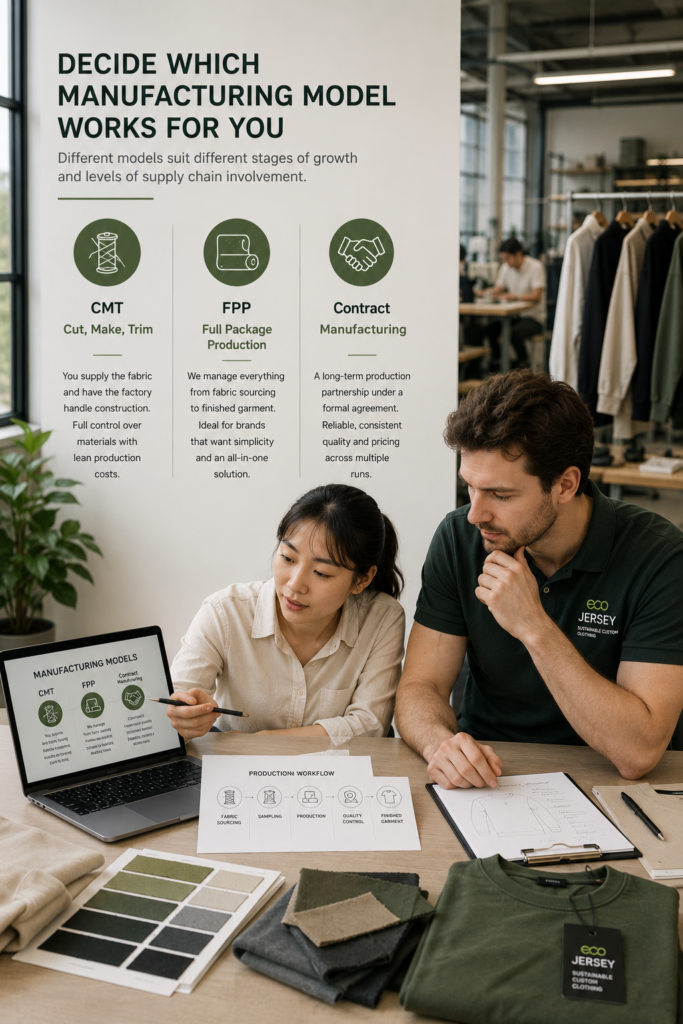
Decide Which Manufacturing Model Works for You
Choosing the right apparel manufacturing model helps brands streamline sourcing, production, and long-term supply chain management for scalable growth.
Not every brand needs the same manufacturing approach. Before choosing a right bulk apparel manufacturer, you need to understand which model fits your business — because different models suit different stages of growth and different levels of supply chain involvement.
If you want to supply your own fabric and have the factory handle construction, a CMT clothing manufacturer gives you full control over materials while keeping production costs lean.
If you’d rather hand off the entire process — from fabric sourcing to finished garment — a FPP apparel manufacturer manages everything end to end. This is a popular choice for brands that want simplicity and don’t have an in-house sourcing team.
If you need a long-term production partner who handles ongoing orders under a formal agreement, a contract clothing manufacturer gives you reliability and pricing consistency across multiple runs.
Choosing the right model before approaching any factory makes the entire conversation clearer and more productive.
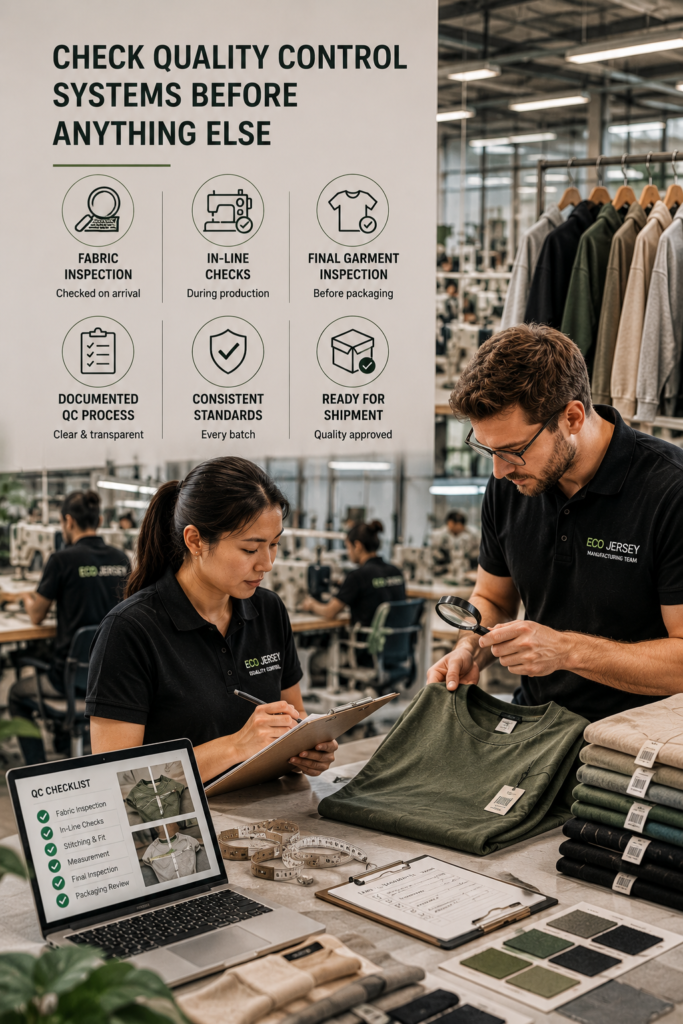
Check Quality Control Systems Before Anything Else
Evaluating quality standards, production capabilities, and manufacturing processes before choosing the right bulk apparel manufacturing partner.
Quality control is where most right bulk apparel manufacturer relationships succeed or fail. A manufacturer might produce great samples, but samples are produced carefully. Bulk production is where the real quality test happens.
Before committing to any manufacturer, ask specifically about their QC process. How do they inspect fabric on arrival? What in-line checks happen during production? How is each finished garment checked before packaging?
A right bulk apparel manufacturer will have clear, documented answers to all of these questions. If they can’t explain their QC process confidently, that’s a strong signal to keep looking.
Consider Sustainability in Your Manufacturer Choice
Sustainability is no longer optional for most brands. Retailers expect it. Customers ask about it. And increasingly, regulations require it.
When evaluating right bulk apparel manufacturer, look at their material sourcing, waste management, energy use, and labour practices. A manufacturer that takes sustainability seriously will be transparent about all of these — and will have certifications or documentation to back it up.
Working with a sustainable apparel manufacturer not only aligns your brand with growing consumer expectations — it also reduces the risk of supply chain issues tied to regulatory or reputational pressures down the line.
This is worth factoring into your decision from the start, not as an afterthought once you’re already in production.
Evaluate Flexibility and Minimum Order Requirements
Not every brand is ready to jump into large bulk orders immediately. Some brands need to test the market first — validating their product with smaller quantities before scaling up.
If that sounds like your situation, look for a manufacturer who offers flexibility. A low MOQ clothing manufacturer lets you start with manageable quantities and grow your orders as your demand increases — without the financial risk of overcommitting upfront.
Equally important is whether the right bulk apparel manufacturer can scale with you. The right partner should be able to handle your order volumes today and your larger volumes in six or twelve months time.
Here are the key flexibility questions to ask any manufacturer:
What is your minimum order quantity per style?
Can you accommodate mixed fabric or colour runs within one order?
How do you handle reorders and repeat production?
What lead times should I expect at different order volumes?
Can you scale production if my order sizes increase?
Request Samples and Visit If You Can
Never commit to right bulk apparel manufacturer you haven’t sampled with first. A sample tells you more about a factory’s capabilities than any sales pitch or portfolio ever will.
Request a sample of your specific product — using your fabric, your construction specs, and your branding. Evaluate the stitching quality, the measurement accuracy, the print or embroidery finish, and how the garment holds up after washing.
If it’s practical, visit the factory in person. Seeing the production floor, meeting the team, and understanding how the operation runs gives you confidence that no sample or video call can fully replicate.
A made to order apparel manufacturer who takes the sampling process seriously is a strong sign that they’ll take your bulk production just as seriously.
Conclusion
Choosing the right bulk apparel manufacturer takes time and due diligence — but it’s one of the most valuable investments you can make in your brand. The right partner brings consistency, reliability, and the capacity to grow with you.
Start with your own requirements. Understand which manufacturing model fits your business. Check quality systems thoroughly. And always sample before you commit to bulk.
When you’re ready to take the next step, explore the full range of bulk apparel manufacturing options and find the right fit for your production goals.
FAQs
What is a bulk apparel manufacturer?
A right bulk apparel manufacturer produces garments in large quantities — typically for brands, retailers, and teams that need consistent output across hundreds or thousands of units.
What is the difference between CMT and FPP manufacturing?
CMT means you supply the fabric and the factory handles cutting, making, and trimming. FPP means the manufacturer manages the entire process including fabric sourcing.
How do I verify a manufacturer’s quality control process?
Ask for a detailed explanation of their QC steps — fabric inspection, in-line checks, and final inspection. A reliable manufacturer will have clear, documented answers.
What minimum order quantity should I expect from a bulk manufacturer?
It varies by factory and product type. Some manufacturers offer low MOQ options for brands starting out. Always confirm MOQ before entering any production agreement.
If you’re new to the fashion industry, you may come across the term CMT Clothing Manufacturing. CMT stands for Cut, Make, Trim. With this method, brands send fabric and design, and the factory handles the production.
If a brand wants full control over the quality of the fabrics and trims, they would prefer CMT services. If a business is after reliable production at scale, a Bulk Apparel Manufacturer can swiftly bring the design to the finished product.
How CMT Clothing Manufacturing Works
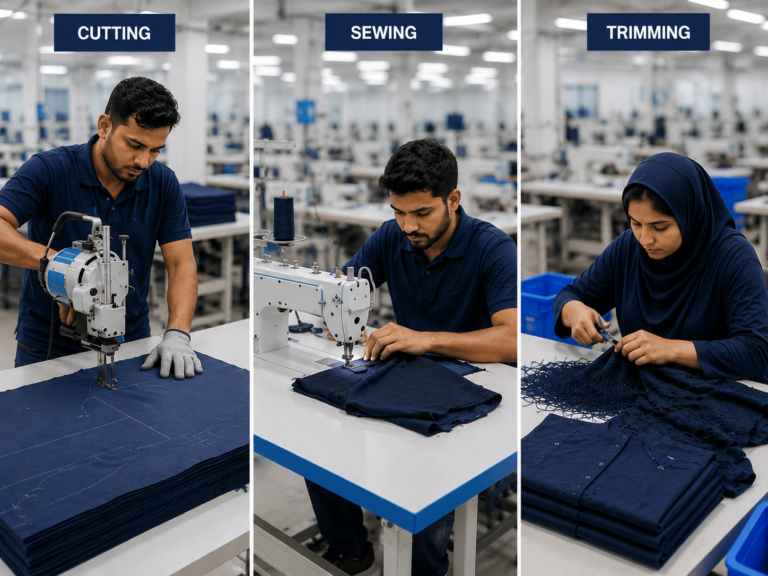
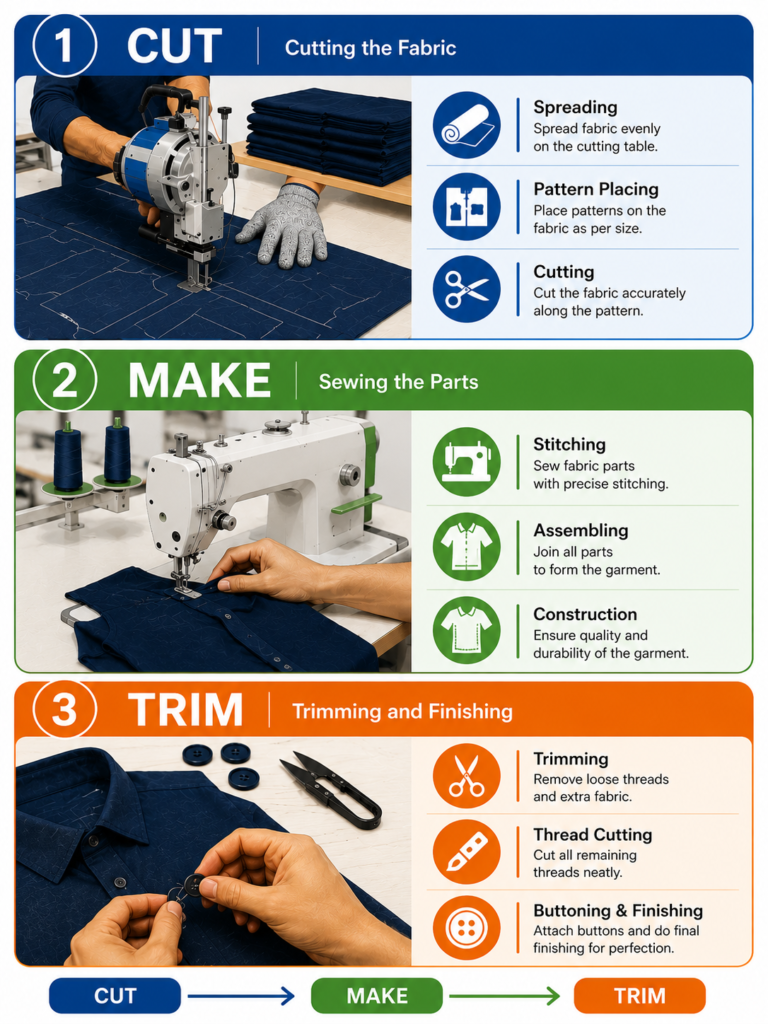
The clothing manufacturing process follows three main steps — cutting fabric according to patterns, sewing the cut pieces together, and finally trimming and finishing the garments for quality and appearance.
A CMT setup comprises three stages in the production process:
Cut: The fabric is shaped to your design as a pattern.
Make: The fabric is assembled into garments by sewing.
Trim: Adding buttons, labels, and other finishings completes the garment.
This option is affordable for brands that already have materials and patterns. Designers who are interested in ethical and sustainable production can receive CMT services with ethical sourcing from a Sustainable Apparel Manufacturer.
Advantages of CMT Clothing Manufacturing
The following are some of the benefits of CMT Clothing Manufacturing:
Material control: Brands provide the fabrics and trims, ensuring the quality of the final product.
Financial reduction: Clients pay for the labor and production services only.
Timely production: Orders are not held up due to production timing.
Design control: Clients decide the design and style overall.
For brands that want to test new collections and have the ability to produce in low volume, the use of a Made-to-Order Apparel Manufacturer is a great option.
CMT vs. Full-Package Production
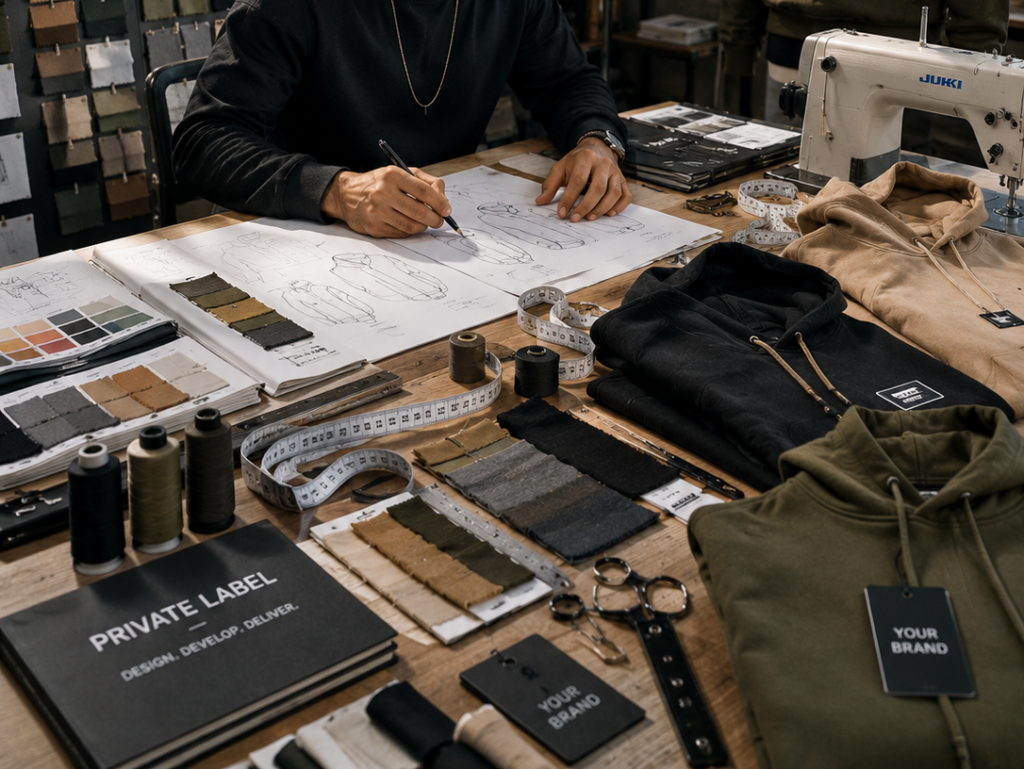
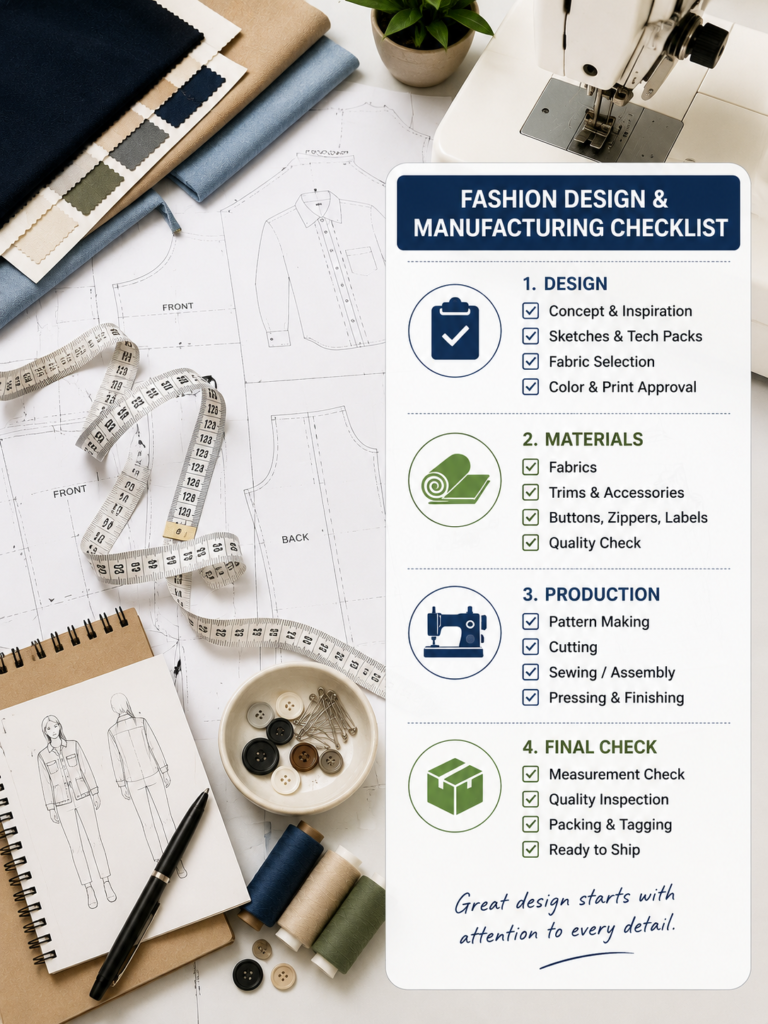
A fashion designer’s workspace captures the full journey from concept to garment — sketches fill the notebook.
CMT is in contrast to full-package production, which means the factory also sources the fabric and trims.
Feature
CMT Manufacturing
Full-Package Manufacturing
Fabric & Trims
Provided by brand
Provided by factory
Cost
Lower
Higher
Control
High
Moderate
Best for
Brands with own materials
Brands without suppliers
CMT Production is often selected by brands that want low cost and already have fabrics in house while new brands often select full-package production. For flexible small runs, a Low MOQ Clothing Manufacturer is the best option.
Suggestions for Collaborating with a CMT Manufacturer
A fashion designer’s workspace captures the full journey from concept to garment — sketches fill the notebook.
For optimal results with CMT services:
Be precise with patterns and specs to reduce errors.
Test run samples and approve before mass production.
Characterize material with details such as the type of fabric, stitching, and the nature of the trimmings, etc.
Quality control checks require frequent monitoring of the progress.
For the brands that want the support of skilled production to be more interactive, the CMT Clothing Manufacturers will help you through the process while keeping the standards of quality intact.
Who Can Benefit From CMT Clothing Manufacturing?
Startups and independent fashion labels.
Designers that incorporate their own trims and fabrics.
Brands that want to manage their own production without a full-package offer.
For designers that want to fully manage their own production at the factory level, an FPP Apparel Manufacturer will manage the production as per your guidelines.
Conclusion
CMT Clothing Manufacturers are great for brands wanting to keep their labor-intensive work to a minimum, to keep their trims, fabrics, and designs in their own hands. With the right manufacturers, they can do just that while getting quality work and saving costs on their work.
Starting your first collection or expanding your company, will be made easier to manage with professional CMT manufacturers, making it a stream-lined production.
FAQs
What does CMT stand for in clothing manufacturing?
CMT is an acronym that stands for Cut, Make, Trim. This process gives the brand the control to provide their own fabric and design, while the factory does the garment production and the finishing touches.
Who should use CMT Clothing Manufacturing?
CMT is suited for brands or designers that provide their own fabric, trims, and designs. They will have the upper hand and control quality as they please.
What is the difference between CMT and full-package manufacturing?
CMT is when a brand supplies fabric and trims. In full-package manufacturing, the factory will source everything. CMT is usually more cost-effective and gives the brand more control.
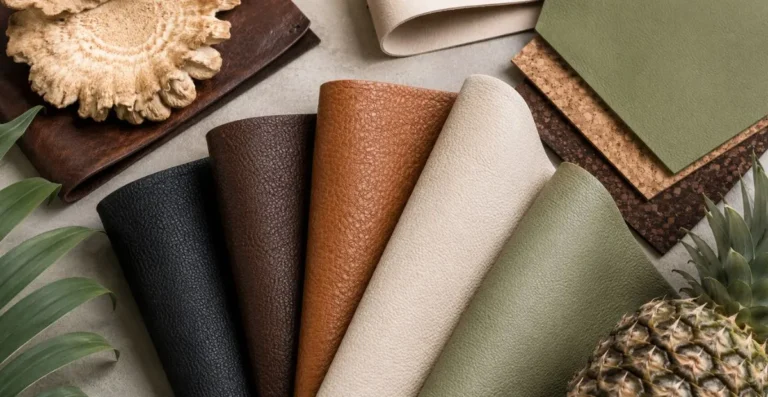
Vegan leather is any leather look-alike that is not made from animal hides. It is most commonly made from synthetic materials like PU (polyurethane) and PVC (polyvinyl chloride) as well as plant-based materials made from pineapple leaves, cactus, mushrooms, apple waste, cork, and grape waste. It is referred to as vegan because it does not contain materials derived from animals. Vegan leather is also preferred by many because it is much cheaper than leather, and does not have ethical and environmental issues like real leather. The biggest variation between different types of vegan leather lies in their sustainability. Some vegan leathers incorporate plastics, while others use bio-based materials that have less environmental impact.
What Is Vegan Leather?
Vegan leather is a material that imitates real leather but is made without using any animal skin. These materials include synthetic leather, artificial leather, faux leather, and plant-based leather alternatives.
Vegan leather is free from animal products and is often marketed as a sustainable fashion alternative, although some versions are synthetic.
The sustainability of vegan leathers can be questionable if they incorporate some of the more environmentally harmful products like synthetic leathers. These, however, can be improved by using agricultural waste or renewable leathers.
Is Vegan Leather the Same as Faux Leather?
Vegan leather is a subset of faux leather. Faux leather is a broader term, and while most faux leathers do not contain animal products, some may use animal-based glues or coatings.
Does Vegan Leather Contain Plastic?
Many vegan leathers contain plastic. This can be PU and PVC leathers. However, there are vegan leathers that have incorporated bio-based materials that have reduced the amount of plastic.
Alternative Names for Vegan Leather
Other names include:
Faux leather
Cruelty-free leather
Plant-based leather
Bio-based leather
Leather alternative
Artificial leather
Synthetic leather
History of Vegan Leather
Synthetic leather was invented in the early 20th century. Early products used rubber-coated fabrics because of the high cost of real leather. This was followed by PVC leather in the 1960s as it was inexpensive and very water resistant. This was soon used for shoes, bags, and upholstered furniture.
In the late 20th century, PU leather replaced a lot of PVC leather products as PU leather was not only softer, but it was also less toxic. At the same time, the demand for animal friendly products increased. Along with recent trends focusing on sustainability, this has led to a lot of innovation with alternative leather products, which are plant based, like mushroom, cactus, apple, and pineapple leathers. Today, vegan leather is at the cutting edge of fashion, biotechnology, material science, and ethics.
What Is Vegan Leather Made Of?
A. Synthetic Vegan Leather
PU Leather
A fabric base coated in polyurethane plastic is called PU leather. Manufacturers use surface embossing to simulate the grain of natural leather. Additionally, PU leather is softer than PVC leather and more flexible.
PVC Leather
PVC leather is a combination of polyvinyl chloride and fabric. Manufacturers add plasticizers to improve flexibility and durability of the product. Furthermore, PVC leather is highly water resistant but has low breathability.
Microfiber Leather
Microfiber leather is a combination of ultra-fine synthetic fibers with PU coatings. It is realistic and durable. Additionally, premium microfiber leather usually has a better lifespan than standard PU leather.
B. Plant-Based Vegan Leather
Pineapple Leather (Piñatex)
Piñatex is a combination of fibers from pineapple leaves that are discarded after harvesting. It is processed into a nonwoven textile material. Additionally, it helps reduce agricultural waste and promotes circular production.
Cactus Leather
Cactus leather is made of cactus leaves that are harvested, and the plant is not killed. The biomass is dried and processed into flexible sheets. Furthermore, cactus leather is produced with very low amounts of water.
Mushroom Leather
Mushroom leather is made from the root structure of fungi called mycelium. Manufacturers grow mycelium into dense mat-like materials. Additionally, mushroom leather has the potential to biodegrade very quickly.
Apple Leather
Manufacturers incorporate unwanted apple bits from juice production in apple leather. They also include apple peels. They combine the peels with synthetic binders and backing materials. Apple leather aids the food industry in reducing their waste.
Cork Leather
Cork leather is from the harvested cork oak trees. The bark is harvested without killing the tree. Cork leather is light, water resistant, and has a natural texture.
Coconut Leather
Plant fiber and waste from coconut water are used in coconut leather. The waste is fermented to produce coconut leather sheets. Coconut leather is used in the coconut industry to aid in the effective reduction of post-harvest waste.
Corn Leather
Bio-polymers derived from cornstarch are used to make corn leather. The material is used with other support layers to make durable fabric. Also, the use of corn leather aids in the reduction of plastic use.
Mango Leather
By making leather substitutes from mango fibers, mango leather uses waste from processed foods. The use of mango leather in the food industry leads to the reduction of waste from the food industry.
Grape Leather
By using the seed and the skins in the wine industry, grape leather aids in the recycling of used materials in the wine industry.
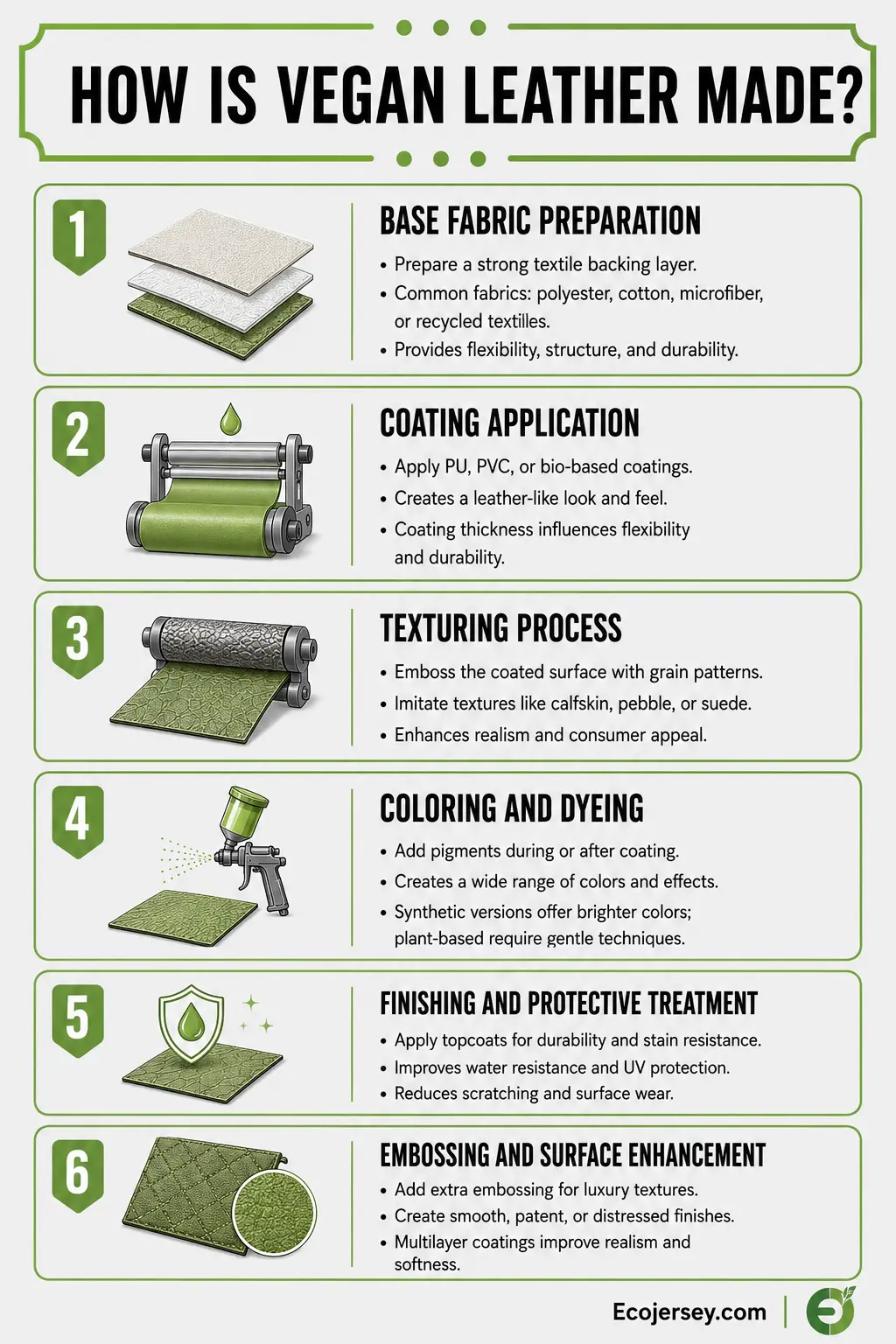
How Is Vegan Leather Made?
Overview of vegan leather production from fabric preparation to surface finishing
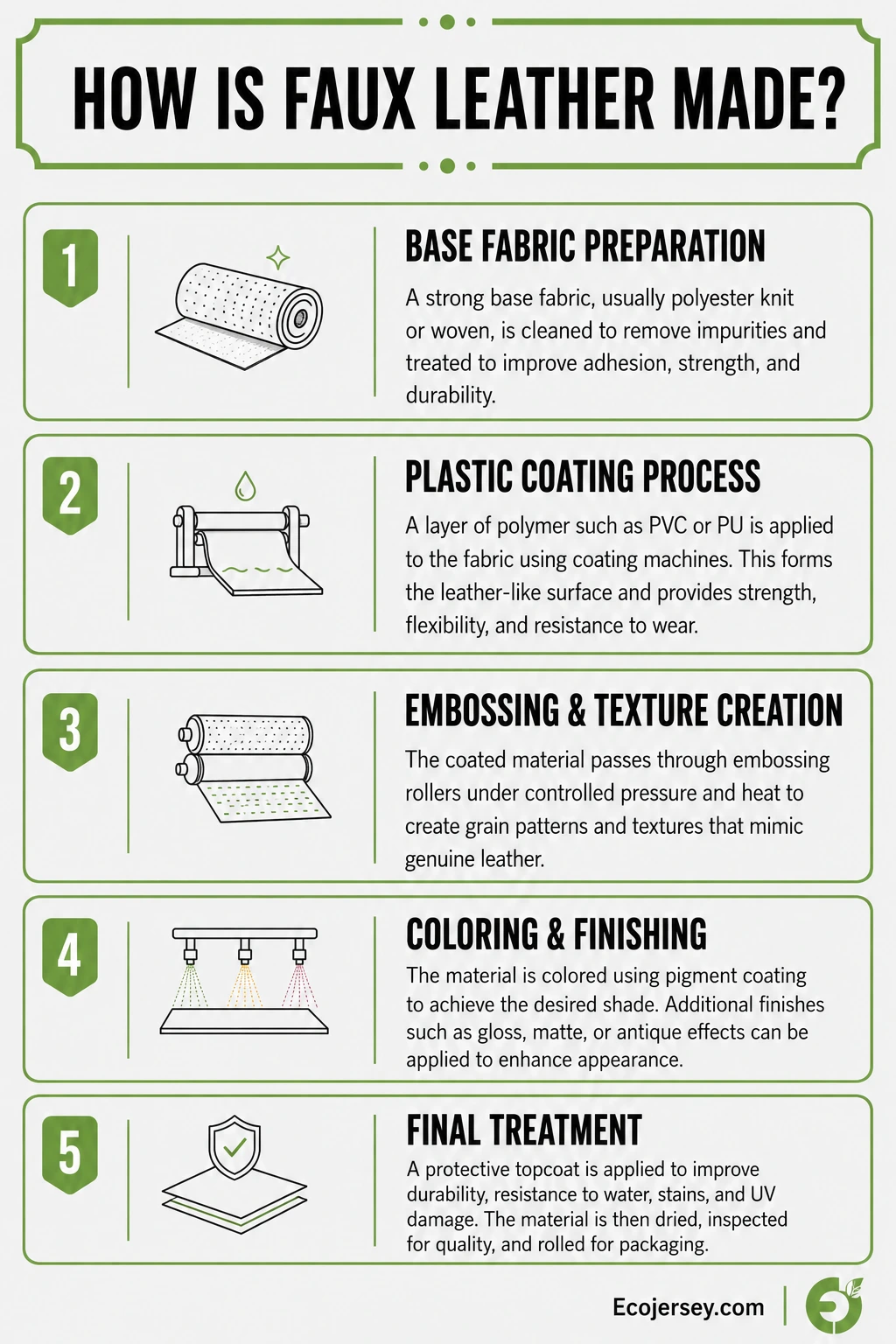
Base Fabric Preparation
Textile backing layer is the first part of the vegan leather making process. This backing layer is made from materials such as cotton or polyester or other synthetic materials or recycled materials. This backing layer aids in flexibility as well as the structure of the leather. In some plant-based vegan leathers, natural fibers are used instead of synthetic materials.
Coating Application
PU, PVC, or bio-based coatings are applied to the fabric surface of the substrate. These coatings are designed to imitate the texture and appearance of leather. Thinner coatings are more flexible, while thicker coatings are more durable. The plant-based versions commonly mesh natural fibers and protective resins.
Texturing Process
The coated substrate is then embossed with grain patterns by machines. Imitations of calfskin, pebble leather, and suede are popular. Many of the embossed materials are also designed with moire finishes and semi-gloss or matte finishes.
Coloring and Dyeing
Pigments are added by manufacturers during or after the coating. This process creates a surface with colors and other effects. Compared to genuine leather, synthetic vegan leather can appear more colorful. Because of this, some plant-based materials are dyed using lower-impact methods.
Finishing and Protective Treatment
Topcoats are added by manufacturers to protect against wear and staining. These coatings are also designed to be water and UV resistant. Finishing treatments also protect against surface wear and scratching. Unfortunately, heavy coatings may slow the biodegradability of the product.
Embossing and Surface Enhancement
The incorporation of additional embossing is common in the luxury industry for the desired texture. In the premium category, the use of multilayer coatings is common for the realism aspect. In the premium category, multilayer coatings are common for realism. Surface enhancement also improves tactile feel and softness.
Types of Vegan Leather
Type
Material Source
Durability
Eco-Friendliness
Texture
Common Uses
PU Leather
Polyurethane coating
Moderate
Medium
Soft and smooth
Bags, jackets, shoes
PVC Leather
Polyvinyl chloride
High
Low
Glossy and stiff
Furniture, upholstery
Microfiber Leather
Synthetic microfibers
High
Medium
Realistic
Luxury goods, automotive
Cork Leather
Cork oak bark
Moderate
High
Natural grain
Wallets, bags
Mushroom Leather
Mycelium fungi
Moderate
High
Soft and flexible
Fashion accessories
Cactus Leather
Cactus leaves
Moderate
High
Smooth matte finish
Handbags, shoes
Apple Leather
Apple waste fibers
Moderate
Medium-High
Flexible
Fashion accessories
Pineapple Leather
Pineapple leaf fibers
Moderate
High
Textured fabric feel
Footwear, bags
Vegan Leather vs Real Leather
Appearance
Both can look similar, however vegan leather can replicate many colors and leather textures more consistently. Over a long time of natural aging, genuine leather begins to develop a unique patina.
Feel
Vegan leather on the premium side of the spectrum looks and feels nice as it is soft and flexible. Leather’s unique ability to breathe can provide thermal comfort.
Durability
High-quality looked-after leather can last decades. Inexpensive vegan leather can crack or peel in only a few years.
Breathability
Natural leather contains natural pores that promote airflow. Vegan leather can trap heat and moisture.
Aging
Natural leather develops character and gets softer. Vegan leather sustains the same appearance.
All leather substitutes that do not use animal products classify as vegan leather. The materials can be either synthetic or plant-based. Additionally, vegan leathers either contain plastic or renewable biomass.
Faux Leather
Any materials that imitate the appearance of leather classify as faux leather. The majority of materials that are faux leather are also vegan. The primary focus of the term is not sourcing, but rather the appearance of the material.
PU Leather
PU leather, a form of vegan leather, is leather that uses a synthetic fabric with a coating of polyurethane. Of synthetic leather products across the globe, this material is one of the most widely used.
Is Vegan Leather Sustainable?
Vegan leather has the potential to be sustainable. However, the level of sustainability is determined by the material and the way in which it is manufactured.
Environmental Positives
Vegan leather is free from animal hides and livestock.
It contributes to a reduction of methane emissions from cattle.
Plant-based materials utilize agricultural waste.
Bio-based innovations encourage the production of renewable materials.
Environmental Negatives
PU and PVC leather are made from fossil-fuel-based plastics.
Synthetic versions may leak microplastics eventually.
Many synthetic products are non-biodegradable for a long time.
Pollution is caused by chemical coatings used in the manufacturing process.
Balanced Reality
Plant-based vegan leather is more environmentally friendly; however, many products still feature synthetic coatings and binders. Therefore, the sustainability of materials and the brands offering them varies substantially.
Is Vegan Leather Biodegradable?
Some vegan leathers are biodegradable, but many are non-biodegradable.
PU leather is a polymer and, therefore, a type of plastic and non-biodegradable. PVC leather is less biodegradable than PU leather and is more likely to cause environmental harm when it breaks down.
Plant-based vegan leather utilises more biodegradable materials than PU and PVC leather; however, many still use polyester backings and synthetic coatings. Therefore, compostable vegan leather is still relatively uncommon.
Is Vegan Leather Waterproof?
Most vegan leather is waterproof; however, PU and PVC leather are more waterproof than real leather and contain better coatings than real leather.
In some cases, prolonged exposure to moisture may cause a coating to weaken. It may also cause a product to peel or crack if the product is low-quality.
How Durable Is Vegan Leather?
Vegan leather’s durability is based on manufacturing quality and the materials used. Cheap PU leather may last only two to five years. Premium microfiber leather can last much longer.
Various conditions affect durability:
thickness of coating
UV light exposure
daily abrasion
exposure to heat
exposure to moisture
As compared to inexpensive synthetic leather, high-quality microfiber vegan leather continues to perform well and, as with any product, good care contributes to a longer life.
Pros and Cons of Vegan Leather
Pros of Vegan Leather
Using vegan leather helps reduce reliance on animal-derived materials.
Vegan leather is generally less expensive compared to real leather.
Many options in colors and textures are available to manufacturers.
Vegan leather is more commonly water-resistant than other materials.
This material is lightweight, flexible and easy to handle.
Little effort is required to keep vegan leather clean.
Support of a plant-based option encourages the recycling of agricultural waste.
Cons of Vegan Leather
Some vegan leather contains large amounts of plastic.
Low-quality products may peel or crack quickly.
Synthetic versions offer lower breathability.
Sustainability differs greatly between materials.
Many products have shorter lifespans than real leather.
PVC leather may release harmful chemicals during production.
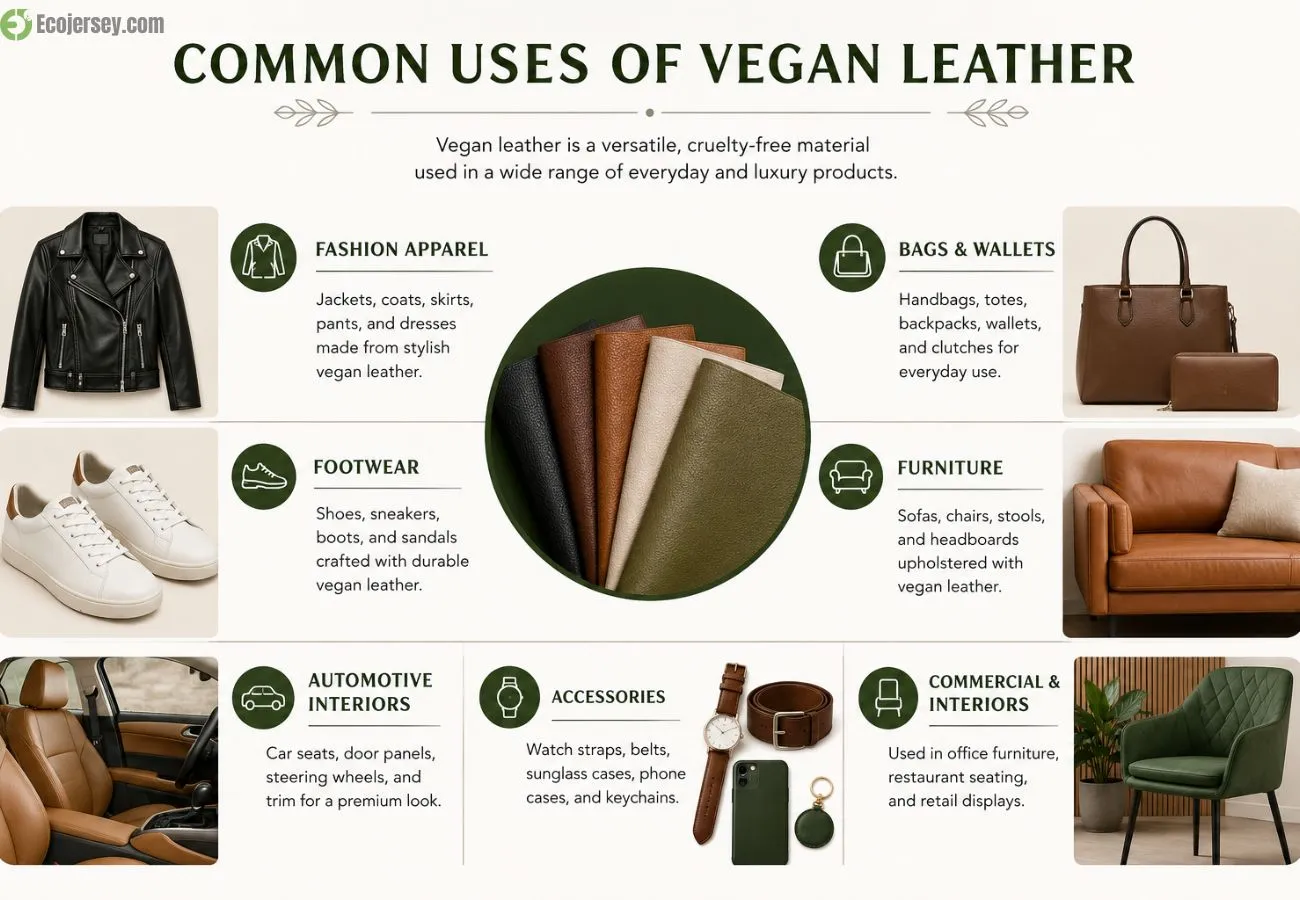
Common Uses of Vegan Leather
Popular applications of vegan leather across multiple industries
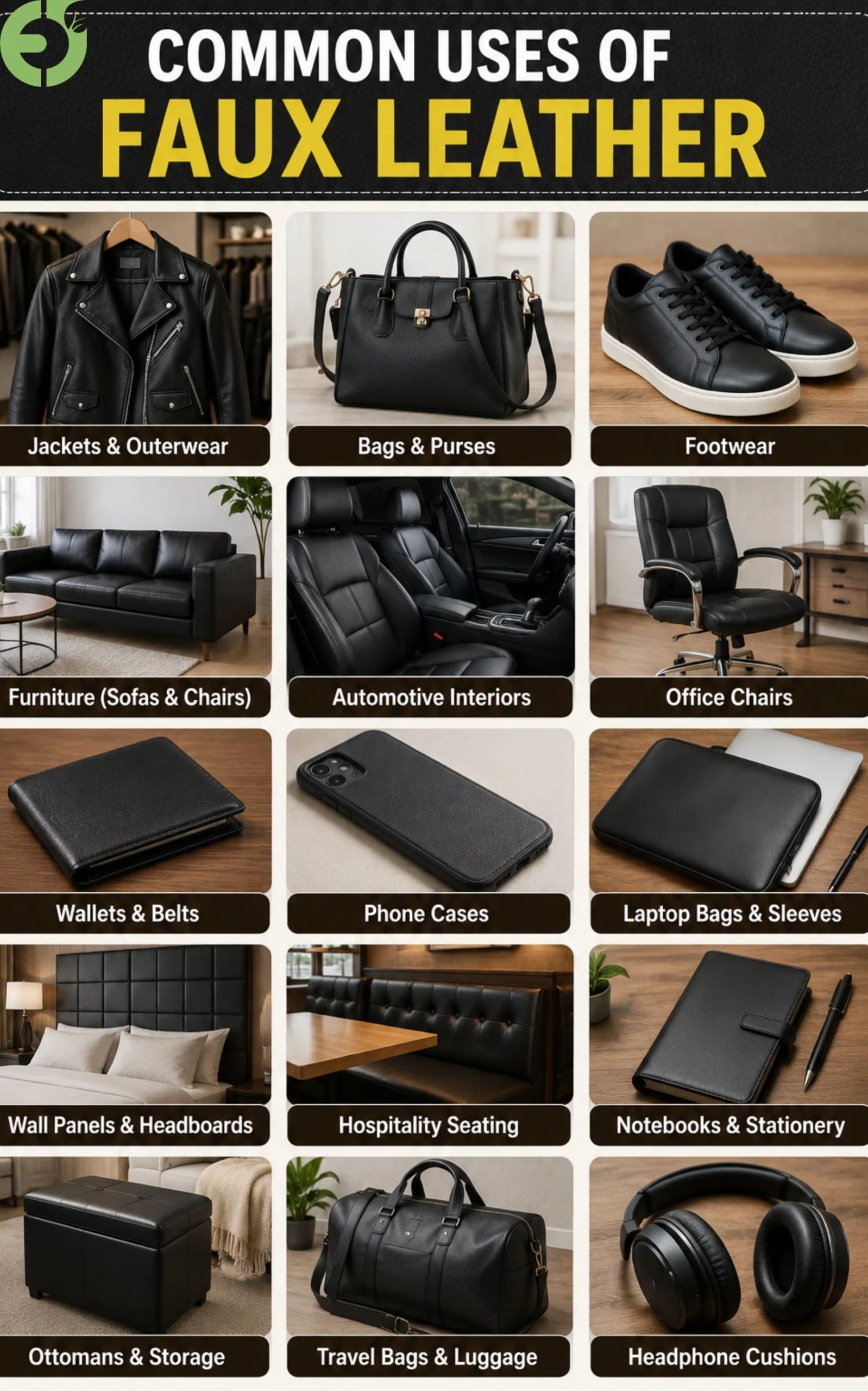
Fashion Uses
Many fashion collections now include cruel animal leather alternatives such as vegan leather jackets.
PU and cactus leather are commonly used for cruelty-free handbags.
Vegan leather provides a more affordable option for leather shoes.
PU leather is often used for wallets and belts.
Furniture Uses
Sofas are commonly upholstered in PVC or PU leather.
Synthetic leather is often used for dining chairs as a cleanable surface.
Vegan leather is used on office furniture because of its water resistance.
Automotive Uses
Interiors of cars now commonly use premium microfiber vegan leather.
Many luxury brands now offer fully vegan seating options.
Synthetic leather has become more stain-resistant for car interiors.
Accessories Uses
Apple leather or PU leather are the materials of choice for watch straps.
Textured synthetic leather coatings are the most commonly used for phone cases.
Vegan leather materials can also be applied to lightweight travel accessories.
How to Identify High-Quality Vegan Leather
Texture Criteria
High quality vegan leather has built-in flexibility and softness. Materials that don’t shine, but have realistic grain patterns, are a sign of a quality product.
Odor
High quality vegan leather has a neutral or mild scent.. Low quality vegan leather will have a strong metallic smell and is a sign of PVC leather.
Flexibility
High-quality vegan leather will resist cracking, while poor-quality materials may degrade quickly.
Stitch Quality
High quality vegan leather will have strong stitching, while poor quality materials will have uneven stitching.
Backing Fabric
Cotton and microfiber backings are a sign of quality vegan leather, while materials that have thin polyester backings will have a lower quality product.
Labels Used
High quality vegan leathers will have their materials specify PU, microfiber, cactus, or plant-based materials.
High quality vegan leathers will have clear labels, while poor-quality products may use vague or unclear labeling.
Caring for Vegan Leather
Cleaning Methods
Most vegan leather can be wiped down with a damp microfiber cloth.
Using soap that is mild and easy will remove stains, but be careful not to damage the surface coating.
Proper Storage
Store the leather in a shaded area out of the sun.
For long term storage, use dust bags.
Preventing Cracks
Regular care will keep the leather flexible and prevent it from cracking.
Avoid compressing the leather or creating folds.
Conditioning Myths
Some vegan leathers may be harmed by conventional leather conditioners.
Use only treatments made for synthetic materials.
Heat Exposure
Leather with PU coatings can deteriorate rapidly with heat.
Never keep vegan leather in a hot car.
Waterproofing
Vegan leather is naturally water resistant.
Any additional waterproofing sprays should be compatible with the material.
Does Vegan Leather Peel or Crack?
Some vegan leathers, like low-quality PU leather, can crack and peel.
Polyurethane coatings can peel and crack. Heat, sunlight, moisture, and friction accelerate the peeling. Leaving vegan leather in a humid environment can also help speed the process. Compared to the cheaper alternatives, premium vegan leather can be a more sustainable and efficient choice.
Is Vegan Leather Better Than Real Leather?
This depends on the person using the leather.
From an ethical standpoint, vegan leather is better because it is a leather alternative that does not use animal skins. Vegan leather also tends to be more affordable and requires less maintenance. Some plant-based vegan leathers may have environmental advantages, but sustainability varies depending on the materials used.
Real leather does have the advantage when it comes to longevity. Real leather also has the ability to develop a character over time and gives the user a better experience.
Focusing on sustainability, a preference for long-lasting leather, and maintenance should help people decide whether vegan leather or real leather is better.
Conclusion-
Vegan leather is an animal-friendly alternative to real leather and is made from synthetic materials and/or plant-based materials. PU leather, microfiber leather, and leather alternatives made from cactus, mushrooms, and pineapples have become increasingly popular in the market.
Vegan leather can be a good option depending on the user’s needs and the specific material used. Microfiber leather is among the most durable vegan leather options, while products that use a higher percentage of plant-based materials are generally considered more environmentally friendly.
Cost is also an important factor. Some vegan leather products are affordable, while premium plant-based and microfiber alternatives can be expensive. Additionally, plastic-based vegan leather is generally less environmentally friendly than bio-based alternatives. Consumers should evaluate the material, durability, cost, and sustainability of the product before making a purchase decision. Read More>> All Types of Leather.
FAQs
Is vegan leather real leather?
No. Vegan leather does not use animal skins or animal hides.
Does vegan leather last long?
With a bit of maintenance, vegan leather that is of good quality can last for many years.
Is vegan leather plastic?
PU, PVC, or other plastic materials can frequently be found in vegan leather.
Is vegan leather toxic?
Although some modern-day PU leather is a bit better compared to the older PVC, potential health and environmental concerns depend on the manufacturing materials and processes used.
Is vegan leather eco-friendly?
There are some plastic vegan leathers that are eco-friendly, but some of the leathers that are made of plastic cannot be classified as such.
Does vegan leather smell?
PVC leather of poor quality can have a strong smell of chemicals.
Is vegan leather expensive?
PU leather is quite affordable, while vegan leather of better quality is more expensive.
Is vegan leather good quality?
When using highly engineered microfiber and plant-based materials, extremely good quality can be achieved.
Which vegan leather is best?
Plant-based leathers such as cactus and mushroom leather, along with high-quality microfiber leather, are considered among the best options.
Can vegan leather replace genuine leather completely?
In many regards, vegan leather can fully replace genuine leather, but in terms of aging and durability, they are still different products.
Polyurethane Leather (PU leather) is an artificial fabric made by applying a layer of Polyurethane (PU) onto a base fabric. Designers create PU leather to mimic real leather and try to keep prices lower while enhancing water resistance. Polyurethane is one of the commonly used plastics in numerous industries: furniture, fashion, footwear, car interiors, and even accessories.
Real leather is obtained from animal skin, whereas PU leather does not. Some PU leather, however, does contain a layer of polyurethane over a base of split animal skin leather. Therefore, PU leather can either be completely synthetic or can be semi-synthetic.
PU leather is usually smooth, lightweight, and flexible. It is also even in texture. It is also relatively inexpensive when compared to full grain leather, and is relatively low maintenance. PU leather, however is relatively less durable and has a low breathability compared to real leather.
Many designers prefer PU leather because it is a vegan option, can be manufactured in many finishes and textures, and has a uniform appearance.
Quick Answer Box
Question
Short Answer
Is PU leather real leather?
No, PU leather is made by covering a base material (fabric or leather) with polyurethane.
What does PU stand for?
PU is shorthand for polyurethane.
Is PU leather waterproof?
PU leather is designed to be water resistant, but not waterproof.
Does PU leather crack?
Yes, in general, some PU leather can crack with time.
Is PU leather vegan?
Most PU leather is vegan, although some contain a leather backing.
Is PU leather durable?
Good quality PU leather can last for years if maintained properly.
Is PU leather better than PVC?
PU leather is generally better than PVC leather in terms of softness, flexibility, and being less toxic.
What Is PU Leather Made Of?
Polyurethane Coating
A layer of polyurethane is coated over fabric or leather backing to create a leather-like surface. PU leather is flexible, soft, and water resistant. It can also be embossed with patterns to mimic the texture of genuine leather.
Base Fabric Materials
PU leather is typically made of polyester, cotton, nylon, and/or microfiber. The used base fabric gives the leather structure. Many PU leathers use polyester backing, as it resists stretching and moisture damage. Additionally, microfiber backing improves softness and durability.
Split Leather Backing
Some PU leather includes split leather in the layer beneath the polyurethane surface coating. This is known as bicast leather or semi-PU leather. The leather backing gives added strength and a more authentic touch. Still, the surface is mostly just the polyurethane coating.
Plastic Polymers
Polyurethane is a member of the family of synthetic plastic polymers that are produced from petroleum-based chemicals. These polymers are used in synthetic leather coatings to improve flexibility and durability. Manufacturers add to or modify the polymers in order to change the softness, elasticity, thickness, or resistance to abrasion. Water-based formulations lower harmful solvent emissions.
Textile Backing
Coated layers must be supported to avoid tearing during usage. Manufacturers choose woven, nonwoven, or knitted fabrics. For upholstery, thicker and woven backing materials are used, while for garments, lighter backing structures are preferred.
100% Synthetic PU Leather
100% synthetic PU leather is completely free of animal-derived materials. Its layers are built with textile backing and polyurethane coatings. For ethical product lines and for brands preferring a vegan option, 100% synthetic PU leather is a preferred choice as it offers consistent color and texture across production runs.
Semi-Synthetic PU Leather
Semi-synthetic PU leather consists of a polyurethane coating and a genuine leather backing. Manufacturers use split leather because it lowers production costs. Compared to fully synthetic versions, this construction offers improvements in feel and durability. However, it remains a non-vegan option.
Bicast Leather
Bicast leather refers to a type of leather that is made up of split leather that is covered with a polyurethane film and then textured with an artificial grain. Manufacturers are able to classify it as leather because there is genuine hide on the inner layer. However, the outer layer is still synthetic polyurethane. Bicast leather is typically cheaper than full-grain leather.
Composition of PU Leather
The actual composition of PU leather typically changes depending on the manufacturer and the intended use of the leather. The composition of PU leather varies depending on the manufacturer and intended use, but it generally includes a textile backing coated with polyurethane. Microfiber PU leather uses a dense synthetic fiber for the best performance. Water-based PU systems use less of a solvent in the process.
History of PU Leather
After World War II, the rapid development of synthetic leather was mainly due to the demand for a less expensive and more mass-producible alternative to animal leather. Early synthetic leather relied heavily on PVC and faced several performance and environmental issues. It was often stiff and less breathable. It became an environmental issue, too. In the 1960s, with the improvement of technology, Polyurethane became an alternative to PVC because it was softer and more flexible.
As technology and manufacturing improved, PU leather became popular with the fashion, furniture, footwear, and automotive industries. Compared to vinyl, polyurethane had more advantages with its realistic textures and less cracking issues. In the last few years, advancement in technology and customer demand for a sustainable product brought water-based PU, bio-based polyurethane, recycled materials, and solvent-free productions.
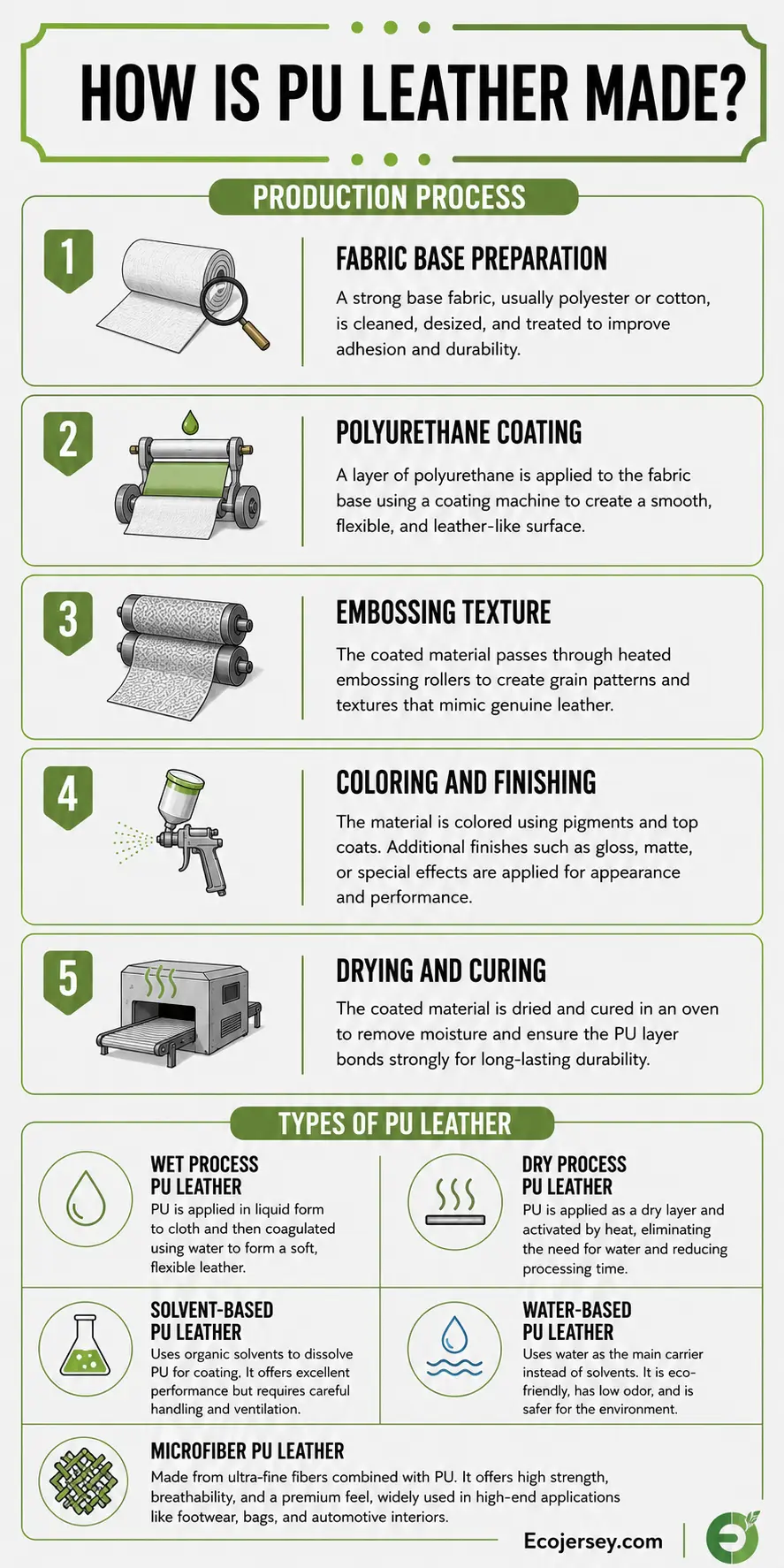
How is PU Leather Made?
Overview of how PU leather is made and the different PU leather variations
Fabric Base Preparation
The textile or microfiber backing is the first thing that is prepared. The coating is done after the backing is cleaned and the surface is treated. A strong backing is important because it improves tear resistance and helps the leather maintain its shape during use. Polyester microfiber is commonly used for backing materials because of its durability and moisture resistance.
Polyurethane Coating
The backed surfacing is then coated to form the layer of leather. The polyurethane coating forms the leather-like surface and provides protection against abrasion and moisture. The coating is typically designed to have the layer of leather exhibit better thickness and to be more abrasion resistant.
Embossing of Texture
Once the surface has the coating, a leather grain design is then embossed to the surface. Different designs of the rollers can provide a surface that can exhibit textures that are smooth, pebbled or exotic. The embossing depth mainly affects the texture and visual appearance of the surface.
Coloring and Finishing
The effect of pigments, dyes, and finishing chemicals used in surface treatment is the improved appearance and gloss. These treatments can also improve stain resistance and UV protection. Matte finishes create a modern premium look for furniture and fashion. Scratch resistance can be improved by adding coatings.
Drying and Curing
To create a stable structure for the finished product, manufacturers use industrial heating systems to dry and cure the coated material. During the curing process, moisture and solvents in the structure are also removed. If the polyurethane is not fully cured, it can peel and crack prematurely. Controlled heating increases the durability and flexibility of the finished product.
Wet Process PU Leather
With this method of manufacturing, polyurethane is applied using coagulation. This method creates a synthetic leather structure that is softer and more breathable. This type of PU is commonly used in premium fashion products because it offers improved flexibility and comfort.
Dry Process PU Leather
Dry process manufacturing simplifies the production process by omitting the coagulation baths, and entails applying the polyurethane directly on backing materials. This method creates a smoother surface finish and is used in many manufactured furniture and accessory products.
Solvent-Based PU Leather
With this method, chemical solvents are used to enhance adhesion and durability, but at the expense of releasing VOCs, which are heavily regulated in many countries due to environmental concerns. This translates to a restricted production method due to new laws.
Water-Based PU Leather
Water-based PU leather seeks to eliminate VOCs by using water-based systems. Eco-conscious brands aim for this type of polyurethane despite higher production costs.
Microfiber PU Leather
The base material of Microfiber PU Leather is ultra-fine synthetic fibers. Compared with other types of PU leather, Microfiber PU leather is more durable, soft, and breathable. Therefore, luxury products and the interior of premium automobiles often use Microfiber PU leather because its quality can approach that of some high-end real leathers in terms of softness and durability.
Types of PU Leather
A. 100% PU Leather
Synthetic materials in 100% PU leather use no animal-derived materials. It is lightweight, inexpensive, and used widely in a lot of fashion accessories. It also has a lot of water resistance and a uniform appearance. However, its lack of durability is a big issue.
B. Semi-PU leather
Semi-PU leather uses a Polyurethane coating and a backing material made of split leather. Therefore, it features better integrity and longevity. Therefore, Semi-PU leather is often used in footwear and furniture. However, it is not vegan leather.
C. Bicast Leather
Bicast leather has a split hide with a polyurethane film. The finish is glossy and highly polished compared to natural leather. Bicast leather is cheaper than full-grain or top-grain leather. However, these leather types may develop surface cracks with extended usage.
D. Microfiber PU Leather
Microfiber PU leather builds up synthetic microfibers and offers excellent performance (high durability, softness, and abrasion resistance). The interiors of high-end cars and high-end bags include Microfiber PU. Compared with ordinary PU leather, this type has a longer life span.
E. Water-Based PU Leather
Water-Based PU leather reduces the use of chemical solvents. Due to a lower output of volatile organic compounds, many of the emerging sustainable fashion brands use this method. Manufacturing costs are somewhat higher, but not by a large margin.
F. Solvent-Based PU Leather
The production methods of Solvent-Based PU leather use chemical solvents to achieve a durable and well-bonded surface. This method is combined with many of the low-cost, mass-produced products. Its popularity, however, is declining due to environmental concerns.
G. Silicone-Enhanced PU Leather
Silicone-Enhanced PU leather consists of layers of polyurethane with silicone surface treatments. The softness is better than the standard variety, and stain resistance and UV stability of the surface are improved. The automotive and medical industries are using these materials regularly. Moreover, it performs better under extreme temperatures.
PU Leather vs Genuine Leather
Feature
PU Leather
Genuine Leather
Material Source
Synthetic purple-coating
Animal hide
Texture
Uniform and consistent
Natural grain variation
Durability
Moderate
High
Breathability
Lower
Higher
Water Resistance
Better initially
Needs protection
Aging
May peel or crack
Develops patina
Smell
Chemical or neutral
Natural leather aroma
Maintenance
Easy
Requires conditioning
Cost
Affordable
Expensive
Sustainability
Vegan options available
Animal-based material
Feel and Texture
PU leather feels smoother than genuine leather. The absence of natural grain makes PU leather less textured, while genuine leather shows grain irregularities.
Aging Characteristics
PU leather may peel or crack, but genuine leather softens with age and develops patina.
Environmental Impact
PU leather avoids animal hide usage but still contains plastics. Traditional leather tanning can have environmental impacts due to chemical use and animal farming.
Maintenance Requirements
PU leather is easier to clean, but full-grain leather softens with time and has great aging aesthetics when properly moisturized.
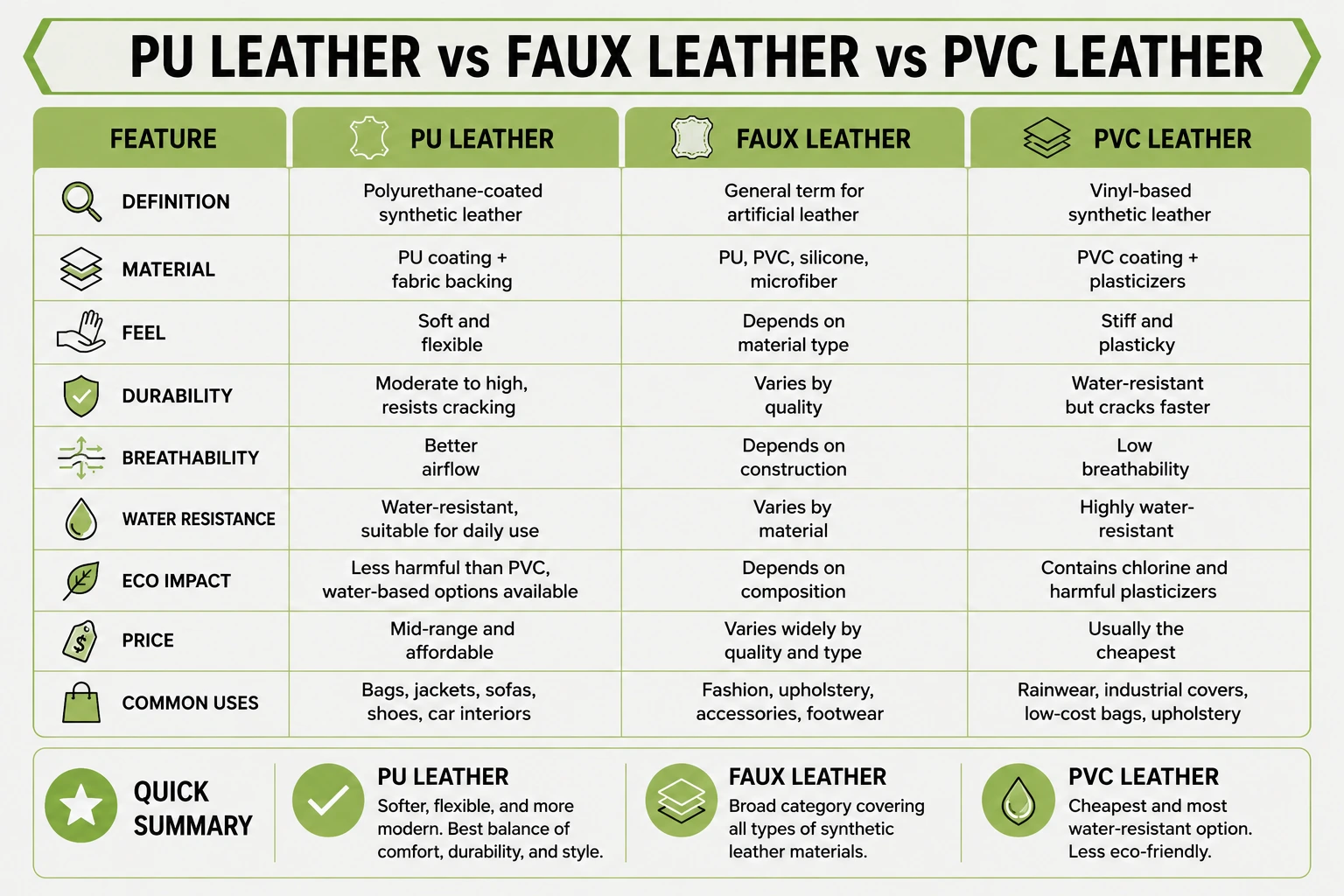
PU Leather vs Faux Leather vs PVC Leather
Key differences between PU, faux, and PVC leather materials
Faux Leather
Faux leather is a general term that encompasses all leather-like materials that are made using synthetic methods. PU leather and PVC leather are both types of faux leather. Faux leather is commonly used in the fashion, furniture, and automotive industries. A lot of customers distinguish faux leather by the particular type of synthetics used.
PU Leather
PU leather is essentially a cohesive layer of polyurethane over the backing of split leather or textile. PU leather is softer and more flexible than PVC leather. PU leather is also more breathable and comfortable. Most contemporary fashion brands opt for PU-based synthetic leather.
PVC Leather
PVC leather has a coating of polyvinyl chloride, combined with plasticizers and additives. PVC leather is generally stiffer and less breathable than PU leather. Due to PVC’s strong water resistance and durability, PVC leather continues to be used in many low-cost commercial items.
Which Is Better: PU or PVC Leather?
PU leather generally has better softness, flexibility and appearance. Furthermore, PU leather is less toxic than PVC leather. PVC leather is more rigid and water resistant. Many modern fashion and furniture brands prefer PU-based synthetic leather because it is softer and more flexible.
Advantages of PU Leather
Affordable Price
In most markets, PU leather offers a much cheaper alternative to genuine leather, allowing manufacturers to produce attractive products at lower prices.
Vegan-Friendly Material
PU leather products do not contain animal-derived materials or animal skin.
Many vegan fashion brands incorporate PU leather into their lines to ensure their products’ adherence to vegan principles.
PU leather can withstand minor spills and surface moisture.
This makes it a strong choice for the manufacturing of furniture, bags, and car interiors.
Simple to Maintain
Cleaning PU leather is easy with some mild soap and a soft rag.
Unlike real leather, conditioning is rarely needed.
Always Looks the Same
Manufacturers of PU leather can achieve uniformity in color and texture.
Hence, brands can produce large batches of products that look the same.
Lightweight
PU leather is often lighter than many real leathers.
This makes jackets, handbags, and shoes made from PU leather more comfortable.
Flexible Fashion
Because PU leather can be made into many finishes and textures, it is often used in fashion.
It is seen in shoes, sofas, bags, jackets, and accessories.
Disadvantages of PU Leather
Cracking and Peeling
Cheap PU leather will begin to peel with extensive use or sun exposure.
Hydrolysis can break down the coating and accelerate surface deterioration.
Shorter Durability
PU leather will typically not last as long as real leather.
The degradation will become more apparent with heavy friction and exposure to heat.
Lacking Breathability
Standard PU leather will not allow air to flow as easily as some natural leather.
This will lead to sweatiness on areas that it contacts for extended periods of time.
Plastic Composition
PU leather is usually made from petroleum-based synthetic polymers.
This is why the topic of PU leather is still relevant in sustainability and the discussion of environmental concerns.
Heat
High temperatures can make the polyurethane coating and the adhesive layer become weak.
Under extreme circumstances, it can crack, warp, or peel.
Sustainability
In making PU leather, chemicals may be released in the manufacturing process.
Disposal challenges also occur due to the slow degradation of synthetic polymers.
Is PU Leather Durable?
The durability of PU leather is determined by the quality of the material, its thickness, the technology used for coating, and the conditions of its use. Cheap PU leather can crack and peel within one to three years. Mid-range PU leather can last three to five years with normal indoor use. High-quality microfiber PU leather can last five to ten years with the proper maintenance.
Microfiber PU leather is usually the most durable as its dense fiber structure helps resist abrasion. On the other hand, thin low-cost PU coatings deteriorate faster under friction, exposure to sunlight, and variation in humidity.
How Long Does PU Leather Last?
PU LEATHER QUALITY
AVERAGE LIFESPAN
LOW-QUALITY PU LEATHER
1-3 years
MID-RANGE PU LEATHER
3-5 years
PREMIUM MICROFIBER PU
5-10 years
Is PU Leather Waterproof?
PU leather is water-resistant, and is not totally waterproof. The PU surface helps to resist water spills and light rain. Coatings and seams can be damaged, and water can seep in through that damage to the PU leather.
Water spills should be wiped quickly because PU leather is water resistant, not fully waterproof. PU leather is not meant to be exposed to water. Long-term exposure to water can cause the adhesives to weaken and the PU leather to peel. PU leather is meant to be used indoors.
Is PU Leather Breathable?
Standard PU leather has poor breathability when compared to real leather, as the polyurethane layer blocks small amounts of airflow. Therefore, heat and moisture can build up over longer periods of wear. This becomes an issue when used for jackets, shoes, and seating.
Microfiber PU leather has better breathability due to its porous fiber structure and improved technology. Many car makers, as well as athletic brands, have implemented breathable PU materials due to their comfort.
Is PU Leather Good Quality?
PU leather quality is subject to more variability than real leather. Poor quality PU leather can be thin and cheap. High-quality microfiber PU leather can closely resemble real leather in feel and appearance.
There is variability of quality, such as the quality of the coating, backing, embossing, and general technology used in construction. As such, it is best to keep in mind the quality of construction before negating the entire category of PU leather.
Does PU Leather Peel or Crack?
PU leather does have a propensity to peel and crack, especially when the leather is of low quality. Hydrolysis is one of the most common causes of PU leather degradation. This process is caused when polyurethane is exposed to moisture and heat via the air.
Cracking can be accelerated when the leather is exposed to UV rays, made dry, and subjected to friction. This greatly is accelerated when the construction of the leather is poor and thin.
How to Prevent PU Leather from Cracking
Keep PU leather away from direct sunlight and excessive heat.
Clean surfaces regularly using soft microfiber cloths.
Avoid folding or compressing the material for long periods.
Maintain moderate humidity levels during storage.
Use protective covers for furniture and automotive interiors.
Cleaning PU Leather
Use Milder Soap Solutions
To clean PU leather, mix mild soap in lukewarm water.
Avoid cleaners with harsher chemicals, as they will harm the polyurethane coating, and finish.
Clean with Soft Cloth
Dust and surface stains on PU leather can be cleaned using soft cloths.
Avoid using anything abrasive to avoid damaging the protective coating layer.
Address Spills Instantly
Address spills as soon as they occur to avoid moisture and staining problems.
Harsh Chemicals
Avoid using bleach and chemical cleaning products as they can discolor PU leather.
Direct heat can cause polyurethane coatings to weaken or crack.
Allow to Air Dry
After cleaning, allow the surface to air dry naturally.
Do not dry using heat sources.
How to Maintain PU Leather
Shield From Sun
UV rays can cause PU leather to fade and crack. To prevent damage, keep PU leather items out of direct sunlight.
Regulate Humidity
Low or high relative humidity can cause damage over time. Keeping the relative humidity in a moderate range can increase PU leather’s durability.
Keep Away From Friction
PU leather can be easily damaged from rough or sharp objects. When using PU leather bags, jackets, or furniture, be careful to avoid contact with sharp or rough objects.
Keep Out of the Sun
Store PU leather items in cool, well-ventilated areas whenever possible. Excessive compression or storage in a small space should be avoided.
Use Minimal Maintenance
Heavy oils and traditional leather conditioners should NEVER be used on PU leather. Regular cleaning is the best form of maintenance.
Where PU Leather is Used
Popular applications and industries using PU leather
Fashion
Jackets, handbags, belts, and wallets often use PU leather. Fashion brands use PU leather for its affordable and flexible qualities.
Shoes and Footwear
PU leather is often used as an upper for shoes and sandals due to its lightweight and moisture-resistant qualities.
Furniture
Chairs and sofas are often upholstered in PU leather. Manufacturers prefer PU leather because of its consistent appearance and ease of maintenance.
Cars
Microfiber PU leather is often used for seating, steering wheels, cover panels, and other interior components. Next-gen automotive interiors use high-end synthetic leather.
Office and Commercial Use
PU Leather is commonly used to cover seating in commercial and office furniture. For businesses, PU leather is easy to maintain and inexpensive to replace.
Accessories and Electronics
PU leather is prevalent in phone cases, tablet covers, and watch straps.
Designers have many cost-effective options for experimenting with colors and textures.
Is PU Leather Eco-Friendly?
PU leather contains many pros and cons for the environment. The positives are it creates less reliance on animal hides and the harsher processes of leather tanning. Also, the newer water-based PU systems have lower VOCs compared to the older, harsher systems that were mostly solvents.
The negatives are that it still mostly relies on petroleum-based synthetic polymers. The same problems that derive from these polymers, such as microplastic pollution, and the same or even worse problems of recycling capacity still persist. For this reason, PU leather won’t be 100% sustainable.
Innovation has meant that there are some options that provide more sustainability with polyurethanes that are bio-based, some recycled polyurethane materials, as of recently, water-based systems, and coatings that are based on polyurethanes. The sustainability is largely impacted by the method of production and the resources that the company has.
Is PU Leather Sustainable?
PU leather can be made more sustainable through water-based systems, recycled materials, and lower-emission manufacturing methods. Re-cycled systems also play a part in the sustainability of this. The standard PU systems, however, do create the same problems with plastic, which is harming the environment.
Is PU Leather Vegan?
PU leather contains no materials that are animal-based, meaning that most PU leather products are in fact vegan. PU leather is synthetic and therefore contains backing that is textile in design as well as a coating of polyurethanes.
Some PU leather systems contain split leather, which is underneath the surface layer. Bicast leather and semi-PU leather both have a component of animal skins. This is why vegan products that fall in these categories need to be labeled prior to purchase.
Does PU Leather Contain Real Leather?
PU leather is synthetic and therefore does not contain real leather. It is typically constructed with a textile backing and a synthetic polyurethane coating.
However, some products sold as PU leather are not in fact entirely synthetic and used split leather, which is a component of animal skin. Bicast leather and semi-PU leather are also in this category.
How You Can Spot PU Leather
What is the Smell?
PU leather smells neutral and is sometimes described as being slightly chemical as opposed to smelling like real leather, which has a much richer and more organic smell.
What is the Texture?
PU leather often has a very uniform grain and consistency, while natural leather has natural imperfections and irregular variation.
What is the Backing Like?
PU leather has a fabric backing that appears around the seams and unfinished edges, while leather has a fibrous type of suede as the backing.
What is the Water Absorption?
PU leather is coated with polyurethane, and this causes it to absorb water slowly, while natural leather absorbs water more quickly.
What is the Price Like?
PU leather products are much less expensive to produce, while leather products are much more costly to produce.
PU Leather Certifications and Safety Standards
Multiple international certifications assess the safety, sustainability, and chemical aspects of PU leather.
Common certifications used for PU leather safety and compliance
Many manufacturers are starting to pursue these certifications as a result of increasing consumer demand for safer, more sustainable materials.
Where is PU Leather Produced?
China is the biggest PU leather producer, while India is a huge producer for the footwear, fashion, and upholstery industries. Italy is known for producing high-quality PU leather materials for luxury fashion markets, while South Korea and Vietnam are expanding the technological capabilities in sophisticated PU leather. Global fashion and automotive industries are able to source PU leather from a plethora of international suppliers.
Future Trends in PU Leather
As PU leather technology continues to develop, we see a greater emphasis on sustainability. Renewable source elastomers, such as biosynthesized polyurethanes, as well as water-based, reduced-emission polyurethane systems are getting more attention commercially.
Significant investment is going towards recycled PU and solvent-free production. Alternative materials such as mushroom-based and silicone-based leathers are also gaining attention in the market. Microfiber PU leather, however, maintains its lead in premium synthetic leather applications.
FAQs
Is PU leather fake leather?
PU leather, which is created with a polyurethane spread over a base layer of split leather or fabric, is a type of synthetic leather. Unlike some materials, PU leather is designed to resemble real leather, both in look and feel, but at a more accessible price point.
Is PU leather better than PVC leather?
Compared to PVC leather, PU leather feels plumper, more flexible, and more breathable. Additionally, producing PU leather has less of a toxic outcome, but in adverse conditions PVC leather provides better water resistance.
Can PU leather get wet?
PU leather can withstand small amounts of water and moisture, however, prolonged exposure to water can damage some of the materials and layers of the leather. Wet PU leather should be dried quickly.
Is PU leather toxic?
PU leather is not toxic when made under regulated standards. Some lower-quality PU leathers may contain harmful chemical residues if manufacturing standards are poor. Those looking to confirm the safety of PU leather should look for the OEKO-TEX or REACH certification.
Is PU leather safe for pets?
In generally PU leather can be used in homes with pets. It is not very difficult to clean and can even resist spills. Its main issue with pets comes with nails. A nail can puncture and rip the surface. Microfiber PU leather is more resistant to those types of problems.
Why does PU leather peel?
PU leather tends to peel when the coating of polyurethane on the surface erodes. This can be through time, hydrolysis, UV rays, and friction. This happens quicker on cheaper PU leather because of low quality glue and thinner coatings.
Can cracked PU leather be repaired?
Cracks in PU leather can sometimes be made to look better with repair compounds or recoloring of synthetic leather. Unfortunately, once cracked PU leather begins to peel, there are very few reliable options for fully restoring it. For a good, long lasting solution, it is better to just replace it.
Is PU leather luxury quality?
PU leather, when it is of good quality, can be very soft and strong. It can even be of a luxury quality. Today many premium luxury products in the automotive and fashion industries are made with their high quality synthetic leather.
Is PU leather used in cars?
Yes PU leather is widely used in the automobile industry. Seats, steering wheels, and panels are made from it. Microfiber PU leather is often preferred for its durability, stain resistance, and ease of maintenance when compared to many real leathers.
Can PU leather be recycled?
Some PU leather can only be recycled in industrial settings. This is due to the difficulty of separating the polyurethane from the textile backing materials. Biodegradable and recyclable synthetic leather is an industry that is growing with more research and development.
Does PU leather smell like real leather?
PU leather does not have that distinct earthy scent. Instead, it can be a bit chemical in smell at first. Better quality PU leather may have little to no smell.
Is PU leather good for sofas?
PU leather sofas may be affordable and easy to clean, but are also stylish. However, cheap PU upholstery can crack with heavy use over time. Premium, Microfiber PU leather provides durable furniture for the long term.
Is PU leather good for jackets?
PU leather jackets offer a lightweight option that is also an affordable, waterproof choice. However, they generally have a shorter life span and are less breathable than genuine jackets.
Can sunlight damage PU leather?
Prolonged exposure to the sun will cause PU leather to fade, dry, crack, and peel. Users should try to avoid spending direct time in the sun when possible.
Is PU leather breathable for shoes?
Compared to genuine leather, PU provides limited breathability. However, modern, Microfiber PU has a porous structure that allows for increased airflow.
Does PU leather stretch?
PU leather has a limited amount of stretch compared to genuine leather because of a flexible, polyurethane coating. These may weaken seams or surface coatings after a lot of stretching.
Is PU leather washable?
PU leather products may be damaged from machine washing due to excessive moisture and highly agitated. They should instead be cleaned with mild soap and a damp cloth.
Is PU leather suitable for luxury bags?
PU leather is stylish while still remaining affordable due to how fashion brands use it as a luxury style. People looking for a luxury leather-like style may prefer premium microfiber PU leather.
Does PU leather fade?
PU will fade due to sunlight, friction, and heavy, harsh cleaning. Higher quality PU will have a UV-resistant coating and lessen the discoloration.
Is PU leather better for the environment than genuine leather?
PU leather does not use animal farming or chrome tanning. But the production of PU leather still utilizes petroleum based plastics. The effect it has on the environment largely depends on the method of production and the source of the materials.
Conclusion: What Is PU Leather?
PU leather is a synthetic leather material which is basically a polyurethane coating laid over a textile or split leather backing. It offers an affordable, water resistant, flexible in design, and vegan friendly option for fashion, furniture, and accessory industries.
PU leather is a good option for a consumer looking for a stylish leather-like appearance at a lower cost and at a reduced level of workload. PU leather of good quality is also very soft and durable. However, genuine leather generally outperforms PU leather in breathability, longevity, and aging.
Sustainability in this arena is a complex topic, but PU leather reduces reliance on animal hides, yet does heavily rely on synthetic polymers. PU leather has also advanced by the use of water-based PU systems, bio based, and the use of recycled materials.
Denim isn’t just a fabric—it’s a statement. For brands, consistent quality is everything. One uneven wash or a color mismatch can turn a customer away. That’s why understanding and mastering denim washing techniques is crucial. Done right, washing enhances comfort, improves longevity, and keeps your collections consistent. Done wrong, it risks inconsistent fades, shrinkage, or weakened fabric.
In this post, we’ll cover the most effective washing methods, share actionable tips, highlight common mistakes, and show how EcoJersey helps brands deliver high-quality denim apparel every time.
Why Washing Denim Is More Than Cosmetic
A denim wash impacts more than just color. It affects:
Texture and softness – How the denim feels on the skin.
Durability – How well it stands up to wear and tear.
Color consistency – Ensuring the same shade across all garments in a collection.
For instance, a brand might launch a batch of raw denim jeans. Without proper washing, some pairs may feel stiff while others fade unevenly. To prevent this, brands rely on precise washing processes and professional guidance. Learn how Eco Jersey can help through Denim Apparel Manufacturing.
Key Denim Washing Techniques and How to Use Them
Understanding each washing method helps brands choose the best approach for their target style and audience.
1. Stone Washing
What it does: Stones tumble with denim to soften it and create a vintage, worn-in look.
Actionable Tip:
Use uniform stone sizes and controlled tumble times to avoid fabric damage.
Test small batches before full production.
Common Mistake: Over-stoning can weaken fibers and create inconsistent fades.
2. Enzyme Washing
What it does: Uses cellulase enzymes to gently break down fibers for a soft hand feel.
Actionable Tip:
Adjust enzyme concentration based on fabric weight.
Rinse thoroughly to stop the enzymatic reaction.
Value for brands: This technique preserves denim color while softening, perfect for premium collections.
3. Acid Washing
What it does: Creates a mottled, high-contrast look using controlled bleaching agents.
Actionable Tip:
Monitor chemical strength and exposure time carefully.
Always test on a sample garment first.
Avoid: Uneven application or excessive chemical use, which can damage fibers.
4. Rinse & Soft Wash
What it does: Simple water rinse and softening agents improve comfort and remove excess dye.
Actionable Tip:
Great for dark denim or collections emphasizing color retention.
Pair with quality finishing treatments to maintain hand feel.
How Brands Maintain Consistent Quality
Consistency isn’t accidental. Here’s what top brands do:
Standardize recipes: Maintain consistent water, chemical, and temperature settings for every batch.
Conduct quality checks: Inspect denim for color, softness, and texture at multiple stages.
Sample and test: Always run a small production sample first.
Brands scaling production often struggle with variability, which is where EcoJersey’s Washing & Dyeing Services make a difference. Every batch undergoes quality validation to ensure garments meet the highest standards.
EcoJersey’s Edge in Denim Manufacturing
At EcoJersey, we do more than wash denim—we refine it. Our expertise includes:
Mastery of multiple washing techniques for every style
Sustainable processes to reduce water and chemical usage
Precision in replicating color and texture across batches
Example scenario: A brand launching a new vintage denim collection can rely on us to deliver soft, faded, consistent garments, batch after batch.
Always test washes on samples before full production.
Keep detailed records of chemical, water, and machine settings.
Monitor fabric shrinkage and adjust patterns accordingly.
Consider sustainable washes to appeal to eco-conscious consumers.
Partner with an experienced manufacturer—this saves time, cost, and reduces waste.
Ready to Launch Your Denim Brand?
Have questions about denim washing, fabric selection, or apparel manufacturing? Contact us and we’ll guide you step by step. If you’re ready to start production, Get a Quote and begin your journey with a trusted denim manufacturer.
Faux leather is a substitute for animal leather. It is a synthetic material that has a similar look to leather. Faux leather is manufactured using fabric, which is then coated with either polyurethane (PU) or polyvinyl chloride (PVC). It is also called synthetic leather, vegan leather, imitation leather, and pleather.
From a manufacturing perspective, faux leather is cheaper, more water resistant, and does not require animal hides. Faux leather is widely and successfully used in numerous fashion items, furniture, automotive interiors, shoes, and even electronics. Modern production methods easily allow the imitation of texture and finishes that look and feel like real leather.
What is Faux Leather?
Faux leather is artificial leather that can be used in place of real leather in any situation or product that requires the use of leather. Being a synthetic textile, faux leather does not use animal hides. Faux leather is manufactured by coating a fabric backing with a plastic-based material.
Faux leather is mainly manufactured using PU or PVC, which helps create products that are flexible, durable, and water resistant. Modern production methods also use embossing machines that can easily create textures and finishes that look and feel like the real thing.
Faux leather is often confused with vegan leather. While faux leather and vegan leather can be used as substitutes for one another, there are subtle differences. Faux leather exclusively refers to leather substitutes that are purely synthetic, while vegan leather can be plant-based and synthetic.
Common Names for Faux Leather
Synthetic leather
Artificial leather
Vegan leather
Pleather
Leatherette
Leather substitute
Why Manufacturers Use Faux Leather
Manufacturers prefer faux leather for all of the following reasons:
Lower cost of production
Uniform quality
Convenience
Resistant to stains
No animal involvement
Efficient for large-scale production
History of Faux Leather
Early Leather Substitutes
The first attempts at leather substitutes can be traced back to the mid-19th century with fabrics bonded with rubber and textiles coated with wax.
Rise of PVC Leather in the 20th Century
During the 1940s and 1950s, PVC leather became widely adopted due to its waterproof and durable nature. For this reason, its adoption in the furniture and automotive industries was rapid.
Development of PU Leather
PU leather was the next major development, offering not only a softer, more flexible alternative to PVC, but also an improved imitation of real leather. It was for this reason that PU leather became a popular choice for fashion brands to produce jackets, shoes, and handbags.
Modern Vegan Leather Movement
The demand for faux leather increased significantly due to the vegan fashion movement of the 2010’s, when a growing segment of consumers began to seek out cruelty-free alternatives to animal derived leather.
Shift Toward Sustainable Alternatives
There has been a growing variety of innovative leather alternatives using mycelium, cactus fiber, and pineapple fiber, although many still contain some synthetic binders or coatings.
Faux Leather Timeline
Period
Development
1800s
Rubber-coated fabric leather substitutes
1920s
Non-woven leather synthetics experimentation
1940s
PVC leather synthesized on an industrial scale
1960s
Leather used in cars and other vehicles
1990s
Increased demand for PU leather
2010s
Increased interest in vegan leathers
2020s
Innovation in plant-based leathers
How Is Faux Leather Made?
Step-by-step overview of how faux leather is produced
A. Base Fabric Preparation
Faux leather is made of a fabric backing, usually polyester, cotton, or nylon. Choosing the fabric backing directly impacts the faux leather’s softness, durability, and flexibility, as well as the fabric’s resistance to tearing.
B. Plastic Coating Process
The fabric then has a coating of PU or PVC laid over it. Once a liquid polymer is spread over the surface, it is heat cured to create a leather-like surface coating.
C. Embossing and Texture Creation
To create the surface texture, an embossed grain and surface patterns are pressed into the coating. Faux leather is designed to imitate natural leather by providing textures to the surface that resemble leather pores and wrinkles. Faux leather can be finished with either a matte or a glossy coating to provide surface luster.
D. Coloring and Finishing
Pigments and finishing coatings can be added to provide surface finishes that improve the faux leather’s scratch and stain resistance. Maintaining the surface finish is now easier.
E. Final Treatment
Manufacturers inspect the finished material for quality and consistency. Manufacturers roll the faux leather and cut it into sheets. Some products get antimicrobial and UV protection. Manufacturers send the materials for the production of goods.
Faux Leather vs Real Leather
Factor
Faux Leather
Real Leather
Material Source
Synthetic polymers
Animal hides
Cost
Lower
Higher
Durability
Moderate
High
Breathability
Lower
Better
Water Resistance
Better
Moderate
Maintenance
Easier
Requires conditioning
Appearance
Uniform
Natural variations
Sustainability
Mixed impact
Animal agriculture impact
Lifespan
3–10 years
10–30 years
Texture
Artificial feel possible
Natural feel
Which Is Better?
Neither option is universally better for every consumer. Faux leather works better for vegan consumers. Genuine leather may be a better choice for consumers seeking long-term durability and natural aging characteristics.
Which Lasts Longer?
Real leather lasts far longer than faux leather, which must be replaced after several years. When well maintained, leather lasts decades with a natural patina.
Which Is More Eco-Friendly?
This depends on the production methods and environmental impacts of each material. Faux leather avoids animal agriculture but usually uses petroleum plastics. Real leather uses livestock emissions and a chemical tan.
Which Cracks Faster?
PVC leather cracks faster than genuine leather. This happens because plastic deteriorates over time, especially when exposed to heat. PU leather lasts longer than PVC leather.
Faux Leather vs Vegan Leather
Though they are often used interchangeably, faux leather and vegan leather are not the same. Faux leather is a synthetic leather alternative. Vegan leather speaks to alternative materials that do not contain animal products.
Faux leather contains PU and PVC. Because of this, not all vegan leather is eco-friendly.
Alternative Plant Based Vegan Leather
Cactus Leather
Cactus leather uses cactus fibers combined with bio-based resins and generally requires less water than traditional leather production.
Mushroom Leather
Mycelium leather uses fungal root-like structures and improves biodegradability and impacts on the environment.
Apple Leather
Apple leather uses discarded apples from juice production for bags and footwear.
Cork Leather
Cork leather uses the outer layer of the cork oak and is lightweight and flexible.
Pineapple Leather (Piñatex)
Piñatex uses fibers from the leaves of the pineapple plant and supports a circular manufacturing system.
Types of Faux Leather
PU Leather
PU leather is very soft and flexible. It also looks very similar to authentic leather. Fashion brands use PU leather for their high end products and marketing because of how breathable and comfortable it is.
PVC Leather
PVC leather is a cheaper option and is very water resistant. It can withstand heavy use, but is much stiffer and less breathable than PU leather. Because of this, it is commonly used in furniture and commercial seating.
Bio-Based Faux Leather
Bio-based faux leather comes from renewable plant materials, not petroleum plastics. Manufacturers use natural fibers combined with bio-resins. This reduces fossil fuel dependence. Additionally, these materials support more sustainable product development.
Silicone Leather
Silicone leather is particularly durable and heat resistant. Additionally, it has low VOC emissions compared to PVC leather. Because of this, many premium automotive companies are developing silicone based interiors. Lastly, it has excellent stain resistance.
Recycled Faux Leather
Recycled faux leather comes from either recycled plastics or waste material created from manufacturing the product. Through this process, manufacturers are creating circular manufacturing systems and decreasing landfill waste. However, there is a lack of adequate recycling infrastructure worldwide.
What Is Faux Leather Made Of?
Polyurethane (PU)
PU produces soft and flexible surfaces to create synthetic leather. This is predominantly used for fashion and upholstery applications. It can closely replicate the texture and appearance of genuine leather.
Polyvinyl Chloride (PVC)
PVC is popular for being strong and highly water resistant. This material must be plasticized to ensure softness. The process of creating PVC leather does have serious environmental concerns.
Plasticizers
Plasticizers create soft and flexible faux leather products. Without this, synthetic leather turns brittle and rigid. Additionally, it negatively affects the product’s durability and cracking resistance.
Fabric Backing
Fabric Backing is used to support the plastic coating structure. The most common fabrics used are polyester, cotton, and nylon. Fabric backing materials improve strength, longevity, and tear resistance.
Additives & Pigments
The finishing or coating of synthetic leather includes improved UV resistance. This is achieved through additives to protect against scratches and improve color retention. Coatings also include pigments and stabilizers.
Is Faux Leather Real Leather?
Faux leather is synthetic since it does not originate from animal skin. It is manufactured with plastic coatings and fabric backing instead of skin fibers.
Is Faux Leather Vegan?
Faux leather is generally classified as a vegan product as it does not utilize animal-derived products. It should be noted that vegan products are not necessarily sustainable.
Faux leather is primarily manufactured with petroleum-based plastic. Consumers should also consider the environmental impact of these materials.
Is Faux Leather Sustainable?
When assessing the sustainability impacts of faux leather products, it becomes clearer that there are some positive and negative aspects.
From a positive perspective, faux leather products reduce the environmental impacts from animal farming and accessory leather tanning. From a negative point of view, faux leather products are predominantly manufactured of petroleum-based plastics.
Sustainability Challenges
Dependence on petroleum
Generation of plastics waste
Low biodegradability
Pollution from microplastics
Recycling difficulties
Sustainability Advantages
Elimination of animal hides
Lower water usage compared to many traditional leather tanning processes
Reduced methane release from cattle
Increased use of recycled materials
Innovations in Sustainability
bio-based PU.
recycled polyester backings.
solvent-free coatings.
plant-based leather substitutes.
circular recycling systems.
Common Uses of Faux Leather
Popular applications of faux leather in fashion, furniture, and accessories
Fashion
Faux leather jackets are stylish and affordable outerwear options.
Various brands utilize PU leather for bags and belts.
Boot and sneaker companies use fake leather for both boots and sneakers.
Faux leather has become widely accepted in fashion and commercial product design.
Furniture
Faux leather sofas are generally more stain resistant than many fabric upholstery materials.
Durability and affordability make PVC leather a common choice for office chair upholstery.
Upholstery manufacturers use PVC leather as it is low maintenance.
Automotive
Vegan leather is commonly used for the interiors of modern vehicles.
Covers for steering wheels often use PVC leather.
Faux leather seats generally resist moisture absorption and everyday wear under normal use.
Electronics
Faux leather meets the requirements of the high-end look of phone cases.
The use of PVC leather in laptop sleeves offers protection against scratches.
Tablet accessories also use a great deal of PVC leather.
Hospitality & Commercial Interiors
Faux leather is an ideal upholstery choice for restaurants.
Hotels use it for decorating wall panels and for furniture upholstery.
It is a great choice for commercial interiors due to its uniform look, as well as its low cost.
Advantages of Faux Leather
Affordable
It is less expensive compared to real leather.
Large-scale production helps reduce manufacturing costs.
Water Resistant
Synthetic coatings provide a high degree of moisture resistance.
This quality also speeds the cleaning process.
Easy Maintenance
Faux leather is low maintenance.
Conditioning is often unnecessary.
Animal-Free
The use of animal hides is completely avoided with faux leather.
Hence it is a preferred choice for many who are concerned about vegan options.
Uniform Appearance
Manufacturers can easily achieve uniform color and texture.
This quality makes it ideal for large-scale commercial production.
Lightweight
Faux leather products are often lighter than genuine leather products.
Hence, bags and jackets are easier to carry.
Cons of Faux Leather
Cracking & Peeling
Faux leather peels with time and use.
Damage by heat and sunlight is significant and increases with time.
Reduced Lifespan
Faux leather of all types (whether PU or PVC) has lower longevity compared to genuine leather.
Cheaper PVC leathers degrade very fast.
Sensitivity to Heat
Faux leather can warp or harden when exposed to elevated temperatures.
Hence, outdoor exposure can lead to damage and shorten its lifespan.
Not Comfortable
Faux leather retains heat and offers a lesser comfort level compared to genuine leather.
It can also become uncomfortable during summer.
Environmental impact
Faux leather is made from plastics and is oil based.
Most faux leathers can also be very difficult to recycle.
How Long Does Faux Leather Last?
Faux leather has a lifespan between 3 and 10 years. PU leathers have a longer lifespan compared to treated PVC leathers.
Sunlight, humidity, heat, and heavy wear can damage faux leather.
High-quality faux leather products can remain durable and visually appealing for many years.
Is Faux Leather Prone to Peeling or Cracking?
Yes, with time, faux leather does peel and crack.
Why it Peels
Plastic coatings degrade and break down over time.
UV Radiation degrades the plastics.
Low-humidity environments can make plastics more brittle.
Frequent bending can scratch the surface.
PVC leather is synthetic and prone to peeling compared to PU leathers.
CRITICAL: Word count must stay within 10% of original word count.
How to Clean Faux Leather
Daily Cleaning
Wipe with warm water and a microfiber cloth. Mild soap can help clean dirt. The surface must be dry after cleaning.
Stain Removal
Use stain removers that are non-abrasive and gentle. Stain removers that contain bleach or alcohol must be completely avoided. Stain removers with harsh chemicals can damage protective coatings.
Conditioners and Protection
Conditioners designed for synthetic leather should be used on faux leather materials. They can help with the flexibility and overall appearance. Protective sprays may be used to reduce the risk of cracking.
What to Avoid
Harsh brushes and exposure to excessive heat must be avoided. Strong solvents must never be used on faux leather surfaces. Direct sunlight can cause aging and fading.
How to Repair Faux Leather
Repair Kits
Faux leather repair kits can help repair cracks and surface damage. Adhesive compounds and color-matching materials are often included in these kits. Small damage can often be repaired seamlessly.
Fixing Peeling Areas
Loosely flaked surfaces must be trimmed before applying repair compounds. This must be evenly smoothed after drying. The protective coatings will improve the durability.
Patching Techniques
These types of damage can be repaired using fabric patches. Many repair patches come with adhesive backing for easier application. Adhesive-backed patches are the quickest. Better results can be achieved with professional repairs.
Faux Leather Manufacturing Process
Wet Process
The wet process creates PU layers with improved softness and porosity using coagulation tanks. This method is often used in the manufacture of upholstery materials that are considered to be of premium quality.
Dry Process
In the dry process method, the coatings are applied directly to the fabrics using solvents. During the curing stages, the chambers of the heating system evaporate the solvents. Because this technique allows the manufacturing process to be faster, dry processing is the preferred method in most factories.
Solvent Usage
In manufacturing, solvents such as DMF are used to improve the consistency of the coating being applied during PU coating production. However, this poses many environmental as well as health risks. For this reason, many manufacturers have been looking for other safer options.
Coating Technologies
Modern coating systems create surfaces that feel more durable and realistic. Multi layer coatings improve resistance to scratching. Technologies are also able to significantly reduce VOC emissions. Therefore, the continuous improvements in manufacturing become more sustainable.
Embossing Rollers
Steel embossing rollers use mechanical methods of engraving a pattern on a surface that resembles the texture of leather. Different roller designs imitate various leather textures, and heated rollers can produce patterns more precisely and consistently. This process helps synthetic leather look more realistic.
Environmental Impact of Faux Leather
The environmental impact of faux leather is a concern because most products rely on plastic polymers derived from petroleum.
Important Environmental Challenges
Carbon emissions caused by oil extraction
VOC emissions during coating and manufacturing processes
Plastic waste
Microplastics
Biodegradation time
Environmental Benefits
Reduced animal-based agriculture
Less water use than some leather tanning processes
Increased use of recycled materials
More plant-based alternatives
Industry Developments
The industry aims to use:
Water-based PU coatings
Bio-based polymers
Closed-loop recycling
Solvent-free methods
Circular design
Faux Leather Certifications
Common certifications used for sustainable and safe faux leather products
Quality faux leather often has a natural-looking grain and a less artificial finish.
Poor quality leather has a shiny and artificial finish.
Odor
Quality faux leather has a slight odor.
Poor quality faux leather has a strong chemical smell.
Flexibility
Quality faux leather should feel flexible and resistant to cracking.
Poor-quality faux leather often feels stiff and may show surface cracking.
Backing
Quality faux leather has a strong fabric backing and strong fabric layers.
Quality faux leather has a strong backing and more layers.
Stitching Quality
Stitching that is well done, is a good sign of overall quality.
Poor stitching and weak seams can reduce a product’s lifespan.
FAQs
Is faux leather waterproof?
Faux leather is water resistant. PU and PVC faux leathers are generally water resistant. However, water can still seep into the faux leather and damage the seams and backing.
Does faux leather last long?
Most faux leather products last about 3–10 years. High-quality PU leather generally lasts longer than PVC leather. Additionally, maintaining the leather properly helps extend its lifespan.
Is faux leather good quality?
Faux leather can look durable and feel sturdy. When made with premium PU materials, faux leather can feel very soft. However, lower-quality faux leathers can peel very easily.
Why is faux leather cheaper?
Faux leather is mass-produced in factories. Therefore, it costs less compared to genuine leather. It also costs manufacturers less because animal hide tanning is not required.
Can faux leather be recycled?
PU faux leather is generally considered a better option for recycling. However, recycling becomes difficult when multiple materials are combined during manufacturing.
Is faux leather breathable?
Breathability refers to a material’s ability to allow air to pass through it. Overall, faux leather is less breathable than genuine leather.
Is PU leather better than PVC leather?
PU leather generally looks and feels more like genuine leather, while PVC faux leather is usually more resistant to heavy wear and moisture.
Does faux leather smell like real leather?
Some faux leather products have a strong plastic smell, while higher-quality versions can smell more similar to real leather.
Is faux leather safe for pets?
Faux leather can withstand scratches and stains for a long time, but sharp claws can puncture the surface and eventually cause peeling or damage.
Can faux leather be repaired?
Yes, faux leather can be repaired. There are repair kits and patches specifically designed for faux leather damage, but the cracks and peeling must be minor for the best results.
Conclusion-
Faux leather is an entirely manmade substitute for real leather which consists of PU or PVC coatings on top of fabric layers. Compared to real leather, it is more affordable, more water resistant, easier to maintain, and does not require animal hides. Along with these advantages, faux leather can have a significant environmental impact because many products are manufactured using fossil fuel-derived and petrochemical-based plastics.
Modern innovation is pushing faux leather toward bio-based materials, sustainable materials, and eco-friendly manufacturing systems. As a result, consumer demand and environmental concerns have accelerated innovation within the industry.