Home Blog Page 123

Shearling Wool Fabric: Properties, Benefits, Uses, & Care Guide

Shearling wool fabric is unique for its softness, warmth, and durability. Unlike common wool, shearling is a natural fabric since it is produced from sheepskin with the wool still attached. The combination of leather and wool is highly luxurious, functional, and fashionable. Also, the insulating quality of shearling wool fabric makes it a winter staple for outerwear and even home décor.

This guide covers everything you need to know about shearling wool fabric: history, properties, uses, benefits, and care. Owing to its natural appeal and quality, shearling is one of the most admired and timeless textiles.

History of Shearling Wool Fabric

Shearling wool fabric history begins with the ancient wool shepherds used to keep warm during the winter. It transitioned from practicality to luxury, high fashion, and consumables in the 20th century. It was introduced in fashion houses, tailored, and used in coats, hats, and boots.

Shearling wol fabric combined with other high-quality materials used in designer clothes is the reason it is referred to as “Timeless” and “High-End”. It is one of the warmest textures designed coats and boots.

Properties of Shearling Wools Fabric
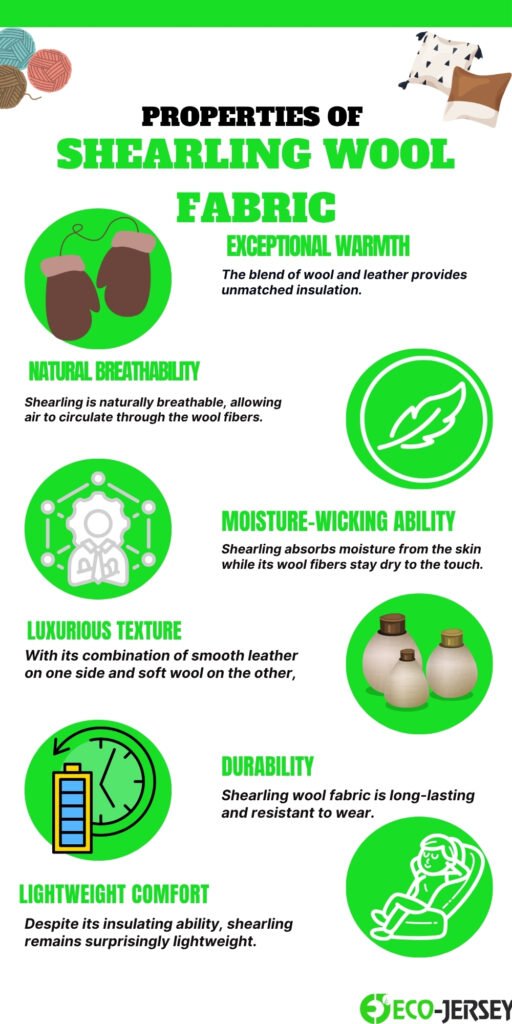
A bright infographic about properties of shearing wool fabric, featuring green circular icons and headings such as Natural Breathability, Moisture-Wicking Ability, Luxurious Texture, Durability, Lightweight Comfort, and Exceptional Warmth; includes small illustrations of wool gloves, fibers, and bottles.
Properties of Shearing Wol Fabric: natural breathability, moisture-wicking, luxurious texture, durability, and lightweight comfort.

One of the most notable features of shearling wol fabric is the combination of natural textures, wool, and leather. The following are some of the features of shearling:

1. Exceptional Warmth

Warmth is attributed to wool and leather combination. This quality of shearling makes it extremely useful during winters.

2. Natural Breathability

In shearling interlining wool, the flow of air is unidirectional passively. This eliminates the risk of overheating.

3. Moisture-Wicking Ability

Moisture from the surface of the skin is absorbed between the wool fibers, and the dry wool maintains comfortable and regulated temperatures.

4. Luxurious Texture

A positive feel accompanied by smooth leather and soft merino wool fabric gives a rich and appreciated texture.

5. Durability

Shearling wol fabric does not get replaced easily. With proper care, it will not get worn out and will last for many years.

6. Lightweight Comfort

Lightweight and warm shearling wools fabric is great for clothing and all types of accessories.

Benefits of Shearling Wools Fabric
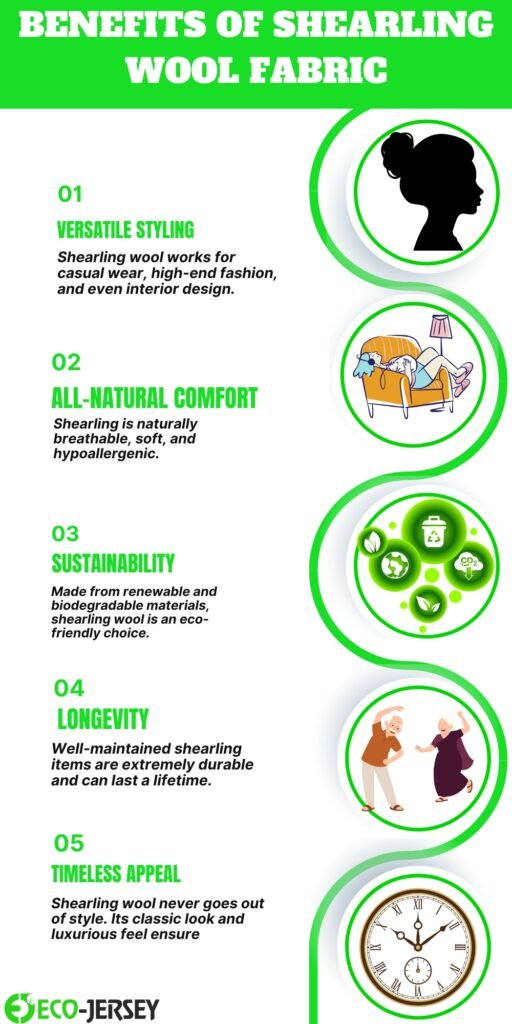
Infographic titled 'Benefits of Shearling Wool Fabric' with five numbered sections and circular icons along the right: 01 Versatile Styling, 02 All-Natural Comfort, 03 Sustainability, 04 Longevity, 05 Timeless Appeal. Each section includes a short description and green accent graphics.
Benefits of Shearling Wol Fabric: Versatile styling, natural comfort, sustainability, longevity, and timeless appeal.

Shearling wol fabric is shearling wools fabric for a reason.

  • Versatile Styling: Casual wear, luxury fashion, and even interior design.
  • All-Natural Comfort: Comfort and ease of breathability as well as hypo-allergenic.
  • Sustainability: Biodegradable, and renewable.
  • Longevity: A lifetime is a minimum for items that are well maintained.
  • Timeless Appeal: A continuous appreciation is a wise investment.

Uses of Shearling Wool Fabric
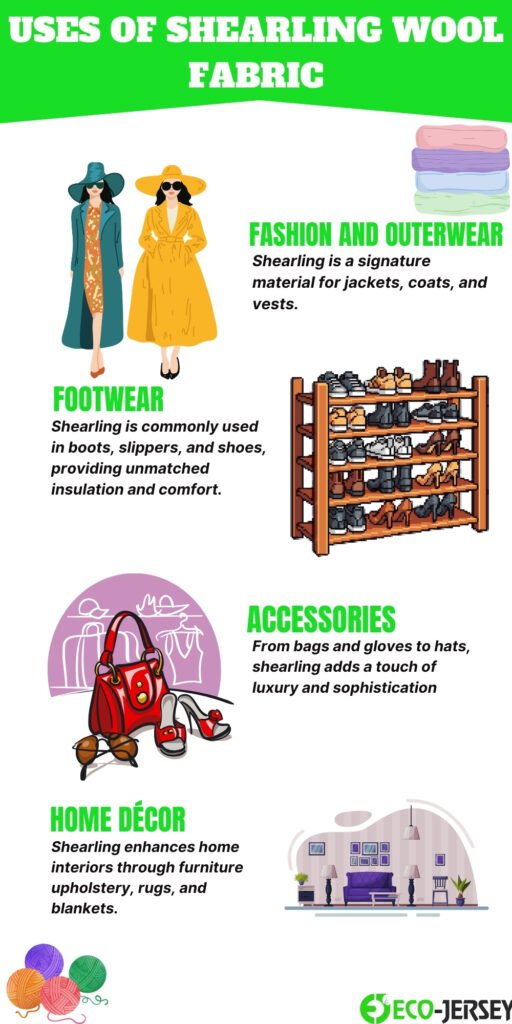
A colorful infographic about uses of shearling wool fabric. Features include fashion outerwear with two stylish coats, a shoe rack with boots, a collection of accessories (handbags, hats, and scarves), and home décor items (sofas and interior accents). Bold green headings label sections: FASHION AND OUTERWEAR, FOOTWEAR, ACCESSORIES, HOME DÉCOR. Small decorative images of yarn balls appear in the bottom left. The Eco-Jersey logo is at the bottom right.
Uses of Shearling Wol Fabric: Fashionable outerwear, footwear, accessories, and chic home décor.

Fashion, lifestyle, and décor all use shearling wol fabric.

1. Fashion and Outerwear

Shearling is a signature material for jackets, coats, and vests. Because it combines warmth and elegance, it remains a favorite for winter collections.

2. Footwear

Boots, slippers, and shoes made of shearling wools fabric provide unmatched comfort and insulation.

3. Accessories

Shearling enhances the luxurious feel of everyday accessories like bags, gloves, and even hats.

4. Home Décor

Furniture upholstery, as well as rugs and blankets made from what is wool fabric can add refinement and cozy warmth to a home.

Disadvantages of Shearling Wools Fabric
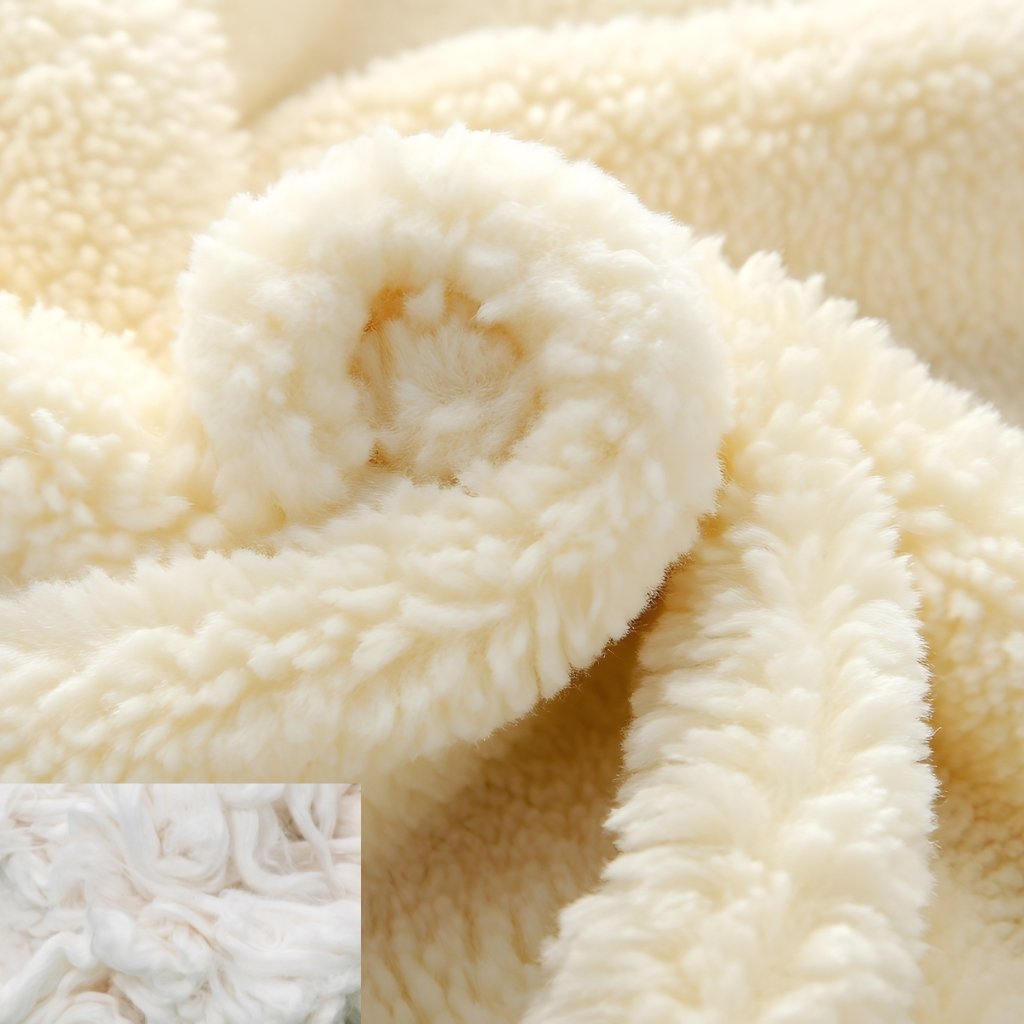
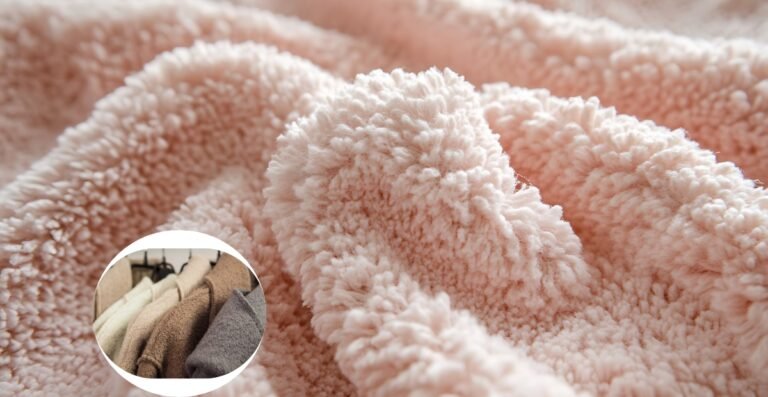
A close-up shot of soft, cream-colored shearling wool fabric with a fluffy, curly texture. The fabric is rolled into a spiral, showcasing its thick, plush interior and fuzzy surface.
Plush cream shearling wool fabric—rich, fluffy texture with a cozy, rolled presentation.

Despite its advantages, shearling wol fabric has some drawbacks:

  • Cost: Quality shearling is costly and has a lengthy processing time.
  • Maintenance: Shearling requires regular and specific maintenance to keep it looking good.
  • Weight: It is lighter than some heavy wool fabric but it still feels heavier than synthetics.
  • Ethical Concerns: Sheskin wool requires ethical practices as the sourcing is from animals.

How to Care for Shearling Wool Fabric
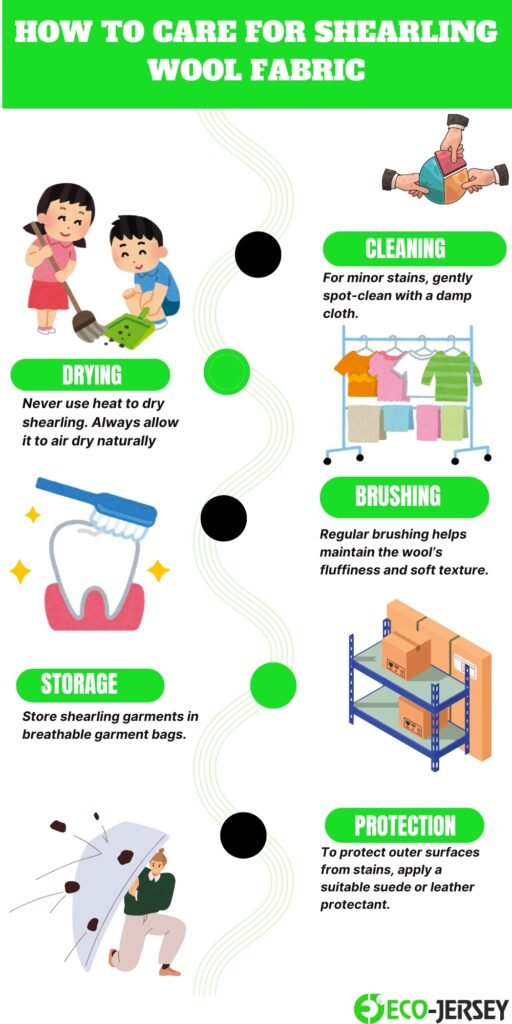
Infographic on how to care for shearling wool fabric with six sections: Cleaning, Drying, Brushing, Storage, Protection, all with green labels and cartoon illustrations of people cleaning, drying, brushing, shelving, and protecting fabric.
How to Care for Shearling Wools Fabric: Cleaning, Drying, Brushing, Storage, and Protection

With good care, shearling wool fabric can be a long-lasting investment. Follow these tips to ensure it can stand the test of time:

  1. Cleaning: Stains should be spot cleaned with a damp cloth, while other large stains should be sent to a professional dry cleaner.
  2. Drying: Do not try to dry shearling wool with heat. Simply let it air dry.
  3. Brushing: Wool can be kept fluffy and fresh with regular brushing.
  4. Storage: It is best to keep former garment bags. Heavy duty laundry bags are okay, but not plastic as it traps moisture.
  5. Protection: For keeping outer layers free from stains, utilize suede or leather protectant.

Storing shearling in the above manner ensures that it remains soft and in shape for decades.

Sustainability of Shearling Wool Fabric

Shearling wool fabric is natural, renewable, and biodegradable. Sheep grow a new fleece every year, and when sourced responsibly, the process becomes sustainable. On top of that, shearling products outlast synthetic alternatives which help sustain slow fashion.

That said, the direct opposite of sustainability is true if farming and tanning practices are unethical. Only shearling from certified and humane sources can guarantee the luxurious fabric is cruelty-free and eco-conscious.

Conclusion

Shearling wool fabric is luxurious, versatile, and practical. It is warm, soft, comfortable, and durable, which makes it pleasant for fashion and home décor. Regardless of the cost and maintenance, shearling wool fabric is a timeless, sustainable investment.

FAQs

What is shearling wool fabric made of?

Shearling wool fabric is made from sheepskin with the wool still attached, which combines soft fleece and durable leather.

Is shearling wool fabric warm?

Absolutely. It is very warm and perfect for winter clothing and accessories.

Can shearling wool fabric get wet?

Light moisture is fine, but sheepskin should not be soaked. Also, it should be dried in the shade, avoiding any source of heat.
Terry Cloth Fabric: Properties, Uses, and Complete Guide

Terry cloth fabric is one of the most popular and practical textiles in the world. Its softness, absorbency and durability, this fabric has become a point of the household. Towels, bathrobes, baby clothing, and sportswear are just a few examples of clothing items where terry cloth is used for comfort and functionality.

Many do use terry cloth garments, yet few are aware of the history, structure, and applications of terry cloth garments. Therefore, this article attempts to provide and cover all the necessary and vital aspects regarding terry cloth fabric; history, types, uses, care, and properties, in which during reading, one understands why terry cloth is one of the most reliable fabric used in daily life and the fabric is trusted in other industries that are specialized.

What is Terry Cloth Fabric?

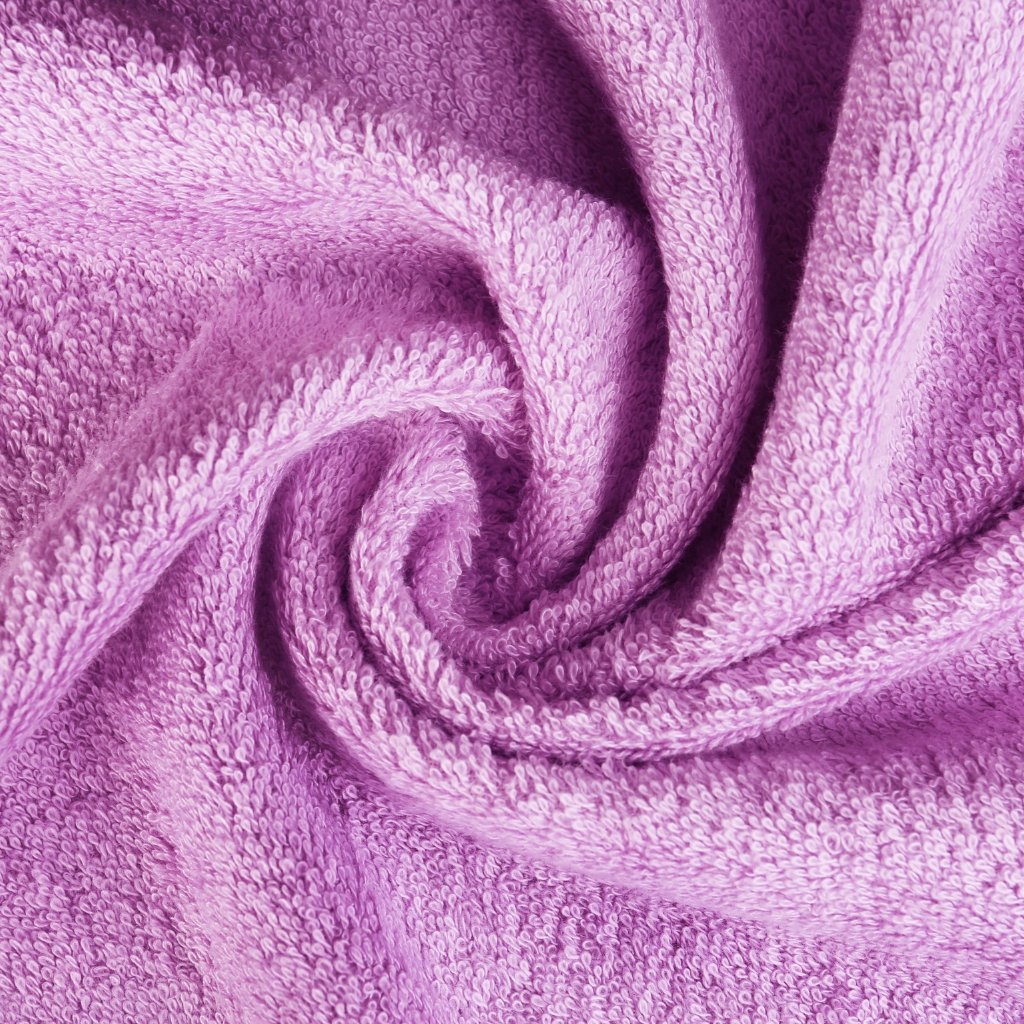
Close-up of a lavender purple terry towel twisted into a spiral.
A soft, purple terry towel artfully twisted into a swirl, showcasing its plush texture.

Terry cloth fabric is a woven or knitted textile where the loops of fabric stand up on the surface. These loops are what provide terry cloth the outstanding quality of absorbance. Traditionally cotton is used to make this fabric, but blended fabrics like polyester can be used to provide it more durability. Read more….Scrim Cotton Fabric

The loops on terry cloth fabric act like little sponges. They help the fabric absorb and retain more water. Because of this, terry cloth is perfect for making towels, bathrobes, and other similar products.

Terry cloth fabric is so versatile that it is used across the fashion, hospitality, medical, and sports industries. The combination of comfort and usability keeps it in demand regardless of the generation.

History of Terry Cloth Fabric

French flag waving on a flagpole against a white background.
The flag of France waving in the wind.

Terry cloth fabric originated in the 19th century. The term “terry” is thought to be derived from the French word tirer, meaning “to pull,” describing the technique of making the loops in the fabric.

Terry cloth was initially handwoven, so it was very expensive and used by the rich. People used terry towels and bathrobes to show off their wealth. Later, with the invention of mechanized looms in the 1800s, terry cloth became cheaper and more widely used.

Terry cloth has not lost its value and is still used in every household, hotels, spas, and gyms across the globe. Its absorbent and soft texture is still highly sought after. Read more…..Voile Cotton Fabric

Properties of Terry Cloth Fabric

A soft lavender-colored towel or blanket with textured fabric and folds.
Luxuriously soft lavender fabric draped in gentle folds.

Terry cloth fabric stands out because of its unique properties. Below are its key characteristics:
High Absorbency – The loops absorb water quickly, making it perfect for towels.
Softness – Cotton terry provides a gentle, skin-friendly touch.
Durability – Strong weave structure ensures long-lasting performance.
Breathability – Cotton fibers allow air circulation, preventing overheating.
Warmth – Loops trap air, offering warmth in robes and loungewear.
Versatility – Suitable for clothing, sportswear, and industrial uses.
Eco-Friendliness – 100% cotton terry cloth is biodegradable and sustainable.

These properties highlight why terry cloth fabric has been a trusted choice for centuries.

Types of Terry Cloth Fabric

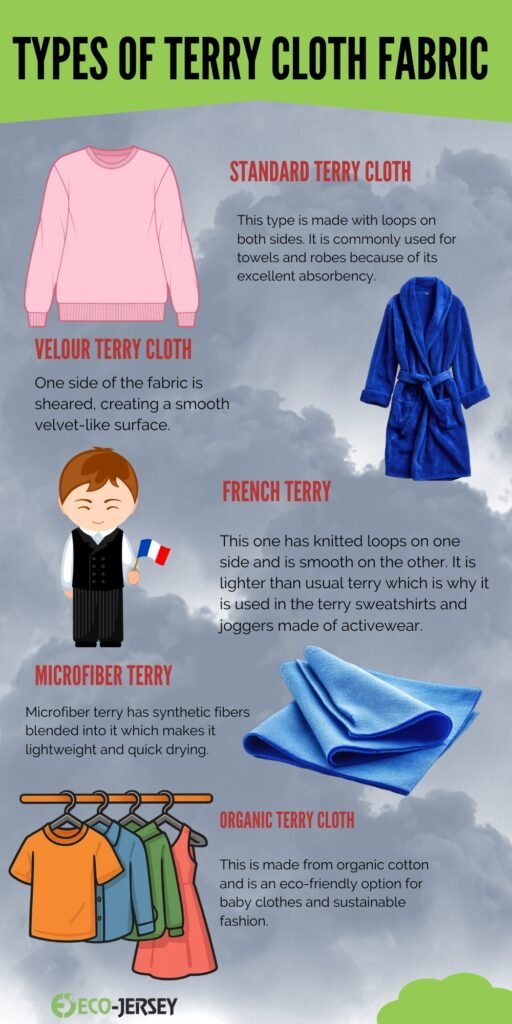
Infographic titled ‘Types of Terry Cloth Fabric’ showing five fabric types with icons: Velour Terry Cloth (pink sweater), Standard Terry Cloth (red text with description), French Terry (knitted loops), Microfiber Terry (blue microfiber cloth), Organic Terry Cloth (clothes on a rack).
A quick guide to different terry cloth fabrics: Velour, Standard, French, Microfiber, and Organic Terry Cloth, with brief notes on texture and uses.

Terry cloth fabric comes in different forms, depending on weaving techniques and end uses. Let’s look at the main types:

  1. Standard Terry Cloth

This type is made with loops on both sides. It is commonly used for towels and robes because of its excellent absorbency.

  1. Velour Terry Cloth

One side of the fabric is sheared, creating a smooth velvet-like surface. The other side retains the loops. It is popular in clothing and luxury robes.

  1. French Terry

This one has knitted loops on one side and is smooth on the other. It is lighter than usual terry which is why it is used in the terry sweatshirts and joggers made of activewear. 

  1. Microfiber Terry

Microfiber terry has synthetic fibers blended into it which makes it lightweight and quick drying. This is best for sports towels and travel towels. 

  1. Organic Terry Cloth

This is made from organic cotton and is an eco-friendly option for baby clothes and sustainable fashion.

Overall, each one serves its own purpose so terry cloth fabric can stay multipurpose.

Uses of Terry Cloth Fabric

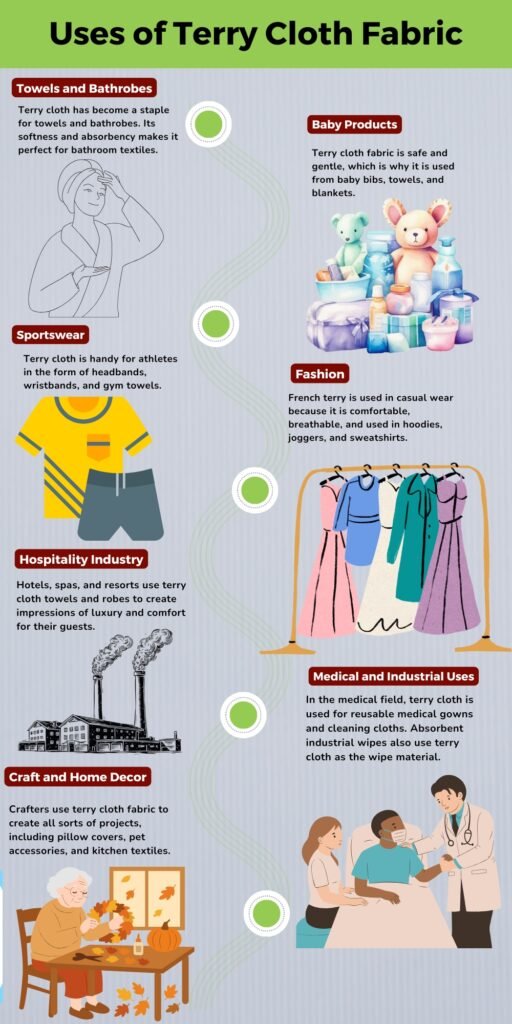
A vertical infographic titled “Uses of Terry Cloth Fabric” showing eight sections with images and short descriptions: Towels and Bathrobes, Baby Products, Sportswear, Fashion, Hospitality Industry, Medical and Industrial Uses, Craft and Home Decor. Each section has a small green dot/line connector along the center and related illustration (bathrobe, baby products, clothing, factory, sewing, etc.).
es of Terry Cloth Fabric: versatility across towels, apparel, hospitality, medical, crafts, and more.

The many uses of terry cloth fabric illustrates its usefulness. Here’s the main uses:

  1. Towels and Bathrobes

Terry cloth has become a staple for towels and bathrobes. Its softness and absorbency makes it perfect for bathroom textiles.

  1. Baby Products

Terry cloth fabric is safe and gentle, which is why it is used from baby bibs, towels, and blankets.

  1. Sportswear

Terry cloth is handy for athletes in the form of headbands, wristbands, and gym towels.

  1. Fashion

French terry is used in casual wear because it is comfortable, breathable, and used in hoodies, joggers, and sweatshirts.

  1. Hospitality Industry

Hotels, spas, and resorts use terry cloth towels and robes to create impressions of luxury and comfort for their guests.

  1. Medical and Industrial Uses

In the medical field, terry cloth is used for reusable medical gowns and cleaning cloths. Absorbent industrial wipes also use terry cloth as the wipe material.

  1. Craft and Home Decor

Crafters use terry cloth fabric to create all sorts of projects, including pillow covers, pet accessories, and kitchen textiles.

With all the different ways to use it, there is little doubt that terry cloth fabric is in high demand.

Advantages of Terry Cloth Fabric

There are many reasons why people choose to use terry cloth fabric. These include:

  • Super absorbent and quick drying.
  • Soft and comfortable for all day wearing.
  • Strong and long lasting.
  • Many and varied uses.
  • Warm but also light.
  • Can be eco-friendly and organic.
  • Can be easily dyed and personalized.

These benefits explain why terry cloth is so popular in the home and commercial markets.

Disadvantages of Terry Cloth Fabric

Terry cloth isn’t without restrictions. These include:

  • Becomes heavy when wet and takes longer to dry.
  • Can shrink in hot water during washing.
  • Can snag easily due to terry loops.

Takes more space for storage when compared to other, thinner fabrics.

These downsides exist to be sure, but the benefits of terry cloth fabric greatly exceed the downsides. This is why it is the most preferred textile all over the globe.

Care and Maintenance of Terry Cloth Fabric

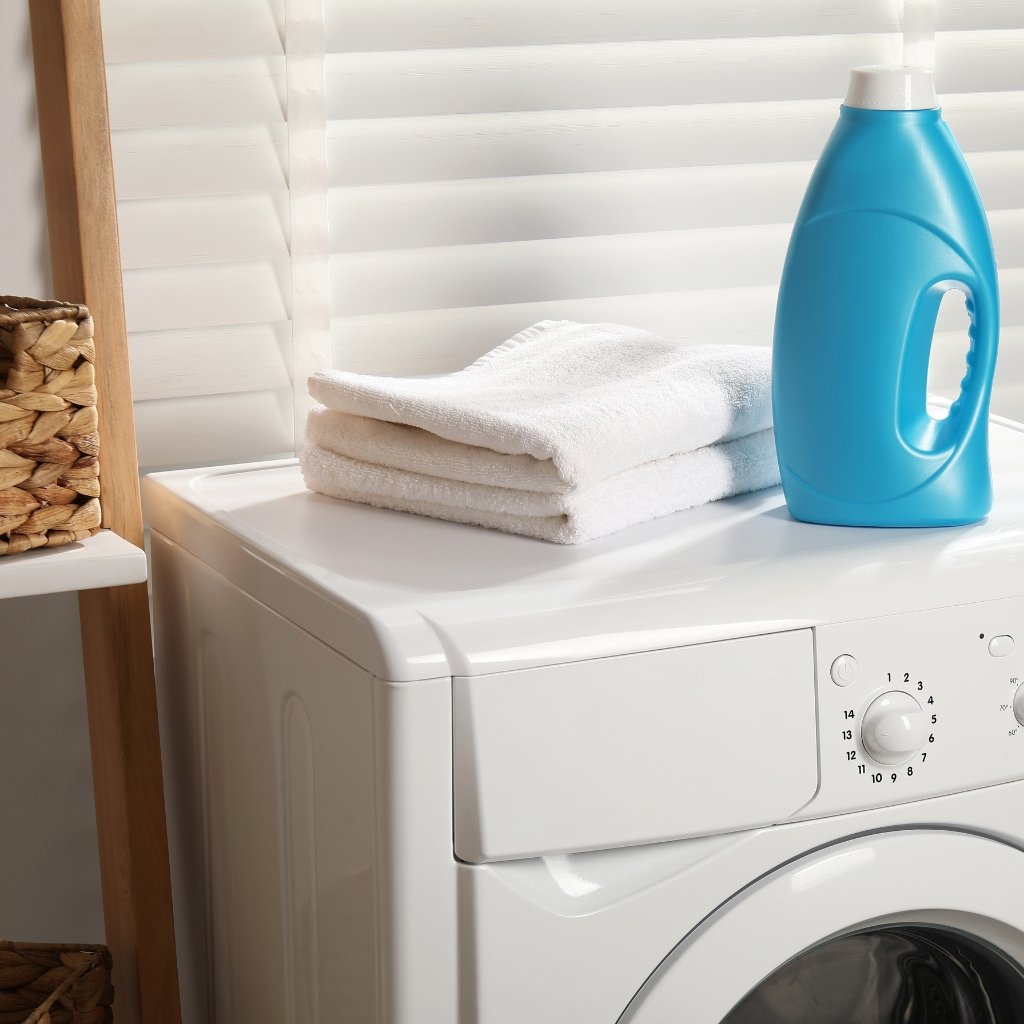
A white washing machine in a laundry nook with a blue laundry detergent bottle and neatly folded white towels on top; a woven basket and light blinds in the background.
Clean and simple laundry setup with fresh towels and detergent ready for a wash.

Taking the right steps in caring for terry cloth will keep it in good condition and and prolong its lifespan.

Wash in Cold or Warm Water – Using hot water can cause it to shrink.

Use Mild Detergents – Unless the fabric is white, bleach should be avoided.

Avoid using Fabric Softeners – They coat the loops and reduce absorbency.

Use Tumble Dry on Low Heat – Tumble driers will keep the fibers from damaging.

Shake it Before Drying – Will lose and fluff the loops.

Store in a Dry Place – Drying is important to keep mildew from forming.

With good care, terry cloth fabric will remain useful for many years.

Why Choose Terry Cloth Fabric?

The main reason for the continued use of terry cloth fabric is the comfort it provides while being functional. To the home, it comes as towels and robes. For the industry, it is used in hospitality, sports, and healthcare. See more…..Muslin Cotton Fabric

Terry cloth is softer and more absorbent and durable compared to its synthetic counterparts. Terry cloth can be organic making its use even more environmentally friendly.

If you need a fabric to provide you with functional luxury then terry cloth fabric is the perfect option.

Terry Cloth Fabric and Sustainability

Terry cloth fabric is becoming more sought after as consumers desire more sustainable materials. Organic cotton terry cloth is chemical free, is sensitive skin friendly, and is compostable. Compared to synthetic materials, organic cotton terry cloth is certainly more sustainable.

Manufacturers to value organic terry cloth more highly, especially for baby products, for sustainable high-end fashion, and for luxury bath robes. This allows consumers to partake in comfort products, and certainly in bath robes, without breaking eco-friendly bathing practices. See more…..Flannel Cotton Fabric

Conclusion

Terry cloth is certainly more than a household item. The softness, elegance, absorbance, and versatility has allowed it to remain a highly trusted and sought after material in textiles for many years. Not many materials have the wide array of high-value products encompassing baby towels, spa robes, gym accessories, fast sustainable fashion and now terry cloth in almost all sustainable products.

The need for organic terry cloth is clear, and as a personal item, cloth terry cloth can be trusted for comfort, practicality, and durability. As a commercial item, it can be trusted for organic tea terry cloth and soulic towels.

FAQs

What makes terry cloth fabric different from other fabrics?

Terry cloth fabric has loops that make it highly absorbent, unlike flat-woven fabrics.

Is terry cloth fabric always made from cotton?

No, while cotton is common, blends with polyester or microfiber are also used.

Can terry cloth fabric be used in fashion?

Yes, French terry is widely used in hoodies, joggers, and casual wear.

Merino Wool Fabric: Properties, Benefits, Uses, and Care Guide

One of the most valued textiles, merino wool fabric, is a prized fabric known for its softness, warmth, and incredible versatility. Unlike regular wool, merino wool is produced by a specific breed of merino sheep mostly found in Australia and New Zealand. It is finer and more elastic than regular wool, which makes it more comfortable and lighter. It is also naturally breathable and odor resistant, which makes it more expensive for use in apparel, activewear, and home, and sports décor.

This guide will explain the history, properties, benefits, available uses, and care tips of Merino wool fabric. Because of its timeless aesthetic qualities and enduring merits, Merino wool is still valued in the fabric industry.

History of Merino Wool Fabric

Merino wool fabric history goes back many centuries. In the 18th century, Merino sheep were introduced to Australia and New Zealand, where the climates were more conducive to sheep farming. As a result, these countries came to be the largest producers of Merino wool.

Merino wool fabric started to gain a reputation for luxuriousness and practicality versatility as the centuries went by. In contemporary times, Merino wool is a popular choice for high-fashion and performance sportswear. The ability to blend the old with the new is what makes Merino wool one of the best natural fibers in the world.

Properties of Merino Wool Fabric

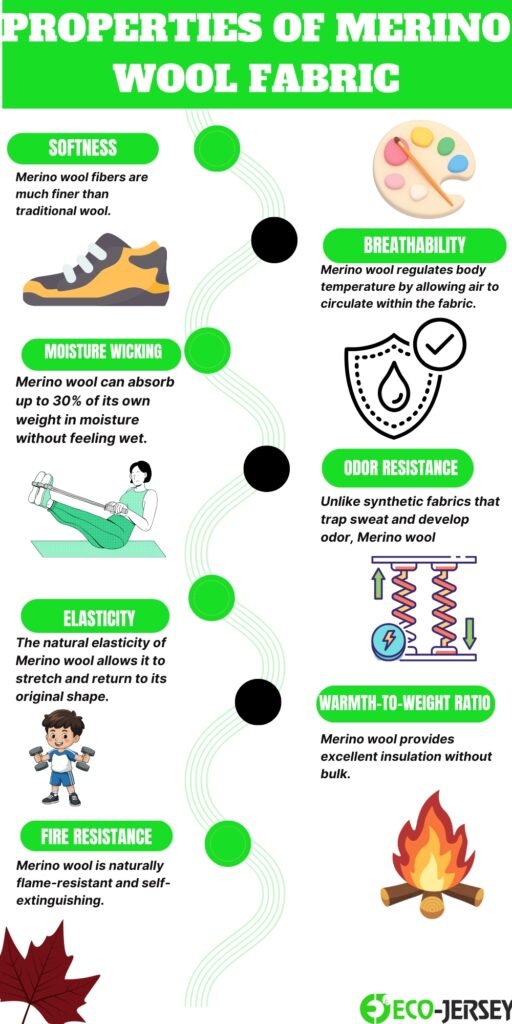
A vertical infographic titled “PROPERTIES OF MERINO WOOL FABRIC” with a bright green header. On the left column, green labels highlight: SOFTNESS with a sneaker icon, MOISTURE WICKING with a person sitting and stretching, ELASTICITY with a child, FIRE RESISTANCE with a fire icon. On the right column, green labels highlight: BREATHABILITY with a mask icon, ODOR RESISTANCE with a shield and sweat drop icon, WARMTH-TO-WEIGHT RATIO with a mattress/coil icon. Between the labels, a wavy line with alternating green circles and black circles connects the points. Each label includes a short description:
SOFTNESS: “Merino wool fibers are much finer than traditional wool.”
MOISTURE WICKING: “Merino wool can absorb up to 30% of its own weight in moisture without feeling wet.”
ELASTICITY: “The natural elasticity of Merino wool allows it to stretch and return to its original shape.”
FIRE RESISTANCE: “Merino wool is naturally flame-resistant and self-extinguishing.”
BREATHABILITY: “Merino wool regulates body temperature by allowing air to circulate within the fabric.”
ODOR RESISTANCE: “Unlike synthetic fabrics that trap sweat and develop odor, Merino wool.”
WARMTH-TO-WEIGHT RATIO: “Merino wool provides excellent insulation without bulk.”
The infographic is credited to ECO-JERSEY in the bottom-right corner.
Merino wool fabric: naturally soft, breathable, odor-resistant, with great elasticity and warmth-to-weight.

All Merino wool fabric’s qualities stem from its accomplished physical as well as natural characteristics. Below are the most notable features.

1. Softness

Compared to other wools, Merino wools are finer. Hence, there is no coarseness and skin itch due to harsher wools.

2. Breathability

Merino wools are able to maintain air in the fabric and regulate the body temperature. It keeps you cool in the summer, but warm in the winter.

3. Moisture Wicking

Merino wool can wick and absorb 30% of its weight in moisture and still not get wet. Hence, there is no moisture remaining and the skin remains time.

4. Odor Resistance

Synthetic fabrics retain moisture and are odorous, not Merino wool. It traps bacteria and neutralizes them.

5. Elasticity

Merino wool fibers are able to stretch and return to their original shape. It is also wrinkle resistant and therefore, durable.

6. Warmth to Weight Ratio

Merino wool is able to keep its wearer warm with less fabric due to its insulation properties. The fibers are lightweight yet provide warmth.

7. Fire Resistance

Merino wool fabric is self-extinguishing. This provides another safety advantage in comparison to non tweed wool fabric materials.

Merino Wool Fabric Benefits

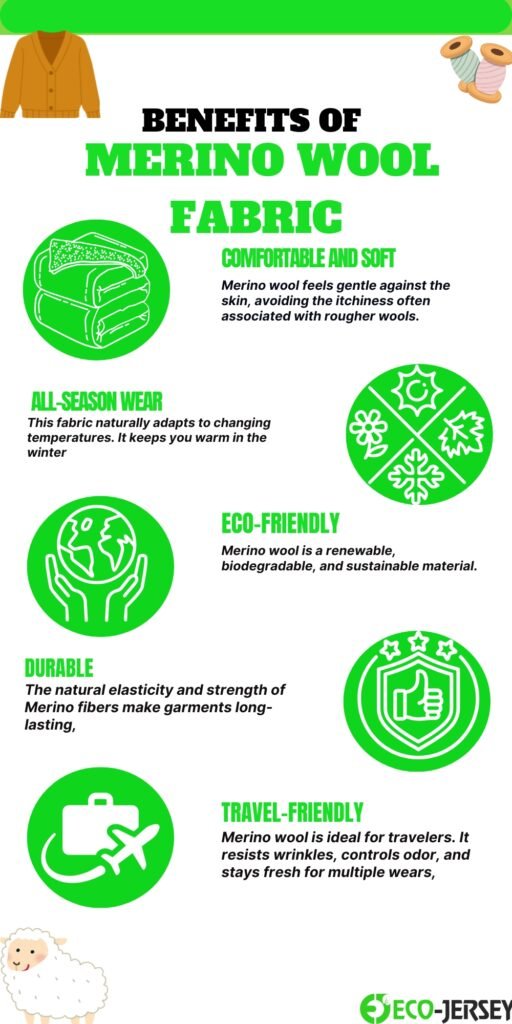
An infographic titled “Benefits of Merino Wool Fabric” with bright green accents. Includes icons: a sweater, a spool of thread, folded blanket, Earth/hand icon, checkmark shield, and travel icon. Sections labeled: Comfortable and Soft, All-Season Wear, Eco-Friendly, Durable, Travel-Friendly. Each section has a short descriptive sentence about Merino wool’s properties.
Discover the comfort and versatility of Merino wool: soft on skin, naturally temperature-regulating, renewable, durable, and travel-friendly.

Incorporating Merino wool fabric in every-day situations is a game changer because of the numerous benefits. Merino wool offers:

Comfortable and Soft

Merino is also pleasant against the skin unlike rough wool.

All-Season Wear

Merino wool works in summer and winter.

Eco-Friendly

Merino wool is also renewable, biodegradable, and sustainable.

Durable

Merino fabric provides strong fibers and lasting clothing.

Travel-Friendly

Merino wool is perfect for travelers. It controls odor and resists wrinkles.

Merino Wool Fabric Uses

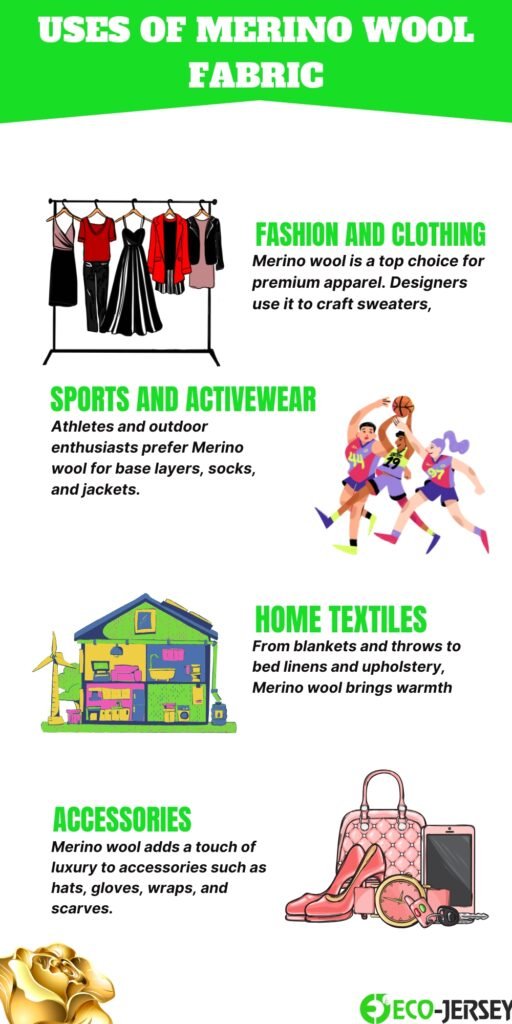
A vertical infographic titled “USES OF MERINO WOOL FABRIC” with a bright green header. It features four sections:
Fashion and Clothing showing a clothing rack with dresses and tops.
Sports and Activewear with cartoon athletes playing basketball.
Home Textiles depicting a colorful house with furniture.
Accessories illustrating a pink handbag, shoes, sunglasses, and a phone. Each section includes bold green headings and a short descriptive paragraph in black.
Discover the versatile world of merino wool: fashion and clothing, sport and activewear, home textiles, and stylish accessories—crafted for comfort, warmth, and performance.

Many industries utilize Merino wool fabric for numerous purposes.

1. Fashion and Clothing

Merino wool is highly sought after for premium apparel. This includes sweaters, coats, scarves, dresses, and even suits. It is a favorite among designers for the blend of functionality and elegance.

2. Sports and Active Wear

Merino wool fabric is the favorite of athletes and outdoor lovers for base layers, socks, and jackets. It keeps you dry and odor free, making it ideal for hiking, skiing, and running.

3. Home Textiles

Wool blankets, throws, bed linens, and upholstery will all incorporate Merino wool. Its coziness and heat will brighten any living space.

4. Accessories

Merino wool also elevates the luxuriousness of hats, gloves, and even scarves.

Disadvantages of Merino Wool Fabric

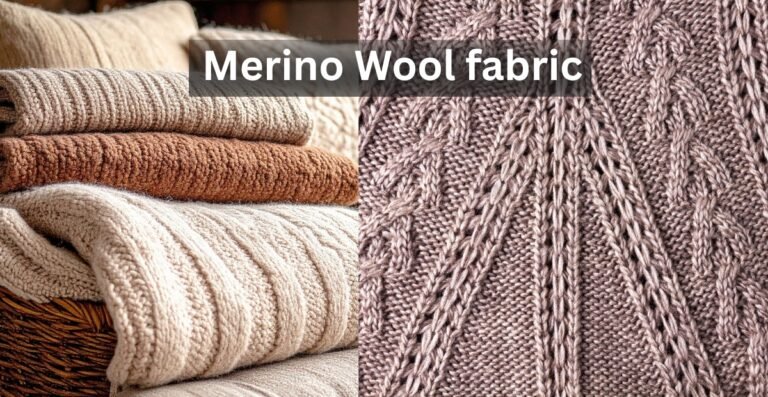
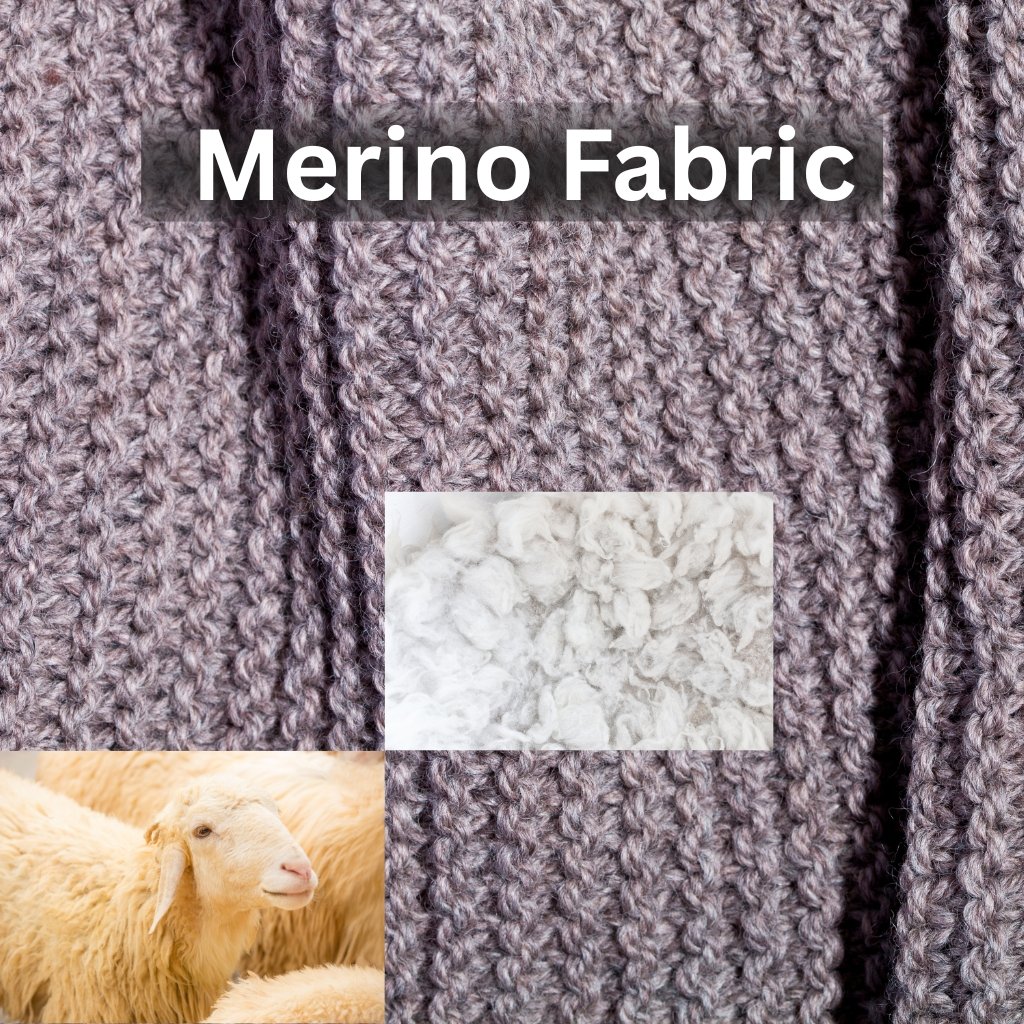
A close-up view of soft, chunky merino wool fabric in a muted lavender-gray color, showing thick knitted stitches. In the lower left, a small collage tile features creamy white merino fiber and a light-colored sheep, highlighting the natural source. The words "Merino Fabric" appear across the top in bold letters.
Merino Wool Fabric: Luxuriously soft, warm, and naturally breathable.

Merino wool fabric is also costly. In comparison to normal what is wool fabric synthetic fabrics, and wool, Merino wool is much more costly.

Some Merino wool garments, also, take more time to care for as they need to be hand washed or dry cleaned, which cannot be sustainable for some people.

Fine wools also may be somewhat more fragile and deteriorate quicker than even coarse wool fabric.

Caring for Merino Wool

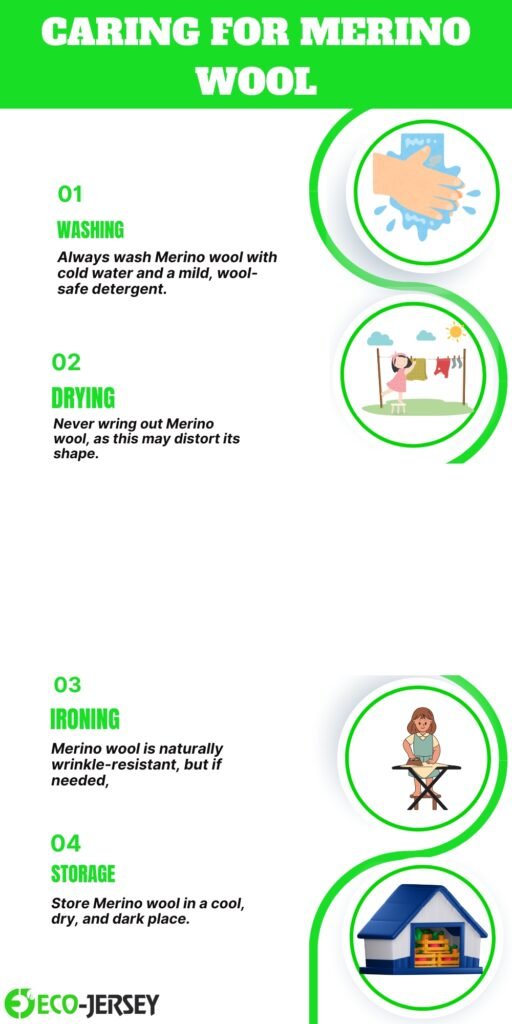
Infographic titled 'Caring for Merino Wool' with four numbered sections: 01 Washing, 02 Drying, 03 Ironing, 04 Storage. Each section has green section headings, short descriptive text, and circular illustrations of washing hands, laundry on a line, a person ironing, and a blue house icon. Brand logo 'Eco-Jersey' at the bottom left.
Caring for Merino Wool: simple, gentle care steps in four parts—washing, drying, ironing, and storage—to keep your Merino wool fabrics soft, breathable, and long-lasting.

Merino fabric will last longest if you wash and dry it properly.

  1. Washing: Cold water and mild detergent are best, along with hand washing or a gentle machine cycle.
  2. Drying: You should not wring it out. Lay the fabric flat to dry.
  3. Ironing: You may also want to release wrinkles with low heat steam.
  4. Storage: Keep the Merino fabric in a dry, cool, and dark place. Use breathable bags as you store it to keep your Merino wool protected from moths.

This will provide structure and increase the lifespan of the fabric.

Sustainability of Merino Wool Fabric

Among the various fabrics out there, Merino wool ranks high on the sustainability list. Because we fleece sheep every year, the fiber is considered a renewable resource. Furthermore, Merino wool is biodegradable, leaving no plaque after decay. Because Merino wool garments last for a long time, the number of replacements and, therefore, the amount of waste is minimized.

The blend of comfort, performance, and eco-friendliness is what makes Merino wool a responsible choice for sustainable fashion.

Conclusion

There will remain few fabrics as versatile and luxurious as Merino wool. Its softness, breathability, warmth, and durability will keep it beloved for both high fashion and performance apparel for years to come, and it being a green, eco-friendly, and sustainable material will accomplish it for decades to come.

FAQs

Is Merino Wool Fabric suitable for sensitive skin?

Yes, Merino wool is substantially softer than ordinary wool and is frequently acceptable for people with delicate skin.

Can you wear Merino Wool Fabric in summer?

Yes, its breathability properties and the ability to wick moisture away from the skin makes Merino wool comfortable in hot weather.

Does Merino Wool Fabric shrink easily?

Yes, Merino wool will shrink if you wash it with hot water or agitate it. Be sure to follow the care instructions.

Alpaca Wool Fabric: Sustainable Luxury for Fashion and Home

The alpaca wool fabric is regarded as one of the most luxurious and sustainable fabrics. Wool is made from the soft, warm, and elegant alpaca fleece and has been a fabric of choice for the ancieent and modern civilization for the durable and beautiful woolend fabrics. In this complete gide, I will summarize the history, properties, uses, benefits and the care instrcuctions for the precious alpaca wool fabric.

A Brief History of Alpaca Wool

The history of alpaca wool begins with the Andean highlands of Peru, Bolivia, and Chile. Alpacas were sacred animals to the Incas and their wool was only used for the royal family. Because of the wool´s fine quality and rarity, it was referred to as the “fiber of the gods.”

The Andean region of Peru is the alpaca wool industry still the weaving and economic impact with the alpaca wool remains. The culture of weaving with the alpaca wool is still practiced today and it is still economically important today as it is used in high-end fashion and home textiles.

Types of Alpaca Wool

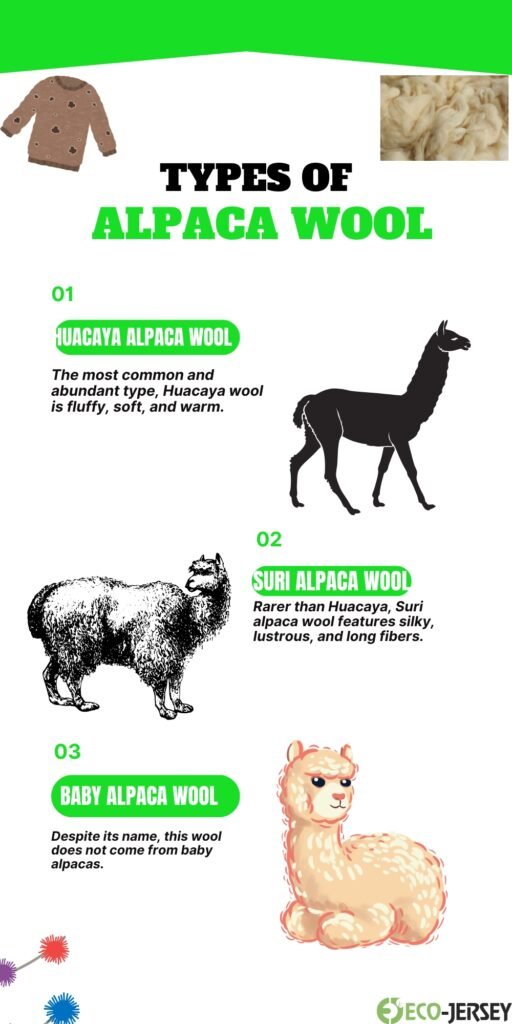
An infographic titled ‘Types of Alpaca Wool’ showing three types: Huacaya Alpaca Wool (text in green badge) with a black silhouette of a standing alpaca; Suri Alpaca Wool (green badge) with a black silhouette of a different alpaca; Baby Alpaca Wool (green badge) with a cute illustrated baby alpaca. Green accents and small images of fabric swatches at the top corners.
Types of Alpaca Wool: Huacaya, Suri, and Baby Alpaca Wool with quick notes on texture and characteristics.

Each alpaca wool does not have the same quality or characteristics. The different types of alpaca wool are determined by the quality and characteristics of the wool.

  • Huacaya Alpaca Wool – This is the most abundant type of wool and also the most commonly known. It is fluffy, soft, warm, and it is excellent to use in the manufacture of sweaters and coats.
  • Suri Alpaca Wool – This type of angora wool fabric is used for scarves, elegant textiles, and shawls. It is rare, has silky, soft, and shiny wool, and has long fibers.
  •  Baby Alpaca Wool – This doesn’t come from baby alpacas! It’s just the name given to the finest and softest fibers sheared from the alpaca in their first few years.

Different types of alpaca wool have their own unique characteristics, but they are all admired for their softness, durability, and natural beauty.

Alpaca Wool Fabric

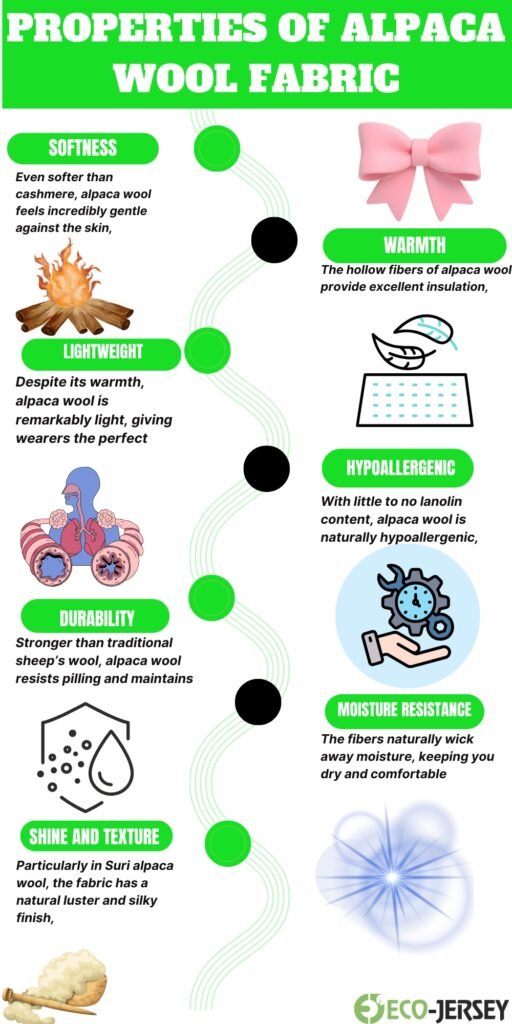
A tall infographic titled “Properties of Alpaca Wool Fabric” with a green header. It features a central curved decorative line with black and green circles along its path. On the left, green labeled badges highlight properties: Softness, Lightweight, Durability, Shine and Texture. On the right, green badges highlight: Warmth, Hypoallergenic, Moisture Resistance. Each badge is accompanied by a short descriptive sentence and small illustrative icons (fire for softness, campfire; bow for warmth; lungs for moisture; fibers/texture images; a needle for shine; a water drop for durability, etc.). The layout uses pastel illustrations and icons to convey fabric qualities like softness, warmth, elasticity, and breathability.
Discover the exceptional qualities of alpaca wool fabric: ultra-soft, lightweight, durable, warm, hypoallergenic, moisture-wicking, and with a beautiful shine and texture.

Alpaca wool fabric is wonderful and works wonders, because of it unique natural characteristics.

  1. Softness – Alpaca wool what is wool fabric is even softer than cashmere and feels amazing on the skin.
  2. Warmth – Alpaca wool has amazing warm hollow fibers that insulate and trap body heat without it feeling heavy.
  3. Lightweight – Alpaca wool is warm but it is also light, which is a great combination.
  4. Hypoallergenic – Alpaca wool is great for sensitive skin, and it is hypoallergenic because it has little to no lanolin.
  5. Durability – Alpaca wool is strong and durable, and it is even stronger than sheep wool fabric. It doesn’t pill.
  6. Moisture Resistance – Alpaca wool helps keep dry because it absorbs moisture.
  7. Shine and Texture – Suri alpaca wool is particularly shiny and has a soft finish that adds to the elegance.

Reasons People Like Alpaca Wool Fabric

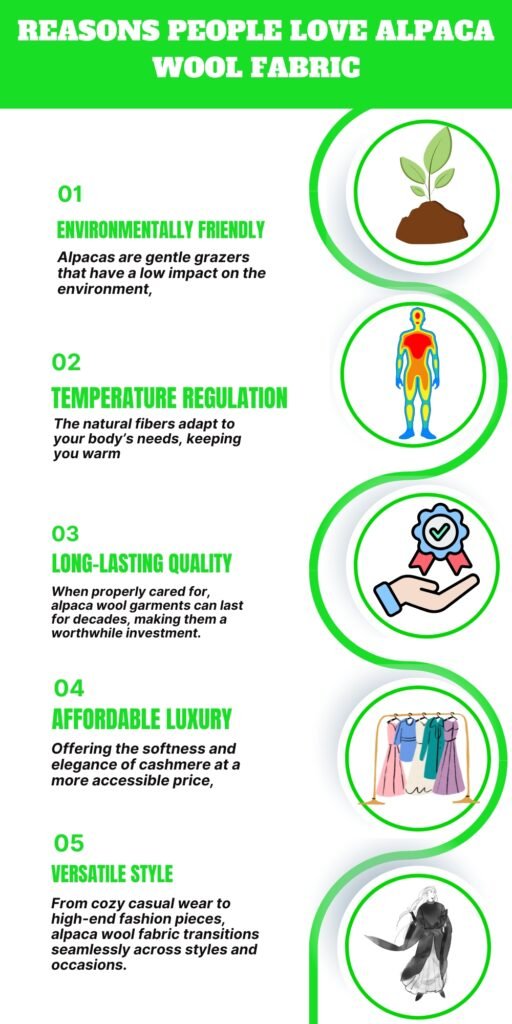
An infographic titled "Reasons People Love Alpaca Wool Fabric" with five circular icons on the right and five numbered sections on the left describing benefits: environmentally friendly, temperature regulation, long-lasting quality, affordable luxury, and versatile style. The layout features green accents and a white background.
Why people adore alpaca wool fabric: eco-friendliness, comfort, durability, luxury at a accessible price, and versatile style.

Here’s why people like alpaca wool fabric:

  • Environmentally Friendly – Alpacas are lightweight grazers and don’t harm the environment, making their wool something you can sustainably use.
  • Temperature Adjustment – Wool from alpacas warms you during freezing temperatures and cools you off during warmer weather.
  • Long Lasting – A well cared for alpaca wool garment will last you many decades, making it a good costly item.
  • Affordable Luxury – Alpaca wool gives you a nice alternative to cashmere for a cheaper price.
  • Works with Everything – It can be transformed from casual clothes to high-end pieces with ease.

Common Uses of Alpaca Wool Fabric

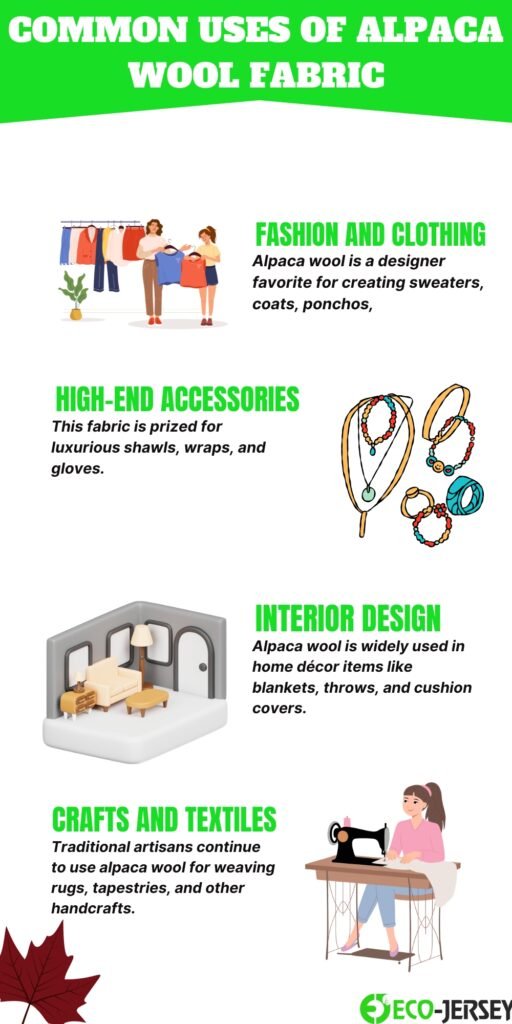
Infographic about common uses of alpaca wool fabric, with sections on Fashion and Clothing, High-End Accessories, Interior Design, and Crafts and Textiles, featuring illustrations of people shopping, jewelry, a miniature room, and a person sewing.
Common uses of alpaca wool fabric: fashion, accessories, interior design, and crafts.

Because you can do a lot with it, alpaca wool fabric is a part of many different trades:

1. Fashion and Clothes

Alpaca wool fabric is common in the making of sweaters, scarves, coats, ponchos, gloves, and hats. It is lightweight, warm, and soft, making it something designers love to use.

2. High-End Accessories

Alpaca wool is coveted for making shawls, wraps, and sloves. Baby-alpaca scarves are especially fancy and are often gifted.

3. Interior Design

Alpaca wool blankets, throws, and cushion covers enhance the decor and provide cosiness to any room. Their strength helps the decor last a long time.

4. Crafts and Textiles

Artisans continue to weave rugs and tapestries using alpaca and handcrafts, cherishing their cultural practices.

Caring for Your Alpaca Wool Fabric

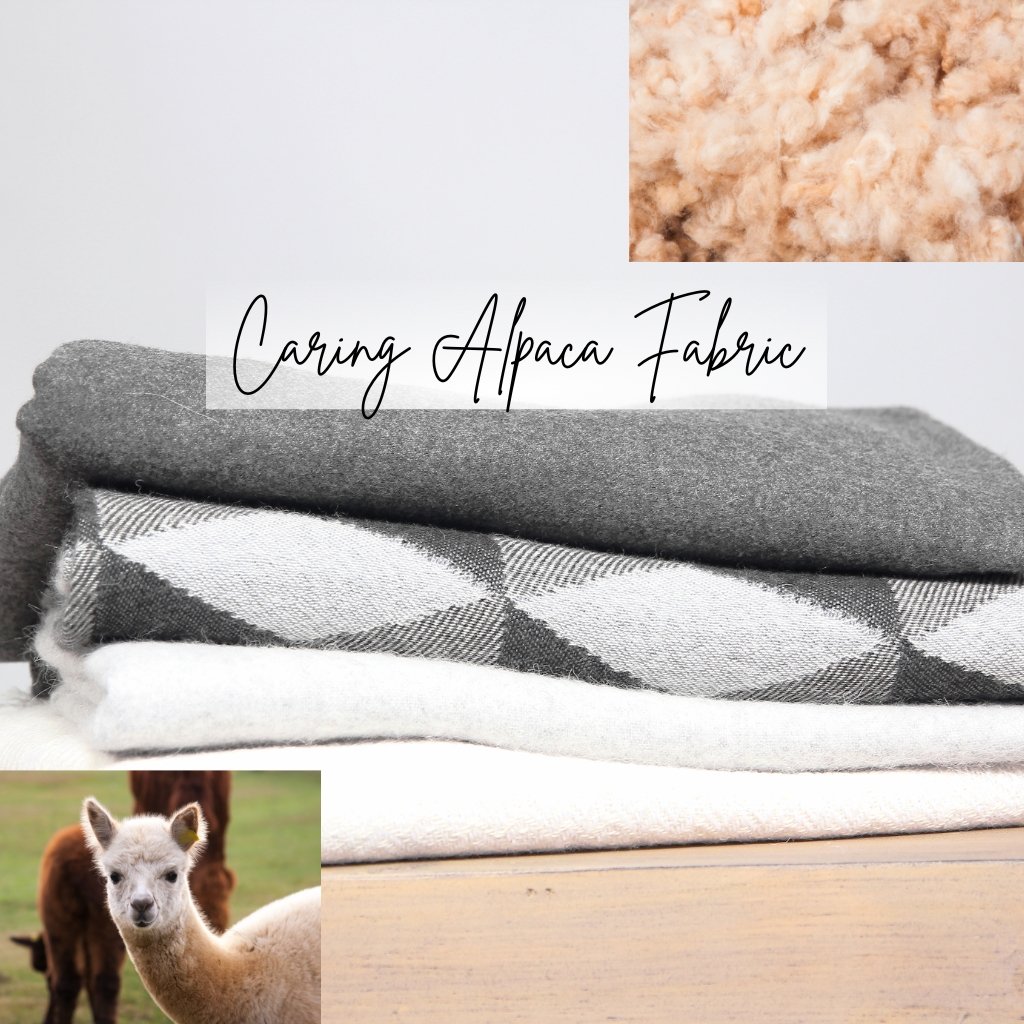
Stacks of gray and plaid wool fabrics with an alpaca image in the corner and a small fluffy textured swatch above.
Caring Alpaca Fabric: Soft, warm wool textures in charcoal, plaid, and cream.

Like any other natural fiber, alpaca wool must be cared for properly.

  • Washing – Hand wash with a mild soap and cold water or dry clean delicate garments.
  • Drying – Drying must be done by laying the garments flat. Do not wring or hang the garments to dry because it will distort the garment.
  • Storage – Storage must be done with breathable bags and with cedar and lavender to knock away moths.
  • Brushing – To keep garments smooth, use a soft garment brush.

By following these simple pointers, alpaca wool fabric will continue to look beautiful and new.

Why Alpaca Wool Fabric is Still High in Demand

Alpaca wool fabric is a textile, tradition, and a luxury. Because alpaca wool is soft, warm, and durable, it is highly valued in other countries too. It is also a perfect eco-friendly option for people.

Final Thoughts

Alpaca wool fabric is timeless. It moved from ancient Incan royalty to modern day runways and homes. It’s the history and properties making it one of the most versatile fabrics in the world. Alpaca wool is one of the most versatile and elegantly timeless fabrics in the world, whether it is worn or used to decorate a home.

FAQs

What is Alpaca Wool Fabric?

Alpaca wool fabric is a natural textile made from the fleece of alpacas, prized for its softness, warmth, and durability.

Is Alpaca Wool warmer than sheep’s wool?

Yes, alpaca wool is warmer and lighter than sheep’s wool due to its hollow fibers, which provide excellent insulation.

Is Alpaca Wool Fabric itchy?

No, alpaca wool is hypoallergenic and lanolin-free, making it softer and more comfortable against the skin than many other types of wool.

Scrim Cotton Fabric: Uses, Benefits, and Complete Guide

Scrim cotton fabric is a lightweight cotton fabric with a loose weave. It is cotton scrim fabric. It is simple fabric that has a variety of uses. It is valuable to manufacturers, designers, and crafters. It is important at the different uses at different levels. It can be adapted and is breathable. It has an important presence in the textile, arts, and industrial uses.

This guide will provide you with the scrim cotton fabric properties, types, uses, benefits and caring. We will also discuss the importance of scrim cotton fabric in different modern and traditional industries.

What is Scrim Cotton Fabric?

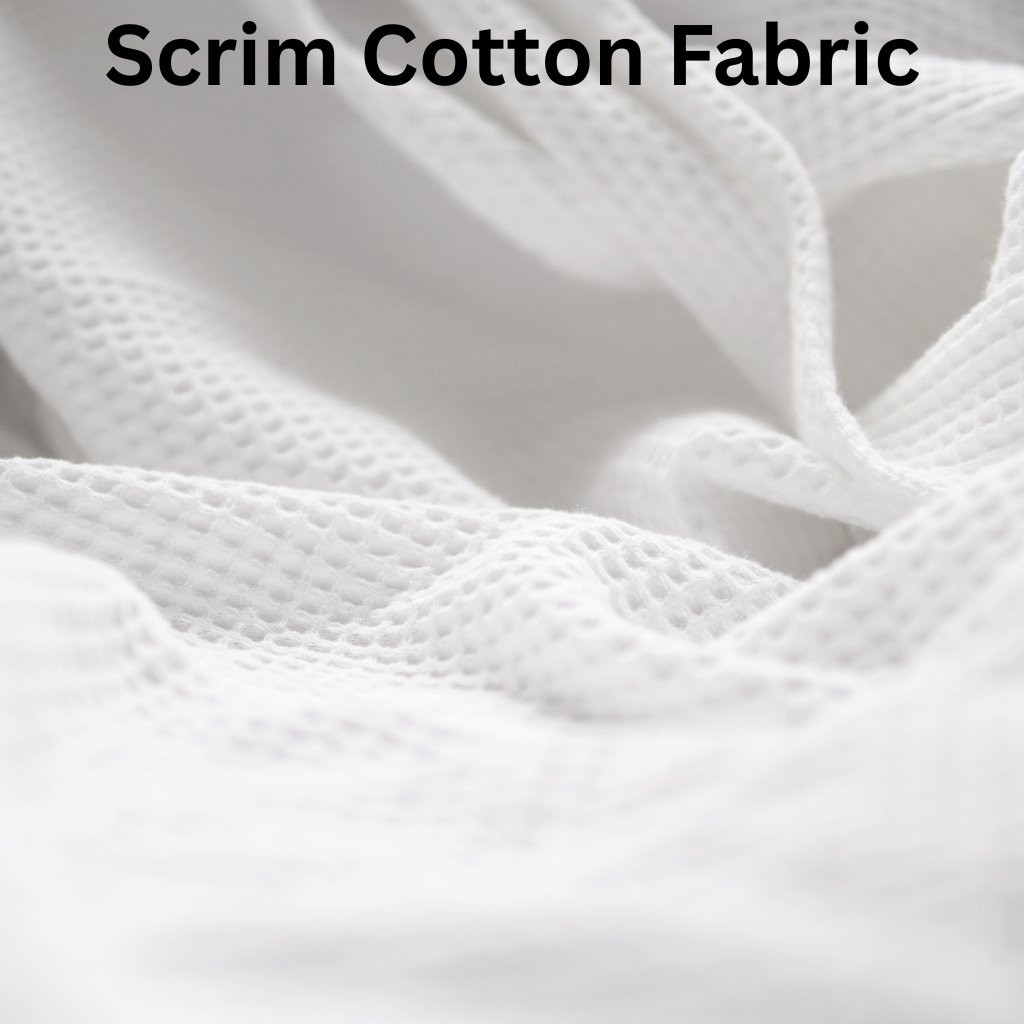
Scrim cotton fabric close-up showing soft, textured white material with small perforations.
Scrim Cotton Fabric: soft, breathable texture in white.

Scrim cotton fabric is a plain fabric that is woven in an open and grid like fashion. Because of this, the fabric appears to be sheer and has a net appearance. Regardless of its delicate appearance, scrim cotton fabric is strong and durable. It can be used alone or as a supportive backing textile for other textiles.

The name ‘scrim’ is an old English textile name. It was used in theater backdrops and curtains. It was also used as curtains because it could create special visual effects when lit. Currently scrim cotton fabric is used in fashion, upholstery, crafts, and industrial uses. Read more…..Lawn Cotton Fabric

Characteristics of Scrim Cotton Fabric

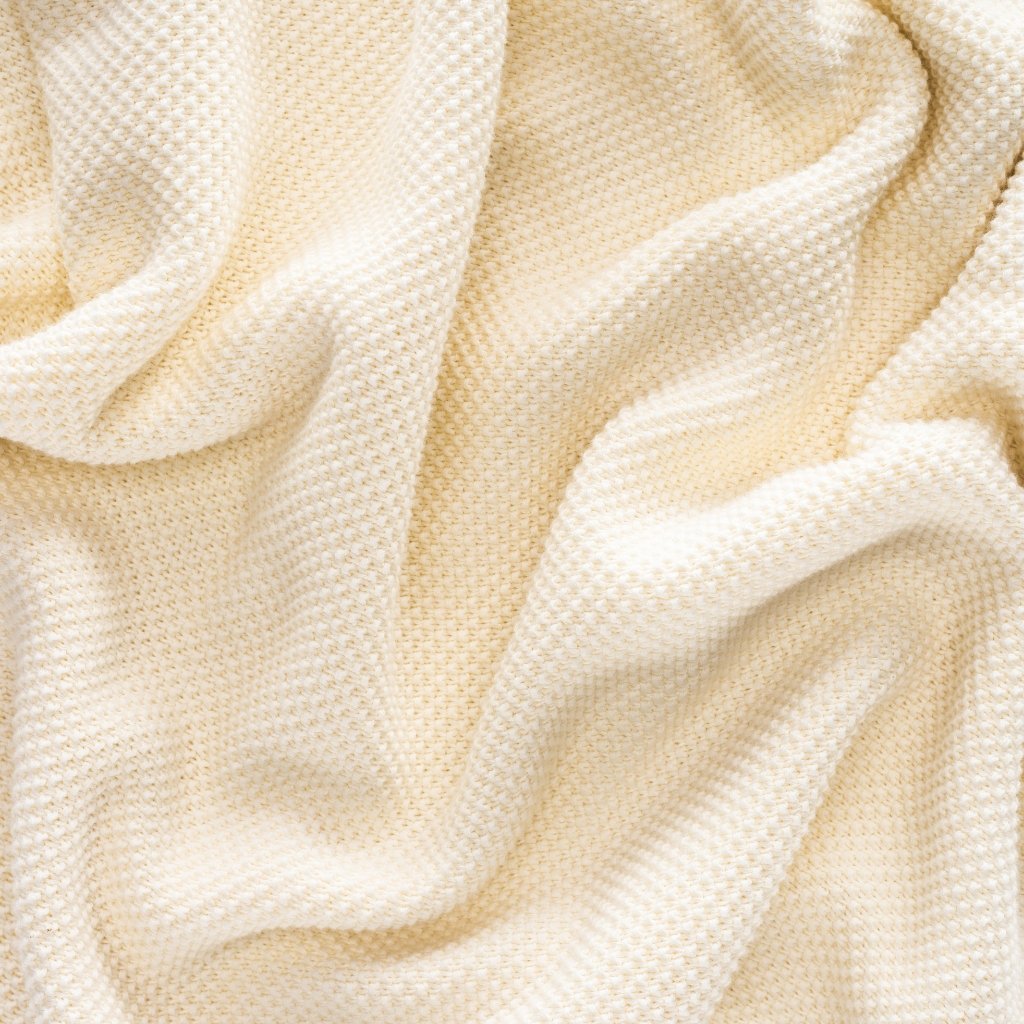
A close-up view of soft, cream-beige fabric with a textured waffle-knit pattern, draped in gentle folds.
Soft cream knit fabric arranged in flowing folds.

Scrim cotton fabric has several noteworthy characteristics which makes it valuable.

Lightweight nature – Its thin and loosely woven yarns makes it very light.

Breathability – It has open weaves which means air is able to pass through it.

Flexibility – It is able to be layered, dyed or even combined with other fabrics.

Absorbency – Because it is cotton, it is able to absorb moisture.

Strength – It may be delicate in nature but scrim offers reliable support.

Eco Friendly – Scrim cotton is biodegradable and offers sustainability.

These characteristics are also why scrim cotton fabric isn’t useable for a range of purposes. Its affordability also offers a great incentive for bulk use.

Varieties of Scrim Cotton Fabric

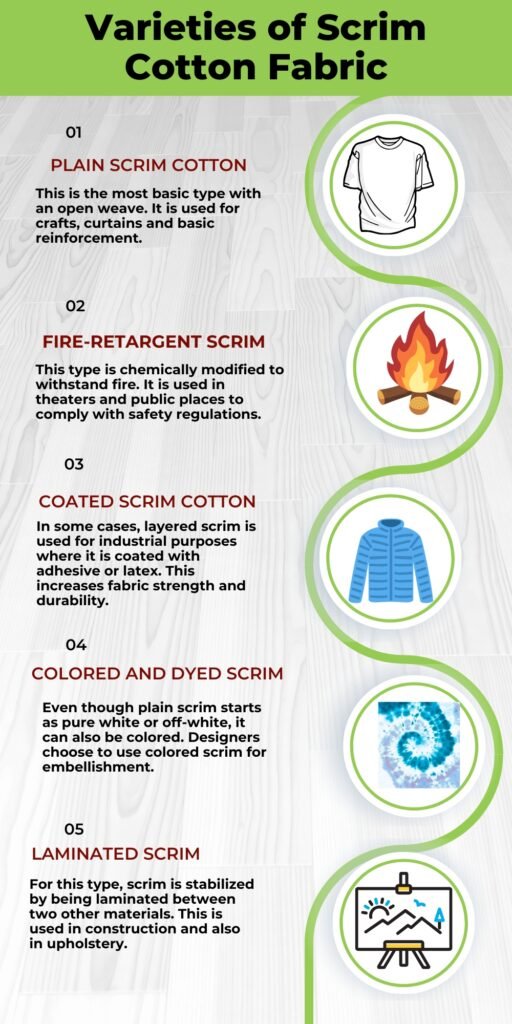
A vertical infographic titled “Varieties of Scrim Cotton Fabric” with five numbered sections: 01 Plain Scrim Cotton, 02 Fire-Retardent Scrim, 03 Coated Scrim Cotton, 04 Colored and Dyed Scrim, and 05 Laminated Scrim. Each section includes a short description and an circular icon on the right: a T-shirt, a campfire, a blue jacket, a swirl dye pattern, and a presentation board, connected by a green curved line.
Varieties of Scrim Cotton Fabric: from basic plain scrim to fire-retardant, coated, colored/dyed, and laminated options, with practical uses illustrated.

Scrim cotton fabric is manufactured for numerous scrim cotton fabric variations. The most common types include:

  1. Plain Scrim Cotton

This is the most basic type with an open weave. It is used for crafts, curtains and basic reinforcement. Read more….Types of Cotton Fabric

  1. Fire-Retardant Scrim

This type is chemically modified to withstand fire. It is used in theaters and public places to comply with safety regulations.

  1. Coated Scrim Cotton

In some cases, layered scrim is used for industrial purposes where it is coated with adhesive or latex. This increases fabric strength and durability.

  1. Colored and Dyed Scrim

Even though plain scrim starts as pure white or off-white, it can also be colored. Designers choose to use colored scrim for embellishment.

  1. Laminated Scrim

For this type, scrim is stabilized by being laminated between two other materials. This is used in construction and also in upholstery.

By selecting the right type, various industries can optimize the use of scrim cotton fabric.

Historical Background of Scrim Cotton Fabric

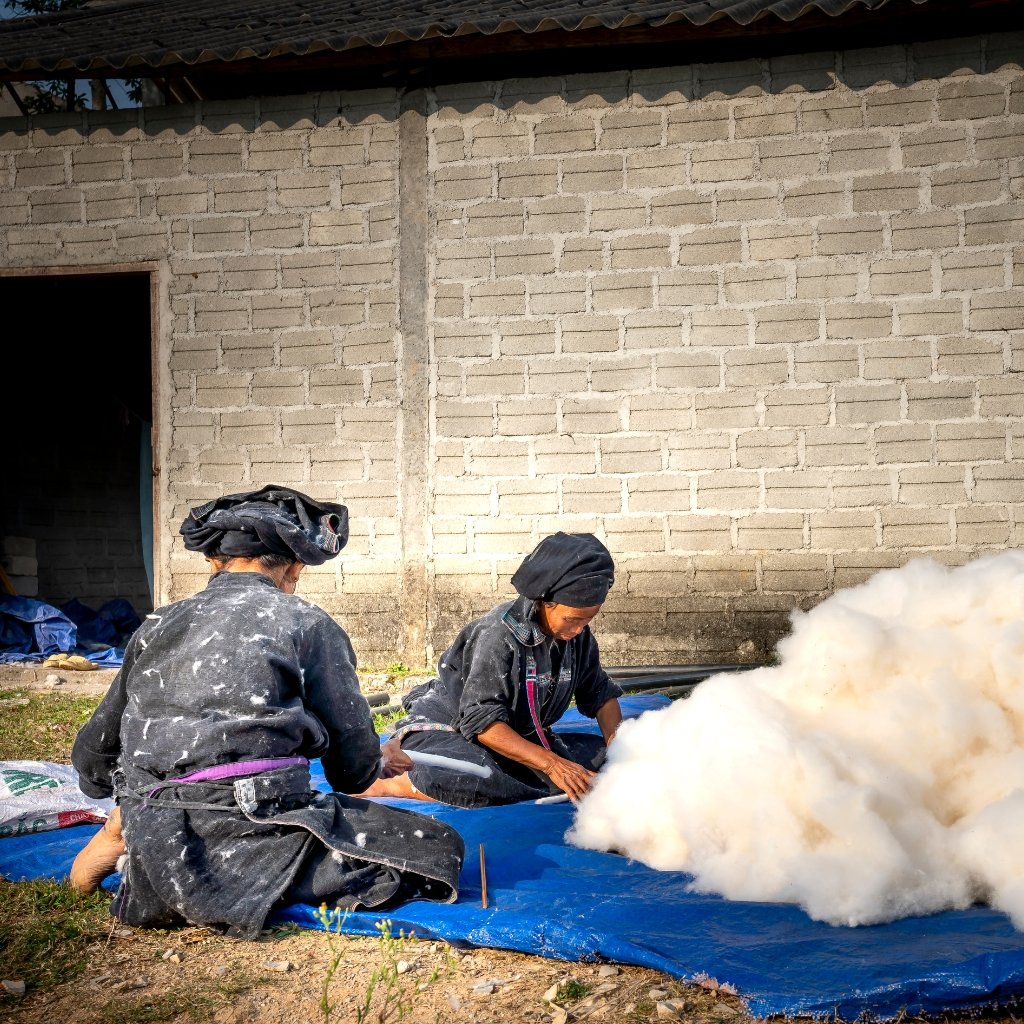
Two people wearing dark clothing and head coverings sit on a blue tarp outdoors next to a gray brick wall. One person appears to be handling white fluffy material, with a large cloud of dust or steam rising nearby.
Craft workers sit on a blue tarp, handling fibrous material beside a brick wall as a cloud of dust forms nearby.

Scrim fabric can be traced back to the early stagecraft. European theaters used scrim backdrops and lighting effects to create illusions. When the fabric was backlit, it became transparent. This quality made scrim a valuable asset in the performing arts. See more….Drill Cotton Fabric

As production of various textiles advanced, scrim cotton fabric spread to additional uses. It was first adopted by upholsterers as a lining and reinforcement material, then in quilting, embroidery, and even the medical field. Over time and with the advancement of other technologies, the simple weave of scrim fabric continued to be a valuable material, this time outside of the performing arts.

Uses of Scrim Cotton Fabric

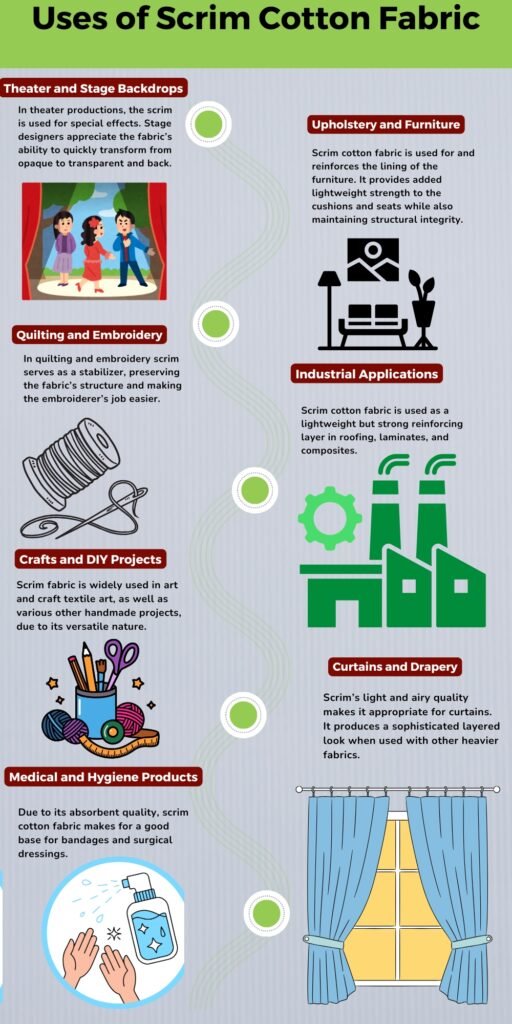
Infographic titled 'Uses of Scrim Cotton Fabric' with sections on Theater and Stage Backdrops, Upholstery and Furniture, Quilting and Embroidery, Industrial Applications, Crafts and DIY Projects, Curtains and Drapery, Medical and Hygiene Products, and a decorative factory icon with a window image.
Uses of Scrim Cotton Fabric: Applications span theater backdrops, upholstery, quilting, industrial uses, crafts, curtains, medical products, and more.

Scrim cotton fabric is extremely versatile and performs a variety of functions, including the following:

  1. Theater and Stage Backdrops

In theater productions, the scrim is used for special effects. Stage designers appreciate the fabric’s ability to quickly transform from opaque to transparent and back.

  1. Upholstery and Furniture

Scrim cotton fabric is used for and reinforces the lining of the furniture. It provides added lightweight strength to the cushions and seats while also maintaining structural integrity.

  1. Quilting and Embroidery

In quilting and embroidery scrim serves as a stabilizer, preserving the fabric’s structure and making the embroiderer’s job easier.

  1. Industrial Applications

Scrim cotton fabric is used as a lightweight but strong reinforcing layer in roofing, laminates, and composites.

  1. Crafts and DIY Projects

Scrim fabric is widely used in art and craft textile art, as well as various other handmade projects, due to its versatile nature.

  1. Medical and Hygiene Products

Due to its absorbent quality, scrim cotton fabric makes for a good base for bandages and surgical dressings. See more…. Batiste Cotton Fabric

  1. Curtains and Drapery

Scrim’s light and airy quality makes it appropriate for curtains. It produces a sophisticated layered look when used with other heavier fabrics.

Advantages of Scrim Cotton Fabric

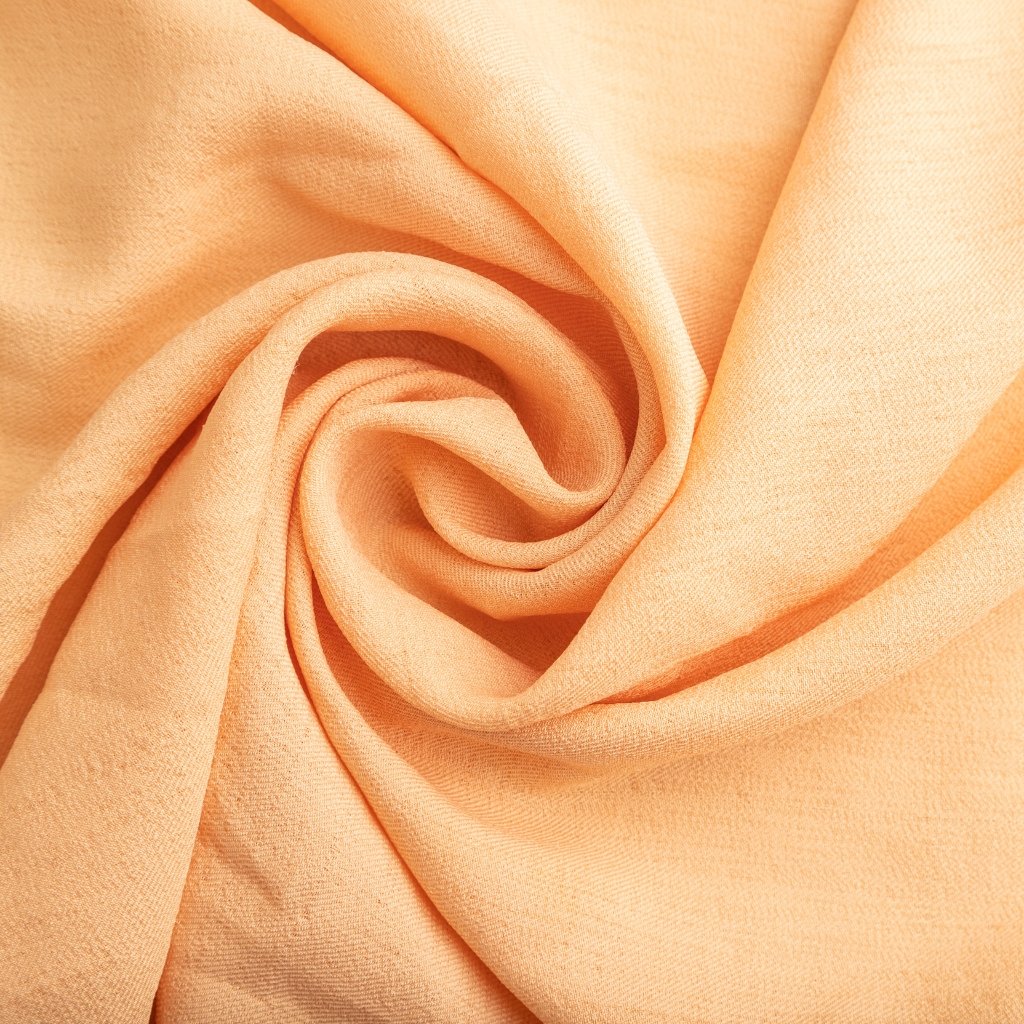
Soft peach fabric folded into a gentle swirl, showing smooth texture and warm peach color.
A piece of peach-colored fabric gracefully swirled to highlight its soft texture.

Scrim cotton fabric has a variety of benefits as mentioned below.

Cost Effective – It is cheaper than most specialty fabrics.

Eco Friendly – Being cotton it is biodegradable.

Customizable – Can be dyed, printed or laminated.

Light yet Strong – Can withstand heavy duty use.

Lightweight and Airy – Gives ventilation in upholstery and drapery.

Manipulable – Easy to sew, cut, and layer.

The benefits mentioned are the primary reasons as to why scrim fabric is always in demand.

Disadvantages of Scrim Cotton Fabric

Close-up of beige linen fabric with visible weave and soft folds.
Soft beige linen fabric with a natural, textured weave.

Matching with the strengths, scrim cotton fabric still has some several weaknesses.

Loose Weave – More prone to fraying.

Barely Aesthetic – Typically is an under fabric.

Weak for Heavy Fabric – Is not effective for high straining.

Shrinkable – Will shrink in a wash.

These are still useful for scrim cotton fabric in practicality.

Care and Maintenance of Scrim Cotton Fabric

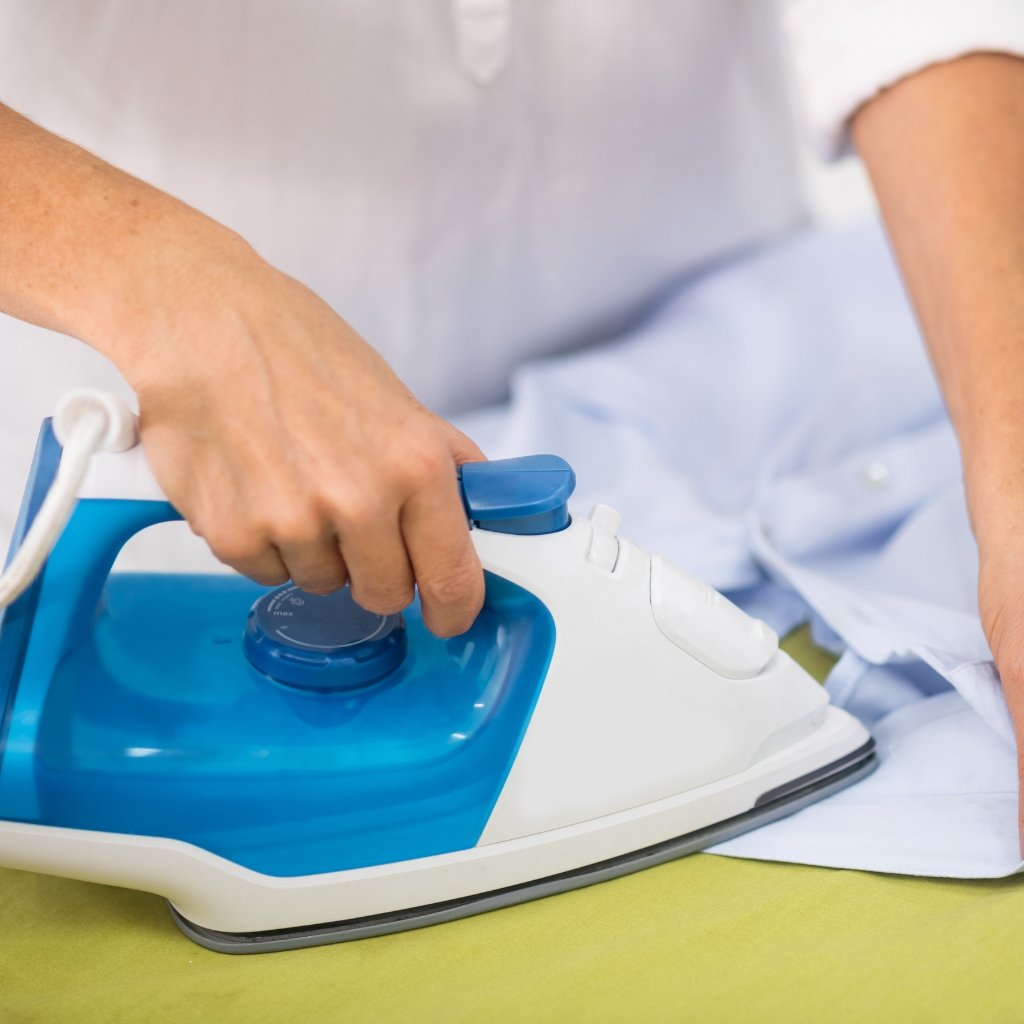
Close-up of a person ironing a light-colored shirt with a blue and white steam iron on a yellow ironing board.
A person ironing a shirt with a blue and white steam iron.

Scrim cotton fabric will require appropriate use and the use of proper strategies to aim prolonging it’s life.

Wash Gently – Can be hand washed or in the machine on a delicate cycle.

Cold Water – Will prevent shrinkage and keep the integrity of the fabric.Mild Detergent – Strong chemicals break down the fibers.

Avoid Overdrying – Either air dry or use a dryer on a low heat setting.

Iron Carefully – Use a low temp setting to prevent burns.

These simple care steps help ensure the scrim cotton fabric remains durable and functional for years.

Why Choose Scrim Cotton Fabric?

Scrim cotton fabric is favored by many industries and people for its blend of functionality and low cost. It is more breathable and environmentally friendly than synthetic substitutes. Additionally, it is scrim is light and reliable, which is perfect for uses where both comfort and strength are necessary.

Scrim cotton fabric does its job well, whether used for upholstery, the theater, or crafts. It is versatile enough to ensure its continued use in modern manufacturing.

Scrim Cotton Fabric in Sustainable Practices

As more people focus on eco-friendly textiles, scrim cotton fabric has received new recognition. It has a positive eco-friendly impact, as cotton is biodegradable. To further eco-friendly initiatives, more manufacturers are using organic cotton scrim.

Scrim can also be recycled and used for other projects. This is a great fabric for businesses wishing to implement more eco-friendly initiatives. Affordability and sustainability make scrim cotton fabric a powerful textile for today’s industry.

Conclusion

Although scrim cotton fabric may seem unassuming, the fabric’s value is shown through its use across several industries. Its attributes of breathability, lightweight nature, and durability assist scrim cotton fabric serve the role of a supportive and functional fabric. The versatility of scrim cotton fabric spans across theatre stages, medical scrubs, and upholstery to fabricating studios.

As industries move to more sustainable options, the scrim cotton fabric remaining biodegradable and inexpensive makes it a perfect choice. Its potent mix of simplicity and strength will ensure it is around for a long time.

FAQs

What is scrim cotton fabric?

Scrim cotton fabric is a lightweight, loosely woven material made from cotton fibers. It is often used as a base or support fabric in sewing, upholstery, and crafts.

What are the main uses of scrim cotton fabric?

It’s commonly used for reinforcing fabric, creating interlining in garments, stage backdrops, embroidery, and various craft projects.

Is scrim cotton fabric breathable?

Yes, scrim cotton is highly breathable due to its open weave structure, making it suitable for lightweight applications and summer projects.

Can You Machine Wash Rayon Without Shrinking or Damage?

0

Introduction

The fashion industry consists of some of the most popular semi-synthetic fabrics such as rayon. It is composed of regenerated cellulose fibers usually of wood pulp. Rayon is lightweight, soft and versatile and is widely used as a fabric in dresses, blouses and in summer. People love its loose and satin texture and can use it daily and in official attire.can you machine wash rayon

Rayon is, however, also delicate. The question is asked by many: Is it possible to machine wash rayon and not to spoil it?can you machine wash rayon? This is posed due to the fact that rayon tends to shrink, change form or become weak when in water and agitation.can you machine wash rayon It is important to be aware of the proper care techniques so that your rayon clothes will last longer and appear fresh after each wash.

Can You Machine Wash Rayon? (Direct Answer)

Rayon is washable in the machine but it must be handled with a lot of care. In contrast to polyester, or cotton, rayon fibers are weakened when wet. These may shrink, distort or even tear in case of improper handling. That is why most rayon garments contain a Dry Clean Only label.can you machine wash rayon

Nevertheless, when washing your rayon garment and the care tag permits it in the machine, you have to do certain things.Wash in a light load, cold water and light detergent to reduce harm. It is always to keep in mind that machine washing rayon is also a risk, but only when carried out cautiously.

That said, not every rayon item is equally fragile. Some modern rayon fabrics—especially those blended with polyester, cotton, or nylon—can tolerate machine washing better.can you machine wash rayon? Likewise, rayon labeled as “machine washable” has often been pre-treated by the manufacturer to withstand water exposure. In these cases, using the correct washing method can safely clean your garment while minimizing risks.

To safely machine wash rayon, you must treat it as a delicate fabric. Always use cold water, select the gentle cycle, and choose a mild, bleach-free detergent.can you machine wash rayon To reduce friction and prevent the fabric from catching or tearing, place rayon garments inside a mesh laundry bag or wash them separately from heavier items like jeans or towels. Avoid wringing, twisting, or scrubbing rayon, as its fibers are most vulnerable when wet.

Tips for Washing Rayon Without Shrinking or Damage

Alt Text:
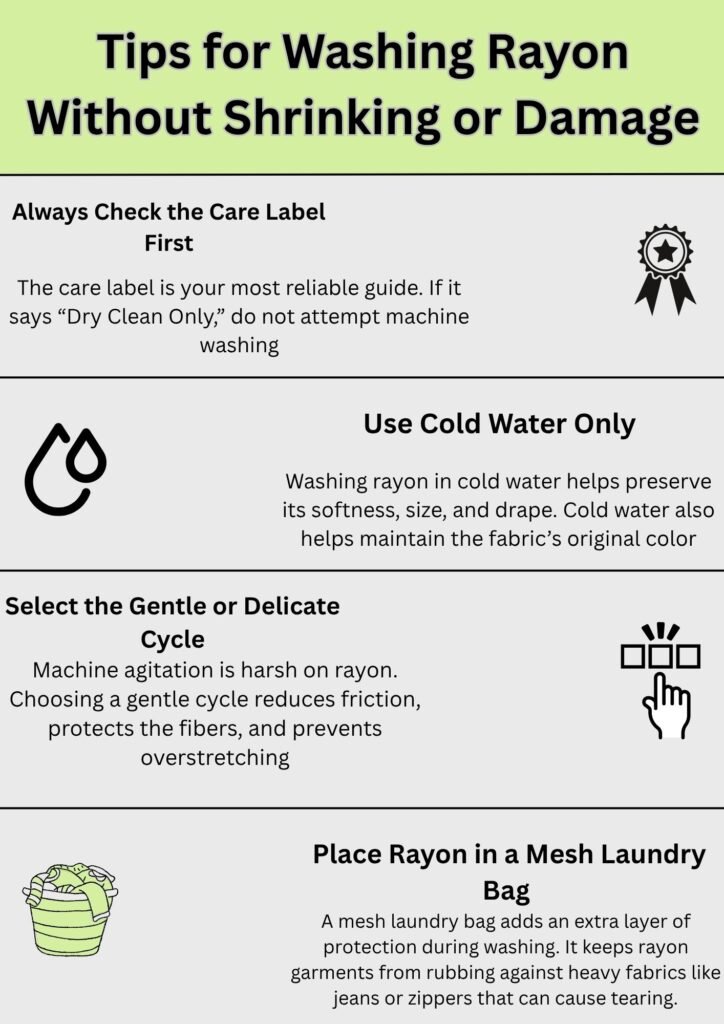
Infographic with tips for washing rayon safely, including checking care labels, using cold water, selecting a gentle cycle, and placing garments in a mesh laundry bag.can you machine wash rayonCaption:
Simple washing tips to protect rayon clothes from shrinking or damage.Description:
This infographic provides helpful guidance on how to wash rayon without causing shrinkage or damage. Key tips include always checking the care label for cleaning instructions, using cold water to preserve softness and color, selecting the gentle or delicate cycle to reduce friction and stretching, and placing rayon garments in a mesh laundry bag for extra protection during the wash. These steps help maintain rayon’s quality, drape, and longevity.

Always Check the Care Label First

The care label is your most reliable guide. If it says “Dry Clean Only,” do not attempt machine washing. If it allows machine washing, follow the instructions carefully. Ignoring the label risks permanent damage to the garment.

Use Cold Water Only

Hot or even warm water causes rayon fibers to shrink and lose their shape. Washing rayon in cold water helps preserve its softness, size, and drape. can you machine wash rayonCold water also helps maintain the fabric’s original color.

Select the Gentle or Delicate Cycle

Machine agitation is harsh on rayon. Choosing a gentle cycle reduces friction, protects the fibers, and prevents overstretching. Avoid high-speed or heavy-duty cycles completely.

Place Rayon in a Mesh Laundry Bag

A mesh laundry bag adds an extra layer of protection during washing. It keeps rayon garments from rubbing against heavy fabrics like jeans or zippers that can cause tearing.

Pros and Cons of Machine Washing Rayon

In the case of can you machine wash rayon, it is best to consider the advantages and disadvantages.

Convenience

Machine washing is time saving and energy saving as opposed to hand washing. To hectic people it is the least exerting thing to do.

Saves Time

When done correctly, you can wash several garments that are made of rayon simultaneously without taking too long hand washing.

Risk of Shrinking

When subjected to hot water or violent washing, rayon is very likely to shrink.

Fabric Losing Shape or Color

When subjected to repeated washing in the machine, rayon may lose its original structure and its color may be lost easily.

Factors That Determine If Rayon Can Be Machine Washed

Rayon fabrics do not all behave in the same manner. The safety of machine washing depends on a number of factors.

Type of Rayon

Rayon is available in such forms as viscose, modal, and lyocell. Modal and lyocell are stronger and more resistant whereas viscose is weaker and vulnerable to shrink.

Care Label Instructions

First always examine the label of the garment. Others require dry cleaning and some rayon clothes are pre-treated to allow them to undergo machine washing.

Blends with Other Fabrics

Rayon mixed with cotton or polyester might be more powerful. These crosses can be very capable of machine washing than pure rayon.

How to Machine Wash Rayon Safely (Step-by-Step Guide)

In a washing machine that has a care tag with this capability, here is how to wash rayon:

Use Gentle Cycle
Select the light cycle to decrease friction and agitation.

Cold Water Wash
Rayon fibers are weakened by hot water. It is always good to use cold water to wash.

Mild Detergent
Wash with a soft detergent, which does not have bleach and rough chemicals.

Wash Inside or Wash a Mesh Bag.
Rubbing can be avoided by turning clothes inside-out or putting them in a mesh laundry bag.

Avoid Wringing or Twisting
Rayon fibers are easily stretched when they are wet. Let them remain flat to dry.

Common Mistakes to Avoid When Washing Rayon

You should also be aware of what not to do when posing a question can you machine wash rayon without destroying it.

Using Hot Water

Hot water is quick to contract rayon and thus renders clothes unfashionable.

Harsh Detergents or Bleach

Bleach removes the color and makes rayon weak.

High-Speed Spin Cycles

High speeds place a strain on the fragile rayon, which stretches and tears.

Mixing with Heavy Fabrics

Rayon fabric can be crushed down by jeans or towels or other heavy substances and destroyed.

Alternative Washing Methods

In case you are not sure of how to wash rayon in the machine, these are the less risky ways:

Hand Washing

The safest process to use on rayon is hand washing in cold water and mild detergent. Wring it delicately.

Dry Cleaning

In case of delicate or expensive rayon clothes, it is preferable to use the services of professional dry cleaning. It maintains the cloth and does not cause any shrinkage.

Common Uses of Rayon Fabric

Rayon is widely used in the fashion and textile industry because of its softness, versatility, and ability to mimic natural fibers like silk or cotton.can you machine wash rayon? Understanding its common uses helps explain why many people ask can you machine wash rayon without shrinking or damage?can you machine wash rayon

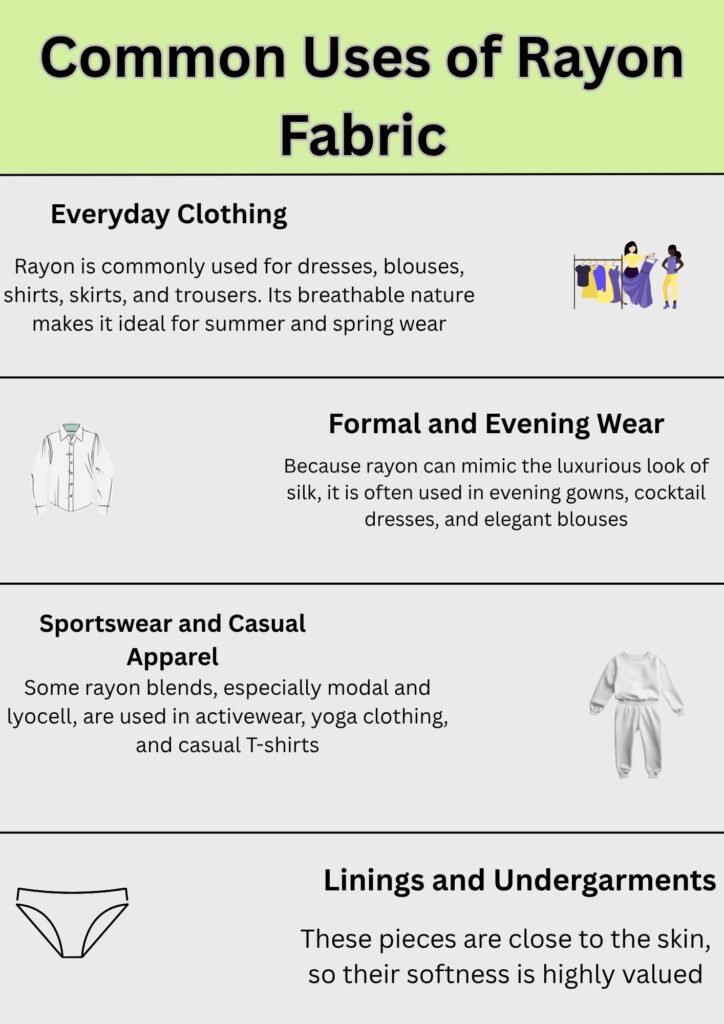
Alt Text:
Infographic titled "Common Uses of Rayon Fabric" showing different applications of rayon including everyday clothing, formal and evening wear, sportswear and casual apparel, and linings and undergarments, with related icons.can you machine wash rayonCaption:
Common uses of rayon fabric include everyday wear, formal attire, sportswear, casual clothing, and undergarments, highlighting its versatility and comfort.Description:
The infographic presents the title “Common Uses of Rayon Fabric” on a green background. Below, it is divided into four sections:

Everyday Clothing

Rayon is commonly used for dresses, blouses, shirts, skirts, and trousers. Its breathable nature makes it ideal for summer and spring wear. People love rayon clothing because it drapes beautifully and feels smooth on the skin.

Formal and Evening Wear

Because rayon can mimic the luxurious look of silk, it is often used in evening gowns, cocktail dresses, and elegant blouses. The fabric’s shine and drape make it a popular choice for party wear. However, these items are usually delicate and often require dry cleaning.can you machine wash rayon

Sportswear and Casual Apparel

Some rayon blends, especially modal and lyocell, are used in activewear, yoga clothing, and casual T-shirts. These versions are more durable and stretch-resistant, making them easier to machine wash compared to pure rayon.

Linings and Undergarments

Rayon’s soft and smooth texture makes it an excellent choice for garment linings, slips, and lingerie. These pieces are close to the skin, so their softness is highly valued. However, since they are delicate, they often require gentle washing methods.can you machine wash rayon

How to Dry Rayon After Washing

It is just as important to dry rayon as it is to wash it.

Avoid Tumble Drying

Never use a dryer for rayon. The distortion and shrinkage are caused by the heat.
Best Methods

Lay rayon clothes on a towel or on padded hangers to dry.

Removing Wrinkles

Steam is best. When ironing, use low iron and never forget to use a pressing cloth.

Special Cases

Not every rayon clothes are alike. Some exceptions exist.

Washing Rayon Blends by Machine.

Rayon can be mixed with cotton or polyester and it can withstand machine washing. They are more stable and stringent blends.

Pre-Washed or Treated Rayon

There are other rayon clothes that have been pre-treated so that they do not shrink. They can be usually washed by the machine.

Conclusion

Then how do you machine wash rayon and not shrink or damage it? The answer is yes, but it needs to be done with care.can you machine wash rayon? Crawling rayon is weak and can very readily be spoiled by heat, strong detergents, or brutes. One should always use cold water, light detergent, and light cycle.

To get the maximum life of your rayon clothes, the best option would be dry cleaning or hand washing. With proper handling, you will be able to wear the rayon clothes during the many seasons of softness and beauty.

However, if the care label says “Dry Clean Only,” it’s best to follow that advice. Rayon garments that are not pre-treated or blended with stronger fibers are far more vulnerable to shrinking, stretching, or tearing.can you machine wash rayon? In these cases, dry cleaning ensures that your clothes keep their vibrant color, elegant drape, and smooth finish.

When comparing washing methods, hand washing stands out as the safest option for pure rayon. A quick soak in cool water with a gentle detergent and light rinsing can clean the fabric without stressing it. For those who value convenience, machine washing may still be tempting, but it’s important to understand that each wash carries a small risk.can you machine wash rayon? Over time, even with care, repeated machine washes can shorten the life of rayon garments.

FAQs

Does rayon shrink in the wash?

Yes, rayon usually goes out of size when it is washed the wrong way, particularly in hot water or tumble dryers.

Can rayon go in the dryer?

No, rayon is not to be tumble-dried. The safest process is air drying.

What do you do with rayon that shrinks?

wet it in a little lukewarm water with baby shampoo or conditioner, then stretch it out to size.

Is rayon hand wash or machine wash?

Rayon is always safer to hand wash, although there are blends that can be machine washed.

What is the life of rayon when well taken care of?

Rayon clothing can be washed and dried gently and still last decades without being of poor quality.

Can You Put Rayon in the Dryer? The Ultimate Care Guide

Introduction

Rayon is a favorite soft, lightweight and breathable fabric. Rayon is very popular among people because it resembles silk, cotton and linen but is less expensive. Rayon however, needs special consideration. In case you already have rayon clothes, then you might ask these questions: Can you put rayon in the dryer? The importance of this question is that drying techniques have direct influence on the life of rayon, its form and the overall appearance.can you put rayon in the dryer

Rayon does not respond well to heat and agitation as compared to polyester or cotton. These are both used in dryers and they pose a big danger to fragile rayon fibers. You have to know how to treat their garments in order to make them last longer. This guide discusses rayon care in details, how to wash, dry, eliminate wrinkles, and even make a comparison with other fabrics.

By the time you are done, you will have a full picture of how to care about rayon fabric and a definite answer to the question whether it should go to your dryer or not.can you put rayon in the dryer

What Is Rayon?

Rayon is a semi synthetic fabric that is produced using natural cellulose fibers, commonly wood pulp. It begins with natural materials but the process of production requires the use of chemicals to convert cellulose into wearable, soft threads. This renders rayon a hybrid fabric which is not entirely natural like cotton, but is not entirely synthetic like polyester.

Uniqueness of rayon is that it has the look and feel of silk. It is usually worn in blouses, dresses and summer clothes because designers believe it is breathable and is soft on skin.can you put rayon in the dryer Rayon has an ability to reproduce silk, wool and sometimes even linen, this is why it is also called a versatile chameleon in the world of fabrics.

Rayon is however more delicate compared to other fabrics. Rayon is also sensitive to moisture, agitation, and temperature as opposed to cotton that can withstand heat or polyester that cannot shrink. Drying methods are of particular importance because of this sensitivity.

Can You Put Rayon in the Dryer?

The answer to this question is in the short run, no, you must not put rayon in the dryer. Rayon is not very resistant to heat and mechanical tumbling.can you put rayon in the dryer A common dryer involves the use of both movement and heat to dry clothes fast. Regrettably, these conditions have the ability to harm the rayon fibers.

The dryer’s two main elements—heat and tumbling—create the perfect storm for rayon damage. Heat causes rayon fibers to contract and shrink, while tumbling causes friction that pulls and stretches them out of shape. Together, these forces strip rayon of its softness, drape, and structure.

Why Rayon Is Not Dryer-Safe

  • Heat causes shrinkage. Low settings are enough to cause fiber contraction.
  • Agitation weakens threads. Rayon is stretched out by falling.
  • Humidity and heat are the cause of wrinkles. These wrinkles are hard to get off once they are in place.

It is based on this fact that professionals advise against the use of the dryer. Polyester or cotton can survive but rayons are weak and their fibers are unlikely to.

Risks of Putting Rayon in the Dryer

If rayon goes into the dryer, here’s what typically happens:

  • Shrinkage: Rayon can shrink anywhere between 5% and 10% in just one drying cycle, and sometimes even more. Unlike cotton, which shrinks once and stabilizes, rayon can continue to shrink with repeated exposure to heat.
  • Wrinkling: The heat and moisture combination in a dryer sets wrinkles deeply into rayon. These wrinkles are much harder to smooth out compared to fabrics like cotton or polyester.can you put rayon in the dryer
  • Weakened Fibers: Rayon threads do not have strong elasticity. When tumbled, they weaken, fray, or even break down, which shortens the lifespan of the garment.
  • Loss of Shape: Because rayon lacks fiber memory, it cannot bounce back into its original form after shrinking or stretching. Clothes may come out twisted, misshaped, or saggy in odd areas.
  • Color Fading: The dyes used in rayon often fade faster when exposed to high heat, leaving the garment looking dull and older than it actually is.

Why Rayon Should Not Go in the Dryer

The reason rayon should not be placed in the dryer comes down to how the fabric is made.can you put rayon in the dryer Rayon is a semi-synthetic material, which means that while it is derived from natural cellulose (wood pulp), it undergoes chemical processing to become soft threads. This process gives rayon a luxurious silk-like feel but also makes its fibers weaker and more vulnerable than fully natural fabrics like cotton or fully synthetic ones like polyester.


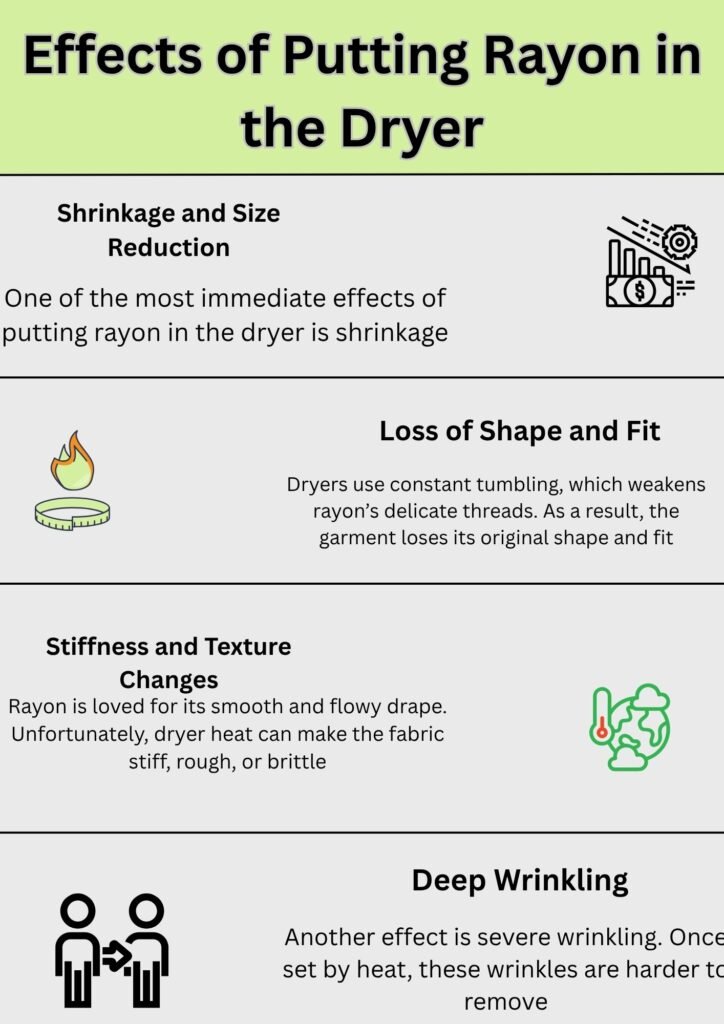
Effects of Putting Rayon in the Dryer

Alt Text:
Infographic titled "Effects of Putting Rayon in the Dryer," explaining issues such as shrinkage, loss of shape, stiffness, and deep wrinkling when rayon is dried in a machine.Caption:
Common effects of putting rayon in the dryer include shrinkage, shape loss, stiffness, and deep wrinkling.Description:
This infographic highlights the negative effects of putting rayon in the dryer. It explains that rayon fabric often experiences shrinkage and size reduction, loss of shape and fit due to tumbling, stiffness and texture changes that make the material rough or brittle, and deep wrinkling that becomes harder to remove once set by heat. The visual uses icons for each effect, paired with short text explanations.
Shrinkage and Size Reduction

One of the most immediate effects of putting rayon in the dryer is shrinkage. Rayon fibers contract under heat, which reduces the size of the garment. This shrinkage is often uneven, leaving the fabric distorted and difficult to wear again.

Loss of Shape and Fit

Dryers use constant tumbling, which weakens rayon’s delicate threads. As a result, the garment loses its original shape and fit. Dresses may look stretched in some areas and tight in others, making them unwearable.

Stiffness and Texture Changes

Rayon is loved for its smooth and flowy drape. Unfortunately, dryer heat can make the fabric stiff, rough, or brittle. This permanent change takes away rayon’s luxurious feel, leaving the garment uncomfortable.

Deep Wrinkling

Another effect is severe wrinkling.can you put rayon in the dryer Once set by heat, these wrinkles are harder to remove. Unlike cotton, which can be ironed easily, rayon’s wrinkles may require steaming or delicate ironing to restore.can you put rayon in the dryer

What Does it Take to Put Rayon in the Dryer?

Putting rayon in the dryer can also lead to a few fabric problems that can be permanently damaging to your clothing.

Shrinkage Percentage

Rayon has a very high susceptibility of shrinking. When put in the dryer, size reduction of between 5 and 10 percent or more can be anticipated depending on the level of heat used. Such shrinkage is very much unequally distributed and makes clothes appear distorted.can you put rayon in the dryer

Fabric Losing Shape and Texture

A smooth drapey feel is one of the greatest attributes of rayon. Nevertheless, when subjected to drier temperatures, rayon can either harden, become coarse or lose its natural slip.

Possible Fading / Weakening of Fibres.

The drying of rayon fibers is repeated and causes weakness in the rayon fibers. They can be torn more easily or they can seem thin and faded lowering the lifetime of the garment.

How to Properly Dry Rayon

Because the question of whether or not you can put rayon in the dryer most often answers no, we shall consider safe substitutes.

Air-Drying Tips

Air drying is the safest process of rayon. Washing should be followed by squeezing off excess water without wringing. Place the garment on the towel on a well-ventilated area.can you put rayon in the dryer This will avoid stretching and ensure shape is guarded.

Laying Flat vs. Hanging

  • Flat lays are best suited to sensitive tops and dresses to keep them in shape.
  • Rayon blends can be hanged, though sturdier ones only, since padded hangers need to be used to prevent stretching.

Using a Towel to Absorb Excess Water

Put your rayon fabric to towel and roll. It is used to dry the fabric without being rough which dries it quickly as well as the structure is maintained.

Can You Use a Dryer on Low or Delicate Settings for Rayon?

Other individuals question whether the dryer can be made safe with rayon through a low heat or a delicate cycle. In most cases, it’s still risky. But when you are forced to a dryer:can you put rayon in the dryer

  • Put the garment in a mesh washing bag to prevent as much tumbling as possible.
  • Choose the air-dry or no-heat, rather than even low heat option.can you put rayon in the dryer
  • Use no dryer sheets because chemicals may make fibers weak. Rather, do not dry clothes using heat, but dryer balls made of wool.

These measures help to diminish risks but not to get rid of them completely.

How to Remove Wrinkles from Rayon Without a Dryer

Rayon is easy to wrinkle, thus individuals usually wish to dry them. Fortunately, they have less dangerous ways.

Steaming

Rayon is best refreshed using a hand held steamer. Steam relaxes fibers without contact and does not cause any damage. The steamer should never be left too close or it will leave a water spot.

Ironing (Half light, Shielding Cloth)

Where steaming is not possible ironing is acceptable. Select the lowest heat level and make certain a thin cotton cloth is in between the iron and rayon.can you put rayon in the dryer Always work hard, but never press because hot rayon will scald.

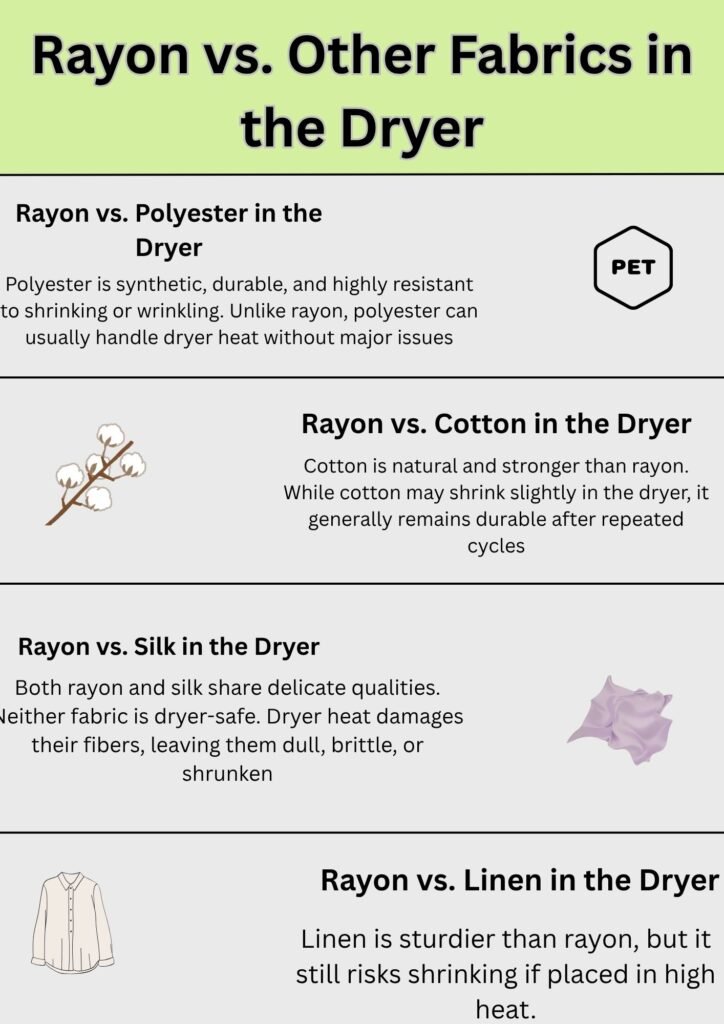
Rayon vs. Other Fabrics in the Dryer

Alt Text:
Infographic comparing how rayon reacts in the dryer compared to polyester, cotton, silk, and linen.Caption:
"Rayon vs. Other Fabrics in the Dryer – A guide to how rayon differs from polyester, cotton, silk, and linen when exposed to dryer heat."Description:
This infographic highlights the differences between rayon and other fabrics in the dryer. Polyester is durable and can withstand dryer heat, unlike rayon. Cotton, though natural and stronger than rayon, may shrink slightly but remains durable. Both rayon and silk are delicate and not dryer-safe, as heat can damage their fibers. Linen is sturdier than rayon but still risks shrinking under high heat. The comparison emphasizes that rayon is more vulnerable to dryer damage than most common fabrics.
Rayon vs. Polyester in the Dryer

Polyester is synthetic, durable, and highly resistant to shrinking or wrinkling. Unlike rayon, polyester can usually handle dryer heat without major issues. Rayon, on the other hand, weakens quickly under high temperatures. can you put rayon in the dryerThis makes polyester far more dryer-friendly than rayon.can you put rayon in the dryer

Rayon vs. Cotton in the Dryer

Cotton is natural and stronger than rayon. While cotton may shrink slightly in the dryer, it generally remains durable after repeated cycles. Rayon, however, loses shape, shrinks drastically, and wrinkles badly when exposed to the same conditions.

Rayon vs. Silk in the Dryer

Both rayon and silk share delicate qualities. Neither fabric is dryer-safe. Dryer heat damages their fibers, leaving them dull, brittle, or shrunken. Just like rayon, silk garments last longer with gentle air-drying and steaming methods.

Rayon vs. Linen in the Dryer

Linen is sturdier than rayon, but it still risks shrinking if placed in high heat. Unlike rayon, linen can sometimes survive low-heat drying, though air-drying is best. Rayon, however, is far more fragile and almost always gets damaged in the dryer.
Conclusion

So, can you put rayon in the dryer? The clear answer is no. Rayon is too delicate to withstand the dryer’s heat and tumbling. Doing so causes shrinkage, fading, stiffness, and even permanent fiber damage. Instead, rely on air-drying techniques such as laying flat, rolling with a towel, or using padded hangers. For wrinkle removal, steaming or careful ironing works best.can you put rayon in the dryer

By understanding rayon’s nature and treating it gently, you extend your garment’s life and preserve its soft, elegant feel. While polyester and cotton may survive the dryer, rayon requires a softer approach. With the right care, your rayon clothes will stay beautiful, breathable, and long-lasting.can you put rayon in the dryer

FAQs

Can you put rayon in the dryer without shrinking it?

No, rayon almost always shrinks when placed in the dryer. Even low heat can cause a 5–10% shrinkage or more, depending on the garment. To avoid this, it’s best to air-dry rayon flat on a towel or hang it carefully on a padded hanger.

What happens if you accidentally put rayon in the dryer?

If rayon goes through the dryer, it may shrink, lose its original shape, or become stiff. The fabric can also wrinkle deeply, making it hard to restore. In some cases, steaming can help, but severe damage is usually permanent.

Can rayon go in the dryer on a delicate or low-heat setting?

Even on delicate or low-heat settings, rayon is not safe in the dryer. The combination of heat and tumbling weakens the fibers. If you must use a dryer, choose the air-dry (no heat) cycle with a mesh bag for extra protection.

How should you dry rayon after washing?

The best method is air drying. Lay rayon flat on a clean towel and roll it gently to absorb water. Then reshape and let it dry naturally. Avoid hanging heavy rayon items when wet, as they may stretch out of shape.

Does rayon shrink more than cotton in the dryer?

Yes, rayon is more prone to shrinking than cotton. Cotton may shrink slightly after the first wash, but rayon shrinks significantly with every dryer cycle. That’s why cotton can sometimes handle dryers, but rayon almost never can.


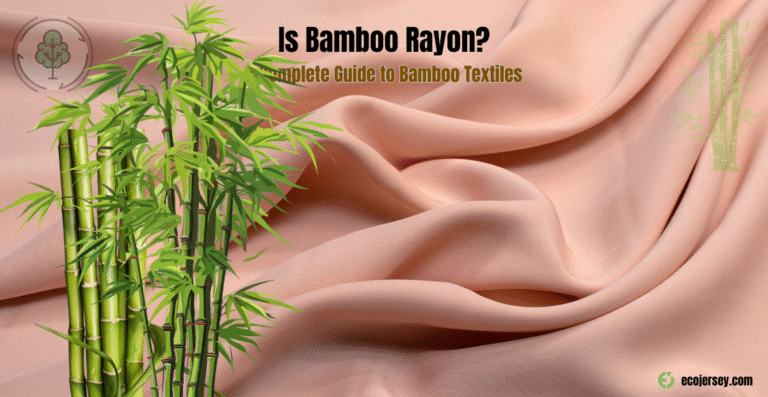
1. Is Bamboo Rayon? A Complete Guide to Bamboo Textiles

Introduction-

The most common question that consumers pose is: Is bamboo rayon? fabric labels can be difficult to understand. Bamboo is used as a green option in the fashion and bedding industry. However, not all of them know that the majority of bamboo textile is rayon.

Bamboo based textiles have become increasingly popular. Out of bamboo sheets to T-shirts they boast to being natural and environmentally friendly. The truth of the matter is however more complicated. As a way of finding the truth, it is necessary to consider what bamboo cloth is actually.

What is Bamboo Fabric?

Natural source: Bamboo plant

Bamboo fabric is made by beginning with the bamboo plant. Bamboo is technically a grass, which has dense woody stalks and powerful fibers. It reproduces very quickly and sprouts once more out of its roots. Indeed, it takes bamboo between 3-5 years to mature and harvest, compared to trees, which take much longer. It also needs very little attention: bamboo stands do not require much additional watering and do not normally need fertilizers and pesticides. Such qualities as rapid growth, high productivity, and low usage make bamboo a sustainable raw material in terms of the reputation.

Sustainable reputation of bamboo

Due to such properties of the plant, bamboo is commonly promoted as eco-friendly. In fact, it is possible to give an example of bamboo, which is more effective in sequestration than numerous hardwoods, and its deep roots make the soil not to erode. Bamboo is cultivated without the need to clear-cut trees (it reproduces through its own root system). This implies that it is possible to avoid deforestation in bamboo farming. In addition, bamboo plots produce large amounts of biomass using comparatively low amounts of water.

These facts make bamboo as a material source to have a green image. One thing to keep in mind, however, is that these advantages have to do with the plant as well. After bamboo has been made into a fabric, numerous benefits of nature may be lost in processing.

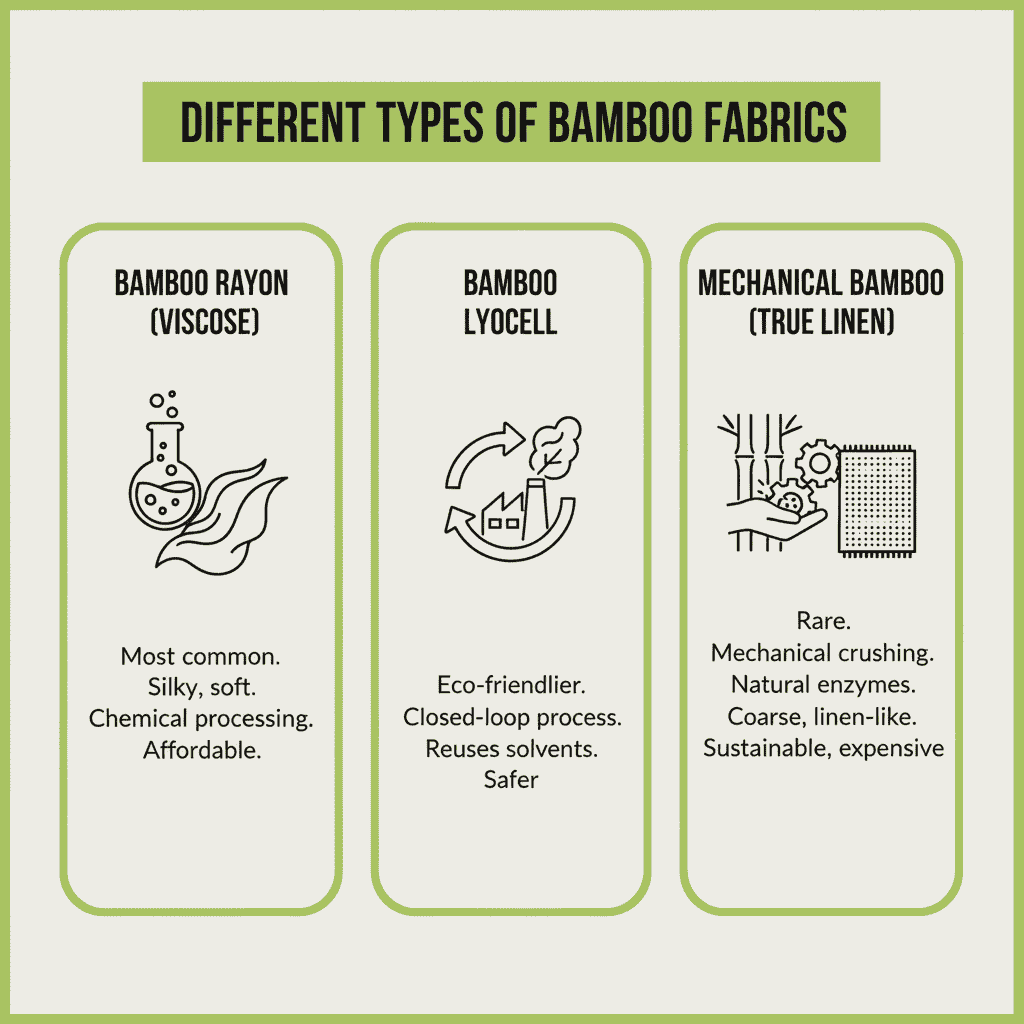
Types of bamboo fabric (mechanical vs chemical)

Mechanically Processed Bamboo (Bamboo Linen):

  • Prepared by crushing bamboo stalks and the natural enzymes.
  • This is done by combing out and spinning into fibers into the yarn, like linen.
  • It is a very rough textured fabric and at the same time very strong.
  • Uncommon in the market since it is a labor-intensive process that is expensive.

Chemically Processed Bamboo (Bamboo Rayon/Viscose):

  • The manufacture is through the dissolution of bamboo pulp in harsh chemical solvents.
  • The silky fibers of the cellulose solution are spun.
  • This type takes the lead of the market as it is the cheapest to manufacture. Soft, smooth and cheap yet not so environmental-friendly.

Bamboo Lyocell (Eco-Friendly Alternative):

  • Utilises closed loop process using non-toxic solvents.
  • The reuse of chemicals helps them to lessen the damage on the environment.
  • Gives the result of a soft, breathable and strong fabric. The most sustainable choice of bamboo fabric.

What is Rayon (Viscose)?

Definition: Semi-synthetic cellulose fiber

Rayon, or viscose as it is sometimes called, is a semi-synthetic fiber, comprised of natural cellulose. That is, it begins with plant cellulose (wood, cotton, or bamboo pulp) and is converted to fiber through human-developed procedures. Rayon is actually an artificial silk, invented technically and thus it is very smooth. Rayon, however, is not a completely natural fiber, despite a little marketing. According to one source, rayon is commonly regarded as a natural fiber, though in fact, it is a substance made of cellulose that needs a lot of chemical work. Bamboo rayon fibers may resemble cotton or silk in their feel, and it is why clothes made of bamboo rayon may feel so soft.

How rayon is produced (chemical process)

Rayon production is a complicated process, which consists of various chemical reactions. Firstly, it prepares pulp of cellulose (wood or bamboo) and combines it with caustic soda (sodium hydroxide). Then a chemical compound known as carbon disulfide is incorporated which transforms the cellulose into a thick liquid. This solution of viscose is then pumped through spinnerets (small holes) into an acid bath. The solution becomes solid in the acid in fine filaments of regenerated cellulose. These filaments are washed, neutralized, and spinned into yarn. More importantly, the process involves toxic chemicals (carbon disulfide and strong acids, in particular), which may be harmful to the environment and human health when they escape.

Common uses in fashion and textiles

Rayon is valued because of its silk characteristics hence it is extensively applied in textiles. For example:

  • Clothing: Rayon is used in dresses, blouses, t-shirts, sleepwear and underwear. It is a great-looking drape, and cool to the touch. Bamboo rayon T-shirts and leggings are known as having a smooth, stretchy feel.
Woman wearing a breathable rayon summer dress on a sunny day
  • Home textiles: Rayon could be applied in bed clothing (sheets, pillowcases), towels, and upholstery to provide a touch. Numerous bamboo sheets available in the market are actually bamboo rayon sheets, and are touted as soft and breathable.
  • Medical: Rayon is a good absorber of liquids, and it is soft; hence it is used in bandages, surgical dressing, and wiping. Hygiene items and bamboo rayon bandages take advantage of its softness. As an example, bamboo rayon is utilized in medical gauze and even baby wipes.
  • Blended fabrics: Rayon is frequently blended with cotton, or even synthetic fibers. Some types of fabrics can resemble linen or wool, and will offer a silky touch at a lower price. Even it is mixed into denim or leisure wear to be even more comfortable.

Is Bamboo Rayon?

Yes -Bamboo fabric is generally rayon. The reality is, that the majority of products sold as bamboo are bamboo viscose/rayon. This implies that it is not bamboo fiber made by the stalk but by regeneration of bamboo cellulose. Even the regulatory bodies have intervened to curb false labellings. As an example, U.S and Canadian law dictates that such textiles should be labeled as rayon, bamboo, and not bamboo. Practically, where you find a bamboo T-shirt or sheets, it is usually bamboo rayon. Authentic mechanical bamboo fiber cloth (bamboo linen) is very rare and it is normally sold at a very high price.


Different Types of Bamboo Fabrics

Different types of bamboo fabrics infographic.
Explore the Different Types of Bamboo Fabrics.

Bamboo Rayon (Viscose)

This is the most popular type of bamboo textile. Bamboo rayon (or bamboo viscose) is fabrics that are manufactured after chemically treating bamboo pulp into fibers. The resultant product is a smooth, silky fabric. Bamboo rayon tends to be extremely soft and luxurious–softer than rough linen. It is loose fitting and flows well. As a matter of fact, bamboo rayon is more comfortable to many people than ordinary cotton. Nevertheless, keep in mind that bamboo rayon is made by using harsh chemicals. The smooth material is a sacrifice to that chemical footprint.

Bamboo Lyocell (TENCEL™)

Bamboo lyocell is a more environmentally-friendly type of bamboo. It employs another production process. It replaces the old viscose chemicals with non-toxic solvent in a closed loop process. Almost all (approximately 99.5 percent) of the solvent is reused. What has been made is a soft, durable fiber quite like rayon to feel. It is frequently marketed as brand names such as TENCEL™. The closed cycle process implies a lot less pollution. Bamboo lyocell in a nutshell is Bamboo rayon with much cleaner chemistry.

Mechanical Bamboo (True Bamboo Linen)

Authentic bamboo fiber (bamboo linen) is made in a mechanical way. The stalks of bamboo are pounded and retted (usually with enzymes) and the long fibers are pulled out either manually or mechanically. This is then spun into yarn. That process does not require any harsh solvents, hence it is entirely natural. The resulting fabric is rough and slightly textured (similar to flax linen). Bamboo linen is cool, absorbent and not that stretchy or silky. The mechanical process is labor-intensive making the bamboo linen costly and not commonly found. When you see the designation “bamboo fiber” (without viscose) on clothing, it is probably this bamboo linen, and it will not be as smooth as rayon.


How Bamboo is Turned Into Rayon: Step-by-Step Process

The general procedures of making bamboo a viscose rayon include:

Bamboo to Rayon fabric production process diagram.
The Journey from Plant to Sustainable Textile: Bamboo to Rayon Fabric.
  • Bamboo harvesting: Stalks of the bamboo are mature and are cut down and chipped. The chips are washed and ready. (At this stage fibers may be combed (in the mechanical process), but in the case of rayon, we pass to chemical pulping).
  • Production of Bamboo Pulp: The bamboo chips are boiled or cooked in a high solution of sodium hydroxide. This decomposes lignin and hemicellulose, and leaves primarily cellulose. A wet bamboo cellulose pulp is left after washing.
  • Chemical Dissolution: It is followed by the addition of carbon disulfide to the purified cellulose pulp and the resulting compound is known as cellulose xanthate. The solution undergoes another dissolution in further sodium hydroxide to produce a viscous liquid ( hence viscose ). It is a very toxic step: carbon disulfide is toxic and flammable, and the chemicals have to be dealt with carefully.
  • Spinning Fibers: The viscose solution is filtered, and then the solution press is pumped through small holes (spinneret) into an acid bath. The cellulose is again solidified into filaments in the acid. The filaments are extracted, rinsed and dried. They are lastly spun into yarn. It is this yarn that is woven or knitted to make bamboo rayon cloth.

Pros of Bamboo Rayon: Why People Love It

Soft and Silky Touch: Bamboo rayon is smooth as cotton or silk.

Lightweight and Breathable: It is lightweight and breathable, which makes it perfect to wear in summer.

Affordable: It is soft luxuriously and cheaper than silk or linen.

Cons of Bamboo Rayon: Drawbacks to Consider

Heavy Chemical Processing is needed: It involves the use of toxic chemicals which may damage the environment.

Not as Sustainable as Advertised: Bamboo rayon, although being promoted as environmentally friendly, has its dark side.

Durability Issues: It is less strong when it is wet and it is easily wrinkled.


Bamboo Rayon vs Other Fabrics

Comparison of Bamboo Rayon with Cotton, Linen, and Polyester.
Bamboo Rayon vs Other Fabrics: A Quick Comparison.

Bamboo Rayon vs Cotton

Both bamboo rayon and cotton are soft and breathable, but have varying strengths. Bamboo rayon is more smooth and silky than cotton. It is loose fitting and it may be cooler to the touch. As a matter of fact, bamboo rayon is said to be just as breathable, or more so, as cotton. But cotton is more resilient: it can withstand higher temperatures during washing and it is likely to increase its strength each time it is washed.

Traditional methods of cotton growing consume large quantities of water and occasionally pesticides, but bamboo consumes less water and no pesticides. However, keep in mind that the fabrication of bamboo to rayon requires the use of harsh chemicals, whereas cotton fiber is natural.

Bamboo Rayon vs Linen

Linen (of flax) is very powerful and hard. Bamboo rayon, in its turn, is much smoother and softer. Linen can be hard before being washed a couple of times, bamboo rayon is soft immediately. Linen is also incredibly tough- as much tougher than cotton- and bamboo rayon is not much more than twice as tough as cotton at best.

Therefore, linen clothes can be used over decades, but bamboo rayon clothes may be shorter lived. Linen is airy and it cools down just like rayon. Linen also wrinkles quite easily (some consider that a virtue), but bamboo rayon is wrinkle-resistant. Lastly, linen tends to be costlier because it is processed in a laborious manner whereas bamboo rayon is cheaper. So: Bamboo rayon is more silky; linen is more coarse and durable.

Bamboo Rayon vs Polyester

Polyester is an entirely synthetic fiber produced out of petroleum. It is highly strong, inexpensive and non-wrinkle; however, it is not breathable. In comparison, bamboo rayon is naturally cooling and moisture-wicking. Polyester is also known to trap heat and it might feel clammy where as Bamboo rayon keeps you cooler. Polyester is tough and low-maintenance (it does not shrink or dry up too fast). But polyester cannot be called environmentally friendly: it releases microplastics and is not biodegradable. The positive feature of bamboo rayon is its comfort: it is more natural and soft to touch the skin. Naturally, both cannot be called ecologically ideal, however, bamboo rayon (plant-based) can be more biodegradable in comparison with polyester.

PropertyBamboo RayonCottonLinenPolyester
SoftnessVery soft, silkySoft, becomes softerInitially coarse, softensSmooth, not silken
BreathabilityHigh (wicking, cool)HighHighLow (traps heat)
DurabilityModerate (weaker when wet)GoodExcellentExcellent
Eco-ImpactMedium (toxic process)Low (water & pesticide use)High (minimal inputs)Low (petroleum-based)
CostModerate (affordable)ModerateHigher (premium)Low (mass-produced)

Is Bamboo Rayon Eco-Friendly?

Misleading “Eco” Marketing

  • Multiple brands promote bamboo rayon as natural or green fabric.
  • Although the bamboo crop is fast growing and requires less water, the production of rayon is a chemical-intensive process.
  • Such terms as eco-bamboo usually conceal the truth of factory work.
  • Customers should not trust what the marketing says but seek to know the actual impact.

Environmental Impact of Chemical Processes

  • The process of manufacture of rayon requires the utilization of harsh chemicals like sodium hydroxide and carbon disulfide.
  • Where it is not managed properly it can lead to water pollution.
  • Employees in ill-managed factories are exposed to risks on health due to chemicals.
  • The process decreases the natural eco-advantages of bamboo making it less sustainable.

Better Alternatives

  • Bamboo Lyocell: It uses the safer solvents in a closed recycled system solvent.
  • Organic Cotton: This is cultivated without the use of pesticides that are dangerous to the environment, and is therefore safer to the soil and farmers.
  • Hemp: Hardy, naturally pest-resistant and need minimum use of water to grow.

How to Identify Genuine Bamboo Rayon Products

  • Looks in Fabric Labels: Find “viscose from bamboo” or “rayon from bamboo.”
  • Certifications: OEKO-TEX, or USDA Organic certifications.
  • Price/ Quality Red Flags: There is very cheap bamboo products that tend to be Rayon of very low quality.

Conclusion-

Bamboo rayon is a mixed bag. On the one hand, it offers you a fabulously smooth, silky and breathable fabric at an affordable price. It can be wonderful to use as snug bedding, lingerie or summer wear. Conversely, it is not the green wonder it is being sold as. The production of it is toxic and its sustainability is overstated.

To conclude, purchase bamboo rayon in case you value comfort and cost-effectiveness and the brand is transparent about its activities. It’s worth it for the feel. However, when it comes to being environmentally friendly, you should use some other options such as organic cotton, linen, hemp, or bamboo lyocell. Those fibers are more environmentally-friendly farm to fabric. Always examine labels and certifications and make the most knowledgeable decision. I hope the question “Is Bamboo Rayon?” has solved.

Read More>> About what is rayon fabric?

FAQs

Is bamboo rayon natural or synthetic?

Bamboo rayon is semi synthetic. It begins with a natural plant (bamboo) though it is very heavily processed with chemicals. It is technically a regenerated cellulose fiber not a raw natural fiber.

Is bamboo rayon the same as viscose?

Yes. Bamboo rayon and bamboo viscose are the same thing, both are made of bamboo cellulose which makes rayon.

Is bamboo rayon breathable for summer?

Generally, yes. Bamboo rayon materials are rather breathable and wicking. They are more comfortable in hot weather and will allow air to move and sweat will evaporate.

Is bamboo rayon better than cotton?

It is a matter of priorities. Bamboo rayon tends to be softer, silkier and absorbs moisture well, and the cotton is stronger, durable and it is easy to wash. Both have problems environmentally (cotton is water intensive; bamboo rayon is treated with harsh chemicals). Bamboo rayon can be more comfortable, whereas cotton is better in terms of durability and consideration.

Does bamboo rayon shrink?

When not correctly washed, bamboo rayon may shrink. Similar to other types of viscose, it is prone to heat and agitation. Wash it in cool or lukewarm water and dry it by air in order to reduce the shrinkage. It can be shrunk or stretched by high heat, or rough washing. It is best to always use the label on the care.

Polyester Organza Fabric: Stylish and Affordable

Some fabrics never go out of style. Polyester Organza Fabric is one of the fabrics that you can choose from. It is strong, light and shiny. Its graceful appearance is admired by many. Designers use it to make dresses and for decoration. Fashion designers have made it a favorite fabric. The fabric is a perfect balance of beauty and durability. Many people trust it because of its style and value.

The History of Polyester Organza Fabric

Two white thread spools and a fluffy white fiber on a pale background.
A view of white polyester threads alongside a ready-to-use mass of polyester organza fiber, illustrating the material’s fabric-weaving base.

Organza fabric used to be made from silk threads. Fabric has gradually replaced it on many markets. Silk was expensive and scarce, so the change occurred. The polyester threads were a more durable and cheaper option. The factories began to weave it in large quantities. Slowly, this new version became popular. The crisp texture and soft shine remained the same. This fabric combines tradition and affordability today.

Why Polyester Organza Fabric Stands Out

Each fabric is unique and has its own special characteristics. The beauty and strength of Fabric makes it a standout fabric. When touched, the fabric feels light yet firm. The transparent appearance adds a touch of elegance to any ensemble. It is not as fragile as some fabrics. It is perfect for fashions that require volume. These features make it a highly sought-after product.

The Texture of Polyester Organza Fabric

Close-up view of red Polyester Organza fabric with a sheer, crisp texture and subtle shine, showing delicate weave and soft folds."
Luxurious red polyester organza: crisp, sheer texture with a gentle sheen and sculpted folds.

You will immediately feel lightness when you touch fabric. It is a smooth, crisp fabric to touch. It is strong without being heavy. It allows soft light to pass. The sheerness of the fabric adds charm to dresses and decor. It has a special feel compared to cotton or silk. It is admired for its shine and easy drape.

Colors and designs in polyester organza fabric

A close-up collage of rolled polyester organza fabric in a vibrant rainbow of colors, including blue, green, pink, purple, yellow, orange, and peach. Each roll shows sheer, delicate, and slightly crinkled edges characteristic of organza, with light-catching highlights.
Vivid Polyester Organza: A rainbow of fabrics ready for dresses, overlays, and decorative accents

Fabric is available in an infinite range of colors. Bright colors are just as lovely as pastels. This material is able to take color well and evenly. The material can be used to create stunning effects for dresses and other decorations. Designers will often embroider or print patterns over it. Colors stay vibrant without fading quickly. There are so many options, there is something for everyone.

Designers are fond of creating gowns using Fabric. Its flow makes evening dresses appear grand. It makes wedding veils glow softly in the light. Layered skirts have more volume. Organza can be used to create stylish scarves. Organza sleeves can also make blouses look new. It is a versatile fabric that has many uses.

The role of polyester organza fabric in home decor

Fabric is not just for fashion. It can also be used to decorate homes. It looks like a dreamy, light fabric. This fabric makes table covers sparkle at parties. Organza is often used to make chair bows at weddings. When light shines through window panels, they glow. Organza covers can be used to dress up lampshades. This fabric can transform any room into a festive atmosphere.

The advantages of choosing polyester organza fabric

Why is this cloth so valuable? The fabric is elegant and low-cost. The fabric looks like silk, but it is cheaper. The fibers are strong and resist shrinkage and wrinkles. The durability of the fabric makes it ideal for repeated uses. After washing, it dries quicker than natural fibers. It is a great way to save money and enjoy beauty.

Caring for Polyester Organza Fabric Properly

With proper care, every fabric will remain beautiful. The Fabric requires the same care. Hand wash gently to avoid damage. To protect the smooth surface, avoid harsh scrubbing. Mild detergents preserve both the color and the shine. Avoid exposing it to high temperatures. The best way to iron is with steam on low heat. It will last for many years with such care.

Cost and Value of Polyester organza Fabric

When buying materials, price is always important. The cost of fabric is much less than that of silk. The same glow is achieved at a lower price. Low cost allows for more purchases. Designers choose it for its ease of sourcing. It is easily stocked in stores. It is still a luxury, but it’s affordable.

Polyester Organza Fabric in Modern Events

Fabrics that are rich in texture and color will enhance the appearance of any event or party.  Fabric is elegant and adds to any occasion. It is often used in wedding halls to decorate. Organza drapes make stage backdrops more vibrant. It is also used for table decorations at birthday parties. Even cultural shows have used it as costumes and props. It brings a graceful and festive mood everywhere.

Polyester Organza Fabric in Cultural Dresses

A model wearing a pastel pink and lavender floral embroidery long dress with sheer organza sleeves and a matching dupatta in a soft, airy fabric. She stands in a sunlit alley, accessorized with statement earrings and bracelets, showcasing delicate embellishments and scalloped borders.
Ethereal Elegance: A pastel floral organza gown with intricate embroidery and a sheer, scalloped-trim dupatta.

Tradition and beauty are often highlighted in traditional clothing. The polyester organza fabric is suitable for both modern and traditional outfits. Designers use this fabric to create saris that have a layered sheen. Lehengas and festival lehengas are great for using it. It creates a princess-like appearance in western gowns. Organza is also used to add volume in many folk costumes. The wide range of uses shows its cultural importance.

Comparing the Fabrics Used in Fashion

Fabrics offer different benefits to fashion.Fabric is unique in many different ways. It does not absorb as much moisture as cotton. It is cheaper and easier to maintain than silk. It holds its shape better than chiffon. Its versatility is due to these features. It is a good balance between cost and beauty.

Polyester Organza Fabric is Lightweight

Airy fabrics are popular with designers because they’re easy to style.  Fabric has a crisp, lightweight feel. The fabric does not add weight to dresses. The feather-like texture makes dresses more comfortable. Designers can easily add layers. The dress remains comfortable even with multiple layers. This is why it’s so popular.

Children’s clothing made from polyester organza fabric

Many parents are looking for stylish and durable clothing to dress their children in.Fabric can help meet these two needs. Organza is often used in party dresses for kids. Organza makes dresses look light and fluffy. Organza bows add a touch of glitz to girls’ dresses. Organza is also used in stage costumes. This fabric is stylish without sacrificing comfort.

Durability of fabric in daily use

Its popularity is largely due to its strength. Fabric is durable. It retains its shape and shine even after multiple washings. It does not fray as quickly as fragile cloth. It can hold embroidery or sequins with little stress. Curtains remain tidy even after a long exposure to sunlight. The fabric is durable and a good choice.

Fabric in Accessories

A close-up of a pink fabric rose accessory with layered petals forming a circular flower on a chain strap.
Pink fabric rose accessory with layered petals.

Fashion is more than dresses and gowns.  Fabric can be used to create beautiful accessories. Tie hair bows with organza strips for a beautiful look. Handbags are often decorated with organza lace, layers or lace. Organza is often used to decorate jewelry boxes. Even gift wrappings are decorated with organza. The versatility of organza is evident in these accessories.

Global demand for polyester organza fabric

The demand for lightweight materials is high in all markets. Many countries use Fabric. Bulk quantities are shipped to fashion capitals across the globe. Designers and event planners order it to use in their projects. Organza is often available in large rolls at textile shops. It is stylish and durable. Global reach makes it an important textile player.

Sustainability in Polyester Organza Fabric

Today, many people are concerned about the environment. Fabric is a fabric that raises many questions. It is made from synthetic, not natural fibers. It is durable and does not waste energy. It is durable, so people can reuse it multiple times. Polyester recycling methods are getting better every year. It can be responsibly used with better care.

The Future of Polyester Organza Fabric

Some fabrics are timeless, while others may be trendy.  Fabric is likely to continue shining in the future. Designers keep coming up with new ways to use this fabric. It is also used in home decor. Organza will be a staple for weddings and events. Organza is able to adapt with new looks as tastes change. This ensures that organza will remain in fashion for a long time.

Conclusion

Organza is a versatile fabric that can be used for fashion, decor and more. The Fabric is stylish and affordable. The fabric is lightweight and durable, resulting in a long-lasting value. It is trusted by designers, event planners and homeowners alike. The timeless luster of this fabric makes it a favorite. It will always remain elegant with creativity and care. Future will bring even more uses.

Angora Wool Fabric: History, Properties, Uses, and Care Guide

Angora wool fabric is the epitome of luxury. The elegance and charm of Angora wol fabric have been keeping it in excellent and high demand for a very long time. is highly appreciated and sought for its delicacy, warmth, and silky touch. The fabric is one of the natural textile fibers of the highest quality.

This article will provide the history, properties, uses, benefits, and care tips of Angora wools fabric. Furthermore, it will explain why the fabric is highly sought for in fashion and home décor.

History of Angora Wool Fabric

The initial instances of Angora wools fabric appeared in Turkey, more precisely, the Ankara region, from which the term “Angora” is derived. For many years, the Angora wol fabric rabbit was cultivated for its fine coat.

Angora rabbits reached 18th century Europe, specifically France, and also became fashionable with the French elite. The practice of breeding Angora rabbits has expanded to many other countries, and today, and today Angora wool is produced in many different countries, with China being the largest supplier.

Angora wool fabric has a long and well documented history, which is one of the reasons why it continues to be viewed as a luxury product in the textile market.

Properties of Angora Wool Fabric

Infographic titled ‘Properties of Angora Wool Fabric’ featuring green circular icons with a bunny, house, sandals, lace, controller, butterfly, flower, and other symbols. Sections highlight exceptional softness, high insulation, natural sheen, lightweight comfort, moisture control, delicate nature, and overall care tips.
Properties of Angora Wool Fabric: softness, warmth, sheen, lightness, moisture management, and careful handling

There is still a question of what makes Angora wool fabric so special? This is almost exclusively due to the unique properties of Angora wool which includes remarkable differentiation from other wool varieties.

1. Exceptional Softness

Angora wool is one of the softest natural fibers in the world. Its silky texture makes it easy to wear for the softest garments.

2. High Insulation

The wool is lightweight, but it offers remarkable warmth. The hollow core of the fiber traps air, which enhances insulation.

3. Lightweight Comfort

The Angora wool garments will leave you feeling like you’re wearing nothing at all. Even the more substantial items will give you this peace of mind.

4. Natural Sheen

The luster of the fabric creates an illusion as if more expensive threads were used, while in reality it’s the Angora threads.

5. Moisture Control

Garments created using Angora wool will keep you comfortable all day due to it’s ability to absorb moisture without feeling wet.

6. Delicate Nature

Angora wool is gorgeous and delicate, needing to be cared all the time to avoid matting and shedding.

Types of Angora Wool

Infographic titled Types of Angora Wool showing five varieties: English Angora, French Angora, German Angora, Satin Angora. Each section includes a brief description and an illustration of the corresponding rabbit or fiber texture; green circular markers connect a wavy path from top to bottom.
Discover the five types of Angora wool: English, French, German, and Satin Angora. Each variety offers distinct fiber texture and characteristics, from fine and luxurious to glossy and durable. Learn how they influence fabric feel and performance.

Angora wool differs from one another. Depending on the rabbit breed and production method, Angora wool differs in:

  • English Angora: Because of it’s finely soft wool and fuzzy look, is well recognized.
  • French Angora: Coarser but stronger compared to the English Angora.
  • German Angora: More wool is produced and is sold commercially.
  • Satin Angora: Best for weaving due to it’s glossy fibers.

This variety enables designers and consumers to expand their creativity in fashion and home décor.

Uses of Angora Wool Fabric

The softness and elegance of Angora wol fabric creates endless possibilities in different industries.

1. Fashion Apparel

A flat lay of a casual outfit on a wooden surface, including a striped navy angora wool shirt, denim jeans, white sneakers, brown leather belt and accessories, and a bottle of cologne.
Effortless everyday style: angora-inspired striped tee, denim jeans, white sneakers, and classic accessories laid out to inspire a relaxed look.

Angora wool is most commonly found in:

  • Sweaters and cardigans
  • Scarves and shawls
  • Hats and gloves
  • Luxury coats

It provides just the right level of warmth during winter apparel season without adding bulk.

2. Accessories

A flat lay of travel essentials on a wooden surface, including a camera, passport, smartphone, sunglasses, compass, wristwatch, belt, belt buckle, denim fabric, white loafers, and a woven hat; the items rest around angora wool fabric accents.
Flat lay of travel essentials around a soft Angora wol fabric accent.

The softness of Angora wool also makes it a desirable material for luxury socks, mittens, and infant apparel.

3. Art Farming

Three people in a field harvest leafy greens, with green crates nearby; sunlight, trees in the background.
Harvesting day: workers carefully pick leafy greens from neatly arranged rows, with bright angora wools fabrics used in their outdoor attire.

Angora wools fabric, although less popularly utilized, can be found in elegant throws and as fabric for some decorative cushions and even blankets.

Benefits of Angora Wool Fabric

 infographic titled ‘Benefits of Angora Wool Fabric’ with a bright green and white theme. A vertical sequence shows five benefits with numbered headings and brief descriptions: 01 Luxurious Feel, 02 Lightweight Warmth, 03 Elegant Appearance, 04 Breathability, 05 Exclusivity. Each benefit is paired with circular images on the right (icons and product pictures) and green circular borders, plus the Eco-Jersey logo at the bottom left.
Benefits of Angora Wool Fabric: luxurious feel, lightweight warmth, elegant appearance, breathable comfort, and exclusivity.

The following are just some of the many reasons what is wool fabric is highly sought after and is a staple in the industry:

  • Luxurious Feel: Soft and delicate against the skin.
  • Lightweight Warmth: Insulating but not heavy.
  • Elegant Appearance: Sheen provides additional sophistication.
  • Breathability: Regulates body temperature.
  • Exclusivity: Rare and often considered a luxury item.

The exclusivity and the overall characteristics of Angora wool make it a highly sought after fabric in the industry.

Disadvantages of Angora Wool Fabric

Cream-colored angora wool fabric with a soft, fuzzy texture. Inset image shows skeins of natural angora yarn on wooden spools, and a grassy field with two sheep (one adult and one lamb) in the lower left corner.
Angora wool: luxuriously soft fibers and natural skeins, ready for cozy knitwear.

Even though Angora wol fabric is highly sought after, it does have some disadvantages:

  • Delicate Nature: It is easily damaged if handled roughly.
  • Shedding: Fibers, especially low-quality products, tend to shed, and this can be problematic.
  • Cost: The expense associated with Angora wool is due to the wool fabric scarcity.
  • Ethical Concerns: The welfare of the Angora goats is also a concern, and many seek ethically sourced Angora due to the unregulated practices in the Angora wool industry.

Knowing the disadvantages allows the consumer to make educated decisions.

Angora Wool Fabric Care

Infographic titled ‘Care Tips of Angora Wool Fabric’ with green header. Left column shows a washing icon (hands under water with soap) and a drying scene with clothes on a rack; right column shows a person checking clothes on a rack and a small table with a hat. Bottom left depicts a storage scene with potted plants and wooden crate with cedar blocks; bottom right shows a jar of brushes for brushing. Each section includes bold green headings: WASHING, DRYING, STORAGE, BRUSHING, with accompanying descriptive text.
Care tips for Angora wol fabric: washing gently, air-drying, proper storage, and regular brushing to keep fibers fluffy and pristine.

Due to the wool’s delicate fibers, Angora wool fabric also requires special consideration.

  1. Washing: Angora wool fabric should be hand washed in lukewarm water and mild detergent, and avoid a wash that requires scrubbing.
  2. Drying: To dry, do not wring the fabric. You should press the fabric to remove excess water and lay flat to dry.
  3. Storage: Use breathable bags and protect from moths with cedar or lavender sachets.
  4. Brushing: To encourage the plush appearance, softly brush the fabric with a gentle touch.

Your care preserves the Angora wool fabric in a fine state.

Sustainable Angora Wool

Ethical Angora production also involves the use of Angora goats. In some countries, the unregulated practices of Angora wool production have started to be controlled due to consumer and environmental sustainability cares.

Nevertheless, Angora wool fabric is eco-friendly and ethically produced Angora wool fabric is still a available.

Ethically sourced Angora wool also should be used to ensure the fabric is luxurious and guilt free.

Conclusion

Angora wool fabric is the epitome of luxury, style, and comfort. The fabric is a classic in the fashion and home decoration industry, and the reason for this is the lightweight warmth it provides along with its silky texture, natural sheen, and softness. This is a timeless piece. The careful maintenance and high costs are justified with the benefits it has for a classy and sophisticated customer. Such a customer has a high regard for quality.

FAQs

What is Angora Wool Fabric made from?

Angora wool fabric is made from the soft fibers of Angora rabbits, known for producing some of the finest and most luxurious natural fibers.

What are the main benefits of Angora Wool Fabric?

The fabric is exceptionally soft, lightweight, warm, breathable, and naturally lustrous, making it a luxury choice for clothing and accessories.

How do you care for Angora Wool Fabric?

Hand wash with mild detergent, lay flat to dry, and store in breathable bags. Brushing with a soft brush helps maintain fluffiness and sheen.