Home Blog Page 122

1. Is Rayon Stretchy or Stiff? Everything You Need to Know Before Buying

Introduction-

One of the questions that many buyers frequently raise is: is rayon stretchy or stiff. This is a simple question that is important since rayon is ubiquitous. You will see it in dresses, skirts, blouses, shirts, bedding and even upholstery.

Rayon is popular with shoppers due to its breathable quality and the feeling of silk. However when one compares rayon with cotton, polyester and spandex, then confusion will occur. There are those who wonder whether it is stretched out and others think it is stiff. Knowledge of the stretchability of rayon will enable you to make the right selection of your style in terms of fabric used.

Now we shall enter the depth of the reality of rayon behavior and blends as well as caring.

What is Rayon?

Definition: Semi-Synthetic Fiber from Plant Cellulose

Viscose (commonly referred to as rayon) is a semi-artificial fiber based on cellulose found in plants (e.g. wood pulp). It is created by the chemical process using natural materials, hence it is not plastic, but neither is it completely natural. The molecular cellulose structure of rayon is the same as that of cotton and silk. Its multifunctional chemistry allows manufacturers to make rayon appear to be different types of natural products (silk, wool, cotton) but remain light and smooth.

Properties: Soft, Breathable, Silky

The rayon fibers are soft, smooth and breathable. So say, rayon tends to feel quite soft against the skin and it is more like silk or finer cotton. It takes up moisture easily, and hence garments remain cool during hot seasons (rayon is also best used in humid climates). Rayon is also very nice to wear around curves (it is in flowing folds). It is somewhat silky or lustrous. To the point, rayon is light and easy to wear on a daily basis, with no disadvantages of silk and cotton.
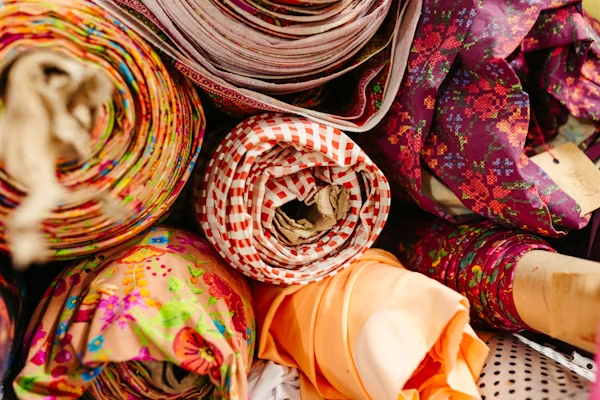
Rayon fabric rolls

Different Types: Viscose, Modal, Lyocell

Rayon has a number of types. The most popular form is viscose rayon. A garment labeled 100 percent rayon will most likely refer to viscose. Rayon also has modal and Lyocell. modal (of beech-tree) is worked to be stronger and less hard; it may stretch nearly 8 per cent of its length. Lyocell (so called Tencel brand name) employs another closed-loop solvent process. Lyocell is quite robust when in wet condition and it is relatively environmentally friendly. Overall, modal and lyocell are shinier and slightly more elastic than standard viscose (stretches up to 5 percent), but they are in fact rayon.

Is Rayon Stretchy?

100% rayon lacks considerable natural stretch. As a matter of fact, the natural stretch of 100% rayon is very low. Rayon drapes, alone, hang gently rather than snapping. It implies that pure rayon clothing tends to hang loose, or wrinkly instead of fitting or stretching. When you stretch a rayon shirt it will not stretch but will wrinkle or will even shrink a little. That is, pure rayon is in effect not elastic. It is soft and flowing, yet is not going to stretch out when stressed. The answer to this is therefore: No, pure rayon is not stretchy.


When Does Rayon Become Stretchy?
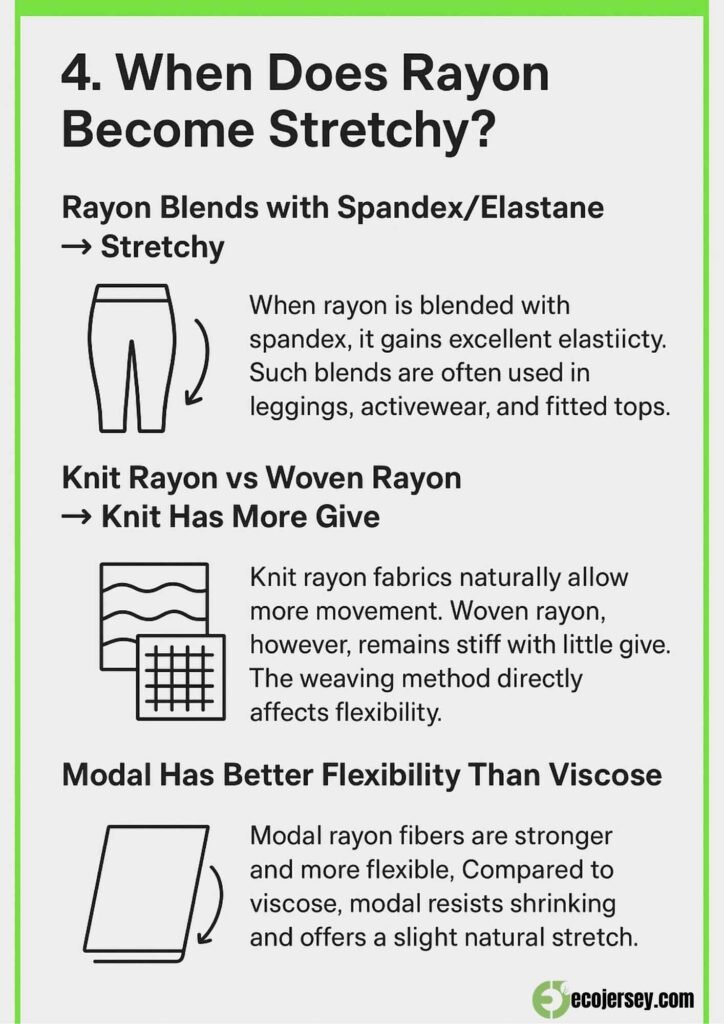
Rayon fabrics' stretchiness explained
Understanding when rayon becomes stretchy

Rayon + Spandex/Elastane Blends

Spandex (elastane) can be added to make rayon stretchy. Spandex is the skimpy fabric of leggings and swimming suits. Sparing a few percent of spandex in a rayon blend renders the fabric elastic. As an example, a 95% rayon/5% spandex jersey will stretch very much. Practically, the knits made of rayon-spandex can be easily stretched to conform to your body. That is why a lot of fitted tops and activewear garments have rayon-spandex mixes: rayon helps the garment to stay soft and drapey and the spandex provides the stretch.

Knit vs. Woven Rayon

The construction is also an issue. Knit rayon (as jersey knits) is stretchable and woven rayon (as twill or poplin) has no stretch. Through an example of rayon jersey knit, this type of fabric can easily be stretched 25-30 percent on each side. On the other hand a rayon fabric that is tightly woven does not stretch much at all. Simply said, knitted rayon is stretchy, and woven rayon is rigid.

Modal vs. Viscose

Modal rayon is slightly more flexible than usual viscose. Modal rayon is capable of stretching to approximately 8 percent as compared to 5 percent of viscose. In this way, modal dresses and underwear will be a little more stretchy and strong. Yet, both of them are not as elastic as spandex-made fabrics. However, when it comes to drape and comfort, there is a notable difference with modal with more bounce than regular rayon.


How Rayon Behaves Compared to Other Fabrics

FabricStretchinessDrape/FeelDurability
RayonLow (≈5–7%); more with spandex blendsExcellent drape; silky, soft feelModerate (weaker when wet)
CottonLow (≈3–5% in woven cotton)Good; natural matte lookHigh (stays stable wet/dry)
PolyesterModerate (plus high when blended)Less drape; firmer handVery high (strong, durable)
SpandexExtremely high (400–500%)Not used alone for garmentsHigh (recovers shape well)

Rayon vs Cotton: Comfort and Stretchiness.

Cotton is a moderate fabric that is capable of stretching slightly when worn. Rayon is more absorbent but it is not elastic. Cotton will be more sturdy, rayon less sturdy and smoother, and silk smoother.

Rayon vs Polyester: Elasticity and Strength.

Polyester is firm and does not lose the shape. Rayon on the other hand has the ability to slump or contract. Polyester has a low level of elasticity and rayon has to be mixed to provide stretch.

Rayon vs Spandex: The Reasons Blends Are Worn.

The spandex is very stretchy. The rayon is mixed with spandex to provide stretch, comfort and durability. With this blend, fabrics that are perfect in active wear and fitted apparel are produced.


Does Rayon Stretch Over Time?

Shape Loss When Wet

Rayon is very susceptible to moisture. The fibers of rayon loosen when wet and may distort. Water destroys the hydrogen bond on the rayon, which causes weakening of the fiber. Consequently, wet rayon will readily stretch out of shape, hang or even tear, when stressed. Designers observe that rayon is more flexible and stretchy when wet hence you should handle wet rayon carefully.

Permanent Stretch vs. Shrink

Rayon can also change shape, over a period of time. Rayon does not bounce back as well as cotton. It is stated that rayon is not very elastic in nature and the sensitivity to moisture may make it lose the shape. Over time rayon can either shrink or stretch out. Therefore, a rayon shirt can unintentionally slack or stretch at the elbows after each use or misuse. When a rayon product is stretched or pulled many times (e.g. by hanging it on a narrow hanger), it may permanently become larger. On the other hand, it can curve back strangely, when not dried flat.

Risk of Shrinking Instead

Actually, the issue of shrinking is greater than that of stretching. Rayon fibers will relax in water and tend to shrink when washed in the wrong way. Our sources say that rayon may shrink by approximately 10 percent when wet or laundered. A rayon cloth can become shorter in length, and thinner in width, unless the mill has pre-shrunk it. This implies that instead of being able to be long-term stretched, rayon clothing tends to be smaller when washed in warm water or dried in heat. Always think that rayon should be treated gently in order to maintain its original size.


Pros & Cons of Rayon’s Stretchability

  • Gorgeous Draping: Rayon is effortlessly flowing and fits the body shapes to make graceful shapes (dresses, skirts, blouses look loose). Its minor stretch makes clothes slide over the body.
  • Silky Softness: Rayon is soft and smooth, the so-called artificial silk. The material is light in weight and breathable (good warm weather). These properties give rayon extremely comfortable properties, though it may not be stretchy.
  • Light Comfort: Rayon has an airy structure that is cool. It is lightweight, but opaque fabric, and light to the touch. It is a good wicker and you are cool.
  • Low Elasticity: Rayon has practically no natural stretch. A rayon garment with a woven fabric will not stretch back to its original shape once pulled and therefore can stretch out of shape as it ages or it can stretch at the seams. Fitted clothes have this disadvantage of lacking bounciness.
  • Wrinkle and Sag Risk: Rayon wrinkles easy. In contrast to polyester, rayon requires ironing and can be creased. When mishandled (this is particularly true when wet) it may end up loose and lose its shape. Rayon fibers are able to contract or expand instead of restoring to their size.
  • Sensitivity to Care: Rayons are sensitive to care in order to preserve shape. They do not stand heat or coarse washing. Rayon garments will either shrink or loosen unless you pay strict attention to instructions on caring unless mixed or treated.

Best Uses of Rayon Fabrics (Stretch & Non-Stretch)
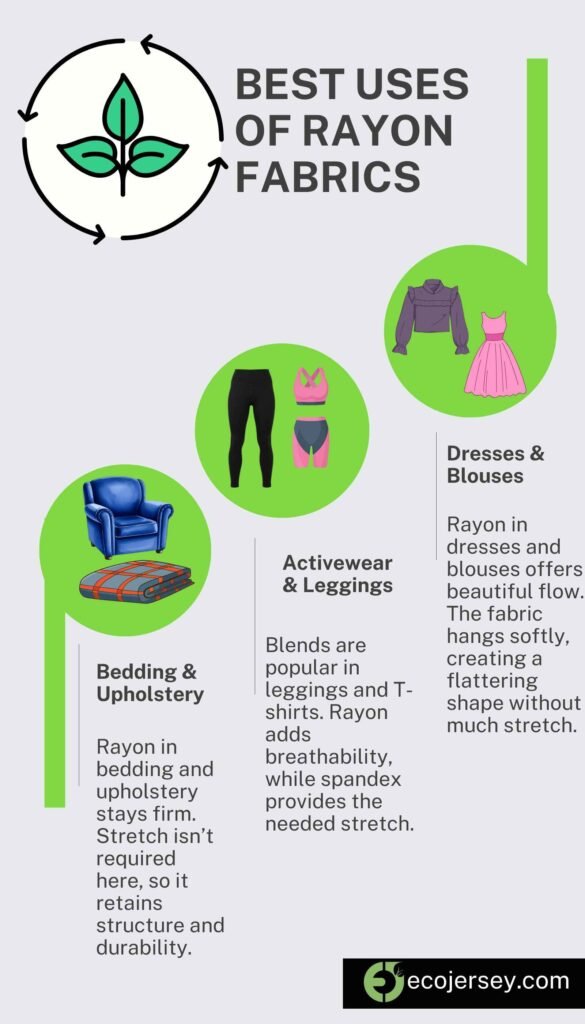
Best uses of rayon fabrics in bedding, activewear, and dresses.
Rayon is versatile, used in bedding, activewear, and dresses for comfort, durability, and flow.

Dresses & Blouses (Draping)

Flowing rayon garments are magnificent. Designers appreciate draping because rayon flows beautifully. Rayon’s silky drape and soft hand are perfect for garments that don’t need stretching. Consider, for example, summertime dresses. The dresses float around the body and the fabric helps keep the heat away. In these styles, rayon is appreciated for pliability and for look.

Activewear, Leggings & T-Shirts (Rayon+Spandex)

Casual fitted styles are made with rayon, usually blended with other materials. A common example would be jersey knit fabric that is 95% rayon and 5% spandex. Descriptions of this fabric state that “it is lightweight with 4-way stretch – perfect for dresses, loungewear, and activewear”. Rayon-spandex blends are used to create leggings, T-shirts, and other activewear. The spandex enables the fabric to stretch, and rayon offers softness, which is important in activewear. These styles are designed to stretch and recover, thanks to the combination of spandex and rayon.

Bedding & Upholstery (Usually Non-Stretch)

Fabrics containing rayon can be used for home textiles, although in these cases stretch is usually unwelcome. For bedding and drapery, rayon’s softness and moisture-wicking properties are prioritized over elasticity. For example, rayon Lyocell (Tencel) is highly regarded for sheets as it feels cool and smooth. Rayon can be incorporated into upholstery fabrics, and it can also be used for curtain softening sheen. In these cases, rayon is more often used in woven form and combined with cotton or polyester. The fabrics formed are relatively stable and stretch very little. These cases leverage my texture and breathability while avoiding great use of stretch.


How to Care for Rayon to Maintain Shape
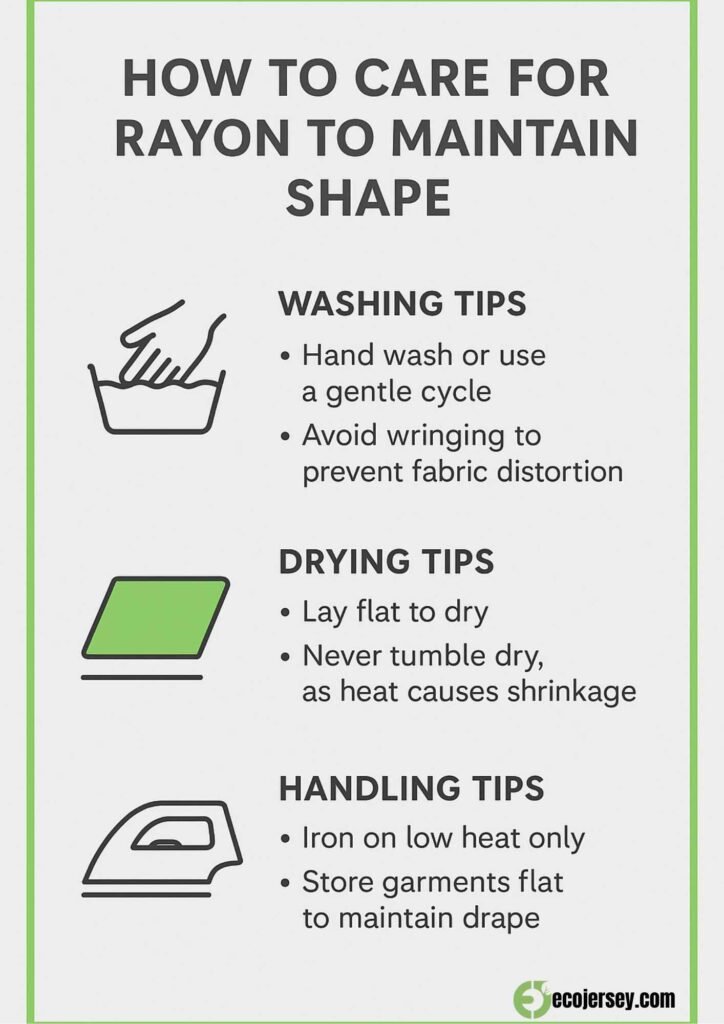
Rayon care tips for washing, drying, and handling to maintain shape.
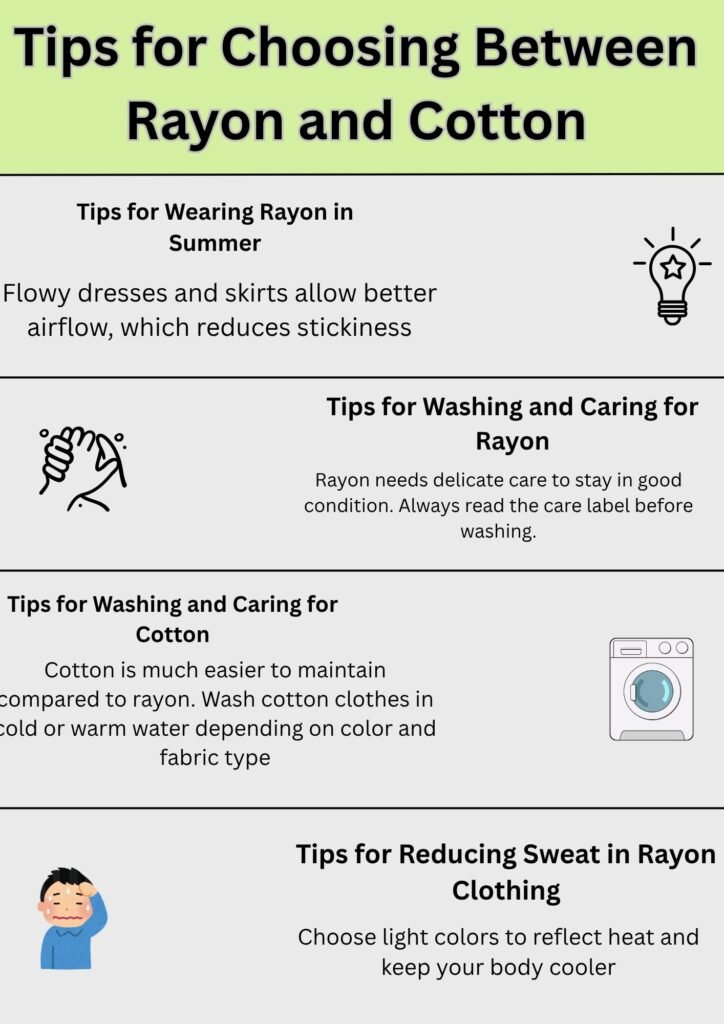
Tips for washing, drying, and handling rayon
  • Gentle Cycle or Hand Wash: Wash rayon in cold water on delicate cycles. Machine washing should be kept to a minimum and use a laundry bag when machine washing.
  • Avoid Wringing or Twisting: Do not force water out of rayon by wringing. It will distort the fiber. Instead, press out water or roll the garment in a towel.
  • Lay Flat to Dry: Always reshape rayon items and dry them flat on a clean towel. Do not hang heavy rayon knits; they can stretch under their own weight. Never tumble-dry rayon (heat damages it).
  • Iron Carefully: If needed, iron rayon on low heat while it is slightly damp, or use a pressing cloth to protect the fabric.
  • Store Properly: Fold or hang rayon clothes on padded hangers to avoid shoulder bumps. Keep them in a cool, dry place to avoid moisture which will weaken the fibers over time.

Conclusion-

Does rayon have some stretch? Well, not really since rayon on its own does not stretch and is not elastic like some other fabrics. It does, however, drape.

When blended with spandex or knitted into other fabrics, rayon stretches. Modal rayon also gives some more stretch. When purchasing, decide if you need stretch or drape. Pure rayon is what you need for flowy dresses. For rotary-spandex blend is best for leggings or fitted tops.

Rayon is also beautiful for its versatility and silky softness. Choose carefully and you can have style and comfort at the same time.
Read More>> About what is rayon fabric?


FAQs

Does rayon stretch when wet?

It’s true that rayon fibers become softer when wet. In fact, the more a rayon fiber absorbs moisture, the more pliable and “stretchy” the fiber will become. You should be careful not to put a damp rayon garment under heavy pulling or hanging because it will stretch a lot when wet.

Does rayon stretch after washing?

If rayon is washed and air-dried hanging, it will stretch and may be permanently altered, sometimes by as much as 15%. However, during gentle washing and drying, most rayon will return almost to the original shape. Once the rayon is dried flat, most of it will return to its original shape.

Is rayon more stretchy than cotton?

Stretchy substantially more than tightly woven cotton. “Rayon is slightly stretchier than 100% cotton, especially when knitted” added a source. In the more loose or knitted weaves, rayon can droop and stretch more than pure cotton. However, in most cases, both fibers will stretch only a little. Compared to rayon, cotton will more likely snap back while rayon will lose its shape.

Do rayon-spandex blends shrink?

Rayon with spandex is usually more stable, but rayon can still shrink if not handled carefully. Fabrics keep their shape because of spandex blends, but high heat and agitation can still shrink blends. To reduce shrinkage, wash rayon-spandex in cold, gentle cycles, and air-dry. Don’t use high heat; the rayon fiber will contract more.

Is modal rayon stretchy?

Modal is one of the stretchier rayons. It typically stretches about 8% of its length, which is more than standard viscose. Modal fabrics feel silky and resilient, so they have moderate stretch and recovery. While not as elastic as spandex, modal garments will give you a comfortable, flexible fit.
Faux Fur Wool Fabric: Properties, Uses, Benefits, and Care Guide

Wracked with the guilt of faux fur, of exhausting your fabrics without destroying the original and without the cruelty and carelessly manipulating the use of animal fur? Cast your guilt away, faux fur is for you. It is cruelty free, guilt free and animal free and to your disposable cash. It’s also soft and warm, and is the tiggest faux warm and soft fabric. It is cruelty fur and guilt free but is warm and soft and cuddly but also disposable cash to you. It is very soft and warm and very tig and soft and cuddly. Easy cash to squall.

What Is Faux Fur Wool Fabric?

Faux fur wool fabric imitates real fur by means of an artificial fabric which is made of acrylic, polyacrylic, polyester, and/or wool blends. Wool adds a touch of softness and insulation which is always a plus.

Faux fur wool fabric is a step above traditional wool and is focused on preserving ethical values. Faux fur wool fabric is cheap, light weight, and, most importantly, cruelty free. It is no wonder that designers, along with consumers, have jumped on the faux fabric train.

History of Faux Fur Wool Fabric

There was an attempt to make artificial fur in the first part of the 20th century. The first faux fur which was commercially made, was in the 1920’s and was made of alpaca hair. It was not until the 50’s that there was major advancements in the making of synthetic fabric that was the replacement for real fur.

The advent of acrylic and polyester made it possible to create faux fur that was luxurious in look and feel. This was later built upon, and instead of just faux fur fabric, we have faux fur wool fabric which integrates the wool along with the lavish pile faux fur.

Now a days, technology has advanced to the point where some faux fur is so bieng made it is hardly distinguishable from real animal fur. Its ethical strength and source makes it more preferred in production.

Properties of Wool Faux Fur Fabric

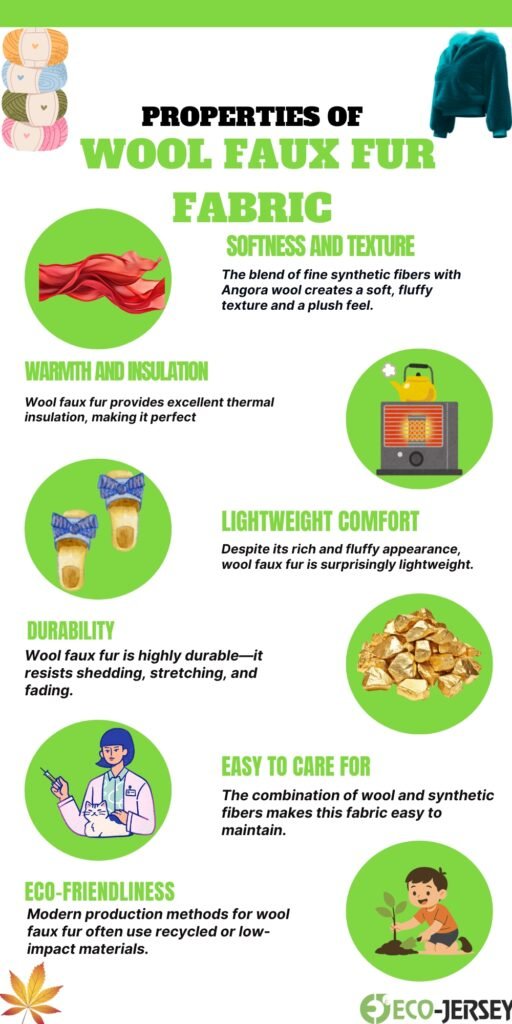
Alt text for the infographic: “Informational poster about properties of wool faux fur fabric, featuring sections on softness and texture, warmth and insulation, lightweight comfort, durability, easy care, eco-friendliness, and visuals of fibers, a heater, a doctor, gold ingots, a plant, and yarn icons on green circular backgrounds.”
Discover wool faux fur fabric: soft, warm, durable, lightweight, easy to care, and eco-friendly.

Wool faux fur fabric has properties that help it remain stylish and functional at the same time.

1. Softness and Texture

The combination of fine synthetic fibres and the angora wool fabric is more fluffy and has a more plush feel.

2. Warmth and Insulation

This fabric has great thermal insulation which makes it an ideal piece for winter collection and a warm cozy home.

3. Lightweight Comfort

Wool faux fur fabric gives the sense of plushness but is lightweight fabirc. Therefor it gives hte user the sense of comfort and the ease of movement.

4. Durability

Wool faux fur is more durable because it does not shed, stretch, or fade.

5. Easy to Care

Wool and synthetic fibres are less set in their ways which means no stubborn dirt.

6. Eco-Friendliness

Use of modern methods has no use of recycled materials, thus reducing the impact of modern age waste.

Varieties of Faux Fur Wool Fabric

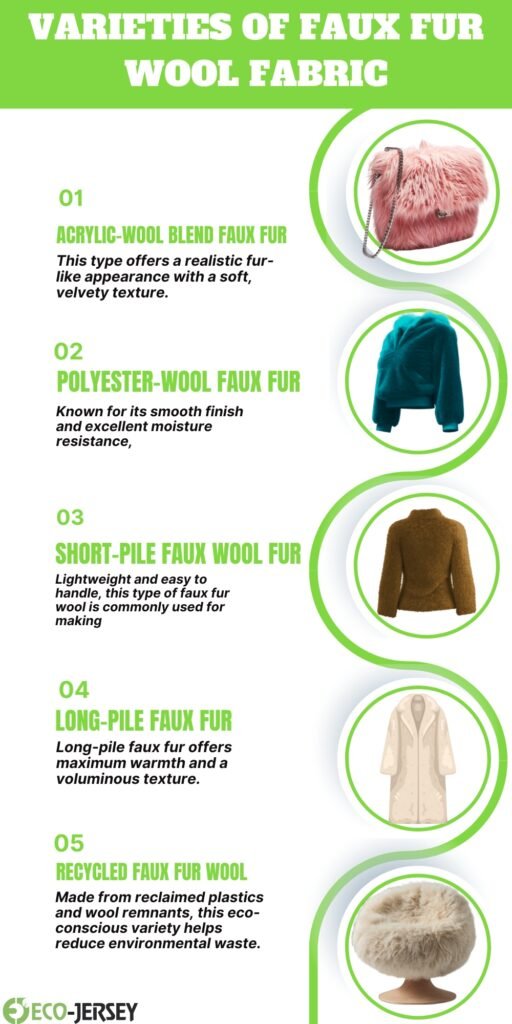
Infographic titled ‘Varieties of Faux Fur Wool Fabric’ with five circular images of faux fur items (pink, blue, brown, beige coat, and beige hat) and numbered descriptions 01–05 detailing different faux fur wool fabrics (acrylic-wool blend, polyester-wool, short-pile, long-pile, recycled faux fur wool).
Varieties of Faux Fur Wol Fabric: A quick guide to five common types, their textures, and uses.

Although there are different kinds of faux fur wool fabric, they vary based on the kind of fibers they use and the finishing touches they have.

  1. Acrylic-Wool Blend Faux Fur: This type has a realistic fur look and is soft to the touch, especially the high-pile.
  2. Polyester-Wool Faux Fur: This kind has a smooth finish and is great at repelling moisture.
  3. Short-Pile Faux Wool Fur: This type is lightweight, easy to work with, and perfect for making clothes.
  4. Long-Pile Faux Fur: This type is great for adding warmth and volume, making it perfect for luxury outerwear and home decor.
  5. Recycled Faux Fur Wool: This type is made from reclaimed plastics and wool fabric waste, making it great for the environment.

All the different types have cozy jackets, classy cushions, and eco-friendly interiors as their end products.

Applications of Faux Fur Wool Fabric

Faux fur wool fabric is flexible in its usage and is applied in different industries.

1. Fashion Industry

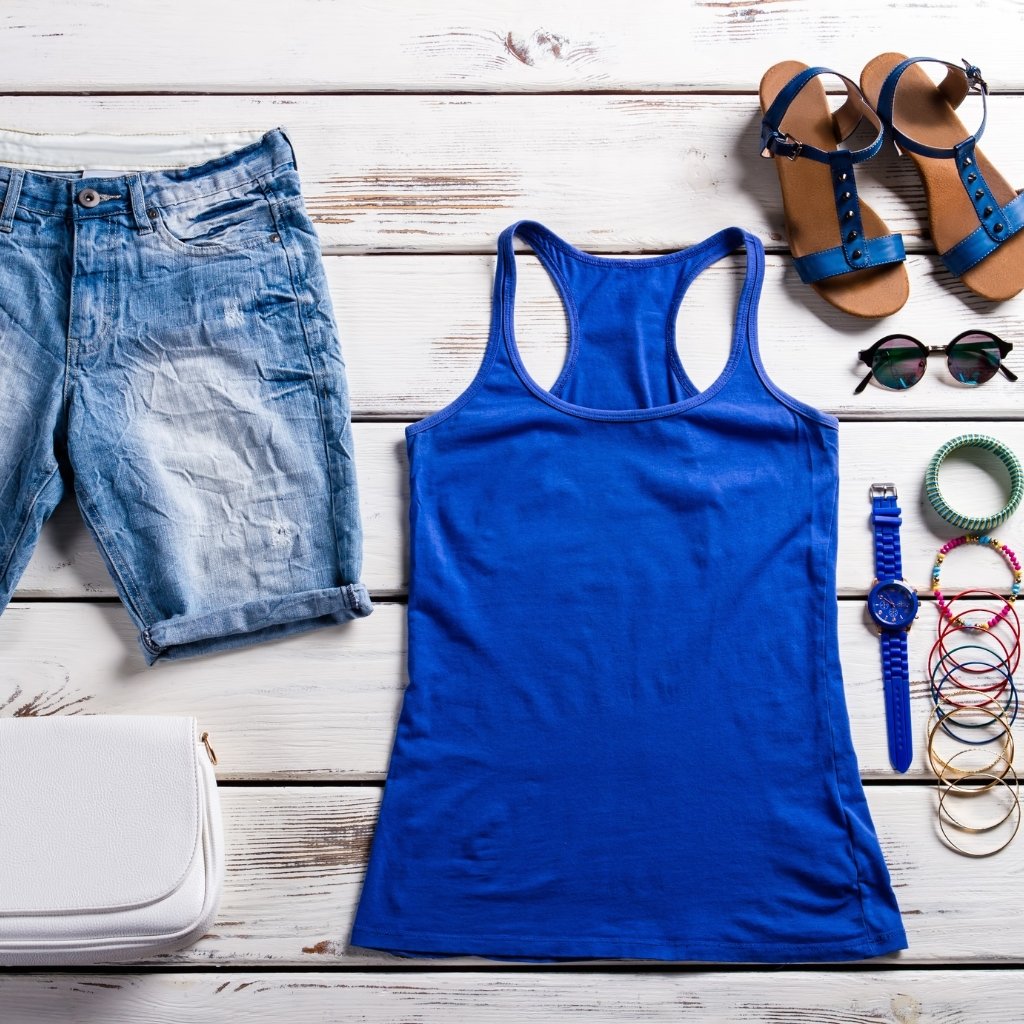
A flat lay of summer clothing and accessories on a white wooden surface: a bright blue tank top, distressed denim shorts, blue sandals, sunglasses, a white purse, and stacked bracelets. The scene emphasizes fabric textures and casual style.
Bright blue tank top with denim shorts and summer accessories laid out for a chic, casual outfit.

In the fashion industry, it is used for coats, jackets, shawls, and as embellishments on other clothes. Because it has a realistic look, it is often used in winter collections. It also appears in handbags, hats, and gloves.

2. Home Décor

A modern backyard scene featuring a white, two-story house with large sliding glass doors, a rectangular pool, and an integrated rectangular fire feature with flames. The patio has light tan tiles, and there are small palm-like plants along a white perimeter wall. The sky is dusk-purple.
Elegant backyard oasis: a contemporary home with a lit fire feature by the poolside at dusk.

Interior designers like using faux fur wool fabrics because of their softness and their what is wool fabrics warmth visually. They use them in:

  • Blankets and throws
  • Cushions and upholstery
  • Bed covers and rugs

3. Accessories and Footwear

Indoor retail or display area with a wooden shelf showcasing colorful sneakers, a purple yoga mat, a blue striped storage box, and potted greenery; clothing on a rack to the left.
Bright sneakers on a minimalist display shelf, paired with a cozy setup of mats and boxes.

The faux fur wool fabric is found in warm and stylish boots and slippers as well as in pliable enough fashion accessories.

4. Sustainable Fashion Collections

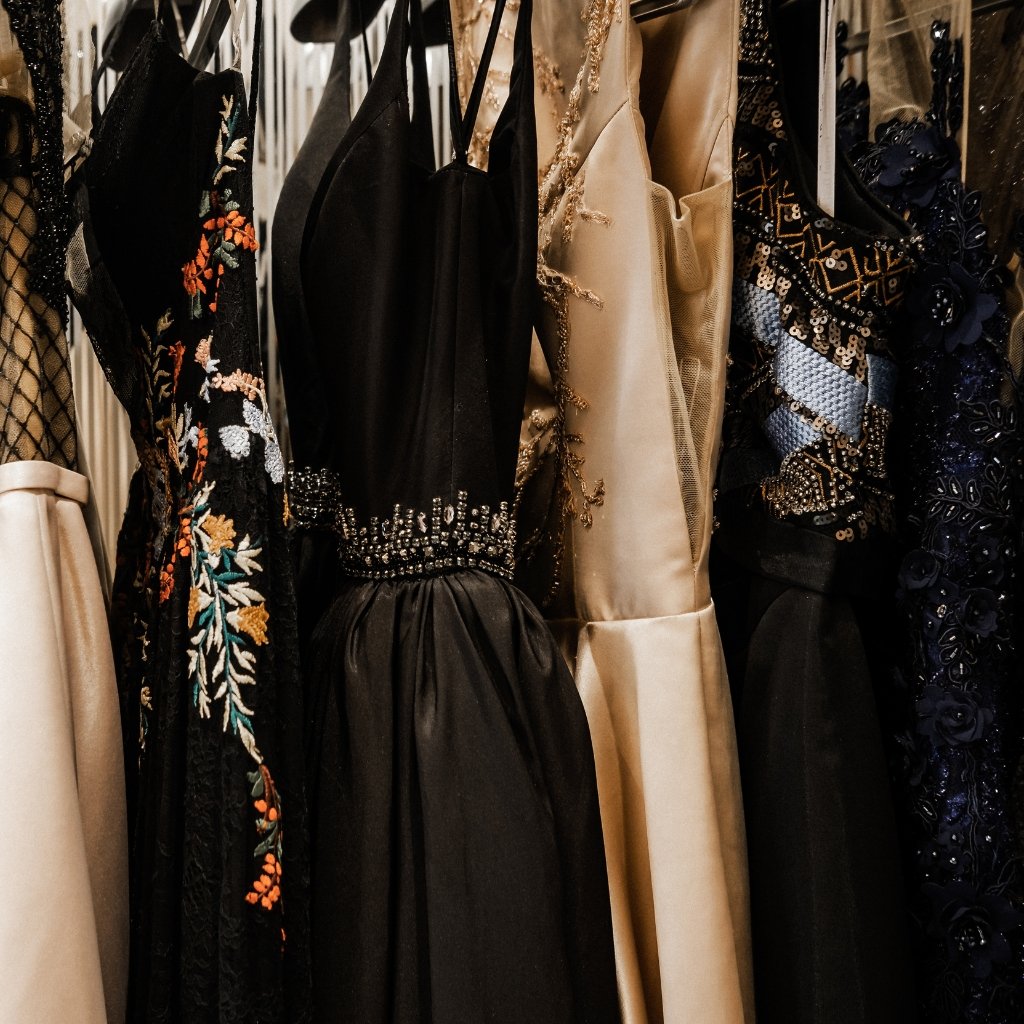
A row of elegant evening gowns in black, cream, and navy, featuring embroidered florals, sequin accents, and satin textures, hung on a wardrobe rack.
Glamorous evening gowns in rich fabrics: embroidery, sequins, and satin textures.

Since faux fur wool is cruelty-free and durable, it is often chosen over real fur and leather in sustainable fashion.

Benefits of Faux Fur Wool Fabric

Faux fur wool fabric has several benefits that explain why it’s in high demand:

  • Cruelty Free Alternative: No animals are harmed in the process.
  • Affordable Luxury: Looks and feels like real fur, much cheaper.
  • Warmth and Comfort: Great for chilly weather and places.
  • Low Maintenance: Fur requires high maintenance, but faux is easy to care for.
  • Ethical and Sustainable: Mostly made from recycled materials.
  • Hypoallergenic: Unlike real fur, it doesn’t cause any allergies.

Disadvantages of Faux Fur Wool Fabric

In spite of its advantages, there are a few drawbacks that should also be acknowledged:

  • Less Breathable: It doesn’t allow much air to pass through as natural fibers do.
  • Static Buildup: Synthetic fibers can create static.
  • Environmental Impact (in older versions): Synthetic fibers that aren’t recycled may take longer to decompose.

These concerns have been significantly lessened with advancements in technology, making modern faux fur wool much more enjoyable and eco-friendly.

Caring for Faux Fur Wool Fabric

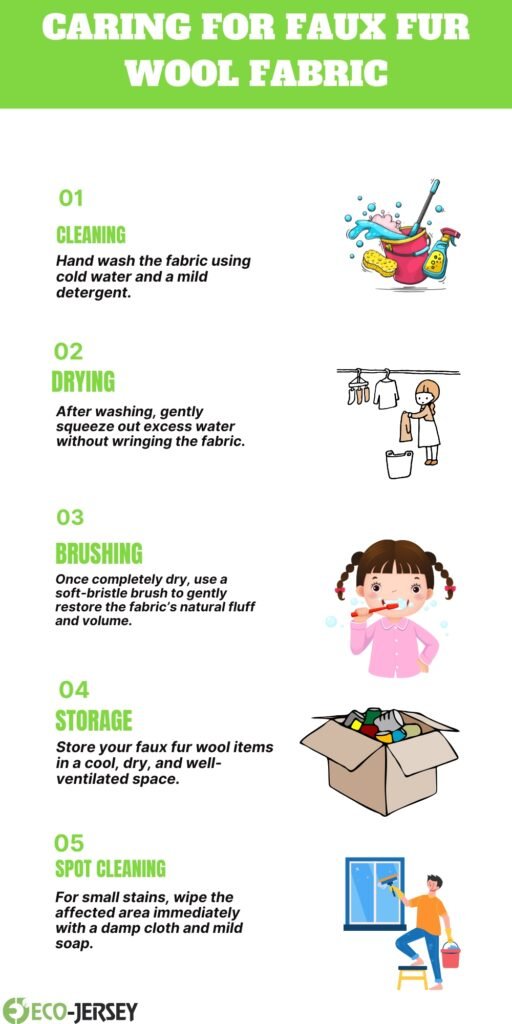
Infographic titled 'Caring for Faux Fur Wool Fabric' with five steps: Cleaning, Drying, Brushing, Storage, Spot Cleaning; each step has a small illustration on the right.
Caring for faux fur wool fabric: quick tips for cleaning, drying, brushing, storage, and spot cleaning.

Your faux fur wool garments will last for years in a soft, clean, and beautiful condition if you take care of them properly.

  1. Cleaning: Hand wash with cold water and a mild detergent. Don’t use bleach, fabric softeners, or any other softeners.
  2. Drying: Air-dry the fabric after you lay it flat and gently squeeze out the water. Avoid direct sunlight and any other heat source.
  3. Brushing: Once the fabric is dry, you can use a soft-bristle brush to restore the fluff.
  4. Storage: Keep it in a cool, dry place and avoid compression or folding for long periods.
  5. Spot Cleaning: Wipe away stains immediately with a damp cloth and mild soap.

These steps will ensure the fabric maintains its beauty and softness.

Sustainability and Ethics

Faux fur wool fabric is an ethical choice for fur and supports sustainable fashion. Many manufacturers use recycled polyester and wool to help with advertising and eco-friendly use. Plus, its long-lasting nature encourages slow fashion as the frequent replacements are minimized.

Chasing down faux fur wool takes less water and fewer chemicals than what goes into tanning real leather and fur. For buyers looking for luxury but trying to care less about the earth, this option is still pretty responsible.

Conclusion

Faux fur wool fabric nourishes the conscience as well as the body with its luxury, softness, and warmth. The eco-friendly production makes it an even better substitute for animals fur. It is perfect for stylish winter wear and cozy home décor as it provides both elegance and ethics.

FAQs

Is faux fur wool fabric real wool?

Not really. It has some wool blends, but mostly, it is synthetic fibers that replicate real fur for the softness.

Is it cruelty-free?

Absolutely. Faux fur wool fabric is made with absolutely no harm to any animals.

Can it be machine washed?

Some can, but it really is best to hand wash it to preserve its texture and to prolong its life.

What Is Velvet Cotton Fabric? Uses, Benefits, and Care Tips

Velvet cotton is considered an all-time classy fabric due to its feeling of richness, softness, and practicality. When compared to other fabrics, its comfortability stands out. Unlike synthetic velvets, which prioritise breathability over comfort, this textile can be worn all day without feeling stuffy. This is why designers and fabric enthusiasts keep choosing it for both fashion and home textiles.

History of Velvet Cotton

A close-up map of Southeast Asia viewed through a magnifying glass, focusing on countries like Malaysia, Thailand, Indonesia, and the Philippines.
Exploring Southeast Asia: a magnified view of the region’s map, highlighting Malaysia, Thailand, Indonesia, and surrounding areas.

Velvet fabric history embellishes prestige. It was considered a royal fabric due to the high level of intricacy and craftsmanship it required. For a long time, silk was the only fabric used for making velvets. Cotton was later woven into the fabric alongside silk which made it more accessible to the masses. Over the years, cotton velvet became the go-to fabric as it was more affordable, durable and versatile. Read more…Muslin Cotton Fabric

Velvet Cotton Features

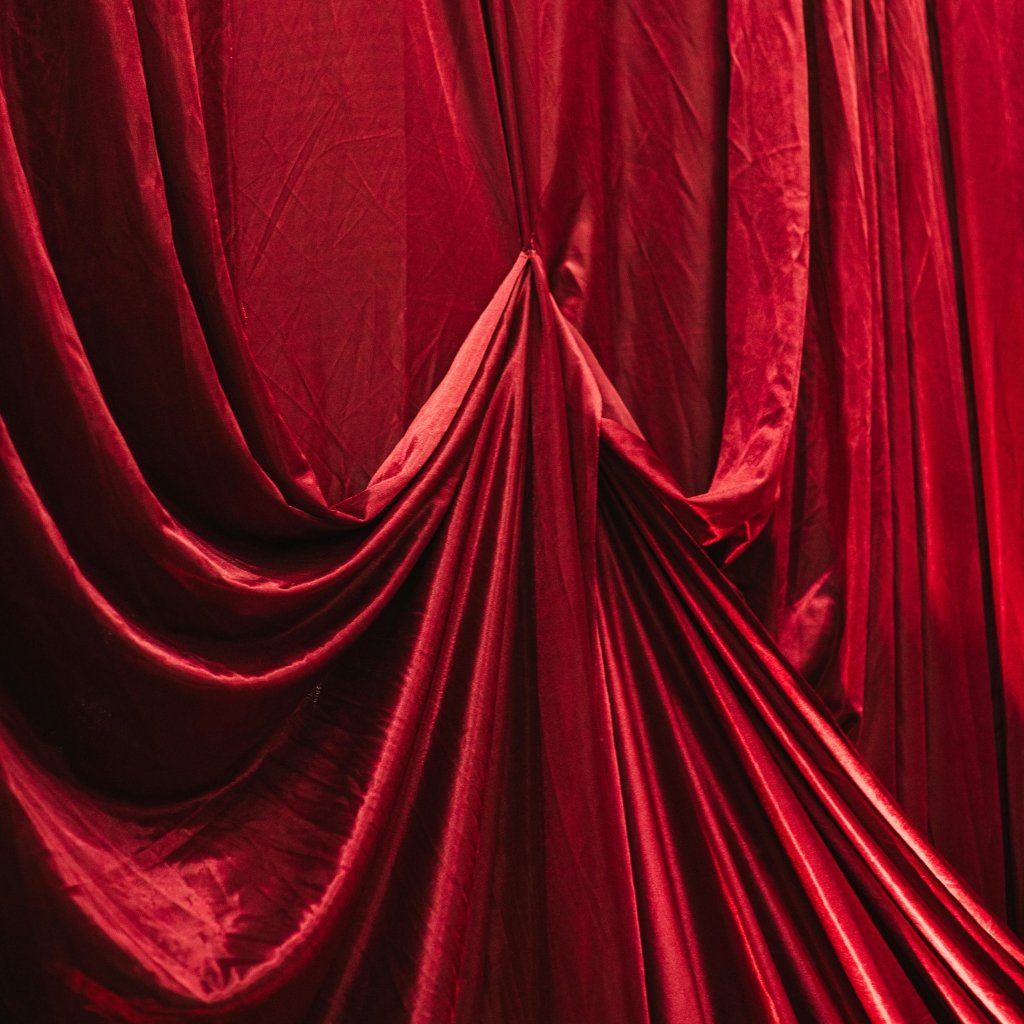
Deep red velvet curtains gathered into a central knot with folds cascading downward.
Luxurious red velvet drapes gathered into an elegant knot, with cascading folds.

Soft Textures: The smooth and plush pile feels gentle against the skin.

Comfort of Natural Fibers: Cotton fabrics are breathable and absorb moisture to keep the skin dry.

Durability: Unlike delicate silks, cotton velvet is strong enough for everyday use.

Elegant Appearance: The rich sheen enhances garments and interiors with sophistication.

Versatility: It adapts well to apparel, upholstery, and accessories.

These qualities explain why velvet cotton fabric is a consistent favorite in fashion and home decor.

How is Velvet Cotton Fabric Made

The weaving of velvet cotton fabric requires a delicate balance of techniques. Unlike flat weaves, velvet is woven using two layers of fabric with specially made looms. The fabric has small loops of fibers and when they are cut, they produce the short, dense pile that gives velvet its signature soft texture.

Although labor-intensive, this technique results in a fabric with remarkable depth and a luxurious finish. Cotton yarn is even more breathable, and will conceal the sheen that characteristic cotton velvet offers.

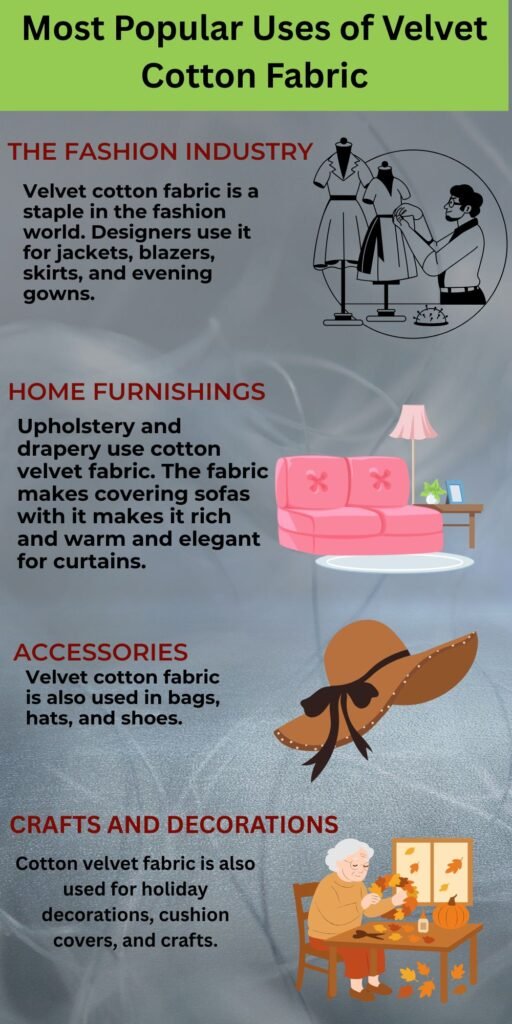
Infographic titled 'Most Popular Uses of Velvet Cotton Fabric' with sections: The Fashion Industry (dressmaking), Home Furnishings (sofas and curtains), Accessories (hats and bags), Crafts and Decorations (holiday decor). Includes illustrations of a designer at a sewing table, a pink sofa, a wide-brim hat, and an elderly person crafting at a table.
Overview of the top uses of velvet cotton fabric across fashion, home furnishings, accessories, and crafts.
  1. The Fashion Industry

Velvet cotton fabric is a staple in the fashion world. Designers use it for jackets, blazers, skirts, and evening gowns. Its plush surface adds depth and elegance to outfits, making it a popular choice for fall and winter collections. Read more….Terry Cloth Fabric

  1. Home Furnishings

Upholstery and drapery use cotton velvet fabric. The fabric makes covering sofas with it makes it rich and warm and elegant for curtains. The fabric improves the aesthetics and makes the furniture more durable.

  1. Accessories

Velvet cotton fabric is also used in bags, hats, and shoes. Because of its flexibility, it matches seamlessly with both laid-back and sophisticated outfits.Crafts and Decorations

  1. Crafts and Decorations

Cotton velvet fabric is also used for holiday decorations, cushion covers, and crafts. Its rich texture improves both festive and everyday decorations.

Benefits of Selecting Velvet Cotton Fabric

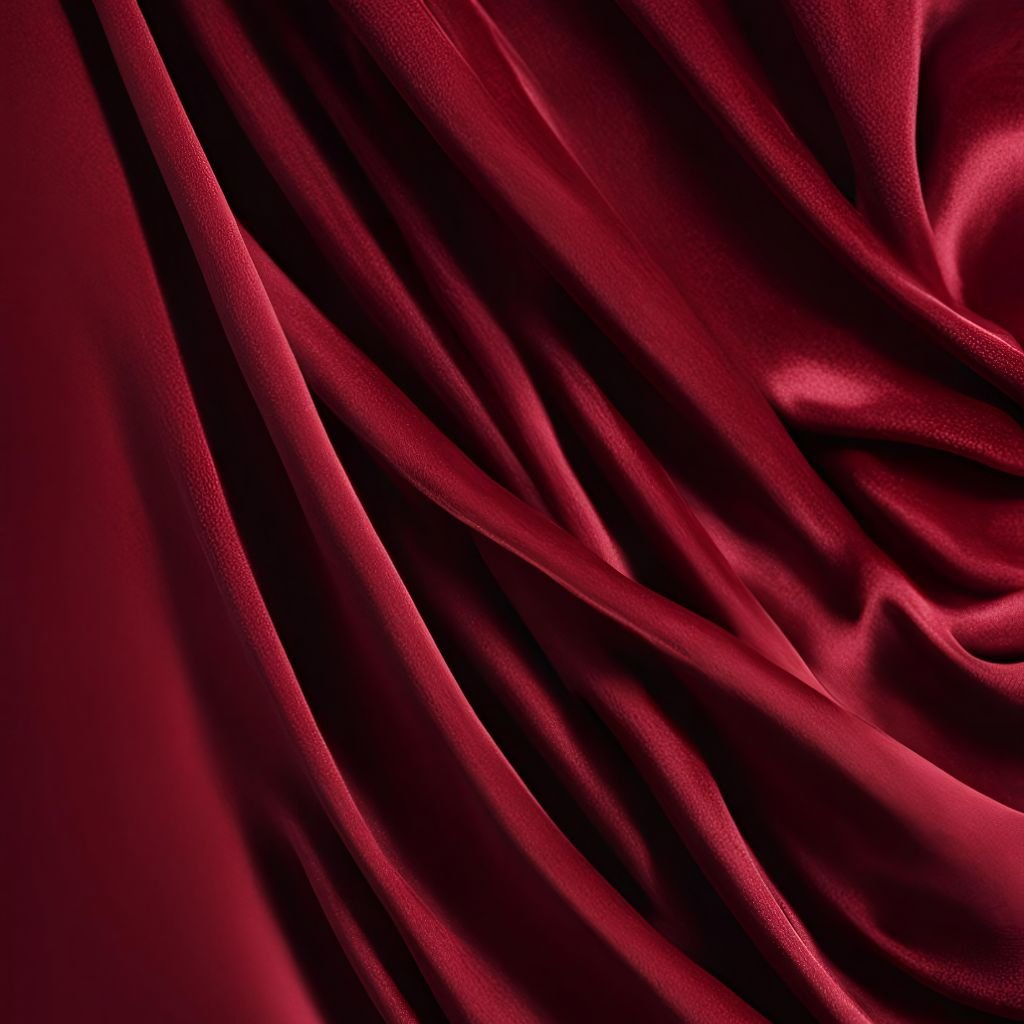
Close-up of rich red velvet fabric with soft folds and shadows.
Luxurious red velvet fabric draped in elegant, flowing folds.

Comfort and Breathability: It lets air circulate so it won’t trap body heat unlike synthetic velvets.

Affordability: Compared to pure silk velvet, it offers luxury for less.

Durability: It is made from cotton which is strong and everyday durable.

Timeless Appeal: Due to its elegant finish, it will always remain relevant unlike other fabric.

Versatile Applications: It is practical in many different areas ranging from clothing to furniture.

These benefits is why velvet cotton fabric is a top choice for many designers and homeowners.

Comparing Velvet Cotton Fabric with Other Velvets

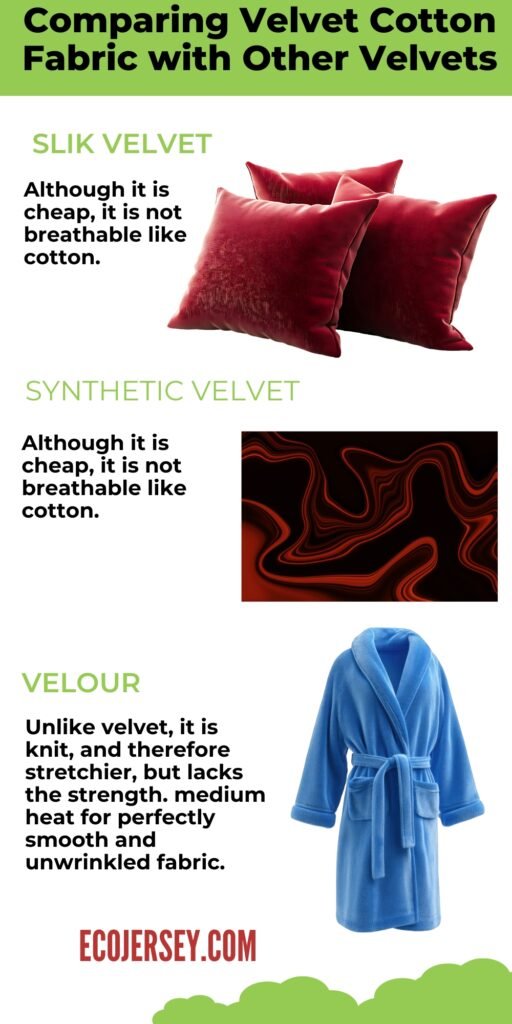
Image comparing velvet fabrics with other velvets: three sections labeled “Slik Velvet,” “Synthetic Velvet,” and “Velour.” Each section shows corresponding visuals (red velvet cushions, abstract red swirl pattern, and a blue bathrobe). The top header reads “Comparing Velvet Cotton Fabric with Other Velvets,” and the source “ECOJERSEY.COM” appears at the bottom.
Comparing Velvet Types: Silk Velvet, Synthetic Velvet, and Velour—with quick notes on texture and warmth. Source: ECOJERSEY.COM

Silk Velvet: While expensive, it is less durable compared to other silk fabrics.

Synthetic Velvet: Although it is cheap, it is not breathable like cotton.

Velour: Unlike velvet, it is knit, and therefore stretchier, but lacks the strength.

Because of these reasons, velvet cotton fabric is the most comfortable, durable, and least expensive.

Styling Velvet Cotton Fabric in Fashion

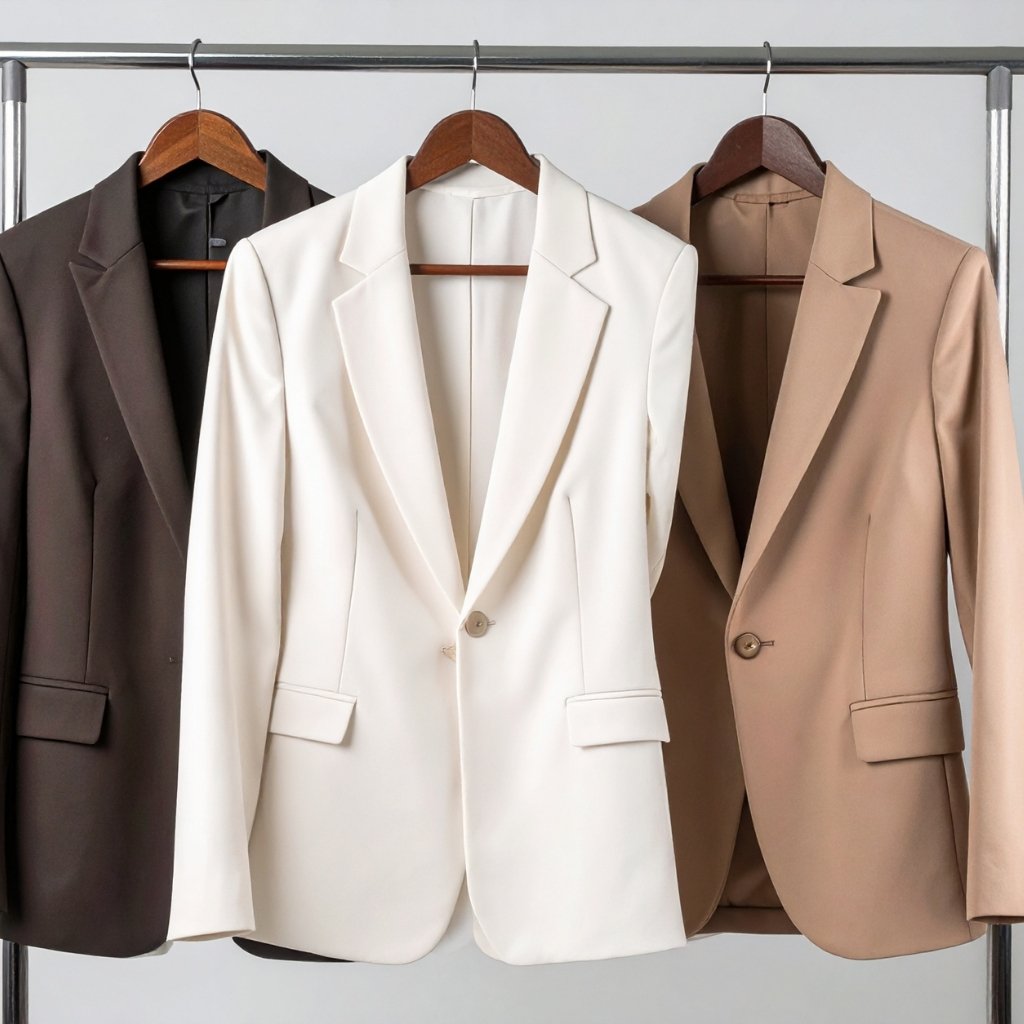
A row of three blazers on hangers: dark brown on the left, ivory white in the center, and light tan/beige on the right, hanging on a metal clothing rack.
Three classic blazers in brown, white, and beige.

There are many ways to style velvet cotton fabric. It can be used to make jackets and blazers which give sophistication for professional or evening wear. It can also be used to make dresses which is particularly elegant in velvet cotton fabric with statement accessories. It can also make casual clothing more glamourous like everyday clothing with tops or skirts.

Velvet cotton fabric, when styled with thought, gives the perfect combination of comfort and sophistication.

Caring of Velvet Cotton Fabric

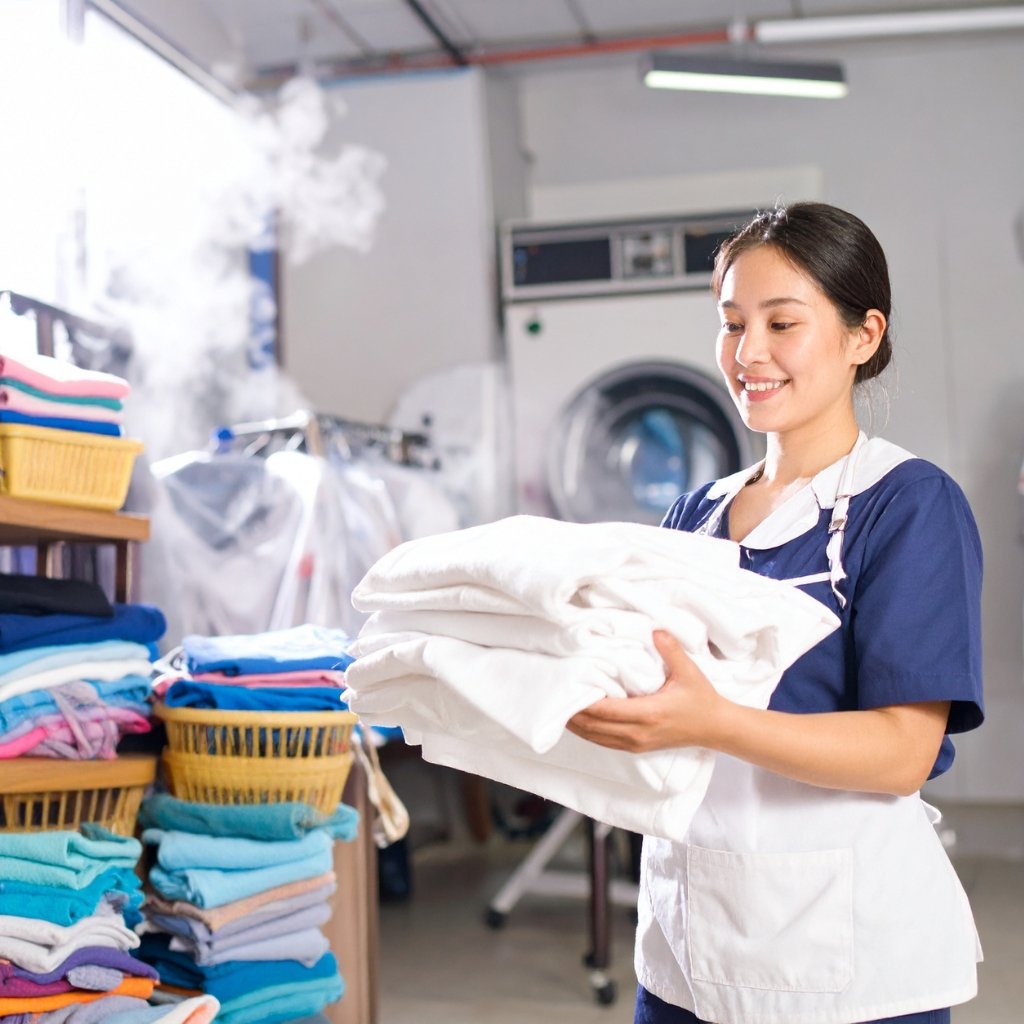
A smiling woman in a navy uniform folding a white bedsheet in a laundry room. She stands beside shelves of folded towels and laundry baskets, with a washing machine in the background.

In order to keep the softness and beauty of velvet fabric, it needs proper care.

Cleaning: Gentle dry cleaning and for smaller items, hand washing in cold water is also recommended.

Ironing: It is better to use steam instead of direct heat. Pressing can damage the pile, and therefore is not recommended. See more….Scrim Cotton Fabric

Storage: Make sure to avoid crushing the velvet pile. Garments should be hung in breathable storage to maintain shape.

Stain Removal: Stains should be blotted as opposed to rubbed to avoid irreversible damage.

With the right care, velvet cotton fabric will retain its luster for many years, thereby proving its long lasting value.

Environmental Aspects of Velvet Cotton Fabric

With the rise of sustainability, the use of cotton is also becoming more popular as the textile is more eco-friendly as opposed to cotton. However, cotton farming does use a lot of natural resources. To lessen this, the use of organic cotton velvet fabric is becoming more common, as it does maintain the softness and strength of regular cotton, but uses much fewer chemicals.

The fabric’s versatility is also matched by its elegance. Very few materials can be as sophisticated, comfortable, and affordable as velvet cotton fabric, so it is no wonder that it is a favorite for use in both fashion and interior design. Read more …Voile Cotton Fabric

With more people preferring sustainable and natural fabrics, velvet cotton fabric will become more common. To keep fabrics modern, designers are working with organic textiles, eco-friendly dyes, and creative new finishes. Also, with velvet cotton fabrics continuing to come back around in the fashion cycles, you can be sure these fabrics will be around for both the casual and luxurious lines for a long time to come.

Conclusion

The versatility of fabrics made from cotton velvet still deserves to be acknowledged. It feels good, looks good, and lasts, which made it a staple fabric in fashion and décor. It breathes well and feels nice, unlike the synthetic alternatives. Plus, it is more affordable than silk velvet which is helpful for people who are on a budget.

Those who appreciate style and functionality will find it in velvet cotton fabric. It can be used in many areas to provide an elegant and modern comfort that lasts for years.

FAQs

What is velvet cotton fabric?

Velvet cotton fabric is a soft, breathable textile made from cotton fibers woven into a dense pile, giving it a luxurious and elegant finish.

Is velvet cotton fabric durable?

Yes. Unlike silk velvet, velvet cotton fabric is stronger and more resistant to daily wear, making it suitable for clothing and upholstery.

What are the main uses of velvet cotton fabric?

Velvet cotton fabric is commonly used in fashion apparel, upholstery, curtains, accessories, and decorative crafts due to its rich appearance and comfort.

1. Is Rayon Toxic? What Science Says vs. Marketing Claims

Introduction-

Over the past few years, there has been an increase in the number of people who pose the question, is rayon toxic? This is an issue that is increasing due to increased awareness of fabric safety and sustainability. Customers will no longer be contented with only softness or cost, but want to know what their skin feels like every day.

Rayon is usually sold as natural and environmental friendly because it is plant-derived. However, the chemical-heavy process is doubtful with regard to its safety. Thus, is rayon safe to wear or is there something wrong with the marketing statements?

What is Rayon?

Definition: A Semi-Synthetic Fiber

Rayon is a semi-synthetic fabric that is produced by re-generation of plant cellulose. Simply put, it is wood or plant pulp that has been spinned into threads. It is not entirely synthetic such as polyester, and it is not entirely natural such as cotton. Cellulose (plant fiber) shares its very basic molecular structure with rayon. This is to say that the fabric itself is also soft and acts as natural fiber. Nonetheless, rayon is semi-synthetic, as it is created only by means of a synthetic chemical reaction.

Different Types of Rayon

Varieties: There are various varieties of Rayon. The original form (usually simply referred to as rayon) is viscose rayon. It was developed more than 100 years ago as a replica of silk. Modal resembles viscose and it is normally produced using beech trees. It is shrink-resistant. The newer type is called Lyocell ( brand name being Tencel ), and is produced using the cleaner process of eucalyptus or bamboo. They are all cellulose fibers, but vary in their mode of manufacture (see below).

Rayon’s Popularity in Fashion

Fashion: Rayon ranks on the third position as a textile fiber used across the globe. It is capable of copying such materials as silk, cotton or wool cheaper. Its flexibility and plushness has seen it widespread in summer dresses, athletics, and home linen. It is easy to dye and makes a nice drape as well. But the more people are informed on how it is produced the more they doubt the safety and sustainability of it.

How is Rayon Made? (The Chemical Process)

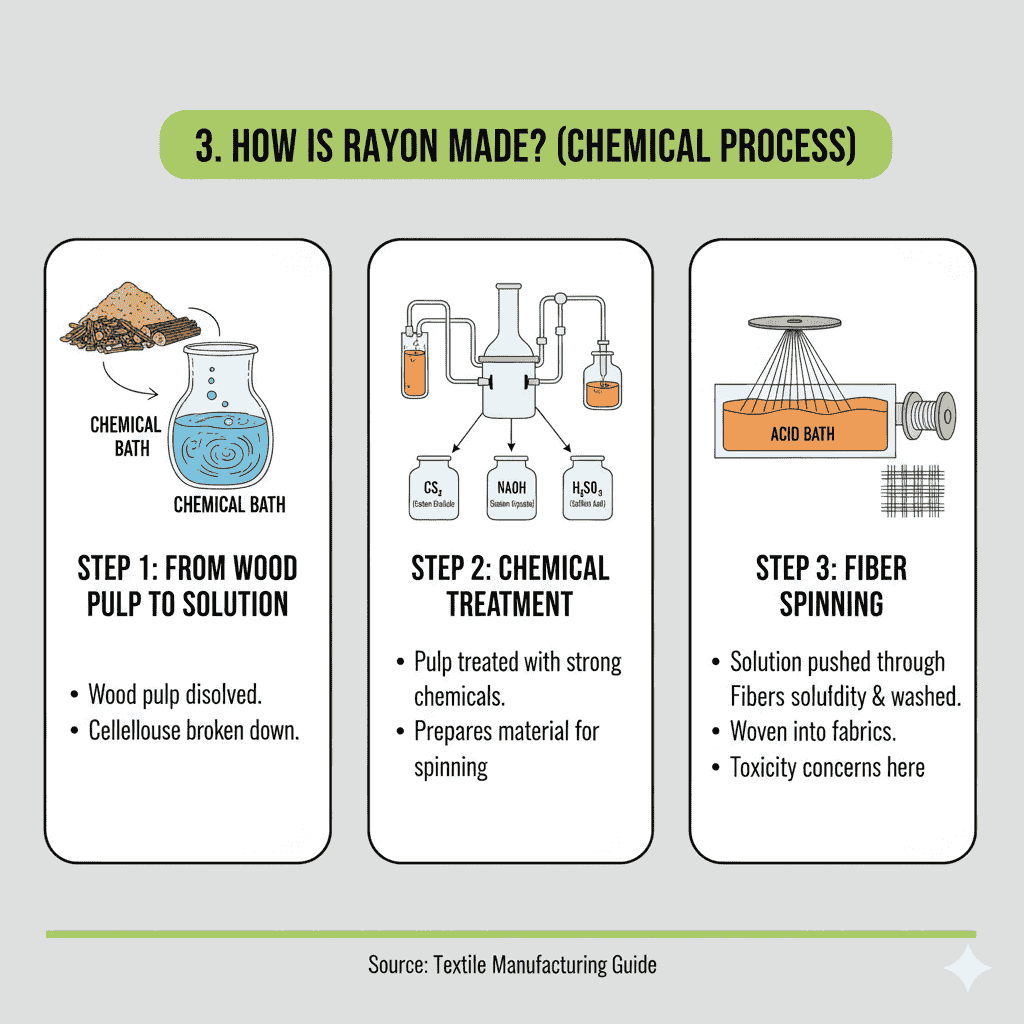
Infographic showing the three steps in rayon production: from wood pulp to solution, chemical treatment, and fiber spinning.
How is Rayon Made? The Chemical Process Explained.

From Wood Pulp to Fiber

The process of making rayon begins with wood or plant pulp (usually of eucalyptus, pine or bamboo). Pulp is originally cooked in strong sodium hydroxide (NaOH) by manufacturers to make it alkali cellulose. They select out the surplus chemicals and leave the pulp to age. Carbon disulfide (CS 2) is then added to produce cellulose xanthate -a viscous, orange solution.

This viscose solution is pressed on a spinneret (as a shower head), to form thin filaments. The wet filaments are then finally dropped into a sulfuric acid bath. The acid recrystallizes solid cellulose fibers and the xanthate is washed off. The final product is long and continuous rayon strands that are ready to be turned into yarn and be woven or knitted.

Key Chemicals Used

Actually the uses of chemical in its manufacturing defines “Is rayon toxic?”

  • Carbon Disulfide (CS 2): This is a volatile toxic solvent that is necessary in the production of viscose rayon. It breaks down the alkali-cellulose into viscose. Exposure to CS2 is harmful: exposure to CS2 has been labeled the worst chemical, which is used in rayon production, causing dizziness, headache, heart conditions, and nerve damage in individuals.
  • Sodium Hydroxide (NaOH): This is a caustic alkali that is used at the beginning to bloat and disintegrate the pulp. It is also very corrosive: when in touch with the skin or eye it burns severely. NaOH should be handled by workers with precautions because it can burn and irritate them in case of safety failure.
  • Sulfuric Acid (H 2 SO 4): This is the strong acid bath whereby the rayon filaments harden. Sulfuric acid is very toxic to the skin, eyes and lungs. Sulfuric acid is diluted by manufacturers to re-form cellulose; it is highly important to have good safety as should be avoided at all costs, or it may prove fatal.

Toxicity of the Process

On the whole, these are chemicals that are significant risks in their manufacturing. Carbon disulfide is particularly poisonous. It is referred as the worst ingredient, and a summary by CDC reports that workers can experience neurological and heart effects due to chronic exposure to CS 2. In a nutshell, all stages of production of rayon involve the use of harsh reagents. It is not the final fiber that is a problem to workers and neighbors but the process.


Is Rayon Toxic to Humans?

During Production (Worker Exposure)

The health of factory workers on rayon mills is really threatened. Breathing in carbon disulfide may harm the nervous and cardiovascular system. The Guardian and science articles associate CS 2 with increased cases of heart disease, birth defects and neural problems among workers who have dealt with it. Hot, concentrated NaOH and H 2 SO 4 are also used by workers, and they cause chemical burns or eye damage on exposure. Summing up, the production of rayon requires toxic chemicals, which may harm individuals when they are not properly managed. Fortunately, nowadays most factories have safety measures, however, accidents do occur in certain areas.
During Use (Clothing & Bedding)

Now to the consumer in rayon clothes the image is quite different. Rayon fiber is nothing more than cellulose, or the same substance as cotton or wood pulp. Individually, it has not been known to cause any toxicity to skin. Rarely do fabrics cause allergies; typically, it is the chemicals added that cause the allergy and not the fiber. Dermatology sources indicate that majority of fabric dermatitis is as a result of dyes, formaldehyde resins or finishes that are used in its processing. That is, the rayon fabric is not essentially poisonous.

Washing & Wearing

Any chemical waste that is left on rayon clothing is most often removable by washing. Washing of all clothes in cold water is encouraged including rayon. It eliminates the vast majority of surface finishes or sizing agents, so there will be nothing that is off-gassing your clothes when you clean them. An official OEKO-TEX -textile, such as one, will ensure that rayon products have traces of negligible formaldehyde or heavy metals. When worn in the usual day-to-day aspect, the rayon fabrics do not emit toxic chemicals to your skin or the environment. Unless washed tenderly, they will wrinkle or shrink, but that is only a longevity problem, not toxicity.


Is Rayon Toxic to the Environment?

Chemical Waste

There is a lot of chemical waste generated during the production of rayon. Historically Mills released carbon disulfide, sodium hydroxide and sulfuric acid remnants into waterways in form of effluent. Viscose factories have been caught pollution rivers by Changing Markets and researchers with acid and metals. As a result of lax regulations in most countries, there is leakage of toxic byproducts (CS₂, zinc, acetates) into the soil and water. Overall, the manufacturing process of rayon pollutes: it discharges water contaminated with chemicals into the ecosystem, and emits volatile organic compounds to the atmosphere. This pollution will be capable of killing fish, destruction of local crops as well as damaging community health.

Water and Air Pollution Concerns

The effluent of viscose is a severe issue. Rayon mills in China and Indonesia were discovered dumping raw waste causing untold environmental harm, including polluted rivers and poisoned lakes in their vicinity. As an illustration, the creation of viscose has been attributed to pollution of the largest fresh water lake in China, which has been devastating aquatic life. In the meantime, volatile organic compounds such as CS 2 are released and add to air pollution surrounding factories. Conversely, greenhouse gases and microplastics are mainly emitted upon manufacturing polyester, whereas pesticides are mostly emitted when cotton is grown.

Wastewater pipe discharging grey pollution near viscose (rayon) factories

Comparison: Rayon vs. Polyester vs. Cotton

  • Rayon (viscose): This is created out of wood pulp, consuming a lot of water and energy using toxic chemicals. The fiber is biodegradable, and pulp acquisition has resulted in deforestation. It produces acids and CS 2 into the ecosystems.
  • Polyester: It is a 100 percent petroleum derived synthetic polymer. It is not biodegradable and it releases fibers of microplastics each time you are washing it. Polyester is also a fabrication that releases greenhouse gases and also uses oil, though it does not have the toxic solvent issue of rayon.
  • Cotton (traditional): It is a natural fabric that, however, is incredibly resource-consuming. It consumes enormous quantities of water (thousand of liters of water per garment) and pesticides. Traditional cotton farms pollute water and destroy soil.

Different Types of Rayon: Which Are Safer?

Viscose Rayon

This is the regular rayon that is produced using CS 2 and acid. It is an open one in which solvents are not necessarily fully recovered. Viscose manufacturing is normally the most toxic to both workers and the environment. Zinc and sulfites can be used as well. That is, viscose rayon has the highest chemical hazard of the usual rayons. Due to this, the least sustainable viscose is that of uncertified sources, and it causes the most health concerns to the factory communities.

Modal

Modal incorporates the same fundamental chemistry as that of viscose (with carbon disulfide and caustic soda) but begins with beech wood fiber. More controlled processes are used by some branded modal (such as Lenzing Modal). On balance, it is possible to say that modal is a bit cleaner, however, its environmental impact is equal to that of viscose unless it is certified specifically. Indeed, EarthDay.org remark that the typical modal production continues to emit CS2 and zinc. The good news is that beech trees are quick growing hardwood, thus plantation modal can exploit renewable forests. But numerous modal mills also emit polluted wastes. in this way modal may be a little better, but not much.

Lyocell (Tencel)

Lyocell is the most safe rayon. It involves an organic solvent (N-methylmorpholine N-oxide, NMMO) rather than CS 2. It is a closed-loop process: more than 99 percent of the solvent is recycled and toxic emissions are almost nonexistent. No zinc or too much caustic soda is required. This practically translates into the fact that lyocell mills produce significantly less pollutants to the air and water. Lyocell is among the most environmentally friendly fabrics produced, so companies such as Lenzing (Tencel™) use certified pulp as well. It is sturdy, breathable and as it can be washed like cotton. All these reasons make lyocell and Tencel be highly advisable as alternatives to the traditional rayon which is green.

Rayon TypeToxicity (Production)Environmental Footprint
Viscose RayonUses CS₂, NaOH, H₂SO₄ in open vats; known for high toxic emissionsWater- and energy-intensive; often causes deforestation and pollution when waste is untreated
Modal RayonSimilar process (CS₂ + additives); somewhat less harsh chemicals than viscose, but still not closed-loopWood (beech) is renewable, but plantation impact exists; environmental gains depend on mill controls
Lyocell (Tencel)Uses non-toxic NMMO solvent in a closed-loop recovery process (≈99% solvent recycled)Considered very eco-friendly: minimal waste, low water use (1/3 that of viscose)

Does Rayon Have Health Risks for Consumers?

Skin Sensitivity & Allergies

Others will respond to rayon when there are traces left in the garment. This is not common yet it may result in mild rashes or irritation.

Breathability & Comfort

Rayon is breathable and absorbs moisture and is therefore comfortable to be worn on the daily basis. These features can be used to avoid overheating and pain.

Myths vs Facts

The typical myth as such is that rayon is toxic to wear. Actually, rayon clothing is not harmful most of the times. The actual danger is unsafe factory production and not the daily use.

Rayon in Bedding & Clothing: Should You Worry?

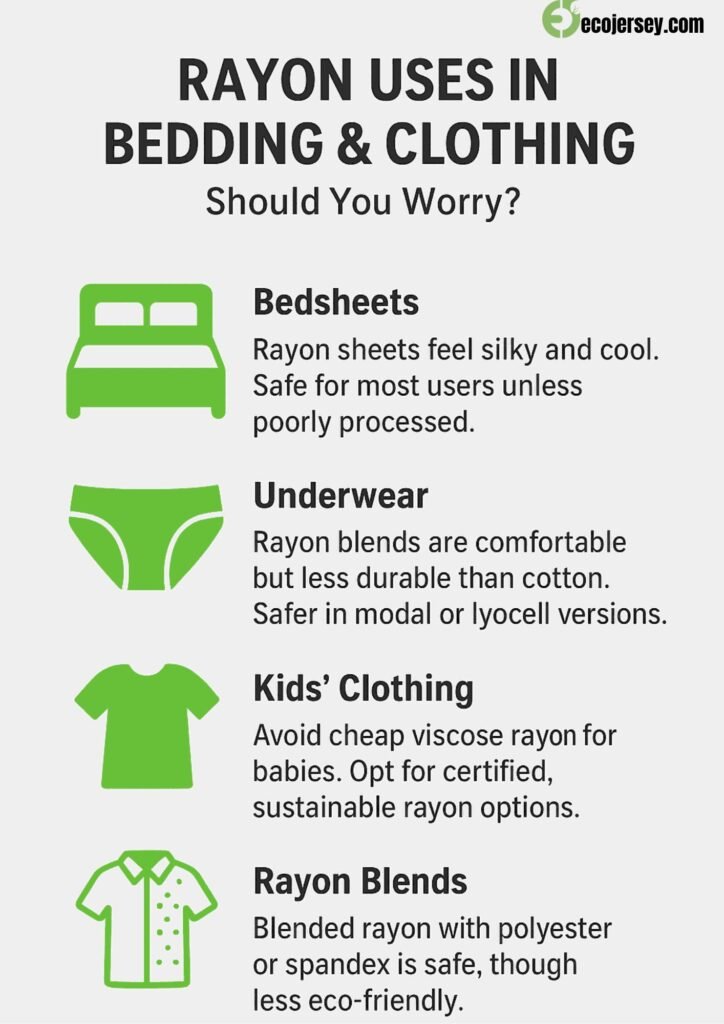
Infographic showing rayon uses in bedding, clothing, and blends with safety tips.
Rayon Uses in Bedding & Clothing: Should You Worry?
  • Bedsheets: Silk bedsheets are cool. Safe to most users except when not processed properly.
  • Underwear: Rayon blends are not strong as compared to cotton. In modal or lyocell forms, it is safer.
  • Children Clothing: babies should not be put in cheap viscose rayon. Use certified and sustainable rayons.
  • Rayon Blends: Blended rayon, either with polyester or spandex, is safe, but less environmentally-friendly.
  • When not Ideal: When wet, Rayon becomes weak and can shrink and hence not the best fabric to use in a heavy daily wear.

Safer Alternatives to Toxic Rayon

To avoid the concerns linked with viscose rayon, consider these fabrics:

Organic Cotton (natural)

Organic cotton is a widely used eco alternative that is grown without using artificial pesticides or fertilizers. It involves much less toxic inputs compared with the conventional cotton. Organic farming reduces water pollution although it is a thirsty crop. Cotton fiber is naturally breathable and hypoallergenic. Find organic cotton clothes and bedding with GOTS certification; this means none of it has been treated with formaldehyde or bleached with chlorine.

Linen (flax fiber)

Linen comes from flax plants. It is light, breathable and very biodegradable. Little irrigation and almost no pesticides are required in Flax. The process of linen production is less chemical than mechanical (retting, beating) and therefore has low environmental footprint. The linen cloths are also absorbent thus cool in summer. The disadvantage is that they are easily wrinkled. On the whole, linen is a highly safe and natural material with few chemical issues.

Hemp (natural)

Hemp fiber is powerful and environmental friendly. The plant is sturdy, is in any case resistant to pests and even replenishes the land with nutrients. Hemp is an anti-microbial and breathable fabric. It can be almost chemical-free in case of mechanical processing. (Chemical retting may be practised with some brands, although it is shunned by good manufacturers.) The fibers of hemp become softer with each wash and become much more comfortable. Simply put hemp is tough and breathable with low levels of toxicity.

Lyocell (Tencel™)

Lyocell is also a type of rayon, however, Lyocell is made using a closed-loop solvent process. The solvent employed (NMMO) is non-toxic and 99 percent is re-introduced into the system. This renders lyocell very eco-friendly as compared to viscose. It is also made with sustainable eucalyptus pulp and it uses approximately one-third of the amount of water used in viscose. Lyocell (available as Tencel™) is soft, absorbent and biodegradable – you have the comfort of the rayon minus the chemical drawback. Numerous bamboo products under the Tencel name are actually lyocell, a good news in terms of the planet.

Bamboo Lyocell (Eco-friendly Bamboo)

This is the most environmental-friendly bamboo textile. Bamboo lyocell is produced as any other lyocell, only the pulp is made of the fast growing bamboo plants. It involves the same closed-loop NMMO process and thus uses no toxic CS 2 of bamboo viscose. The outcome is a soft, strong, antibacterial and hypoallergenic fiber. It evaporates water and rests cool in the summer. On the environmental front, bamboo plants grow fast and even purify the air and practically no processing waste is released back to the environment. The only proviso is the price: products made of bamboo lyocell (sheets, towels, clothing) are more expensive. Nevertheless, they are indeed a green, and non-toxic alternative to rayon.


How to Identify Safer Rayon Products

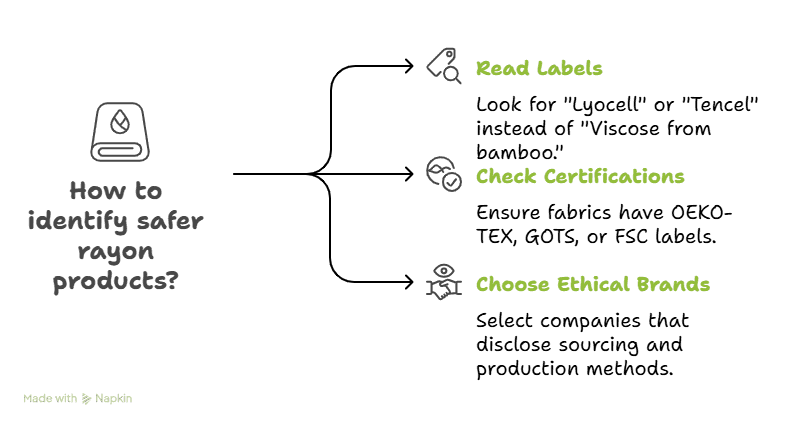
Flowchart showing how to identify safer rayon products
How to Identify Safer Rayon Products.
  • Read Labels with Attention: “Viscose from bamboo” means rayon and not real bamboo. Search for “Lyocell” or “Tencel.” 
  • Look for Certifications: OEKO-TEX, GOTS, and FSC certification means the fabric has undergone testing for harmful substances. 
  • Pick Ethical Brands: Purchase from genuine companies that share their sourcing and production pathways. 

Conclusion-

So, is rayon toxic? The straightforward answer is no – rayon itself is not highly toxic when worn and most consumers can safely use rayon clothing and bedding with no direct health risks. The concern lies primarily with the production of  viscose rayon, especially the viscose, which employs dangerous chemicals that contaminate the air, water, and soil.

If you want to enjoy rayon softness without the guilt, you can use modal and lyocell (Tencel) which is made using safer methods.  These fabrics are just as comfortable and more environmentally friendly. In the end, the aim is to reduce sustainable rayon types to protect workers and workers and environmentally to reduce ethical manufacturing. Mindful fabric choices ensure your comfort while contributing to a healthier planet.
Read More>> About what is rayon fabric?


FAQs

Is rayon safe to wear?

Yes, most people can wear rayon without any issue. The fabric doesn’t retain any toxins after processing, although poorly made rayon can cause a bit of skin irritation for those with very sensitive skin.

Is rayon toxic to babies?

Rayon is not toxic to infants, although their sensitive skin could react adversely. Better alternatives are organic cotton, bamboo lyocell, and lyocell (Tencel). These are breathable, soft, and less chemically processed.

Does rayon release harmful chemicals when washed?

Rayon doesn’t usually wash off any harmful chemicals, but it can contribute to water pollution by shedding microfibers. Gentle cycles can help prolong the life of the rayon fabric and minimize microfiber shedding.

Is rayon better or worse than polyester?

Rayon is softer and more breathable than polyester and more comfortable to wear. Polyester is stronger and more durable long-term. Rayon production is harsher in terms of toxicity, but polyester is more harmful to the environment due to its prolonged presence.

Is rayon eco-friendly?

Viscose rayon is not eco-friendly. Modal is slightly better and lyocell (Tencel) is the cleanest rayon. With closed-loop processing, lyocell provides comfort as well as sustainable, eco-friendly rayon.

Is Rayon a Natural Fabric? Pros, Cons, and Surprising Facts

Introduction

One of the most common fabrics in the textile industry in the world today is the Rayon. The question many would ask themselves is, is rayon a natural fabric since it is smooth and breathable, like cotton or silk. Nevertheless, its source and the process of making it confuse customers and designers.is rayon a natural fabric?

The increasing popularity of rayon is attributed to the fact that it is cheap, versatile, and resembles luxury fabrics. It is popular among many people as clothing and home textile and even industrial purposes.is rayon a natural fabric Although it has its merits, the question of whether rayon should be considered as natural, semi-synthetic or synthetic remains a topic of debate.

As we shall see in this article, we are going to find out the truth behind rayon, compare it to other fabrics and point out the advantages and disadvantages.is rayon a natural fabric And at the end, you will have a definite answer to the question, is rayon a natural fabric, and also be aware of the surprising facts surrounding it.is rayon a natural fabric

Is Rayon a Natural Fabric?

The simple answer is no, rayon is not a fully natural fabric. It begins with natural plant cellulose, but it undergoes chemical processing to become fabric.

Natural vs. Semi-Synthetic vs. Synthetic

  • Natural Fabrics: Cotton, silk, wool, and linen come directly from plants or animals.
  • Synthetic Fabrics: Polyester, nylon, and acrylic are 100% man-made from petroleum.
  • Semi-Synthetic Fabrics: Rayon, acetate, and lyocell start from natural fibers but are chemically treated.

Rayon belongs to the third group, meaning it is semi-natural or semi-synthetic. This classification explains why people often get confused when asking is rayon a natural fabric.

What is Rayon?

Rayon is a semi-synthetic fiber that is produced using natural cellulose which is typically derived out of wood pulp or cotton linters.is rayon a natural fabric Though a product of plants, it takes excessive chemical treatment to be transformed into cloth. This process of treatment is what makes it not entirely natural like cotton or linen.

Rayon was invented in France in the late 19 th century. It was initially developed as a cheap alternative to silk and it soon came to be known as artificial silk.is rayon a natural fabric Throughout the decades, it turned into one of the most significant fabrics in the fashion industry of the whole world.

Rayon is available in various types such as:

  • Viscose Rayon: This is the most widely used one, usually in dresses, blouses, and upholstery.
  • Modal Rayon:-Yeasouffer and more robust and usually utilized in sportswear and underwear.
  • Lyocell (Tencel): A greener form of rayon, produced using less toxic chemicals.

All rayons are not the same, though they are all based on the cellulose of plant origin.

How is Rayon Made?

Step-by-Step Production Process

  • Cellulose Extraction: Cellulose is obtained from wood pulp or cotton linters.
  • Chemical Treatment: The pulp is treated with sodium hydroxide and carbon disulfide.
  • Viscose Solution: The chemicals convert cellulose into a thick liquid called viscose.
  • Spinning Process: The viscose solution passes through spinnerets to form filaments.
  • Solidification: The filaments are hardened in an acid bath.
  • Finishing: The fibers are washed, dried, and woven into fabric.

Is Rayon a Natural Fabric?

The immediate response is negative, rayon is not a completely natural fabric.is rayon a natural fabric Although it is produced using natural cellulose fibres, it undergoes a chemical process which leaves it without being entirely natural. This is the reason why it is frequently termed as semi-synthetic or regenerated cellulose fiber.

There are usually three types of fabrics:

  • Natural fabrics: Cotton, wool, silk, linen: are directly a product of plants or animals.
  • Synthetic fabric: Polyester, nylon, acrylic- totally man made using petroleum-based chemicals.
  • Semi-synthetic fabrics Rayon, acetate, lyocell: plant-based, however chemically refined.

Rayon is positioned in the center since it is a natural material but it goes through rigorous chemical treatment.is rayon a natural fabric? When we consider whether rayon is a natural fabric, therefore, the true answer is: it is semi-natural and not completely natural.is rayon a natural fabric

How is Rayon Made?

The production of rayon begins with the process of extracting cellulose using wood pulp, bamboo or cotton linters. Strong chemicals like sodium hydroxide and carbon disulfide are then added to the pulp. These chemicals dissolve the cellulose and convert it to a thick solution known as the viscose solution.

The viscose solution is then pressed through minute apertures in a spinneret and forms long filaments. These are solidified in an acid bath and then washed and then spun into yarn. The yarn is either knotted or woven into fabrics.

A balance is demonstrated between nature and man-made factors in the process. The raw material is natural although the transformation depends greatly on the industrial chemical treatment. That is the reason why rayon cannot be referred to as natural.

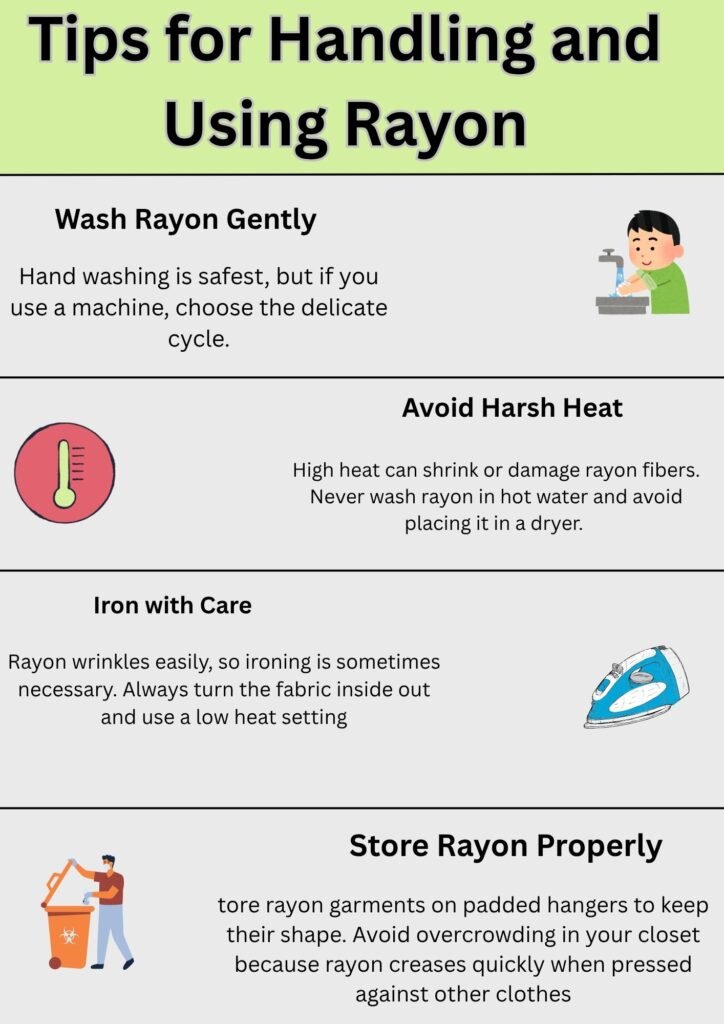
Tips for Handling and Using Rayon

Rayon is a versatile fabric, but it requires special care to maintain its beauty and quality. Below are practical tips to help you get the most out of rayon in clothing, home décor, and other uses.

Alt Text:
Infographic showing tips for handling and using rayon, including guidance on washing gently, avoiding harsh heat, ironing with care, and proper storage.is rayon a natural fabricCaption:
Essential tips for caring for rayon fabric—learn how to wash, dry, iron, and store rayon to maintain its softness and shape.Description:
This infographic provides practical tips for handling and using rayon fabric. It advises washing rayon gently—preferably by hand or on a delicate machine cycle—avoiding high heat to prevent shrinkage or fiber damage, ironing with care using a low setting, and storing rayon garments properly on padded hangers to maintain their shape. Each section includes relevant icons for easy understanding, promoting proper rayon care and longevity.

Wash Rayon Gently

Rayon becomes weaker when wet, so always wash it gently. Use cold water and mild detergent. Hand washing is safest, but if you use a machine, choose the delicate cycle.

Avoid Harsh Heat

High heat can shrink or damage rayon fibers. Never wash rayon in hot water and avoid placing it in a dryer. Instead, air-dry your garments flat or hang them in a shaded area.

Iron with Care

Rayon wrinkles easily, so ironing is sometimes necessary. Always turn the fabric inside out and use a low heat setting. Placing a thin cloth between the iron and the fabric can prevent shine or scorching.

Store Rayon Properly

Store rayon garments on padded hangers to keep their shape. Avoid overcrowding in your closet because rayon creases quickly when pressed against other clothes.

Comparison of Rayon and Other fabrics.

Rayon vs. Cotton

Both cotton and rayon are of vegetable origin, although cotton comes directly out of the fiber of the cotton plant.is rayon a natural fabric? On the other hand, cellulose must be chemically converted to make rayon. Rayon is smoother and softer, but cotton is more resistant, and easier to care about.

Rayon vs. Polyester

Polyester is a complete synthetic material which is produced using oil products. Rayon comes in semi-synthetic and it is made out of plant cellulose. Rayon is more natural and much more breathable, whereas polyester is stronger and wrinkle-free and cheaper to manufacture.

Rayon vs. Silk

Rayon has its very beginning as a replica of silk. It is smooth and drapes beautifully like silk but it is much cheaper. Nevertheless, silk is still superior in terms of luxury, durability and natural origin. Rayon is therefore called occasionally artificial silk.

Is Rayon Eco-Friendly?

Rayon is ecologically friendly as well as environmentally disadvantaged.

Pros:

  • It is made of renewable vegetal materials as wood and bamboo.
  • Under the right conditions it can be biodegradable.
  • The Lyocell which is a variant of rayon has safer solvents and is more environmentally friendly.

Cons:

  • Viscose process necessitates toxic chemicals which could be dangerous to the workers and the ecosystem.
  • Mass production of large-scale production is known to cause deforestation in case wood pulp is not sourced sustainably.
  • Rivers and soil are polluted with untreated wastewater released by many factories.

To sum up, although rayon begins with a natural form, its manufacture creates significant kinds of environmental issues. It is more sustainable to use more environmentally friendly versions such as Lyocell.

Advantages of Rayon

  • Non-slippery and Soft: Rayon permits air flow, thus the material is comfortable to wear in summer.
  • Affordable Alternative: It is similar to silk and cotton but extremely cheaper.
  • Good Drape: Rayon is loose and has a good appearance to clothing.
  • Multipurpose: It can be mixed with cotton, polyester or wool to be used in a mixture.

These characteristics render rayon very fashionable, household fabric, etc.

Disadvantages of Rayon

  • Weak When Wet: Rayon is weak, and can be torn easily when it is wet.
  • Shrinking and Wrinkling: It shrinks rapidly, and wrinkles without additional care.
  • Environmental Impact:This production process contaminates and damages ecosystems.
  • Not So Tough: Rayon is not as long-lasting as cotton, or polyester.

These disadvantages are the reason why a significant number of environmentally friendly customers choose recycled or natural fabrics.

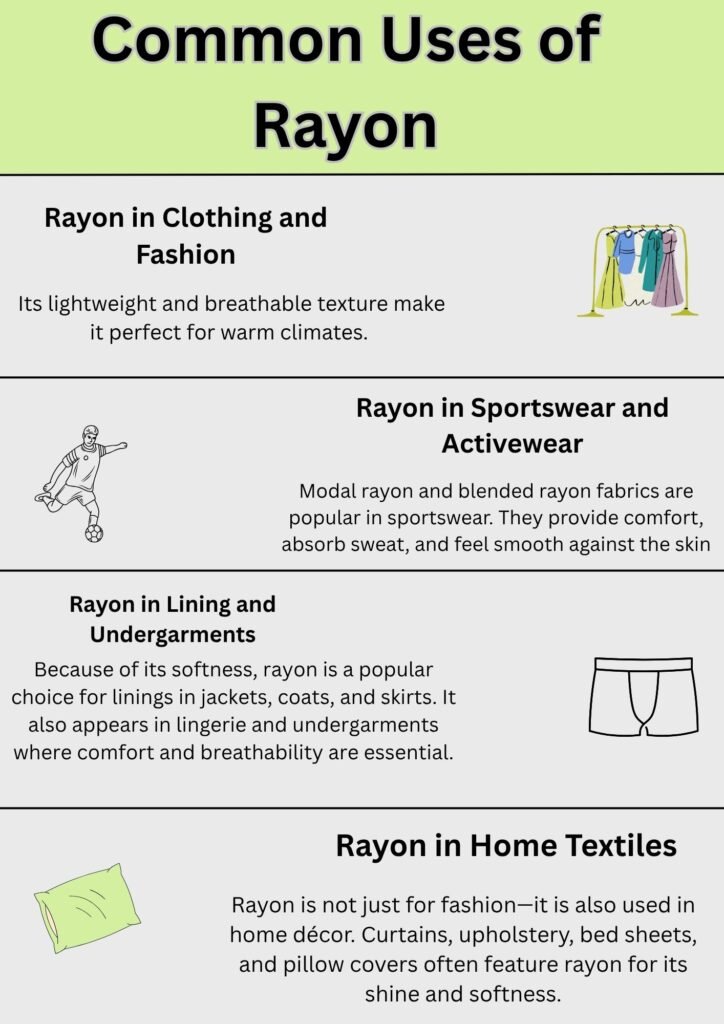
Common Uses of Rayon

Rayon is one of the most versatile fabrics, used in clothing, home décor, and even industrial applications. Its silky feel, breathable nature, and affordability make it highly desirable. Below are the most common uses of rayon explained under clear subheadings.

Alt Text:
Infographic titled “Common Uses of Rayon” showing four main applications: clothing and fashion, sportswear and activewear, lining and undergarments, and home textiles, each with short descriptions and small illustrative icons.is rayon a natural fabricCaption:
Common uses of rayon in everyday life, including fashion, sportswear, linings, and home décor.Description:
This infographic explains the various uses of rayon fabric. It highlights that rayon is lightweight and breathable, making it ideal for clothing and fashion. It’s also popular in sportswear and activewear for its sweat-absorbing and soft qualities. The material is commonly used in linings, lingerie, and undergarments due to its softness and comfort. Beyond fashion, rayon appears in home textiles like curtains, upholstery, bed sheets, and pillow covers because of its smooth texture and elegant shine. Each section is illustrated with simple icons representing the respective fabric use.

Rayon in Clothing and Fashion

Rayon is widely used in dresses, skirts, blouses, shirts, and summer wear. Its lightweight and breathable texture make it perfect for warm climates. Designers often use rayon as a substitute for silk because it drapes beautifully and looks elegant.

Rayon in Sportswear and Activewear

Modal rayon and blended rayon fabrics are popular in sportswear. They provide comfort, absorb sweat, and feel smooth against the skin. This makes rayon-based clothing suitable for yoga, gym wear, and active lifestyles.

Rayon in Lining and Undergarments

Because of its softness, rayon is a popular choice for linings in jackets, coats, and skirts. It also appears in lingerie and undergarments where comfort and breathability are essential.

Rayon in Home Textiles

Rayon is not just for fashion—it is also used in home décor. Curtains, upholstery, bed sheets, and pillow covers often feature rayon for its shine and softness. Its ability to blend with cotton and polyester makes it a practical choice for household fabrics.

Conclusion

So, is rayon a natural fabric? The ultimate solution is: Rayon is unnatural in its entirety.is rayon a natural fabric? It is a semi-synthetic, which is composed of natural cellulose but modified by the use of chemicals. It is easy, breathable, and graceful though it also comes with the environmental burdens.is rayon a natural fabric

To the environmentally-conscious consumers, rayon is preferable when selected in more environmentally-friendly versions such as Lyocell or certified viscose. Knowing its advantages and disadvantages assist you in making more intelligent decisions about your cloths that will help you and the environment.

FAQs

Is rayon 100% natural?

No, rayon is semi-synthetic. It is made using natural cellulose that is chemically processed.

Is rayon soft, as cotton or silk?

The feel of rayon is soft and smooth just like silk, yet more breathable as cotton.

Would rayon be superior to polyester?

Compared to polyester, rayon is less strong, more breathable and difficult to take care of.

Is rayon environmentally unfriendly?

The conventional rayon production is detrimental to the environment because of the toxic chemicals and the dangers of deforestation.

Is rayon good for hot weather?

Yes, rayon is lightweight, breathable and comfortable to wear in summer.

United Nations Day: Celebrating Peace, Unity, & Global Cooperation

October 24 is United Nations Day. On this date, we recognize the anniversary of the United Nations’ founding in 1945. On this day, we appreciate the central value of the UN service, the maintenance of peace, human rights, and international cooperation.

Each United Nations Day serves as a reminder and an encouragement for global cooperative action to fight the world’s most crucial issues, such as poverty, inequalities, the climate, and the conflicts. Over the years, this date has developed as an international expression of hope, cooperation and the active willing to build a better world.


History of United Nations Day

United Nations Day originates from the time immediately after World War II. The destruction of the war motivated leaders to come up with a way to stop such large-scale conflicts from happening in the future. The idea was to establish a global agency with communication, diplomacy, and respect.

The Formation of the United Nations

The idea of a unified global organization was first brought up with the Atlantic Charter when British Prime Minister Winston Churchill and U.S President Franklin D. Roosevelt signed it in 1941. The charter laid out principles for peace, freedom, and cooperation amongst nations.

In 1945, diplomats from 50 countries attended the United Nations Conference on International Organization in San Francisco. After weeks of arguing, the United Nations Charter was ratified on June 26, 1945, and became law on October 24, 1945, which marked the birth of the United Nations.

Thereafter, October 24 has been marked every year as United Nations Day. In 1948, the UN General Assembly commemorated the day with an international observance to celebrate the goals and accomplishments of the organization.


Meaning of United Nations Day

UN Day has great symbolic meaning. It celebrates how far we have come in building wonderful worlds of peace & cooperation, and how far we still have to go.

Promoting Global Peace

Still keeping peace during times of conflict no matter what means the United Nations has and continues to succeed. UN Day means celebrating the peace keeping and conflict avoiding activities.

Advancing Human Rights

Everywhere and any place a citizen standing for a nation holds the right to defend and stand for themselves. The UN works to ensue dignity, equality, and freedom advocated.

Fostering Sustainable Growth

UN Day works to promote achieving the sustainable development goals (sdg’s) aimed at eliminating poverty, providing safe drinking water, preserving the environment, and advancing education.

Promoting Global Cooperation

Nations providing services of cross border integration, and combining efforts providing services of treating globally critical health issues, and mitigating the consequences of poverty, climate change, and disrupted migration.


2025 United Nations Day Theme

Every year, United Nations Day focuses on different global priorities. The 2025 theme is “Building Trust, Restoring Hope, and Advancing Global Solidarity.”

This theme speaks on the importance of coming together. The world is impacted by crises including climate change, wars and politics. The call to action is to work together and restore peace and trust on direct collaboration. The future is reliant on communication and avoiding extremes.


The Role of the United Nations in Today’s World

The UN was and is the building block of institutions that control global power and influence which the United Nations accomplished by having 193 member states and governing cooperative world bodies, and specialized agencies and networks surrounding them.

1. Peacekeeping Operations

The UN peacekeeping offered protection in places like South Sudan and the Democratic Republic of the Congo. UN peacekeeping offered protection and peace.

2. Humanitarian Aid

The World Food Programme, UNICEF, and UNHCR the UN offer aid to the world to millions who suffer from crisis, war, and famine.

3. Health and Education

The World Health Organization (WHO) and UNESCO improve healthcare and education. Building a healthier and more educated world requires their focus on disease eradication and expanding digital healthcare.

4. Climate Action

The United Nations (UN) is the global leader on the issue of Climate Change. The UN organizes the UN Climate Change Conferences (COP) bringing all the world’s nations together and promoting agreements on emissions and sustainable solutions.

5. Advocating for Equality

The United Nations (UN) promotes and advocates for women’s rights and equality through programs such as UN Women which works to empower women, eradicate violence against women, and offer equal opportunities.

Celebrating United Nations Day

Every country celebrates United Nations Day differently, with each organized activity tailored to their specific culture. Government institutions, community organizations, and schools organize their programs to celebrate the UN’s milestones and promote the global awareness principles of the UN.

1. Flag Raising

Numerous nations raise the UN flag and their own as a gesture of solidarity to the UN’s peace and unity mission.

2. Educational Activities

Schools and universities hold seminars, debates, and exhibitions about the history and role of the United Nations. These activities stimulate and encourage students to appreciate global citizenship and international unity.

3. Cultural Programs

Musical, artistic, and other cultural performances recognize the richness and variety of the member states of the United Nations. These activities and events facilitate the understanding of different peoples and cultures.

4. Official Messages and Staments

UN leaders, heads of states, and ambassadors address the audience of these events with speeches that endorse the principles of international cooperation and the maintenance of peace.

Community Projects

UN values are the hallmark of many local projects organized by various NGOs and community groups, that include tree planting and clean-up drives, blood donation drives, and charity activities.

The Achievements of the United Nations

In the last 80 years, the United Nations has accomplished important and remarkable progress in many different areas:

1. Peacekeeping Successes

Stability has been restored in many war-torn countries around the globe through the peacekeeping missions of the United Nations. These missions have helped to end the conflicts in Sierra Leone, Liberia, and Cambodia.

2. What the World Health Organization Has Done in the World

The World Health Organization has helped get rid of smallpox and responds to pandemics. The World Health Organization responds to Health Issues. The UN aids in vaccination and in maternal health programs worldwide.

3. Protection of Human Rights

The UN through the Office of the High Commissioner for Human Rights (OHCHR) monitors the abusers, and violators of human rights, and gives justice to the victims.

4. Social and Economic Development

The UN Development Programme (UNDP) implemented social and economic reforms that helped integrate social inclusion, economic, and environmental development in the developing nations.

5. The United Nations and Protection of the Environment

The UN Environment Programme (UNEP) works to dispose of pollution and works to protect the environment these are especially the endangered animals.

6. Education and the United Nations

UNESCO works to promote the idea of education globally and for equal access to education of all girls.


The United Nations Global Warming Problem

The United Nations Global World Problems.

1. Global Challenges in the UN Security Council

All members try to protect the interest of their country which greatly affects the outcome of the UN Security Council.

2. Funding Problems

The UN gets its money from its member states. If some countries take too long to pay or cut back on what they offer, it has consequences for what the UN can do to help with aid, peacekeeping missions, and other active operations.

3. Climate Change Threats

Even with global agreements, climate change continues to be a big threat. The UN advocates for greater global collaboration to mitigate climate change and global warming.

4. Humanitarian Crises

Conflicts, natural disasters, and refugee influx all put a strain on UN resources. The UN must respond to new emergencies increasingly rapidly.


The UN and the Digital Revolution

The UN is adjusting its approaches to meet effectiveness and inclusivity goals within its strategy framework in response to the rapidly advancing digital global environment.

1. Good Use of Technology

The digital environment streamlines engagement with the UN for advocacy on global issues. People are united for a common cause with the aid of online campaigns and digital conferences to promote global advocacy.

2. Young People and the UN

The UN formally involves young people by the UN Youth Delegate Programme to embark in global advocacy.

3. Cyber Stability

As technology advances, so do cyberspace threats. The UN supports the advocacy of stabilized and responsible use of technology and collaboration on cyber borders.


The Future Vision of the United Nations

The UN hopes to have even more impact around the world, promoting equality, building thriving and sustainable communities, and encouraging innovation and peace through cooperation.

1. Achieving the Sustainable Development Goals (SDGs)

The 17 SDGs provide a roadmap to peace, prosperity, and sustainability by 2030. United Nations Day celebrates and reinforces the global commitment to these goals, encouraging action and support.

2. Building Inclusive Societies

As part of building inclusive societies, the UN incorporates and promotes safe and inclusive environments constructed on the principles of equity, diversity, and equality. Nobody gets left behind.

3. Strengthening Global Solidarity

The UN’s Future Vision services peace through trust and maintains peace through dialogue. While trust among nations perpetuates peace mono-directionally, the UN’s dialogue consistently flows to and from the nations.


Why United Nations Day Matters Today

United Nations Day is fundamental in politically divided and hostile environments. It emphasizes and celebrates the idea that partnership is more powerful than dissent and discord.

The UN’s global message of hope proves that in all humanitarian efforts, peace efforts, and education, there is a world of help and hope in the global collaboration.


Conclusion

United Nations Day is about appreciating the strength that comes from unity and the need to work together to make the future brighter. The UN has been making the world better through peace, equality, and sustainability since 1945.

Most importantly, this day is a call to action to the world. It asks all people, localities, and nations, to work together to deal with the issues that affect the world.

As we look to United Nations Day 2025, let’s again focus on the values of peace, cooperation, and dignity for all people. We will continue to create a world where harmony wins over conflict and kindness wins over division. Read More : denim jackets

FAQS

When is United Nations Day celebrated?

United Nations Day is celebrated every year on October 24 to mark the anniversary of the UN’s founding in 1945.

What is the theme of United Nations Day 2025?

The theme for 2025 is “Building Trust, Restoring Hope, and Advancing Global Solidarity.”

Why is United Nations Day important?

It highlights the role of the UN in promoting peace, protecting human rights, and supporting sustainable development worldwide.

Can You Dye Rayon? Tips for Long-Lasting Colors

Introduction

Rayon is a semi-synthetic fiber that is produced by the use of cellulose fibers of wood pulp. It has a natural absorbency and soft texture which makes it comparable to cotton. The question many people ask is, is it possible to dye rayon as they can cotton or polyester?

The answer to this is, yes, yes, you can dye rayon, though with a lot of preparation and the correct type of dye. Rayon takes on any dye well, unlike polyester, however it also tends to shrink or lose strength when not properly handled. This guide will discuss the most appropriate dyes, techniques as well as recommendations to get a long life and bright colors on rayon.

What is Rayon?

Rayon is a multifunctional fabric commonly referred to as artificial silk due to its feel and fall. It is made out of recycled cellulose fibers, and thus it is semi-synthetic, neither natural nor synthetic.can you dye rayon

Types of Rayon

  • Viscose Rayon- This is the most prevalent form that is smooth and absorbent yet shrinks easily.
  • Modal Rayon – This is a softer and more durable one, which is easier to dye uniformly.
  • Lyocell (Tencel) – More environmentally responsible, durable and will not weaken easily during dyeing.

Properties Affecting Dyeing

Rayon is very absorbent and thus very good in dyeing. However, it also:

  • Shrinks when exposed to heat.
  • Old soft when wet, and to be handled carefully.
  • Effloresces when there is no proper fixing of colors.

Knowing these properties will be useful to make sure that your dyeing project does not harm.

Can You Dye Rayon?

Yes, rayon can be dyed, and the effect is usually very bright due to the good uptake of color by the fibers. Nevertheless, it all depends on the kind of dye you apply and the fabric special finish.can you dye rayon

Rayon is more dyeable like cotton than polyester is. This is to say that fiber-reactive or natural dyes would be the most effective in this case. When the dye applied is of a low quality or when fixatives are omitted, then the color can fade rapidly.

However, while rayon dyes beautifully, it is also a delicate and temperamental fabric. Unlike cotton or linen, rayon weakens when wet, shrinks under high heat, and can become misshapen if handled roughly.can you dye rayon This means the process of dyeing rayon requires extra care and attention at every stage—choosing the right dye, controlling water temperature, stirring gently, and setting the color properly. If you skip these steps, you risk blotchy results, fading, or even damaging the fabric permanently.

Effects of Dyeing Rayon

Dyeing rayon brings both positive outcomes and potential challenges, depending on how carefully the process is done.can you dye rayon Understanding these effects helps you make better decisions and avoid surprises when working with rayon fabric.

Alt Text:
Infographic titled "Effects of Dyeing Rayon" explaining the benefits and drawbacks, including vibrant colors, risk of shrinkage, customization potential, and uneven coloring.can you dye rayonCaption:
Effects of dyeing rayon include vibrant colors and creative possibilities, but also risks like shrinkage and uneven results.Description:
This infographic visually presents the effects of dyeing rayon fabric. It highlights four main points:

Vibrant and Long-Lasting Colors

One of the biggest effects of dyeing rayon is the rich and vibrant results. Because rayon fibers are highly absorbent, they soak up dye deeply, creating strong, bold colors that often look brighter than on other fabrics like polyester.

Risk of Shrinkage and Weakening

Rayon can shrink when exposed to high heat during the dyeing process. Additionally, the fibers weaken when wet, which means they can tear if handled roughly.can you dye rayon This effect makes it important to use gentle methods and low heat.

Enhanced Customization and Creativity

Dyeing rayon allows for personalized designs such as tie-dye, ombre, or solid shades. The fabric’s smooth texture makes it easy to achieve artistic effects that remain soft and wearable. This effect is especially popular for fashion and crafts.

Potential for Uneven Coloring

If the fabric isn’t pre-washed or stirred properly during dyeing, rayon may show blotchy or uneven results. This effect can either ruin the project or create a unique, textured appearance depending on your preference.

Best Dyes for Rayon

It is important to select the dye. All dyes do not attach themselves to rayon fibers. Let’s compare the main types:

Fiber-Reactive Dyes

Rayon is the most suitable to make use of fiber-reactive dyes. They develop a good chemical attachment with cellulose fibers giving rich and vibrant colors.can you dye rayon Such dyes also deteriorate slower.

All-Purpose Dyes

Rayon can be used with all purpose dyes like Rit but the color may not be as bright and durable. They are less challenging to the novices but may not last as long once they had been washed a few times.

Natural Dyes

Rayon can be dyed in plant-based dyes, like indigo or turmeric. These give less harsh and more natural tones, but need mordants such as alum or vinegar to fix the color.

Pros and Cons:

  • Fiber-reactive: Colorful, durable, however, needs soda ash or salt.
  • All-purpose: Simple to operate, weakening.
  • Natural dyes: Unique, environmentally friendly colors, but not as colorfast.

Dyeing Rayon (Wiki Guide)

And this is the stepwise way to get beautiful results:

Preparation

  • Pre-washing of fabric before dyeing is used to remove finishes.
  • Try a swatch in order to preview a color result.

Choosing the Right Dye

  • Choose a dye that is fiber-reactive to produce bright colours. Polyester-specific dyes are not permitted- they will not bond with rayon.

Dyeing Process

  • Dye It Place the dye in hot water according to instructions.
  • Wet the rayon material in the dye bath.
  • To avoid blotches, stir continuously.

Fixing the Color

  • Depending on the dye, add salt, soda ash or vinegar.
  • This will seal the color onto the fibres and make it not fade.

Rinsing & Aftercare

  • Rinse under cold water till it comes clear.
  • Wash individually in mild detergent.
  • Air dry flattened to prevent stretching or shrinkage.

Common Mistakes to Avoid When Dyeing Rayon

Numerous dyeing works fail as a result of mistakes. These are some of the main pitfalls to be avoided:

  • Wrong dye- Polyester dyes can not be used on rayon.
  • Omitting pre-washing – The finishes of dirt and fabric prevent the uptake of dye.
  • Excessive heat exposure- Rayon gets weak or shrinks when exposed to hot water or dryers.
  • No fixatives -Colors will fade easily without salt or soda ash.

These errors can be avoided to achieve smooth, even and vibrant results.

Can You Tie-Dye Rayon?

Yes rayon is a wonderful tie-dye drug. Due to the absorbent fibers, tie-dye patterns are bright and bold.

Tips for Tie-Dye Rayon:

  • Apply fiber-reactive dyes to bright colors.
  • Store bands of rubber tautly to achieve definite designs.
  • To preserve the fabric, do not let the fabric to get too hot.

Rayon tie-dye is used to produce loosely fitting, artistic-colored clothing.

Tying Techniques That Work Best on Rayon

Because rayon is soft and drapey, it can be harder to hold folds than cotton. Try these methods:

  • Rubber Bands: Wrap tightly to prevent dye bleeding into areas meant to stay white.
  • String or Twine: Works well for creating sharper, defined lines.can you dye rayon
  • Folding Techniques: Accordion folds, spirals, or crumple effects give bold, artistic designs.

Can You Dye Rayon Blends?

All rayon blends do not respond to dye in the same way.

  • Rayon + Cotton- Both cellulose fibers therefore dye colorfully and create rich colors.
  • Rayon + Polyester- Polyester does not take all dyes, thus the color might appear patchy.
  • Rayon + Spandex- There is a good dyeing rayon, but the spandex can still be light, and leave patchy.

Never dye blends without reading the label fabric.

Applying the Dye

  • Soak in Fixative First: For fiber-reactive dyes, soaking rayon in soda ash solution helps colors bond.
  • Apply Dye Generously: Rayon soaks up dye quickly, so ensure even coverage.
  • Use Squeeze Bottles: These allow for more control over color placement and patterns.
  • Keep Colors Separate: Avoid muddy results by using complementary colors or leaving buffer spaces.

Caring for Dyed Rayon

When it is taken care of, dyed rayon has a long shelf life.

  • Rinse in cold water with a soft detergent.
  • Do not expose to intense sunlight, which causes colours to fade.
  • Do not use machine drying, dry using air.
  • And when it is wet, do not wring rayon–fibers weaken.

Rayon clothes, when properly taken care of, will have a long life of brightness and beauty.

Alternatives if Dyeing Fails

In case the process of dyeing rayon is not going as planned, you can use:

  • Fabric Paints- Stamp or brush on rayon.
  • Fabric Markers These are excellent in detailed design and smaller projects.
  • Professional Dyeing Services- The professionals can re-dye rayon accurately.

These options will make sure that your fabric still has a fresh colorful appearance.

Practical Tips for Dyeing Rayon Successfully

Alt Text:
Infographic titled "Practical Tips for Dyeing Rayon Successfully" with four illustrated tips: pre-wash fabric, choose fiber-reactive dyes, use salt or soda ash, and avoid high heat.can you dye rayonCaption:
Practical tips for dyeing rayon effectively, highlighting steps like pre-washing, choosing fiber-reactive dyes, fixing color with salt or soda ash, and avoiding high heat.Description:
This infographic provides helpful guidance on how to successfully dye rayon fabric. It features four main tips:

Always Pre-Wash the Fabric

Wash rayon before dyeing to remove dirt, oils, and factory finishes. These can block dye absorption and lead to patchy results. Use mild detergent and cold water, then air dry before starting the process.

Choose Fiber-Reactive Dyes for Best Results

While all-purpose dyes work, fiber-reactive dyes bond better with rayon fibers. They provide brighter shades and resist fading after multiple washes, making them ideal for long-lasting results.can you dye rayon

Use Salt or Soda Ash to Fix the Color

Fixatives like salt or soda ash help the dye bond firmly with the fibers. Skipping this step is one of the main reasons rayon colors fade quickly.

Avoid High Heat During the Process

Rayon is sensitive to high temperatures. Hot water can cause shrinking and weaken the fibers. Always follow dye instructions and keep water warm but not boiling.

Conclusion

So, can you dye rayon? Yes–but with proper treatment–yes. Rayon fiber is absorbent and can be dyed to produce vibrant and long lasting colours hence it is an ideal fabric to use in dyeing projects. The secrets of success are to select the right dye, treat the cloth, and take care of it.can you dye rayon

Rayon has inexhaustible creativity options whether you wish to tie-dye, restyle an old outfit, or even play with natural dyes. You can have beautiful results that are lasting by making sure that you do not make mistakes and stick to the right approach.

FAQs

Can you dye rayon with Rit dye?

Yes, however fiber-reactive dyes are more efficient and lasting.

Does rayon shrink when dyed?

Yes, particularly when hot water is applied to them. Use cool to warm water only.

Could you bleach rayon and then dye it?

No, bleach makes the rayon weaker. Use a dye remover instead.

Does rayon dye easier than polyester?

Yes, the rayon takes the dye far better than the polyester.

Is Rayon Breathable Like Cotton? Pros, Cons, and Best Uses

0

Introduction

Rayon and cotton are the two cloths that people tend to compare when making choices of comfortable clothes. Cotton is a natural fiber that has been a popular one since ancient times whereas rayon is a semi-synthetic material produced out of wood pulp. They are both adopted commonly in fashion, bedding, and everyday wear.

Breathability is an important factor in fabric selection. It establishes the amount of air that moves through as well as the effectiveness with which a piece of clothing handles sweat. Clothing is sought out that is breathable, particularly in summer, sports, and damp conditions.Is Rayon Breathable Like Cotton?

This article discusses the question; is rayon breathable like cotton? We shall find out the advantages, disadvantages and applications by comparing their properties. You will also be able to understand the differences between them in terms of comfort, moisture control, durability and sustainability.

What does Breathability in Fabrics mean?

Breathability is the ease in which air passes through a fabric. A breathable fabric also permits the heat and moisture to move out of the body, keeping the user comfortable. This is particularly useful in hot weather or when one is exercising.

Fabric breathability is influenced by a number of factors. These are fiber structure, weave style and absorbency. Fabrics made of natural fibers such as cotton are free to pass air. In the meantime, the semi-synthetic or synthetic fibers differ in their manufacture.Is Rayon Breathable Like Cotton?

Breathable fabrics are popular amongst the consumers since they minimize the effects of sweat. They also avoid the clammy and wet sensation of having no air. That is why it is usual to use cotton, linen, and rayon to make the clothes in warm season.

Effects of Rayon’s Breathability on Comfort

Rayon’s breathability creates a light and cool sensation, which makes clothing comfortable in warm weather. Is Rayon Breathable Like Cotton?However, when exposed to humidity, rayon can cling to the body. This reduces comfort and may leave wearers feeling sticky. The effect of rayon’s semi-breathable nature is that it works best in dry heat but less effectively in tropical climates.

Alt Text:
Infographic explaining the effects of rayon’s breathability on comfort, including comparisons with cotton, moisture and sweat management, durability, and fashion styling choices.Is Rayon Breathable Like Cotton?Caption:
Effects of Rayon’s Breathability on Comfort: From moisture control to fashion appeal, here’s how rayon compares with cotton in terms of wearability.Description:
This infographic highlights the effects of rayon’s breathability on overall comfort. It explains that cotton’s natural breathability keeps the body cool and fresh, while rayon absorbs moisture quickly and initially feels cool but can cling to the skin when damp. The chart also notes that rayon’s lightweight nature makes it less durable compared to other fabrics. However, its breathable and silky texture provides a smooth, elegant drape, making it a popular choice in fashion and styling.

Effects of Cotton’s Breathability on Comfort

Cotton’s natural breathability keeps the body cool and fresh in almost every climate. Its fibers allow steady airflow, which prevents overheating. This effect makes cotton ideal for summer, sportswear, and daily clothing. Unlike rayon, cotton does not cling when wet, so it remains comfortable even in humid conditions.

Effects on Moisture and Sweat Management

Rayon absorbs moisture quickly and feels cool at first. Yet, once damp, rayon can make sweat more noticeable because it clings to the skin. Cotton absorbs sweat more evenly and holds it in its fibers. This effect allows cotton to keep the skin drier, though it takes longer to dry after washing.Is Rayon Breathable Like Cotton?

Effects on Durability and Longevity

Breathability also influences how fabrics wear over time. Rayon’s lightweight nature makes it less durable. Frequent washing, sweat exposure, and humidity can weaken its fibers. Cotton, however, retains strength even after heavy use. The effect of this difference is that cotton garments last longer and remain reliable for everyday wear.

Effects on Fashion and Styling Choices

Rayon’s breathable and silky texture gives clothing a smooth, elegant drape. This effect makes rayon a favorite in stylish, flowy garments like blouses and dresses. Cotton, on the other hand, creates a crisp and casual look, which is perfect for everyday wear. The contrast in breathability impacts how designers choose these fabrics in fashion trends.

Is Rayon breathable like Cotton?

Rayon is a natural cellulose fabric, which is chemically treated to make a soft fabric. Its semi synthetic structure makes it have a silky texture and good airflow. Rayon is lightweight and airy; thus it is a bit breathable to many people.

Cotton on the other hand is a natural fabric which also lets in a lot of air. It has an open construction that allows heat and moisture to get out of it easily.Is Rayon Breathable Like Cotton? This renders cotton as one of the most breathable materials.

So is rayon breathable as cotton? The answer is yes, albeit with some restrictions. Cotton is superior to rayon but it is breathable. The undyed natural structure of cotton can admit more air, and is more dependable in hot and humid weather.

Moisture Wicking / Sweat Absorption Rayon vs Cotton.

The breathability is not only served in regards to airflow but also in terms of the way a fabric treats moisture. Rayon is very absorbent, and can easily absorb sweat. This feature renders it cool to the skin. During rain, however, rayon is cling controls, and thus may be uncomfortable.Is Rayon Breathable Like Cotton?

Cotton too takes up moisture but in the other manner. It evaporates sweat off of the body, making the skin drier. Cotton however, requires more time to dry and therefore, wetness can remain longer.

In comparison of speed of drying, rayon dries quicker than cotton due to the light structure. Nevertheless, cotton is still the choice of cloth to wear without being sticky when dealing with perspiration.

Comfort in Hot & Humid Weather

Rayon is also commonly used in dresses and blouses used in summer as it feels light. It is cozy in medium temperature and gives an airy effect.Is Rayon Breathable Like Cotton? However, when it is very humid, rayon can become sticky to the skin. This is not the best stickiness in tropical climates.

When hot weather comes, cotton is the preferred one. It is a good one to use on T-shirts, bedding, and casual clothing because it can breath and absorb the sweat. Cotton does not tend to stick to the skin, even during a humid climate, so it is more trustworthy.

Rayon may also be useful in winter since it is warm to wear. Cotton is however flexible all the seasons because of its natural qualities.

Maintenance Factor Durability Factor.

Cotton is usually superior to rayon, in terms of durability. Cotton fibers very strong and do not ruin after washing. When well taken care of, cotton clothes may serve years.

Rayon is the one that is more delicate, though. Otherwise, it will become smaller, longer or lose its form. Rayon can be washed or dry cleaned frequently. Its fibers are weaker hence less durable in the long run.

Maintenance is also different in the two. Cotton is machine-washable and low-maintenance although rayon requires special care. This aspect renders cotton more convenient in our daily lives.Is Rayon Breathable Like Cotton?

Tips for Choosing Between Rayon and Cotton

When deciding between rayon and cotton, always consider the climate.Is Rayon Breathable Like Cotton? Cotton works best in hot and humid areas because it stays breathable and absorbs sweat effectively. Rayon is a great choice for moderate temperatures or when you want clothing with a smooth, elegant drape. Matching fabric choice with your environment ensures maximum comfort.

Alt Text:
Infographic titled "Tips for Choosing Between Rayon and Cotton" with advice on wearing rayon in summer, washing and caring for rayon and cotton, and reducing sweat in rayon clothing.Is Rayon Breathable Like Cotton?Caption:
Tips for choosing between rayon and cotton clothing, including care instructions, summer wear guidance, and ways to stay cool.Description:
This infographic provides helpful tips for deciding between rayon and cotton fabrics. It explains that flowy rayon dresses and skirts are best for summer to allow airflow, but rayon requires delicate washing and care. Cotton, on the other hand, is easier to maintain and can be washed in cold or warm water depending on the fabric type. It also suggests choosing light-colored rayon clothing to reduce sweat and stay cooler in hot weather.

Tips for Wearing Rayon in Summer

If you want to wear rayon in summer, choose loose-fitting clothes. Flowy dresses and skirts allow better airflow, which reduces stickiness. Avoid very tight rayon outfits in humid conditions, as they can cling when damp. Pairing rayon garments with light cotton layers also increases comfort.

Tips for Washing and Caring for Rayon

Rayon needs delicate care to stay in good condition. Always read the care label before washing. Handwashing or using a gentle machine cycle with cold water is safest.Is Rayon Breathable Like Cotton? Avoid wringing rayon clothes, as this can damage fibers. Lay them flat or hang them carefully to dry instead of using a dryer.

Tips for Washing and Caring for Cotton

Cotton is much easier to maintain compared to rayon. Wash cotton clothes in cold or warm water depending on color and fabric type. Use mild detergent and avoid heavy bleach to preserve softness. Cotton can usually handle tumble drying, but removing it early prevents wrinkles and shrinkage.Is Rayon Breathable Like Cotton?

Tips for Reducing Sweat in Rayon Clothing

Since rayon can cling when wet, plan ahead to reduce sweat discomfort. Choose light colors to reflect heat and keep your body cooler. Wear undershirts or inner cotton layers to absorb extra moisture. Stick to loose silhouettes like blouses and maxi dresses instead of tight outfits.

Sustainability and Friendliness to the environment.

Cotton is a natural biodegradable cloth. Nevertheless, traditional cotton production consumes water and pesticides in huge quantities. Organic cotton is a greener choice and has more eco-friendly advantages.

Although it is made of natural wood pulp, rayon is processed in a heavy manner.Is Rayon Breathable Like Cotton? Unless produced in a responsible manner, the production may harm the environment. Conventional rayon is hence not as sustainable as cotton.

However, the more recent versions of rayon, including modal and lyocell, are greener.Is Rayon Breathable Like Cotton? They have closed loop processes which are capable of recycling water and chemicals and as such, are a greener option.

Use Cases & Fashion Trends

Rayon is also mostly applied in fluid, fashionable attire. Rayon is frequently used in dresses, skirts, and blouses due to the way it drapes and the soft feel. Summer fashion is also a popular use of it due to the coolness it feels like.

Cotton is the fabric of choice when one wants to wear something casual such as T-shirts, jeans and underwear. It is also leading in terms of bedding and towels due to its softness and longevity. Due to its capabilities, cotton is used in nearly any kind of clothing.

Rayon/cotton combinations are on the increase.Is Rayon Breathable Like Cotton? These blends are mixtures of the durability of cotton and the softness of rayon to produce fabrics that are comfortable and long lasting.

Pros and Cons of Rayon vs Cotton (Table Format)

FeatureRayonCotton
BreathabilityBreathable but less than cottonExcellent airflow and breathability
Moisture HandlingAbsorbs moisture, dries faster, clings wetAbsorbs sweat, slower drying, less cling
Comfort in HeatCool but sticky in humidityBest choice for hot climates
DurabilityDelicate, weaker fibersStrong, long-lasting
MaintenanceNeeds gentle washing or dry cleaningEasy to wash and maintain
Eco-FriendlinessSemi-sustainable, chemical processingNatural and biodegradable

Conclusion

So, is rayon breathable like cotton? The answer is yes, but only to a certain extent. Rayon is breathable and lightweight, but cotton outperforms it in overall comfort and airflow. Cotton is the safer choice for hot and humid weather, while rayon works well for stylish, flowy outfits.

Both fabrics have their strengths and weaknesses. Cotton wins in durability, maintenance, and breathability. Rayon shines in softness, drape, and lightweight comfort.Is Rayon Breathable Like Cotton? The best choice depends on personal preference and intended use.Is Rayon Breathable Like Cotton?

For a balance of both, blended fabrics offer an excellent solution. This way, you get the cool softness of rayon with the durability of cotton.

FAQs

Is rayon more breathable than polyester?

Yes, rayon is more breathable than polyester. Polyester traps heat, while rayon allows better airflow.

Is rayon good for summer?

Rayon is good for summer because it feels light and cool. However, it may feel sticky in humidity.

Does rayon make you sweat?

Rayon absorbs sweat quickly, but it may cling when wet. This can make some people feel sweaty.

Is rayon cooler than cotton?

Rayon feels cooler to the touch, but cotton is more breathable in long-term wear.

Which is softer: rayon or cotton?

Rayon is softer and silkier, while cotton feels natural and smooth. Both are comfortable in their own way.


Leather Wool Fabric: Properties, Uses, Benefits, & Care Guide

Within the fashion and upholstery fabric leather wool is regarded as one of most luxurious and most durable fabrics. The combination of leather’s rugged elegance and the soft warm wool creates a comfortable and long lasting leather wool textile. While most traditional fabrics floppy wool, are more on the side of durability, leather wool blends both evenly to create the desired durable textile. The combination of both classic and contemporary attributes is why leather wool is used in high-end fashion, outerwear, accessories, and embroidery home decor.

This guide discusses the history and attributes of leather wool, as well as its many uses, the reason why it is beneficial, and how to care for it. By the end, you will realize why leather wool remains a timeless staple.

What Is Leather Wools Fabric?

Leather Wool Fabric is a hybrid of leather and wool created by joining the surface of leather with leather wool. The surface wool side provides softness, warmth, and breathability, while the leather side offers sturdiness, texture, and weather resistance. This combination creates a dual purpose textile.

Leather wol fabric is frequently utilized in the making of shearling coats, jackets, boots, and high-end upholstery. It highlights not only the protective qualities of wool, but also the versatility of natural fibres within the sheerling. It also highlights wool’s ability to meet contemporary style demands

History of Leather Wools Fabric

Leather wol fabric, indeed, has a rich history. It dates back to ancient civilizations and all the way to middle ages. Used by cultures for warmth, leather provided protection from the elements. It was noted that untreated leather hides wiith wool attached provided warmth. Over the years, process refinements were made for softness, pliability, and ultimately, the leather wol fabric we know today.

In the 20th century, leather wools fabric found its way back in civilian fashion, where it was made into jackets, aviator coats, and military gear. It is still widely recognized and used for high-end garments and luxury home textiles

Properties of Leather Wools Fabric

Infographic titled ‘Properties of Leather Wool Fabric’ listing five features: Durability, Warmth, Breathability, Water Resistance, Luxurious Appearance, with circular icons beside each item.
Key properties of leather-wool fabric: durability, warmth, breathability, water resistance, and luxurious appearance.

The outstanding attributes of Leather Wol fabric explain its widespread use:

1. Durability

The outer leather surface of the fabric stands up to wear and environmental exposure. Garments and furnishings fashioned from this material have a long lifespan.

2. Warmth

Garments made from this material are perfect for winter wear because the wool lining traps a substantial amount of heat within its natural fibers.

3. Breathability

Leather-wol fabric doesn’t trap heat within the fabric unlike synthetic blends. The airflow reduces the chances of overheating or discomfort.

4. Water Resistance

Leather wools fabric allows for a unique combination. The leather side resists moisture and wool captures small amounts of moisture and dampness while still being warm.

5. Luxurious Appearance

The combination of different textures provides the fabric with a unique leather wool blend. This combination allows for use of material in high end fashion and décor.

Types of Leather Wool Fabric

An infographic titled "TYPES OF LEATHER WOOL FABRIC" with a bright green header. It features five clothing illustrations: a brown shearling leather jacket on the left, a light brown wool coat on the right, a tan utility jacket near the bottom left, and a beige knit scarf near the bottom right. Each item has a bold green heading and a short black caption describing the fabric type. A small yarn ball icon appears near the bottom left, and the Eco-Jersey logo sits in the bottom right.
Exploring types of leather-wool fabrics: shearling leather wool, suede wool leather, faux leather wool blends, luxury leather wool, and related accessories. Each description explains texture, feel, and typical uses.

The quality of leather wool fabric is determined by the source of the material and the methods used for finishing:

  1. Shearling Leather Wool – This is made from sheep skin with the what is wool fabric still attached and is commonly used for coats and boots.
  2. Suede Wool Leather – This type of leather wool fabric has a softer, brushed leather surface along with a warm wool lining.
  3. Faux Leather Wool Blends – These blends use synthetic leather and are bonded with wool or wool-like fibers. This is a cruelty-free alternative to the real leather wool blends.
  4. Luxury Leather Wool – Made using high-quality hides and Merino wool fabric for a beautifully lightweight and elegant result.

Each type confers a different texture and style to suit varied fashion and home uses.

Uses of Leather Wool Fabric

Because of its versatility, the leather wool fabric is used in many different fields:

Fashion and Apparel

Bright yellow sleeveless dress laid flat on a white wooden surface, with yellow flip-flops, a brown and tan crossbody bag, yellow sunglasses, bracelets, and a pendant necklace arranged around it.
Sunny yellows: a complete summer outfit featuring a vibrant yellow dress, matching accessories, and straw-toned crossbody bag.

The leather wool fabric is dominant in winter fashion. It can be found in:

  • Shearling jackets and aviator coats
  • Wool gloves and lined backpacks
  • Wool lined handbags and leather belts
  • Luxury scarves and stoles

Home Décor and Upholstery

A traditional dining room with a polished wood table and chairs, red walls, a glass-front china cabinet, and a white wainscoted lower wall.
Elegant traditional dining room with a rich red palette and classic wooden furnishings.

It is highly sought after in home design for:

  • Sofas and armchairs
  • Decorative cushions
  • Warm throws and blankets
  • Luxury space rug accents

Accessories and Lifestyle Products

A flat lay of men’s accessories on a wooden surface: brown leather dress shoes at the bottom, a striped blue tie on the left, sunglasses and a watch on the right, a black leather belt, a car key fob, bracelets, rings, a small brown leather card wallet, a lighter brown coin purse, a notebook with a pen, and a few leather items including a small leather pouch and a wallet.
Organized menswear essentials arranged on warm wooden planks: shoes, belts, wallets, jewelry, sunglasses, and a notepad.

The leather wool fabric is used for:

  • Headphones with wool fabric padding
  • Premium watch straps
  • High-end car interiors

Benefits of Leather Wool Fabric

The leather wool fabric boasts a number of benefits for the long term:

  • Warmth and Comfort: Excellent for cold climates.
  • Durability: Outlasts many synthetic fabrics.
  • Sustainability: Natural and biodegradable.
  • Style Statement: Enhances the appearance of materials and interiors with a luxurious look.
  • Convenience: Cleaning is relatively infrequent in comparison to other materials.

Shortcomings of Leather Wool Fabric

Leather wool is still luxurious, but it does have its downsides:

  • Price: Real leather wool is a costly investment.
  • Heaviness: It might be heavier than some people prefer during winter compared to other synthetic materials.
  • Maintenance: It may require more tedious maintenance than some synthetic materials.
  • Ethics: Some customers prefer to buy cruelty-free goods.

Caring for Leather Wool Fabric

Image showing a bright infographic titled “Caring of Leather Wool Fabric” with green circular icons illustrating Cleaning, Storage, Conditioning, Drying, and Professional Help. Includes cartoon people and small illustrations (dog with bowl, clothesline, laundry facility) and a logo at the bottom.
Caring for Leather, Wool, and Fabric: quick tips on cleaning, storing, conditioning, drying, and when to seek professional help.

Maintenance should be performed in a manner that preserves both the appearance and the materials strength:

  1. Cleaning: The leather surface should be maintained with a damp cloth and the wool side with a soft brush. Avoid cleansers that contain harsh chemicals.
  2. Storage: Plastic covers should be avoided. Store garments in breathable bags.
  3. Conditioning: Avoid cracking fine leather by applying moisturizer on a regular basis.
  4. Drying: For best results, allow the garment to air-dry. It may not be put in a location with direct sunlight or heat.
  5. Professional help: For deep cleaning, use a specialist dry cleaner familiar with leather wool.

Leather Wool Fabric’s Contribution to Sustainable Fashion

More than other materials used in fashion, leather and wool have the least negative impact. Since both wool and leather comes from biodegradable will decompose quicker than synthetic materials. Wool is also unique in that it is a renewable resource and grows back, and often leather is a by-product in the food industry. This helps to reduce waste.

Through meticulous sourcing and eco-friendly manufacturing processes, leather wool can meet 21st century contemporary ideals of sustainability.

Conclusion

Leather wool fabric embodies the ultimate combination of portability, style, comfort, and durability. Whether in the form of classy outerwear or elegant chairs, leather wool fabric always spells sophistication and utility. Given the softness, classic appearance, and warmth of leather wool, the investment and special care it requires is justified. As both fashion and interior design continue to prefer natural materials, leather wool fabric will continue to be the centerpiece of those who appreciate elegance and strength in their materials.

FAQs

Is leather wool fabric the same as shearling?

No. Shearling is the particular leather wool fabric variation which is made from sheepskin with the wool still attached.

Can leather wool fabric be washed at home?

It is not advisable. Please refrain from washing and instead lightly spot clean or dry clean.

Is leather wool fabric suitable for summer?

Because of the heat it retains, it is primarily for winter and colder weather.

Suede Wool Fabric: Properties, Benefits, Uses, & Care Guide

Suede wool fabric is one of the most luxurious textiles. It combines the elegance of suede with the softness of wool. c is known for its smooth texture and durability. It has been a favorite in fashion and home décor for decades. It is unique in that construction allows it to provide warmth and comfort while remaining stylish. From outerwear and accessories to furniture, this fabric provides a stunning and functional product. There is beauty in the combination.

This complete guide will provide you with the history, properties, uses, benefits, and care of suede wol fabric. Each of these aspects would help you make the most informed decision while maximizing the product lifespan of suede wool.

History of Suede Wool Fabric

The history of suede wools fabric began with leatherworking in Europe. Craftsmen learned how to soften and create a velvet-like finish on the underside of tanned leather. Eventually the technique improved and the addition of wool provided extra warmth and comfort.

Throughout the 20th century, suede wool became a staple across luxury fashion and furnishings. Its sophistication and durability made it a go-to fabric for jackets, coats and boots, as well as for high-end home furnishings. Suede wol fabric is still appreciated to this day for its timeless appeal and versatile functionality.

Properties of Suede Wools Fabric

Infographic titled ‘Properties of Suede Wool Fabric’ with green accents and circular illustrations showing warmth and insulation, durability, lightweight comfort, breathable fibers, elegant appearance, and images of wool, a house, clothes, plants, and people.
Properties of Suede Wool Fabric: soft, smooth texture with warm insulation, durable and lightweight comfort, breathable natural fibers, and an elegant appearance.

Suede wools fabric is practical and stylish, and for the following reasons, it is very pleasant to wear.

1. Soft and Smooth Texture

The suede finish creates a fabric with a gentle texture and luxurious softness to the skin. These features, in addition to the deep comfort of the fabric, make it perfect for clothing, stylish accessories and the more relaxed dress of the upholstery in home.

2. Warmth and Insulation

Because of the wool component, suede wol fabric provides excellent insulation, keeping you warm in colder climates.

3. Durability

As a suede wol fabric, this is resilient and resistant to wear and tear. This makes it suitable for long-lasting garments and furniture items.

4. Lightweight Comfort

Even with its remarkable strength and insulating properties, suede wool stays lightweight, enhancing its comfort and broadening its applications.

5. Breathability

Wool’s natural fibers allow for air flow to prevent overheating and helps maintain comfort and balance in variable temperatures.

6. Elegant Appearance

The soft nap and subtle sheen of suede wools fabric make it attractive for both casual and formal use.

Advantages of Suede Wool Fabric

Infographic titled ‘Advantages of Suede Wool Fabric’ listing five benefits: 01 Flexible Styling, 02 Sustainable, 03 Soft and Breathable, 04 Durable, 05 Luxurious. Includes circular illustrations: a person stretching, a plant in hands, a shirt, a flame shield, and a handbag.
Advantages of suede wol fabric: flexible styling, sustainability, softness and breathability, durability, and luxurious appeal.

The characteristics of suede wools fabric offer several benefits including:

  • Flexible Styling: Great for jackets, skirts, bags, boots, and home accessories.
  • Sustainable: When ethically sourced, wool’s renewability and biodegradability make suede wool a sustainable option.
  • Soft and Breathable: The combination of suede and alpaca wool fabric provides warmth without compromising comfort.
  • Durable: Suede wool items and garments can be expected to last for decades with proper care.
  • Luxurious: It has a high-end look and feel, typical of extravagant fashion and home décor.

Common Uses of Suede Wools Fabric

The versatility of several elements, including suede wol fabric, is shown in several different aspects, including design and functionality:

1. Fashion and Apparel

Flat lay of a burgundy sports outfit including a sports bra and high-waisted shorts, black sneakers, a black water bottle, and two dumbbells on a wooden floor.
Cozy burgundy workout set paired with black sneakers and essential gear for a durable, stylish training session.

Suede wool jackets and coats, as well as skirts and pants, are fashionable and provide warm coverage. Additionally, the extraordinary softness of the fabric contributes to the comfort and luxuriousness of both casual and formal attire.

2. Accessories

A flat lay of a stylish orange handbag with a decorative charm, a wide-brim hat, light blue sneakers, sunglasses, a small alarm clock, a bracelet, a belt, a potted plant, and a tiny Eiffel Tower figurine arranged on a wooden surface.
Summer chic: vibrant orange bag, sun hat, and casual sneakers ready for a stylish day out.

Suede wool bags, gloves, hats, and shoes are practical and long-lasting. They are also stylish, comfortable, and of classic design.

3. Home Décor

Bright living room with a light gray wall, white fireplace, cream suede wool sofa and chair, glass coffee table with gold frame, and a large abstract floral painting on the wall.
A sunlit, modern living room featuring cream suede-wool upholstered seating, a white fireplace, and gold-accented coffee tables.

The fabric’s softness and look in elegance boosts both the design and comfort of rooms in the house which is also the rationale behind the use of what is wool fabric in the upholstery of furniture and in cushions as well as in throws.

4. Specialty Items

A flat lay of outdoor survival gear spread on a gray surface, including a green tactical pouch, a green canteen cover, a black digital watch, a knife with a wooden handle, a compass, a folding knife, a camera with strap, a coil of orange paracord, metal stakes, tent poles, a metal mug, and various hiking accessories.
Essential camping and survival kit laid out for quick reference.

High-grade suede wool is used in the creation of artisanal items, including rugs, hand-made decorations, and wall hangings which produce a unique blend of artistry, tradition, and skill.

Care Tips for Suede Wool Fabric

An infographic titled “Care Tips for Suede Wool Fabric” with a bright green header. Left column illustrations include a person cleaning with a mop, a drying and storage section with shelves of bottles, and a medical/protection scene. Right column includes cleaning with a washing machine, storage of suede wool items, a family with a shield (protection), and a professional care scene with a technician. Decorative wavy line connects sections with alternating green and black circular markers.
Care Tips for Suede Wool Fabric: Cleaning, Drying, Protection, Storage, and Professional Care

To maintain the appeal and ensure the long life of suede wool fabric, routine care should include:

  1. Cleaning: For very light stains, clean with a soft brush or damp cloth and don’t use abrasive or harsh chemicals.
  2. Drying: Air dry. Never use direct heat or sunlight, which can Watts and damage the fabric.
  3. Storage: For items behind breathable bags or containers to prevent dampness and maintain a soft texture.
  4.  Protection: Use suede protectant sprays to keep the fabric soft and to keep water and stains away.
  5. Professional Care: For suede wool deep cleaning, take garments or furniture to a professional dry cleaner who understands suede wool.

These care tips keep the suede wool fabric soft, warm and elegant for years.

Benefits of Suede Wool Fabric

A bright infographic titled “Benefits of Suede Wool Fabric.” It features green and white colors with icons and illustrations: hands holding a plant, a row of trees, a wedding harp-like figure, a jar labeled “Milk” and a bag labeled “Flour,” and a tree with spools of thread at the bottom. Section headings include Eco-Friendly, All-Season Versatility, Non-Allergenic, Timeless/Classical, and Wide Range of Uses, each with small descriptive text. A red bow decorates the top-right corner.
Benefits of Suede Wool Fabric: Eco-friendly, all-season versatility, non-allergenic, timeless/classical appeal, and a wide range of uses from clothing to decor.

There are quite a few benefits that suede wool fabric has over other textiles.

  • Eco Friendly: As a sustainable fabric, it is composed of natural fibres, making it a sustainable fabric.
  • All-Season: Ranges for warm and cool for transitional seasons, so it is a warm yet not overheating fabric.
  • Classical: Suede wool is classic and timeless, so it appreciates the value of the garments and home décor.
  • Non Allergenic: Suede wool fabric does not attract dust and is generally soothing to the skin.
  • Many Uses: It can be worn, as well as, used for home dividers, foot wear, and decor items.

Disadvantages of Suede Wool Fabric

  • High Cost: One of the reasons is because high quality suede wool is more costly than synthetic alternatives.
  • High Maintenance: Specialised care is needed in order to maintain the suede wool’s texture and appearance.
  • Moisture: Suede absorbs water yet stains easily if exposed to too much water
  • Ethical Concerns: This involves sourcing fabrics from humane suppliers and ensuring proper sourcing etiquette.

Sustainability of Suede Wool Fabric

Suede wool fabric is sustainable and positive for the environment as it is made of wool fabric. Sheep produce fleece on a renewable basis, and as wool is a natural fiber, it is also biodegradable and wool will break down without polluting the environment. Ethically sourced suede wool offers consumers the opportunity to indulge in sustainable, luxurious, and cruelty-free production.

Also, the wrinkled finish on suede wool guarantees durability. This will reduce the need to replace it, thereby decreasing the waste created in the industry. Therefore, it is a great environmentally-friendly option for those who appreciate suede wool in fashion and home textile products.

Conclusion

Suede wool fabric is prized in fashion for its cozy warmth and elegant look, as well as for its versatility, durability, and applications in interior design. It is also perfect for high-fashion garments and home furnishings.

FAQs

What is suede wool fabric?

Suede wool fabric is a fabric created with wool fibers and the soft underside of leather called suede, making it a warm and luxurious textile.

Is suede wool fabric warm?

Yes, it is warm and great for cold weather because of its wool fibers.

How do you clean suede wool fabric?

For minor stains, you can use a soft brush or a damp cloth, and for a full cleaning, it should be professionally dry cleaned.