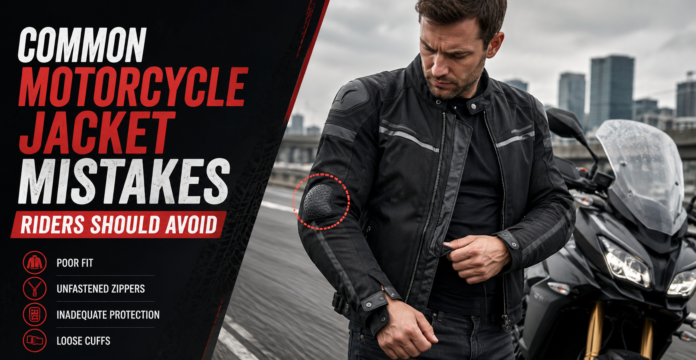
A motorcycle jacket is more than something riders wear to look good on a bike. It is an important part of riding gear because it covers the upper body, including the shoulders, elbows, arms, chest, and back. A good jacket may help reduce injury during a slide, protect the skin from wind and road debris, and make changing weather easier to manage. However, simply owning a riding jacket does not mean a rider is properly protected. Many common motorcycle jacket mistakes happen because riders focus too much on style, price, or appearance while ignoring fit, armor placement, materials, ventilation, and riding conditions. A jacket that looks perfect while standing in front of a mirror may become uncomfortable when the rider bends forward and holds the handlebars. In the same way, an expensive jacket may still be a poor choice if it does not suit the motorcycle, climate, or riding style. Understanding common motorcycle jacket mistakes before buying or wearing a jacket makes it easier to choose equipment that feels comfortable and works properly during everyday rides.
Common Motorcycle Jacket Mistakes Riders Make With Fit
One of the most common motorcycle jacket mistakes is choosing a jacket that is either too loose or too tight. A very loose jacket may feel comfortable while walking, but the material can move around at higher speeds. More importantly, protective armor may shift away from the elbows and shoulders if the jacket does not sit closely enough against the body. A jacket that is too tight creates a different problem. It can limit arm movement, pull across the shoulders, and make longer rides tiring. Riders should check the fit while sitting in a normal riding position rather than judging the jacket only while standing upright. The sleeves should continue covering the wrists when the arms reach forward, while the back should remain long enough to cover the lower waist. Riders comparing different designs can start by reviewing the wider range of motorcycle jackets to understand how different cuts, lengths, and constructions are used. The correct fit should feel secure without restricting normal movement, allowing the armor and outer shell to stay where they are supposed to be.
Choosing Style Instead of Real Riding Protection
Another mistake is buying a jacket mainly because it matches a certain fashion style. Motorcycle jackets have a strong connection with street fashion, and many casual jackets are designed to copy the appearance of real riding gear. This can make it difficult for new riders to tell the difference between a fashion jacket and a protective motorcycle jacket. Some fashion pieces may use thin materials, light zippers, decorative padding, or no impact protection at all. They can look similar to riding jackets without being designed for contact with the road. This is one of the common motorcycle jacket mistakes that riders should take seriously because appearance cannot show how a jacket will perform during a fall. Riders who prefer the classic biker look should still check material strength, seam construction, reinforcement zones, armor pockets, fasteners, and overall coverage. A properly made men’s biker jacket can show how traditional biker styling can be combined with a more practical jacket structure. Style can influence the final choice, but protection, comfort, and suitability for riding should come first.
Ignoring Shoulder, Elbow, and Back Armor
Ignoring protective armor is also among the common motorcycle jacket mistakes seen with inexperienced riders. Jackets may include armor at the shoulders and elbows, while some provide a back protector or at least a pocket where one can be installed. Armor needs to cover the correct part of the body when the rider is actually sitting on the motorcycle. If an elbow protector moves toward the side of the arm or a shoulder protector sits too low, it may not offer useful coverage when needed. Riders should therefore put the jacket on, close every zipper and fastener, move their arms into a riding position, and feel where each armor piece sits. Back protection deserves similar attention.
Some jackets contain only a thin foam insert instead of a proper protective piece. Riders should understand what is actually included rather than assuming every padded area gives the same protection. These common motorcycle jacket mistakes are easy to avoid by checking the jacket carefully before riding. Armor should sit comfortably, remain stable during movement, and avoid creating pressure points that become painful during longer journeys.
Buying the Wrong Material for Your Riding Needs
Selecting the wrong outer material is another one of the common motorcycle jacket mistakes. Leather, textile, mesh, and synthetic materials each have different strengths and limits. Leather is widely associated with motorcycle clothing because good-quality motorcycle leather can provide strong abrasion resistance. However, leather may feel heavy and warm in hot climates, especially when ventilation is limited. Textile jackets can provide more options for ventilation, waterproof construction, removable liners, and lighter weight. Mesh jackets allow greater airflow and can be useful in very warm weather, but their protective performance depends heavily on the quality of the material and reinforced areas. Riders should avoid assuming that every material in the same category performs equally.
Even products described as leather or synthetic leather can differ greatly in thickness and construction. For riders considering a traditional option, looking at a leather biker jacket can help show how material choice affects the structure and appearance of the garment. Choosing according to riding conditions is better than selecting material based only on fashion or popularity.
Wearing the Same Jacket in Every Weather Condition
Trying to use one jacket in every type of weather is another example of common motorcycle jacket mistakes. A thick jacket designed for cold conditions can become uncomfortable during summer traffic, while a heavily ventilated jacket may offer little comfort during cold morning rides. Heat can cause tiredness and reduce concentration, especially when riders are stuck in slow-moving traffic with little airflow. Cold air can also become uncomfortable quickly at motorcycle speeds because wind passes continuously over the rider’s body. Riders should therefore think about seasonal conditions before choosing their jacket.
Ventilation panels and zippered vents can help in warmer weather, while removable thermal liners make some jackets more flexible when temperatures change. Waterproof liners or outer shells can help during rain, but they may also reduce airflow. Climate can vary even during a single trip, so layering is often useful. Avoiding common motorcycle jacket mistakes means accepting that the jacket needs to match the environment. A rider who regularly experiences very different seasons may eventually need more than one jacket rather than expecting one piece of gear to perform perfectly throughout the entire year.
Common Motorcycle Jacket Mistakes to Check Before Riding
Riders can avoid many problems by carrying out a short check before leaving. This is useful with a new jacket and should also be repeated regularly with older equipment because zippers, fasteners, armor, and fabric can change with use. The following checks cover several common motorcycle jacket mistakes in a simple way:
- Check that the main zipper closes fully and does not separate when pulled.
- Make sure shoulder and elbow armor sits directly over the correct joints.
- Confirm that sleeves still cover the wrists when reaching toward the handlebars.
- Check that the jacket does not rise too far above the waist in the riding position.
- Close cuffs firmly enough to prevent the sleeves from moving excessively.
- Open or close ventilation according to the expected temperature.
- Look for damaged seams, worn fabric, broken fasteners, or loose stitching.
- Make sure pockets are completely closed before starting the motorcycle.
- Check that reflective areas are clean if the jacket uses them for visibility.
- Remove bulky objects from pockets if they press against the body.
- Make sure the collar is comfortable and does not rub against the neck.
- Confirm that removable liners are attached correctly before riding.
A basic check takes very little effort, yet it can prevent several common motorcycle jacket mistakes from turning into larger problems once the rider is already on the road.
Forgetting About Visibility During Low-Light Riding
Visibility is sometimes forgotten because riders think mainly about abrasion resistance and impact protection. However, ignoring how easily other road users can see the rider is another of the common motorcycle jacket mistakes. Black motorcycle clothing remains popular because it looks clean and works well with many motorcycles, but dark clothing can be harder to notice at night, during rain, or on poorly lit roads. Riders do not necessarily need to wear extremely bright colors at all times, but they should think about contrast and reflective details. Reflective piping, panels, logos, or strips can become much more noticeable when vehicle headlights shine toward them.
A bright helmet, reflective vest, or other visible equipment can also support a dark jacket. Riders should keep reflective surfaces clean because dirt can reduce their effectiveness. Visibility should never replace safe riding habits, correct lighting, or careful road positioning, but it can add another useful layer. Understanding common motorcycle jacket mistakes means looking beyond crash protection alone and thinking about the entire riding environment, including how easily the rider can be noticed by people driving nearby vehicles.
Leaving Zippers, Cuffs, and Closures Open
A rider may buy the right jacket and still use it incorrectly. Leaving the front zipper partly open, forgetting wrist closures, or failing to adjust the waist properly are common motorcycle jacket mistakes that can change how the garment behaves. At higher speeds, air can enter through an open front and make the jacket flap around. Loose cuffs allow wind to travel up the sleeves and may also let the sleeve move more than intended. A loose waist can cause the lower part of the jacket to rise when the rider bends forward. Before riding, the main zipper should normally be fully closed, while cuffs and waist adjusters should be set securely without becoming uncomfortable.
Ventilation zippers are different because they are designed to control airflow, but riders should understand which openings are vents and which are structural closures. Jacket pockets should also remain closed, especially when carrying keys, a phone, or other objects. Avoiding common motorcycle jacket mistakes involves using all the adjustment systems properly instead of treating the jacket like ordinary casual clothing. A secure jacket usually feels more stable and predictable when the motorcycle reaches normal road speed.
Carrying Hard or Sharp Objects in Jacket Pockets
Many riders use motorcycle jacket pockets for phones, keys, tools, wallets, coins, and other personal items. However, filling those pockets with hard or sharp objects can become another of the common motorcycle jacket mistakes. A key ring, metal tool, or bulky phone may press against the body during normal riding and become even more uncomfortable when the rider bends forward. In a fall, a hard item trapped between the body and the road could also create a concentrated pressure point. Riders should keep only necessary items in jacket pockets and avoid carrying anything sharp. Heavy objects can also pull on pocket fabric and make the jacket feel uneven. If a motorcycle has storage space, secure luggage, or a tank bag, some items may be better stored there.
Pocket zippers should be closed before moving because objects can easily fall out when exposed to strong airflow. Avoiding common motorcycle jacket mistakes does not require removing every item from every pocket, but riders should think carefully about what they carry, where it sits, and whether the object could become uncomfortable or create unnecessary risk during a ride.
Poor Cleaning and Storage Can Damage a Motorcycle Jacket
Poor maintenance is one of the common motorcycle jacket mistakes that develops slowly, so riders may not notice the problem until the jacket has already aged. Dirt, sweat, road grime, rain, and insects collect on riding clothing over time. The correct cleaning method depends on the jacket material. Leather normally requires different care from textile or mesh, and strong household detergents may not be suitable for every garment. Riders should follow the care label or manufacturer’s cleaning guidance whenever possible. Protective armor may need to be removed before washing, while removable thermal or waterproof liners can have separate care instructions.
Drying is also important. Strong direct heat from heaters or dryers can damage certain materials, coatings, adhesives, or leather. Storage should allow the jacket to keep its shape, so hanging it on a strong, wide hanger is usually better than leaving it folded under other clothing for long periods. Common motorcycle jacket mistakes also include storing damp gear inside a closed bag. Allowing the jacket to dry before storage can help control odor, moisture buildup, and unnecessary material damage.
Conclusion
A motorcycle jacket works best when the rider chooses it carefully, wears it correctly, and looks after it over time. The most common motorcycle jacket mistakes are often simple decisions: choosing the wrong size, buying for style alone, ignoring armor placement, selecting unsuitable material, using the same jacket in every climate, leaving closures loose, forgetting visibility, carrying hard objects in pockets, or neglecting maintenance.
FAQs
What are the most common motorcycle jacket mistakes?
The most common motorcycle jacket mistakes include wearing the wrong size, choosing style over protection, ignoring armor placement, using unsuitable materials, leaving zippers open, and failing to maintain the jacket properly. Riders should check fit and protective features before every ride.
Should a motorcycle jacket fit tight or loose?
A motorcycle jacket should fit closely without restricting normal movement. It should not be so loose that the armor moves away from the shoulders or elbows. At the same time, it should not be so tight that reaching the handlebars becomes uncomfortable.
Can I wear a normal leather jacket on a motorcycle?
A quick check before every ride is useful. Riders should inspect the main zipper, cuffs, armor position, seams, fabric, pockets, and adjustment points. A more detailed inspection is helpful after heavy use, long trips, bad weather, or any fall.
How often should a motorcycle jacket be checked?
A quick check before every ride is useful. Riders should inspect the main zipper, cuffs, armor position, seams, fabric, pockets, and adjustment points. A more detailed inspection is helpful after heavy use, long trips, bad weather, or any fall.