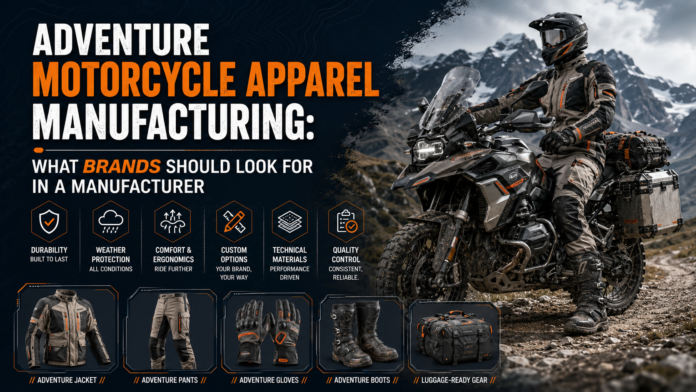
Adventure riding is a sport that pushes the rider as well as their gear to its limits. It involves riding in unpredictable terrains, weather changes, and over long distances. These are things that road riding does not require. Finding the right manufacturing partners is crucial for brands creating adventure motorcycle apparel manufacturing. It can make the difference between developing a product that will earn rider trust on multiple continents, and one that will fail the first test. This guide will explain what is involved in manufacturing adventure motorcycle clothing, how construction and materials are defined, and what capabilities brands should consider when evaluating manufacturing partners.
Why Adventure Motorcycle Apparel is a Specialized Field
Adventure motorcycle clothing must be able to perform in a wide variety of conditions. Riders often travel from sealed highways to unpaved mountains tracks, and from desert heat to snowy alpine weather, all within a multi-day trip. Adventure garments need to integrate weather protection, protective armour, ventilation systems, thermal management, and other features into one product. This will ensure that the product is comfortable and functional in all scenarios. A manufacturer who lacks experience in the production of adventure motorcycle clothing may create garments that perform well in certain conditions but fail in others, leaving riders vulnerable when weather conditions suddenly change. Adventure motorcycle apparel production requires a technical sophistication far beyond that of standard motorcycle or outdoor clothing.
The Core Materials for Adventure Motorcycle Apparel Manufacturing
The material selection for adventure motorcycle clothing must consider abrasion resistance and weather protection as well as breathability and durability. This eliminates the use of single materials in garments that are simpler.
High-Tenacity textile outer shells
High-tenacity fabrics are often used as the primary outer shell of adventure motorcycle jackets and trousers. These materials provide strong abrasion resistant while being lighter, packable and more weather-resistant than leather. Cordura nylon, in 500D or 600D denier counts, offers excellent tear and wear resistance for off-road riding, while ripstop blends of polyester offer similar performance with reduced weight, which is ideal for long-distance riders. textile motorcycle coats made from high-tenacity fabric can be designed to incorporate waterproof membranes, removable thermal liners, and other features that leather cannot. This makes them the outer shell of choice for adventure motorcycle apparel manufacturers.
Waterproof Breathable Membranes
The need for weather protection is a must-have in adventure motorcycle clothing, as riders are often forced to endure rain, wind, and cold over long distances, without having the option to retreat indoors. Quality adventure garments feature waterproof membranes that are laminated between outer shell and inner lining. This keeps water out, while allowing the moisture vapor produced by the rider, to escape. motorcycle rainwear for adventure riding is often designed with fully taped seams to prevent water infiltration. This is because untaped seams allow moisture to penetrate even when the fabric remains waterproof. When developing adventure motorcycle clothing, brands should pay attention to the membrane quality and standard of seam tape.
CE-Rated Armor Integration
All serious adventure motorcycle clothing manufacturers must include protective armor inserts at the shoulders, elbows and hips. They also need to incorporate them in the knees and back. CE Level 1 armor is designed to provide a high level of protection for road and light-off-road riding. CE Level 2 armor, on the other hand, offers a higher impact absorption standard that’s better suited to more-risky riding situations. In addition, the armor pocket design must place inserts at the primary impact zones of both standing and riding postures. Brands must ensure that their manufacturing partners understand the specific armor positioning requirements for adventure riders rather than applying road-focused armor.
Removable Thermal Liners
The removable thermal liners are ideal for adventure riders who frequently travel through different climate zones in a single trip. They can adapt their clothing from cold mountain riding to warmer valley riding, without having to change completely. These liners are integrated into quality adventure motorcycle apparel through full-perimeter zipper systems, which allow for secure attachment while riding at high speeds but still enable quick removal when stopping to rest. Liner construction requires insulation materials that can be compressed into a manageable size when stored in luggage. This adds an additional packaging dimension to the liner design, something that is rarely addressed by standard motorcycle apparel.
Stretch and Articulation Fabrics
The outer shell is designed to protect, but strategically placed stretch panels in key areas of movement allow adventurers to remain comfortable and maintain control on dynamic off-road terrain. The gussets under the arms, along the back of the legs, and in the crotch of pants improve rider comfort when riding standing up, which is a common position on unpaved tracks. In order to integrate stretch and articulation fabric correctly into a protective shell garment, manufacturing expertise is required.
The Brands should specify the following features:
Specific construction details, beyond material selection, distinguish genuine adventure motorcycle clothing manufacturing from products that look similar on a specification page but perform differently when used in the field.
- Fully-taped waterproof seams: Confirm that all primary seams of the waterproof membrane are fully taped, and not just those high-visibility seams.
- Double stitching in stress areas: Require reinforced double or triple stitches at armor pockets, zipper attachments and panel joints where crash forces are concentrated most intensely.
- Use YKK or an equivalent closure hardware. Verify that zippers, buckles and adjustment systems are made with hardware rated to withstand the vibrations and UV exposure associated with long-distance cycling.
- Construction of gussets underarms and crotches: Check that stretch gussets are present in the jacket underarms as well as in the crotch area of pants for a full range of articulation when riding in any position.
- Secure armor retainment systems: Confirm that armor pockets are secured with velcro, snaps, or bonded retention, rather than loose-fitting pockets which allow inserts shift position while riding.
- Integrate reflective elements: Select reflective piping or panels as well as logo applications to meet minimum visibility standards on long-distance routes at night.
Brands can reduce the risk that they will receive products that do not meet functional performance specifications by including these details in their manufacturing brief.
What to look for in an adventure motorcycle apparel manufacturer
The choice of a manufacturing partner for adventure motorcycle apparel is one of most important decisions a brand can make. The following criteria can help identify suppliers with the experience and capabilities that this category requires.
Experience with multi-layer garment construction
Adventure motorcycle jackets usually have three or more fabric layers. These include an outer shell, a waterproof membrane and a removable thermal lining. Each layer must be integrated correctly. Before committing to a partnership, brands should ask prospective manufacturers for examples of multi-layer adventure clothing and evaluate the construction quality, layer attaching systems, and overall finish.
Source Armor in-House, or with Verification
A manufacturer that sources CE-rated armour from verified and certified suppliers can provide brands with the documentation they need to confirm that their products meet published standards. A manufacturer that cannot identify the armor supplier or provide certification documents introduces a compliance risk which can impact both brand reputation as well as regulatory standing on key markets. By confirming armor sourcing capabilities and documentation standards during supplier evaluation, brands are protected from finding compliance gaps once bulk production begins.
Riding-Position Development Capability
Adventure riding requires a greater range of body positions compared to road riding. This includes standing on footpegs, crouching in rough terrain and sitting down while touring along smooth highways. Manufacturing partners that develop patterns for adventure riding ergonomics rather than adapting standard templates of motorcycle jackets consistently produce garments which fit and function better under real-world conditions. Brands should directly ask manufacturers how they develop riding-position patterns and if they test on bikes during the sample process.
Weather Protection Testing
It is important to confirm that the manufacturer has tested waterproof membranes under standard conditions. This can be done in-house, or by a third-party facility that has been verified. This will give you confidence that your finished garments are going to perform as expected in wet conditions. While visual inspections can reveal obvious waterproofing problems, standard testing reveals limitations in performance that are only apparent when riding at high speeds and sustained rain exposure.
Matching manufacturing capabilities to your Riding Category
When it comes to adventure riding, different riding styles have different manufacturing priorities. Aligning your supplier with the target category will improve product results. When developing offroad motorcycle apparel, brands typically prioritize stretch articulation and compatibility with external armor over waterproofing. While brands that focus on touring apparel are more concerned with weather protection and comfort padding than maximum ventilation, they prioritize luggage integration, comfort padding and compatibility with external body armor.
The complete Motorcycle apparel collection is a great reference for brands looking to expand their motorcycle apparel line. It will help them understand how the construction priorities change between Racing motorcycle apparel and Urban motorcycle apparel. Brands that want to expand their product range into motorcycle suit or protective gear can benefit from working alongside a manufacturer who has experience in multiple motorcycle apparel categories.
Partner with a trusted manufacturer for Adventure Motorcycle Apparel
To develop adventure motorcycle clothing that riders can trust in demanding and unpredictable conditions, you need a manufacturer who has a combination of technical expertise, certified materials sourcing, as well as genuine riding-world experience. Working with a manufacturer that has experience in multi-layer constructions, armor integration and weather protection engineering is the key to a successful adventure motorcycle apparel line.
We are a manufacturer of custom motorcycle apparel. As such, we work with brands to develop apparel that is suitable for long-distance riders in all weather conditions and terrain types. Contact our team today to learn more about material specifications, construction standard, armor sourcing and production timelines that are tailored to the adventure riding category of your brand.
Final Thoughts
Adventure motorcycle clothing manufacturing requires a technical sophistication that is different from other motorcycle and outdoor apparel categories. The multi-layer construction, CE armor integration, waterproof membranes and breathable membranes as well as ergonomic riding positions all contribute to the products that riders rely on in demanding and unpredictable conditions. Selecting a partner who has demonstrated expertise in all of these requirements is a better option than choosing a supplier that can produce apparel. This will improve the quality and reliability. Understanding what adventure motorcycle clothing manufacturing involves and evaluating suppliers based on specific criteria will help brands develop gear that builds trust with adventure riders.
FAQs
What is the difference between adventure motorcycle clothing and standard motorcycle jackets
Adventure motorcycle clothing must be able to perform in a wider range of conditions, than standard road jackets. This includes waterproof protection, removable thermal liner, CE-rated armor and ventilation systems, all integrated into one garment.
What fabrics are used to make adventure motorcycle jackets?
Most adventure motorcycle jackets are made from Cordura nylon or ripstop blends of polyester and nylon. These fabrics offer abrasion-resistant properties while still being compatible with waterproof membrane integration and removable liners.
What is the importance of CE armor certification for adventure motorcycle clothing?
CE-rated motorcycle clothing is important for serious adventurers because it shows that the protective inserts meet published standards of impact absorption.
What questions should brands ask suppliers during supplier evaluations?
Ask about the brand’s experience with multi-layer garment construction, armor certification and sourcing documentation, pattern development for riding positions, and weather protection capabilities.