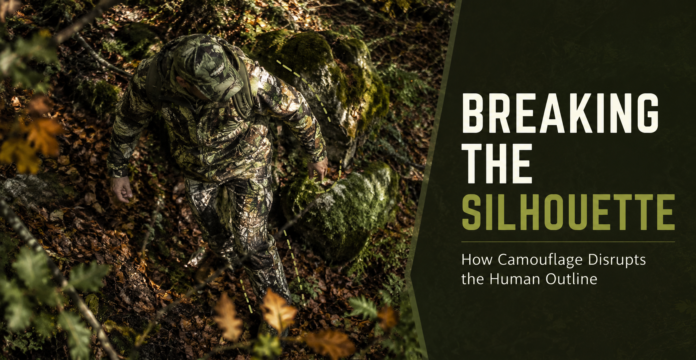
The human silhouette is one of the most recognizable shapes in nature. Two legs, two arms, a torso, and a head create a distinctive bilateral symmetry that animal and human vision has evolved to detect automatically — often before conscious recognition even occurs. How camouflage patterns work to defeat this automatic detection is a genuinely fascinating intersection of visual science, pattern design, and outdoor performance engineering that goes far deeper than simply printing green and brown colors onto fabric.
Why the Human Silhouette Is So Easy to Detect
Understanding why camouflage is necessary requires understanding why the human form is so easily detected in natural environments. The visual systems of game animals and humans alike have evolved powerful object recognition capabilities that operate partly through shape detection — identifying characteristic outlines and proportions that signal the presence of specific objects even when color and detail information is incomplete or ambiguous.
The human silhouette presents several detection cues simultaneously. Bilateral symmetry — the mirror-image relationship between left and right sides of the body — is a powerful detection signal that visual systems recognize even at long distances where fine detail is unavailable. The characteristic proportions of head, shoulder width, and upright posture create a shape signature that differs fundamentally from the irregular, asymmetric forms of natural terrain and vegetation.
Camouflage must interrupt this automatic shape recognition before it reaches conscious awareness — disrupting the visual processing chain that converts raw light information into recognized object identification.
The Three Core Mechanisms of Camouflage Pattern Science
Mechanism 1 — Background Matching
Background matching is the most obvious camouflage principle — using colors and tones that approximate the dominant visual character of the surrounding environment. When clothing colors match environmental colors closely enough, the contrast between the wearer and their background decreases — reducing the signal that drives visual attention toward the human form.
Background matching alone is insufficient for effective concealment. Even perfectly color-matched clothing presents the recognizable human silhouette against the background — providing color concealment without shape concealment that visual systems can still detect through outline recognition rather than color difference detection.
Mechanism 2 — Disruptive Coloration
Disruptive coloration uses high-contrast pattern elements to create false visual edges within the body surface that confuse the visual system’s boundary detection processes. When the visual system attempts to identify the outline of an object, it looks for consistent edges — boundaries where brightness or color changes significantly and continuously across space.
High-contrast pattern elements within camouflage clothing create internal edges that compete with and disrupt the detection of the actual body outline. The visual system’s edge detection processes become confused by multiple competing boundary signals — some representing the actual body outline and others representing internal pattern contrasts that have no correspondence to object boundaries. This confusion slows and disrupts the automatic shape recognition that makes human silhouettes so easily detectable in natural environments.
Mechanism 3 — Coincident Disruptive Coloration
The most effective camouflage combines disruptive coloration with pattern elements that align at the body outline — creating the impression that the boundary between the wearer and the background is a continuation of a pattern element rather than the edge of a distinct object.
When a high-contrast pattern element crosses the body boundary — appearing both on the clothing surface and (apparently) on the background environment — the visual system’s boundary detection process is directly fooled. Instead of reading the body outline as an object boundary, the pattern alignment causes the visual system to interpret the body edge as just another pattern element within the continuous visual field — preventing the object-boundary recognition that enables human silhouette detection.
How Pattern Scale Affects Concealment at Different Distances
One of the most important and often overlooked dimensions of how camouflage patterns work is the relationship between pattern element scale and effective concealment distance. Pattern elements that provide effective silhouette disruption at one observation distance may completely fail at different distances — and understanding this scale-distance relationship explains many real-world camouflage performance observations that pattern color analysis alone cannot account for.
At close observation distances, fine pattern elements remain individually distinguishable — each element contributing to silhouette disruption and disruptive coloration effects that interrupt shape recognition. At longer distances, fine pattern elements blend into uniform color through the averaging effects of visual resolution limits — eliminating the disruptive coloration effect while potentially preserving some background matching benefit.
Effective camouflage for varied-distance hunting scenarios requires pattern elements at multiple scales simultaneously — fine elements providing close-range disruption while larger macro-pattern elements maintain silhouette disruption at distances where fine elements have blended into uniform color. This multi-scale approach is one of the primary design advantages of digital pixel-based camouflage patterns — their mathematical element distribution creates effective disruption across multiple spatial frequency scales simultaneously rather than optimizing for a single distance.
The Role of Color in Camouflage Pattern Effectiveness
Color contributes to camouflage effectiveness through background matching — but its relative importance varies significantly between different observer species and viewing conditions in ways that human pattern evaluation doesn’t automatically capture.
Human observers have trichromatic color vision with strong red-green discrimination — leading human camouflage designers to emphasize the green-brown color matching that human visual evaluation finds most convincing in woodland environments.
Deer and many ungulates have dichromatic vision without red-green discrimination — making orange hunter safety vests far less visible to deer than to human observers, and making the precise green-brown color matching that human evaluation prioritizes less important for deer concealment than silhouette disruption and UV management.
Birds have tetrachromatic vision including UV sensitivity — perceiving colors across a broader spectrum than human camouflage evaluation captures. Waterfowl camouflage benefits from UV-treated fabrics that reduce the UV signature standard fabrics present to bird vision even when human-visible color matching appears accurate.
Understanding how fabric properties — including color management across different lighting conditions — affect overall camouflage system performance is explored in this camouflage fabrics guide covering the material performance requirements that support effective pattern concealment in real field conditions.
Movement — The Camouflage Property That Pattern Cannot Address
All the pattern science discussed above applies specifically to stationary concealment — and this is a critical limitation that even perfectly designed camouflage patterns cannot overcome. Movement detection in animal visual systems operates through a fundamentally different neural pathway than pattern and shape recognition — one that is specifically tuned to detect motion against stationary backgrounds.
Game animals with visual systems far less sophisticated than human perception in color and detail discrimination can detect the slightest movement at distances where their color and pattern recognition would completely miss a stationary camouflaged hunter. This movement detection sensitivity explains why experienced hunters prioritize stillness so absolutely during critical hunting moments — because no amount of pattern sophistication compensates for the movement signature that visual motion detection systems identify immediately and reliably.
Camouflage pattern design cannot solve the movement detection problem — but construction choices can partially mitigate it. Flexible, quiet fabrics that minimize the visual noise of rustling during small unavoidable movements, and patterns that incorporate moving vegetation elements that make small movements less obviously associated with rigid human form movement, both contribute to movement concealment that purely static pattern analysis doesn’t capture.
How Camouflage Construction Supports Pattern Function
The visual science of how camouflage patterns work operates most effectively when construction choices support rather than undermine pattern function across real field conditions.
3D texture elements — ghillie suit construction, leaf-like attachments, and three-dimensional fabric elements — extend camouflage effectiveness beyond flat pattern printing by eliminating the characteristic smooth, flat surface appearance of clothing that the human visual system recognizes as artificial against natural terrain backgrounds. Texture matching supplements color and pattern matching — addressing a visual dimension that flat fabric printing cannot serve regardless of pattern sophistication.
Shadow elimination — the predictable shadow patterns that the human form creates under directional lighting provide detection cues that pattern cannot disrupt. Loose-fitting camouflage construction that breaks up the shadow profile of the human form reduces this additional detection signal that form-fitting clothing amplifies rather than conceals.
For outdoor brands building camouflage apparel collections, understanding the visual science underlying pattern effectiveness creates genuine product development advantage — enabling construction decisions that support rather than undermine the pattern investments that camouflage product development requires. Our hunting apparel manufacturer page covers the complete range of camouflage clothing options available — including the construction quality standards that ensure pattern printing accuracy and fabric performance support genuine concealment effectiveness across real field applications.
How clothing construction choices more broadly affect outdoor performance — including the specific construction details that distinguish genuinely functional garments from aesthetic approximations — is covered in this outdoor clothing layering guide — directly relevant to understanding how camouflage outer layer construction integrates within complete outdoor clothing systems for hunting and tactical applications.
For a practical product example of how camouflage construction principles translate into complete outdoor garments, these outdoor cargo pants demonstrate the fabric construction, stretch performance, and practical field features that support effective camouflage clothing system performance across varied terrain and hunting applications.
Conclusion
Understanding how camouflage patterns work — through background matching, disruptive coloration, coincident boundary disruption, multi-scale element distribution, and species-appropriate color management — reveals that effective camouflage is a sophisticated visual science application rather than simply a decorative pattern tradition. The human silhouette is powerfully detectable precisely because evolution has tuned visual systems to recognize it — and defeating that detection requires pattern designs that exploit the specific limitations and processing characteristics of the visual systems you’re trying to fool. Get the science right and camouflage genuinely works. Ignore it and you’re wearing interesting clothing patterns that provide minimal real-world concealment advantage.
FAQs
Does pattern complexity directly determine camouflage effectiveness?
Not necessarily — terrain-appropriate color matching and correct pattern scale for the relevant observation distance matter more than visual complexity alone. A simple pattern correctly matched to terrain often outperforms a visually complex pattern mismatched to the environment where it’s used.
Why does movement destroy camouflage effectiveness even with perfect pattern matching?
Movement detection in animal visual systems operates through separate neural pathways from pattern and color recognition — specifically tuned to detect motion against stationary backgrounds regardless of how effectively static concealment has been achieved through pattern design.
Do animals see camouflage the same way humans evaluate it?
No — different species have fundamentally different visual systems. Deer lack red-green color discrimination that human camouflage evaluation emphasizes. Birds have UV sensitivity that human pattern evaluation ignores. Effective camouflage design accounts for the specific visual system of the target species rather than relying solely on human visual evaluation of pattern effectiveness.
Can camouflage clothing effectiveness be tested objectively?
Yes — scientific testing using spectrophotometric color measurement, spatial frequency analysis, and controlled detection distance studies can objectively evaluate camouflage performance beyond human visual evaluation alone. Professional military and commercial camouflage developers use these objective testing methodologies to validate pattern effectiveness claims before field deployment.