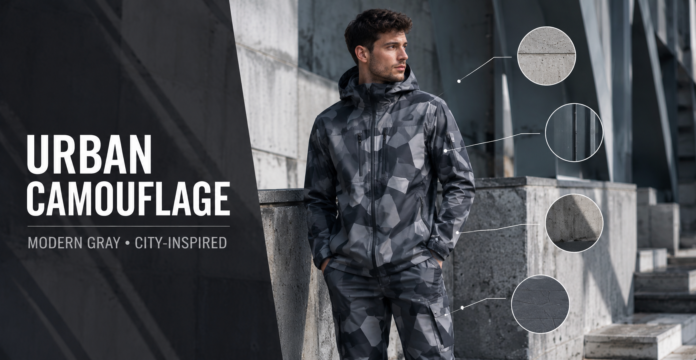
Camouflage has always been environment-specific. Woodland patterns serve forests. Desert patterns serve arid terrain. Arctic patterns serve snow environments. But what happens when the environment is concrete, glass, asphalt, and grey stone? Urban camouflage clothing answers that question — developing pattern systems specifically calibrated to the visual character of built environments rather than adapting natural terrain patterns that create obvious contrast against the city backgrounds they were never designed for.
What Defines the Urban Visual Environment
Built environments present a fundamentally different visual character from natural terrain — and understanding these differences explains why dedicated urban camouflage pattern development was necessary rather than simply applying general-purpose camouflage to urban contexts.
Dominant grey palette — concrete, asphalt, stone, and weathered metal create a visual environment where grey in its many variations dominates the color spectrum. From pale silver-grey freshly poured concrete through the medium grey of aged pavement to the dark charcoal of wet urban surfaces — grey tones in multiple values define the visual signature of built environments globally.
Geometric structure — natural environments are defined by organic, irregular forms. Urban environments impose geometric structure — right angles, regular grid patterns, uniform surface textures — that create a visual language fundamentally different from the organic irregularity that natural terrain camouflage addresses. Effective urban patterns must work within or against this geometric visual language rather than simply reproducing natural pattern elements that read as obviously artificial against built backgrounds.
Mixed materials and textures — urban environments combine concrete, glass, brick, painted surfaces, metal, and asphalt within close proximity. This material diversity creates texture variation that urban camouflage patterns must account for across the full range of built environment contexts where tactical and outdoor users operate.
Variable lighting conditions — urban environments create complex lighting from multiple sources simultaneously — direct sunlight, reflected light from glass and metal surfaces, artificial lighting, and deep shadow zones created by building structures. Urban camouflage patterns must maintain concealment effectiveness across this more complex and variable lighting environment than natural outdoor terrain typically creates.
The Development of Urban Camouflage Patterns
Urban camouflage development followed a different evolutionary path than natural environment patterns — driven initially by military requirements for built environment operations and subsequently by law enforcement, security professionals, and ultimately lifestyle and fashion markets that adopted urban camo aesthetics for purposes entirely removed from their functional origins.
Military urban pattern research began seriously during the Cold War era when potential built environment conflict scenarios made urban concealment a genuine military priority. Scientific analysis of built environment color spectra using spectrophotometric measurement identified the grey, off-white, charcoal, and muted blue-grey tones that most consistently match global built environment visual signatures across diverse urban contexts.
Law enforcement and security adoption brought urban camouflage into civilian professional use — where tactical units operating in urban environments required concealment calibrated to the built settings where their operations occur. Law enforcement tactical units in multiple countries developed urban-specific pattern programs that served operational requirements that general outdoor camouflage couldn’t adequately address.
Fashion and lifestyle crossover has become the most commercially significant development in urban camouflage evolution. Grey camouflage patterns that began as functional concealment tools have entered mainstream fashion through streetwear, urban outdoor lifestyle, and the gorpcore aesthetic movement that brought technical outdoor clothing into everyday urban style. Understanding how camo patterns transition from functional outdoor applications into lifestyle fashion contexts is explored in this camo wool coat guide — demonstrating exactly how camouflage aesthetics move between functional outdoor and urban lifestyle markets simultaneously.
Key Urban Camouflage Pattern Types
ACU Urban (Grey Digital) — applying the pixel-based design principles of digital camouflage to urban grey color palettes creates patterns that disrupt visual detection across multiple observation distances within built environments. Grey digital patterns use precisely calculated pixel element distributions in multiple grey values — from pale silver through medium concrete grey to dark charcoal — creating multi-scale disruption that performs across the variable observation distances that urban operational environments regularly create.
SWAT/Law Enforcement Urban — tactical law enforcement units have developed specific urban pattern variants prioritizing concealment within the close-range built environment contexts where law enforcement tactical operations primarily occur. These patterns typically use higher contrast between grey values than military alternatives — optimized for the closer observation distances and specific built environment contexts of law enforcement tactical use rather than longer-range military engagement scenarios.
Lifestyle Urban Grey — commercial fashion-driven urban camouflage uses grey pattern aesthetics without the scientific concealment engineering behind functional alternatives. These patterns prioritize visual appeal and fashion credibility over functional concealment performance — successfully crossing urban camo aesthetics into streetwear, casual outdoor, and urban lifestyle markets where the visual language of tactical camouflage creates desirable aesthetic associations regardless of actual concealment function.
Urban Camouflage Beyond Pure Grey — City-Inspired Pattern Variations
Contemporary urban camouflage clothing extends beyond purely grey palettes into broader city-inspired pattern developments that capture different aspects of built environment visual character.
Industrial pattern variations incorporate the rust, oxidized metal, weathered paint, and surface deterioration textures of industrial urban environments — creating patterns that perform specifically within the industrial outdoor and urban-fringe environments where working professional and outdoor lifestyle consumers regularly operate.
Night urban patterns address the dramatically different visual character of illuminated urban environments after dark — where artificial light sources, deep shadow zones, and reflective surfaces create pattern performance requirements that differ fundamentally from daylight urban concealment needs. Night urban patterns typically use darker overall palettes with lighter elements calibrated to the specific contrast characteristics of illuminated night urban environments.
Mixed terrain transitional patterns — for outdoor enthusiasts who regularly move between natural outdoor environments and built urban contexts — incorporate both urban grey tones and subtle natural earth colors that maintain reasonable effectiveness across both environment types without optimal performance in either. These transitional patterns serve the urban outdoor lifestyle consumer who values single-garment versatility over environment-specific performance optimization.
Performance Fabric Requirements for Urban Camouflage Clothing
Urban camouflage clothing serves diverse use cases that create varied performance fabric requirements across different user groups and applications.
Tactical and law enforcement applications demand the same performance fabric properties as serious outdoor tactical use — moisture management during high-intensity operations, durability under demanding physical activity, silent construction that doesn’t rustle during cautious approach movement, and quick-dry performance for sustained operational wear across full tactical duty days.
Urban outdoor lifestyle applications prioritize comfort, breathability, and everyday wear durability alongside the urban camouflage aesthetic — creating fabric performance requirements closer to premium casualwear than technical tactical specifications.
Fashion and streetwear applications prioritize fabric hand feel, color reproduction quality for pattern printing, and construction aesthetics over technical performance properties that lifestyle consumers typically don’t evaluate through operational field use. Understanding how modern hunting and outdoor professionals evaluate performance clothing construction across both functional and aesthetic dimensions is explored in this modern hunters guide — relevant context for brands positioning urban camouflage clothing across both performance and lifestyle market segments simultaneously.
The Commercial Opportunity in Urban Camouflage
Urban camouflage occupies a uniquely powerful commercial position — serving genuine functional needs for tactical and law enforcement professionals while simultaneously delivering strong fashion credibility for the much larger urban lifestyle and streetwear consumer market that adopted urban camo aesthetics without requiring functional concealment performance.
This dual commercial appeal creates product positioning opportunities that natural environment camouflage patterns don’t easily replicate. A woodland hunting pattern primarily appeals to hunters. An urban grey pattern appeals to tactical professionals, urban outdoor enthusiasts, streetwear consumers, and fashion-forward lifestyle customers simultaneously — creating significantly broader commercial market reach from a single pattern investment.
Our tactical outdoor apparel manufacturing page covers the complete range of urban camouflage clothing options available for brand development — from genuinely performance-focused tactical constructions through lifestyle and fashion applications that serve the broader commercial urban camouflage market with consistent quality and pattern printing standards.
These outdoor cargo pants demonstrate how performance fabric construction and practical field features combine in lower body outdoor garments — construction principles directly applicable to urban camouflage tactical pant development for professional and lifestyle market segments alike.
Conclusion
Urban camouflage clothing addresses a genuine visual environment that natural terrain patterns cannot adequately serve — built environments with their grey palettes, geometric structures, variable lighting, and mixed material textures all demand purpose-built pattern design rather than adaptation of natural terrain alternatives. From military and law enforcement functional origins through tactical professional applications and into mainstream streetwear and urban lifestyle fashion — urban camouflage has followed a commercial trajectory that demonstrates the powerful crossover potential when genuinely functional design innovation meets broader aesthetic appeal that fashion markets recognize and adopt at scale.
FAQs
Does urban camouflage provide effective concealment in natural outdoor environments?
Urban grey patterns create obvious contrast against natural green, brown, and earth-tone outdoor environments — making them ineffective for woodland, desert, or open country concealment applications where environment-specific natural terrain patterns are necessary for effective concealment performance.
What grey tones are most effective in urban camouflage patterns?
Multiple grey values from pale silver-grey through medium concrete grey to dark charcoal create the most effective urban camouflage — using contrast between grey tones to disrupt the human silhouette against built environment backgrounds rather than attempting to match any single dominant grey value.
Can urban camouflage clothing be produced under a private label?
Urban grey camouflage performs well for urban outdoor lifestyle activities — city hiking, urban exploration, and everyday outdoor use — where blending with built environment backgrounds may be desirable and the aesthetic appeal of urban camo patterns suits the urban context where these activities occur.
Can urban camouflage clothing be produced under a private label?
Yes. Professional outdoor apparel manufacturers offer complete private label production with urban camouflage pattern options across tactical, lifestyle, and fashion applications — with performance fabric constructions, pattern printing quality, and full branding control giving outdoor brands complete creative and commercial authority over their urban camouflage collections.