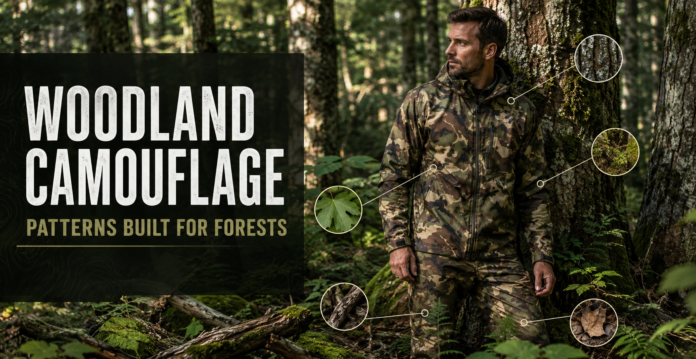
Stand in a dense forest and look carefully at what surrounds you — layered greens in dozens of shades, brown bark textures, filtered light creating high contrast patches, fallen leaves in russet and gold, shadow pools beneath canopy coverage. Now imagine wearing desert tan camouflage in that environment. The visual mismatch would make concealment impossible. This is why woodland camouflage clothing exists as a distinct category — forest environments have specific visual characteristics that demand purpose-built pattern design rather than generic camouflage that works adequately across no environment particularly well.
What Makes Forest Environments Visually Unique
Forest environments create a distinctive visual signature that sets them apart from every other outdoor environment where camouflage serves a purpose. Understanding these specific characteristics explains why woodland pattern design differs fundamentally from desert, arctic, urban, and open country alternatives.
Color complexity — forests combine multiple green tones simultaneously. Fresh canopy growth in bright lime, mature leaves in deep forest green, dying vegetation in olive and yellow-green, and mossy ground cover in grey-green all appear within the same visual field. Effective woodland camouflage must incorporate this color range rather than representing the forest through any single dominant green shade.
Contrast variation — filtered sunlight through forest canopy creates high contrast patches of bright illumination alongside deep shadow pools that shift constantly as wind moves leaves above. These contrast variations break up visual uniformity in ways that open environments don’t create — and woodland patterns must account for how the human eye detects objects through contrast rather than color recognition alone.
Texture layering — forests present texture at multiple simultaneous scales. Fine leaf surface texture, medium bark pattern texture, and large branch structure all create visual complexity that woodland patterns must disrupt across multiple scales simultaneously to prevent the human form from standing out as an unnaturally smooth, regular shape against organically complex backgrounds.
Vertical structure — forest environments have strong vertical visual organization from ground cover through undergrowth to canopy. Woodland patterns that incorporate vertical element representation blend more effectively with this natural structural orientation than purely horizontal or random element distributions.
How Woodland Camouflage Patterns Are Designed
Classic woodland pattern design translates the forest’s visual characteristics into fabric construction through deliberate color selection, element shaping, and distribution patterns that create effective visual disruption against forest backgrounds.
Color palette selection starts with the dominant colors of the target forest environment across the hunting season. Temperate deciduous forests in full summer leaf demand deeper greens and darker browns. The same forest in early spring and late autumn presents very different color balances — more bark tones, less green, more yellow and brown from seasonal leaf changes.
This seasonal variation explains why serious hunters often carry multiple woodland pattern variants — one for summer and early fall when dense foliage dominates, another for late season when bare branches and fallen leaves change the forest’s visual character completely.
Element distribution in effective woodland patterns replicates the organic irregularity of natural forest elements — using irregular shapes with soft edges that suggest leaves, branches, and shadow patches rather than geometric forms that the human eye immediately identifies as artificial. Understanding how to select the right pattern for specific forest hunting environments and seasonal conditions is explored in this hunting clothing guide — covering pattern selection criteria alongside the broader clothing choices that successful forest hunting demands.
The Performance Requirements Beyond Pattern Design
Woodland camouflage clothing serves more than visual concealment — the construction requirements for effective forest hunting and outdoor use extend across several performance dimensions that pattern alone cannot address.
Silent fabric construction matters critically in forest hunting environments where game animals detect human presence through sound as reliably as visual detection. Standard synthetic fabrics create audible rustling during movement against vegetation that alerts deer and other game animals before visual detection occurs. Quality woodland hunting garments use brushed fabric surfaces, fleece constructions, or specialized silent synthetic weaves that minimize the noise signature during the movement through undergrowth that forest hunting consistently requires.
Moisture management addresses the perspiration demands of active forest movement. Pushing through undergrowth, climbing to elevated positions, and maintaining alert stillness across temperature changes throughout a hunting day all create moisture management demands that inadequate fabric construction fails across extended field use. The evolution of modern hunting apparel — including fabric performance requirements alongside concealment capabilities — is examined in this modern hunters guide covering how contemporary hunting clothing has developed beyond basic pattern application.
Scent control — many serious woodland hunters prioritize scent control fabric treatments alongside visual concealment. Activated carbon treatments, antimicrobial fabric finishing, and silver-ion odor control technologies all aim to reduce the human scent signature that game animals detect from distances that visual camouflage effectiveness cannot compensate for when wind conditions carry scent toward approaching game.
Branch and vegetation resistance — forest movement subjects clothing to constant contact with branches, thorns, and undergrowth that tests abrasion resistance beyond what open terrain hunting or casual outdoor use creates. Woodland hunting clothing must maintain its integrity through this sustained vegetation contact without the snagging, tearing, or surface damage that reduces both garment longevity and concealment effectiveness across extended hunting seasons.
Major Woodland Pattern Types and Their Forest Applications
Classic Military Woodland (M81) — the original US military woodland pattern developed for temperate forest environments globally. Its combination of dark green, medium green, brown, and black creates effective multi-season concealment across a wide range of temperate deciduous and mixed forest environments. The pattern’s proven track record across decades of military and civilian use makes it one of the most commercially trusted woodland options available.
Realtree and Mossy Oak Woodland Variants — photorealistic woodland patterns incorporating actual leaf, branch, and bark imagery create visual matching with specific forest environments that geometric pattern alternatives cannot replicate. These licensed patterns require manufacturer agreements before commercial use — but the concealment effectiveness credentials they carry in serious hunting markets justify the licensing investment for brands serving dedicated hunting customers.
Digital Woodland Patterns — applying pixel-based design principles to woodland color palettes creates patterns that maintain effective concealment across varied observation distances. Digital woodland variants used by multiple national military organizations have validated this pattern approach across genuine operational field conditions in forested terrain.
Seasonal Adaptation in Woodland Camouflage
Forest environments change dramatically across hunting seasons — and woodland camouflage clothing that performs perfectly in October’s dense green canopy may fail visibly in November’s bare branch landscape where the same pattern creates obvious contrast against the grey-brown visual character that deciduous forests present after leaf drop.
Serious woodland hunters address this through seasonal pattern selection — choosing patterns matched to the specific visual character of their hunting environment at the particular point in the season when they’re hunting. Early season full-foliage patterns use more green. Late season bare-branch patterns use more grey, brown, and black to match the changed visual environment that winter woodland hunting creates.
Layering systems also affect seasonal adaptation — lightweight summer concealment garments worn during early bow season give way to heavier, warmer constructions as temperatures drop through late rifle season, requiring camouflage patterns to remain effective across the thicker, bulkier silhouettes that cold weather layering creates beneath the outer pattern layer.
Building a Woodland Camouflage Collection
For outdoor brands developing woodland camouflage clothing collections, the commercial opportunity spans dedicated hunting markets, tactical outdoor users, and the growing lifestyle camouflage segment where woodland pattern aesthetics attract consumers who value the visual language of outdoor heritage without necessarily hunting themselves.
Our hunting apparel manufacturing page covers the complete range of woodland and camouflage clothing options available for brand development — including the specific construction requirements for silent fabric, moisture management, and pattern printing quality that serious hunting apparel demands across every garment in a commercially credible woodland collection.
These cargo pants demonstrate how performance fabric construction — the foundation that woodland pattern application requires beneath the visual layer — combines durability, stretch, and practical features in outdoor lower body garments that forest hunting and tactical outdoor use genuinely depend on across full field days in demanding woodland environments.
Conclusion
Woodland camouflage clothing exists because forest environments have specific, demanding visual characteristics that generic camouflage cannot address effectively. Color complexity, contrast variation, texture layering, and vertical structure all require purpose-built pattern design that matches the forest’s visual signature across multiple simultaneous dimensions. Combined with the silent fabric construction, moisture management, and abrasion resistance that active forest use demands alongside concealment — effective woodland camouflage clothing represents one of the most technically demanding specialized categories in outdoor apparel manufacturing.
FAQs
Does woodland camouflage work year-round in forest environments?
Summer and early fall woodland patterns work poorly in late season bare-branch forests where the changed visual environment creates contrast that full-foliage patterns weren’t designed to address. Serious woodland hunters carry separate patterns matched to different seasonal forest visual characters.
What makes a woodland camouflage pattern effective at different observation distances?
Effective woodland patterns disrupt visual detection across multiple scales simultaneously — fine texture elements disrupting close-range detection while larger macro-pattern elements break the human silhouette at longer observation distances where smaller elements blend into uniform color.
Is silent fabric more important than pattern design for woodland hunting?
Both matter — but silent fabric often makes the first critical difference during approach and positioning phases when sound detection by game animals occurs before visual detection range is reached. Visual concealment then maintains effectiveness once positioned for the hunt.
Can woodland camouflage clothing be produced under a private label?
Yes. Professional outdoor apparel manufacturers offer complete private label production with woodland camouflage patterns — including licensed commercial patterns and proprietary designs — with silent fabric constructions, performance treatments, and full branding giving outdoor brands complete creative and commercial control.