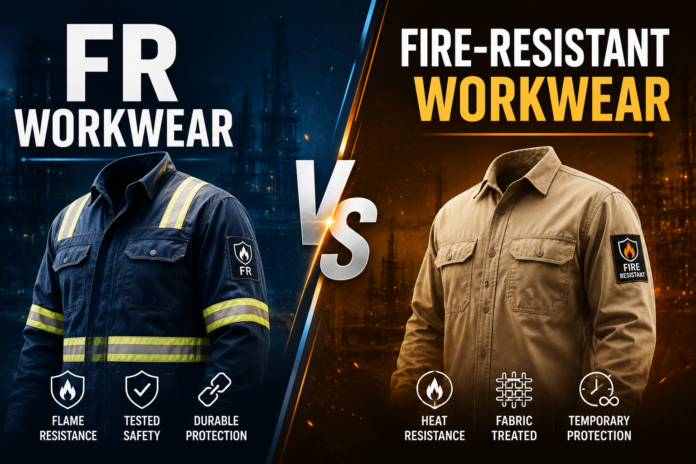
It is important to distinguish between FR workwear vs fire-resistant workwear clothing because buyers often use the terms interchangeably. FR is usually used to refer to flame-resistant clothing in workplace discussions. The phrase “fire-resistant clothing” is often used, although it may not be as specific when the product description does not specify the level of protection.
It is important to understand that no workwear can be completely flameproof. Good FR clothes are designed to reduce the spread of flames, resist ignition and auto-extinguish themselves after removing the source. The safest option for industrial teams is always determined by job risks, fabric ratings, garment labels, and workplace PPE requirements. To compare the different options of protective workwear for various job sites, you can browse through our collection.
What does FR workwear mean?
FR workwear means flame-resistant workwear. Protective clothing for workers exposed to flames, flashfires, arc-flashes, heat, and sparks. Fabrics that don’t burn like regular clothing are used to lower the risk of injury.
The term FR clothing can be used to describe coveralls and jackets as well as shirts, trousers, and other layers of protection. OSHA’s guidance on electric power work uses the term “flame-resistant clothing” and states that employers should assess flame and arc hazards before choosing protective clothing.
What does fire-resistant workwear mean?
Many people refer to clothing as fire-resistant workwear. It is often used to refer to clothing that resists flames in everyday speech. Buyers should take care because “fire resistant” may sound more powerful than it actually is.
Fabrics may be flame-resistant, but this does not guarantee that they will protect you from every type of fire. Fabric type, labeling, intended hazards, test ratings, and garment labels should all be considered when evaluating workwear. It is particularly important for oil and gas workers and utility workers as well as industrial maintenance and welders.
The main differences between FR and Fire-Resistant Workwear
The main difference between FR and fire-resistant clothing is the technical definition. Fire-resistant clothing is often referred to as FR, while FR in safety apparel is used for flame-resistant clothing.
Names alone are not sufficient for a purchaser. The garment must clearly state what level of protection is offered, the fabric used, and what workplace hazards are addressed. The garment should not be considered as protective clothing if it does not state that the fabric is flame resistant, has been tested, and can handle workplace hazards.
The Words Matter
Safety clothing isn’t normal fashion. If exposed to electric arc or flame heat, a regular shirt can melt, ignite or burn. Workwear designed for protection is intended to minimize this risk.
OSHA’s guidance states that employees who are exposed to electric arc or flame hazards need to wear clothing that won’t melt, ignite or burn in the workplace. The correct choice of clothing is more important that choosing clothes with an appealing product name.
Protective Coveralls that cover the entire body
Coveralls with FR are ideal for workers who need a one-piece coverall that covers the arms and legs, as well as the chest. Coveralls can reduce the gap between the upper and lower clothing, making them useful for industrial work where there may be sparks, heat or flash exposure.
Flame resistant coveralls can be used for a variety of industrial applications, including oil and gas, electrical support, utility, and heavy duty. Fit should be such that it allows for movement, while covering the entire body.
The FR jackets are designed to provide layers of protection.
When workers require an outer layer of protection, they use FR jackets. These jackets are useful in cool conditions, for outdoor work or industrial maintenance. They can also be used on job sites that require flame-resistant layers. If the danger requires complete protection, a jacket shouldn’t replace base and mid-layers.
When selecting a jacket, pay attention to the fabric, type of closure, coverage, cuffs, and comfort. It should be able to support the wearer’s movement while bending or reaching overhead.
The FR Pants are designed to provide lower-body safety.
These pants are designed to protect workers’ lower bodies from workplace flame hazards. These pants are ideal for those who prefer separate garments on the upper and lower body. The pants must be comfortable and durable.
Flame resistant pants must fit snugly around the seat, waist, thighs and hem. Too loose pants can catch on the equipment. Pants too tight may restrict your movement or reduce comfort when working long hours.
Workwear FR Shirts
Many workers wear FR shirts because they need to be protected from flames without having to wear a coverall. A shirt may be paired up with FR jackets or pants depending on your work environment.
Flame resistant shirts must cover arms correctly, be closed securely and remain comfortable when moving. If the work hazard is melting or ignition, workers should wear protective synthetic clothing underneath.
Why FR Workwear is Needed
Workwear with FR is needed in situations where there are flames, flashfire, arc-flash, sparks or heat hazards. Industries that are commonly used include electrical utilities, oil and gas plants, welding, metalwork, chemical factories, refineries and industrial maintenance.
A workplace assessment will determine the exact requirements. OSHA’s PPE guidelines place importance on the identification of workplace hazards, and choosing protective equipment that is suitable for these hazards.
The Fabrics Used in Workwear
Fabrics that are flame resistant can be manufactured in many different ways. Fabrics that are flame resistant by nature have the property built in. Some fabrics have a chemical treatment to make them resistant to flame.
When they provide the necessary protection, both types are useful. Buyers should carefully examine the label of their garment, information on fabric, instructions for washing, and rating. It depends on the job, budget, comfort, durability and washing conditions.
The term “fire-resistant” does not mean that the product is fireproof
Fire-resistant clothing can be confusing to buyers, as “fire-resistant”, may sound like it cannot burn. This is incorrect. The protective clothing does reduce the risk but doesn’t make the worker completely fireproof.
It is important to provide workers with more protection, than just normal clothing, by preventing ignition and reducing the amount of burning. The workers still require safe procedures, the correct PPE and training as well as proper hazards controls. Safety at the workplace is not just about clothing.
The right fit and comfort is important
Wearable protective workwear is also required. Workers may not wear the correct clothing if it is uncomfortable, too hot, stiff or poorly fitted. Safety and productivity can be affected.
Clothing that is FR-safe should be able to balance the protection of the garment with its ability to move, breathe, weight and size. It isn’t always about the most heavy garment. The best garment is one that fits the danger and allows the worker to perform their task safely.
Cleaning and Washing
The care of FR garments is important, as incorrect washing may reduce their performance, comfort or appearance. The care label should be followed and workers must avoid using washing methods which damage fabric or finish.
Some treated FR fabrics may need extra care to maintain performance. Fabrics that are inherently flame resistant may retain their protection for longer but still require proper washing and inspection. Before continuing to use damaged, heavily used, or contaminated garments, they should be inspected.
Checklist for FR vs. Fire-Resistant Workwear
Checklist to use before purchasing protective clothing
- On the label of the product, check to see if FR stands for flame resistant.
- Don’t assume that fire-resistant is the same as fireproof.
- The garment should be matched to the work environment hazard.
- Please check fabric types and their protection ratings.
- Choose coveralls for fuller body coverage.
- Layering jackets is a great way to protect yourself.
- Select FR shirts for workwear separates.
- Please check the washing instructions.
- Under FR clothing, avoid wearing synthetic materials that are not protective.
- Before ordering in bulk, test the fit, comfort, durability, and movement.
The Best Approach to Buying
It is best to begin your search by identifying the hazards, and not just the name of the product. Buyers should consider the risks that workers are exposed to, which body parts need protection, as well as what style of garment is most practical and meet any required standards.
Compare options within a FR category. It is easier to choose coveralls and jackets based on the actual job rather than choosing them purely based upon appearance.
Common mistakes to avoid
A common mistake people make is to buy clothing just because the label says “fire resistant”. It is important that the product’s description clearly explains its purpose of protection, type of fabric, and appropriate work environment. Safety clothing cannot be identified by a vague name.
Comfort is another mistake when comparing FR and fire resistant workwear. The clothing must be comfortable enough to wear for the entire shift. Before finalizing the selection, it is important to check for protection, fit, comfort, heat stress and washing performance.
Conclusion
Clarity, safety and the correct selection of products are key factors in deciding between FR workwear and fire-resistant clothing. Fire-resistant workwear, or FR, is more general and includes a range of terms, including fabric, labeling and workplace compatibility.
It is important to consider the danger when choosing protective clothing. Select garments to match your job. They should cover all body parts, provide comfort and adhere to safety guidelines. Workwear that is FR should provide better protection than regular clothing, while still allowing workers to work and move comfortably.
FAQs
What is flame resistant in clothing?
FR means usually that it’s flame-resistant. Clothing designed to reduce the risk of fire and to prevent it from continuing to burn is what FR refers to.
Is the fire resistant clothing and fireproof clothing the same?
Fire-resistant clothing isn’t fireproof. The wearer is not completely protected from all fire hazards.
Which is more comfortable, the FR coveralls and FR shirt or pants?
The FR coveralls offer a one-piece solution, while the FR shirts with pants provide more versatility. What’s the best option? It depends on your job hazards.