Over the last two decades, the motorcycle jacket market has changed dramatically. Riders are increasingly choosing textile constructions, which offer greater weather adaptability, lighter weight and multi-season versatility alongside the protective performance leather had historically dominated. Custom textile motorcycles jackets are now one of the fastest-growing segments in motorcycle clothing manufacturing. They attract brands from adventure touring, urban commuter, and multi-discipline riders who understand the commercial potential in technical fabric constructions. This guide will explain why brands choose technical fabric for custom textile jackets. It will also describe what materials and construction techniques define quality and how to evaluate manufacturers who can deliver genuine performance in this technically demanding category.
Why the market is shifting towards custom textile motorcycle jackets
Over the last decade, the custom textile motorcycle jacket market has grown rapidly. Understanding these forces can help brands understand the opportunities and requirements for this category. As riders embark on longer and more varied journeys, they are increasingly exposed to different climate zones. This creates a demand for jackets which can handle rain, heat, or sun in a single piece, rather than needing multiple specialist pieces. The growth of adventure tours as a riding style has also brought a large number of new riders to the market. These riders prioritize practicality and versatility along with value, which makes custom textile motorcycles a great product category for brands that serve this growing demographic.
The core technical fabrics in custom textile motorcycle jackets
The outer shell fabric is the first material to be selected for custom-made textile motorcycle jackets. It determines the protective performance, the weather resistance and the aesthetic positioning of the jacket.
Cordura Nylon
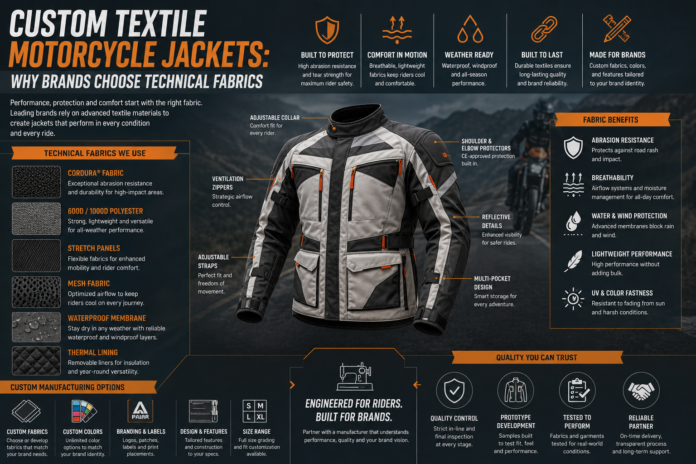
Cordura nylon is the most popular and widely used technical fabric for custom textile motorcycle jackets. It is known for its exceptional tear strength and durability in demanding riding conditions. Cordura nylon is available in denier counts from 300D to 1000D, allowing brands to choose the level of protection that best suits their target riding category. This does not compromise weather resistance or membrane compatibility which are key factors for textile jackets to be attractive to consumers. Cordura fabrics are more suited to digital printing, reflective treatments and brand surface applications than leather. This allows brands to have greater flexibility when designing custom textile motorcycle jackets.
Ballistic Nylon and High Tenacity Polyester
These fabrics are a great alternative to standard outerwear materials. They offer abrasion-resistant technical shells at a price point that allows brands to reduce production costs without compromising protection in the majority of riding situations. These fabrics are ideal for custom textile motorcycle jackets that target value-conscious segments. They offer a significant protective improvement over standard outerwear fabric at material costs which allow brands to maintain retail margins in a variety of price ranges. High-tenacity poly fabrics also accept sublimation print programs, which create distinctive brand surface appearances that are not possible on nylon or leather outershells.
Ripstop technical fabrics
The ripstop weave structure prevents small tears from spreading into larger failures, when jackets come in contact with terrain features, road furnishings, or abrasive surface during an accident or incident. This makes the ripstop construction especially valuable for adventure and off-road motorcycle jackets. In addition, ripstop fabrics are able to incorporate different fiber types into their warp-and-weft structure. This allows manufacturers to create hybrid fabric that combines the abrasion resistant of Cordura fibers with stretch properties of synthetic performance fibres. Ripstop technical fabrics are becoming an increasingly popular material choice for companies creating custom textile motorcycle jackets that require both protection and freedom of movement.
Softshell technical fabrics
Softshell fabrics are made up of a technical fabric face and a stretch fleece or performance back. They provide four-way stretch with moderate weather resistance, as well as inherent breathability. Softshell construction is ideal for custom textile motorcycle jackets aimed at urban commuters and mild-weather riders. The jackets are lighter, more flexible, and feel more like premium lifestyle outerwear. Softshell fabrics are more flexible and stretchier than rigid Cordura, but they require CE armor integration.
Waterproof Membrane Integrated in Custom Textile Motorcycle Jackets
Custom textile motorcycle jackets offer waterproof protection, which is a major competitive advantage over leather. The quality of membrane integration determines the effectiveness of this advantage in delivering real riding performance.
Membrane Lamination Approaches
In most cases, waterproof breathable membranes for custom textile motorcycle jackets can be integrated using two- or three-layer processes of lamination that bond the membrane with the outer shell fabric or the inner lining at the same time. The three-layer lamination process bonds the membrane to both the outer shell fabric and the inner lining of a motorcycle jacket in one construction. This produces a waterproof textile that is more durable and performs better than two-layer options, but it adds to manufacturing costs. Drop-liner constructions, which hang a membrane liner separately inside the outer shell of the jacket, offer brands an accessible waterproofing solution.
Seam Sealing Standards
The performance of the membrane in a finished custom textile motorcycle jacket is as dependent on the seam sealing standards used as it is on the material. Unsealed seams or partially sealed ones allow water to penetrate at the stitch penetration points, which compromises the waterproof function of the membrane under prolonged rain exposure. The highest level of waterproof protection is achieved by fully taped primary seams, while critical taped seams are limited to the most exposed areas in order to reduce costs. Zipper waterproofing with waterproof zip tapes and laminated zip covers is also important, as they must seal any openings through the waterproof membrane.
The breathability of waterproof custom textile motorcycle coats is a measure of how well body heat and perspiration escapes through the membrane when riding. This directly affects rider comfort in varying riding conditions and temperatures. A higher breathability rating, usually expressed as moisture-vapor transmission rates, indicates membranes which allow for more effective heat and sweat management. This is important in active riding styles such as adventure, trail and enduro, where riders produce significant body heat through sustained physical effort. Brands specifying breathability in their custom motorcycle jackets should ensure that the claims made by suppliers are not backed up by test data.
CE Armor integration in custom textile motorcycle jackets
CE armor integration into custom textile motorcycle jackets is based on the same principles as leather jacket engineering, while also addressing the unique construction challenges posed by textile outer shells or removable lining systems.
Armor Pocket Construction on Textile Jackets
The placement of armor pockets on custom textile motorcycle jackets should align the protective inserts with the primary impact zones in the body, regardless of the size range that the jacket is designed to serve. Retention systems must be adapted to the weight and construction of the outer shell fabric. The placement of armor pockets must also take into account the movement of the outer shell fabric relative to the body when riding dynamically. Textile fabrics, which are more flexible and stretchy than leather, may be able to move the jacket in a way that can displace the armor if the pocket construction is not done correctly.
Compatible with removable liner armor
Brands must specify whether CE armour is integrated into the outer shell or the removable liner. This decision impacts the consistency of protection across different jacket configurations. The armor integrated into removable liners only provides certified protection while the liner remains in place. This could leave riders with no protection when they remove the liner during warm riding conditions. Integrating primary shoulder and elbow armour into the outer shell, rather than only into a removable lining, ensures consistent protection regardless of the thermal conditions.
Specifications for Custom Textile Motorcycle Jackets
To ensure the quality of their custom motorcycle jackets, brands must clearly specify these construction features when developing their manufacturing brief.
- Denier and specification of outer shell fabric: Confirm Cordura denier, hybrid fiber composition, and the jacket’s level of abrasion resistant.
- Membrane Integration Approach: Specificate two-layer or three-layer construction, and confirm the seam sealing standards required along primary and secondary seams.
- CE armor specifications: Confirm CE Level 1, Level 2, and chest armor pockets as required.
- Design of ventilation system: Specification for chest intake vents, underarm zipper vents, and rear exhaust panels including hardware closures and weatherproofing on vent edges.
- Lining Specification: Confirm the lining fabric type and moisture-wicking requirements. Also, confirm where to place stretch panels at key movement zones.
- Hardware Grade: Use YKK or comparable quality zippers. Also, specify corrosion-resistant snaps and buckles. Cuffs and hems should be adjustable to match the jacket’s price.
The Technical Fabrics to the Riding Category
Different riding categories have different fabric specifications. This means that aligning the outer shell material with your target riding category will produce more commercially viable products than using a single fabric specification for diverse market positions. For adventure apparel, brands specify Cordura nylon that is fully taped with integrated membranes and ventilation systems to accommodate riders in a wide range of weather conditions. touring apparel manufacturers prioritize comfort-focused linings and removable thermal liners along with strong waterproof performance.
urban motorbike apparel is often made with lighter Cordura or softshell constructions for urban riding. These prioritize everyday wearability, stealth aesthetic integration and basic weather protection. off road motorcycle apparel uses mesh-panel and ripstop constructions to maximize ventilation and freedom of movement over weather protection. This is because off-road riders prefer thermal management and rain resistance for most riding conditions. Brands developing motorcycle jackets can adhere to the highest standards of waterproofing and seam sealing without compromising membrane performance.
The motorcycle clothing collection is a useful resource for brands looking to develop complete motorcycle apparel lines alongside textile jacket programs. It provides a reference on how fabric construction techniques are applied across motorbike suits and protective riding equipment categories.
Trusted manufacturer of custom textile motorcycle jackets
Custom textile motorcycle jackets are a great way to showcase your brand and deliver a high level of technical performance. However, they require partnering with a manufacturer who is familiar with the challenges presented by technical fabrics compared to leather. Working with a manufacturer who has experience in the field is essential when developing jackets that are suitable for adventure touring, urban outerwear or multi-season riding jackets.
We are a custom motorcycle apparel manufacturer that helps brands create custom textile motorcycle jackets for all riding categories. From initial fabric specification, CE armor integration, pattern development and bulk production, to quality-controlled bulk manufacturing, we assist with the entire process. Contact our team for more information on fabric options, waterproofing membrane standards, armor specs, and production timelines that are suited to the riding category and positioning of your brand.
Conclusion
Custom textile motorcycle jackets are a highly sophisticated and commercially important product category. They reward brands that invest in high-quality materials and construction, as well as a compelling design. Cordura nylon and ballistic polyester technical fabrics offer the outer shell protection that riders require, while waterproof membranes, fully taped construction, CE armor engineering and riding position ergonomic patterns determine the effectiveness of the jacket in real riding conditions. Similarly, matching the technical fabric and construction specifications with the demands of the targeted riding category will produce more commercially relevant product than applying generic specifications for textile jackets across different market segments.
FAQs
Why choose brands textile fabrics for motorcycle jackets instead of leather?
Textile fabrics enable brands to incorporate waterproof membranes and removable thermal liners. They can also integrate ventilation systems and complete ventilation systems, which leather constructions cannot.
What is the best technical fabric for motorcycle jackets to protect against impact?
Cordura nylon, in denier counts ranging from 600D to 1,000D, offers the best abrasion resistance of all the technical fabrics commonly used in motorcycle jacket production.
What is the importance of seam sealing on waterproof motorcycle jackets made from textile?
Seam sealing plays a crucial role in preventing water from entering the fabric at seam penetration points, even if the fabric membrane surrounding it is waterproof.