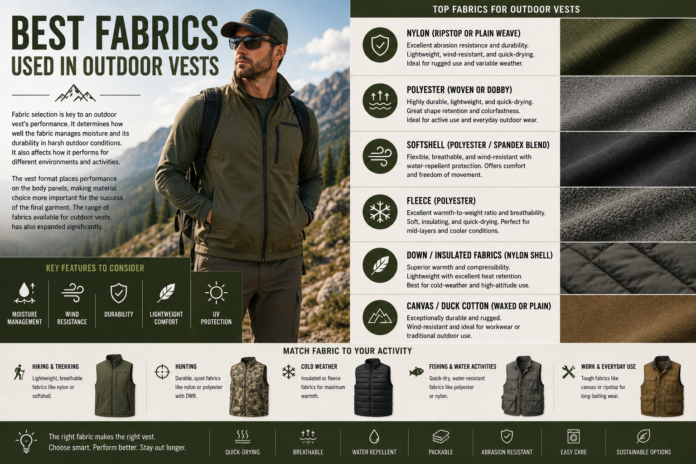
Fabric selection is key to an outdoor vest’s performance. It determines how well the fabric manages moisture and its durability in harsh outdoor conditions. It also affects how it performs for different environments and activities. It is important for brands developing outdoor apparel or buyers making informed purchases to understand the best fabrics used in outdoor vests. The vest format is different from full jackets, where the lining and sleeve options complicate the fabric selection. Instead, the vest format places the performance on the body panels. This makes the material choice more important for the success of the final garment. The range of fabrics available for outdoor vests has also expanded significantly.
Fabric Choice Determines Outdoor Vest Performance
It is important to know the specific performance requirements that vests have before you start looking at fabric options. Vests have no sleeves. The body panel fabrics are responsible for all the insulation, weather protection and moisture management that would be distributed across the jacket’s body, sleeves and hood.
Core Performance Requirements For Outdoor Vest Fabrics
Fabrics for outdoor vests must have several different performance characteristics depending on their type and intended usage. Insulating vests need fill materials that are high in warmth to weight, have a good loft retention and perform well both in wet and dry weather. Softshell and shell vests need face fabrics that are wind-resistant, water repellent, and have enough breathability to be used outdoors. All vests must have outer fabrics that are abrasion-resistant to resist pack contact, outdoor surface wear, and repeated outdoor usage without premature degradation.
The importance of sustainability is also reflected in the fabric selection. Recycled content, certified responsibly, and less chemical processing are all important commercial differentiators. Contact our outdoor garment manufacturing today to begin the conversation.
Best fabrics used in outdoor vests by category
Knowing which fabrics perform best across vest types and applications can help brands make better sourcing decisions. It also helps buyers to understand the quality of the materials behind the products that they purchase.
Down Fill – The Standard Insulation for Lightweight Vests
The down fill, sourced from ducks or geese, remains the standard insulation material for lightweight outdoor vests. No synthetic substitute can match its warmth to weight ratio with equivalent fill power. Natural down clusters are a three-dimensional structure that traps air, creating insulating barriers and retaining core body heat.
Fill power is another way to measure down fill. It’s a rating which indicates how many cubic inches an ounce of feathers will occupy when they are allowed to loft. A higher fill power is a sign of better insulation. The 600 fill power is suitable for outdoor general use and comes at a reasonable price. For serious outdoor and Alpine applications, 700 to 800 Fill Power delivers superior warmth-to weight performance. The highest fill power is 900 and above — this is used in ultralight expedition jackets, where every gram counts.
When wet, however, down fill is no longer insulating. Moisture causes the clusters of feathers to collapse. This eliminates the loft created by the trapped air. Down fill is best suited to dry, cold environments or activities that are unlikely to experience sustained precipitation. Synthetic fill is the best choice for brands creating vests that will be used in wet environments. Contact our outdoor garment manufacturing team today to discuss fill options for your vest.
Synthetic Fill – Reliable Insulation for Wet Environments
Synthetic fabrics, which are typically polyester continuous filament or short-stack fibre constructions, replicate the insulation properties of down and maintain warmth even when they get wet. Synthetic fill, unlike down, retains its loft after moisture exposure. This makes it a better choice than down for outdoor environments that are consistently damp.
In recent years, synthetic fills, such as PrimaLoft, Thinsulate and Coreloft, have become more efficient, delivering heat-to-weight values that are comparable to quality, even at thinner thicknesses. PrimaLoft has been a standard synthetic insulation for outdoor clothing. It is available in different variants that are optimised to meet specific performance goals, such as active breathability and packability.
Also, recycled synthetic fills – made from post-consumer bottles and textiles – are widely available. They perform as well as virgin alternatives. Recycled synthetic fill is a great option for brands creating camping clothing collections that require performance in both wet and dry weather conditions.
Ripstop Nylon Shell Fabrics
The fabric used to make the outer shell of an insulated jacket determines its durability and packability. It also affects how well it resists wind and light rain. Ripstop nylon is widely used in the construction of premium outdoor vests. The distinctive ripstop pattern – woven into nylon at regular intervals – prevents small tears spreading across the fabric. This improves tear resistance without adding significant weight.
Ripstop nylon is also resistant to water and accepts DWR treatment well, which causes rain to run off and bead on the surface. It dries rapidly after being exposed to wet conditions. The light weight of ripstop nylon makes it an ideal fabric for vests that need to be compacted into a small stuff bag or integrated pocket.
Also, ripstop is available in different weights that are suitable for different vest applications – from ultralight 10 denier constructions for lightweight performance vests up to heavier 30 denier constructions and beyond for everyday outdoor constructions. Our outdoor Jackets Manufacturing team has extensive experience with ripstop in multiple weights. Contact us to discuss your vest shell fabric options.
Softshell composite fabrics
Softshell composite fabrics – typically a stretch woven exterior bonded to a jersey or fleece inner – deliver wind resistance, breathability and stretch all in one fabric layer. They are ideal for active outdoor vests where weather protection is just as important as freedom of movement.
Softshell vests are made of composite fabrics and they suit high output activities well. For example, ski touring, trail-running in cool weather, and technical climbing. The body produces significant heat when moving and a vest that is breathable and stretchable will outperform an insulated vest which would cause overheating.
The vest , and jacket made of the same composite fabric creates a cohesive layering. The vest serves as an active layer while the jacket provides additional weather protection if conditions worsen. Contact our team to create a softshell outerwear collection that includes vests and jackets.
Fleece fabrics for vest construction
The use of fleece fabrics, which are brushed polyester constructions with a GSM between 200 and 350, is common in mid-layer applications for outdoor vests. This is where warmth, breathability and moisture management are primary requirements, without the need to pack the garment, as down or synthetic fillings are more suitable.
Moreover, fleece vests can be used as both outerwear for casual wear and in outdoor layering systems. Fleece vests are a great option for brands looking to create a range that bridges the outdoor and casual market. They combine warmth, breathability and a clean aesthetic.
Outdoor fleece Vests are a great match for matching fleece jackets, base layers and other outerwear. This creates a coordinated range that drives higher average order values. Contact us today to learn more about fleece vest options for your lifestyle or outdoor brand.
Shell Vests with Breathable Membranes that are Waterproof
Waterproof shell vests are made with the same waterproof membrane technology that is used in full waterproof jackets. They block external liquid water and allow internal moisture vapours to escape, but they have no sleeves. This provides core weather protection while being lighter.
Waterproof shell vests with fully-taped seams provide genuine waterproof performance, rather than simply water resistance. They are therefore suitable for prolonged rain exposure when cycling, trail running and other outdoor activities, where arm protection from rain is not as important as core dryness.
Contact us to learn more about our waterproof clothing production capabilities. We can produce waterproof membrane vests with fully taped edges and technical face fabrics.
Recycled and sustainable fabric options
The options for brands to choose from have significantly improved. The Responsible Down Standard certified recycled down, nylon and polyester shell fabric, and recycled synthetic fibers made from waste plastic waste are all comparable to virgin fabrics while reducing production’s environmental impact.
Bluesign-certified fabric also provides independent verification of the production process meeting responsible environmental, safety, and health standards throughout the entire supply chain. This gives brands a credible, verifiable sustainability message to communicate to outdoor consumers who are becoming more conscious. Brands developing collection of hiking apparel alongside outdoor vests will benefit from using certified sustainable fabrics in both product types.
Key Fabric Properties for Outdoor Vest Production
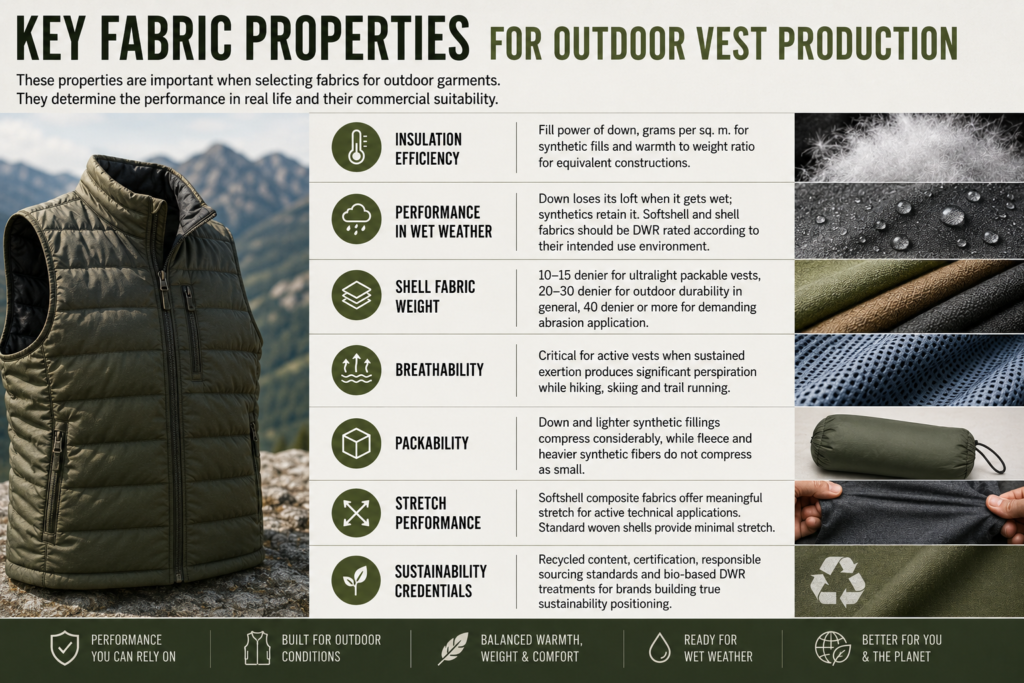
These properties are important when selecting fabrics for outdoor garments. They determine the performance in real life and their commercial suitability.
- Insulation efficiency – fill power of down, grams per sq. m. for synthetic fills and warmth to weight ratio for equivalent constructions
- Performance in wet weather — Down loses its loft when it gets wet; synthetics retain it. Softshell and shell fabrics should be DWR rated according to their intended use environment.
- Shell Fabric Weight — 10-15 denier for ultralight packable Vests, 20-30 denier for outdoor durability in general, 40 denier or more for demanding abrasion application
- Breathability – critical for active vests when sustained exertion produces significant perspiration while hiking, skiing and trail running
- Packability — Down and lighter synthetic fillings compress considerably, while fleece and heavier synthetic fibers do not compress as small.
- Stretch performance — Softshell composite fabrics offer meaningful stretch for active technical applications. Standard woven shells provide minimal stretch
- Sustainability credentials — recycled Content Certification responsible sourcing Standards and bio-based DWR Treatments for brands building true sustainability positioning
Choose the right fabrics for your outdoor vest range
Fabric selection is a key component of the development of an outdoor vest. However, translating this choice into a vest that meets all specifications requires both manufacturing expertise and material knowledge. A product that is made with the right fabric but constructed incorrectly will disappoint, regardless of its technical merits. A vest with the right fabric, baffling specified correctly, fill weight appropriate, shell fabric compatible, and well-designed elements will deliver on all performance claims and build lasting customer confidence.
In addition, using the same face fabric family across the entire range, including outdoor coats and waterproof jackets, simplifies the sourcing process, improves the visual coherence and reduces the complexity of quality control across the production process.
Are you ready to start developing your outdoor vest collection from the very beginning with the best fabrics? Contact our technical manufacturing department today. We support outdoor brands from the initial fabric selection, tech pack preparation to bulk production quality assurance and on-time deliveries.
Conclusion
Outdoor vest fabrics are available in a wide range of technical and commercially viable options. They can be anything from waterproof membranes with breathable properties for technical shells, to recycled and sustainable materials for all vest types. The foundation for building a successful outdoor vest line is understanding which fabric offers the best combination of warmth and weather protection with breathability and sustainability.
Making the right fabric choice at the beginning of the process, whether you’re sourcing fabrics for a new vest production run or creating your first outdoor vest line, is the most important step towards a product that your customers will recommend and trust.
Explore the range of outdoor garment manufacturing options to get started today.
FAQs
What is the best insulation for a lightweight packable outdoor vest?
High fill power down — 700 to 800 fill power and above — delivers the best warmth-to-weight ratio for lightweight packable outdoor vests in dry conditions. For wet environments, premium synthetic fills like PrimaLoft Gold maintain warmth when wet and are the more appropriate choice.
What shell fabric is best for an outdoor vest?
Ripstop nylon is the most widely used shell fabric for insulated outdoor vests — delivering good tear resistance, light weight, and effective DWR treatment compatibility. Heavier denier ripstop suits durability-focused constructions, lighter denier suits ultralight packable applications.
What is the difference between down and synthetic fill in outdoor vests?
Down delivers superior warmth-to-weight ratio in dry conditions but loses insulating properties when wet. Synthetic fill maintains warmth when wet but is heavier and less packable than equivalent down constructions.
Are recycled fabrics suitable for technical outdoor vest production?
Yes — recycled nylon and polyester shell fabrics, recycled down, and recycled synthetic fills now perform comparably to virgin alternatives — making them viable choices for technically demanding outdoor vest production without compromising performance.