Understanding the different types of fleece clothing is important for anyone who wants to build a brand for outdoor clothing or choose the best insulating layer according to their activity. Fleece fabrics, which are usually made of polyester, mimic the insulation properties of wool. They also offer many practical benefits, including being lighter, quicker drying and more resistant to moisture absorption. The variety of fleece clothing has also increased significantly. From lightweight grid fleece baselayers to heavyweight expedition jackets, each type is engineered to meet a particular activity level, temperature range and performance requirement. This guide covers all major types of fleece clothing. It explains the differences between each type and gives examples for outdoor and everyday uses.
Fleece clothing is different from other insulation layers
It is important to know what fleece is and why it plays such an integral role in the layering of outdoor clothing. The fleece fabric is made by brushing a knitted polyester base into a raised fibrous surface. This traps air in the fabric and creates an insulating barrier for the wearer.
Fleece fabric: its core properties
Fleece has four important performance characteristics that make it a valuable addition to outdoor layering systems. It is more efficient in terms of warmth to weight than most natural fibres at the same thickness, so lighter garments are able to provide equivalent insulation. It continues to provide insulation even when damp, unlike down insulation which collapses and loses thermal properties when saturated with moisture. It dries much faster than cotton or wool after being exposed to moisture, allowing it to quickly recover its full insulation performance. It is also highly breathable, allowing moisture vapour to escape from the fabric rather than condensing on the skin.
How Fleece Fits into the Layering System
Most commonly, fleece clothing is used as a middle layer in outdoor apparel layering systems. It sits between a moisture wicking bottom layer, and an outer shell that protects against wind and weather. Certain fleece types, particularly those with heavyweight constructions, can be used as an outer layer in cold dry conditions. Understanding the place of each fleece type in the layering scheme is key to choosing the right type.
Fleece Clothing Types and their Specific Uses
Each fleece garment is optimised to a particular performance level, activity, or temperature range. Each type has its own commercial positioning, making fleece clothing one of the most diverse and versatile categories available to outdoor apparel brands.
Microfleece
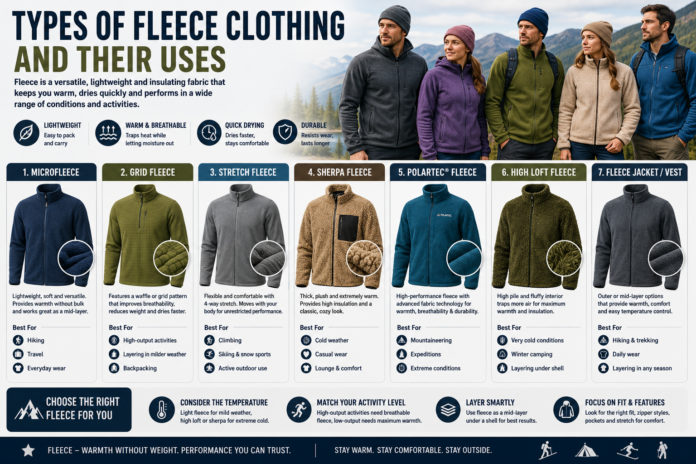
Microfleece, the lightest fleece available (typically in the range of 100-150 GSM), provides a minimal layer of insulation that adds warmth while avoiding significant bulk and weight. The microfleece fibres are finer than those in standard fleece constructions, creating a smoother and softer surface. They also have better moisture-wicking qualities than heavier alternatives.
Microfleece can also be used as a mid-layer or base layer for high-output sports where comfort and moisture management are more important than warmth. It is a great next-to skin layer for activities like hiking, trail-running, and skiing, where moisture management and comfort are more important than warmth.
Microfleece, with its softness, moisture management, and light insulation, is also widely used as a liner in gloves, hats and jackets.
Grid Fleece
Grid fleece, also called thermal grid fleece and waffle fleece, has a grid pattern created on the inside surface by removing material in regular intervals. The grid structure is a way to reduce fabric weight and maintain insulation performance. This is because the air pockets that are created by the grid pattern trap heat as well as a continuous surface of fleece at a fraction the weight.
Grid fleece is one of the most efficient fleeces for its weight and warmth. Grid fleece is popular for base layers, which are designed to keep you warm and dry in cold weather.
Grid fleece is also increasingly being used for ultralight midlayers, packable fleece jackets, and other lightweight outdoor pursuits. Every gram counts when it comes to a light pack. Contact our outdoor wool manufacturing team to discuss your requirements if your brand is looking to develop lightweight technical fleeces for high-performance markets.
Midweight Fleece
The most versatile and popular type of fleece is midweight fleece, which has a GSM between 200-280. It provides warmth in cool to cold weather conditions, while still remaining lightweight enough for active wear as a middle layer beneath an outer jacket.
Midweight fleece jackets also make the best mid-layers for most outdoor activities, including hiking, camping and skiing. They balance breathability and insulation better than lighter or heavier options, regardless of the conditions.
Midweight fleece is also a popular fleece type for brands that target both outdoor enthusiasts and lifestyle customers. We have outdoor jackets manufacturing capabilities that cover midweight fleece production in a range of styles and constructions. Contact us today to begin your development process.
Heavyweight Fleece
The maximum amount of insulation is provided by heavyweight fleece, which typically ranges from 300 to 400 GSM. It can be worn as an outer layer alone in cold, dry conditions.
Heavyweight fleece is also well-suited for static outdoor uses — such as belaying on a climbing crag or sitting in a tent, or standing on the ski slope lift. The body produces minimal heat, and insulation is more important than breathability. The fleece is widely used for cold climate and expedition applications, where the maximum weight insulation is more appropriate.
Heavyweight fleece, however, is not suitable for high-output sports. Its weight and reduced breathability can cause overheating when doing sustained aerobic exercise. It is therefore most effective when used as part of a layering scheme that includes a lightweight active layer during movement phases, and heavyweight fleece during rest and static exposure.
Stretch Fleece
Stretch fleece is a fleece fabric that incorporates elastane to provide the same insulation and breathability as standard fleece, but with a four-way stretch for unrestricted motion during dynamic physical activities. It is therefore the best choice for sports where warmth and freedom of movement are equally important. This includes skiing, climbing and other technical alpine pursuits, where the body is in complex positions. Standard fleece constructions may restrict this.
Stretch fleece garments are also more athletic in fit, as the fabric’s stretch allows for a cut that is tighter and moves without restriction. The athletic fit reduces the bulk of an outer shell jacket. Stretch fleece is therefore the mid-layer fabric of choice for technical applications, where layering efficiency and insulation performance are equally important.
Our skiwear manufacturing team can produce stretch fleece base pieces and mid-layers in a variety of weights and constructions. Contact us to discuss the development of your ski or alpine polar fleece.
Windproof Fleece
The windproof fleece is a combination of a fleece with a thin membrane that blocks wind. It has the warmth, breathability and wind-blocking performance of fleece. Windproof fleece jackets can be worn as an outer layer in windy cold conditions, where a shell jacket is not required.
Windproof fleece is also a great choice for mountainous and exposed ridge environments, where wind chill can be more challenging than rain. This eliminates the need for a separate jacket to protect against wind — reducing the total weight of the pack and simplifying layering for activities when the weather is cool, windy and not too wet.
The softshell jacket, and the windproof fleece are adjacent layers in an outdoor layering system. Windproof fleece is more important for warmth while softshell is more important for stretch and active ventilation. This distinction allows brands to position their products clearly within the outdoor range.
Sherpa Fleece
Sherpa is a popular fleece that mimics the look and feel of sheepskin. It has a curly, dense pile that provides warmth and an appealing tactile appearance.
Sherpa fleece can also be used in standalone jackets and vests. Its warmth and aesthetic appeal give the garment a premium look. Sherpa fleece is produced in standalone styles such as sherpa jackets, outdoor vest, which have enjoyed great commercial success on the outdoor, heritage and fashion markets.
Sherpa fleece is also a growing trend in sustainable apparel. Recycled sherpa fabrics made from recycled plastic bottles are comparable to virgin sherpa and offer a performance and aesthetic that’s comparable to virgin alternatives, while still delivering significant sustainability credentials. Are you ready to create sherpa outerwear for your company? Let our manufacturing team help you create a product that your customers will love.
Polar Fleece
Polar fleece is a standard weight, brushed poly fabric that ranges from 200 to 300 GSM. It offers reliable insulation and easy care.
Polar fleece is used in a wide range of garments, from jackets and pullovers to fleece-lined hiking pants, winter accessories, and more. The fabric is used in a wide range of garments, from outdoor jackets to fleece-lined hike pants.
Polar fleece comes in virgin and recycled versions, so brands can easily transition to sustainable production while maintaining their product specifications.
Comparison of Fleece Clothing: Key Features
These properties are important when evaluating fleece fabrics to be used in clothing production and for commercial purposes.
- Fabric Weight — 100-150 GSM microfleece, grid fleece and midweight base layers. 200-280 GSM midweight layers. 300-400 GSM heavyweight outer layers.
- Heat-to-weight ratio — Grid fleece and stretch fleece provide the most efficiency, while heavyweight and Sherpa provides maximum absolute warmth
- Breathability — Microfleece, grid fleece and windproof fleece have the lowest breathability within the category.
- Stretch — stretch fabric with elastane for technical applications. Standard fleece constructions have minimal stretch.
- Wind Resistance — windproof flannel adds a membrane to block the wind, standard flannel offers minimal wind resistance.
- Sustainability credentials — recycled Polyester constructions are available in all fleece types with no performance compromise
- Aesthetic – Sherpa fleece has the most distinct visual character. Polar and midweight fleece has the most neutral appearance.
How to Create a Fleece Clothing Range For Your Outdoor Brand
A well-structured range of fleece clothing can cover multiple customer segments, activities, and temperatures from one product category. In addition, fleece clothing is typically priced at a high retail level relative to its production costs. This makes it an attractive base for outdoor and casual lifestyle brands.
In addition, by developing fleece clothing in conjunction with complementary outerwear — water-resistant jackets to provide outer shell protection — and technical base layers that manage moisture, you can create a complete outdoor layering solution for your customers.
Are you ready to create your own fleece clothing line? Contact our manufacturing team to discuss your project. We work with outdoor brands and lifestyle brands from the initial fabric selection, tech pack preparation, through bulk production, quality assurance, and on time delivery.
Conclusion
Today’s fleece clothing covers a wide range of styles, from lightweight grid fleece baselayers for alpine pursuits with high output to heavier sherpa outerwear for the lifestyle and heritage markets. Understanding the differences between each type helps brands create more targeted and commercially successful outdoor ranges. It also helps buyers select fleece clothing that is suitable for their activity and weather conditions.
If you’re looking for fleece to use on your next adventure, or creating a range of fleeces for your clothing line, it is important that you understand the different types. This will help ensure that your decision is always the right one.
Explore the outdoor wool manufacturing options when you’re ready to create your fleece clothing collection. Contact our team today to begin your production journey.
FAQs
Which type of fleece clothing is the warmest?
The heavyweight fleece ranges from 300 to 400 GSM and provides the maximum warmth in the category. It can be used as an outer layer for dry, cold weather or as a mid-layer with maximum insulation in cold climates.
What exactly is grid fleece, and why is it so effective?
Grid-fleece has a grid pattern that allows material to be removed at regular intervals. This creates air pockets which trap heat while reducing the fabric weight. It has an excellent warmth-to weight ratio, making it one of most efficient fleece constructions.
Can you wear fleece as an outer layer in cold, dry conditions?
Both heavyweight and windproof fleece work well as outer layers. Midweight fleece works best as a midlayer under a shell jacket that protects you from the wind and weather.
What’s the difference between polar fleece and sherpa?
The surface of polar fleece is smoother and has a curly, dense pile that resembles sheepskin. Sherpa provides substantial warmth with a distinct tactile aesthetic. Polar fleece has a standard brushed surface with a smoother finish. It is more versatile for outdoor, casual, and workwear markets.