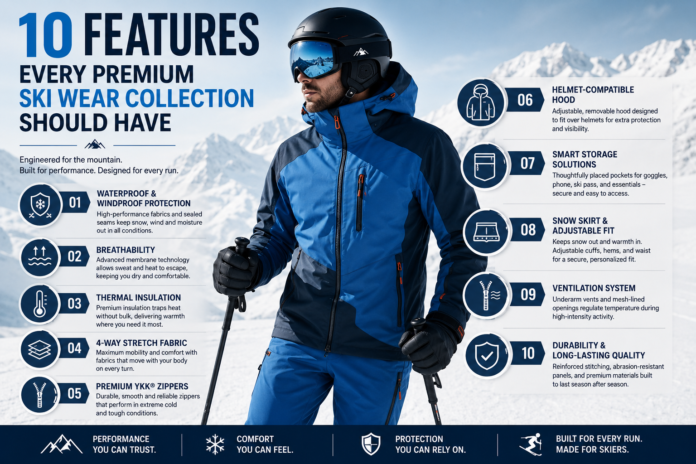
Skiing is unforgiving on poorly designed clothing. Wind, snow, extreme cold, high physical intensity, and rapid weather changes all happen simultaneously — and ski apparel that doesn’t perform across all these demands fails its wearer at exactly the wrong moment. Understanding the 10 features ski wear collections must deliver helps brands build products that serious skiers trust, recommend, and return to buy season after season. Here’s what genuinely premium ski wear looks like.
Waterproof and Breathable Outer Shell
The outer shell is the first and most critical line of defence in any ski wear collection. It must block snow and moisture penetration completely while simultaneously allowing body heat and sweat vapor to escape — preventing the internal dampness that destroys comfort and performance across a full day on the mountain.
Waterproof ratings of 20,000mm and above suit serious skiing conditions. Breathability ratings of 20,000 g/m²/24h ensure adequate moisture vapor transmission during high-intensity runs. A professional ski wear manufacturer uses membrane technologies that deliver both waterproofing and breathability at the performance levels serious skiers demand — not just the minimum acceptable ratings that budget alternatives scrape past.
Fully Sealed Seams
Waterproof fabric means nothing if seams allow moisture penetration. Premium ski wear uses fully taped or welded seams across every panel junction — preventing water and snow from entering through the needle holes that standard stitching creates in fabric.
Critical seam areas — shoulders, hood attachment points, pocket openings, and leg inseams — require particular attention. Any unsealed seam in these high-exposure areas becomes a moisture entry point that undermines the entire garment’s weather protection performance during sustained snow or rain exposure.
Insulation System for Extreme Cold
Effective insulation retains body heat without adding excessive bulk that restricts movement on the slopes. Premium ski collections address insulation through either high-fill-power down or advanced synthetic alternatives — each with distinct performance advantages depending on conditions.
Down insulation delivers exceptional warmth-to-weight ratio for dry mountain conditions. Synthetic insulation maintains warmth when wet — critical for highly active skiers whose body heat generates internal moisture that can dampen insulation layers. Puffer jackets designed specifically for ski applications use strategic insulation placement — heavier fill in core zones and lighter fill across high-mobility areas — maintaining warmth where it matters without restricting shoulder and arm movement.
Articulated and Stretch Construction
Skiing demands explosive movement — crouching, reaching, turning, and recovering across varied terrain and snow conditions. Ski apparel that restricts these movements forces skiers to fight their clothing rather than focus on technique and enjoyment.
Premium ski wear uses articulated pattern construction — pre-shaped knees, gusseted crotches, and stretch panels at critical joint areas — allowing natural athletic movement without fabric pulling or binding. Four-way stretch fabrics in high-mobility zones deliver unrestricted performance that rigid constructions simply cannot match for serious skiers.
Helmet-Compatible Hood
A ski jacket without a proper helmet-compatible hood is incomplete for serious mountain use. Premium hoods adjust to fit over ski helmets without restricting peripheral vision or creating uncomfortable pressure points. Wire-brim peaks maintain hood shape against wind without collapsing across the face during high-speed descents.
Adjustable volume, cinch, and hem controls allow precise hood fitting across different helmet sizes and head shapes — ensuring complete face and neck coverage exactly when mountain conditions demand it most.
Snow Gaiter System
Snow gaiters prevent the most frustrating skiing experience — snow entering through the waist or ankle openings during falls, deep powder runs, or high-speed descents. Internal powder skirts at jacket waists seal against ski pants. Internal ankle gaiters in ski pants seal around boot tops — creating a complete barrier that keeps snow outside the clothing system regardless of conditions.
Premium gaiters use stretch fabrics with silicon grip strips that maintain seal position through active movement without restricting comfort or requiring constant readjustment throughout the skiing day.
Strategic Ventilation Systems
Physical skiing intensity generates significant body heat — and overheating creates exactly the moisture management problems effective insulation aims to prevent. Premium ski wear addresses this through strategic ventilation systems that allow rapid heat dumping when activity intensity demands it.
Underarm zip vents — sometimes called pit zips — open directly at the body’s highest heat generation points, releasing accumulated warmth efficiently without removing the entire jacket. Chest vents and back vents provide additional airflow options for different skiing styles and intensity levels. These systems transform static insulation garments into adaptable temperature management tools that skilled skiers actively control throughout their mountain day.
Lift Pass and Equipment Pockets
Practical pocket design separates genuinely skier-focused apparel from generic outdoor clothing adapted for snow environments. Premium 10 features ski wear collections include arm pockets sized specifically for lift passes — with RFID-transparent windows that allow pass scanning without removing the card. Goggle pockets with soft internal lining prevent lens scratching during storage. Internal security pockets protect phones and valuables at body temperature — preventing battery failure in extreme cold.
Hardshell jackets designed for skiing integrate these practical storage solutions without adding bulk that compromises the clean, aerodynamic silhouette performance skiers prefer.
Integrated Base Layer Compatibility
Premium ski collections don’t design individual garments in isolation — they design complete systems. Jacket cut and collar construction must accommodate base layer and mid-layer necklines cleanly. Pant waistbands must sit correctly over base layer bottoms without bunching or creating pressure points during extended wear.
A quality base layer clothing system works with ski outerwear rather than against it — managing moisture at the skin level so the insulation and shell layers above can focus on their specific performance roles without becoming compromised by accumulated internal moisture throughout the skiing day.
Durable, High-Quality Hardware Throughout
Zippers, buckles, and adjusters in ski apparel face brutal conditions — extreme cold, ice contamination, repeated operation with gloved hands, and constant mechanical stress across hundreds of skiing days. Premium ski wear uses YKK Aquaguard or equivalent waterproof zip systems throughout — including main zippers, pocket entries, and ventilation systems.
All hardware operates smoothly with gloved hands — a non-negotiable requirement that budget alternatives frequently fail at exactly the moments when skiers most need reliable, fast access to pockets and ventilation systems. Robust construction across every hardware component ensures the garment performs consistently across multiple seasons rather than failing during the first demanding trip.
Brands building complete outdoor apparel ranges alongside outdoor jackets and waterproof jackets benefit from the same hardware quality standards applied consistently — because customers who trust your ski wear extend that trust to every other outdoor product your brand produces.
Conclusion
The 10 features ski wear collections must deliver — waterproof breathable shells, sealed seams, effective insulation, articulated construction, helmet-compatible hoods, snow gaiters, ventilation systems, practical pockets, base layer compatibility, and quality hardware — work together as a complete performance system rather than independent features. Premium ski apparel brands that engineer all ten features with genuine expertise build products that serious skiers recognize, respect, and depend on across every demanding day they spend on the mountain.
FAQs
What waterproof rating is sufficient for serious ski wear?
A minimum waterproof rating of 20,000mm suits serious skiing conditions — providing reliable protection across sustained snow, sleet, and wet mountain weather that lower-rated alternatives cannot handle effectively.
Is down or synthetic insulation better for ski jackets?
Both serve different needs. Down delivers superior warmth-to-weight for dry conditions. Synthetic maintains performance when wet — making it more reliable for highly active skiers who generate significant internal moisture during intense runs.
Can premium ski wear collections be produced under a private label?
Yes. Professional ski wear manufacturers offer complete private label production including custom fabrics, membrane technologies, colors, hardware, labels, and packaging — giving outdoor brands full creative and commercial control.
How important are sealed seams in premium ski apparel?
Critically important. Unsealed seams are the primary moisture entry point in ski garments — making fully taped or welded seams across all panel junctions a non-negotiable construction requirement for genuinely waterproof ski apparel.