
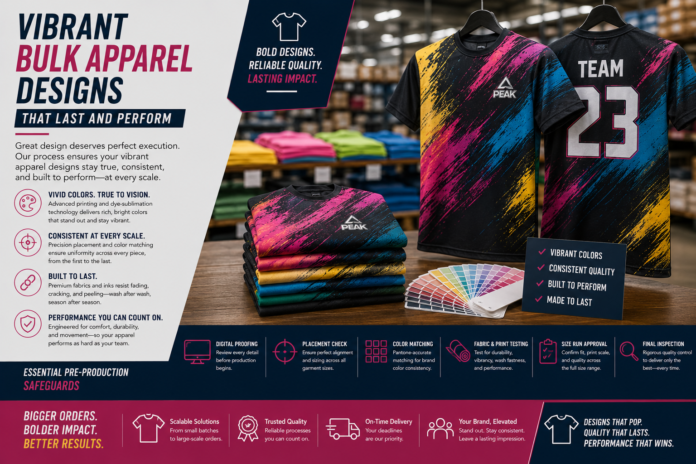
Visually appealing products are the goal of every apparel brand, and this goal looks different depending on production volume. The challenges of consistency grow at scale. What was a perfectly placed design on a sample can become off-centre on many prints. And because of the realities of high-volume production, it can take time to find and fix an issue when presenting thousands of subpar units. This guide details the secrets of achieving vivid and scalable vibrant bulk apparel designs That Last and Perform while outlining the essential pre-production safeguards you should take to safeguard your design integrity.
The Challenge of Bulk Production on Design Integrity
The challenges of design bulk production run beyond finding a good appearance. Prospective bulk designers should first consider the difficulty of printing many units of the same design. This means design elements like placement, colour, and graphic integrity must all be uniform on an enormous run.
While these burdens of high volume production can be monumental, the brands known for consistently producing bold and scalable apparel design do not rely on luck. They rely on systems built to address these challenges at the earliest stage of production and are integrated throughout entire production runs.
Selecting a Printing Method
The printing method you choose for a bulk apparel design can have effects on the vibrancy, durability, and feel of the design. This is a monumental and often irreversible bulk production design decision.
Each method has its strengths and its limitations. Sublimation printing bonds ink directly into polyester fabric — delivering vibrant, permanent results with no cracking or peeling, even after hundreds of washes. It’s the top choice for activewear, team kits, and any garment where fabric performance matters.
Custom printing — including screen printing, DTG, and heat transfer — works across a wider range of fabric types and suits fashion apparel, casual wear, and lifestyle brands well.
Embroidery branding adds a premium, textured finish that works beautifully on outerwear, caps, and team uniforms where a structured logo is the priority.
The right method depends on your fabric, your design, and your end use. Choose based on those factors — not on cost alone.
Lock In Fabric Before You Finalise the Design
Here’s something many brands learn too late. The fabric you choose directly affects how your design looks in production.
Sublimation only works on polyester. Screen printing behaves differently on jersey versus woven fabric. Embroidery thread tension varies depending on fabric weight. If you finalise your design before confirming your fabric, you may end up having to change everything anyway.
The right sequence is fabric first, design second. Go through proper fabric sourcing and development before briefing any print supplier. Confirm the fabric composition, weight, and base colour — then build your design around what the fabric can actually deliver.
This single step prevents more production problems than almost anything else.
Build a Detailed Tech Pack for Every Design
A great design file is not enough. Your factory needs a complete technical reference — and that means a proper tech pack.
Your tech pack should include print file specifications, colour references, placement coordinates, print boundaries, fabric details, and finishing instructions. Every decision documented in one place so there is no room for interpretation on the factory floor.
For colour accuracy, always use the Pantone colour library to define your exact shades. Describing a colour as “bright red” means something different to every person in the supply chain. A Pantone code means exactly one thing — and it matches every time.
Professional tech pack development covers all of this in a format that factories can work from directly. It’s the single most reliable way to protect your vibrant bulk apparel designs through production.
Here are the key elements every print tech pack should include:
- High-resolution print file at correct dimensions
- Pantone colour codes for every colour in the design
- Placement measurements from seam reference points
- Print boundary specifications for each garment panel
- Fabric composition and base colour confirmed
Always Approve a Sample Before Bulk Production
No matter how detailed your tech pack is, always request a physical sample before approving bulk production. This is your last chance to catch problems before they scale.
Check the colours against your Pantone references under good lighting. Check the print placement against your tech pack measurements. Stretch the garment and see how the design responds. Wash it and check how it holds.
Only approve bulk once every element of the sample matches exactly what you specified. A single round of revisions at sampling stage costs a fraction of what corrections cost mid-production.
Our sampling and pattern-making process ensures your approved sample becomes the benchmark that every bulk unit is measured against throughout the run.
Quality Control Has to Run Throughout Production
Approving a great sample is only the beginning. The real challenge is making sure every unit in the bulk run matches that sample — from the first piece to the last.
That requires quality control at multiple points during production — not just a final check before shipment. Colours need checking as printing begins. Placement needs verifying on the first units off the line. And consistency needs monitoring as the run progresses.
A reliable manufacturing process builds these checkpoints into the production schedule as standard. Catching a colour drift on unit 20 is a minor adjustment. Catching it on unit 2,000 is a major problem.
Keep Designs Consistent Across Every Reorder
Getting strong results the first time is good to see, but the real test comes when those results have to be reproduced each time an order is placed.
Every reorder has factors that can lead to slight color changes. The fabric can be of a different batch, there can be a change in the ink formulation, or there can be a different print operator. All of this can cause the results on a reorder to be different from previous orders. Without an order management system, the first production run can be consistent, but subsequent runs can become inconsistent.
To fix this dynamic, orders must have constant sampling and documentation to describe the order. Manufacturing checklists can be used to record approvals and sign-offs when each stage is produced.
To be cost effective, orders have to be self-reviewed each and every time an order is placed. The discipline of self-review is what allows brands to be successful. Consistent quality is what those successful brands are able to achieve.
Conclusion
The designs that an apparel bulk order includes are only possible after intense planning and order fulfillment quality control. Consistency at every order fulfillment stage is what separates successful brands from others.
When you’re ready to move forward, explore the full range of manufacturing solutions and find the right approach for your brand.
FAQs
What printing method is best for vibrant bulk apparel designs?
It depends on your fabric and end use. Sublimation works best for polyester performance wear. Screen printing and DTG suit fashion and casual apparel. Embroidery is ideal for premium logos on outerwear and uniforms.
Why do colours shift between vibrant bulk apparel designs?
Colours shift due to fabric batch variations, ink formulation changes, or differences between print operators. Using Pantone codes and keeping approved samples on file helps manage this consistently.
Do I need a tech pack for print production?
Yes. Without a detailed tech pack, factories have no clear reference for colour, placement, or print boundaries. Inconsistencies at scale are almost guaranteed without one.
What is a pre-production sample?
It’s a printed sample produced on the actual production fabric before bulk printing begins. It lets you verify colour accuracy and placement before committing to a full run.


