Cashmere is a luxurious wool that has been prized for centuries because of its warmth, softness and elegance. Cashmere is not created equal. Grade D cashmere fabric is equally important in the textile industry. It offers an appealing balance between affordability, performance and durability that is attractive to both consumers and manufacturers.
This guide will explore Grade B cashmere fabric and its features, production process advantages, limitations and best uses. This article also explains why Grade C Cashmere is a great option for budget-conscious shoppers without compromising comfort or functionality.
Understanding Cashmere Wool Grading
It is important to know how cashmere is graded before diving into Grade C. Cashmere can be classified into three grades: grade A, grade B, and grade C . These grades are determined by fiber size, fiber diameter and softness.
The Grade C cashmere has shorter fibres and a slightly rougher texture in comparison to the higher grades. It still comes from the undercoat of the cashmere goat, so its core properties remain intact.
What is Grade C Cashmere wool fabric?
The fibers that are usually smaller than 14 microns are used to make Grade C cashmere. These fibers may not be as long as those in Grade A, but they are still soft and warm.
Grade C Cashmere Wool Fabric is usually blended or woven to enhance durability. It is therefore widely used for everyday clothing and home textiles, where durability is more important than ultra-luxurious texture.
Cashmere wool fabric grade C: Key characteristics
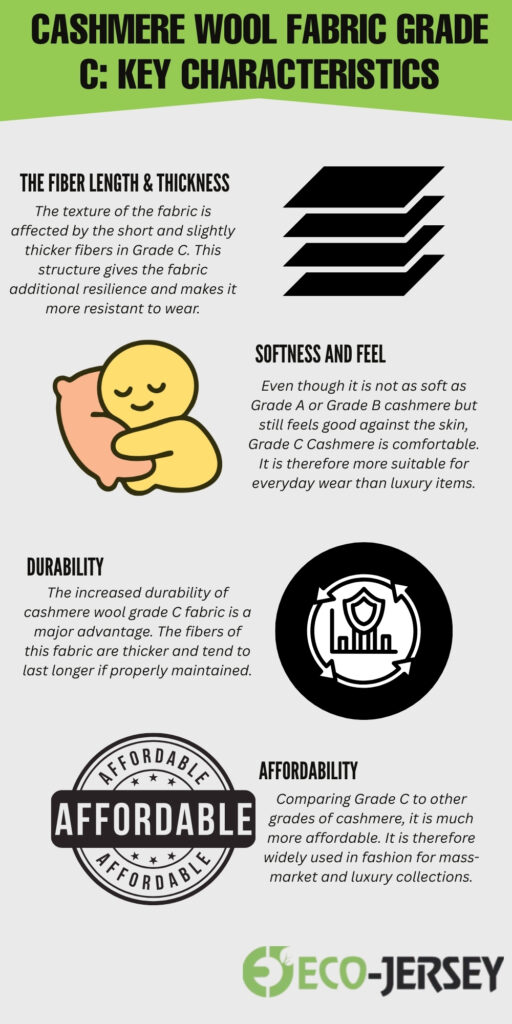
Cashmere Wool Fabric Grade C: Key Characteristics
1. The Fiber Length & Thickness
The texture of the fabric is affected by the short and slightly thicker fibers inGrade C Cashmere Wool Fabric. This structure gives the fabric additional resilience and makes it more resistant to wear.
2. Softness and Feel
Even though it is not as soft as Grade A or Grade B cashmere but still feels good against the skin, Grade C Cashmere is comfortable. It is therefore more suitable for everyday wear than luxury items.
3. Durability
The increased durability of cashmere wool grade C fabric is a major advantage. The fibers of this fabric are thicker and tend to last longer if properly maintained.
4. Affordability
Grade C Cashmere Wool Fabric to other grades of cashmere, it is much more affordable. It is therefore widely used in fashion for mass-market and luxury collections.
How to Produce Grade C Cashmere wool fabric
Grade C Cashmere Wool Fabric is produced in the same way as traditional cashmere. The shorter fibers are separated by additional sorting.
Step 1: Shearing and Combing
Grade C Cashmere Wool Fabric undergo a gentle comb during the molting period. The soft undercoat fibers can be collected without harming animals.
Step 2: Sorting the fiber
After collection, the fibers are separated based on their length and diameter. The shorter fibers are classified in Grade C.
Step 3: Cleaning & Dehairing
At this stage the coarse guard hairs and impurities are separated. The cashmere fibers that are usable are then refined.
Step 4: Weaving and Spinning
The fibers are spun to yarn and then woven into fabric. Blends are often created to increase strength and lower cost.
What is Grade C Cashmere Wool Fabric?
Grade C Cashmere Wool Fabric is still important to the textile industry, even though it’s considered lower quality. Cashmere products that are affordable to a wide range of consumers would not be available without it.
Many designers also prefer Grade C Cashmere to create entry level collections because it allows them the opportunity to offer cashmere clothing at competitive prices.
Cashmere Wool Grade C Fabric: Common Applications
Grade C Cashmere Wool Fabric fabric is widely used in different sectors.
Everyday Apparel
Sweaters
Cardigans
Scarves
Shawls
The fabric is suitable for clothing that is worn often.
Outerwear and Blends
jackets and coats are often made by blending Grade C cashmere with wool. The warmth is maintained while the cost is reduced.
Home textiles
Blankets
Throws
Cushion covers
Grade C Cashmere Wool Fabric is a natural insulation material, but it doesn’t have to be ultra-fine.
Cashmere wool fabric grade C has many advantages
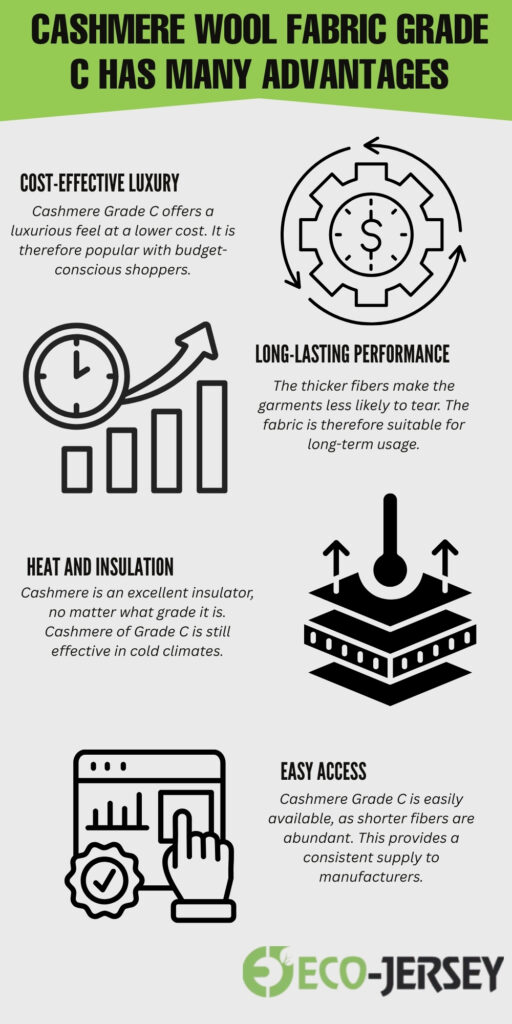
Cashmere Grade C: Key advantages at a glance—cost-effective luxury, durable performance, excellent insulation, and easy access for manufacturers.
Cost-Effective Luxury
Cashmere Grade C offers a luxurious feel at a lower cost. It is therefore popular with budget-conscious shoppers.
Long-Lasting Performance
The thicker fibers make the garments less likely to tear. The fabric is therefore suitable for long-term usage.
Heat and Insulation
Cashmere is an excellent insulator, no matter what grade it is. Cashmere of Grade C is still effective in cold climates.
Easy Access
Cashmere Grade C is easily available, as shorter fibers are abundant. This provides a consistent supply to manufacturers.
Cashmere Wool Grade C Fabric Limitations
Cashmere of Grade C has its benefits but also some limitations.
Reduced Softness
The texture of Grade A cashmere is slightly coarser. This difference is usually minimal when it comes to blended fabrics.
The Pilling Potential
Less Luxurious Appearance
While Grade C cashmere is visually appealing, it may not have the same refined drape as premium grades.
How to care for Cashmere Wool Fabric Grade C
When properly maintained, your appearance and longevity will be preserved.
Washing Tips
Handwash in cold water
Use mild detergent
Avoid wringing
Drying Recommendations
The garments should be dried flat. This prevents shape distortion.
Storage Advice
To keep moths away, store in bags that are breathable and scented with lavender or cedar. Fabric integrity is preserved.
Sustainability and ethical considerations
Cashmere Grade C supports sustainability through by utilizing fibers which would otherwise be discarded. So, waste is reduced and resource efficiency improves.
Responsible manufacturers also ensure that goats are raised in an ethical manner and dyeing is done using environmentally friendly processes.
Why manufacturers choose Grade C Cashmere
Cashmere Grade C is flexible from a production perspective. It is easily blended, dyed, and mass produced without compromising its warmth.
Moreover, brands can introduce collections of cashmere at affordable prices. As a result, the brand’s reach is increased.
What is the best cashmere for you?
Cashmere of Grade C is perfect if you:
Cashmere at affordable prices
Durability is more important than ultra-softness
You like everyday comfort
Warmth and practicality are important to you
If luxury softness and comfort are your main priorities, you may prefer higher grades.
The Future of Cashmere Wool Fabric Grade C
Cashmere Grade C is expected to grow in popularity as the demand for luxury at an affordable price increases. Already, innovations in spinning and finishing technologies have improved softness and appearance.
Cashmere of Grade C will continue to be a popular choice for textiles.
The conclusion
Although it is not the most luxurious fabric, Grade C Cashmere Wool Fabric remains one of the most cost-effective. The fabric is durable, warm, and comfortable, while still maintaining the true essence of cashmere.
Cashmere is also affordable, making it more accessible. Cashmere Grade C can last for years if it is chosen carefully and properly cared for. It proves, in the end, that luxury doesn’t always come with a high cost.
FAQs
What is Grade C cashmere wool fabric?
Grade C cashmere wool fabric is made from shorter and slightly thicker cashmere fibers. It offers warmth, durability, and affordability for everyday use.
Is Grade C cashmere real cashmere?
Yes, Grade C cashmere is 100% real cashmere. It comes from the soft undercoat of cashmere goats but uses shorter fibers than higher grades.
How does Grade C cashmere differ from Grade A cashmere?
Grade C cashmere is less soft and more affordable than Grade A. However, it is more durable and better suited for regular wear.
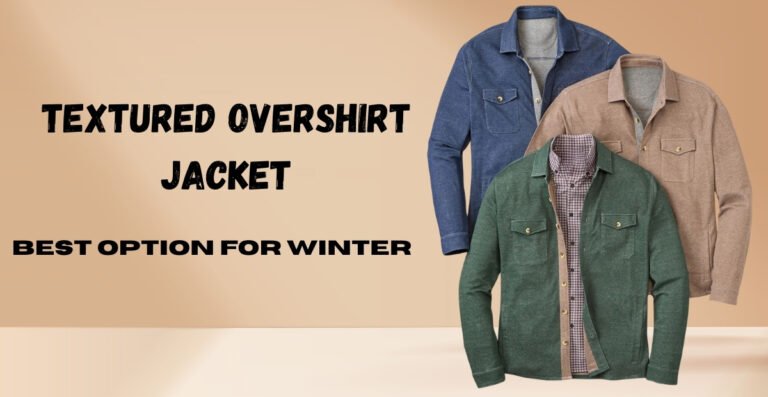
Versatility is now a necessity in today’s fashion world. Clothing pieces that can be adapted to suit different seasons and situations are more valuable than ever. A timeless wardrobe staple is the textured overshirt coat. It is not only a great way to layer, but also offers unmatched comfort and style.
This fashion staple has become a favorite among designers, stylists and the general public. The textured overshirt bridges that gap between traditional jackets and shirts. It has therefore become the go-to option for men who value both fashion and function.
What is a Textured Overshirt?
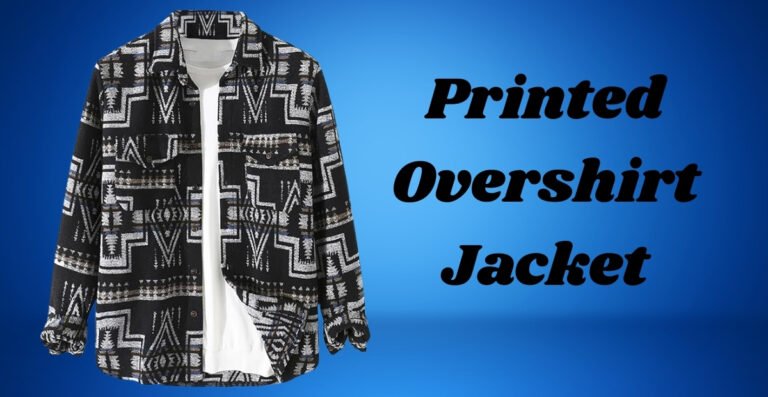
A textured overshirt is a hybrid jacket that combines the comfort of a shirt with the structure of an outer jacket. This version of the overshirt features fabrics textures like twills, corduroys, waffle knits, brushed cotton or jacquard weaves. This adds depth and character to an outfit without needing loud patterns.
These jackets have relaxed silhouettes and button-fronts. They can be worn open or closed, in layers or alone. Neutral tones are often preferred in many collections. However, seasonal colors can also be introduced to keep things fresh.
Why Texture is Important in Fashion
Texture is a key component of visual appeal. Color is often the first thing that catches our attention, but texture is what makes a look memorable. Even when using minimal colors, textures can add depth and dimension.
Texture also enhances the tactile sensation. The garment is not only luxurious but it also looks good. Textured overshirt jackets are therefore often associated with quality craftsmanship.
Texture can make simple outfits stand out. Layering a textured jacket over a basic T-shirt with jeans can instantly elevate the look. Style becomes effortless and powerful.
Overshirt Trends on the Rise
Overshirts have gained in popularity over the last decade. Overshirts were originally designed to be durable and inspired by military uniforms and workwear. As fashion evolved, however, these garments became more refined and suitable for everyday use.
Designers began to experiment with fabrics and textures. textured jacket became a modern icon. The textured overshirt jacket was featured on street style blogs and worn by celebrities around the world.
The global trend towards smart-casual clothing has also fueled its popularity. Overshirts have become more popular since office dress codes relaxed. They are a good balance between comfort and professionalism.
The Key Features of a Textured Jacket
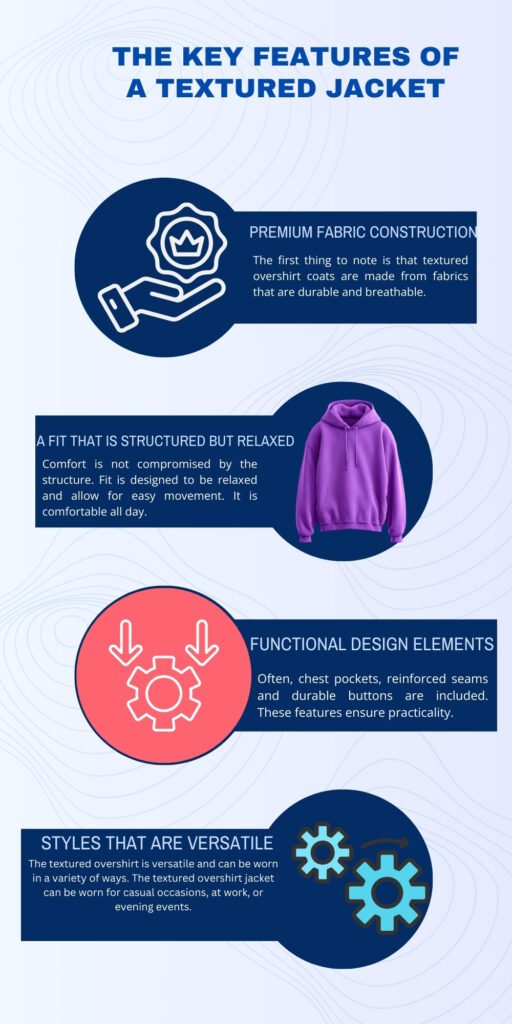
The key features of a textured jacket: premium fabric construction, a comfortable fit, functional design elements, and versatile styles.
1. Premium Fabric Construction
The first thing to note is that textured overshirt coats are made from fabrics that are durable and breathable. Commonly used fabrics include cotton blends, heavyweight flannels, and Wool mixes. Fabrics are often brushed, woven or woven to enhance softness.
2. A Fit that is Structured but Relaxed
Comfort is not compromised by the structure. Fit is designed to be relaxed and allow for easy movement. It is comfortable all day.
3. Functional Design Elements
Often, chest pockets, reinforced seams and durable buttons are included. These features ensure practicality. Adding thickness to the garments makes it easier to layer in colder months.
4. Styles that are Versatile
The textured overshirt is versatile and can be worn in a variety of ways. The textured overshirt jacket can be worn for casual occasions, at work, or evening events.
How to style a textured overshirt jacket
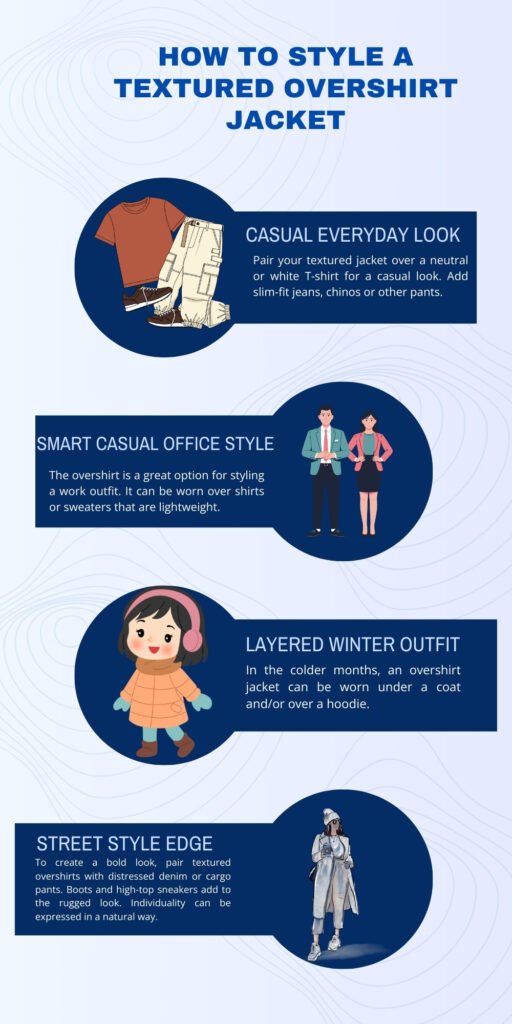
How to style a textured overshirt jacket: four versatile looks for casual, smart casual, layered winter, and street style.
Casual Everyday Look
Pair your textured jacket over a neutral or white T-shirt for a casual look. Add slim-fit jeans, chinos or other pants. Complete the look with sneakers or loafers. This gives the appearance of a stylish and clean look.
Smart Casual Office Style
The overshirt is a great option for styling a work outfit. It can be worn over shirts or sweaters that are lightweight. Dark trousers and leather footwear add polish. This creates a modern and professional outfit.
Layered Winter Outfit
In the colder months, an overshirt jacket can be worn under a coat and/or over a hoodie. The texture of the overshirt jacket adds warmth both visually and physically. This makes it feel cozy and refined.
Street Style Edge
To create a bold look, pair textured overshirts with distressed denim or cargo pants. Boots and high-top sneakers add to the rugged look. Individuality can be expressed in a natural way.
The Versatility of Textured Jackets for All Seasons
The ability to wear textured jackets all year round is one of their biggest advantages.
Spring:Lightweight fabrics provide comfort in mild weather.
Summer: Breathable fabric allows evening layering to be worn without overheating.
Autumn : Earth tones textures compliment fall palettes beautifully.
Winter: Layering heavier textures will add depth and warmth to the winter look.
A textured overshirt is a great investment because of its adaptability.
Traditional Jacket vs Textured Overshirt Jacket
Traditional jackets are useful, but they lack style flexibility. Overshirt jackets, on the other hand, offer greater styling flexibility.
Features
Textured Overshirt Jacket
Traditional Jacket
Weight
Medium
Heavy
Styling
Highly Versatile
Limited
Comfort
Breathable
Often Stiff
Layering
Easy to Use
Restricted
The overshirt jacket is a versatile and comfortable garment.
Fabric Types Most Commonly Used
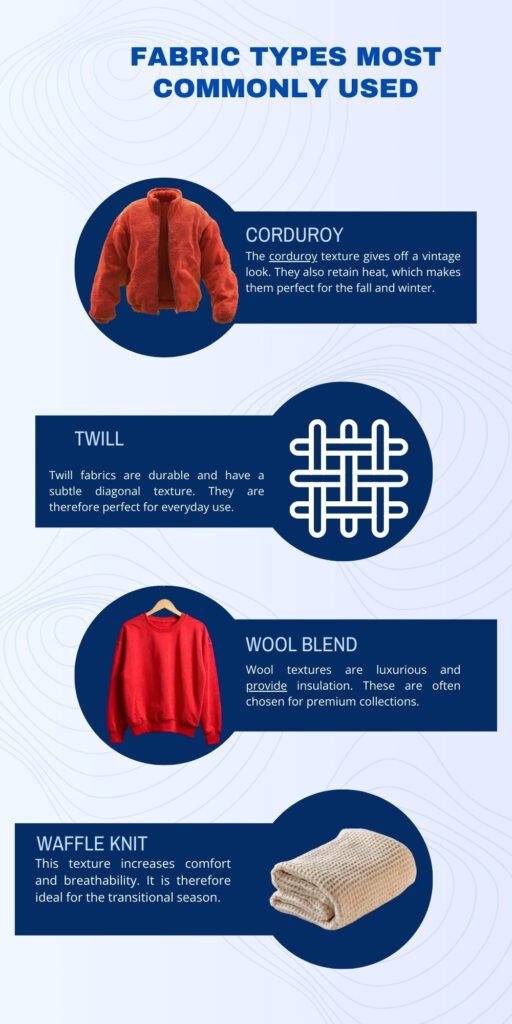
Fabric Types Most Commonly Used: Corduroy, Twill, Wool Blend, and Waffle Knit—quick facts about texture, appearance, and typical applications.
Corduroy
The corduroy texture gives off a vintage look. They also retain heat, which makes them perfect for the fall and winter.
Twill
Twill fabrics are durable and have a subtle diagonal texture. They are therefore perfect for everyday use.
Wool Blend
Wool textures are luxurious and provide insulation. These are often chosen for premium collections.
Waffle Knit
This texture increases comfort and breathability. It is therefore ideal for the transitional season.
The Best Overshirt Jackets for SEO
Search results for textured overshirt coats are exceptional. The fashion-focused audience is attracted by keywords like men’s textured shirt, styling an overshirt jacket and textured men’s jacket.
The garment is also searched for year-round because it suits many seasons and styles. Fashion blogs and eCommerce platforms have prioritized this product as part of their content strategy.
Sustainability and Ethical Fashion
Sustainability has been a growing concern in recent years. Many textured overshirt coats are produced now using eco-friendly material. More and more people are adopting organic cotton, recycled fibres, ethical manufacturing practices, etc.
The result is that consumers can now enjoy style without having to compromise their environmental values. Overshirt jackets have become more popular among environmentally conscious consumers.
Care and Maintenance Tips
For your textured jacket to maintain its quality, it is important that you take proper care of it.
Check the label for instructions before washing.
It is best to wash your clothes in cold water to maintain texture
Avoid excessive machine drying
If required, iron on low heat
These steps will ensure that the jacket looks and feels premium for a long time.
Who should wear a textured overshirt jacket?
This garment is universal in nature. It is suitable for:
Smart-casual clothing for professionals
Style Layering for Students
Travelers who need versatile clothing
Fashion enthusiasts embracing minimalism
It is a must-have for all men, as it suits a variety of body types.
Future of Textured Overshirt jackets
In the future, we can expect to see textured overshirt coats evolve. Designers are experimenting more with technical materials, innovative fabrics and bolder textures. Classic silhouettes are timeless and remain the same.
The textured overshirt will continue to be popular for many years, as fashion continues to emphasize comfort and adaptability.
Final Thoughts
The textured jacket is the epitome of modern fashion. This piece combines practicality and sophistication to offer endless styling options. This versatile piece is a favorite, regardless of the trends.
It is a wardrobe staple because it can be worn in any season, for any occasion, and with any style. A textured overshirt is more than just a stylish fashion statement. It is also a wise investment.
FAQs
What is a textured overshirt jacket?
It is a versatile layer combining shirt comfort with jacket structure, featuring fabric textures for added style and depth.
Can a textured overshirt jacket be worn year-round?
Yes, it works well in all seasons due to its breathable yet insulating fabric options.
How should a textured overshirt jacket fit?
It should have a relaxed but structured fit, allowing easy layering without feeling bulky.
Every day on the calendar commemorates something. Some days celebrate the world and others celebrate a country, its customs and its people. International Days January 15 does not hold a United Nations observance day, but International Days January 15 does mark a date that is important to many people.
January 15 celebrates the observance of the courage and services of people, and the humanity of people.January 15 celebrates the observance of the courage and services of people, and the humanity of people. It is a time to reflect on the sacrifices made for the betterment of society, and to acknowledge the everyday acts of kindness that bind us together.
How International Days January 15 Are Significant
International Days January 15 provide the world with the opportunity to stand still and provide the necessary focus on the day and its importance. They serve as a reminder of the history and the principles and responsibilities that the world must abide by. So even if a day does not have a United Nations observance, it does not mean that it does not hold meaning.
International Days January 15 speaks to the world about commemoration of services, sacrifice and the expression and demonstration of love. These are attributes that bind people together irrespective of geographical boundaries.
Indian Army Day – January 15
Indian Army Day is one of the most significant January 15 commemoration days.
Army Day is dedicated to those who have served and protected India’s borders. This day is significant, as it was the day the first Indian Commander-in-Chief, General K. M. Cariappa, received his appointment in 1949.
Why is Indian Army Day Significant?
This day is significant in many ways, including but not limited to…
To Recognize Courage and Discipline
Honors the Oblations That The Soldiers Have Made
Bolsters the Pride That We Have For Our Nation
Proves To The Country The Importance of Peace and Security
Indian Army Day is one of the most important days that we honor, for it is the significant symbol of our great Nation. This day reminds us of the countless sacrifices made by our brave soldiers to protect our freedom and sovereignty. It is a day to remember and pay tribute to the indomitable spirit and courage of our Jawans, who stand tall against all odds, guarding our borders with unwavering dedication. International Days January 15.
Humanitarian Awareness on January 15
Many humanitarian calendars also have January 15 marked, for it serves as a day of humanitarian awareness. Although this particular day is not recognized as an Official United Nations International Day, many other organisms choose to advocate this day as one that promotes the helping and supporting of others.
What Is the Purpose of Humanitarian Awareness Day?
The aims of humanitarian acts are to:
Provide Aid to the Less Fortunate
Assist in the Relief of Victims of Natural or Human Disasters
Defend the Rights and Dignity of Humanity
Advocate and Foster the Values of Peace and Compassion
Our experiences in these Indonesian days often serve as poignant reminders. They highlight the profound truth that significant and impactful transformations are indeed within the grasp of the individuals who constitute our local societies. These moments underscore the potential for collective action, demonstrating that meaningful progress and lasting change can be initiated and driven by the very people who live and work within our communities.
What Is The Best Way To Celebrate International Days Today?
You can participate in your own special ways, including simple acts You can participate in your own special ways, including simple acts. International Days January 15 Every little bit counts when we are trying to make the world a better place. If we work together we can accomplish so much.
Some suggestions are:
Post information about Indian Army Day online
Thank a soldier or veteran
Make a donation to a charity
Volunteer to help others
Think about the importance of and the need for peace and onetrity
Doing any of the above will help you honor International Days January 15.
The Bigger Picture of International Days
International Days January 15 serve as valuable opportunities to educate individuals, ignite innovative ideas, and foster meaningful conversations, all of which can contribute to positive change within our societies. These observances encompass a wide range, with some dedicated to celebrating national identities and achievements, while others focus on commemorating global events and promoting international cooperation. Each type of International Day holds its own unique significance and plays an important role in raising awareness about various issues, promoting cultural understanding, and inspiring action on both local and global scales. Whether highlighting national heritage or addressing shared global challenges, these days provide a platform for reflection, learning, and engagement.
January 15 may not be officially designated as an International Day by the United Nations, yet it still offers valuable opportunities to learn about crucial principles. Specifically, this date serves as a reminder of the importance of dedicating oneself to the service of others. Furthermore, it highlights the virtues of bravery in the face of adversity and the significance of showing compassion towards those in need. Therefore, even without formal recognition, January 15 provides meaningful lessons related to service, bravery, and compassion.
Conclusion
International Days January 15 are not on the official UN roster, but it is a date of significance with observances like Indian Army Day and an awareness of humanitarian issues. International Days January 15 also marks the anniversary of the end of the Nigerian Civil War. It’s a day to reflect on conflict, peace, and the importance of humanitarian efforts worldwide, even if it isn’t formally recognized by the UN.
This date is a reminder to pay tribute to people who serve, extend help to those in need, and to appreciate and promote the notion of peace. Each important date accumulates to greater global awareness.These dates are more than just calendar markings; they are opportunities to reinforce the values we cherish and to put those values into action. They serve as an invitation to reflect on the interconnectedness of humanity and to strive for a better world, one gesture of goodwill, one act of service, one promotion of peace at a time. They highlight the importance of understanding, empathy, and collective responsibility in building a harmonious and thriving global community.
International days are not just date on a calendar. They are a chance to think, learn, and do something impactful even if it is small.
Cashmere is known for its softness, warmth and elegance. Cashmere is not the same. While Grade A Cashmere is often the focus, Grade C cashmere wool fabric provides an excellent balance of luxury and affordability. It is a favorite among designers, manufacturers and conscious consumers.
Cashmere Grade B is renowned for its fine texture, durability and versatility. It may not be ultra-fine like Grade A but it is still a premium natural fibre. For those who are looking for comfort and value, but without the high price tag, grade B cashmere is a great investment.
This guide will explore the benefits, uses and care of Grade A cashmere. Comparing Grade B cashmere to other grades of cashmere will also help you make a more informed decision.
What is Grade B Cashmere wool fabric?
The soft undercoat fibers from cashmere goats are used to produce Grade B cashmere fabric. These fibers, while slightly thicker than those of Grade A, are still incredibly soft and warm. The fiber diameter is usually between 15 and 18 microns. This still puts it in the luxury category.
Cashmere Grade B is sorted and processed with care, unlike lower-graded wool. The result is a fabric that is smooth and consistent. Although there may be a slight variation in the texture, overall appearance is elegant and refined.
Cashmere of Grade B is also often blended with silk or wool to increase strength and durability. It is used widely in clothing and home textiles.
What makes Grade B Cashmere Different from Other Grades?
Understanding cashmere grade helps buyers select the best fabric for their needs. Cashmere is classified as Grades A, B, and C according to the length and fineness of the fiber.
Grade A vs. Grade B Cashmere
Cashmere Grade A is made from the finest and longest fibres. It is therefore extremely soft and light. It is also significantly more expensive.
Cashmere grade B is slightly thicker. It still has a softness and warmth that is impressive. It may pill over time but with proper care, this can be reduced. Cashmere of Grade B is therefore often chosen for luxury clothing.
Grade B vs. Grade C Cashmere
Cashmere grade C is made with much coarser fibres. It is less soft, and can irritate sensitive skin. Cashmere Grade B, on the other hand, is more durable and provides a better structure.
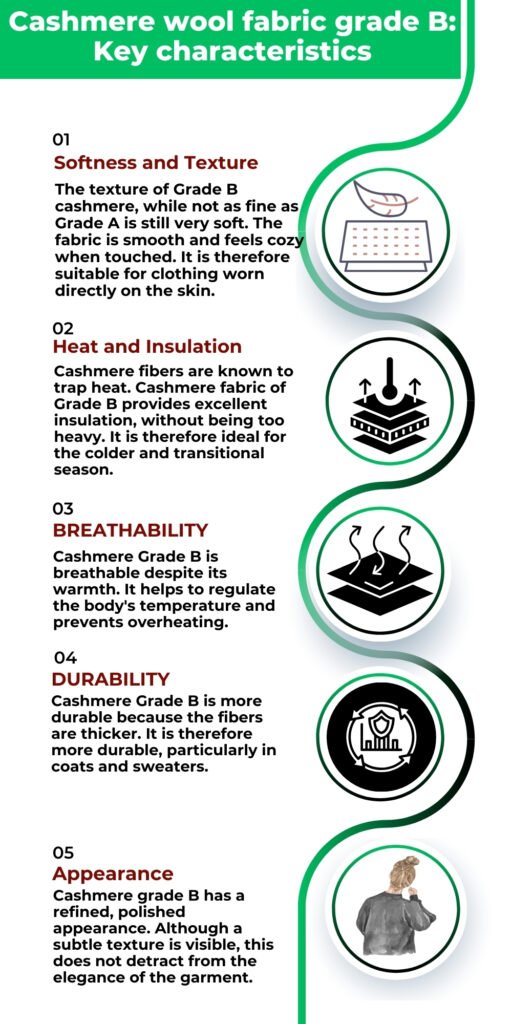
Cashmere wool fabric grade B: Key characteristics
Key characteristics of Cashmere Grade B fabric: softness, insulation, breathability, durability, and appearance.
Softness and Texture
The texture of Grade B Cashmere Wool Fabric, while not as fine as Grade A is still very soft. The fabric is smooth and feels cozy when touched. It is therefore suitable for clothing worn directly on the skin.
Heat and Insulation
Cashmere fibers are known to trap heat. Cashmere fabric of Grade B provides excellent insulation, without being too heavy. It is therefore ideal for the colder and transitional season.
Breathability
Cashmere Grade B is breathable despite its warmth. It helps to regulate the body’s temperature and prevents overheating.
Durability
Cashmere Grade B is more durable because the fibers are thicker. It is therefore more durable, particularly in coats and sweaters.
Appearance
Cashmere grade B has a refined, polished appearance. Although a subtle texture is visible, this does not detract from the elegance of the garment.
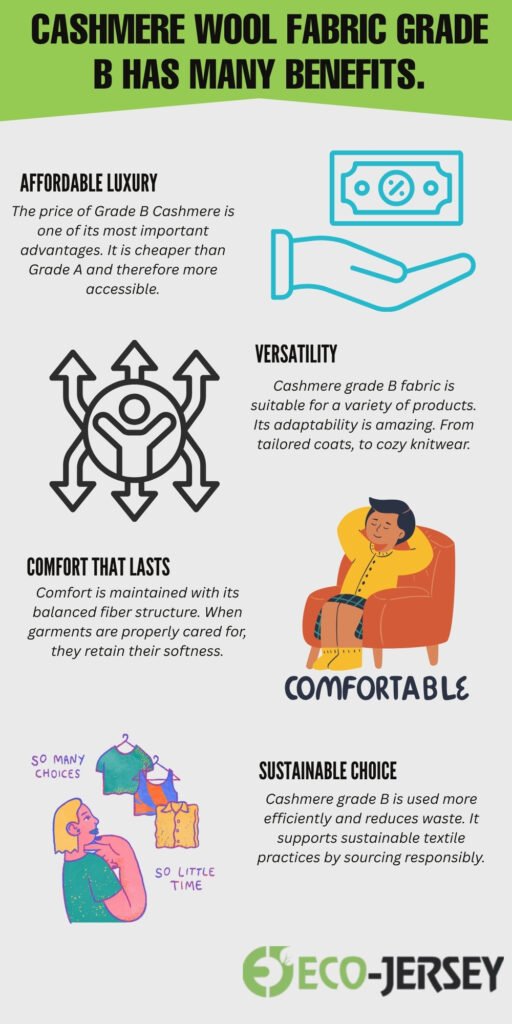
Cashmere wool fabric grade B has many benefits.
Grade B Cashmere Wool Fabric: affordable luxury, versatile use, lasting comfort, and a sustainable choice.
Affordable Luxury
The price of Grade B Cashmere is one of its most important advantages. It is cheaper than Grade A and therefore more accessible.
Versatility
Cashmere grade B fabric is suitable for a variety of products. Its adaptability is amazing. From tailored coats, to cozy knitwear.
Comfort that Lasts
Comfort is maintained with its balanced fiber structure. When garments are properly cared for, they retain their softness.
Sustainable Choice
Cashmere grade B is used more efficiently and reduces waste. It supports sustainable textile practices by sourcing responsibly.
Cashmere wool fabric grade B is used for a variety of purposes.
Outerwear
trench coats, overcoats and pea coats are often made from grade B cashmere. The durability and warmth of cashmere make it perfect for everyday wear in winter.
Knitwear
Cashmere sweaters, cardigans and scarves of Grade B provide a softness that is enhanced by their resilience. They are therefore perfect for both casual and semi-formal attire.
Blended fabrics
Cashmere Grade B is frequently blended with synthetic, wool, and silk fibers to improve performance. Strength, elasticity and cost efficiency are enhanced.
Home textiles
Cashmere Grade B is soft and warm, making it ideal for blankets, throws and upholstery fabrics. Interiors are given a subtle touch of luxury.
The Manufacturing Process for Grade B Cashmere Fabric
Fiber Collection
Grade B Cashmere Wool Fabric fibres are harvested by combing goats in their natural molting period. The fibers are kept soft and intact by using this method.
Sorting and Grading
After collection, the fibers are sorted according to length and fineness. To maintain consistency, Grade B fibers must be separated with care.
Cleaning and Dehairing
After washing, the fibers are cleaned to remove oil and dirt. The coarse guard hairs will then be removed. This step is essential for achieving smooth texture.
Spinning and Weaving
After cleaning, the fibers are spun to yarn and then woven or knitted together into fabric. Quality checks are conducted to ensure uniformity.
Cashmere Wool Fabric Grade B in the Fashion Industry
Grade B Cashmere Wool Fabric is popular in the fashion industry because of its versatility. Designers prefer it in ready-to wear collections. It is a good choice for mid-range brands and premium brands because it provides luxury at an affordable price.
Many brands also choose Grade B Cashmere to make structured garments. The slightly thicker fibres help to maintain the shape better. Coats and jackets retain their shape over time.
How to care for Cashmere Wool Fabric Grade B
Cashmere is delicate and requires special care.
Washing
It is best to wash by hand. Use cold water with a mild detergent designed specifically for wool. Dry cleaning is an alternative for structured garments.
Drying
Drying garments on a flat surface is recommended. It is not recommended to hang clothes because they may stretch.
Stores
Grade B Cashmere Wool Fabric is best stored in a folded position, not hanging. Also, it is recommended to use breathable garment bags as well as natural moth repellents.
Pilling Management
It is possible to see some pilling. Cashmere combs can remove the pills and restore the fabric’s look.
The advantages of using wool instead of traditional wool
Grade B Cashmere Wool Fabric Grade B is softer than regular wool. It also provides better insulation while being lighter. Cashmere is softer than traditional wool, which can itch.
Grade B Cashmere Wool Fabric drapes better. The garments will look refined and polished.
What is the Grade B Cashmere worth buying?
The answer to this question is “yes” for most consumers. Cashmere of Grade B is a great compromise between luxury and functionality. It may not have the ultra-fine texture of Grade A but it compensates for this with durability and affordability.
Cashmere Grade B is often better for everyday wear. It is therefore the perfect choice for anyone who values comfort, durability, and affordability.
Sustainability and ethical considerations
Sustainability in cashmere production has become increasingly important. When responsibly sourced,Grade B Cashmere Wool Fabric supports ethical herding. Moreover, fibers are used more efficiently to reduce waste.
Grade B Cashmere Wool Fabric are encouraged to select brands that place animal welfare and environmental responsibility as a priority.
Style Tips for Cashmere Wool Fabric Grade B
Everyday Wear
For a casual, refined look, pair a cashmere sweater of Grade B with denims or chinos.
Office Wear
Cashmere blend blazers, coats and jackets add elegance to professional attire while maintaining comfort.
Layering
Grade B Cashmere Wool Fabric is breathable and therefore works well with layers. It can therefore be worn in multiple seasons.
Cashmere Grade B for Different Climates
Cashmere grade B is a good choice for cold climates because of its insulation. It can also adapt to milder weather due to its breathability. It is comfortable all day long.
Cost vs. value analysis
Grade B Cashmere Wool Fabric is more expensive than wool standard, but its durability justifies the cost. Over time, less replacements will be needed. In this way, value is gained over the long term.
Cashmere Grade B: High Quality Cashmere
Look for cashmere with a tight weave, a uniform texture and brands that are reputable when purchasing Grade B. Check the labels to see what fibers are used and where they come from.
The Future of Cashmere Wool Fabric Grade B
Grade B Cashmere Wool Fabric is expected to grow in popularity as consumers become more price-conscious. Softness and durability will be further enhanced by innovations in processing. Its role in the textile sector will therefore continue to grow.
The conclusion
Cashmere fabric grade B is a blend of elegance, comfort and affordability. It may not be of the highest quality, but it is a reliable fabric with enduring appeal. It is a popular choice for fashion and home textiles.
Cashmere Grade B is a luxurious fabric that will last for years with the right care. For those who are looking for premium quality at a reasonable price, the Grade B Cashmere Wool Fabric is a great option.
FAQs
What is Grade B cashmere wool fabric?
Grade B cashmere wool fabric is made from slightly thicker cashmere fibers than Grade A. However, it still offers excellent softness, warmth, and durability, making it a cost-effective luxury fabric.
Is Grade B cashmere real cashmere?
Yes, Grade B Cashmere Wool Fabric is 100% real cashmere. It is sourced from the undercoat of cashmere goats and carefully processed to maintain comfort, insulation, and quality.
How soft is Grade B cashmere compared to Grade A?
Grade B Cashmere Wool Fabric is slightly less soft than Grade A due to thicker fibers. Nevertheless, it remains smooth, comfortable, and suitable for everyday wear.
A coat in today’s fashion is much more than just a piece of clothing. Among the many pieces of outerwear, the Executive Topcoat and the Windproof Topcoat are some of the most stylish and practical. Whether walking down a city street, attending a business meeting, or trying to block the elements, these topcoats are the perfect combination of classy and practicality. This article will cover these important pieces of clothing and everything they have to offer including their history, characteristics, materials, designs, and how to select which topcoat is right for you.
What can we say about Executive Topcoats?
A classic black suit and overcoat on display by a window.A classic black suit and overcoat on display by a window.
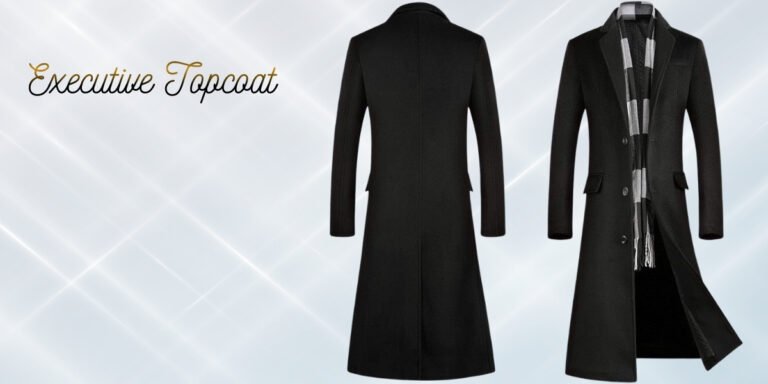
An Executive Topcoat is worn by professionals who value functionality and sophistication. Traditionally, Topcoats are long, tailored, and knee-covering overcoat that can go with just about any formal/business attire. Executive Topcoats are a step up from other casual overcoats, giving you that personalized and professional look with clear lines and a polished finish.
Due to the crisp look overcoats can give you, they are usually made of higher-end materials like wool, cashmere, or a mixture of the two. These materials give off higher-end looks that other casual coats just can’t keep up with. So, yes, Topcoats will keep you warm, but they will also give you an investment in your professional wardrobing.
Key Features of an Executive Topcoat
Tailored Fit: Made to show off the lines of your body with a little bit of room to put on your full suit.
Design: Made with a minimal look, usually a single or double-breasted look.
Materials: Higher-end materials like wool, cashmere, or both.
Color: High-end overcoats come in a select few colors: black, charcoal, charcoal, and navy.
Details: Better overcoats will have real pockets, so that is a big plus.
Understanding the Windproof Topcoat
Winter-ready with a sleek plaid overcoat.
The Executive Topcoat will keep you looking perfect and feeling great on your next long drive, and stay warm on those cold winter drives. Understanding the Windproof Topcoat The covert Topcoat focuses more on practicality, while the Executive Topcoat focuses more on looking good. If you need a coat for a cold and windy climate, the Windproof Topcoat is for you. The Windproof Topcoat has specialized construction and different types of fabrics that let little to no wind penetrate. It is often made with tighter weaves, a waterproof or water-resistant finish, and wind-resistant closures. Because of this, it is both functional and aesthetically good for the city or the wilderness. Key Features of a Windproof Topcoat. Wind-Resistant Fabric fabric clothing that is tighter woven with wool, polyester, and/or synthetic blends .Weatherproof Technology Some clothing has waterproof materials and membranes. Insulated Design Quilted lining and/or padding to keep you warm. Adjustable Elements Closure looseness protected by snaps, drawstrings, or velcro. Versatile Style Modern fitting clothing with no accessories.
The Windproof Topcoat is not just for extreme weather—Windproof Topcoat offers comfort and durability while keeping your warm and protected, and top your style.
History and Evolution
Executive Topcoat
The Executive Topcoat traces its history back to 19th century Europe when professional and aristocratic men paired their suits with long overcoats. Wool was the only used fabric and the coats were a symbol of authority and power. As the years passed, designers adapted to the trend by expanding their used materials, and altering styles and lengths of their coats. Now, with the use of modern techniques, the Executive Topcoat is a representation of professional outerwear.
Windproof Topcoat
The Windproof Topcoat began to emerge over the rest of the 20th century with the advancement of technology in fabric design. A coat that retained heat while blocking wind and powered functionality without giving up on design style became achievable. As travel became more frequent and cities expanded, the Windproof Topcoat became a necessary choice for professionals. Now, with changing times, the Windproof Topcoat can still provide protection from the weather and maintain a more refined look for the office.
Fabrics and Materials
Choosing the right materials is crucial for both Executive Topcoats and Windproof Topcoats. Different materials influence the warmth, durability, and the overall look.
Executive Topcoat Fabrics
Wool: It’s warm, durable, and gives a classic look that many professionals wear.
Cashmere: While expensive, it is warm and beautiful. Many designers and stylists love the soft light feel.
Wool-Cashmere Blend: Offers the best combination – the warm and rugged wool with the soft cashmere.
Synthetic Blends: For wrinkle resistance, low price, and light weight, synthetics are a good option.
Windproof Topcoat Fabrics
Tightly Woven Wool: gives the best professional look and warmth, and is also wind protection.
Polyester or Nylon: Lightweight and water protection, good for with Windy weather.
Technical Fabrics: Fabrics that are laminated or treated, are very good for wind and water protection.
Insulated Linings: Linings that are quilted provide good warmth and keep the thin look.
Choosing a fabric is important for balancing protection, look and ease of care.
Styles and Designs
Executive Topcoat Styles
Single-Breasted Executive Topcoat: This has a clean, minimal, and professional design that many businesses love.
Double-Breasted Executive Topcoat: Adds a touch of formality and sophistication.
Belted Executive Topcoat: Combines structure with a tailored silhouette.
Classic Colors: Navy, black, camel, and charcoal dominate executive styles.
Windproof Topcoat Styles
Sleek and sophisticated: a tailored brown double-breasted coat layered over a navy suit.
Hooded Windproof Topcoat: Provides elegance with a little extra protection.
Collar-Adjustable Windproof Topcoat: Keeps the wind out and the lines sleek.
Insulated Windproof Topcoat: For extreme climates, warmth and wind resistance.
Urban Minimalist Design: Modern cuts and style with professional looks and functionality.
It’s important to think about the style of topcoat with what you already own. For example, with formal office attire you will need to use an Executive Topcoat. For winter commuting, a Windproof Topcoat would be the best option.
Layering and Seasonal Considerations
Layering is an essential factor when wearing either men topcoat. The Executive Topcoat is designed to be worn over suits, blazers, or shirts, while still maintaining a tailored fit. On the other hand, the Windproof Topcoat can accommodate multiple layers, including sweaters and thermal undergarments, without restricting movement.
Seasonal Tips
Winter: Opt either a wool-cashmere blend Executive Topcoat for warmth, or a Windproof Topcoat with padding for extreme conditions.
Fall and Spring: Soft wool or synthetic blends works great for warm and cold weather.
Rainy Seasons: Windproof Topcoats with water-resistant coatings let you stay dry while looking good.
Good knowledge of topcoat seasonal requirements will help you with practicality and style.
Styling Tips
For Executive Topcoat
For a more professional look, pair with tailored suits and polished shoes.
For a sophisticated look, add a leather briefcase and a silk scarf.
Stick to a neutral palette for timeless appeal
For Windproof Topcoat
For a more urban, functional look pair with casual trousers or some jeans.
For style and protection, add some gloves, a knitted hat, and some boots.
Provide some room to layer without making your coat look bulky.
Mixing elements of both styles will create a interesting look, making it perfect for people, especially, for working professionals, who need to easily adapt from indoor to outdoor environments.
Maintenance and Care
The insulated topcoats will last longer with more care. Windproof Topcoats and Executive Topcoats will need some extra specific attention for quality and appearance.
Wool and Cashmere: Only dry clean; using machine washes will ruin it.
Synthetic Blends: May be machine washable. Check manufacturer’s care instructions.
Storage: Use sturdier hangers to keep garments from losing their shape. Avoid overcrowded closets.
Spot Cleaning: Use the correct cleaner on the correct stain to prevent any damage on the material.
Ignoring these instructions can result in your garments losing their style and lasting days to years.
Why Invest in Both?
In the end, the choice may be an individual one, however, buying an Executive Topcoat and a Windproof Topcoat together is totally worth it. The Executive Topcoat has you looking the part in business, and the Windproof Topcoat has your back on the the tough weather. Together, you are ready to take on any outfit requirement: formal, casual, or outdoors. You be the most stylish and versatile.
Conclusion:
In the end, both the Executive Topcoat and Windproof Topcoat are must-have staples for any modern professional. While the Executive Topcoat focuses on providing elegance, structure, and formal tailoring, the Windproof Topcoat offers protection from the elements while keeping you looking refined. Knowing the distinct quality of each coat and its versatility and styling potential, you are on your way to making quality choices that reflect your comfort and styling needs. The addition of versatile topcoats to your clothing collection is an indication that you can handle any professional demands, setting, or climate.
FAQs
What is the difference between an Executive Topcoat and a Windproof Topcoat?
An Executive Topcoat focuses on elegance, tailored fit, and professional style, while a Windproof Topcoat prioritizes protection against wind and harsh weather, often with technical fabrics and insulated linings.
Can I wear an Executive Topcoat in windy or rainy weather?
Yes, but for extreme conditions, a dedicated Windproof Topcoat provides better protection. Some Executive Topcoats feature wind-resistant fabrics, offering moderate weather defense.
Which fabrics are best for Executive Topcoats?
Wool, cashmere, and wool-cashmere blends are ideal, as they provide warmth, structure, and a refined appearance suitable for professional wear.
Gabardine Topcoat is not just a coat, it is a wardrobe investment. It is a blend of style, sophistication, and functionality. For decades It has been a timeless fashion staple, admired by men and women alike. Whether it is a formal event, work commute, or casual outing, topcoat in Gabardine will gives you the blend of elegance and ease.
In this guide, we will explore the history, materials, styling tips, care, and benefits of a top coat in gabardine. We will also explore the tips to answer your questions, to help you make an educated purchase.
What Is a Gabardine Topcoat?
Sharp and sophisticated: a gray double-breasted overcoat layered over a navy suit.
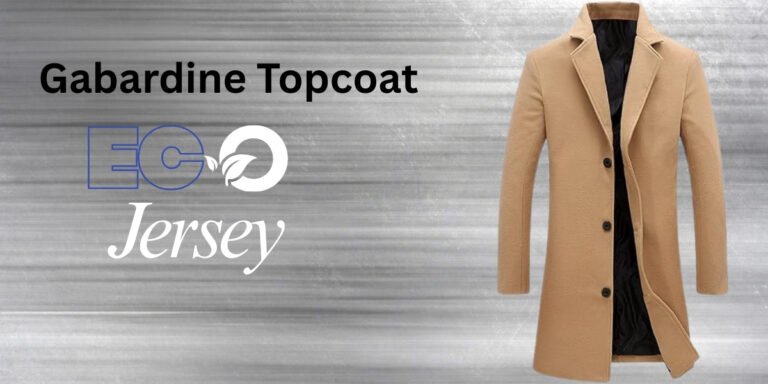
A gabardine topcoat is a type of coat made from gabardine fabric. Gabardine is one of the several types of tightly woven materials that are known for being durable, smooth, and for being able to withstand light amounts of moisture. Gabardine is made out of wool, cotton, or man-made materials, and it is less bulky than conventional fabrics.
Gabardine topcoats offer structure and ease, but are also comfortable and elegant. They are perfect for both professional and casual use. Their smooth jackets are sophisticated while their topcoats are made with tightly woven fabric to ensure longevity.
Key Features of a Gabardine Topcoat:
Durable construction, weather resistance, lightweight warmth, timeless aesthetic, and are perfect for formal or casual use. Durable Construction: Resistant to wear and tear.
Weather Resistance: Lightly water-repellent, ideal for transitional seasons.
Lightweight Warmth: Provides insulation without heaviness.
Timeless Aesthetic: Perfect for formal and casual outfits.
Thus, the gabardine topcoat is not only practical but also a statement of timeless fashion.
Gabardine topcoats serve a need while also being a timeless depiction of fashion.
History of Gabardine Topcoats
Sharp in a dark overcoat and gray suit, standing poised on a city street.
Gabardine fabric was first invented by Thomas Burberry in 1879. Gabardine was initially designed to withstand the occupational hazards of outdoor exploration. Gabardine was wind and water proof.
First part of the 20th Century: The Men’s gabardine topcoats became the mark of sophistication within formal wear.
1920s–1930s: The gabardine coats became part of the functional and stylish outerwear of women.
Present Day: The topcoats have become part of the luxury fashion and the high street collections.
What is more interesting is that the core design principles of the original gabardine coat which focuses on structure, durability and the elegance continues to form the basis of modern tailoring.
Materials and Fabrics of Gabardine Topcoats
The urban topcoat‘s fabric determines its comfort, durability and style. Let’s delve into the most common ones.
Wool Gabardine
Wool gabardine is the most classic and also the most luxurious option. It provides:
Great insulation for the cold
A more polished and structured look
It is also the most durable option
It is specially suited for formal occasions and professional work settings.
Cotton Gabardine
The cotton gabardine is very lightweight and quite breathable. It is best suited for spring and fall and provides comfort while also giving a clean look to the person. It is largely versatile. The cotton kantha is best suited for semi formal looks and also casual looks.
Wool Cashmere Blends
This loses very little warmth. The softness of cashmere and the wool combined make the topcoats very luxurious. The wool cashmere gabardine are lightweight, perfect for long term investment and very soft to touch.
Synthetic Blends
Gabardine blended with synthetic fibers such as polyester or nylon is cheaper and more wrinkle resistant. Although respiratory issues or sweating may become a concern with real wool or cotton, synthetic Blends offer a polished structured look at a more affordable price.
Pro Tip: Make it a habit to check the fabric composition before buying to make sure it is in line with your comfort, climate, and style preferences.
Benefits of a Gabardine Topcoat
Gabardine topcoats are stylish, yet practical. Here are the main benefits:
Versatility: Pairs well with suits, jeans, or dresses.
Seasonal Adaptability: Works for fall, winter, and spring.
Timeless Style: Elegant design is classic and never ages.
Weather Protection: Light water resistance keeps you dry in drizzle.
Durability: High quality gabardine does does wear out for years. Versatility: Pairs well with suits, jeans, or dresses.
This makes gabardine topcoats a functional investment that combines fashion with practicality.
Styling Tips for Gabardine Topcoats
Cold day, sharp style: a navy peacoat and a classic watch.
Gabardine topcoats can elevate your look, be it formal or casual.
Styling for Men
Formal Look: Style with a tailored suit, dress shirt, and leather shoes.
Casual Look: Match with denim, a turtleneck, and Chelsea boots.
Accessories: A scarf, leather gloves, and a hat add the look.
Women`s Styling
Professional Outfits: With a pencil skirt or tailored trousers and a blouse.
Casual Looks:Combine with skinny trousers, boots, and a comfy sweater.
Evening Look s: Gabardine topcoats with dresses are elegant.
Pro Tip: Wearing neutral tones like black, navy, grey, or camel will bring the most versatility. Wearing one bold color, or one subtle patterned piece will add a statement.
What Colors and Patterns Of Gabardine Topcoats Are There?
The color and pattern you choose for your gabardine women topcoat play an important role in influencing the overall impression your topcoat creates.
Classic Colors: Black, navy, grey, and camel are always in style and will go with anything.
Subtle Patterns: Herringbone, and the various shades of plaid and check are nice, but not too busy.
Deep Colors: A modern option is a coat with a bold color like deep green or burgundy and still gives a touch of sophistication.
The color you choose means that your gabardine topcoat can easily cover a variety of situations and can be worn across different seasons.
7. Gabardine Topcoat vs Other Outerwear
Gabardine Topcoat vs Other Outerwear
Elegant black double-breasted coat with gold buttons.
Understanding the differences between a gabardine topcoat and other coat types highlights its unique advantages:
Clearly, gabardine topcoats offer the perfect balance of elegance, comfort, and practicality.
Caring for a Gabardine Topcoat
Your coat can be polished and long-lasting if you dedicate time to care.
Dry Cleaning: Most gabardine fabrics should be professionally cleaned.
Storage: Use a wide padded hanger to keep the shoulders of your coat from deforming.
Spot Cleaning: Use a clean damp cloth and gently rub the stain. Avoid detergents.
Brushing: Frequently brush your coat to remove the dust and keep the fabric smooth.
Your coat can last for decades and will be able to retain its style and structure if it receives the right care.
Gabardine Topcoat Accessories
When it comes to stylistic enhancements, here are some functionally useful accessories:
Scarves: Cashmere or wool scarves can complement the texture of the topcoat.
Gloves: Leather gloves could add an element of sophistication, and will keep your hands warm.
Hats: A fedora, or beanie could function well depending on the formality or casual of the event.
Footwear: You can wear dress shoes, chelsea boots, or loafers depending on topcoat, and outfit.
These accessories will improve aesthetics, and maximize comfort during the colder months.
How to Choose the Right Gabardine Topcoat
When it comes to selecting a men topcoat, here are some things to keep in mind:
Material: selection of natural fibers, or wool-cashmere will be the best options.
Fit: Topcoats should be tailored and structured, but should be to allow movement around the chest and shoulders.
Length: Topcoats ideally rest mid thigh to the knee.
Color: Going with neutral colors will add longevity to the topcoat, and if you want to add some personality to the topcoat you can add patterns.
Brand Quality: A trusted brand will usually be a good indicator to top quality fabric and construction.
When you Invest in a quality topcoat it will guarantee you years of reliable eear.
Except for the unisex topcoats, is you want to wear your gabardine topcoat, it is essential to have an oversized or tailored topcoat for a unisex appearance.
Conclusion
In conclusion, the gabardine topcoat is the ultimate fusion of style, comfort, and functionality. Its rich history, durable fabric, and elegant design make it a wardrobe essential for both men and women. By investing in a high-quality gabardine topcoat, you can enjoy years of sophisticated fashion while staying comfortable and protected from the elements.
Whether dressing for a formal event, casual outing, or workday commute, a gabardine topcoat ensures you look polished, stylish, and confident. Timeless, versatile, and practical, it truly is an investment piece that never goes out of style.
FAQs
What is a gabardine topcoat made of?
Gabardine topcoats are usually made from tightly woven fabrics such as wool, cotton, or wool-cashmere blends. Some may include synthetic fibers for durability and affordability.
Is a gabardine topcoat suitable for rainy weather?
Gabardine fabric is water-resistant but not fully waterproof. It can protect against light rain or drizzle, making it ideal for transitional seasons.
How do I clean a gabardine topcoat?
Most gabardine topcoats require professional dry cleaning. For minor stains, gently blot with a damp cloth. Avoid harsh detergents to maintain the fabric’s texture.
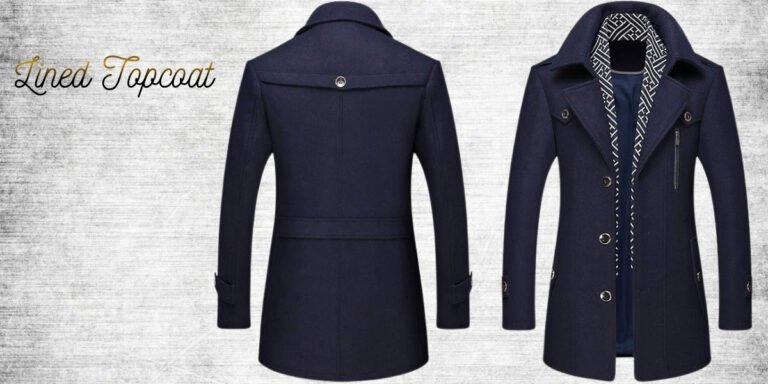
More than an outer layer, a lined topcoat is a complex piece of outerwear that offers warmth, structure, and sophisticated style. While many may look the same, the lining of a topcoat is a critical element that affects the performance, feel, and longevity of the piece. Paying attention to the details in a lined topcoat will improve your overall fashion and investment knowledge.
This guide will answer the questions, what is a lined topcoat, why does lining matter, how a variety of linings impact your level of comfort, and how to find the most suitable topcoat for your way of life. This article is easy to read, SEO optimized, and written with the confidence of a style expert.
What is a Lined Topcoat?
Classic double-breasted wool coat in a textured grey finish with peak lapels and black buttons.
A lined topcoat is a long, tailored coat with an additional layer of fabric that is stitched between the outer shell of the coat and the body of the wearer. Topcoat linings add to the coats, insulation, comfort, durability, and freedom of movement. In many, higher quality coats, the lining is selected to be a complement to the outer fabric.
Coat linings are made from materials like viscose, polyester, silk, Bemberg, or even quilted stuff. This makes it easy for the coat to slide on over suits, sweaters, or shirts. Also, it prevents the inner fabrics from wearing the outer fabrics down from rubbing together.
Even though unlined or partially lined coats are lighter weight, a fully lined top coat is usually preferred for cold climates. Therefore, lined top coats are commonly worn during the winter, fall, and the transitional seasons.
Why Lined Topcoats are Better
To most people, top coat lining may not seem like a huge deal. But lining actually impacts the way a top coat functions. Many top coats have high-end qualities because of the lining materials.
More insulation
To start off, a lining is going to give you more insulation. By trapping air between materials, heat is going to be retained and that is why a lined top coat is going to keep you warmer in the same outer fabric for an unlined coat.
In cold weather, quilted or padded inner linings are often utilized. This enhances the heat of the coat without steering too much bulk. Lining materials are still going to give you thermal balance during the other seasons.
Better Comfort and Wearability
Elegant in neutrals: a tailored light-gray blazer over a soft beige sweater pairs perfectly with dark jeans for a polished, casual look.
Comfort is one of the biggest advantages. Premium lined coats are smooth and can be worn over several layers. It also allows the wearer to move easily when sitting and walking.
Also, high-end linings are meant to be breathable, meaning you avoid overheating and feeling uncomfortable because of moisture, unlike cheap coats that trap moisture.
Structural Support and Shape Retention
A lined coat retains its shape better than an unlined coat. The lining gives support to the outer fabric and thus reduces stretching and sagging. It helps the coat retain its silhouette season after season.
Furthermore, lining also reinforces the tailored details on the coat, making the coat look high-end.
Types of Linings Used in Topcoats
Types of Linings Used in Topcoats: Polyester, Rayon, Bemberg, Silk, and Insulated Linings with notes on softness, breathability, luxury feel, and temperature regulation.
Understanding the different kinds of linings helps you to decide what is best for you.
Polyester Lining
Polyester is one of the most common lining materials. It is cheap and thus a good option for people on a budget. It is also durable and great for people who are concerned about wrinkles. It helps the coat to slide over clothing.
However, polyester doesn’t breathe like natural fibers do. This means it might be warmer, but will be less comfy over longer periods of wearing it. Still, it is commonly used in everyday men topcoats.
Viscose and Rayon Lining
Viscose and rayon are semi-natural fibers that come from cellulose. They are softer and more breathable than polyester. Because of this, they are used in mid-range and premium lined topcoats.
These linings feel great against your skin. They are soft and also absorb moisture better than polyester.
Bemberg Lining
Bemberg lining is lightweight and breathable, and that is why it is a top choice for luxury lined topcoats. It’s more expensive, but many high-end brands trust Bemberg for a reason.
Silk Lining
Silk linings are rare, but they are offer the smoothest and most lux and great for temperature reguation. They are left for the bespoke and designer insulated topcoats as they are the most delicate and expensive
Quilted and Insulated Linings
For winter-focused lined topcoats, quilted linings are often added. These include synthetic padding or natural insulation. Consequently, warmth is maximized without sacrificing style.
Lined Topcoat vs Unlined Topcoat
When considering either lined or unlined topcoats, the differences are worth considering. Your choice really comes down to what you need.
Lined topcoats are better for cold weather as they provide warmth, comfort, and structure. Longer, daily wear is also better for the lifespan of the jacket due to less wear and tear from movement. They are great for formal dressing and winter commuting.
Unlined topcoats are more lightweight and better for breathability. They are perfect for layering and wearing in the winter as they are less durable and warmer.
Overall, lined topcoats offer more practical versatility and are the better choice.
Construction of Lined Topcoats
There are several steps in the construction of lined topcoats. First, the outer shell is tailored from wool, cashmere, or blended fabrics. Then, the lining is cut to match the coat’s pattern.
After, the lining is tacked to the inner side of the coat, and enough ease is left for movement. Some designs have linings that are partially tacked to each side for even more airflow. In addition, this greatly improves the comfort.
Quality construction of lined topcoats ensures that no linings are pulled or bunched. Good fit, and great sleek lines are the tailored results of less movement in the linings.Wool vs Cashmere vs Wool-Blend
A good quality top coat is as much about the outer fabric as it is about the functional linings. The best women topcoats combine premium linings and shells.
Wool Lined Topcoat
Wool is the best and most popular fabric. It’s insulating, breathable, and durable. Paired with quality linings, a wool lined top coat is a winter essential.
Cashmere Lined Topcoat
Cashmere is soft and warm and makes the coat feel light and luxurious. While it is a bit of a splurge, you won’t find a more comfortable top coat.
Wool-Blend Lined Topcoat
Wool-blends are the most cost effective fabric option and when lined properly, provide a good balance of warmth and comfort.
Styling a Lined Topcoat
A lined top coat is as versatile as you need it to be. It can be easily styled for a variety of outfits and occasions.
Formal Styling
A lined top coat pairs perfectly with a formal outfit. Dress shoes, suits, and a scarf complete the look. With the lining offering smooth layering, it sits over tailored clothing
Smart Casual Outfits
Over knits, Chinos and Denim, it can be worn and styled to feel polished or relaxed.
Everyday Winter Wear
A topcoat is a perfect winter option. It’s a go-to for work and travel so you can stay warm and stylish.
Seasonal Use of a Lined Topcoat
Topcoats are mainly fall and winter pieces. However, lighter linings are great for early spring, becoming a topcoat you can wear all year in a lot of places.
Cold climates need insulated linings. On the moderate side of the scale, you need breathable linings for the perfect amount of comfort.
How to Choose the Right Lined Topcoat
Finding lined topcoats that are right for you takes some work.
First, you need to consider your location. If you get really cold winters, heavier linings are great, but for spring, fall, and early winter, opt for lighter linings. After that, check the lining. Make sure that it is breathable and lined for comfort.
You’ll need to pick a topcoat that gives you enough room to wear a lot of layers underneath. It should fit perfectly over all your winter clothing.
Last, for versatility, choose topcoats in blacks, greys, navy, or camel.
Care and Maintenance of a Lined Topcoat
Take good care of your topcoat and you can keep it for a long time. Just follow all the care instructions on the label, and it usually says to get it dry cleaned.
To air the coat out, hang it on a wide hanger to keep its shape.
To keep it looking good, the lining should be washed to remove sweat and friction.
Why is a lined topcoat a good investment?
There will be a higher upfront cost (but over time, lined topcoats have better value). Since they are more durable, lined to coats will be less warm, and less styled, which will be the ideal piece for fewer replacements.
A good lined topcoat will elevate any outfit, remaining a perfect piece that will never go out of style.
Final thoughts
Ignited coats are constructed better. They supply comfort and style better than unlined coats.
When you invest in a lined topcoat, you are choosing durability, elegance, and seasonal versatility. Therefore, they remain one of the most impressive outerwear pieces available today.
FAQs
What is the purpose of lining in a topcoat?
The primary purpose of lining in a topcoat is to improve warmth, comfort, and durability. A lining helps trap heat, allows the coat to slide easily over clothing, and protects the outer fabric from internal wear.
Is a lined topcoat warmer than an unlined topcoat?
Yes, a lined topcoat is generally warmer than an unlined one. Because an extra layer is added, insulation is improved and body heat is retained more effectively.
What is the best lining material for a topcoat?
The best lining material depends on your needs. Bemberg (cupro) is considered premium due to its breathability and smooth feel.
Quilted Fabric Explained starts with knowing the reason why this fabric has continued to be a necessity among cultures and industries. Quilted cloth is a cloth fabric that is created by sewing together a number of cloth fabric layers. This stratified building is soft, insulated and durable simultaneously. Consequently, quilted fabric has multiple functions and uses as well as decorative purposes. In addition, it is not overweight and is warm.
This cloth remains a trend in fashion, home fabrics and winter clothes since it is comfortable and practical. Structure and texture are appreciated by designers. It is warmer and more appealing to the eye of the homeowner. Quilted fabric is an effective trap to air unlike thick fabrics. Hence, it is more warm and yet breathable.
Also, quilting enhances comfort with the help of evenly spread padding. Stitching also does not allow the inner filling to move. Thus, quilted products have years of shape and performance. Quilted Fabric Explained is aimed at explaining to buyers why this fabric will always be timeless.
What Is Quilted Fabric? (Quilted Fabric Explained Clearly)
Quilted cloth is a multi-layered cloth in which the fabrics are woven in designs. It is composed of an outer-lying fabric, an insulating layer and a backing fabric. The layers are combined to produce cushioning and warmth. Consequently, quilted material is soft but supportive.
This fabric is not similar to the single-layer fabrics since they are used as a form of insulation. It is also not similar to padded cloth since the layers are held together by stitches. Hence, the filling remains consistently distributed. This eliminates cold spots and lumps.
The embroidery makes it stronger and much more comfortable. In addition, the quilting patterns provide visual richness. Hence, quilted fabric is useful in the world of fashion and interiors.
History and Origins of Quilted Fabric.
Quilted Fabric Explained is also in need of historical context. Quilting was used to keep people warm and protect them in the ancient civilizations. Egyptians overlaid fabrics as bedding and clothing. Equally, the Chinese cultures created quilted armor to offer insulation and flexibility.
In medieval Europe, quilting was introduced in bedding and clothes. Craftspeople crossed layers by hand with the use of wool and cotton. Consequently, quilts were useful house materials. In addition, the quilting was a family tradition.
Quilting developed at a high rate with industrialization. Mass production was done by the replacement of hand stitching by machines. As a result, quilted fabric was introduced into the modern world of fashion, upholstry, and accessories. It is a combination of tradition and technology today.
Colorful patchwork quilt layered over a solid gray quilt.
How Quilted Fabric Is Made (Quilted Fabric Explained Step by Step)
The knowledge of production makes Quilted Fabric Explained more feasible. Manufacturers start with the selection of the top fabrics. Blends, wool, cotton and polyester are still utilized. Then, they include batting as insulation and cushioning.
Decorative patterns are used to hold the layers together by stitching. Diamond and channel stitching is still in use. All the patterns have an effect on flexibility and warmth. As such, the design of stitches is important.
The batting layer is important in performance. The natural batting is breathable. Synthetic batting is durable. Consistency is guaranteed by industrial quilting and uniqueness and craftsmanship are provided by handmade quilting.
Types of Quilted Fabric Explained by Material
Understanding quilted fabric becomes easier when you explore it by material. Each material affects warmth, breathability, durability, and overall comfort. Therefore, choosing the right quilt fabric depends heavily on the fiber used. Quilted Fabric Explained by material helps buyers select the best option for clothing, bedding, or accessories. Moreover, material choice determines care needs and seasonal suitability.
Quick guide to different quilted fabrics: cotton, polyester, wool, and silk.
Cotton Quilted Fabric Explained
Cotton quilted fabric remains one of the most widely used options worldwide. It feels soft against the skin and allows natural airflow. As a result, it provides comfort without overheating. Cotton quilting works especially well for bedding, baby products, and light jackets.
Additionally, cotton absorbs moisture efficiently. This feature makes it suitable for people with sensitive skin. However, cotton quilted fabric may wrinkle easily. It may also shrink if washed incorrectly. Therefore, gentle care improves longevity. Cotton quilted fabric suits mild winters and indoor use best.
Polyester Quilted Fabric Explained
Polyester quilted fabric offers strength, durability, and affordability. It resists wrinkles and holds shape after repeated washing. As a result, manufacturers prefer it for outerwear and daily-use products. Polyester quilting also dries quickly, which adds convenience.
However, polyester quilted fabric feels less breathable than natural fibers. It may trap heat more aggressively. Therefore, it suits colder environments or short outdoor exposure. Polyester quilting works well for jackets, vests, and accessories requiring low maintenance.
Wool Quilted Fabric Explained
Wool quilted fabric provides exceptional insulation and temperature regulation. It traps heat efficiently while allowing moisture to escape. As a result, wearers stay warm without feeling damp. Wool quilting performs well even in freezing conditions.
Moreover, wool naturally resists odors and bacteria. This quality enhances comfort during extended wear. However, wool quilted fabric requires careful washing. Improper care may cause shrinking. Therefore, it suits premium winter clothing and high-quality bedding.
Silk Quilted Fabric Explained
Silk quilted fabric represents luxury and refinement. It feels lightweight yet surprisingly warm. Silk naturally regulates body temperature. As a result, it keeps users comfortable in changing climates.
Additionally, silk quilted fabric offers a smooth texture and elegant appearance. It enhances decorative quilts and upscale bedding. However, silk demands gentle handling and dry cleaning. Therefore, it suits decorative or luxury applications rather than heavy daily use.
Quilted Fabric Compared to Padded and Thermal Fabric
Quilted fabric, padded fabric, and thermal fabric often appear together in winter clothing and home textiles, yet they serve different purposes. Understanding these differences helps buyers choose the most suitable option. Quilted fabric stands out because it uses multiple fabric layers stitched together in fixed patterns. This construction keeps insulation evenly distributed. As a result, quilted fabric provides balanced warmth and consistent comfort during use.
Padded fabric relies on a thicker layer of loose filling placed between fabric layers. Unlike quilted fabric, padding often remains unsecured or lightly stitched. Therefore, the filling may shift over time. This shifting can create uneven warmth and bulky areas. However, padded fabric offers higher immediate insulation. It works well in extreme cold conditions where maximum warmth matters more than flexibility.
Thermal fabric differs significantly from both quilted and padded fabrics. Instead of layered construction, thermal fabric uses specially engineered fibers or weaves. These fibers trap body heat while allowing moisture to escape. As a result, thermal fabric feels lightweight and breathable. It works best as a base layer rather than an outer garment.
Key Benefits of Quilted Fabric
Quilted fabric offers a combination of comfort, warmth, and durability that few textiles can match. Its layered structure improves performance while maintaining flexibility. As a result, quilted fabric works well in both fashion and home textiles. Moreover, it supports everyday comfort across seasons. Quilted Fabric Explained through its benefits highlights why this fabric remains widely preferred.
Excellent Heat Retention Without Heavy Weight
Quilted fabric retains heat by trapping air between stitched layers. This trapped air acts as natural insulation. As a result, the fabric stays warm without feeling heavy. Unlike bulky winter materials, quilted fabric allows easy movement.
Additionally, the stitched construction distributes warmth evenly. This prevents cold spots during wear. Therefore, users enjoy consistent insulation. Quilted fabric suits mild to cold climates effectively.
Lightweight Insulation for Daily Comfort
One major benefit of quilted fabric is its lightweight feel. The batting layer provides warmth without excessive thickness. As a result, garments feel comfortable for long hours. This feature supports everyday use.
Moreover, lightweight insulation allows layering. Wearers can add or remove layers easily. Therefore, quilted fabric adapts well to changing temperatures.
Soft and Cushioned Feel Against the Skin
Quilted fabric feels soft due to evenly spread padding. The stitched layers prevent bunching or stiffness. As a result, the surface feels smooth and supportive. This improves comfort in both clothing and bedding.
Additionally, cushioned texture reduces pressure points. Therefore, quilted blankets and mattress pads improve sleep quality. Comfort remains consistent over time.
Long-Lasting Durability and Shape Retention
Quilted fabric maintains its structure through stitching. The layers stay firmly connected. As a result, the fabric resists sagging and flattening. This improves long-term performance.
Moreover, durable construction supports frequent use and washing. Therefore, quilted fabric lasts longer than loosely padded materials. Longevity adds value.
Common Uses of Quilted Fabric
Quilted fabric appears across many industries because it combines warmth, comfort, and durability. Its layered structure makes it suitable for practical and decorative purposes. As a result, quilted fabric remains a preferred choice for designers, manufacturers, and consumers. Moreover, its ability to adapt to different needs increases its value. Quilted Fabric Explained through its uses shows how versatile this textile truly is.
Quilted fabric is widely used in clothing because it provides insulation without excessive bulk. Jackets and coats often feature quilted fabric to offer warmth while maintaining a structured shape. This makes outerwear comfortable for daily wear. Additionally, quilted vests provide core warmth while allowing free arm movement. Hoodies and sweatshirts also use lightweight quilting to add comfort in cooler weather. Baby clothing frequently includes quilted fabric because it feels soft and protective. As a result, infants stay warm without discomfort.
In home textiles, quilted fabric plays a major role in comfort and decoration. Quilts and blankets remain the most traditional applications. These items trap heat effectively and feel cozy during sleep. Moreover, quilted bedspreads add texture and visual appeal to bedrooms. Mattress pads made from quilted fabric improve cushioning and support. As a result, sleep quality often improves. Cushion covers also benefit from quilting because it adds depth and softness to furniture.
Breathability and Comfort of Quilted Fabric
Quilted fabric is widely appreciated not only for warmth but also for comfort. Its layered construction creates a balance between insulation and airflow. As a result, quilted fabric feels cozy without causing overheating. Moreover, proper stitching and material selection improve overall wearability. Quilted Fabric Explained through breathability and comfort helps users understand its everyday performance.
Air Circulation Between Quilted Layers
Quilted fabric allows air to circulate through stitched channels. These small spaces between layers help regulate body temperature. As a result, heat remains trapped while excess warmth escapes slowly. This balance prevents discomfort during prolonged use.
Comfort improves when moisture stays under control. Quilted fabric manages moisture by allowing vapor to escape through layers. Natural fillings like cotton and wool enhance this effect. As a result, the fabric feels dry and comfortable.
Synthetic fillings may trap moisture slightly. However, modern blends improve performance. Therefore, choosing the right filling supports moisture balance and comfort.
Softness and Skin-Friendly Feel
Quilted fabric feels soft because padding spreads evenly. The surface remains smooth and gentle. As a result, it suits sensitive skin. This feature benefits baby products and bedding.
Additionally, quilted fabric reduces friction during movement. Therefore, it feels comfortable during daily wear. Consistent softness enhances long-term satisfaction.
Temperature Regulation in Different Climates
Quilted fabric adapts well to changing temperatures. It retains warmth in cold conditions. At the same time, it prevents overheating in mild weather. This adaptability increases usability.
Careful arrangement of a dark pleated blanket on a bed.
Is Quilted Fabric Good for Winter?
Quilted fabric is widely considered a reliable choice for winter use because it provides warmth without excessive weight. Its layered construction plays a major role in thermal performance. The stitching holds the inner filling in place, which allows warm air to stay trapped. As a result, body heat remains close to the wearer. This insulation effect makes quilted fabricsuitable for cold weather.
Quilted fabric performs well because it balances insulation and comfort. Unlike very thick fabrics, it does not feel heavy or restrictive. Therefore, people can move freely while staying warm. This feature makes quilted jackets, coats, and blankets practical for daily winter use. Moreover, quilted fabric adapts easily to layering systems. It works well over base layers and under outer shells.
Another reason quilted fabric works well in winter is its ability to distribute warmth evenly. Stitching prevents the filling from shifting or clumping. As a result, cold spots rarely form. This even insulation improves comfort during extended wear. In bedding, quilted blankets provide consistent warmth throughout the night.
How to Choose the Right Quilted Fabric
Choosing quilted fabric depends on climate and usage. Cold regions require thicker insulation. Mild climates need lighter quilting. Fashion demands flexibility and appearance.
Bedding requires softness and warmth. Stitch density affects insulation performance. Natural fillings suit breathability. Synthetic fillings suit durability and ease of care.
How to Care for Quilted Fabric
Proper care helps quilted fabric maintain its warmth, softness, and shape. Because quilted fabric contains multiple layers, it requires gentle handling. With the right care routine, quilted items last longer and perform better. Quilted Fabric Explained through care practices ensures users protect their investment while preserving comfort.
Quick care guide for quilted fabrics: washing, hand washing, drying, and protecting winter fabrics.
Washing Quilted Fabric Correctly
Washing quilted fabric requires attention to fabric type and filling. Most quilted fabrics tolerate gentle machine washing. Cold or lukewarm water works best because it prevents shrinkage. Mild detergent protects fibers and stitching.
Avoid heavy agitation because it stresses the seams. Gentle cycles preserve the layered structure. Therefore, careful washing keeps quilted fabric in good condition.
Hand Washing for Delicate Quilted Items
Delicate quilted fabrics benefit from hand washing. Silk and wool quilting require special care. Gentle soaking removes dirt without damaging fibers. Light squeezing removes excess water.
Avoid wringing the fabric because it distorts batting. As a result, hand washing preserves softness and shape.
Drying Quilted Fabric Safely
Drying quilted fabric correctly prevents damage. Low heat drying works for many synthetic quilts. Air drying suits natural fibers best. Flat drying prevents stretching.
Occasionally fluff the fabric during drying. This restores loft in the batting. Therefore, insulation remains effective.
Preventing Flattening of Quilted Batting
Flattening reduces warmth and comfort. Avoid storing quilted items under heavy weight. Shake quilts regularly to maintain loft. Light sun exposure refreshes fibers.
Poor stitch quality reduces insulation performance. Wrong filling affects comfort. Ignoring breathability causes overheating. Overlooking care labels leads to damage.
Careful inspection prevents regret. Quality construction always matters.
Is Quilted Fabric Sustainable?
Quilted Fabric Explained also includes sustainability. Organic cotton and wool reduce environmental impact. Recycled polyester batting lowers waste. Durable quilting reduces replacement frequency.
As a result, quilted fabric supports responsible consumption.
Soft, coiled fabric textures in light gray.
Conclusion
Quilted Fabric Explained shows why this textile remains versatile and practical. Quilted fabric offers warmth, comfort, and durability. It suits fashion, home textiles, and accessories.
Moreover, proper selection and care maximize benefits. Choosing the right quilted fabric enhances everyday comfort and long-term value.
FAQs
Is quilted fabric warm enough for winter use?
Yes, quilted fabric is warm enough for winter in most cases. Its layered construction traps air between fabrics, which helps retain body heat. As a result, it provides effective insulation without excessive weight. However, warmth depends on the type of filling and fabric thickness. Heavier quilting with wool or synthetic batting suits colder climates better.
Can quilted fabric be machine washed safely?
Most quilted fabrics can be machine washed using a gentle cycle. Cold or lukewarm water works best to prevent shrinkage and damage. Mild detergent protects fibers and stitching. However, delicate quilted fabrics like silk or wool may require hand washing or professional cleaning. Always check the care label before washing.
Does quilted fabric shrink after washing?
Quilted fabric may shrink if it contains natural fibers like cotton or wool. Shrinkage usually occurs due to hot water or high heat drying. Therefore, gentle washing and low heat drying reduce this risk. Pre-shrunk or blended quilted fabrics shrink less. Proper care helps maintain original size and shape.
Grade-A cashmere fabric is the ultimate in luxury when it comes to textiles. It is praised for its softness and warmth. This fabric is now a favorite for luxury outerwear and timeless wardrobe staples.
This guide will cover everything you need about Grade A cashmere wool fabric. This article will help you understand the benefits of Grade A Cashmere, its uses and its care. It will also explain its origins, quality standards, its uses and its care.
What is Grade A Cashmere wool fabric?
The finest and longest fibers are sourced from cashmere sheep, which can be found mainly in Mongolia, Inner Mongolia and China. The Grade A cashmere comes from the undercoat, which is naturally smoother and thinner.
Grade-A cashmere fibers are typically 14-15 microns in diameter, which makes them extremely soft on the skin. This fine diameter reduces irritation and provides unmatched comfort. In addition, only the finest fibers are chosen, and shorter or coarser hairs will be removed during processing.
Why Cashmere of Grade A is the best
The finest fibers and lengths available
Cashmere Wool Fabric of Grade A is valued for its longer fibre length. The longer fibers create smoother yarns which result in stronger, more durable fabrics. Cashmere garments of Grade A resist piling better than lower grades.
The fineness of the fibres also ensures the fabric is exceptionally soft. Cashmere of Grade B or C may be slightly rougher, but Grade A has a smooth texture which enhances comfort.
Softness and comfort that is unsurpassed
Cashmere Wool Fabric of grade A is characterized by its softness. The fibers are silky and lightweight, so they feel soft on the skin and drape beautifully. This fabric is used for scarves and sweaters as well as coats and shawls.
The fabric’s breathability keeps you warm without overheating. Cashmere of Grade A is suitable for all climates because it has the right balance between insulation and airflow.
The ethical and sustainable sourcing of grade A cashmere
Sustainability has gained importance in recent years. The good news is that reputable cashmere producers prioritize ethical farming practices and ethical sourcing.
Cashmere goats will be combed gently by hand, during the molting period. In this way, the animal welfare and environmental impact are reduced. In addition, sustainable grazing techniques are used to protect ecosystems and grasslands.
Cashmere wool fabrics of Grade A, sourced responsibly, not only offer luxury but also support long-term environmental balance.
Cashmere wool fabric grade A is made
Fiber Sorting and Collection
Cashmere is first collected by hand combing. The fibers are then sorted according to color, length and fineness. Only the finest fibers will be selected at this stage for a Grade A classification.
Cleaning and Dehairing
The fibers are then cleaned to remove dirt, impurities and other contaminants. Next, the dehairing procedure is used to separate the soft undercoat from the coarse guard hairs. This step is vital, as it guarantees the smooth texture of Grade A cashmere Cashmere Wool Fabric.
Spinning and Weaving
The fibers are then spun into yarn. The Grade A fibers are durable and consistent because of their strength and length. The yarn is then woven or knitted using advanced techniques to preserve softness and structural integrity.
The finished fabric will have a luxurious, refined feel.
Cashmere wool fabric grade A: Benefits
Benefits of Cashmere Wool Fabric Grade A: warmth, comfort, breathability, and durability.
Warmth Unmatched without Weight
High insulation capacity is one of the best features of cashmere fabric grade A. The fabric is light, but it traps air effectively, providing warmth with minimal bulk. It is therefore ideal for winter and layering.
Breathability & Temperature Regulation
Cashmere Wool Fabric regulates its temperature naturally, unlike synthetic fabrics. Cashmere is a natural thermo-regulator, so it will keep you warm when the weather is cold but breathable during milder conditions. Cashmere of Grade A is suitable for all seasons because of its versatility.
Long-Lasting Durability
Cashmere Grade A garments will last many years if they are properly maintained. The fabric retains its softness and shape over time because longer fibers are being used. Reduced pilling also improves the appearance and longevity of garments.
Cashmere Wool Fabric Grade A: Common Applications
Coats, outerwear and luxury coats
High-end overcoats and tailored jackets are often made from cashmere fabric of Grade A. Its insulating qualities and elegant drape provide warmth and sophistication.
Sweaters and Knitwear
Cashmere Wool Fabric knitwear is a wardrobe essential. From crewnecks and fine cardigans to classic crewnecks, it’s a staple. Cashmere Grade A is soft and ideal for clothing worn next to the skin.
Scarves and Shawls
Cashmere scarves and wraps are also highly desired. These are stylish, lightweight and comfortable. They can be worn for formal or casual occasions.
Grade A Cashmere and Other Cashmere grades
Grade A vs Grade B Cashmere
Cashmere of Grade B typically measures between 18-19 microns. It is still soft, but it does not have the same refined feel as Grade A. The garments of Grade B are also more likely to wear and pill over time.
Grade A vs Grade C Cashmere
Cashmere grade C is made from fibers that are thicker, sometimes exceeding 20 microns. It is coarser in texture and usually blended with another fiber. Cashmere of Grade A is pure, luxurious, and soft.
Cashmere of Grade A is the best choice for premium quality.
What is Genuine Grade A Cashmere Fabric?
Check the Fiber Softness
Cashmere of Grade A is exceptionally soft to the touch. The fabric may not be Grade A if it feels rough or itchy.
Minimal pilling is a good sign
Cashmere Wool Fabric of higher quality has longer fibers, which means it pills less. Even though slight pilling is normal, excessive pilling indicates a lower-quality cashmere.
Please read product labels carefully
Reputable brands clearly indicate the fiber composition and grade. Always check the labels and certifications of products before buying.
Care for Cashmere Wool Fabric Grade A
Care Guidelines for Cashmere Wool (Grade A)
Proper Washing Techniques
Cashmere is best washed with cold water, and a mild detergent. Avoid harsh chemicals as they can damage the fibers.
Drying and Storage
The garments should then be dried flat. Hanging can distort garments’ shape. Folding is the best method of storage. Use breathable garment bags to keep moths at bay.
Preventing Damage
Avoid excessive friction to maintain fabric softness. Regular gentle brushing will also help to remove surface lint from the fabric and maintain its appearance.
Why Cashmere Grade A is Worth the Investment
Although it is more expensive, Grade A cashmere fabric offers an exceptional value over the long term. Its durability, comfort and timeless appeal make it outlast cheaper alternatives. Its classic elegance also ensures that it will never go out of fashion.
Cashmere of Grade A is therefore a great investment for your wardrobe.
Fashion Trends Featuring Grade A Cashmere
Cashmere of Grade A continues to be a staple in luxury fashion. Designers are increasingly focusing on minimalist silhouettes to highlight the fabric quality. Cashmere coats and oversized sweaters are timeless yet trendy.
Neutral tones, such as camel or ivory, are also popular, because they allow the fabric’s natural beauty to shine through.
Grade A Cashmere for Custom Tailoring
Cashmere wool is often used in custom tailoring for coats and suits. Its drape and flexibility allow it to adapt beautifully to structured design. It is therefore commonly used for premium tailoring in both menswear and ladieswear.
Blending Grade A Cashmere with fine Wool can also increase durability and softness.
Cashmere Wool Grade A Fabric Demand in the Global Market
Cashmere of Grade A continues to be in high demand around the world as luxury markets continue to expand. Cashmere is increasingly used by countries known for their fine tailoring or fashion craftsmanship. It has therefore become a global symbol of fine taste and high quality.
Final Thoughts
Grade-A cashmere fabric is the ultimate in luxury textiles. It is a favorite of designers and consumers alike because it offers unsurpassed softness, warmth and durability.
The rewards of cashmere are unquestionable, even though it is a delicate fabric that requires care. Cashmere of Grade A elevates all garments, from sophisticated coats to everyday knitting. Cashmere of Grade A is synonymous with comfort, style and timeless luxury.
Today’s fashion industry is constantly evolving, and versatility has become a key factor in defining great style. The people no longer desire clothing that is only suitable for one event. They want pieces that can be worn from casual mornings into stylish evenings. The overshirt jacket is a perfect example.
A printed overshirt is much more than a simple seasonal layer. It was designed to bridge between shirts, jackets and add personality with bold or subtle prints. It has therefore become a wardrobe staple for fashion-conscious people around the world.
Overshirt jackets with printed patterns are also popular because they combine comfort, style and functionality into one piece. There is a printed jacket that suits your style, whether you like minimalist patterns or eye-catching design. This guide will show you why this item of clothing deserves to be a staple in your wardrobe.
What is a Printed Overshirt Jacket?
Printed Overshirt Jacket
A printed overshirt is a hybrid piece that combines a lightweight shirt feel with the warmth and structure of a jacket. Overshirts are traditionally made of solid colors, and worn as utility layering garments. Modern fashion has given them a new look with creative prints, textures and patterns.
These jackets can be made from denim, cotton, twill or blended fabrics. They are durable and breathable. They are also often designed with chest pockets and button closures.
The element is the most important. It elevates an overshirt to a bold look. Even a simple outfit will look stylish and well-put together.
Why Overshirt Jackets with Printed Designs Are Popular
Print overshirt jackets are still a popular choice, despite the fact that fashion trends change. This growing demand is due to several factors.
Modern consumers have prioritized versatility. The printed overshirt can be worn closed or open, as a layer or alone, and for casual or semi-formal events. It is therefore more valuable than traditional jackets.
Second, prints are a way to express yourself. Prints tell a tale, while solid colors remain timeless. Personality is easily displayed with a checkered design, abstract design or floral print.
Printed overshirt jackets can be worn all year round. In the spring, they can be worn as outerwear. They are also great for layering under heavy coats in winter. They are also perfect for cool summer evenings.
Types of prints used in overshirt jackets
The variety of prints on printed overshirt jackets is what makes them so attractive. Each print has a unique aesthetic and mood. Understanding the different options will help you select the perfect piece.
1. Check and Plaid Prints
Checks and plaid prints are popular. These prints are known for their classic, rugged appearance and are frequently associated with casual and workwear styling. These prints are timeless and will never go out-of-style.
2. Abstract and artistic prints
These prints are ideal for those who want to stand out. These prints are often characterized by creative patterns and vibrant color combinations. They make a powerful fashion statement.
3. Floral Prints
Florals are no longer limited to summer shirts. They can be found on many jackets worn over a shirt. They create a refined and stylish look when printed subtly.
4. Geometric Prints
Geometric patterns have a structured and modern feel. They are perfect for those who like a clean, sharp look.
5. Camouflage Prints and Utility Prints
Camouflage prints are inspired by workwear and military fashion. They have a rugged and bold vibe. Street-style lovers are particularly fond of them.
Fabrics and their Importance
Fabric used in a printed jacket overshirt is crucial to its comfort and durability. Style is important but functionality shouldn’t be overlooked.
Cotton jackets are lightweight, breathable and ideal for everyday wear. They are therefore ideal for everyday use. Twills and denims, on the contrary, offer a more structured appearance and improved durability.
During the colder months, it is best to wear a jacket with a flannel print. They are very practical because they provide warmth without being bulky. They are also used in large quantities because they offer wrinkle resistance and durability.
Many premium designs are treated with a fabric that retains print quality. The fading of the fabric is therefore reduced, even after multiple washes.
How to style a printed overshirt jacket
It’s easier to style a printed jacket than people realize. It can be easily adapted for different occasions with the right combinations.
How to style a printed overshirt jacket: Casual, smart casual, street style, and layered winter looks.
Casual Everyday Look
Pair your printed overshirt with jeans and a plain t-shirt for a casual look. The print will stand out better with neutral colors underneath. Complete the look with sneakers or loafers.
Smart Casual Outfit
The overshirt can also be worn on top of a button-down or knit shirt to achieve a smart casual look. The addition of tailored trousers or chinos adds refinement. Subtle prints are preferred in this case.
Street Style Appearance
Overshirt jackets with printed patterns are often worn over graphic tees or hoodies by street style fans. Cargo pants and distressed denim add to the edgy look. The outfit is bold and modern.
Layered Winter Style
In the colder months, overshirt jackets with prints are worn under puffer jackets or wool coats. They are lightweight and add warmth while not restricting movement.
Printed Overshirt for All Seasons
The fact that they can be worn all year round is one of the biggest advantages of printed overshirt coats.
Lightweight cotton overshirts can be worn in spring as outerwear. In the evenings of summer, they can replace heavy jackets. Flannel and twill versions are essential for layering in the autumn. In winter, however, they can be used as midlayers to add insulation.
A printed overshirt is a great fashion investment because of its adaptability. Read more ….type of overshirt
Fit and Comfort: What To Look For
Fit is important when selecting a printed overshirt. The jacket shouldn’t appear oversized, even though relaxed silhouettes are popular.
Overshirts that are well-fitted allow for free movement and maintain structure. The shoulder seams must be aligned correctly, and the sleeve should comfortably reach the wrist. Fabrics that breathe will also provide comfort throughout the day.
Many overshirt jackets have been designed to be a little loose. It is designed to allow for layering.
Why Overshirt Jackets with Printed Prints are SEO Fashion Favorites
Print overshirt jackets are a great choice for eCommerce and blogs. Search engines prefer keywords that combine season, style, and functionality. This fashion item is a top search result for fashion searches.
Keywords like printed overshirt for men and stylish jacket are often searched. Brands and bloggers focus on this category in order to drive organic traffic.
Moreover, images of products featuring overshirt jackets with printed designs tend to do better on social media platforms. Fashion marketing relies heavily on visual appeal, and prints are a natural way to attract attention.
Sustainability and Ethical Fashion
In recent years, fashion has been increasingly concerned with sustainability. Many brands offer printed overshirt coats made of organic cotton or recycled material.
To minimize the environmental impact, eco-friendly dyes have also been used. The result is that consumers can wear stylish clothing and make responsible choices.
Durable overshirt jackets also reduce the need to replace them frequently. Slow fashion and long-term planning of wardrobes are supported by this.
Care and Maintenance Tips
Care and maintenance tips for cloth.
Your printed overshirt jacket will look great for many years if you take care of it properly. Check the label for instructions before washing. In most cases, hand or gentle machine washing is recommended.
Mild detergents protect fabrics from damage by using cold water. The jacket should also be dried by air instead of being machine-dried.
Prints should not be directly ironed. Ironing at low temperature is recommended. These steps will improve the longevity of your garments.
Why Every Wardrobe Should Have a Printed Overshirt-Jacket
It is a good investment in fashion to invest in a printed overshirt jacket. It adds style to your outfit, is comfortable, and can be adapted to many different styles.
It allows the wearer to express their individuality, without sacrificing its functionality. It is a great value because it can be worn in all seasons and for any occasion.
Printed overshirt jackets are essentials in modern fashion. They offer flexibility and have become a staple of the wardrobe.
Final Thoughts
The overshirt jacket is a perfect example of modern fashion. This garment combines comfort, creativity and versatility into one piece. This jacket is perfect for wearing to casual outings or smart casual events. It also works well with layered winter looks.
Overshirt jackets with printed designs are expected to stay relevant as trends evolve. Designers, influencers and consumers have all embraced them. Add one to your closet and you’ll not only look stylish, but also make a good investment.
FAQs
What is a printed overshirt jacket?
It’s a lightweight jacket-shirt hybrid featuring printed designs for stylish layering.
Can it be worn in all seasons?
Yes, it’s ideal for layering in spring, autumn, and cool summer or winter days.
How should I style a printed overshirt jacket?
Pair it with plain tees, jeans, chinos, or hoodies for versatile looks.