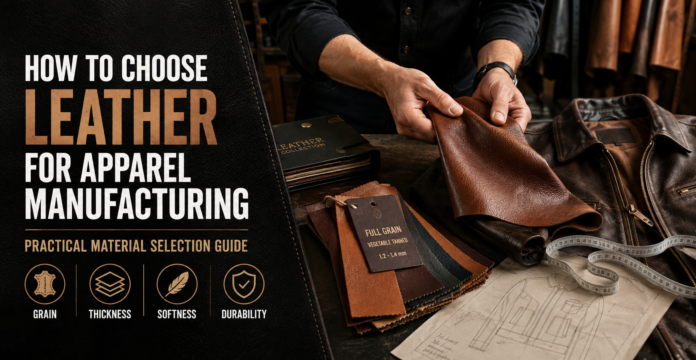
Choosing leather for clothing is not as simple as choosing a color or surface finish. Leather can feel soft, firm, heavy, thin, stretchy, smooth, rough, or structured depending on the animal hide, tanning method, thickness, finishing process, and grade. The same leather that works well for a heavy motorcycle jacket may feel uncomfortable in a skirt or fashion coat. This is why leather selection for apparel manufacturing should begin with the final product, expected performance, target customer, and required price range.
Manufacturers also need to think about cutting yield, stitching, movement, care, color consistency, and bulk production. A beautiful sample hide can cause problems if the bulk leather changes in thickness or shade. Good leather selection for apparel manufacturing therefore looks beyond appearance. It considers how the leather will behave during cutting, sewing, finishing, wearing, packing, and long-term use.
Leather Selection for Apparel Manufacturing Starts With the Product
The first step is to decide what you are making. A jacket, trouser, skirt, glove, coat, belt, apron, and bag all place different demands on leather. Jackets usually need a balance between strength, drape, comfort, and shape. Pants need enough flexibility for sitting and walking. Skirts may need softer leather with a clean fall. Gloves normally require very soft and flexible material because the fingers must move freely. This product-first approach makes leather selection for apparel manufacturing more practical.
The design also changes the material requirement. A fitted fashion jacket may need soft leather that follows the body, while an oversized bomber jacket can use slightly heavier material to hold its shape. Manufacturers planning leather outerwear can compare different product constructions in Eco Jersey’s leather jackets catalog while deciding how weight, panels, closures, collars, cuffs, and lining may affect material choice. The important point is to select leather for the actual garment instead of choosing a hide first and trying to force it into every design.
Understand Full-Grain, Top-Grain, Split and Corrected Leather
Leather grades describe different parts or treatments of the hide, but the highest grade is not automatically the best choice for every garment. Full-grain leather keeps the natural outer grain and usually shows more natural marks. It can be strong and develop character with wear. Top-grain leather has been processed or lightly corrected to create a cleaner and more even surface. Corrected leather may receive sanding, pigments, embossing, or other finishing to create more uniform appearance. Split leather comes from lower layers of the hide and normally has different strength and surface characteristics.
For leather selection for apparel manufacturing, manufacturers should match the grade to the price point and customer expectation. Premium natural-looking jackets may suit full-grain or high-quality top-grain leather. Fashion garments that require very consistent color and surface appearance may benefit from carefully finished top-grain or corrected leather. Split leather can be useful in certain products when cost is important, but its performance should be tested for the intended use. Rather than buying leather because of a grade name alone, request physical samples and judge feel, strength, finish, consistency, and sewing behavior.
Choose the Right Animal Hide for the Garment
Cowhide is widely used because it can provide good strength and durability, but different cowhide constructions can range from soft garment leather to much heavier leather. Lambskin is usually valued for its soft hand, smooth surface, and lightweight feel, making it useful for fashion jackets, skirts, coats, and other garments where comfort and drape are important. Goatskin often provides a useful mix of softness and strength. Sheepskin can also be soft and comfortable and is used in many fashion and outerwear products.
The right hide depends more on performance than the animal name printed on a specification sheet. For example, leather pants need enough strength for repeated movement but should not feel stiff around the knees, hips, and waist. Manufacturers can review different silhouettes in the leather pants category when considering how fitted, straight, cropped, or relaxed designs change material needs. Effective leather selection for apparel manufacturing means comparing actual hand feel, thickness, stretch, recovery, surface finish, and durability instead of assuming one animal hide is suitable for every garment.
Check Leather Thickness, Weight and Drape
Thickness is one of the most important technical decisions in leather selection for apparel manufacturing. Thin leather usually feels lighter and bends more easily, while thicker leather often gives more structure and resistance to wear. However, thicker does not always mean better. If a fashion jacket is too heavy, the shoulders can feel uncomfortable and the garment may not drape properly. If leather trousers are too stiff, walking and sitting become difficult. If leather is too thin for a structured product, seams and stress points may not perform as expected.
Manufacturers should measure thickness across several parts of each hide because natural leather is not always perfectly uniform. Sample garments should then be checked while standing, sitting, bending the arms, walking, and using pockets or closures. Drape is especially important in longer coats, skirts, soft jackets, and wide-leg pants. The goal is to achieve the correct balance between structure and movement. A leather that looks impressive while lying flat may behave very differently after it is cut into curved garment panels and stitched together.
Evaluate Softness, Stretch and Wearing Comfort
Comfort should be tested before production because leather clothing is worn close to moving parts of the body. The shoulders, elbows, waist, hips, knees, and fingers all require movement. Softness helps, but extremely soft leather is not always suitable if the garment needs to hold a strong shape. Some leather naturally gives more than others, and its direction of stretch can also change across the hide. Manufacturers should therefore examine both softness and recovery during leather selection for apparel manufacturing.
Gloves show why this matters clearly. A leather that works for a coat may be far too thick or stiff for fingers. Leather used for gloves normally needs to bend easily while still providing enough strength around seams and high-movement areas. The Eco Jersey leather gloves range shows how leather can be used in smaller, movement-focused products where flexibility is a major concern. For apparel, the best material should feel comfortable during real movement instead of only feeling soft when touched by hand.
Inspect Surface Quality, Color and Natural Marks
Natural leather may contain scars, wrinkles, grain changes, small marks, and differences between areas of the hide. Some brands want these features because they create a natural character. Other brands need a cleaner and more uniform appearance. Before placing a bulk order, the buyer and manufacturer should agree on acceptable and unacceptable surface marks. Without a clear standard, one side may consider a hide natural while the other side considers the same hide defective.
Color control is another major part of leather selection for apparel manufacturing. Black may appear easy to match, yet black leather from different production lots can still show changes in depth, gloss, or undertone. Brown, tan, burgundy, cream, green, and fashion colors may show even greater variation. Bulk hides should be checked together under suitable lighting before cutting. Garment panels that sit next to each other should come from matching shades wherever possible. This reduces the risk of one sleeve, front panel, pocket, or collar looking different from the rest of the garment.
Match the Finish to the Intended Look and Performance
Leather finishing changes both appearance and performance. Pigmented finishes can create a more even surface and help cover some natural variation. Aniline-style finishes allow more of the natural grain to remain visible, although they may show marks more easily. Semi-aniline approaches can provide a middle ground between natural character and surface protection. Leather may also be waxed, oiled, polished, printed, embossed, coated, distressed, or given a matte or glossy finish depending on the design.
Finish should be considered during leather selection for apparel manufacturing because it can change sewing, handling, appearance after bending, and customer care. A heavily coated finish may look very uniform but can feel different from more natural leather. Distressed finishes can create a vintage look, but the finished garment should still match the approved sample. Manufacturers should test rubbing, folding, light scratching, moisture exposure, and normal handling to see whether the chosen finish changes too quickly during production or use.
Practical Leather Buying Checklist Before Bulk Production
Before approving bulk material, manufacturers should create one clear leather standard and use it for every shipment. This prevents the factory, leather supplier, quality team, and buyer from judging the material differently. A proper checklist makes leather selection for apparel manufacturing easier because important details can be checked before large quantities are cut.
- Confirm the exact leather or hide type.
- Approve the required thickness range.
- Check average weight and garment feel.
- Approve the surface finish and gloss level.
- Define acceptable natural marks.
- Set the approved color and shade tolerance.
- Check softness and flexibility.
- Test stretch and recovery where needed.
- Check rubbing and color transfer.
- Test seam and needle performance.
- Inspect the reverse side of the leather.
- Review odor and finishing quality.
- Confirm consistency between hides.
- Make a complete pre-production sample.
- Keep an approved leather swatch for bulk comparison.
Test Cutting, Sewing and Production Performance
Good leather can still create manufacturing problems if it is difficult to cut or sew. Unlike ordinary roll fabric, natural hides have irregular shapes and different usable areas. A cutter must work around holes, deep scars, weak sections, or unacceptable surface marks. Pattern placement therefore affects material consumption. Large garment panels may require larger clean areas of the hide, while smaller accessories can sometimes use sections that would not work for a jacket front or coat panel.
Sewing tests are equally important in leather selection for apparel manufacturing. Needle holes stay in leather, which means sewing mistakes cannot always be removed without leaving marks. The factory should test needle size, thread, stitch length, seam type, reinforcement, edge finishing, and machine settings before bulk production. Very soft leather may stretch while sewing, while thicker leather can become bulky where several layers meet. A production trial helps find these problems before hundreds or thousands of pieces enter the sewing line.
Calculate Leather Consumption, Waste and Cost Correctly
Leather cost should never be judged only by the quoted price of the raw material. Two leather options with different prices can create very different final garment costs because usable yield may vary. A cheaper hide with many defects can create more waste than a slightly more expensive hide with a larger clean cutting area. Pattern size also matters. Long coats and large jacket panels can require more usable surface area than small accessories or garments made from many narrow panels.
For this reason, leather selection for apparel manufacturing should include a cutting trial and realistic consumption calculation. Manufacturers should consider hide size, usable area, natural defects, shade grouping, pattern direction, panel matching, and expected cutting waste. They should also include lining, interlining, zippers, buttons, snaps, labels, thread, edge paint, packaging, labor, and finishing when calculating the final garment cost. Material price is important, but total production efficiency gives a more accurate picture.
Approve a Pre-Production Sample Before Bulk Cutting
The safest way to confirm leather selection for apparel manufacturing is to turn the selected leather into a complete pre-production garment. A small swatch cannot show every problem. A complete sample lets the manufacturer and buyer judge appearance, fit, weight, drape, movement, stitching, panel matching, lining, hardware, pocket position, collar shape, sleeve movement, and overall comfort. It also shows whether the chosen leather works with the actual construction.
The approved sample should become the main reference for bulk production. Keep the approved leather swatch, color standard, trim details, measurements, stitching instructions, and finishing notes together. When bulk leather arrives, compare it with the approved standard before cutting begins. If the bulk material feels much stiffer, looks more glossy, varies in color, or falls outside the approved thickness range, the problem should be handled before production rather than after finished garments have already been made.
Conclusion
Successful leather selection for apparel manufacturing comes from matching the leather to the product instead of choosing material by appearance alone. Check hide type, grade, thickness, softness, stretch, surface quality, color, finish, cutting yield, sewing performance, comfort, and total cost before bulk approval. A tested material standard and a complete pre-production sample can prevent many quality problems and help manufacturers produce leather apparel that looks consistent, feels comfortable, and performs as intended.
FAQs
What is the best leather for apparel manufacturing?
There is no single best leather for every garment. Soft lambskin or sheepskin can work well for lightweight fashion garments, while cowhide or goatskin may suit products that need more structure or durability. The best choice depends on the product design, thickness, comfort, finish, price, and required performance.
How do manufacturers choose leather thickness for clothing?
Manufacturers choose thickness according to garment type, desired weight, structure, movement, and sewing construction. A soft fashion jacket usually needs different thickness than a heavy protective jacket. Samples should always be made because thickness numbers alone cannot show how the finished garment will feel.
Why should leather be tested before bulk production?
Testing helps identify problems with color, rubbing, stretch, sewing, thickness, surface finish, panel matching, and comfort. A complete pre-production sample also shows how the leather behaves after cutting and stitching. This reduces the risk of discovering material problems after bulk garments are already produced.
What should buyers check when sourcing leather apparel?
Buyers should check leather type, grade, thickness, color consistency, softness, finish, natural marks, sewing quality, lining, hardware, measurements, and overall workmanship. They should also approve a physical material swatch and finished sample before bulk production begins.