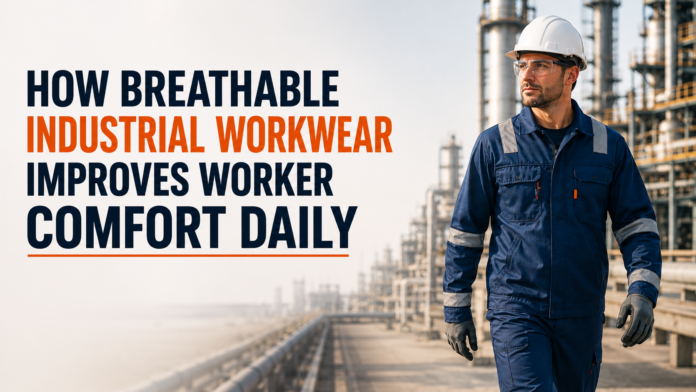
Breathable industrial workwear clothing is not just a preference for comfort. It is now a safety and productivity priority for organisations that deploy workers to physically demanding environments over extended shifts. Overheating workers experience increased fatigue, reduced concentration, higher error rates and a greater vulnerability to heat stress. This leads to both operational and human costs. The relationship between worker performance and workwear breathability is well-established in occupational health research. It also explains which fabrics and constructions provide the best breathability. And it explains what brands and procurement departments need to know when specifying breathable garments for industrial environments.
Breathability in Workwear: The Science Behind It
Understanding how industrial fabrics breathe helps brands specify better materials and procurement teams to evaluate claims more accurately. Breathability is often misrepresented in the workwear industry.
What Fabric Breathability Really Means
The fabric’s breathability is the ability of the fabric to allow perspiration to escape through its structure. The Moisture Transmission Rate is expressed as grams of moisture per square metre per 24 hours. A higher MVTR value indicates better breathability.
Breathability is also distinct from wind and water resistance. A fabric can be highly breathable and resistant to wind and water, but still be resistant to both, or it could be highly breathable and offer no weather protection. This distinction allows procurement teams to specify workwear with breathability and other protective features that each role needs. Contact our Industrial Workwear Manufacturing team to discuss fabric specifications that are breathable for your workforce.
Why breathing is more important in industrial environments
Industrial workers produce significantly more heat when they are engaged in sustained physical activity compared to office workers and sedentary staff. They also wear multiple layers of clothing for safety reasons, which further inhibits the body’s cooling mechanisms. Breathability has a greater impact on safety and comfort in industrial settings than it does for everyday clothing.
In addition, inadequate breathing in industrial environments can have far-reaching consequences that go beyond discomfort. Heat stress, a condition that is caused by a body’s inability regulate core temperature, can be a real occupational hazard when workwear doesn’t allow for adequate moisture vapour to escape. When worn correctly, breathable industrial clothing reduces the risk of heat stress by lowering skin surface temperatures.
Industrial Workwear Fabrics that Deliver Superior Breathability
Fabric selection is key to achieving good performance for industrial workwear. This is because fabric properties such as fibre type, fabric weight, and weave structure determine breathability, not just garment design.
Moisture-Wicking Polyester Fabrics
The most popular breathable fabric for industrial workwear is moisture-wicking polyester. It provides reliable moisture management and is affordable across a wide range of industrial applications. The wicking effect moves sweat quickly away from the surface of the skin — spreading it over the fabric’s surface to speed up evaporation.
Further, performance polyester fabrics designed specifically for industrial applications incorporate treatments that retain moisture-wicking efficacy through repeated industrial washing — a crucial durability requirement that distinguishes industrial-grade moisture wicking fabrics from consumer-grade sportswear alternatives which lose wicking ability after relatively few wash cycle.
Cotton-Polyester Fabrics
Blends of cotton and polyester, typically 65/35 or 50%, are used to create breathable industrial clothing. They combine the natural breathability of cotton with the durability and reduced shrinkage offered by polyester. Cotton allows for natural moisture absorption, which is comfortable when doing lower-intensity tasks. Polyester adds stability and consistency to the garment through repeated washing.
Cotton-polyester fabrics are also a great choice for industrial workwear, where both breathability and fire resistance is required. Contact our workwear manufacturers to discuss the blend specifications for your industrial range.
Fabrics Ripstop With Breathable Contructions
Fabrics with a grid weave that is reinforced to prevent tear propagation can be designed for breathability, as well as their inherent durability. The 150-200 GSM range of lightweight ripstop fabrics offers good breathability, abrasion resistance and tear resistance. They are therefore suitable for industrial applications that require durability and moisture management.
Additionally, ripstop fabric accepts DWR treatments which add a light water repellency to the fabric without significantly reducing breathability. This creates versatile outer garments capable of handling light rain or liquid splashes while maintaining moisture transmission during physical activities. This combination is ideal for outdoor industrial roles, where physical activity and weather exposure occur throughout the day.
Merino Wool Blends to Premium Industrial Applications
Merino blends, which combine merino with nylon or polyester for durability, provide superior breathability and temperature regulation. They are used in industrial base layers and midlayers. Merino’s natural structure of crimp creates air pockets which buffer temperature changes. This keeps workers warmer and cooler when they are exposed to static conditions.
Merino wool is also a natural odour-resistant material, which is an advantage for industrial workwear when frequent washing is not possible between shifts. This allows the garment to maintain acceptable hygiene standards over longer periods of time than synthetic alternatives.
Industrial Workwear with Breathable Construction
The construction of the garments has a significant impact on the ability to expel moisture from the clothing system when working for prolonged periods.
Placement of Strategic Ventilation Panels
Ventilation panels, which are made of mesh or open weave fabric and placed in high heat-generating zones, improve the breathability of garments beyond what primary fabrics can provide alone. The ventilation zones on the side panels, back panels, and underarm gussets allow air to flow directly into the areas of the body that produce the most heat when performing physical work.
The placement of ventilation panels should also take into account the performance requirements for the workwear. For example, panels in zones that are specified to provide abrasion protection or chemical resistance cannot be replaced by open mesh without compromising certification requirements. Our safety standards team creates ventilation strategies to maintain certification compliance while improving breathability. Contact us today to learn more about ventilation options for industrial workwear specifications.
The Underarm and Sleeve Ventilation Features
The underarm vents, which are zippered openings in the armholes that allow air to enter directly, are among the most effective features of breathable industrial outerwear. Workers can increase ventilation without having to remove the outer garment during periods of high exertion. This allows them to maintain protection and manage core temperature better.
These features also provide additional cooling options to workers who are experiencing heat stress in the hottest parts of their day. These features increase manufacturing complexity, but they also provide meaningful comfort for workers in hot industrial environments. This directly impacts productivity and workforce well-being.
Breathability is achieved by using a layering system.
The layering system for industrial workwear — base layer/mid-layer/outer shell — should be designed to ensure breathability across all layers at the same time. When a highly breathable base is paired with an outer shell that does not breathe, moisture can accumulate between the layers. This occurs because sweat from the base layer can’t escape the outer layer and collects in the middle.
In order to achieve a high level of breathability across the entire garment system, it is necessary to use waterproof outer shells that are constructed with breathable membranes.
Breathable Workwear Specific to Industrial Environments
Workwear specifications should be based on the thermal and activity requirements of each role, rather than using a generic fabric for all work roles.
Heat and Humidity in Industrial Environments
The most difficult environments to breathe in are hot and humid ones, such as food processing facilities, chemical plants, or tropical outdoor construction. The combination of high ambient temperatures and humidity can reduce the cooling effect of moisture-wicking fabric. This is because the air surrounding the fabric is already saturated with moisture, and therefore cannot accept any additional vapour.
The best results are achieved when lightweight fabrics with maximum MVTR ratings and ventilation panels are used. Active cooling is also a good option. Our oil & gas workwear team creates breathable workwear to suit hot climate operations. Contact us for more information.
Outdoor Industrial Environments
Workers in outdoor industrial roles face a variety of conditions, including heat generated by physical activity and weather exposure which can change from hot sun to cool rain within a single work shift. For outdoor industrial roles, breathable workwear must balance moisture transmission during physical exercise with adequate weather protection when exposed to rain and winds.
corporate clothing manufacturing is also required for outdoor industrial environments where site management and supervisory positions are performed. This is because the management personnel, who travel across sites actively, generates significant heat.
Specifications for Breathable Industrial Workwear
These features are important when developing or purchasing breathable industrial workwear. They determine comfort and durability over the entire working life of the garment.
- MVTR Rating — Minimum 5000g/m2/24h in general industrial applications, 10000g or more for hot environments that require high levels of exertion.
- Moisture wicking durability — confirm that wicking performance is maintained throughout the entire planned industrial laundering cycle rather than only at the new garment stage
- Panel placement for ventilation — strategically placed mesh or open-weave panels on the back, underarms, and side areas without compromising protection performance requirements
- Fabric Weight — 150-200 GSM in hot climates and for high-exertion, 200-280 GSM when combined protection is required.
- Active Venting Features — Underarm Zips, Sleeve Vents, and Collar Vents for High-Exertion Roles where Active Cooling Control Improves Comfort Results
- Layering breathability consistency — Confirm that all layers of the workwear system — base layer, mid-layer, and outer — contribute rather than restrict moisture vapour transfer
- FR compatibility — verify that breathability is maintained even after application of FR treatment and combined FR-breathable laundry programs
Build a Breathable Workwear Range
Breathable industrial clothing is an important and profitable product category. Brands that create breathable industrial workwear with proven performance credentials are positioned well in industrial channels, where comfort and productivity results are becoming increasingly valued as safety-related priorities.
The development of breathable workwear in conjunction with a complete industrial clothing system – including certified safety garments and comfortable breathable options suitable for standard industrial environments – creates an extensive range that meets the needs of the entire workforce from a single provider.
Are you ready to create breathable industrial workwear that is comfortable for your brand? Contact our manufacturing team to learn more about how we can help you. We support brands and procurement teams with everything from fabric specifications and performance testing, through bulk production, quality assurance, and laundry program development.
Conclusion
Breathable industrial clothing provides daily comfort improvements which translate directly into productivity, safety and workforce wellbeing. This makes it a strategic investment, rather than a simple garment upgrade. Understanding which fabrics, features, and constructions deliver true breathability performance, as well as how breathability interacts and impacts the other protective requirements for each industrial role, is essential to developing or purchasing workwear that supports workers across all shifts.
If you want to create breathable industrial workwear that employees will actually wear, it is important to start with an understanding of the fabric and breathability requirements.
Explore the full range industrial workwear production options to begin your production journey.
FAQs
How is industrial workwear made breathable?
The fabric used in breathable industrial workwear has a high Moisture-Vapor Transmission Rate, which allows perspiration to escape the fabric and not accumulate against the skin.
What does MVTR mean and why is it important in workwear?
Moisture Vapour Transmission Rate (MVTR) measures the amount of moisture vapour that passes through a square metre fabric in 24 hours. A higher value indicates better breathability.
Can breathable clothing be flame resistant too?
Yes, inherent FR fabrics such as Nomex or modacrylic blends are engineered to provide both breathability and flame resistance. The FR cotton blends are also breathable, but their treated FR performance is dependent on the management of the laundry program to maintain certification compliance.