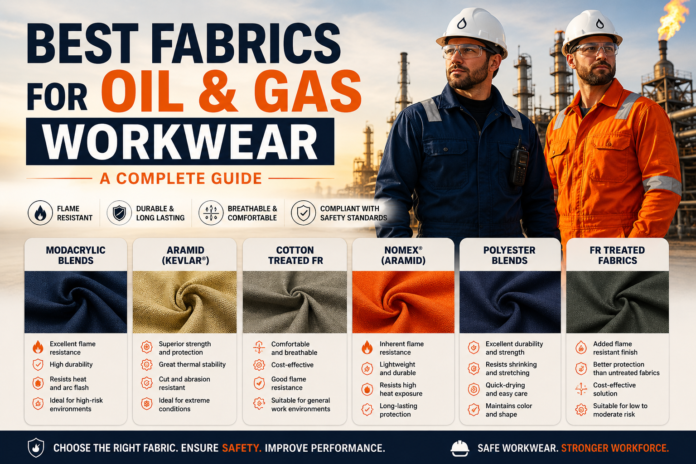
Best fabrics for oil & gas workwear face multiple hazards every shift. The best fabrics are designed to protect them from flames, chemical exposures, arc flashes, and extreme temperatures in one of the world’s most dangerous industrial environments. The workwear of oil and gas workers must be able to address multiple hazards simultaneously during each shift, without compromising mobility or comfort. Fabric selection for oil and gas workwear goes beyond a simple manufacturing decision. This guide covers all major fabric categories used in the manufacturing of oil and gas workwear. It explains their performance against specific hazards and helps brands make informed fabric choices that protect workers and comply with regulatory requirements.
Fabric selection is critical in oil and gas workwear
Workers on oil and gas sites are exposed to ignition sources, flammable chemicals, spills and extreme temperatures at the same time. Fabrics that fail under these conditions can be life-threatening.
The Multi-Hazard Challenge
Oil and Gas Workwear, unlike standard industrial workwear, where a single hazard dominates fabric specifications, must address flame resistance and chemical resistance as well as antistatic performance and thermal protection. Fabric selection is therefore based on a multi-hazard strategy rather than optimisation for a single performance characteristic.
Certification and Fabric Approval
Fabrics used in oil and gas workwear that are certified must be tested independently against the relevant standards — EN ISO 11612, EN 1149, for antistatic performance and EN 13034, for chemical splash resistance. Most major operators cannot use a fabric that passes testing but does not have certification documentation in compliant workwear . Our workwear manufacturing team can discuss fabric options that are certified for your oil and gasoline range.
The primary protection requirement is flame-resistant fabrics
Every fabric used for oil and gas workwear must meet the minimum performance standard of flame resistance. The fabric should self-extinguish after the ignition source has been removed. This will prevent the continuous burning that is the cause of most serious burn injuries during industrial fire incidents.
Inherent Flame-Resistant Fabrics vs. Treated Flame Resistant Fabrics
Fabrics that are flame-resistant can be classified into two categories: treated and inherent. Fabrics with inherent flame-resistance are those made of fibres that have a flame-resistant chemical composition. They do not need to be treated chemically and, therefore, cannot lose their protective qualities through washing or wearing.
The treated flame-resistant fabric is made from cotton or synthetic fabrics that are chemically treated for flame resistance. These fabrics are usually more affordable but they require special care to maintain the effectiveness of the treatment. Their flame-resistant properties also degrade over time with repeated washing. Inherent fabrics are the most appropriate specification for industrial clothing manufacturing where durability and protection are important.
Nomex – The Benchmark Flame Resistant Fabric
Nomex, a meta-aramid fiber manufactured by DuPont, is the most widely specified and recognised inherent flame-resistant material in oil and gasoline workwear worldwide. The flame-resistant properties of Nomex are permanent – they can’t be removed by washing, wearing, or using chemicals. It is the best fabric for industrial environments with high fire risks.
Nomex: Performance Properties
Nomex offers excellent thermal protection, along with its inherent flame-resistance. It protects the wearer against radiant heat, convective exposure and direct flame contact. Nomex fabrics come in different weights to suit the needs of each application and climate. These range from lightweight 150 GSM for hot climates to heavier 210GSM for colder environments with higher thermal exposure risks.
Nomex Blends to Enhance Performance
Nomex is often blended with high-performance fibers, such as Kevlar to increase tensile strength or Lenzing FR to improve moisture management. This creates multi-property fabric that addresses more than just flame resistance. These blends improve the wear comfort and durability of workers in challenging environments while maintaining inherent flame resistance. Contact our workwear manufacturers today to discuss your requirements.
Modacrylic Blends – Affordable Flame Resistant Blends
Modacrylic fibres blends – typically combined with cotton or lyocell in blended fabric constructions – deliver inherent flame resistance for a lower price than pure aramid options. These blends are used widely in oil and gasoline workwear to meet cost-sensitive procurement requirements without compromising the inherent protection properties.
Modacrylic performance characteristics
The blends of modacrylics offer good flame resistance and thermal protection as well as comfort for everyday wear. They are therefore a strong commercial choice for operators that need to provide compliant workwear in large quantities, where the cost per unit is an important consideration.
Common Modacrylic Mix Ratios
Modacrylic blends are most commonly used in oil and gas workwear. These include modacrylic and cotton blends, which provide a comfortable and breathable fabric that is flame resistant. They also come with modacrylic and aramid blends for added tensile and abrasion strength to meet the demands of more physically demanding work environments. To confirm the blend ratio that meets your certification requirements, contact our safety standards today.
FR Cotton — Flame Resistant Cotton for Cost-Effective Use
The most common treated flame-resistant fabric used in industrial workwear is FR cotton, a standard cotton fabric that has been treated with a durable chemical finish. It provides adequate flame resistance in many low-risk oil and gasoline applications, at a price point that is significantly lower than the inherent alternatives.
Where FR Cotton performs well
The FR cotton is suitable for applications in which workers are exposed to flame hazards, but their exposure is not extreme. This includes maintenance, site support, and other working environments, where flame contact may be possible, but is not a daily danger. The cotton base offers excellent wear comfort and breathability over long shifts, which is an important advantage for oil and gas operations in hot climates.
Limitations on FR Cotton
The primary limitation of FR cotton is its treatment durability. The flame-resistant chemical finish deteriorates after repeated industrial washing. Incorrectly laundered FR Cotton can lose its certification level flame resistance even before the garment has reached the end of its physical life. workwear standards compliance must include fabric monitoring along with garment inspection in order to ensure that FR cotton workwear retains its protective qualities throughout its life.
Antistatic fabrics — essential in environments with flammable atmosphere
In oil and gas environments, where there are flammable gases or vapours present, antistatic fabric performance can be as important as flame resistance. Antistatic clothing is a safety feature, not a comfort one. Static electricity discharge can ignite flammable environments if it has enough energy.
Antistatic fabrics: How they work
The antistatic fabric is made up of conductive fibres, usually carbon or stainless steel fibers, woven at specific intervals into the base material. These fibres dissipate static charges before they reach ignition-capable levels. EN 1149, the European standard that governs antistatic performance for workwear, requires that both the fabric as well as the entire garment construction meet specific charge dissipation standards.
Combining Flame and Antistatic Resistance
Oil and gas workwear must be made from fabrics that offer both antistatic and flame-resistant properties. This is because both are a risk to workers. The majority of premium Nomex blends and modacrylic fabrics used for oil and gas workwear include conductive fibre antistatic elements as standard – delivering both certifications in a single fabric. Contact our industrial textile manufacturing to get advice on the best fabric specification for your application.
Fabrics that are Waterproof and Resistant to Chemicals
Oil and gas work sites are exposed to liquid hydrocarbons and chemical process fluids. They also face severe weather conditions. This creates a need for outer layers that are resistant to chemicals and waterproof, in addition the primary flame-resistant base clothing system.
Waterproof FR outer layers
These outer layers combine weather protection with flame resistance by using laminated constructions. A waterproof membrane is bonded to a FR fabric to create a durable outer layer. These constructions need to maintain their flame-resistant characteristics throughout the lamination process as well as the life of the garment. This is a requirement that specialist waterproof manufacturing facilities are aware of and incorporate into their quality assurance processes.
Chemical Splash Protective Fabrics
Chemical splash resistant fabrics are tightly woven synthetics that have chemical-repellent surfaces. They prevent liquid hydrocarbons or process chemicals from reaching the skin. These fabrics are usually used over flame-resistant base garments to add chemical protection.
High-Visibility fabric integration
For many oil and gas jobs, high-visibility clothing is required, along with flame resistance and chemical protection. This is especially true for those working in zones of vehicle movement, offshore operations and at night shifts, where visibility and safety are paramount.
FR High Visibility Fabrics
FR high visibility fabrics combine retroreflective and fluorescent tapes with flame-resistant fabric construction. They meet both EN ISO 20471 requirements for high visibility and EN ISO 11612 standards for heat and fire protection. Retroreflective tape must be attached in a way that does not compromise the flame resistance of the fabric. This requires specialist tape bonding rather than standard sewing methods, which could create fire pathways at the attachment points.
Certification Compatibility
Some retroreflective materials do not maintain their performance after being applied to FR fabric. The combined garment should be tested to ensure that both certifications are still valid. Contact us to discuss your requirements for high-visibility, FR-certified workwear.
Key Fabric Properties for Oil & Gas Workwear
These properties are important for determining both the regulatory compliance of oil and gas clothing and worker protection from all hazards on site.
- Flame Resistance Type — Inherent for permanent protection throughout garment service life; treated for cost-sensitive application with compliant laundry programs
- Thermal Protection Rating – HTI and Arc Rating values determine the level of protection against heat flux exposure and electrical arc flash.
- Antistatic performance — Conformity with EN 1149 for all garments worn within flammable atmosphere environments
- Chemical Resistance — Type 6 EN 13034 rating for liquid hydrocarbons and process chemicals
- Weight and Breathability — lighter constructions for hot climates, heavier constructions in cooler environments with higher thermal exposure.
- Washability — Inherent fabrics retain properties indefinitely; treated fabrics require monitoring to ensure ongoing compliance
- High visibility integration — EN ISO 20471 compatible retroreflective taping application without compromising FR fabric certification
Build an best fabrics for oil & gas workwear Line
The range of oil and gas workwear covers the entire spectrum of roles on site, from high-risk workers in process who require maximum chemical and flame resistance protection to administrative and support site staff whose exposure levels require certified protection at a lower performance level.
In addition, the development of workwear along with coordinated corporate Uniforms Manufacturing for Site Management and Visitor Roles creates a complete brand workwear system which communicates professionalism as well as safety culture at every level within an organisation.
waterproof garments for outdoor operations can be used in conjunction with the core FR range to provide complete weather protection to workers who are exposed to outdoor conditions. This includes the entire workwear system, from the next-to-skin base layers to the waterproof outer shells.
Are you ready to create your own oil and gas workwear collection with the best fabrics? Contact our manufacturing team to learn more. We support workwear brands, procurement teams, and fabric specifications at every stage, from fabric specification, certification planning, through bulk production, quality assurance, and compliance documentation.
Conclusion
Fabrics used for oil and gas workwear are diverse and technically challenging. They range from Nomex aramids with their inherent flame resistance for maximum protection to modacrylic blends that offer cost-effective performance and FR cottons that provide treated protection for moderate-risk applications. Knowing which fabric offers the best combination of chemical resistance, flame resistance, antistatic performance and comfort for the specific role on site and the risk level will help you create a range of oil and gas workwear that protects workers while meeting regulatory requirements.
Explore the range of oil & gas workwear production options, and contact our team today to begin your production journey.
FAQs
What’s the difference between treated and inherent flame-resistant fabric?
Inherent fabrics are made of fibres that are chemically resistant, so the protection is not washable. The flame-resistance of treated fabrics is achieved through chemical finishes that are degraded with repeated washing over the life of the garment.
What certifications are needed for oil and gas workwear fabric?
EN ISO 11612 is required for heat and fire protection, EN 1149 is for antistatic performance and EN 13034 is for chemical splash resistance. Specific standards vary by market and user specifications.
Does Nomex make the best fabric for oil & gas workwear?
Nomex fabric is the standard inherently flame-resistant fabric, providing permanent protection which cannot be degraded by washing or wearing.
Why are antistatic fabrics important for oil and Gas workwear?
Static electricity discharge can ignite flammable gases and vapours on oil and Gas worksites. Antistatic fabrics can dissipate static electricity before it reaches levels that are ignition-capable.