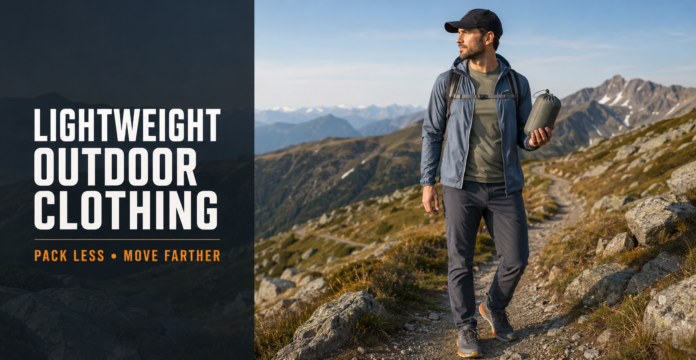
Every experienced hiker knows the feeling — that moment mid-trail when pack weight stops being background noise and starts actively working against you. Your pace slows. Your energy depletes faster. The joy of the trail gradually gives way to the grind of managing unnecessary burden. Lightweight outdoor clothing addresses this problem directly — reducing the weight and volume your clothing system adds to every mile you cover without sacrificing the protection and performance that serious trail use demands.
The Real Impact of Clothing Weight on Trail Performance
Clothing weight compounds across distance in ways that static weight comparisons don’t fully capture. A 500-gram difference between two jacket options sounds modest on paper — but every gram of unnecessary weight costs measurable energy across thousands of steps on a long trail day. Research consistently shows that weight carried on the feet and body significantly impacts energy expenditure — with each 100 grams of unnecessary clothing translating into meaningful cumulative energy cost across full hiking days.
Beyond pure energy cost, unnecessary clothing weight affects trail safety through fatigue accumulation. Tired hikers make poorer decisions, move less carefully on technical terrain, and are more vulnerable to cold when energy reserves are depleted by excessive pack burden that appropriate lightweight gear selection eliminates entirely.
What Makes Outdoor Clothing Genuinely Lightweight
Lightweight outdoor clothing achieves low weight through deliberate material and construction choices — not through simply using less material or sacrificing protection that trail use genuinely requires.
Fabric Denier Optimization — reducing face fabric denier from standard 70D to 20D or 30D nylon cuts fabric weight significantly while maintaining adequate durability for the intended application. Ultralight rain jackets use 10D to 15D fabrics that would fail under pack abrasion daily use demands — but work perfectly as emergency layers carried and worn occasionally rather than continuously.
Minimal Hardware — zippers, buckles, and adjustment systems add meaningful weight that well-designed lightweight garments minimize through careful hardware selection and elimination of features that don’t justify their weight contribution across the specific garment’s use case.
Packable Construction — garments that pack into their own pockets or small stuff sacks eliminate the volume penalty that standard construction adds to pack organization. A packable rain jacket that compresses to 150ml volume versus a standard jacket requiring 3 liters of pack space creates meaningful practical difference across a fully loaded backpacking kit.
Advanced Fabric Technologies — high-tenacity nylon and polyester fiber constructions achieve equivalent strength to heavier fabrics at lower weight per unit area. Understanding why polyester specifically enables lightweight construction while maintaining performance is explored in this polyester fabric guide — covering the fiber properties that make it the dominant material across lightweight outdoor clothing categories.
Lightweight Clothing Across the Layering System
Ultralight Base Layers — lightweight merino or synthetic base layers in 120 to 150gsm construction provide necessary moisture management with minimal weight addition. These constructions feel almost weightless during wear while delivering the moisture handling that sustained physical outdoor effort demands throughout active trail days.
Packable Mid Layers — lightweight insulated jackets using 40 to 60g synthetic fill provide meaningful warmth at weights of 200 to 350 grams — significantly lighter than fleece mid layers at equivalent warmth ratings. These packable insulated layers compress to small volumes and deploy rapidly during rest stops without requiring pack excavation that slows the layering adjustment that dynamic outdoor conditions demand.
Ultralight Shell Jackets — 2.5-layer waterproof constructions produce genuine membrane waterproofing at sub-200 gram jacket weights. These shells carry in a hip belt pocket or jacket chest pocket — ensuring weather protection is always immediately available without the weight penalty that standard shell construction adds to every mile of trail regardless of actual rain probability during that specific outing.
Lightweight Trail Pants — 80 to 100gsm nylon-elastane constructions provide four-way stretch, quick-dry performance, and meaningful abrasion resistance at weights approaching 200 to 280 grams per pair. These ultralight trail pants perform equivalently to heavier alternatives across most trail conditions while reducing clothing system weight meaningfully across the full kit.
Packability — The Underrated Performance Factor
Weight reduction captures most attention in lightweight outdoor clothing discussions — but packability matters equally for practical trail performance. A garment that weighs little but packs bulkily creates pack organization problems that slow transitions, discourage carrying the piece consistently, and reduce the system flexibility that packable clothing enables.
Packability determines whether protection actually gets carried on every outing rather than left behind when pack weight optimization removes non-essential items from the load. Rain gear left at the trailhead provides zero protection when unexpected weather arrives mid-trail — making packability a genuine safety factor rather than simply a convenience consideration for trail-focused outdoor enthusiasts.
Practical packability targets for trail clothing system components — shell jackets under 300ml packed volume, insulated layers under 500ml, trail pants folding to 400ml — ensure every protective layer carries consistently across all outings regardless of weather forecast confidence.
Where Lightweight Has Genuine Limits
Honest assessment of lightweight outdoor clothing requires acknowledging where weight reduction creates real limitations that serious outdoor use cannot accept regardless of the weight savings achieved.
Abrasion Resistance — ultralight fabrics fail faster under pack hip belt contact, scrambling terrain, and repeated technical use than heavier alternatives. Accepting some durability reduction for weight savings makes sense for occasional-use layers. For daily-use trail pants and frequently worn outer layers, moderate weight fabrics that maintain durability across seasons of hard use deliver better long-term value than ultralight alternatives requiring more frequent replacement.
Insulation Volume — genuinely cold conditions require insulation volume that no lightweight construction can eliminate. The laws of thermodynamics don’t yield to weight optimization — if you need warmth, you need insulation, and insulation has minimum volume requirements that lightweight construction minimizes but cannot eliminate for genuinely cold outdoor applications.
For practical rain protection that balances lightweight packability with cost-effective performance — this cheap rain gear guide covers accessible options that demonstrate how lightweight protection doesn’t necessarily require premium price points to deliver genuine trail utility.
Building a Lightweight Outdoor Clothing Collection
For brands developing lightweight outdoor clothing collections, the commercial opportunity is significant — lightweight outdoor enthusiasts represent a growing, passionate, and commercially active consumer segment that actively seeks products that genuinely deliver on weight and packability claims rather than simply marketing lightweight credentials without delivering them.
Our camping apparel manufacturer page covers lightweight outdoor clothing options across the complete camping and trail category range — giving outdoor brands the manufacturing capability to build genuinely weight-optimized collections that serve the growing ultralight outdoor market with credible technical performance.
For a practical product example of lightweight construction in a complete outdoor garment, these hiking pants demonstrate how nylon construction balances weight efficiency with the stretch, durability, and practical features that trail use genuinely demands across varied outdoor applications.
Conclusion
Lightweight outdoor clothing improves trail performance through the straightforward mechanism of reducing the energy cost and burden that unnecessary clothing weight imposes across every mile covered outdoors. Packable shells that carry on every outing provide protection when unexpected weather arrives. Lightweight base layers reduce fatigue accumulation across long trail days. Ultralight insulation delivers warmth during rest stops without meaningful pack weight addition. Building a clothing system around genuine weight optimization — without sacrificing the performance protection trail safety requires — transforms every outdoor adventure into a more enjoyable, more efficient, and ultimately more rewarding experience.
FAQs
What is a reasonable total clothing system weight for day hiking?
A well-optimized day hiking clothing system — including base layer, mid layer, and packable shell — should target 600 to 900 grams total for three-season conditions. Cold weather additions increase this meaningfully but the principle of minimizing unnecessary weight applies across all seasons.
Does lightweight outdoor clothing sacrifice durability?
Ultralight constructions do trade some durability for weight savings — typically at friction points and high-abrasion zones. Moderate lightweight constructions in 30 to 50D fabrics balance meaningful weight reduction with adequate durability for regular trail use without requiring frequent replacement.
Which clothing layer offers the greatest weight saving opportunity?
Shell jackets typically offer the greatest weight saving opportunity — standard shells weigh 400 to 600 grams while equivalent ultralight alternatives weigh 100 to 200 grams. This 200 to 400 gram saving per garment represents significant system weight reduction for minimal performance compromise in recreational outdoor applications.
Can lightweight outdoor clothing be produced under a private label?
Yes. Professional outdoor apparel manufacturers offer complete private label lightweight clothing production with verified weight specifications, packable constructions, performance fabrics, custom designs, and branding — giving outdoor brands full technical and commercial control over their lightweight trail clothing collections.