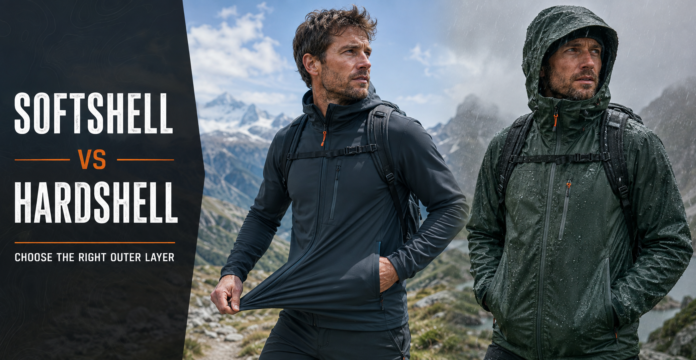
Two outer layer options sit at the top of every serious outdoor enthusiast’s decision list — softshell and hardshell. Both protect against outdoor elements. Both come in technically impressive constructions. But softshell vs hardshell outdoor clothing serve fundamentally different performance purposes — and choosing incorrectly for your activity and conditions creates real problems that no amount of technical fabric quality compensates for once you’re outdoors and committed to the conditions you’ll face.
What Defines Each Construction
Understanding what makes each jacket type distinct removes the confusion that marketing language often creates around these two categories.
Hardshell jackets use rigid waterproof breathable membrane laminates — Gore-Tex, eVent, Pertex Shield, and equivalent technologies — bonded to face fabrics to create complete weather barriers. They contain no insulation and provide maximum waterproofing with fully sealed seams and waterproof zippers. Their rigid face fabric construction prioritizes weather protection over comfort and flexibility during wear.
Softshell jackets use stretch woven face fabrics — typically bonded to fleece or grid-back interior linings — that provide genuine windproofing and water resistance alongside the stretch performance and wearing comfort that hardshell constructions sacrifice for their superior weather protection. Softshells are windproof and water-resistant — but not waterproof in sustained heavy rain that hardshell membrane construction handles indefinitely.
This single distinction — water-resistant versus genuinely waterproof — defines the most important performance difference between these two outer layer categories and should anchor every selection decision you make between them.
When Hardshell Is the Right Choice
Choose hardshell when weather protection is the non-negotiable primary requirement. Mountain hiking in changeable alpine conditions, ski and snowboard use in heavy snow, backcountry travel where weather deteriorates without warning, and any outdoor situation where getting thoroughly wet creates genuine safety consequences all demand hardshell construction that softshell alternatives cannot adequately replace.
The safety dimension matters particularly in mountain and remote environments. Wet clothing against skin loses insulating effectiveness dramatically — creating hypothermia risk at moderate temperatures when activity drops during rest stops that transition from physical effort to cold stationary exposure rapidly. Hardshell construction prevents this wet-out scenario indefinitely during sustained heavy rain that softshell alternatives cannot withstand beyond initial light rain exposure.
Hardshell jackets also suit ski applications where snow contact is constant — internal powder skirts, helmet-compatible hoods, and lift pass pockets serving skiing-specific requirements that general softshell constructions don’t address. Understanding the full range of hardshell jacket types available for different outdoor applications is covered in this jacket types guide — directly relevant for selecting the right hardshell construction for your specific outdoor activity.
When Softshell Is the Better Choice
Choose softshell when activity intensity and freedom of movement matter more than maximum weather protection. Trail running in dry cold conditions, ski touring during sustained uphill skinning sections, fast hiking in predominantly clear weather with light wind, and technical climbing where full range of motion is genuinely critical all benefit from softshell construction that hardshell alternatives cannot serve as effectively at equivalent effort levels.
The breathability advantage of softshell construction matters most during high-output aerobic activity where moisture vapor generation exceeds what even quality hardshell membranes can transmit efficiently. Softshell fabrics breathe more freely than hardshell constructions because their mechanical stretch structure allows unrestricted vapor movement rather than depending on selective membrane permeability that creates transmission rate limits during maximum physical output.
Softshell wearing comfort against mid-layers and base layers also improves significantly over hardshell alternatives during extended active wear — the soft interior lining moving smoothly against layers beneath rather than the stiff rustling that hardshell interiors create during sustained movement. The detailed performance characteristics of modern softshell construction are explored in this softshell jacket guide — covering fabric constructions, use cases, and selection criteria that help outdoor enthusiasts choose correctly.
Softshell vs Hardshell: Direct Comparison
| Feature | Softshell | Hardshell |
|---|---|---|
| Waterproofing | Water-resistant only | Fully waterproof |
| Windproofing | Full | Full |
| Breathability | Very high | High |
| Stretch and Mobility | Excellent | Moderate |
| Wearing Comfort | Very high | Moderate |
| Weight | Light to moderate | Light to moderate |
| Best Conditions | Dry cold and windy | Rain, snow, severe weather |
| Packability | Good | Excellent |
Can You Use Both Together?
Many serious outdoor enthusiasts carry both — using softshell as their primary active layer during high-intensity movement sections and deploying a packable hardshell over the top when weather deteriorates beyond what the softshell handles reliably. This combination approach delivers the breathability advantage of softshell during sustained physical effort alongside the complete weather protection of hardshell when conditions genuinely demand it.
The combined weight of a softshell plus packable hardshell often approaches the weight of a single premium hardshell — making the two-jacket approach commercially and practically viable for outdoor enthusiasts who regularly encounter the full spectrum of conditions from high-intensity clear-weather ascents through sudden severe weather deterioration that mountain environments regularly create.
For brands building complete outer layer collections, our waterproof clothing range covers both softshell and hardshell construction options available for brand development — giving outdoor brands the manufacturing capability to serve customers across both outer layer categories with consistent quality standards.
For a practical product example of how waterproof outer layer construction translates into complete garment solutions, these waterproof pants demonstrate hardshell membrane technology applied to lower body outdoor protection — completing the outer layer system that jacket-only hardshell selection leaves incomplete for serious wet weather outdoor applications.
Making the Final Decision
The decision between softshell vs hardshell ultimately comes down to honest assessment of three factors — the weather conditions you typically encounter, the activity intensity you regularly sustain, and the consequences of getting wet in your specific outdoor environment.
If your primary outdoor activities involve sustained rain, serious mountain weather, or any environment where wet clothing creates genuine risk — hardshell is the correct choice. If your activities primarily occur in dry cold conditions where breathability and movement freedom genuinely matter more than maximum rain protection — softshell serves you better. If your activities span both scenarios regularly — carry both and use each where it genuinely performs best.
Conclusion
Softshell vs hardshell outdoor clothing isn’t a debate about which jacket is objectively better — it’s about which jacket serves your specific outdoor activities and conditions most effectively. Hardshell protects completely when weather gets serious. Softshell breathes freely and moves naturally during high-intensity dry condition activity. Understanding this fundamental distinction clearly — and choosing accordingly — ensures your outer layer genuinely serves you rather than compromising performance in the conditions where you need it most.
FAQs
Is a softshell jacket waterproof enough for hiking in light rain?
Quality softshell jackets handle light rain and brief showers effectively through DWR treatment. For sustained heavy rain or prolonged wet exposure during serious mountain hiking — hardshell membrane construction provides the reliable protection that softshell water resistance cannot consistently deliver.
Are hardshell jackets uncomfortable during high-intensity activity?
Premium hardshell constructions with high breathability membrane ratings manage moisture vapor effectively during sustained effort. However, softshells do breathe more freely — making them genuinely more comfortable during maximum-intensity aerobic output in dry conditions where weather protection isn’t the primary need.
Which jacket type is better for ski touring?
Ski touring benefits from softshell during uphill skinning sections where maximum breathability prevents overheating during sustained physical effort. A packable hardshell carried for deployment during weather deterioration and exposed descent sections provides complete protection across the full ski touring activity range.
Can softshell and hardshell jackets be produced under a private label?
Yes. Professional outdoor apparel manufacturers offer complete private label production for both jacket types with certified performance fabrics, custom colors, hardware, labels, and packaging — giving outdoor brands full technical and commercial control over their complete outer layer collection.