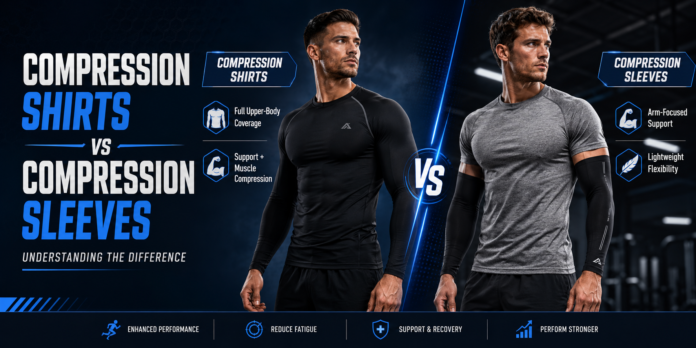
Compression shirts vs compression sleeves is a simple comparison, but many people still get confused because both products are made for support, comfort, and better movement. A compression shirt covers the chest, shoulders, back, and arms, while compression sleeves only cover the arms. This means a shirt gives full upper-body compression, and sleeves give targeted arm compression. Athletes, gym users, runners, cyclists, and people who work long hours may use either one depending on their activity. If you want support for your whole upper body, a compression shirt is usually better. If you only need arm support, sweat control, sun protection, or muscle warmth around the arms, compression sleeves can be enough. The right choice depends on where your body needs support, how much coverage you want, and what type of activity you do.
What Is a Compression Shirt?
A compression shirt is a tight-fitting performance top designed to sit close to the body and gently press the muscles. It usually covers the chest, shoulders, back, stomach area, and arms if it is long-sleeved. Some compression shirts are short-sleeved, while others are sleeveless or full-sleeved. The main purpose is to support the upper body during movement and reduce fabric looseness during training. A good compression shirt should stretch easily, feel smooth on the skin, and help manage sweat. Many people wear compression shirts for gym workouts, running, football, basketball, cycling, hiking, and outdoor training. If someone wants to explore full upper-body compression clothing, a category like compression wear can help them understand different options beyond just one product style. In compression shirts vs compression sleeves, the shirt is the better choice when the chest, shoulders, and back also need coverage and support.
What Are Compression Sleeves?
Compression sleeves are fitted fabric tubes worn on the arms. They usually cover the area from the wrist to the upper arm, but some styles may cover only the forearm or elbow area. Unlike compression shirts, sleeves do not cover the chest, back, shoulders, or stomach. They are useful when a person wants arm support without wearing a full tight top. Runners, basketball players, cyclists, tennis players, and outdoor workers often use compression sleeves because they are light, easy to remove, and simple to pair with different shirts. They may help keep the arms warm, reduce sweat discomfort, protect skin from sunlight, and support arm muscles during repetitive movement. In compression shirts vs compression sleeves, sleeves are more flexible because you can wear them with a T-shirt, jersey, hoodie, or uniform. However, they do not give full upper-body support, so they are not the same as wearing a compression shirt.
Compression Shirts vs Compression Sleeves
Compression shirts vs compression sleeves is mainly about coverage, support, and purpose. A compression shirt works like a base layer for the upper body. It gives pressure around the torso and may help the body feel more stable during workouts. Compression sleeves only focus on the arms, so they are better for people who do not want a tight shirt but still want arm coverage. A compression shirt is often better for heavy workouts, cold-weather layering, contact sports, and activities where the whole upper body moves a lot. Compression sleeves are better for hot weather, outdoor sports, arm-only support, and situations where you want quick comfort without changing your full outfit. The difference is not about which product is always better. The real question is where you need compression. If you need support from chest to arms, choose a shirt. If you only need arm support, choose sleeves.
Coverage and Body Support
Coverage is one of the biggest differences in compression shirts vs compression sleeves. A compression shirt covers more body area, so it can support more muscle groups at the same time. This may include the chest, shoulders, upper back, lower back, arms, and sometimes the core area. This makes it useful for training sessions where the whole body is active. For example, during weight training, football practice, or high-intensity workouts, the body moves in many directions. A compression shirt can stay close to the skin and reduce loose fabric movement. Compression sleeves, on the other hand, only cover the arms. This makes them useful for arm-heavy sports like basketball shooting, tennis swings, cycling grip, or running arm movement. If your outfit already includes a comfortable sports top, sleeves can add arm support without changing the rest of your clothing.
Comfort, Heat, and Breathability
Comfort matters a lot because compression clothing sits close to the skin. In compression shirts vs compression sleeves, the shirt can feel more secure, but it can also feel warmer because it covers more area. This may be good in cold weather or indoor training, but some people may feel too hot during summer workouts. Compression sleeves are easier to control because you can remove them quickly if your arms feel warm. They also allow more airflow around the torso because your main shirt can be loose or lightweight. For active people who train in different temperatures, activewear options can help build a better outfit around comfort, moisture control, and movement. The best fabric should feel soft, stretchy, breathable, and quick-drying. If the fabric traps sweat, feels rough, or limits movement, it will not feel good during long use.
Performance Benefits in Sports and Training
Compression shirts vs compression sleeves also matters when we talk about performance. A compression shirt can help an athlete feel locked in because it stays close to the body and does not flap during movement. This is useful under jerseys, jackets, and uniforms. It may also help reduce friction between skin and outer clothing. Compression sleeves are useful when the arms need extra attention. For example, a basketball player may wear one sleeve for shooting comfort, while a runner may wear both sleeves for warmth and sweat control. Cyclists may wear sleeves because they are easy to remove when the temperature changes. Gym users may prefer compression shirts for upper-body workouts because the shirt covers more muscle groups. Still, compression clothing does not replace proper training, rest, hydration, or warm-up. It is a support layer, not a magic performance tool.
Simple Buying Points
When choosing between compression shirts vs compression sleeves, check these simple points before buying: choose a compression shirt if you want chest, shoulder, back, and arm coverage; choose compression sleeves if you only want arm support; pick breathable fabric for hot weather; pick thicker fabric for cooler weather; avoid sizes that feel painfully tight; choose flat seams to reduce rubbing; check stretch recovery so the fabric does not become loose quickly; choose moisture-wicking fabric if you sweat a lot; match the product with your sport or work activity; make sure the item is easy to wash and keeps its shape after repeated use. These buying points are simple, but they help you avoid the wrong product. Good compression should feel firm, not painful. If it leaves deep marks, limits blood flow, or feels uncomfortable after a few minutes, the size or fabric may not be right.
When Should You Choose a Compression Shirt?
You should choose a compression shirt when you need full upper-body coverage and a stable base layer. It is useful for people who train in gyms, play team sports, run in cool weather, work outdoors, or wear uniforms. A compression shirt can also be helpful when you want a clean look under another shirt or jacket. Long-sleeve compression shirts can cover the arms, while short-sleeve versions focus more on the chest and shoulders. If your main need is a fitted performance top, compression T-shirts are a natural option because they give upper-body coverage while still working like a normal sports shirt. In compression shirts vs compression sleeves, choose the shirt when your activity involves the chest, back, shoulders, and arms together. It is the more complete option for upper-body support and layering.
When Should You Choose Compression Sleeves?
You should choose compression sleeves when your arms need support but your torso does not need compression. Sleeves are a good choice for warm weather because they do not add extra tight fabric around the chest or stomach. They are also good when you already like your shirt but want arm coverage for sport, sun, sweat, or muscle warmth. Many players use sleeves because they are easy to wear with jerseys and uniforms. Outdoor workers may also like sleeves because they can protect the arms from sun exposure and light friction. In compression shirts vs compression sleeves, sleeves are the more flexible and lightweight option. They are also easier to pack in a gym bag or sports kit. However, if you need posture-like support, core coverage, or full upper-body compression, sleeves alone will not be enough.
Conclusion
Compression shirts vs compression sleeves comes down to one main question: do you need full upper-body support or only arm support? A compression shirt is better when you want coverage for the chest, shoulders, back, and arms. It works well for workouts, sports, layering, and cooler conditions. Compression sleeves are better when you want targeted arm coverage without wearing a full tight top. They are lighter, easier to remove, and useful for warm weather or arm-focused activities. Both products can be helpful, but they solve different problems. The best choice is the one that matches your activity, comfort level, weather, and body support needs. If you want full coverage, choose a compression shirt. If you want simple arm support, choose compression sleeves.
FAQs
Are compression shirts better than compression sleeves?
Compression shirts are better if you need full upper-body coverage and support. Compression sleeves are better if you only need support or protection for your arms. In compression shirts vs compression sleeves, the better choice depends on the body area you want to cover.
Can I wear compression sleeves with a normal T-shirt?
Yes, you can wear compression sleeves with a normal T-shirt, sports jersey, hoodie, or uniform. This is one reason many athletes like sleeves. They give arm coverage without forcing you to wear a full compression shirt.
Do compression shirts help during workouts?
Compression shirts can help you feel more supported during workouts because they stay close to the body and reduce loose fabric movement. They may also help with sweat control if the fabric is breathable and moisture-wicking.
Which is better for hot weather, compression shirts or compression sleeves?
Compression sleeves are often better for hot weather because they cover less body area and are easier to remove. A compression shirt can still work in hot weather if it is lightweight, breathable, and quick-drying.