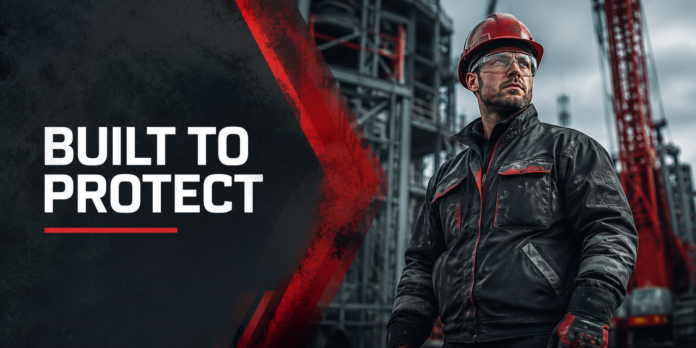
Worker protection is vital for workplace safety. Dust, heat, rain, sharp edges, low visibility, heavy tools, and other hazards are faced daily. Industrial workwear should protect, support, and improve comfort to help keep workers focused.
As a custom apparel manufacturer and supplier, we understand that industrial workwear is creating clothing that can stand up to tough conditions and not just making tough uniforms. Fabric, stitching, pockets, reflective taps, closures, and fit should all focus on safety and durability.
What is Industrial Workwear?
Industrial workwear is the clothing made for tough jobs. These include work jackets, trousers, coveralls, bib pants, vests, rainwear, flame resistant clothing, and other heavy duty garments and uniforms.
Regular clothing does not have the construction or focus on features and stitching that industrial workwear does. Industrial workwear helps workers perform in tough environments and in the trades of construction, manufacturing, oil and gas, logistics, and maintenance.
Why Industrial Workwear is Important for Worker Protection
Regular clothing cannot stand up to tough job tasks and is more likely to restrict movement, moisture, and provide less protection to workers. Proper industrial workwear is made for this and provides workers with a safer and more reliable level of protection.
Industrial Workwear and Work Safety
Apart from making employees visible and protecting them from various weather conditions, Industrial Workwear Manufacturing shows a company’s professional image. Hence, industrial workwear safety is also a uniform safety system.
Industrial Workwear Protection on the Job
The protecting ability of industrial workwear varies among jobs and the risks they encounter. Some employees need protection against rough surfaces. Others need protection against the weather, sparks, heat, dirt, and low visibility.
Because every job site is unique, companies need to select industrial workwear according to the actual job that employees are going to do. The following categories show how industrial workwear provides protection to employees who work in difficult conditions.
Protection from Physical Work Hazards
Employees are exposed to tools, equipment, machines, construction materials, and job site work aids. Industrial workwear that is made of tough fabric reduces the employees’ exposure to scratching, friction, and light impacts.
Some tough fabrics are canvas, twill, ripstop, and poly-cotton blends. These fabrics can be made into industrial workwear that has reinforced knees, elbows, pockets, and seams.
Protection from Weather Conditions
Employees that work outdoors encounter the effects of rain, wind, cold, and heat. Because of the changing weather conditions, industrial workwear that is specially made can keep employees dry, warm, cool, and comfortable.
Employees can stay focused and productive inside work aids while avoiding the discomfort of cold air and the effects of overheating and wet clothes.
Protection Against Low Visibility
Low visibility poses a serious threat in construction, on roadways, in warehouses, at ports, at airports, and in any other outdoor work areas. The use of high visibility industrial workwear ensures that workers can be seen in the presence of vehicles and moving machinery and equipment.
The use of bright colors and reflective tap is important during the early morning, evening, and night work as well as in the hazardous effects of different weather. High visibility workwear jackets, vests, trousers, shirts, and coveralls are instrumental in worker safety.
Protection Against Heat, Sparks, and Flame Risks
Workers exposed to heat and sparks and to welding and other flame related risks are exposed to the additional danger of ordinary fabric. Once ordinary fabric burns, melts or disintegrates, the danger is even worse.
Flame resistant industrial workwear can help reduce this risk for workers that perform these especially high risk tasks. In this case, the company in question needs to be careful in the selection of the FR fabric as well as the trims, stitching, and construction of the garments, as they relate to the hazards present in the work area.
Protection Against Dirt, Dust, and Contamination
Industrial workers are exposed to different dirt and chemicals and other contaminants present in the industrial work environment. Protective workwear helps keep the body and personal clothing clean throughout the day.
Coveralls and other work shirts, trousers, aprons, and jackets help reduce contact with dirty work surfaces. Standard workwear also helps a company maintain a professional and orderly appearance in the workplace.
Key Features of Protective Industrial Workwear
Protective industrial workwear should combine durability, comfort, function, and safety. If a garment looks strong but restricts movement, it may not support workers properly. Similarly, if a uniform feels comfortable but tears quickly, it fails in heavy-duty environments.
For this reason, companies should check the most important features before placing a bulk order:
- Durable fabric for abrasion and tear resistance.
- Reinforced seams for long-lasting strength.
- Strong knees, elbows, cuffs, and pocket areas.
- Proper fit for bending, lifting, climbing, and reaching.
- Breathable fabric for long working hours.
- Waterproof or water-resistant protection for outdoor jobs.
- High-visibility colors for risky or low-light areas.
- Reflective tape for roads, warehouses, and construction sites.
- Flame-resistant options for heat and spark exposure.
- Functional pockets for tools, phones, pens, and accessories.
- Strong zippers, buttons, snaps, and closures.
- Comfortable linings and flexible panels for movement.
- Easy-care fabric for repeated industrial washing.
- Custom branding options for company identity.
When these features work together, industrial workwear gives workers better protection and companies better value. Therefore, a custom apparel manufacturer should always design workwear around real worker needs, not only around appearance.
Industrial Workwear Across Industries
There are many types of workwear for many different industries. A construction worker, warehouse worker, oil and gas worker, factory worker, etc. are all in different industries and likely face different daily risks.
Because of this, companies should not use a standard uniform style across all departments. Instead, they should choose garments based on job role, worksite conditions, climate and safety standards requirements.
Construction Workwear
Workers in construction need sturdier clothing because in construction they are often surrounded by dust, concrete, tools, timber, metal, and even heavy and rough materials. Because of this construction workwear should include work trousers, reinforced jackets, and work shirts, high-visibility vests, and coveralls, as well as weatherproof outerwear.
Additionally, construction workwear needs to allow construction workers a great deal of movement because they do a lot of bending, lifting, climbing, and kneeling throughout the day. Workwear should protect the high-stress areas such as the knees and the seams and the pockets and the elbows as well.
Oil and Gas Workwear
Workers in oil and gas face fire risks, static risks, and even exposure to grease and chemicals and all of these can especially be a problem in extreme weather and in remote working environments. Because of this, they often need flame-resistant coveralls, as well as antistatic workwear, work jackets and tough work trousers.
Also, workwear for oil and gas should be suitable to wear during long shifts. Workers should be protected by workwear that is made of strong construction and is breathable to allow for adequate movement.
Manufacturing Workwear
Workers in manufacturing need workwear that is suitable for the repetitive movement and work of operating machinery, as well as the lifting and indoor work. Work shirts and trousers are typical workwear choices for factory teams. Coveralls, jackets, and aprons are also common choices.
However, the surrounding environment should influence the choice of fabric. A hot production floor may require a need for breathable workwear, while a workshop that has grease and dirt, may require easy-care, stain resistant clothing.
Workwear for Warehouse and Logistics
Because warehouse and logistics workers quickly travel, lift packages, and operate around loading areas, flexible, durable clothing that supports comfort for long shifts is necessary.
High visibility clothing is necessary in aiding workers to be seen among travel of forklifts and trucks and moving goods. Branded uniforms also assist instant identification to supervisors of staff among busy work areas.
Workwear for Roadside and Utility
Because roadside and utility workers often have the danger of working near moving traffic, machinery and outdoor hazards, workwear that has high visibility protection is essential.
Since these workers also have the comfort of easily changing weather, workwear that protects from the rain and cold would be necessary. In this case, a protective layered system of outer waterproof and inner breathable would be sufficient.
Common Mistakes in Construction Workwear
Construction workwear must protect workers from rough surfaces, tools, dust, weather, and constant movement. However, many companies make simple selection mistakes that reduce comfort, safety, and garment life.
These mistakes can create poor worker experience and increase replacement costs:
- Choosing cheap fabric that tears quickly on rough jobsite surfaces.
- Using weak stitching that opens during lifting, bending, or kneeling.
- Selecting tight workwear that restricts movement.
- Selecting loose workwear that can catch on tools or equipment.
- Ignoring high-visibility colors on busy construction sites.
- Forgetting reflective tape for low-light or roadside work.
- Using non-breathable fabric in hot weather.
- Choosing jackets without rain or wind protection for outdoor teams.
- Ignoring reinforced knees, elbows, and pocket areas.
- Adding too few pockets for tools and daily work items.
- Using poor-quality zippers, buttons, snaps, or closures.
- Not testing samples before bulk production.
- Ignoring worker feedback about comfort and fit.
- Choosing one uniform style for every construction role.
- Using branding methods that damage waterproof or protective garments.
- Not checking shrinkage, fading, or washing performance.
Avoiding these mistakes helps companies create stronger and safer construction uniforms. Therefore, buyers should work with a custom apparel manufacturer that understands fabric strength, garment fit, and real construction jobsite needs.
Importance of Proper Fit in Industrial Workwear
The main purpose of industrial workwear is to protect employees, which is why fit is critical. Clothing that is too tight restricts movement. Clothing that is too loose is a safety hazard because it can get snagged on tools and equipment.
Clothing that fits properly should allow employees to bend, reach, squat, climb, lift, and walk without any restrictions. For this reason, companies need to make sure they have the correct size charts, sample the fit of the clothing, and get feedback from employees before they authorize bulk purchases.
Importance of Fabric Selection in Industrial Workwear
The type of fabric that is used in the construction of industrial workwear is critical in considering the performance of the clothing in that work environment. Different fabrics have different characteristics and cotton is comfortable, polyester adds strength, ripstop fabric is tear resistant, canvas can be used in workwear that takes a lot of abuse, and softshell fabric resists the weather and has a good amount of stretch.
The construction of industrial workwear for different work environments may also be a factor in the type of fabric that is used. A tough work environment may need heavyweight fabric, while a work environment that is hot may need a more lightweight and breathable fabric.
How Industrial Workwear is Designed to Improve Comfort & Productivity
Comfortable industrial workwear helps employees to remain more focused on the task at hand during long shifts. Industrial work garments that are designed to be movement friendly, resistant to the elements, and protective help employees to complete their task with less distraction.
This also helps to increase employee satisfaction & productivity. Employees are also more likely to wear their industrial workwear as designed, because the clothing is comfortable, compared to clothing that is protective, but is uncomfortable and not meant for the work environment.
How Custom Workwear Manufacturers Protect Employees
Because custom apparel workwear manufacturers design industrial workwear based on the climate of that specific work environment, the job that the employees do, and the branding of that company, companies have more control on fabrics, colors, fit, stitching, the presence of pockets, the style of trims, reflective tape, and the function of the garment.
Custom manufacturing fills the gaps that the typical workwear lines are unable to manage. Businesses will have the ability to customize pockets, add more durable sections, and adjust the sizing. Custom manufacturing also allows companies to use less risky branding methods and develop workwear that is better suited for the work environment.
Choosing the Correct Workwear
When trying to select the proper workwear, the most important factor is determining the worksite conditions. Companies should analyze the risks on the job, how the employees will be moving, the conditions of the weather, how visible the employees need to be, what type of protection the employees will require, and how the clothing will need to be cleaned.
Buyers should also consider the quality of the fabric and the construction of the workwear. To help companies make a better selection, workwear should also be sampled.
Recognizing Jobsite Hazards
Risks differ from site to site. Buyers must first outline the key jobsite hazards. These can be abrasion, rain, cold, sparks, chemicals, dust, traffic, equipment and low-visibility.
Understanding the risks will help companies choose the right type of workwear. For this reason, the review of risks will help stop the choosing of the wrong type of fabric as well as the poor performance of the garment.
Choose the Appropriate Fabric
The fabric should be appropriate for the tasks the worker does on a daily basis. As an example, construction workers may need fabric that is more heavy duty, such as ripstop or canvas. For workers in a warehouse, fabric that is more lightweight and may be a poly-cotton blend, may be appropriate.
Also, the weight of the fabric should consider the temperature. In summer, heavy fabrics may be too hot, while thin fabrics may not offer sufficient protection in cold and/or harsh conditions.
Fabric Durability
Fabric Durability is a way to test if the fabric may be appropriate under the pressure of the job. Before a bulk order is placed, a Buyer should check Fabric tear strength, abrasion, seams and wash performance.
This is very important for construction, oil and gas, maintenance and outdoors jobwear. This way, the company may prevent garments that are easily broken.
Fabric Comfort
Fabric Comfort is a way to test if a worker can easily perform the tasks of their job. A garment can look good while hanging on a display but must also be practical for a job that lasts several hours.
To this end, a company may test a garment on an employee to gather feedback for problems that may include fit, length of the sleeves, fabric and fit, placement of pockets and breathability.
Examining Garment Construction
The quality of construction encompasses the overall quality of stitching and the seam types, reinforcements and the hardware (zippers, buttons, snaps, etc.), labels, and finishing. Strong fabric will not compensate for weak stitching, or poor trims.
A serious manufacturer will focus on all the stages of production. Better construction will improve the life of the garment, the comfort of the wearer, and the safety performance.
Branding and Customization
Branding improves the appearance of Industrial workwear and makes it uniform. Companies can add custom workwear using embroidery, heat transfer, screen printing, woven labels, rubber patches, and custom trims.
Although branding improves appearance, it should never compromise safety. An example would be the branding for a waterproof jacket. It will be a leakproof branding, thus maintaining the jacket’s waterproof quality. It would be a similar situation for a flameproof garment.
Why Industrial Workwear is Good for Business
Industrial workwear protects employees and helps companies improve their image and decrease the cost of workwear. Strong, well-designed workwear helps employees look good and supports them in doing their work.
Branded workwear also promotes a professional appearance. A consistent appearance helps all workers to be identified easily by customers and others outside the company.
Why Industrial Workwear is Good for Employees
Workwear designed for employees is protective and helps with movement and visibility. A well-designed garment is an aid in confidently doing the job in a tough environment.
It shows the company cares if the workwear is designed well, and if employees are given workwear that is tough and comfortable, the employees are even more prepared and feel good about doing the job.
Solutions for Improved Protection for Workers
To protect workers better, companies should consider using appropriate workwear driven by the actual conditions of given tasks instead of solely on workwear costs. Companies should consider hazards, the environment, the strength of fabric, fit, visibility, and washing performance before manufacturing workwear.
Professional custom apparel manufacturers can help businesses by providing fabric suggestions, samples, size charts, branded workwear, and workwear quality control. This helps businesses design workwear that protects workers and helps the business as well.
Why Industrial Workwear Helps Brand Identity
Industrial workwear helps a company’s brand identity. Uniforms that are clean, matching, and of good quality help enhance a business’ Professional image and help a business gain trust from the public.
Custom workwear can be made to be more branded by using a company’s colors, logos, and trims. Safety and performance of workwear should always be the top consideration, and so every detail of the branding should be done within the context of the workwear fabric.
Conclusion
There is a very important role that industrial workwear plays in protection of workers. It helps in the protection from exposure to the weather, the elements, and from the risks that are industrial in nature.
For a business, the right workwear is much more than a uniform. It is a safety tool, an aid to productivity, and branding for professionalism. Because of this, it is important that businesses partner with a respected custom apparel manufacturer. This manufacturer should be knowledgeable and have a deep understanding of industrial workwear, worker protection, fabric limitations, garment construction, and real jobsite constraints.
FAQs About Industrial Workwear Worker Protection
What is industrial workwear worker protection?
Industrial workwear worker protection means using special work clothing to help protect workers from jobsite risks. These risks may include weather, dust, abrasion, heat, sparks, low visibility, and rough work surfaces.
Why is industrial workwear important?
Industrial workwear is important because workers need reliable clothing in demanding jobs. Regular clothing may tear, restrict movement, or fail during industrial tasks.
What are the main features of protective industrial workwear?
The main features include durable fabric, reinforced stitching, proper fit, strong closures, functional pockets, and protective finishes. High-visibility colors and reflective tape are also important for risky job areas.