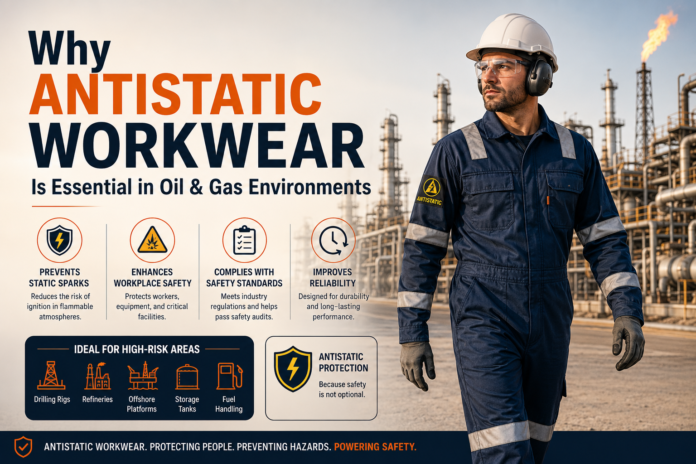
Why antistatic workwear can be a critical investment in safety for oil and gas operations. It protects workers from electrostatic discharge, a hazard that is invisible, but deadly, in an environment where there are flammable gases, liquids and vapours at almost every moment of the day. Static electricity is silent and builds up on clothing or the body when moving. It can cause catastrophic consequences in an atmosphere of flammable vapours, gases, and liquids. It also explains how it functions, what standards govern it, and what brands or procurement teams should know before specifying it.
Understanding the Electrostatic Hazard of Oil & Gas
In most environments, static electricity does not pose a significant risk. The same static electricity that can cause a harmless spark by touching a door handle in oil and gas environments is capable of igniting a flammable environment with potentially deadly consequences.
What Causes Static Electricity on Workwear?
Workwear accumulates static charge through triboelectric production — the transfer and separation of electrical charges between surfaces that are in contact. Because they are electrically insulators, synthetic fabrics are more prone to accumulation of static charge. They do not allow the charge to flow down to earth.
The charge accumulation rate is also affected by the fabric composition, humidity in the environment, and nature of the job. In low-humidity conditions, such as those found in oil and gas operations in the desert and air-conditioned control rooms offshore, charge builds up faster and can reach higher discharge potentials. Fabric specification, rather than environmental control, is the most reliable way to manage electrostatic hazards in oil and gas clothing.
The Ignition Hazard in Flammable Airs
When three conditions are present, electrostatic discharge can be a fire hazard. These include a static charge, a flammable environment within the ignition range, and an electrical discharge path. All three conditions are common at oil and gas sites. Hydrocarbon gases and vapours are constantly present in the atmosphere during processing, storage and transfer operations. Workers also move continuously through this atmosphere throughout their shift.
The most sensitive hydrocarbon/air mixtures can be ignited with a discharge energy of 0.2 millijoules. A human wearing synthetic clothing will accumulate discharge energies that are several orders above this threshold. Standard synthetic workwear lacking antistatic properties can cause ignition in any classified area of an oil and gasoline facility. Contact our oil & gas workwear manufacturing today to learn more about certified antistatic fabrics.
What makes antistatic workwear different?
Antistatic workwear is designed to prevent static charges from accumulating to levels that can ignite. This eliminates the need to rely on the environment or the worker’s behaviour to mitigate the risk.
Conductive Fibre Integration
The fabric must be woven or knitted with conductive fibres, usually carbon or stainless steel, at specified intervals. These conductive fibers create pathways which allow static charges to be dissipated continuously throughout the fabric structure, rather than building up to discharge potential.
The fabric’s antistatic properties are also determined by the grid spacing and the continuity of the conductive fibers across the entire garment. EN 1149 Part 3 – the European standard for antistatic clothing – specifies the limits of the charge decay and residue following a standardised testing. These limits ensure that the fabric will dissipate charge during normal working activity, preventing charge accumulation and ignition risk.
The Complete Garment System is Required
Antistatic performance is not only a fabric characteristic. It’s a system quality. The antistatic performance of a garment made from certified fabric may still be compromised if it is constructed with non-conductive zipper pulls or large areas that are non-conductive.
The EN 1149 standard applies to the entire finished garment, including the seams, pockets, closures and trims. It does not apply only to the base fabric. Our workwear standards manages EN 1149 certification of complete garments for our manufacturing customers. Contact us today to learn how you can ensure that your antistatic clothing meets the standard.
EN 1149 — Standard for Antistatic Workwear
EN 1149, the European Standard Series that defines the antistatic performance requirements of protective clothing is the benchmark certification oil and gas operators refer to when specifying the antistatic requirements for workwear for site access.
EN 1149 Parts – What they Cover
EN 1149 is divided into several parts that address different aspects of performance. Part 1 measures surface resistivity, which is how well the fabric surface conducts charges laterally. Part 3 measures the rate at which accumulated charges dissipate from fabric surfaces. Part 5 specifies the performance requirements of the entire garment, including the fabric, construction and all components.
Most oil and gas operators specifications also refer to EN 1149-3 together with EN 1149-5, requiring fabric-level performance in charge decay and full garment antistatic compliance. Wholesale buyers must confirm the parts of EN 1149 that their target operator specification requires before finalising fabric specifications.
Antistatic Workwear Grounding Requirements
The most effective why antistatic workwear is when it’s combined with the appropriate grounding provided by antistatic footwear. This is because the path of charge dissipation from the fabric has to reach the earth via the wearer’s feet. Antistatic footwear that conforms to EN ISO 20345 completes the system of grounding initiated by why antistatic workwear. Most oil and gas operators specify both elements in a combined system.
To this end, specifications for why antistatic workwear should be developed as part of a complete system of personal protective equipment rather than a single garment. Contact our Industrial Workwear Manufacturing Team today to discuss the complete antistatic PPE System Specifications for your workwear line.
Combining Flame-Resistant and Antistatic Properties
Fabrics that are both flame resistant and antistatic perform well in the most demanding oil and Gas workwear applications. This is because workers who work in these environments can be exposed to both direct heat and static ignition hazards.
Fabrics with FR-Antistatic Inherent Properties
Nomex blends and modacrylic fabrics that are used for oil and gas workwear often include conductive fibre components to provide antistatic and flame-resistant properties. This allows them to meet both EN ISO 11612 and EN 1149 standards with a single fabric. This combination of performance simplifies workwear specifications, eliminates the need to select incompatible solutions and reduces total garment weight when compared with layered approaches.
Antistatic Compatibility and Treated FR fabrics
The antistatic treatment used on treated FR fabric must be compatible. Some antistatic treatments can interact with FR finishes and reduce their effectiveness. Fabric testing is required to confirm the combined performance of both treatments after they have been applied.
The repeated industrial launder of FR-antistatic fabrics is also required to maintain both properties. This requires the development of a laundry program and its monitoring, which confirms compliance during the entire garment’s service life. Contact our workwear manufacturers today to discuss how we can help you develop combined FR/antistatic workwear that includes integrated laundry compliance programs.
Wearing Why Antistatic Workwear in Different Oil & Gas Roles
Workwear specifications should be based on the level of risk that each job presents, rather than a blanket standard for the entire workforce.
Process and Production Workers
The highest level of antistatic hazards is for workers in production and process industries who work continuously within hazardous zones, where flammable environments are regularly present during normal operations. Workwear must be certified EN 1149-compliant across all layers — base layers, middle layers, and outer shells. This is because any insulating layer of clothing can accumulate and discharge charges, regardless of the other layers around it.
Maintenance and Technical Workers
Maintenance workers who regularly enter classified zones during repairs and maintenance require the same antistatic certification level as process workers. This is because they disturb process equipment, which can temporarily increase the flammable atmosphere risks above normal operating levels.
Personnel for Site Support and Administration
Support personnel who visit classified zones on a regular basis — for inspections, site visits, or administrative functions — may need why antistatic workwear when they enter classified zones, but can operate under visitor workwear program specifications rather than full-time issued clothing specifications.
Antistatic Workwear: Specifications and Features
These features are important for both regulatory compliance and performance on site.
- Certification for EN 1149-3 & EN 1149-5 — Confirm fabric level and garment antistatic compliance prior to approving workwear in classified zones
- Type and spacing of conductive fibres — Carbon or stainless steel fibers at defined grid inter-sections, confirmed by test report instead of manufacturer’s claim only
- Combined FR antistatic certification — EN ISO 11612 & EN 1149 compliance with a single fabric for high-risk roles and process sites
- Confirm that the construction of garments is continuous — Check to ensure that pockets, seams, closures and trims don’t interrupt the conductive fiber dissipation path
- Compatible with laundry programs — ensure that antistatic and FR characteristics are maintained throughout the entire planned wash cycle
- Compatibility with grounding systems — confirm coordination of the entire PPE grounding system with EN ISO 20345 antistatic shoe specification
- Compliance with Operator Specifications — verify alignment with specific EN 1149 parts referred to in the target operator’s site access requirements.
Developing antistatic workwear for the Oil & Gas Markets
Antistatic workwear is a stable and significant category of procurement in the oil and gas market. This is due to regulatory requirements, which create a consistent demand irrespective of economic conditions. Brands that create certified antistatic clothing with strong technical documentation, operator specifications and alignment with the brand’s standards can also establish long-term relationships with major oil companies that offer commercial stability that is beyond fashion-driven apparel categories.
In addition, by developing antistatic workwear in conjunction with waterproof workwear for outdoor site operations, a complete certified system is created — one that meets both the performance requirements of antistatic and flame resistant work zones and the weather protection needs outdoor operational environments.
Brands targeting the industrial workwear market can create a complete brand-named workwear proposition by combining corporate uniforms with certified safety workwear. This will serve both safety-critical operational roles as well as management and visitors who represent an organisation on site.
Are you ready to create certified antistatic workwear in the oil and gas market? Contact our manufacturing team to learn more. We support brands and procurement teams with everything from EN 1149 fabric specifications and planning through bulk production and quality control.
Conclusion
It is vital that workers are protected from a lethal but invisible hazard by wearing why antistatic workwear. Standard workwear simply cannot do this. Understanding the factors that make why antistatic workwear effective – conductive fiber integration, complete garment certification EN 1149, combined FR/antistatic performance and grounding systems compatibility – is essential to developing or procuring clothing that protects workers while meeting the regulatory requirements for accessing classified oil and gas sites.
Explore the oil & gas workwear manufacturing and contact our team today to begin your production journey.
FAQ
Why is antistatic clothing needed on oil and gas sites?
The conductive fibres in antistatic clothing dissipate the static charge before ignition is possible. This prevents electrostatic sparks from igniting flammable gases and vapours.
Which standard governs the antistatic performance of workwear?
EN1149 is the main European standard series, with Part 3 covering charge degradation performance at fabric levels and Part 5 covering garment antistatic compliance, including all construction components and trims.
Can antistatic footwear be worn without antistatic clothing?
The most effective antistatic footwear is EN ISO 20345 certified. This is because the path of charge dissipation from the fabric has to reach the earth via the wearer’s foot.