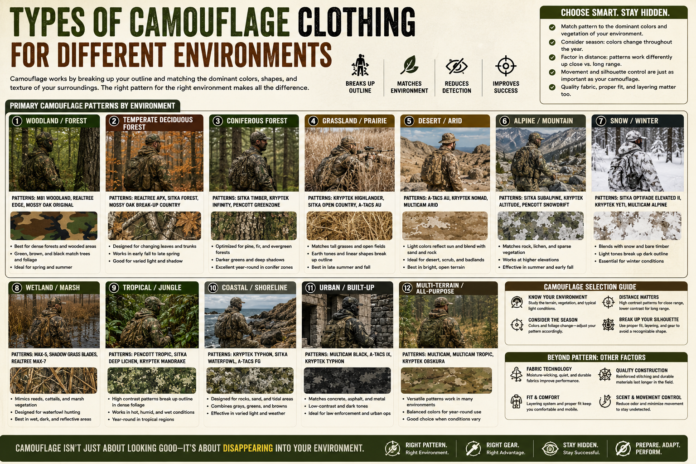
Camouflage clothing serves a specific and serious purpose — making the wearer visually difficult to detect within a specific environment. But not all camouflage patterns perform equally across different terrain types and lighting conditions. Choosing the wrong types of camouflage clothing for a specific environment can be as ineffective as wearing no camouflage at all — and for hunters, military personnel, and tactical professionals, that ineffectiveness carries real consequences. Here’s a complete breakdown of every major camouflage type and where each one genuinely performs.
How Camouflage Works — The Basic Principle
Effective camouflage achieves concealment through two simultaneous mechanisms — color matching to the dominant tones of the specific environment and pattern disruption that breaks up the recognizable human silhouette against natural backgrounds.
Color matching alone doesn’t achieve effective concealment. Pattern disruption alone doesn’t either. Both must work together — matched to the specific visual characteristics of the environment the wearer operates in — for camouflage to deliver genuine concealment performance rather than simply a visual approximation of the surrounding terrain.
Understanding this dual requirement explains why environment-specific camouflage patterns consistently outperform generic alternatives — and why serious hunters, military users, and tactical professionals invest in pattern-specific garments matched to their specific operating environments.
Woodland Camouflage — Forest and Dense Vegetation
Woodland camouflage patterns use combinations of dark green, medium green, brown, and black to match the visual complexity of forested environments — dense canopy, undergrowth, fallen timber, and varied vegetation creating the layered visual environment these patterns replicate.
Classic woodland patterns — including the US military’s original M81 woodland and equivalent patterns from multiple national military traditions — remain highly effective in temperate forest environments globally. Contemporary woodland patterns incorporate digital pixel elements that create more effective visual disruption at varied observation distances than the blended brush stroke elements of classic woodland designs.
Camouflage clothing manufactured in woodland patterns serves deer hunting, turkey hunting, and general woodland field activity across the temperate forest environments that cover significant portions of North America, Europe, and Asia — making woodland pattern one of the highest commercial volume camouflage categories for outdoor apparel brands.
Desert Camouflage — Arid and Semi-Arid Environments
Desert camouflage patterns use combinations of tan, sand, light brown, and muted olive to match the sparse, sun-bleached visual character of desert and semi-arid environments where vegetation is minimal and earth tones dominate the visual landscape.
Three-color desert patterns — using distinct tan, brown, and light green tones — suit transitional desert environments where sparse vegetation introduces green tones alongside dominant earth colors. Six-color desert patterns provide finer visual disruption through more complex color interactions that improve effectiveness at closer observation distances where coarser patterns become visually detectable.
Arid environment hunting — predator hunting, open country big game pursuit — benefits from desert pattern selection over woodland alternatives that would create obvious visual contrast against the light-toned arid backgrounds these hunting environments present.
Snow and Arctic Camouflage — Winter White Environments
Snow camouflage patterns use predominantly white with minimal grey or pale blue tones to match the high-contrast, low-color environments that snow cover creates across winter landscapes. The near-complete whiteness of snow-covered terrain makes non-white garments immediately visually obvious — making correct snow camouflage selection critical for winter hunting and cold weather tactical operations.
Winter hunting applications — particularly snow goose, late-season deer, and coyote hunting in snow-covered terrain — benefit enormously from proper snow camouflage that eliminates the visual contrast that any darker pattern creates against white snow backgrounds. Hunting apparel manufacturers build snow camouflage into lightweight over-garments that layer over base hunting clothing — allowing quick deployment when snow conditions create concealment requirements that standard woodland patterns fail completely.
Digital Camouflage — Pixel Pattern Technology
Digital camouflage patterns replaced traditional brush stroke designs across most modern military organizations — using pixelated pattern elements that create more effective visual disruption at varied observation distances than analog brush stroke patterns achieved across equivalent environments.
The pixel element structure in digital camouflage creates a visual disruption effect that works across multiple observation distances simultaneously — where traditional patterns optimized for one distance often became visually detectable at different ranges. Multiple national military digital patterns — US Marine Corps MARPAT, Canadian CADPAT, and numerous equivalent national systems — demonstrate the broad institutional adoption that validated digital pattern effectiveness over traditional alternatives.
Commercial outdoor brands incorporating digital pattern elements into tactical outdoor apparel collections attract customers who value the proven effectiveness credentials that military adoption provides — distinguishing genuinely functional tactical garments from fashion-inspired alternatives that use camouflage aesthetics without functional performance justification.
Realtree and Mossy Oak — Photorealistic Pattern Technology
Realtree and Mossy Oak represent a distinctly American approach to hunting camouflage — using photorealistic imagery of actual vegetation, bark, branches, and natural elements to create pattern systems that match specific vegetation environments with visual accuracy that geometric pattern alternatives cannot replicate.
These pattern systems are licensed commercial products — Realtree and Mossy Oak each offer multiple pattern variants matched to specific hunting environments and seasons. Realtree AP (All Purpose) suits mixed woodland environments across multiple seasons. Realtree Edge suits late-season open country and agricultural hunting environments. Mossy Oak Break-Up Country suits open terrain and transitional environments between woodland and agricultural land.
The photorealistic visual matching these patterns achieve in their intended environments creates genuinely effective concealment that serious hunters recognize and actively seek — making licensed pattern partnerships commercially valuable for outdoor apparel brands serving dedicated hunting markets.
Urban and Grey Camouflage — Built Environment Concealment
Urban camouflage patterns use combinations of grey, off-white, charcoal, and muted blue-grey to match the visual characteristics of built environments — concrete structures, asphalt surfaces, grey building facades, and the generally desaturated color palette of urban and industrial settings.
These patterns serve law enforcement, security professionals, and military personnel operating in urban environments where woodland and desert patterns create obvious visual contrast against the grey built environment that urban camouflage matches effectively. Urban pattern tactical garments also attract lifestyle and streetwear customers who appreciate the visual aesthetic of grey camouflage beyond its functional concealment applications.
MultiCam — Adaptive Multi-Environment Performance
MultiCam represents a significant evolution in camouflage design philosophy — creating a single pattern that performs effectively across multiple environments rather than optimizing for one specific terrain type at the expense of others.
The pattern uses a complex blend of green, tan, brown, and black tones with carefully designed element distribution that transitions visually between different environments more effectively than single-environment patterns manage when used outside their intended terrain. US military adoption for operations across the environmental diversity of Afghanistan — transitioning between green valleys, brown hillsides, and rocky terrain — validated MultiCam’s multi-environment effectiveness credentials through demanding operational real-world testing.
For outdoor apparel brands building versatile outdoor jackets and tactical collections that serve customers operating across varied environments, MultiCam pattern offers commercial efficiency — a single pattern investment serving multiple terrain types that environment-specific alternatives require separate pattern development to address.
Waterfowl Camouflage — Marsh and Wetland Environments
Waterfowl camouflage patterns incorporate the specific visual elements of marsh and wetland environments — cattails, reeds, water reflections, mud, and the mixed brown-green-grey palette that wetland hunting environments present to waterfowl during flight observation.
Duck and goose hunting in marsh environments creates specific concealment requirements that woodland and desert patterns don’t serve — the horizontal water surface background, reed and cattail vertical elements, and the variable lighting of open water environments all require pattern designs specifically developed around these visual characteristics.
Specialized waterfowl patterns — including dedicated marsh, flooded timber, and open water variants within the Mossy Oak and Realtree pattern families — serve dedicated waterfowl hunters who understand that pattern specificity to their hunting environment directly impacts concealment effectiveness and hunting success.
Military Surplus and Heritage Patterns — Authentic and Commercial
Military surplus camouflage patterns from various national military traditions carry authentic heritage credentials that attract specific commercial markets beyond their original military applications. British DPM, German Flecktarn, French Lizard, and numerous other national patterns are widely recognized and commercially valuable for brands targeting military heritage, tactical fashion, and collector markets.
These patterns transition effectively from genuine functional applications into lifestyle and fashion contexts — carried by military heritage brands, tactical fashion labels, and outdoor brands seeking the authentic credibility that proven military pattern adoption provides over commercially developed alternatives without institutional validation credentials.
Building Your Camouflage Collection
The types of camouflage clothing each serve specific environments and customer applications that other patterns cannot optimally replace. Brands building outdoor and tactical collections benefit from understanding which camouflage types serve their specific target customers most directly — and developing those patterns with genuine construction quality that serious hunting and tactical users evaluate through real-world concealment performance.
Working with a professional camouflage clothing manufacturer ensures pattern printing quality, color accuracy, and garment construction standards that create camouflage products performing as their pattern design intends across real field use conditions.
Conclusion
Understanding the types of camouflage clothing — woodland, desert, snow, digital, photorealistic, urban, multi-environment, waterfowl, and military heritage patterns — gives outdoor brands the commercial knowledge to build camouflage collections that serve specific environments and customer needs with genuine functional credibility. Each pattern type achieves concealment through specific color and pattern combinations matched to particular visual environments — and covering the right combination for your target market creates a camouflage collection that serious outdoor professionals trust and recommend from real-world experience.
FAQs
Which camouflage pattern is most versatile across different environments?
MultiCam performs most effectively across the widest range of environments — its multi-environment design philosophy and proven military operational validation make it the strongest single-pattern choice for brands serving customers who operate across varied terrain types.
Do photorealistic camouflage patterns like Realtree perform better than digital patterns?
Each excels in its intended application. Photorealistic patterns achieve superior visual matching in specific vegetation environments they were designed around. Digital patterns provide more consistent performance across varied observation distances and diverse environment types.
Can camouflage clothing be produced under a private label?
Yes. Professional camouflage clothing manufacturers produce private label garments with custom or licensed pattern printing, construction specifications, and branding — though licensed commercial patterns like Realtree and Mossy Oak require formal licensing agreements before commercial use.
How important is fabric choice alongside camouflage pattern for hunting applications?
Critically important. Silent fabric constructions that don’t rustle during movement, moisture management for all-day field wear, and appropriate warmth specification for the hunting season all matter as much as visual concealment pattern selection for serious hunting apparel performance.