
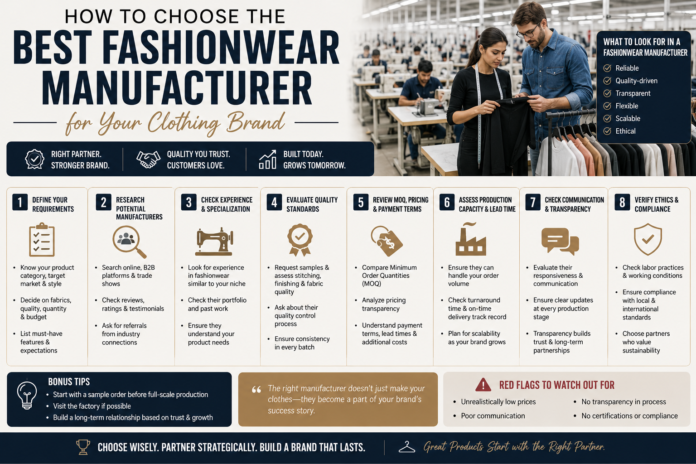
Finding manufacturers for fashionwear is not difficult, but knowing How to Choose the Best Fashionwear Manufacturer for your brand can be challenging. Everyone can show clean samples and polished presentations, but true reliability is proven when it’s time to deliver quality, consistency, and production results.
This guide will give you the most important information necessary in order to select a manufacturer that is the best fit for your brand.
Start With Your Own Requirements
Only after you understand your own requirements are you able to examine manufacturers.
You must understand your requirements. What kind of fashionwear are you trying to produce? What types of fabric and what level of construction does your product demand? What do you want to charge, and how much do you want to sell? You must know the answers to all of these.
Only after you can answer these are you able to have conversations with manufacturers. A manufacturer that specializes in casualwear is completely different than a manufacturer that makes technical knitwear. If you do not understand your own requirements you will waste a lot of time with conversations with many manufacturers that are not a good fit for your needs.
A broad fashionwear manufacturer who covers multiple categories can sometimes be a useful starting point — but always confirm that their strongest capabilities match your specific product, not just their general range.
Step 1 — Look for Category Specialisation
What factor do you think is most important for selecting a fashionwear manufacturer? It is most heavily related to manufacturing experience in that particular category. A manufacturer that makes great t-shirts may not produce great tracksuits. They may excel in knitwear but struggle in making woven fashion jackets.
When looking at manufacturers, inquire about the product/service category experience. Make sure to get examples of products they’ve manufactured that are close in relation to your category. Ask about the brands that they partner with. This is not incurring a confidentiality clause, but more to understand the degree of market they operate within.
A streetwear manufacturer who regularly works with established streetwear brands understands the graphic application standards, the fabric weights, and the finishing expectations of that market. That category knowledge is not something a general factory can replicate — regardless of how capable they are in their own specialty.
Step 2 — Evaluate Fabric Knowledge and Sourcing
A production facility is a manufacturer who is only capable of producing what you dictate. A real partner type of manufacturer is one who can inform you about your fabric options based on how the different materials behave in their machinery in their production process.
When assessing manufacturers, inquire about their fabric sourcing relationships. Are they able to obtain the fabrics necessary for your product? Do they have access to sustainable or certified fabrics? Are they able to provide advice on fabric performance at your desired price level or within particular garment construction?
For brands producing hoodies and sweatshirts, fabric weight and handfeel are critical quality indicators that a knowledgeable manufacturer will discuss confidently — rather than simply accepting whatever GSM you specify without comment.
Step 3 — Check Minimum Order Quantities Against Your Volume
MOQ is amongst the first valid filters when searching for manufacturers. If a factory has a minimum order quantity (MOQ) of 1,000 units, then they aren’t a suitable partner for a brand with an order quantity of 150. Validating the MOQ before going into the details of a contract saves a lot of effort for both parties.
Find out the MOQ for each style, color, and fabric, since the minimums usually aren’t the same, and there may be separate minimums for each variation. Inquire about the possibility of reducing the MOQ for future reorders. Lastly, ask if the minimum order quantity can be complemented by combining different styles in the same order.
For brands at an early stage, a casual wear manufacturer or fashionwear specialist who works with growing brands at flexible order sizes is a better starting point than a large factory built for volume production that has no interest in smaller initial orders.
Step 4 — Assess Print and Branding Capabilities
Most fashion items require some sort of printing or branding, like screen printing, DTG, embroidery, sublimation, or heat transfer. Legitimacy with any of these applications varies greatly from one manufacturer to another, and is the main cause of bulk production rejections due to inconsistency in print quality or issues in placement.
When evaluating a manufacturer, take time to analyze their branding or printing samples for various techniques. Look for placement consistency, details of print edges, and how well it withstood a wash. A manufacturer who brands in-house gives you one less variable in your production chain, and gives you tighter quality control.
For t-shirts and graphic-led fashionwear in particular, print quality is a core product attribute — not an add-on detail. Your manufacturer’s print capability directly affects your product’s quality perception in the market.
Step 5 — Request Samples and Evaluate Honestly
Avoid doing bulk deals with any manufacturer that you haven’t sampled with. No portfolio, website, or even factory visit can show you what that factory can actually do better than a sample.
Ask them to create a sample with your fabric, with your specs, with your construction, and with your label. Be thorough and order samples to be objective and analyze every component, stitch, seam, print, label, and even how the garment holds up after a wash.
If you are genuinely impressed with a sample, that is a good sign. However, if you see any of the mentioned issues in the sample, you can expect exactly what you got in bulk. It should be noted that the sampling process is an overview of what you can expect in the production process and is not a reflection of the product.
A co-ord set manufacturer who samples both pieces in exactly matched fabric from the same dye lot — without being asked — is demonstrating the kind of attention to detail that makes bulk production reliable.
Step 6 — Verify Quality Control Processes
In the relationship between value and quality in clothing production, quality control (QC) is of utmost importance. Instead of saying they have a QC process, ask each manufacturer to explain their QC process in detail.
You should expect answers to questions like, how do you examine the fabric before construction? What is done at each stage during the construction process? What assessment is done on the garment after it is constructed? A manufacturer with a clear QC process should give answers with confidence. If the manufacturer cannot answer these questions in a detailed manner, then it is safe to say, they have poor QC process.
For brands producing cargo pants or joggers — where pocket construction, waistband integrity, and hem finishing are all visible quality indicators — a manufacturer with strong in-line QC prevents the kind of bulk production errors that are expensive and time-consuming to correct after the fact.
Conclusion
Choosing the right manufacturer for your brand means focusing on capability, experience, fabric knowledge, and quality control. This guide on How to Choose the Best Fashionwear Manufacturer helps brands identify reliable partners that deliver transparency, accurate sampling, and consistent production quality.
Take your time. Sample thoroughly. Choose a partner who is equally as invested in your product as you are.
When you’re ready to find your manufacturing partner, explore the full range of fashionwear manufacturing options and start the conversation.
FAQs
What is the most important factor when choosing a fashionwear manufacturer?
Category experience. A factory that specialises in your specific product type will consistently outperform a general factory claiming to handle everything equally well.
How do I evaluate a manufacturer’s fabric knowledge?
Ask them to recommend fabrics for your product and explain why. A knowledgeable manufacturer will give specific, confident answers — not just accept whatever you specify.
What MOQ should I expect from a fashionwear manufacturer?
It varies widely — from 50 to 1,000 units per style depending on the factory, product type, and fabric. Always confirm before entering detailed discussions.
How many sample rounds should I expect before bulk production?
Two to three rounds is typical for most fashion wear. More complex styles or technical constructions may require additional rounds.



