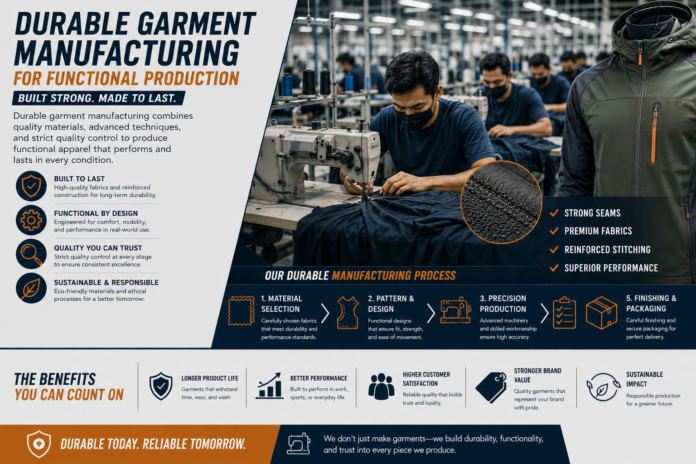
The durable garment manufacturing process helps to produce functional and long-lasting clothing with improved quality and performance.
The production of durable garments is a great way to create apparel that will last for a long time. Many brands today need garments to perform well during daily use. Durable garment production has therefore become essential to modern apparel manufacturing.
Customers expect high-quality garments. Durable garments production also improves the performance of products and customer satisfaction. In order to achieve this, manufacturers are focusing more on quality and advanced production techniques.
Why durable garment manufacturing is important
Durable garment production improves the strength and life of garments. Fabrics with high quality stitching and strong fabrics will keep clothing functional even after daily washing. Manufacturers carefully monitor every stage of production.
The modern garment industry also helps brands to reduce returns. Clothing that retains its color, shape and comfort over time is preferred by customers. Garment manufacturing also helps to maintain the professional image of businesses.
To improve the efficiency of garment manufacturing, manufacturers also use advanced production methods. These systems allow factories to maintain quality even when producing large quantities.
Related Services
High-quality fabrics improve the strength of apparel
Fabric selection is a key factor in the garment production process. Garments can lose their shape and function quickly if they are not made of strong materials. Fabrics are tested by manufacturers before production begins.
Professional Fabric Sourcing Development assists businesses in selecting better fabrics for functional clothing.
Manufacturers test their products:
- Fabric durability
- Stretch recovery
- Shrink resistance
- Moisture management
- Color consistency
The result is stronger and more reliable clothing.
Cutting and sewing increases durability
Professional stitching is a great way to improve garment production. Even high-quality fabrics can be damaged by poor stitching. For this reason, factories use advanced sewing techniques in production.
Manufacturing Capability improves garment structure and strength of seams.
Manufacturers reinforce important areas of clothing such as:
- Shoulder seams
- Knees
- Underarms
- Waistbands
- Necklines
These methods create durable clothing that is stronger for long-term wear.
Quality Control Improves Product Consistency
Durable manufacturing relies heavily on quality control. Continuous inspection is required for large-scale production to maintain consistency and reduce defects.
Standards for Quality Control are available to help improve the quality of products at every stage of production.
Teams of quality inspectors:
- Stitch quality
- Measurements
- Fabric defects
- Printing accuracy
- Packaging Standards
In turn, this improves the customer’s satisfaction and product quality.
Tech Packs reduce manufacturing errors
Planning in detail is essential to the efficiency of garment production. Technical documents are used by manufacturers to guide their production teams.
The development of tech packs by professionals helps maintain accurate garment specifications.
In addition, proper planning improves:
- Size consistency
- Production speed
- Material Management
- Garment accuracy
The production of durable clothing becomes more organized, scalable and efficient.
Performance Clothing Needs Advanced Construction
Many modern industries need more than just basic apparel. Today, many brands need functional garments that have advanced performance features. Durable garment manufacturing also includes technical garment construction methods.
Performance Garment construction improves comfort, flexibility and moisture control.
Performance wear can include:
- Breathable fabric panels
- Lightweight Materials
- Stretch fabric zones
- Sweat management systems
In turn, this supports the performance demands of modern apparel.
Samples Improve Product Accuracy
The sampling stage is also important in the production of durable garments. Manufacturers test samples before bulk production to identify fit and construction issues.
Sample Making and Pattern Making can improve garment quality, and reduce production errors.
Samples also improve:
- Product consistency
- Fit accuracy
- Fabric performance
- Production planning
Durable garment production becomes more reliable and efficient.
The development and size grading improve fit
In the production of durable garments, accurate sizing is crucial. Incorrect sizing increases product returns and decreases customer satisfaction.
Professional development and size grading help brands maintain consistency in sizing across all garments.
This process is a step in the right direction.
- Fit precision
- Customer experience
- Production consistency
- Brand Trust
In turn, this leads to better products for different markets.
The conclusion of the article is:
The production of durable garments at large scale allows industries to produce reliable and functional apparel. The performance of garments is improved by using strong fabrics, advanced stitches, strict quality control and professional planning.
To meet the needs of customers and to maintain product quality, companies today rely on a stable garment manufacturing process. Manufacturers continue to improve production systems in order to achieve better clothing durability and functionality.
FAQs
What is durable garment manufacturing?
Durable garment manufacturing is the process of producing long-lasting and high-quality apparel using strong materials and professional construction methods.
Why is quality control important in garment production?
Quality control helps manufacturers maintain product consistency, reduce defects, and improve customer satisfaction.
Which fabrics are best for durable apparel?
Polyester blends, performance fabrics, and reinforced cotton materials are commonly used for durable apparel production.
How do tech packs improve apparel manufacturing?
Tech packs provide detailed garment instructions that help factories reduce production mistakes and improve consistency.