Introduction
Pilling in simple terms can be defined as the tiny, furry balls which develop on the surface of clothes due to wear or washing. Not only are these small pieces of tangled fibers unpleasing to the eye, but also they interfere with the comfort and smoothness of your clothes. Pilling is in essence a consequence of friction, that is, as the cloth rubs against itself or against another surface, some loose fibers will interlace and form pills.Does Cotton Fabric Pill
The reason why pilling is important is that even high-quality clothes can be used only a few times and then they appear old and dilapidated. It influences the fabric durability, appearance and softness. People that adore smooth and clean looking cotton garments have to know why, and how, pilling occurs. Cotton fabrics can be pretty long-lasting and free of pill when they are taken care of and made of the best fiber.
Does Cotton Fabric Pill? The Honest Answer
So, does cotton fabric pill? The answer to this is yes but in certain circumstances. Cotton is a natural fiber and therefore typically pill more than synthetic fabrics such as polyester or acrylic. But not every cotton is made equal. Pills on low quality cotton or short-staple fiber fabrics tend to be more common compared to those of high quality like Egyptian or Pima cotton.Does Cotton Fabric Pill?
Generally 100% cotton fabric pills compared to less than blended fabrics which consist of synthetic fibers. This is because it is the natural cotton fibers which do not have such a property as the static charge which attracts lint and fuzz. Even so, the cotton may pill in cases where the fibers are weak and or short or when there is too much friction such as in machine washing or tumble drying.Does Cotton Fabric Pill
Essentially, the ability of cotton fabric to act and resist piling is based on the quality of the fiber and the weave as well as the method of care. Tight weaves, long-staple cotton and soft washing ensure that your clothes always appear fresh and smooth.
How Can Pilling happen on Cotton? Understanding the Science
Pilling occurs as a result of three factors, fiber friction, fabric tension, and fiber length. Abrasion takes place on the outermost fibers when cotton clothes are either worn or washed. After a long period, these loose fibers are twisted and this creates small knots, which are called pills.
The pilling in short-staple cotton fibers is more likely to occur since it has more end sticking out of the surface of the fabric. These ends are readily entangled on rubbing.Does Cotton Fabric Pill Conversely, long-staple cotton such as Supima or Egyptian cotton possess fewer exposed ends and thus the possibility of pills developing is reduced.
Friction of fabric is another cause. When the cotton clothes continually rub against other surfaces e.g. during washing, drying, or daily movement, the fibre surface becomes weak. This ultimately causes fuzz and pilling to be visible.Does Cotton Fabric Pill? It can be significantly reduced by means of proper laundering methods, as well as with the help of high quality of cotton fabrics.
Which Cotton Fabrics Are More Likely to Pill?
Cotton fabrics are not equally durable. There are naturally smoother and stronger than some because of the quality of the cotton fibers and the finishing methods which are employed.
Regular Cotton and Combed Cotton.
Ordinary cotton can have short and jagged fibers, and these fibers are likely to protrude through the fabric covering and lead to pilling. Combed cotton on the other hand has another procedure of short fibers being cut away. The result is a more durable, less pillable fabric.
Egyptian Cotton Pima Cotton vs. Pima Cotton.
Both Egyptian and Pima cotton are long-staple that is characterized by high softness and longevity.Does Cotton Fabric Pill Their length in fibers makes them resistant to pilling as compared to ordinary cotton. Egyptian cotton can be made of the finest and longest fibers, and this results in it being extremely smooth and luxurious between the two.
Polycotton (Cotton-Polyester, Cotton-Rayon)
Blended fabrics can provide either stretch or resistance to wrinkling, yet they can easily pill. Artificial fibers such as polyester generate friction and statical forces which hold loose fibers on the surface. Consequently, cotton-polyester mixes more than pure cotton products.
Effects of Cotton Fabric Pilling
Understanding the effects of cotton fabric pilling helps you see why it’s more than just a cosmetic issue. When cotton starts to pill, it affects not only how your clothes look but also how they feel and perform. Although cotton is known for its softness and natural durability, excessive friction, washing, or low-quality fibers can lead to small fuzz balls that change the fabric’s texture over time.
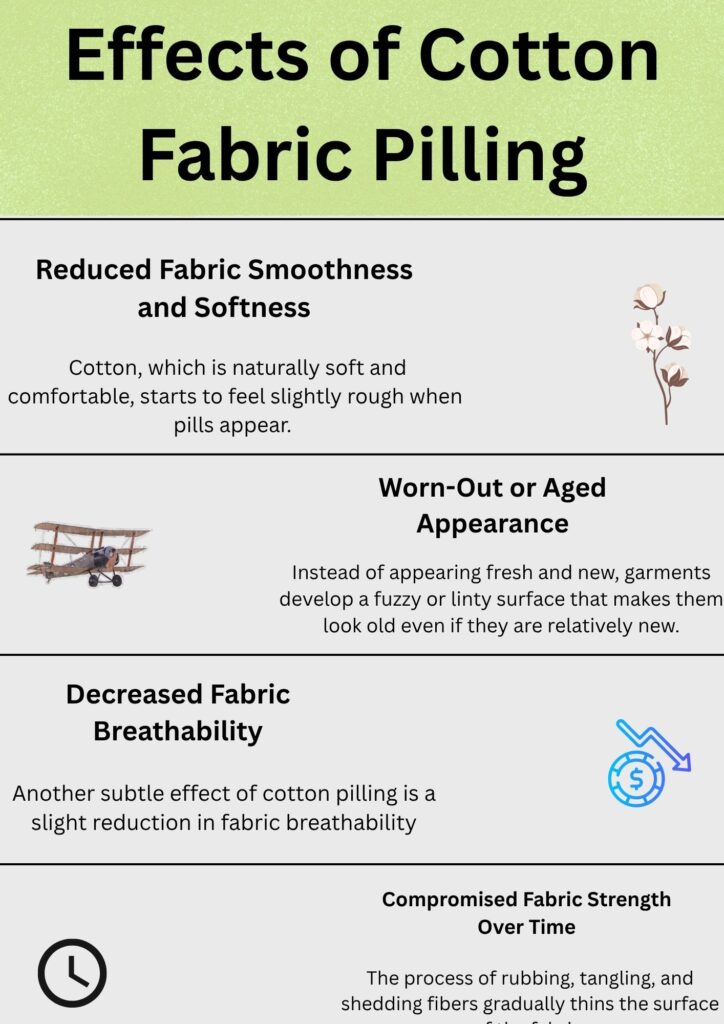
Reduced Fabric Smoothness and Softness
The most noticeable effect of pilling is the loss of smoothness. Cotton, which is naturally soft and comfortable, starts to feel slightly rough when pills appear.
Worn-Out or Aged Appearance
Pilling often gives cotton fabrics a dull, aged, or worn-out look. Instead of appearing fresh and new, garments develop a fuzzy or linty surface that makes them look old even if they are relatively new.
Decreased Fabric Breathability
Another subtle effect of cotton pilling is a slight reduction in fabric breathability. When pills form, they create small raised clusters that disrupt the airflow through the fabric.
Compromised Fabric Strength Over Time
When pilling occurs repeatedly, it can signal that the fibers are weakening. The process of rubbing, tangling, and shedding fibers gradually thins the surface of the fabric.
How to Prevent Cotton Fabric from Pilling
To minimize the occurrence of pills in your cotton clothes, it is necessary to begin with conscious washing and manipulation. Good cotton might as well get pills when it is not taken care of.
To start with, it is always good to wash your clothes inside. This minimizes contact friction on the surface. Then wash in soft wash cycles using light-detergents to avoid damaging the fibers.Does Cotton Fabric Pill? Cotton is vulnerable to harsh detergents and rough agitation resulting in fibre breakage.
Not to be dried at high temperature because the high temperature causes the fibers to be brittle and can easily shed or intertwine. Rather, dry on air or low-heat tumble setting. Fabric softeners also can be used to decrease the friction between the fibers.
In case of pill appearance, it is possible to take them away using a fabric shaver or a de-pilling comb. This prevents the surface being dirty and the cotton fibers not being ruined.
With these steps, you will be able to make your cotton clothes last a long time and look good.
Does Cotton Blend Pill More Than 100% Cotton?
Yes, the blends containing cotton are more likely to pill as compared to pure cotton. This is because of the manner in which fibers interact. Unnatural substances such as polyester are more likely to produce friction between fibers by producing static electricity.Does Cotton Fabric Pill? This friction will stimulate free fibres to be stuck together and take the shape of pills.
Pills in 100 percent cotton fabrics tend to be washed off easily thereby maintaining smoothness in the fabric. But when using cotton blends, synthetic fibers hold the pills on the surface hence difficult to remove.
That is why the garments named as cotton-rich or poly-cotton can seem new at the beginning but can be pilled after a few washing.Does Cotton Fabric Pill? When long smooth feel is what you appreciate, then 100 percent long-staple cotton would be preferable.
How to Fix or Remove Pilling from Cotton Clothes
Pilling may eventually appear in some of the cotton garments even with the best care. Fortunately, they are easily restored with easy tools.
The simplest way is by using a fabric shaver, which is a safe way of trimming surface pills without cutting the fabric. Pull it through the problem area to get rid of the fuzz.Does Cotton Fabric Pill? A sweater comb is the other alternative, particularly when it involves delicate or lightweight cotton.
To apply fast solutions, DIY techniques such as sticky tape or a pumice stone might also be used.Does Cotton Fabric Pill? Circular motion of stone over the surface will loosen pills. It is always better to test it in a small area to avoid making it damaged.
After taking off the pills, clean the garment with some water and leave it to air dry. Washing often is used to ensure that no accumulation occurs in the future and your cotton garments will remain smooth and clean.
Best Cotton Fabrics That Don’t Pill Easily
The type of fabric to buy when purchasing cotton clothes or bedding is also significant. Some types of cotton have natural pilling resistance as they are based on the length of fibers and the weave.
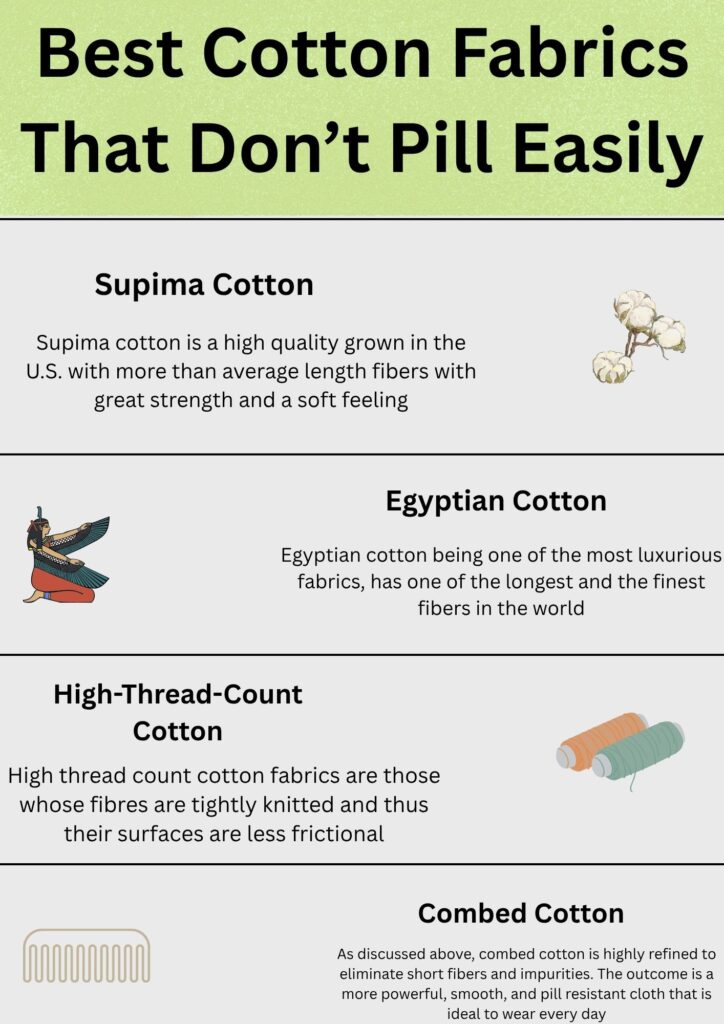
Supima Cotton
Supima cotton is a high quality grown in the U.S. with more than average length fibers with great strength and a soft feeling. It has a long-staple construction which implies that it has less loose ends, has less pilling and excels in durability.
Egyptian Cotton
Egyptian cotton being one of the most luxurious fabrics, has one of the longest and the finest fibers in the world. This makes it difficult to fuzz and pill despite numerous washings, which makes it suitable in bedding and luxury clothing.
High-Thread-Count Cotton
High thread count cotton fabrics are those whose fibres are tightly knitted and thus their surfaces are less frictional. This does not only enhance comfort, but it also reduces the risk of pilling in the long run.
Combed Cotton
As discussed above, combed cotton is highly refined to eliminate short fibers and impurities. The outcome is a more powerful, smooth, and pill resistant cloth that is ideal to wear every day.
When shopping, seek out labels with such words as long-staple, combed or Supima. Such keywords are an indicator of the quality and lifespan of the fiber.
Cotton vs Other Fabrics: Which Pills More?
To understand cotton’s performance, it’s helpful to compare it with other common fabrics.
| Fabric Type | Tendency to Pill | Reason |
| Cotton (Long-Staple) | Low | Natural fibers, fewer loose ends |
| Cotton Blends | Moderate | Synthetic fibers increase friction |
| Polyester | High | Static buildup traps pills |
| Wool | High | Loose surface fibers and friction |
| Acrylic | Very High | Soft but weak synthetic fibers |
| Linen | Very Low | Strong, smooth fibers with minimal fuzz |
As the table shows, cotton ranks among the least likely fabrics to pill when the quality is high. Synthetic fibers like polyester or acrylic may offer stretch and affordability, but they often sacrifice long-term appearance.
Therefore, when you ask “does cotton fabric pill more than polyester?”, the answer is clear cotton, especially premium types, is far more resistant and durable.
Conclusion
In conclusion, while cotton fabric can pill under certain conditions, it remains one of the most durable and comfortable natural fibers available. The key to keeping cotton smooth lies in the quality of the fiber and the care you give it. Long-staple cotton fabrics like Supima or Egyptian cotton are naturally resistant to pilling and maintain their softness over time.
By washing your garments gently, avoiding harsh drying, and choosing high-quality cotton fabrics, you can enjoy their freshness and beauty for years. Cotton’s breathability, strength, and timeless appeal make it a favorite in the fashion and textile industry.
So, the next time you wonder, does cotton fabric pill, remember with the right choice and care, your cotton clothes can stay soft, smooth, and pill-free for the long run.
FAQs
Does cotton fabric pill easily?
Cotton fabric does not pill easily compared to synthetic materials like polyester or acrylic. However, low-quality cotton with short fibers may form small pills after repeated friction or washing. High-quality long-staple cotton, such as Egyptian or Supima cotton, is far less likely to pill and stays smooth for a long time.
Why does cotton fabric start to pill after washing?
Cotton fabric pills after washing when the loose surface fibers rub together and form tiny tangles. The agitation in the washing machine creates friction, especially if the garment is turned right-side out. Washing cotton clothes inside out and on a gentle cycle can significantly reduce pilling.
How can I prevent cotton fabric from pilling?
To prevent cotton fabric from pilling, wash garments inside out, use a mild detergent, and select gentle wash cycles. Avoid high heat during drying, as it weakens fibers. Using a fabric softener and air-drying cotton clothes also helps maintain a smooth, pill-free surface over time.
Do cotton blends pill more than 100% cotton?
Yes, cotton blends tend to pill more than pure cotton fabrics. Synthetic fibers like polyester increase friction and static, which trap loose fibers on the surface. As a result, cotton-polyester blends are more prone to pilling than 100% natural cotton fabrics.