The wool textile industry values Types of Grade B Cashmere Wool Fabric because it is a combination of softness and durability with affordability. While Grade A cashmere may be the best available, Grade B cashmere continues to be highly sought after by fashion brands, textile manufacturers, and designers. Understanding the types Grade B Cashmere Wool Fabric will help buyers make informed decisions. This category offers excellent performance at a reasonable cost.
What is Grade B Cashmere wool fabric?
The fiber diameter of Types of Grade B Cashmere Wool Fabric is slightly larger than that of Grade A. is a soft, but resilient fabric that measures between 16-19 microns. Fabrics made with this grade are more durable and suitable for everyday wear. The fibers have been combed and cleaned before being spun to achieve a luxurious look.
Grade A fibers have a finer texture, while Types of Grade B Cashmere Wool fibers are stronger. The fabric is more resistant to pilling and keeps its shape for longer.
Cashmere wool fabric in Grade B: Main types
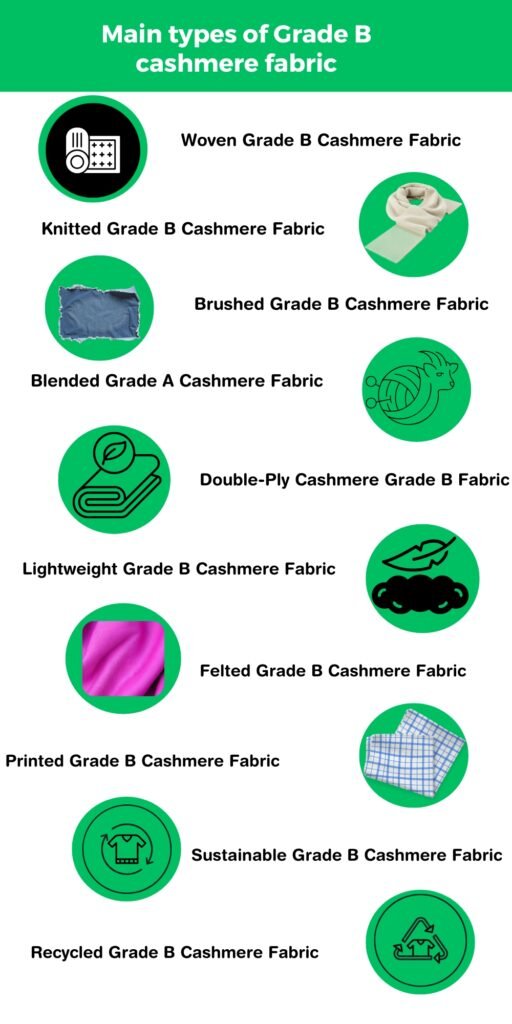
Main types of Grade B cashmere fabric
Cashmere Grade B is transformed into a variety of textile structures. The different types of cashmere are used for specific purposes and their performance depends on the weave, knitting, and finishing technique.
1. Woven Grade B Cashmere Fabric
Interlacing yarns are used to create woven Grade B cashmere fabrics. The fabric is Types of Grade B Cashmere Wool Fabric stable and durable because of its structure.
Key Features:
Tight weaving produces a smooth surface
The strength of the knitted type is increased.
Reduce wrinkles
Fabric structure can be maintained for many years
Common uses: Blazers and coats.
Woven fabrics also give a refined look. They are therefore preferred for formal wear. This fabric is ideal for structured garments because of its slightly thicker fibres.
2. Knitted Grade B Cashmere Fabric
Cashmere Grade B is knitted by looping the yarns. increases the stretch and flexibility of the fabric.Types of Grade B Cashmere Wool Fabric
Key Features:
The hand feels softer
Elasticity has been improved
Heat is retained efficiently
Maximum comfort
Common uses: Cardigans, sweaters, scarves and winter clothing.
Cashmere knitted is also well-suited to adapting to the body’s movements. is used widely in casual and comfort garments.
3. Brushed Grade B Cashmere Fabric
Cashmere brushed is created by gently raising the surface using brushing methods. creates a fuzzy texture.
Key Features:
Softening the skin is a great way to achieve extra softness
The finish is luxurious
Thermal insulation can be improved
Common Uses: Winter shawls, coats, blankets.
brushing increases softness but excessive brushing may weaken the fibers. is still popular in luxurious products.
4. Blended Grade A Cashmere Fabric
Blended Cashmere is a combination of Grade B fibers and wool, silk or synthetic fibers. Performance and affordability are therefore balanced.
Key Features:
Durability is improved
Costs are reduced
The fabric strength has been improved
Shrinkage can be controlled
Common Uses: Mass-market sweaters, fashion accessories, outerwear.
As an example, blends of cashmere and wool provide warmth and resilience. Silk blends also enhance shine and drape.
5. Double-Ply Cashmere Grade B Fabric
Two twisted strands are used to make double-ply fabrics. The Types of Grade B Cashmere Wool Fabric thickness and strength of the fabric are increased as a result.
Key Features:
Enhances shape retention
The temperature increases
The fabric life is extended
Common Uses: Luxury sweaters, coats, premium knitwear.
is also resistant to sagging. is therefore ideal for long-term usage.
6. Lightweight Grade B Cashmere Fabric
TheTypes of Grade B Cashmere Wool Fabric lighter types are made using finer spinning techniques. The fabric is breathable as a result.
Key Features:
Weight is reduced
Improved airflow
Comfortable climates
Common Uses: Spring sweaters, travel wraps, layering garments.
is preferred in the transitional season because it is less bulky.
7. Felted Grade B Cashmere Fabric
The Types of Grade B Cashmere Wool Fabric process of felting involves heat, humidity, and pressure. The fibers are bonded tightly as a result of.
Key Features:
The dense structure formed
Improved wind resistance
Insulation is improved
Common Uses: Coats, winter accessories, footwear linings.
While‘s softness has been slightly reduced, its durability has increased significantly.
8. Printed Grade B Cashmere Fabric
Printing techniques can be used to add colors and patterns. The aesthetic value of is therefore elevated.
Key Features:
Fashion versatility can be achieved
The variety of designs is expanding
The appearance of luxury is preserved
Common Uses: Scarves, shawls, designer garments.
Digital printing is a great way to get fine details without damaging the fibers.
9. Sustainable Grade B Cashmere Fabric
Types of Grade B Cashmere Wool Fabric is produced using eco-friendly methods. As a result the environmental impact is minimized.
Key Features:
The ethical sourcing of goods and services is guaranteed
Minimize the use of chemicals
Reduced water consumption
Common uses: Sustainable fashion brands and eco-luxury brands
Today sustainability is a key selling point.
10. Recycled Grade A Cashmere Fabric
Cashmere recycled from waste is made by using pre-consumer and post-consumer materials. Resource efficiency is increased by.
Key Features:
Reduced waste
Carbon footprint is reduced
The fabric softness is maintained
Common uses: Ecoconscious clothing and accessories
Cashmere wool fabric grade B has many benefits
The affordability of the product makes it more accessible. Durability ensures a long-lasting wear. Softness is still impressive.
What Type to Choose?
When selecting, consider:
Garment purpose
Climate Change
Budget
Softness desired
For example, woven styles are more formal, while knitted styles are more comfortable.
Care Tips
Handwashing is recommended
Use mild detergents
It is recommended to dry flat.
Avoid excessive heat
The longevity of your car is dependent on the care you give it.
The conclusion
Types of Grade B Cashmere Wool Fabric is the perfect balance between luxury, comfort and functionality. It may not be as fine as Grade A but it is stronger and more affordable. is a versatile choice for fashion and textiles.Types of Grade B Cashmere Wool Fabric Each type of fabric has its own advantages, whether it is brushed, recycled or woven.Types of Grade B Cashmere Wool Fabric Understanding these variations will ultimately help brands, designers and buyers make better textile decisions.
FAQs
What garments use Grade B cashmere?
Types of Grade B Cashmere Wool Fabric Sweaters, coats, scarves, suits, and accessories.
Is Grade B cashmere still soft?
Yes, excellent softness is maintained, although fibers are slightly thicker than Grade A.
Can Grade B cashmere be sustainable?
Yes,The Types of Grade B Cashmere Wool Fabric eco-friendly processing methods are increasingly used.
Each year, February 4 is marked as the International Day of Human Fraternity and serves as a reminder that the world is one big family. It is a day that provides the world with the opportunity to promote the virtues of peace, love, and respect for one another, irrespective of the different cultures, religions, and ethnic backgrounds. It champions dialogue over fighting, and understanding over hatred.
In today’s world, the message of the International Day of Human Fraternity is more relevant than ever.
Understanding the International Day of Human Fraternity
The International Day of Human Fraternity is a United Nations global observance meant to reinforce the relationships and bond of people, regardless of their faith and beliefs, for one shared, collective purpose. It speaks about the values of humanity that binds people together in the spirit of love, dignity, and togetherness.
While many world events highlight the divisions in humanity, the International Day of Human Fraternity seeks to celebrate the values that unite humanity.
History of International Day of Human Fraternity
In 2020, the United Nations proclaimed February 4 as the International Day of Human Fraternity. The U.N. made this decision after they received the Document on Human Fraternity for World Peace and Living Together.
In Document on Human Fraternity for World Peace and Living Together the Pope and Grand Imam Sheikh Ahmed El-Tayeb provide a message calling for peace, tolerance, and cooperation of all nations and religions. This gives the International Day of Human Fraternity its purpose to celebrate and further the peace and tolerance of the world.
Why Is International Day of Human Fraternity Important
The Day of Human Fraternity gives a foundation upon which the world can build on to create a more harmonious future. The Day of Human Fraternity is a reminder of the consequences that come from hatred, indiscrimination, and violence. The day reminds us of the strength that comes from the unity and respect of all diverse communities. The importance of this day is that it:
Advocates for peaceful coexistence
Promotes interfaith dialogue
Opposes racism and discrimination
Advocates for human dignity and social equality
Promotes global solidarity
The International Day of Human Fraternity is important for the future of all generations. “`
Basic Principles of the International Day of Human Fraternity
The International Day of Human Fraternity promotes the profound values that guide humanity on the right path in building a better world.
1. Value of Acceptance
People practice different religions, cultures, and customs. The International Day of Human Fraternity helps us learn to accept and not fear such differences.
2. Peace and Unity
It all starts with understanding. This day promotes peace, dialogue, and cooperation to bridge the gap of conflict.
3. The Value of a Person
Everyone is equal and deserves to be treated that way. The International Day of Human Fraternity defends the equal rights of all and advocates for all people to be treated with dignity.
4. The Value of Just Being Good
Doing good is a value that a lot of people. This day reminds us that we should help each other.
The Global Observance of the International Day of Human Fraternity
The International Day of Human Fraternity is celebrated by numerous countries, various organizations, and communities in many different ways.
Some of the most common ways to celebrate the day are:
Interfaith dialogue and discussions
Activities in primary, secondary, and tertiary educational institutions
Seminars and conferences on the topic of peace
Volunteer activities
Advocacy for Peace on social media
The activities mentioned allows for the observance of the International Day of Human Fraternity to create a positive impact.
Youth Contribution on the International Day of Human Fraternity
The International Day of Human Fraternity highlights the importance of young people in today’s society. The energy, enthusiasm, and the ability of youth to influence positive future developments, make them crucial.
Activities youth can engage in include:
Promoting tolerance in the digital sphere
Speaking out against online hate speech
Engaging in voluntary activities across coexisting-diverse groups
Educating themselves on the importance of coexisting-diverse groups and their beliefs
The values promoted in the International Day of Human Fraternity serves to reaffirm the belief of young people in creating a better, more peaceful world.
Activities to Honor the International Day of Human Fraternity
The celebration of the International Day of Human Fraternity does not require a large organized activity. Small things are a great way to make an impact.
You can participate by honoring the following suggestions:
Show an act of kindness to people who are different
Listen to people with different opinions
Post and share unifying and positive statements
Value other people’s cultural and religious practices
Engage in activities aimed at promoting a peaceful and united society
Your actions on the Human Fraternity are greatly appreciated.
Message of the International Day of Human Fraternity
The focus of the Human Fraternity is as follows:
We are powerful when united.
This day is a reminder that the first step toward the peace of the world is the peace of the people. If people treat one another as siblings the world will be a better place.
Conclusion
Although Human Fraternity is a day that occurs on a calandar, it is a day that is meant to be a reminder of the peace and understanding that is to be fought for. We share this world and on this day we are to be reminded of the things that make us the same and the things that unify us.
To be respectful, to be kind, to be cooperative are all things that should be done to be in the spirit of the Human Fraternity. We should be aiming toward a place that promotes peace and respect. Learn About : International Days on 4 Februar And World Cancer Day
On World Cancer Day, the world celebrates it together because of the awareness that needs to be spread, as there are many individuals affected by cancer across the world. This also reminds that if we focus on life saving methods, like early detection, treatment, and prevention, we can save many lives.
There are many things other than numbers about World Cancer Day. Because, at the end of the day, World Cancer Day is about people, families, and people affected by cancer. It is also about how people can contribute to the fight to end cancer.
What is World Cancer Day?
World Cancer Day is on February 4 and is set by the Union for International Cancer Control (UICC). The goal is to try to increase the reach of awareness and the amount of information that is within the world on cancer and try to reduce the world\’s cancer burden.
In addition to that, World Cancer Day is a way to unite all the nations, health professionals, and individual people, as they all have one aim; to spread awareness that *cancer is preventable and we can fight it together.*
The Importance of World Cancer Day
Cancer is a leading cause of death in many countries. Each year there are millions of new cases worldwide that are often complicated by delayed diagnoses and treatment accessibility.
Every year, on World Cancer Day, there are initiatives to:
Educate and improve knowledge of cancer worldwide
Encourage early diagnosis and treatment
Promote and encourage healthy behaviors
Advocate for and support active cancer patients and survivors
Advocate for and drive change for equitable management of cancer
World Cancer Day is a reminder that everyone should have support when facing cancer.
The event was first orgnaized in 2000, when the first World Cancer Summit was held in conjunction with the Charter of Paris Against Cancer. Since, World Cancer Day has turned into a global event with participation from over 100 countries.
World Cancer Day annually selects a new theme to highlight and bring attention to a particular and relevant cancer issue.
Recent examples include:
\”I Am and I Will\” – Motivating people to take initiative
\”Close the Care Gap\” – Noting the inequity in the incorporation of cancer care
\”United by Unique\” – People centered approaches to care
While the individual experiences of every patient diagnosed with cancer are different for a variety of reasons, the care and support needs to be the same for all.
Most Frequently Seen Types of Cancer
Unlike many diseases, cancer can touch every part of the body. Whilst many different types of cancer exist, some types are more prevalent than others.
The most frequently seen types of cancer are:
Breast cancer
Lung cancer
Colorectal cancer
Prostate cancer
Skin Cancer
In spite of how different the types of cancer are, it is critical to note that most cancers are more survivable the earlier they are detected.
Risk factors and Causes of Cancer
Many variables go into cancer manifestation. Some are within our control and some are outside of it.
Some Avoidable Risk Factors
Tobacco use
Poor Nutrition
Not enough exercise
Over drinking
Contact with harmful chemicals
HPV, Hepatitis and other infectio
As seen above, many risk factors are behavior related and can be addressed through some lifestyle changes.
How Cancer can be Prevented
The number of instances of cancer can be reduced through effective preventative measures, and World Cancer Day aims to highlight the importance of measures that can be taken to prevent cancer.
There are very easy ways to lower your risk of developing cancer.
Stay away from any kind of tobacco products
Increase the fruits and vegetables in your diet
Make sure to workout
Make and keep a healthy weight
Wear sunscreen and limit the time you are in the sun.
Get your vaccines for HPV and hepatitis
Go to the doctor periodically for a check-up
Making any of these changes can lower your risk of cancer.
Why the early detection of cancer is important.
Knowing you have cancer early can keep you alive, and many forms of cancer can be treated and cured if the cancer is found early.
Screening can help find cancer before you notice any symptoms. For example:
Mammograms for detecting breast cancer
Pap smears for detecting cervical cancer
Colonoscopies are for detecting of any cancer in the colon
CT scans are for detecting lung cancer
World Cancer Day reminds and encourages us to get consulted and screened for any kind of cancer on time.
How to treat cancer
How to treat cancer depends on the type and stage of the cancer. Normally, doctors suggest one or more treatment options.
Surgery to remove the cancer
Chemotherapy which is using drugs to treat the cancer
Radiation therapy which is using radiation to kill the cancer
Immunotherapy which is giving your body more of its own immune cells to kill the cancer
Targeted therapy which is using drugs to turn off the growth of cancer cells
Every year the survival rate of people diagnosed with cancer increases due to the work of medical professionals and the work they put into research and developing new ways to help those diagnosed with any kind of cancer.
Helping Survivors and Cancer Patients
The effects of cancer go beyond physical issues. It can have a serious impact on one’s emotional well-being and mental health.
The importance of World Cancer Day includes:
Community support
Family involvement
Mental health assistance
Emotional support
Simply listening and caring for someone can ease their journey.
How to Participate in World Cancer Day
You can make a difference on World Cancer Day. You don’t have to be a doctor or a scientist to help.
You can:
Encourage screening for loved ones
Support cancer charities
Adopt a healthier lifestyle
Wear a cancer awareness ribbon
Share awareness messages on social media
Volunteer or donate
Small things can make a big difference.
World Cancer Day’s Impact Around the World
Millions of people participate in World Cancer Day. It helps to start conversations about health and make changes around the world. Countries announce new health measures. Organizations push out new educational material. Communities run events and educational fundraisers.
These actions save lives, reduce stigma, and increase awareness.
The Future of Cancer Care
There is hope in the future of cancer care. More innovative methods of diagnostics and treatment are under constant development. The fundamental aspects of cancer treatment are being influenced by personalized medicine and immunotherapy.
Research and equal access to care the world over is the theme of World Cancer Day.
Conclusion: Together, We Can Beat Cancer
Cancer knows no borders. World Cancer Day is also a celebration of the collaborative efforts deployed to nullify the implications of a cancer diagnosis. Advocacy, education, and early screening are complemented by the humanity in actions to enhance lives.
Each day of the year has a different meaning. Some are fun holidays and others bring attention to important issues concerning the world. International Days on 4 February bring attention to and celebrate, health, peace, togetherness, and the value of every human life.
Today marks a day of significance as it is recognized by two major International Days on 4 February. These observances are not merely symbolic; rather, each carries a powerful and resonant message that seeks to capture the attention of people worldwide. Furthermore, both observances serve as a call to action, urging individuals and communities to actively engage with the issues they highlight and contribute to positive change.
In this blog, we will review the International Days on 4 February and examine the significance of each.
World Cancer Day – 4 February
One of the most essential International Days on 4 February is World Cancer Day. Every year, World Cancer Day is celebrated to advocate for cancer awareness and for the promotion of cancer prevention, early detection, and treatment.
Cancer is a disease that has affected millions of people all over the world. World Cancer Day is a reminder to the world that a lot of cancers are actually preventable and treatable, given that there is early enough detection.
World Cancer Day Goals
World Cancer Day has the following goals:
Encourage people to be aware of the different types of cancer.
Encourage people to get tested.
Provide people with information to help them live healthy.
Provide support to cancer patients.
To achieve these goals, various organizations, hospitals, and communities have planned various activities, including campaigns and educational programs.
World Cancer Day Significance
The World Cancer Day Significance are:
Cancer leads to a significant number of deaths yearly.
If people are educated about cancer, there will be less fear of getting cancer.
Fear of getting cancer can be stigmatized.
As a result of World Cancer Day, people will be encouraged to be educated about cancer, support people with cancer, and take disease control measures to improve their lives.
International Day of Human Fraternity – February 4
The International Days on 4 February of Human Fraternity is a significant observance of the February 4 International Days.
The purpose of this day, according to the United Nations, is to promote peace, understanding, and cooperation among people of different cultural and religious backgrounds.
Concept of Human Fraternity
The pillars of human fraternity include:
Appreciation of differences
Peaceful cohabitation
Understanding each other
Unity among all
The emphasis of this day is to promote dialogue over closure.
The Significance of the International Day of Human Fraternity
The International Days on 4 February of Human Fraternity holds significant value due to the following reasons:
* Fractured relationships and lack of empathy are increasing across the globe
* Stronger communities are built on the foundations of mutual and reciprocal respect
* Global issues can only be addressed through collaborative and unified efforts
* The first step toward peace is through the comprehension of different perspectives
Observed annually, the International Days on 4 February of Human Fraternity serves as a focal point for global citizens to reflect upon and champion the significance of fundamental human values. These values, deeply ingrained in ethical and moral frameworks worldwide, include empathy, enabling us to understand and share the feelings of others; kindness, prompting acts of generosity and compassion; and respect, fostering an environment of consideration and appreciation for the inherent dignity of every individual. On this particular day, people around the world collectively acknowledge and celebrate these principles, recognizing their vital role in building more inclusive, harmonious, and interconnected societies.
Why The International Days on 4 February Should be Observed
International Days on 4 February, observed annually on the 4th of February, serves to highlight and underscore the fundamental and essential requirements that each and every human being possesses. These basic needs are absolutely vital for the purpose of maintaining a state of overall well-being, encompassing both physical and mental health, as well as fostering a sense of internal and external harmony. The observance of this day emphasizes the importance of ensuring that all individuals have access to the resources and support necessary to live healthy, fulfilling lives in balance with themselves and their surroundings.
The observances:
Create awareness on a global scale
Promote the idea of shared responsibility
Motivate collective and individual efforts
Advocate for the ideal future of humanity
The observances emphasize the need for collaborative global efforts.
Ways in Which People Celebrate International Days on 4 February
There are a number of ways in which various individuals and organizations around the globe celebrate the various International Days.These celebrations can range from public rallies and concerts to educational workshops and online campaigns. Many United Nations agencies, along with member states, non-governmental organizations, and civil society groups, use these days as opportunities to raise awareness about specific issues of concern, mobilize resources, and advocate for policy changes. Some organizations host conferences and seminars to discuss the challenges and opportunities related to the day’s theme, while others organize cultural events to showcase the diversity and richness of human experience.
Some of the most common ways to celebrate include:
Organizing seminars to create awareness
Health screenings and medical consultations
Educational activities, discussions, and workshops
Social media campaigns aimed toward raising awareness
Organizing activities in the community and across various religions
Every individual is capable of making a significant contribution to the community in various ways. Every individual is capable of making a significant contribution to the community in various ways. Whether it’s through volunteering time at a local charity, offering expertise in a specific field, or simply lending a listening ear to a neighbor in need, the potential for positive impact is boundless. Often, the most meaningful contributions arise from recognizing and leveraging one’s unique skills and passions.
The Role of People on International Days
You do not have to be a part of a big institution to be involved in the International Days on 4 February.Small actions can make a big difference, and the International Days are all about that! Whether it’s spreading awareness online, organizing a small local event, or simply having a conversation with someone about a global issue, every contribution counts. The most important thing is to get involved in a way that feels meaningful to you.
You can:
Find out ways to prevent cancer.
Gain support to help someone fighting cancer.
Foster positivity.
Uphold respect.
Spread uplifting messages of togetherness.
Every action counts.
Final Thoughts
The International Days on 4 February are a reminder for the focus to shift back to the fundamentals. Health is life. Unity is power. By marking World Cancer Day and the International Day of Human Fraternity, we are acknowledging the importance of a world that is healthy, harmonious, and compassionate.
The observances inspire the maintenance of our bodies whilst fostering the respect for one another. Learn About: Sports Jackets
Dusk Leather Jacket is an effortless sophisticated piece with an elegant vintage look reminding the calm of the evening light. The Dusk Leather Jacket is a favorite piece of many style lovers as it offers versatility. This piece gives a balanced statement with bold and subtle soft tones making it a standout piece. It is a quality and comfort piece that will have lasting appeal. Wardrobes are never truly complete without a Dusk Leather Jacket.
What is the Dusk Leather Jacket Inspired From
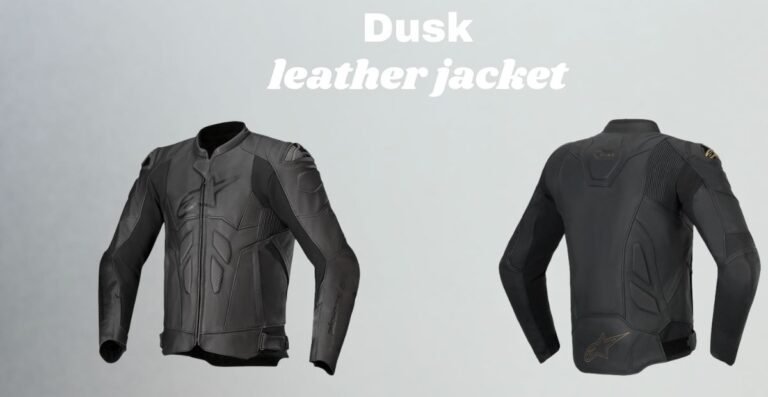
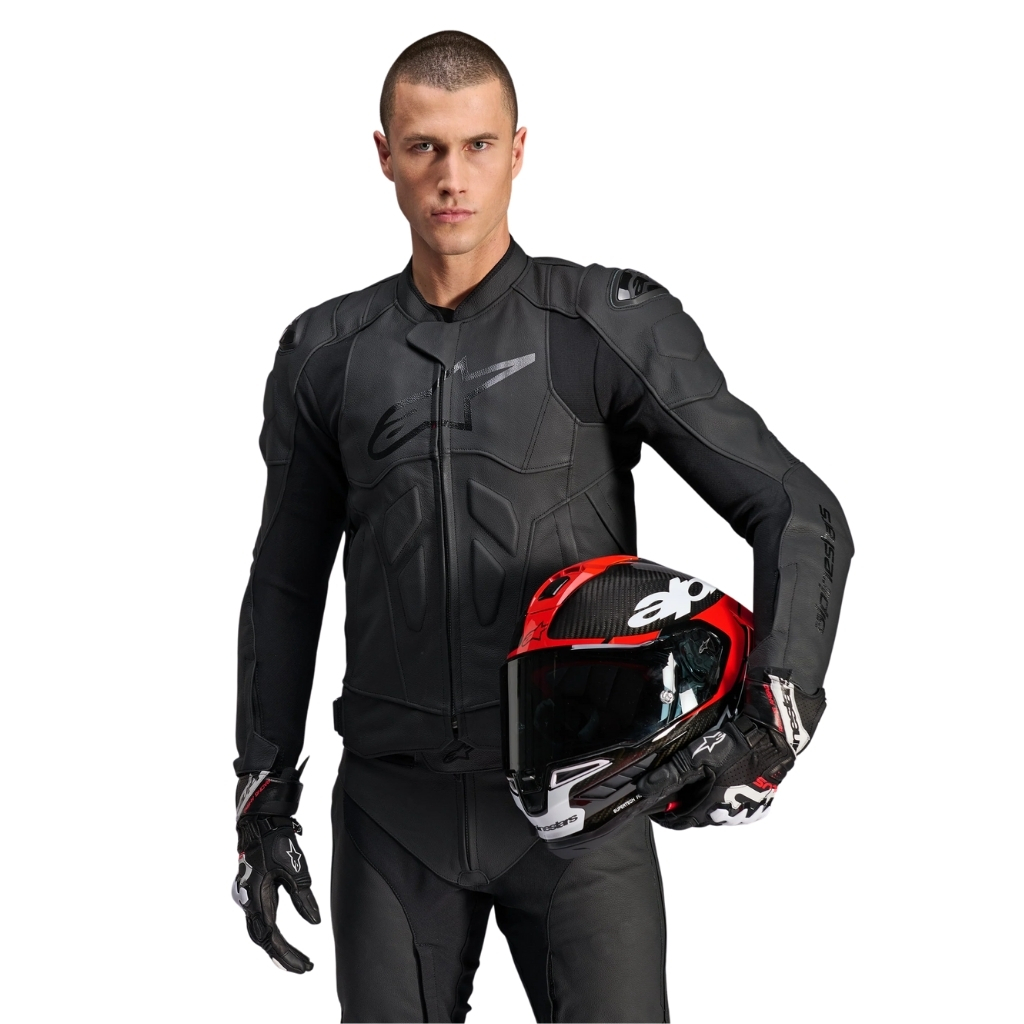
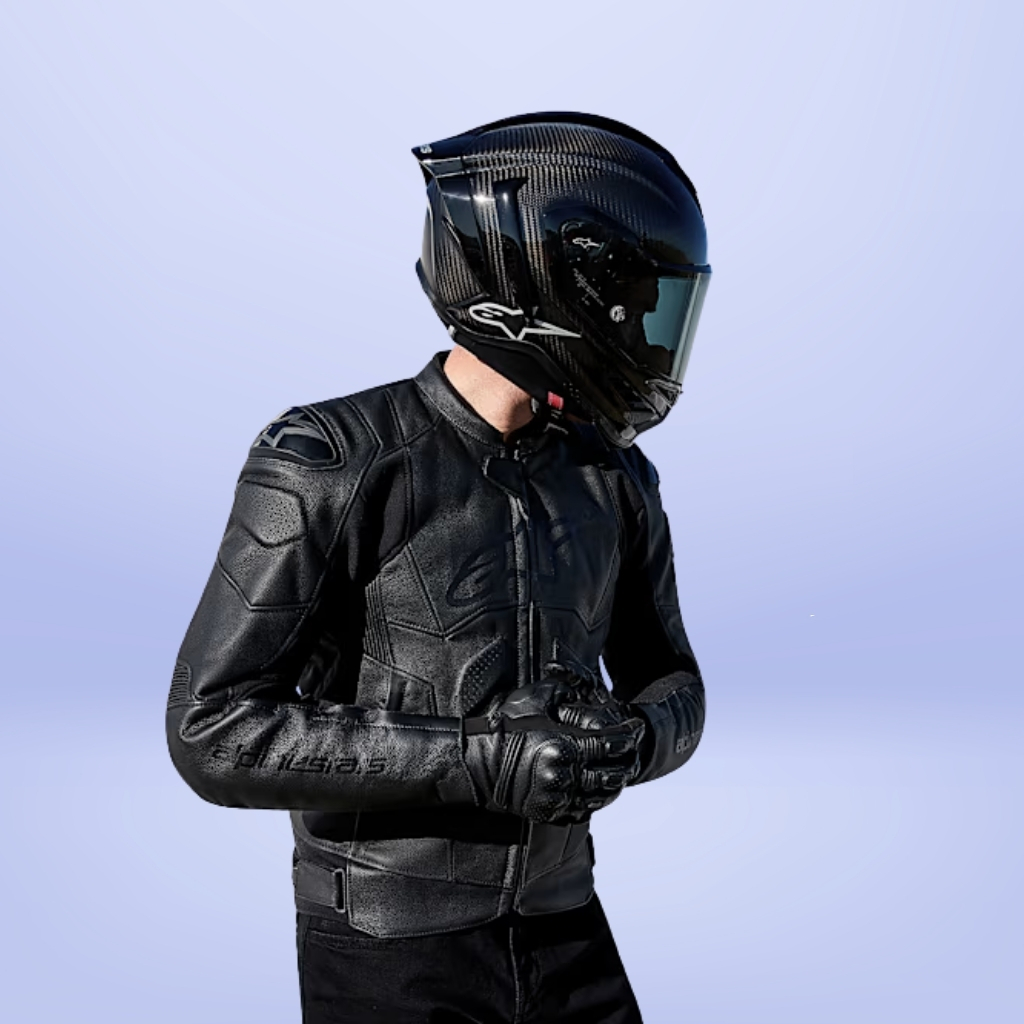
Dusk Leather Jacket: sleek, protective motorcycle gear in all-black, paired with a striking red-and-black helmet.
Dusk is the transition of daylight losing the light tone and moving into the richer deeper tones. Dusk jacket moves with that transition using the rich color tones and the soft inner lining and smooth textures. It is a dual work jacket, with one side serving utility and the other the style and fashion of today’s needs. Dusk Leather Jacket is dual as it has the spirit of tradition and innovation, as it is built with the contemporary style and honors the classic leather wear.
What Makes a Dusk Leather Jacket Different
Dusk Leather Jacket: rugged style and protection for the ride.
Jackets may appear to be similar, but the Dusk Jacket is the result of a meticulous creation process. For example, the Dusk Leather Jacket has an outstanding tone. Its color is neutral; it is neither too dark nor too light, achieving an ideal balance of color that works well in both the daytime and the evening hours. Additionally, the jacket is made of high-grade, supple leather that has a soft hand, and is strong and durable. A natural patina forms over time, enhancing the leather. Finally, the jacket is constructed to provide a lot of structure without being stiff, which allows for natural movement.ski jacket
Craftsmanship and Material Excellence
The finest leathers are made from animals skins that show the fewest scars. For the Dusk Leather Jacket, full or top grain leather, which offers a natural finish of the hide, is typically used. Leather is tanned in a way that preserves the softness, and enhances the strength; a process that results in leather that feels amazing, and is durable. Neat and precise seams, and supple, supple lining are hallmarks of a durable and well-crafted jacket. A jacket like this is built to last and to age well.
Comfort & Fit for Everyday Wear
The most significant factor that attributes to the appeal of the Dusk Jacket is the comfort of it. The Dusk Leather Jacket is not only appealing in terms of its style; the jacket is designed in such a way that it is comfortable, and that is truly essential. The patterns of the jacket are made to follow the body’s natural lines. The aim is to present a relaxed fit that is flexible and can be comfortably layered over any outfit. The choice of inner lining is also made for the purpose of breathability, making the jacket comfortable for everyday wear even in changing seasons. The adaptability of the Dusk Jacket, is what truly makes it a reliable choice for everyday wear.Read more heavy leather jacket
Styling the Dusk Leather Jacket
The Dusk Leather Jacket has a lot of possibilities in terms of styling. For the most simplistic and casual look, you can wear it with denim and a simple t-shirt. On the other hand, you can dress it up and wear it with a knit top and tailored pants for a classy and polished look. The jacket’s color is perfectly complemented by neutral tones. The choice of boots, a watch, or a scarf are also nice touches to finish the look. The Dusk Leather Jacket stays in style and gives you the ability to style the jacket in a multitude of ways.
Seasonal Versatility and Practical Use
The Dusk Leather Jacket’s versatility is a highly commendable feature. The Dusk Leather Jacket has versatility is a highly commendable feature. During cooler months, it provides warmth without excess bulk. In transitional weather, it serves as the perfect outer layer. Leather maintains a comfortable environment, and naturally adjusts. The Dusk provides adequate warmth and protection from the wind. Because of these features, with an excess of weather protection, it is often chosen as a go to piece for unpredictable weather.
A Symbol of Confidence and Identity
The Dusk Leather Jacket communicates the wearers individuality, and confidence, but without being over the top. The Dusk hits the sweet spot with an added elegance. The jacket is often associated with creativity, independence, and modern elegance. It speaks to a wide and diverse range of personalities of those that wear it. This versatility hits the outer limit of what a range of clothing can be. It goes beyond simply being an item of clothing. The Dusk hits the area of being art.
Care and Maintenance for Longevity
With proper care, Dusk Leather Jackets can be kept beautiful for years. Dust and surface marks can be removed by cleaning with a soft cloth on a regular basis. Drying and loss of suppleness can be prevented by conditioning the leather. To maintain the shape of the jacket, store it by hanging on a wide hanger. Leather can be damaged by extreme moisture and heat, so exposure to these conditions should be avoided. Mindful maintenance can extend the lifespan of the jacket.
Sustainability and Responsible Fashion
More attention to Sustainability from ethical production and eco-friendly practices when buying Dusk Leather Jackets is now possible. Improved methods of tanning, coupled with the longer lifespan of Dusk Jackets, reduce the need for replacements, thereby minimizing waste. A well made Dusk Leather Jacket will provide you with classic style while practicing more responsible consumption.
Why the Dusk Leather Jacket will Remain Timeless
Fashions come and go, but the Dusk Leather Jacket has stood the test of time. The Dusk Leather Jacket has a timeless fit and is of exceptional quality. The Dusk Jacket is so versatile because it can be paired with so many different clothes. It is also an exceptional clothing option because core design remains relevant to modern culture. It is a design that will always stay relevant. It will soon become a trusted and loved piece. People will wear the jacket to special events, and will even wear it while doing mundane, everyday activities.
Why people Feel Attached to Leatherwear
Leatherwear invokes emotion because it is a piece that many people wear while experiencing monumental moments in their life, and in their journey. Due to the intrinsic sentimental value, and the growing of a history with the Dusk Leather Jacket, every person jacket will look different, and will show wear and tear that reflects the owner’s lifestyle. It is highly likely that no other person will have a jacket like yours and that is a big reason why many people cherish their leather jacket and keep it for a long time.
Selecting the Ideal Dusk Leather Jacket
When selecting a Dusk Leather Jacket, fit, quality of leather, and the buyer’s style are all things a customer should consider. For determining fit and quality of leather, purchasing the Dusk Leather Jacket requires the customer to try on different cuts and styles. For the customer to determine style, the customer is required to evaluate things such as the zippers, collars, linings, and all the other possible style determinants. Leather is an investment, and a customer must make the right choice and ensure the best quality so the leather will last the customer a long time. Once the customer finds the right jacket, the jacket will elevate the confidence of the customer. Also, the jacket will match many different styles.
Conclusion
The Dusk Leather Jacket is a masterpiece, and combines elegance and comfort and shows the customer how it is made with durable materials. The Dusk Leather Jacket is inspired by the beauty of the night. The Dusk Leather Jacket shows the customer quality in materials and appreciation of the customer in a discreet, excellent and special manner. It is the best Dusk Leather Jacket for gives a customer the best fit in all Jackets for an elevated look, casual look, or a sophisticated look. When a customer is purchasing a Dusk Leather Jacket, the customer is purchasing a confidence booster.
FAQs
What is a Dusk Leather Jacket
A Dusk Leather Jacket is a premium leather outerwear piece inspired by the calm and refined tones of evening. It features a balanced color that sits between deep and muted shades, making it versatile for both casual and refined styling.
What type of leather is used in a Dusk Leather Jacket
Most Dusk Leather Jackets are crafted from high quality genuine leather, such as full grain or top grain leather. This ensures durability, softness, and a natural finish that improves in appearance over time.
Does a Dusk Leather Jacket age well
Yes, the jacket develops a unique patina as it ages. Over time, the leather becomes softer and gains character, which adds to its charm and individuality.
Double-Ply Grade A Cashmere Fabric wool is the ideal combination of softness and durability. It also provides premium insulation. This fabric stands out amongst the many luxurious textiles that compete for our attention. It is not only warm, but also has a long-lasting performance. Designers, fashion houses and high-end fabric buyers continue to choose it for their premium collections.
Double-Ply Grade A Cashmere Fabric construction also enhances the natural beauty of Grade A Cashmere. The fabric is smoother and looks richer because only the finest undercoat fibres are used. It also lasts longer. This textile is therefore considered an investment piece rather than a seasonal purchase.
What is double-ply cashmere fabric?
Double-Ply Grade A Cashmere Fabric is made by twisting together two strands Grade A Cashmere yarn before knitting or weaving. Double-ply cashmere provides more structure than single-ply. The material is therefore stronger, warmer and more resistant to wear.
The highest grade of cashmere is Grade A, and is defined by its longer, finer fibres. The fibers of Grade A cashmere are typically smaller than 15 microns. This fineness makes the fabric feel exceptionally soft on the skin. The longer fibers also reduce pilling and improve the longevity of garments.
Double-Ply Grade A Cashmere Fabric is also processed with care using spinning, weaving and finishing techniques. The fabric is washed, brushed and dried to bring out its natural loft. This gives the fabric a plush feel without sacrificing its breathability.
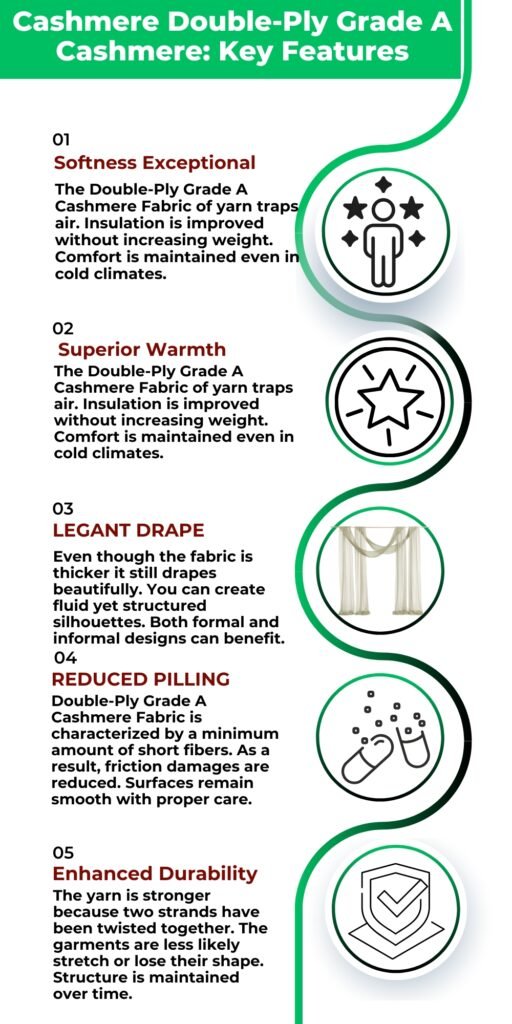
Cashmere Double-Ply Grade A Cashmere: Key Features
Key features of Cashmere Double-Ply Grade A: softness, superior warmth, elegant drape, reduced pilling, and enhanced durability.
1. Softness Exceptional
The silky feel of grade A fibers is well known. When two plies are combined the softness is fuller and luxurious. The texture is smooth and irritation is rare.
2. Superior Warmth
The Double-Ply Grade A Cashmere Fabric of yarn traps air. Insulation is improved without increasing weight. Comfort is maintained even in cold climates.
3. Enhanced Durability
The yarn is stronger because two strands have been twisted together. The garments are less likely stretch or lose their shape. Structure is maintained over time.
4. Elegant Drape
Even though the fabric is thicker it still drapes beautifully. You can create fluid yet structured silhouettes. Both formal and informal designs can benefit.
5. Reduced Pilling
Double-Ply Grade A Cashmere Fabric is characterized by a minimum amount of short fibers. As a result, friction damages are reduced. Surfaces remain smooth with proper care.
Why Grade A Fibres Matter
Double-Ply Grade A Cashmere Fabric is not all the same. The soft undercoats of goats in Mongolia, Inner Asia and high-altitude areas are the source for Grade A fibers. These regions are characterized by extreme temperatures, which causes goats to develop fibers that act as insulators.
These fibers are also hand-combed, rather than being sheared. This preserves the length and purity. The yarn is smoother and more durable as a result. The lower-grade fibers are shorter and coarser. This leads to a faster wear.
Manufacturing Process
Cashmere fibres are first cleaned and sorted. Impurities are removed. Fibers are then aligned, and spun into fine thread. Then, two strands of yarn are twisted to form double-ply.
The fabric is then woven or knitted, depending on its intended use. The fabric is then washed, softerened and brushed. During the finishing process, consistency of texture is checked. The material is then inspected to ensure uniformity and strength.
Quality is maintained in the production process because each stage is closely controlled.
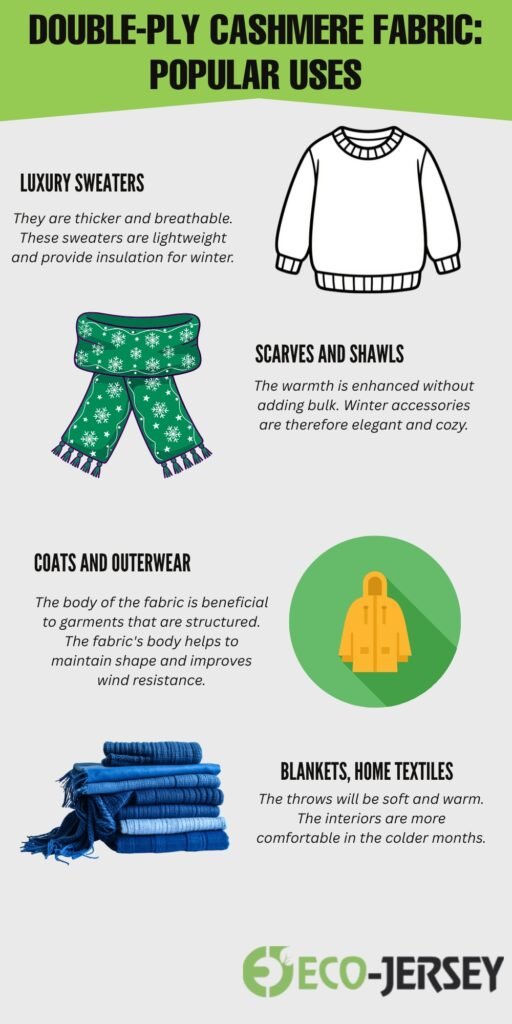
Double-Ply Cashmere Fabric: Popular Uses
Popular uses of Double-Ply Cashmere Fabric: luxury sweaters, scarves and shawls, coats and outerwear, and blankets/home textiles.
Luxury Sweaters
They are thicker and breathable. These sweaters are lightweight and provide insulation for winter.
Scarves and Shawls
The warmth is enhanced without adding bulk. Winter accessories are therefore elegant and cozy.
Coats and Outerwear
The body of the fabric is beneficial to garments that are structured. The fabric’s body helps to maintain shape and improves wind resistance.
Blankets, Home Textiles
The throws will be soft and warm. The interiors are more comfortable in the colder months.
Fashion Brands Benefit from a Wide Range of Services
Double-Ply Grade A Cashmere Fabric is preferred by designers because it communicates premium value instantly. Fabric looks luxurious and feels rich. It also performs well. The brand’s reputation is strengthened as a result.
Cashmere is also associated with exclusivity. The higher prices are therefore justified. The garments retain their original appearance, reducing returns.
Sustainability is a key concern
Cashmere production requires careful management of the land, but responsible sourcing practices have become more common. The promotion of eco-friendly dyeing, ethical herding and reduced overgrazing are all promoted. Slow fashion is also aided by garments that last a long time.
Double-ply garments are more durable, so replacement cycles are reduced. The textile waste is reduced.
Care Instructions
Softness and structure are important to preserve.
Handwashing is recommended.
Use mild detergent.
Lay flat the garments to dry.
Folding is the preferred method of storage, rather than hanging.
Fabrics can last for many years if they are properly maintained.
Buy Guide
Double-Ply Grade A Cashmere Fabric is available in two different grades:
Check the fiber origin and micron counts.
Smoothness is determined by the texture.
Check the stitching and weave density.
Check for certifications that are reputable.
Cashmere of high quality will be dense, soft and uniformly constructed.
Market Trends and Demand
Luxury consumers are increasingly looking for comfort and durability. Double-ply cashmere is in high demand. Sustainability and traceability is also a priority.
Modern collections are dominated by neutral tones, natural dyes and minimalist designs. Bold colors are introduced to create statement pieces.
Common Myths
Some people believe that thicker cashmere is less soft. Double-ply Grade A Cashmere is soft and offers structure. Some people believe that all cashmere is pilling, but Grade A long fibers are resistant to this.
The Conclusion
Double-Ply Grade A Cashmere Fabric is a luxurious fabric that provides warmth, resilience and elegance. It is superior to many other luxury fabrics because of its superior construction and fiber quality. It also supports sustainable fashion by ensuring longevity.
This fabric is a favorite of brands, designers and consumers who are looking for enduring luxury.
FAQs
How should double-ply cashmere be washed?
Double-Ply Grade A Cashmere Fabric Hand washing in cold water with mild detergent is recommended.
Is double-ply cashmere warmer?
Yes,Double-Ply Grade A Cashmere Fabric more insulation is provided because air is trapped between yarn layers.
What does double-ply cashmere mean?
It refers to two strands of yarn twisted together, creating thicker and stronger fabric.
Softshell fabric explained in simple terms means a soft, flexible, and breathable outerwear fabric. It protects against wind, light rain, and cold air while allowing free movement. Unlike stiff jackets, softshell fabric feels comfortable and quiet during wear. Because of this balance, it has become very popular in outdoor and winter clothing. People who hike, work outdoors, or travel often choose softshell garments. They want comfort without sacrificing protection.
In recent years, outdoor clothing has shifted toward lighter and smarter designs. Heavy coats often cause overheating during activity. Softshell fabric solves this problem by releasing heat and moisture. At the same time, it blocks wind and mild weather exposure. Softshell Fabric Explained:As a result, it works well in changing conditions. This article explains softshell fabric clearly and practically.
Readers will learn what softshell fabric is and how it works. They will understand its benefits, drawbacks, and real-world uses. The article also explains care, sustainability, and buying tips. Each section uses easy words and clear explanations. By the end, readers can confidently choose softshell fabric. Let’s begin with the basics.
History Of Softshell Fabric
Softshell fabric explained in historical terms has a relatively recent origin. Unlike traditional outerwear materials such as wool or heavy nylon, softshell was created to meet the needs of modern outdoor sports. Climbers, skiers, and hikers required a fabric that allowed full freedom of movement while providing protection from wind and light rain. In the 1990s, outdoor apparel brands began experimenting with woven and layered fabrics to combine stretch, breathability, and weather resistance. These innovations gave rise to the first softshell garments.
Early softshell jackets replaced stiff hardshell layers that often trapped heat and caused discomfort during active use. Designers focused on creating a fabric that moved naturally with the body while still offering moderate protection from the elements. Stretch fibers and tightly woven polyester became common components. Softshell Fabric Explained:Over time, manufacturers added membranes or DWR coatings to improve wind and water resistance.
“Vibrant orange fabric with rich texture and folds.”
What Is Softshell Fabric?
Softshell fabric explained technically refers to a performance fabric system rather than a single textile. It combines comfort, stretch, and weather resistance in one layer. Manufacturers designed it to replace rigid outer shells in many situations. Unlike traditional outerwear, softshell fabric focuses on breathability and movement. This design supports active lifestyles and outdoor sports. Therefore, it fills the gap between fleece and hardshell jackets.
The origin of softshell fabric lies in outdoor sports innovation. Climbers and skiers needed flexible protection during movement. Traditional shells blocked wind but trapped sweat. This caused discomfort and cooling during rest periods. Designers responded by creating softer, stretchable fabrics. Over time, softshell fabric became a standard outdoor layer.
Softshell fabric explained accurately is not one fixed structure. Softshell Fabric Explained:Some softshell garments include membranes. Others rely on dense woven fibers. Each version offers different performance levels. This flexibility allows brands to tailor softshell fabric for specific uses. As a result, softshell clothing serves many environments.
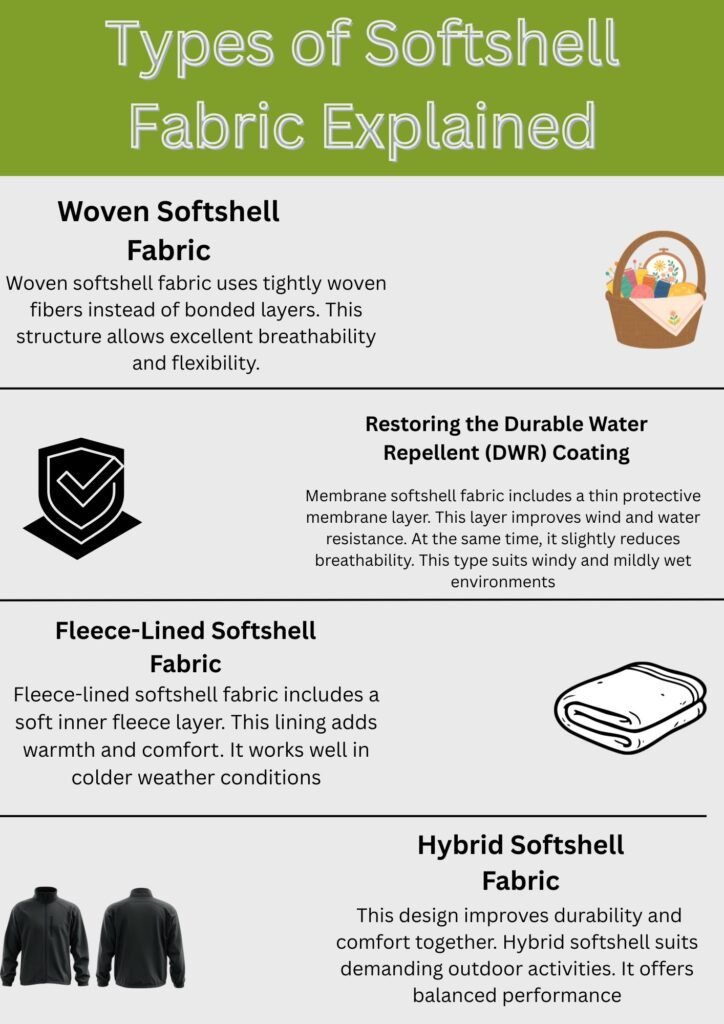
Types of Softshell Fabric Explained
Softshell fabric explained through its types helps readers understand performance differences. Not all softshell fabrics work the same way. Manufacturers design each type for specific weather and activity levels. Some focus on breathability, while others prioritize protection. Knowing these types makes fabric selection easier. Below are the most common types of softshell fabric used today.
A quick guide to different softshell fabrics: woven, DWR-coated, fleece-lined, and hybrid varieties.
Woven Softshell Fabric
Woven softshell fabric uses tightly woven fibers instead of bonded layers. This structure allows excellent breathability and flexibility. It feels lighter and more natural during movement. Because airflow remains high, it works best for active sports. Hikers and climbers often prefer this type. It performs well in dry and cool conditions.
Membrane Softshell Fabric
Membrane softshell fabric includes a thin protective membrane layer. This layer improves wind and water resistance. At the same time, it slightly reduces breathability. This type suits windy and mildly wet environments. It offers better protection than woven softshell. Many winter softshell jackets use membranes.
Fleece-Lined Softshell Fabric
Fleece-lined softshell fabric includes a soft inner fleece layer. This lining adds warmth and comfort. It works well in colder weather conditions. Wind resistance helps retain body heat. This type feels cozy during winter activities. It suits moderate cold rather than extreme temperatures.
Hybrid Softshell Fabric
Hybrid softshell fabric combines multiple fabric types in one garment. Manufacturers place tougher panels in high-wear areas. Stretch panels appear in movement zones. This design improves durability and comfort together. Hybrid softshell suits demanding outdoor activities. It offers balanced performance.
How Softshell Fabric Is Made
Softshell fabric production uses either layered or woven construction methods. Layered softshell fabric bonds multiple layers together. Each layer performs a specific role such as weather protection or comfort. This structure improves durability and resistance. However, it may reduce airflow slightly. Manufacturers choose this method for windy conditions.
Woven softshell fabric uses tightly woven fibers instead of bonded layers. This structure increases breathability and stretch. It feels lighter and more natural during movement. Because of this, woven softshell works well for high-activity sports. Both constructions serve different performance needs. Choosing depends on climate and intensity.
Most softshell fabrics use polyester or nylon as base materials. Softshell Fabric Explained:These fibers resist abrasion and maintain shape. Elastane or spandex adds flexibility and stretch recovery. Some fabrics include a fleece inner surface for warmth. Others remain smooth and thin for lightweight use. Material selection strongly affects performance.
Key Features of Softshell Fabric Explained
Softshell fabric explained through its features shows why it performs so well. First, it provides strong wind resistance. Wind blocking reduces heat loss significantly. Second, it offers water resistance through DWR coatings. Light rain and snow bead off the surface easily.
Third, softshell fabric remains highly breathable. Heat and moisture escape during activity. Fourth, stretch and flexibility support natural movement. This reduces fatigue and improves comfort. Finally, softshell fabric feels lightweight and soft. These features combine to create a versatile outdoor fabric.
Is Softshell Fabric Waterproof or Water-Resistant?
Softshell fabric explained clearly often raises one common question about waterproofing. Many buyers expect full rain protection from outdoor clothing. However, softshell fabric works differently. It focuses more on comfort, breathability, and flexibility. Understanding this difference helps users choose the right outerwear. This section explains the truth in simple terms.
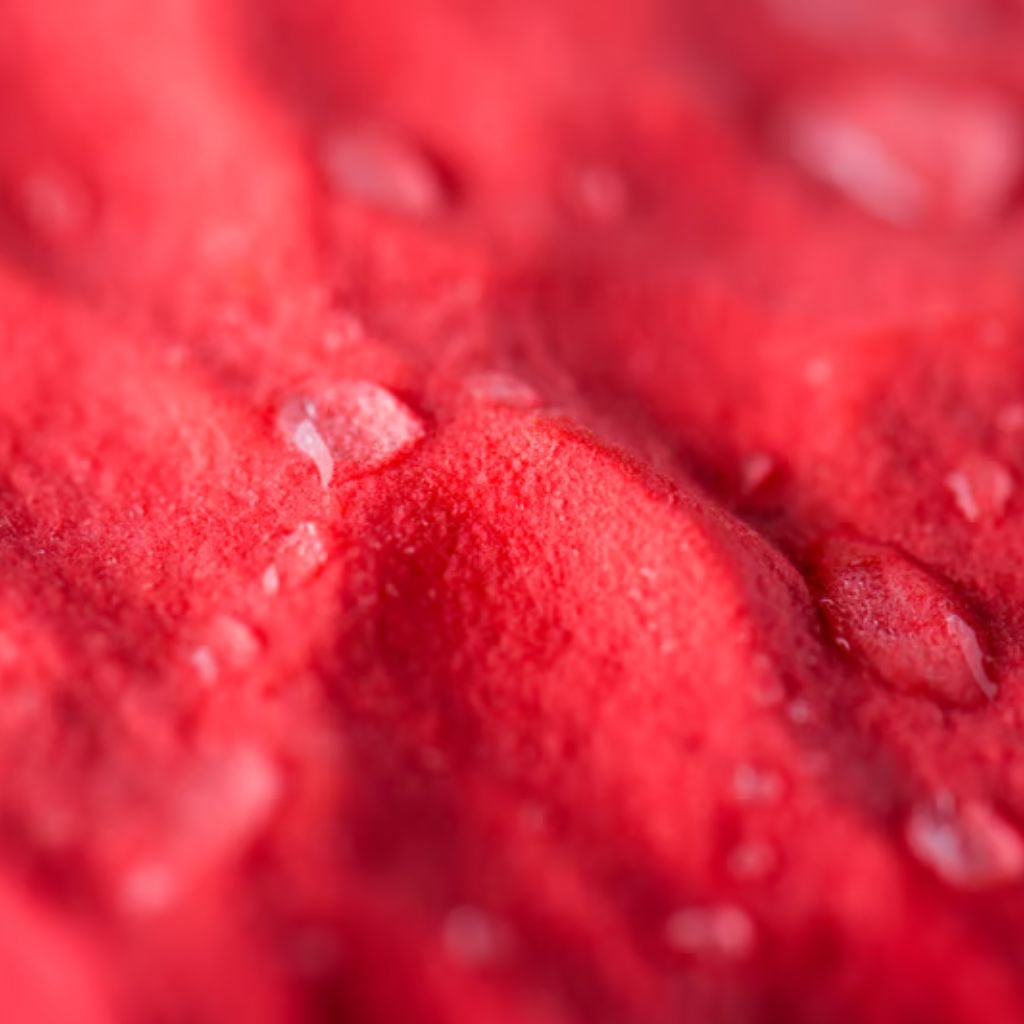
“Glossy droplets sparkle on a rich red surface.”
Understanding Waterproof vs Water-Resistant Fabrics
Waterproof fabrics stop water completely from entering. They use special membranes and sealed seams for protection. Rain jackets and hardshells fall into this category. In contrast, water-resistant fabrics repel water for a short time. They slow water penetration but do not block it fully. Softshell fabric belongs to the water-resistant category.
How Softshell Fabric Handles Moisture
Softshell fabric explained in performance terms shows that it handles light moisture well. Most softshell garments use a DWR coating on the surface. This coating causes water to bead and roll off. Light rain, snow, and mist usually do not soak in immediately. Therefore, softshell works well in mild and changing weather.
When Softshell Fabric Performs Best in Wet Conditions
Softshell fabric performs best during short exposure to wet conditions. It works well for light rain during hiking or commuting. Snow also does not easily penetrate softshell fabric. Because it remains breathable, it keeps the body dry from sweat. This balance makes it ideal for active outdoor use.
Limitations of Softshell Fabric in Heavy Rain
Softshell fabric explained honestly does have limits. Heavy or prolonged rain will eventually soak through the fabric. Unlike waterproof jackets, softshell seams are not sealed. Once the DWR coating wears off, water resistance decreases further. For storms or long rain exposure, a waterproof hardshell is necessary.
Softshell vs Hardshell Fabric Explained
Softshell fabric explained alongside hardshell fabric helps readers choose correctly. Both fabrics serve outdoor protection, yet they perform very differently. One focuses on comfort and movement. The other prioritizes weather defense. Understanding these differences prevents poor buying decisions. This comparison explains performance in real outdoor situations.
Weather Protection Comparison
Hardshell fabric provides maximum weather protection. It blocks heavy rain, snow, and strong wind completely. Sealed seams and waterproof membranes prevent water entry. In contrast, softshell fabric offers moderate protection. It resists wind and light moisture but allows airflow. Therefore, hardshell suits storms, while softshell suits mild conditions.
Breathability and Moisture Management
Softshell fabric explained through breathability shows a clear advantage. It allows heat and sweat to escape quickly. This keeps the body dry during physical activity. Hardshell fabric restricts airflow due to waterproof membranes. As a result, condensation can build inside. Active users often feel more comfortable in softshell.
Comfort, Flexibility, and Movement
Softshell fabric feels soft, stretchy, and quiet. It moves naturally with the body. This makes it ideal for hiking, climbing, and workwear. Hardshell fabric feels stiffer and less flexible. It may restrict movement during long wear. Comfort becomes a key difference for active use.
Weight and Packability
Softshell garments usually feel lighter and more flexible. They pack easily into bags. Hardshell jackets often feel heavier due to membranes and reinforcements. Although some modern hardshells are lightweight, they still feel rigid. For everyday use, softshell often feels more practical.
Benefits of Softshell Fabric Explained
Softshell fabric explained through its benefits shows why it is widely used in outdoor clothing. It combines comfort, flexibility, and weather resistance in one layer. Unlike stiff outer shells, it feels soft and natural during wear. This balance makes it suitable for both active and casual use. The following benefits explain its growing popularity.
Comfort and Freedom of Movement
Softshell fabric offers excellent comfort during daily wear. Stretch fibers allow the fabric to move with the body. This reduces pulling and restriction during activity. Hikers, climbers, and workers benefit from this flexibility. Because of this, users can move freely for long periods.
High Breathability for Active Use
Softshell fabric explained in terms of breathability performs very well. It allows heat and sweat to escape easily. This helps regulate body temperature during movement. As a result, wearers feel dry and comfortable. Breathability reduces overheating in changing weather.
Effective Wind Resistance
Softshell fabric blocks cold wind effectively. Wind often causes rapid heat loss outdoors. By stopping airflow, softshell helps maintain body warmth. This feature improves comfort in cool conditions. Wind resistance makes it ideal for open environments.
Lightweight and Soft Feel
Softshell fabric feels lightweight compared to traditional jackets. It does not feel bulky or heavy. The soft texture also reduces noise during movement. This quiet feel benefits outdoor activities like hiking. Many people prefer it for everyday wear.
Drawbacks of Softshell Fabric
Softshell fabric explained honestly must include its limitations. While softshell fabric offers comfort and flexibility, it does not perform perfectly in every situation. Understanding its drawbacks helps users make smarter clothing choices. These limitations become important in extreme weather or long outdoor exposure. The following points explain where softshell fabric may fall short.
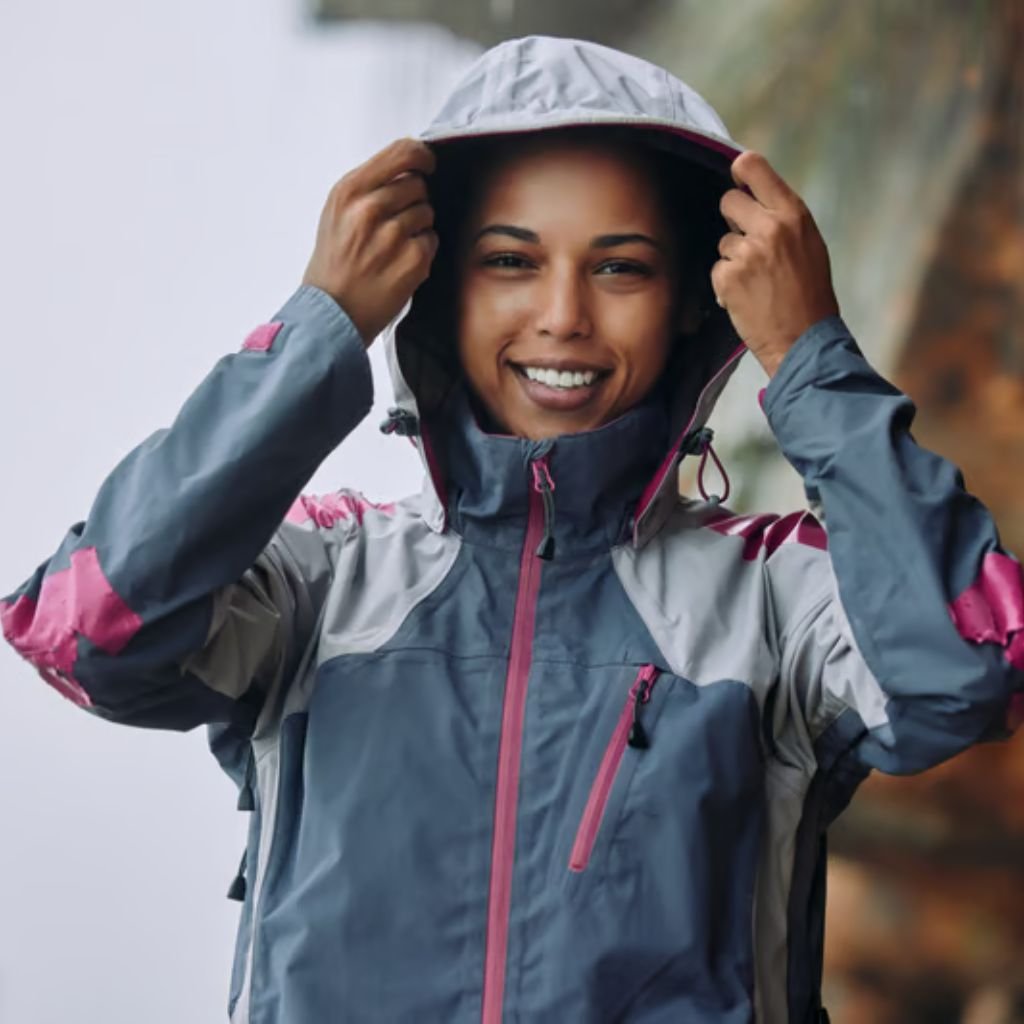
“Bright, cheerful rain-ready style with pink accents.”
Not Fully Waterproof in Heavy Rain
Softshell fabric is water-resistant rather than waterproof. It repels light rain, snow, and mist effectively. However, prolonged or heavy rain will eventually soak through. Unlike hardshell jackets, softshell garments usually lack sealed seams. Once the outer surface becomes saturated, moisture enters easily. For wet climates, this limitation can be problematic.
Limited Protection in Extreme Weather
Softshell fabric explained in harsh conditions shows clear limits. It cannot block heavy storms, freezing rain, or severe wind. In extreme weather, heat loss increases quickly. Softshell fabric alone may not provide enough protection. As a result, users must add extra layers. Without proper layering, comfort and safety decrease.
Less Insulation for Very Cold Temperatures
Softshell fabric focuses on breathability more than insulation. Most versions provide minimal warmth by themselves. In freezing temperatures, this becomes a disadvantage. Even fleece-lined softshell may not handle extreme cold alone. Insulated jackets perform better in such conditions. Softshell works best as part of a layering system.
Water Repellency Decreases Over Time
Softshell fabric relies on DWR coatings for water resistance. Over time, washing and wear reduce this coating. When water stops beading, fabric absorbs moisture faster. Without maintenance, performance drops noticeably. Reapplying water repellents requires time and effort. Many users overlook this care need.
Common Uses of Softshell Fabric Explained
Softshell fabric explained through its common uses shows how versatile this material truly is. It balances comfort, protection, and flexibility in many environments. Because it adapts well to movement and changing weather, designers use it across many clothing categories. From outdoor sports to everyday wear, softshell fabric serves multiple purposes. The following sections explain where it performs best.
Softshell Jackets for Outdoor Activities
Softshell jackets remain the most popular use of this fabric. They provide wind resistance and breathability during movement. Hikers and climbers rely on them for comfort. The stretch allows free arm and body motion. These jackets also feel lighter than traditional coats. As a result, they support long outdoor adventures.
Outdoor Sportswear and Performance Apparel
Softshell fabric explained in sportswear highlights its performance value. Athletes need clothing that adapts to movement. Softshell pants and tops stretch easily during activity. Breathability helps regulate body temperature. This makes the fabric suitable for skiing, cycling, and running. Comfort remains consistent during intense motion.
Hiking and Trekking Apparel
Hiking clothing often uses softshell fabric for flexibility. It handles uneven terrain and variable weather well. Wind blocking keeps hikers warm at higher elevations. Moisture escapes during uphill movement. The fabric resists light rain and snow. Therefore, trekkers prefer softshell layers.
Winter Workwear and Outdoor Jobs
Softshell fabric performs well in winter workwear. Workers need comfort during long hours outside. Softshell jackets allow movement while blocking cold air. The fabric feels lighter than insulated coats. This improves productivity and comfort. Many industries now use softshell work uniforms.
Softshell Fabric for Winter Clothing: Is It Warm Enough?
Softshell fabric explained for winter depends on design and layering. On its own, it suits mild to cold weather. Fleece-lined softshell offers added warmth. Wind blocking reduces heat loss significantly.
During activity, breathability prevents sweat buildup. This keeps the body warm and dry. In extreme cold, insulation layers become necessary. Proper layering ensures comfort and safety. Softshell works best as part of a system.
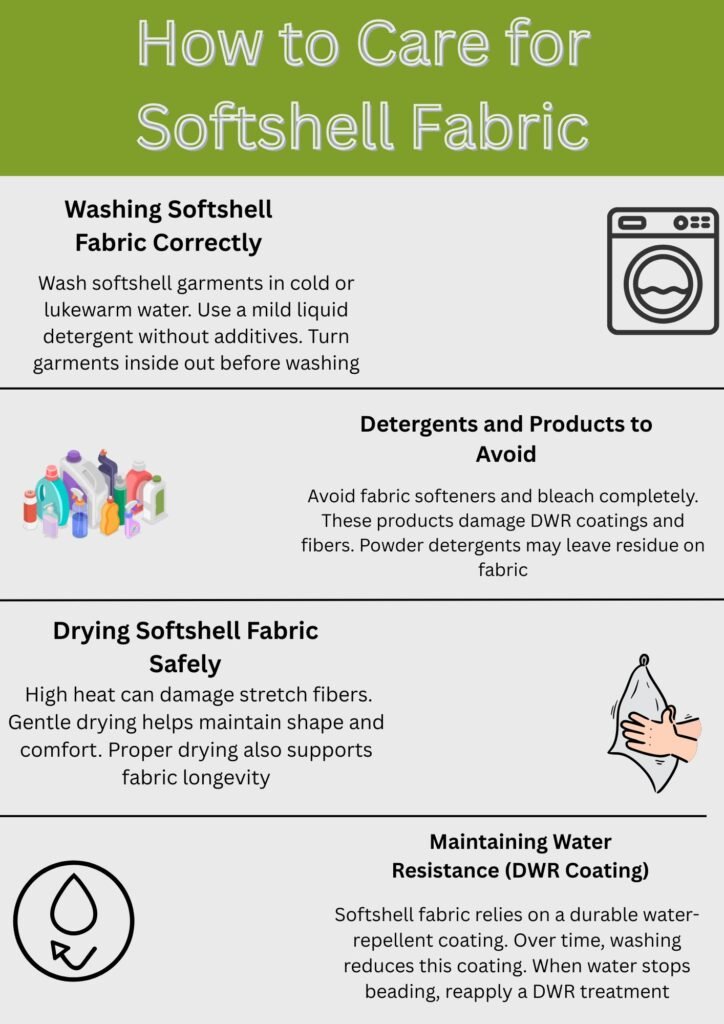
How to Care for Softshell Fabric
Softshell fabric explained in care terms requires gentle handling to maintain performance. Proper care preserves stretch, breathability, and water resistance. Many performance issues come from incorrect washing and drying. With the right methods, softshell garments last longer and perform better. The following guidelines explain how to care for softshell fabric correctly.
How to care for softshell fabric: washing, avoiding certain products, safe drying, and maintaining DWR.
Washing Softshell Fabric Correctly
Wash softshell garments in cold or lukewarm water. Use a mild liquid detergent without additives. Turn garments inside out before washing. This reduces surface wear and protects coatings. Choose a gentle or synthetic cycle. Proper washing prevents fiber damage.
Detergents and Products to Avoid
Avoid fabric softeners and bleach completely. These products damage DWR coatings and fibers. Powder detergents may leave residue on fabric. Strong chemicals reduce breathability and stretch. Always check the care label. Using the wrong product lowers performance quickly.
Drying Softshell Fabric Safely
Air drying is the safest option for softshell fabric. Hang garments away from direct sunlight. If machine drying is necessary, use low heat. High heat can damage stretch fibers. Gentle drying helps maintain shape and comfort. Proper drying also supports fabric longevity.
Maintaining Water Resistance (DWR Coating)
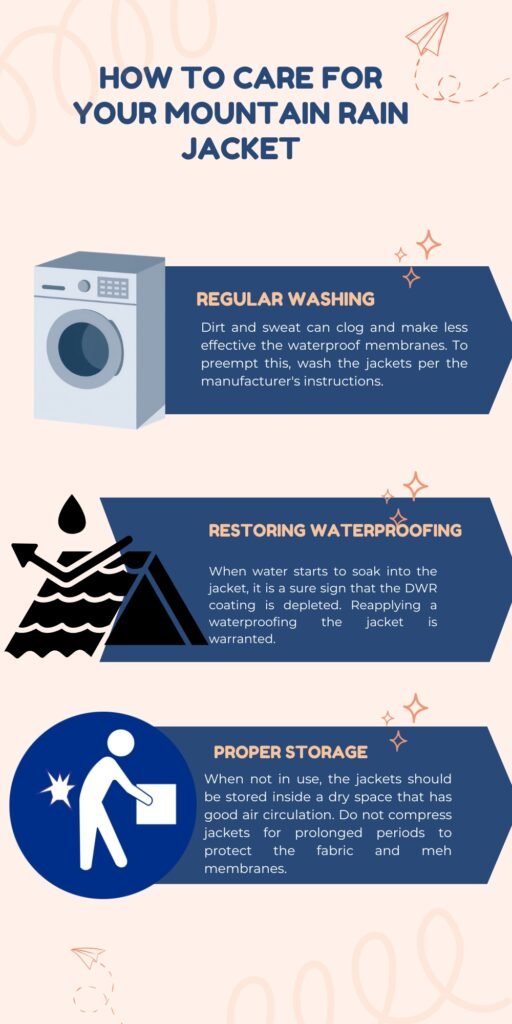
Softshell fabric relies on a durable water-repellent coating. Over time, washing reduces this coating. When water stops beading, reapply a DWR treatment. Clean the garment before reproofing. Follow product instructions carefully. Restoring DWR improves weather performance.
How to Choose the Best Softshell Fabric
Softshell fabric explained selection starts with activity type. High-output sports need high breathability. Cold climates benefit from fleece backing. Stretch level affects comfort and mobility.
Fit should allow easy layering. Fabric weight affects warmth and endurance. Climate exposure also matters. Membrane softshell suits windy regions. Smart choices prevent regret.
“Ukrainian flag resting on aged wood, blue above yellow with a rugged backdrop.”
Sustainable and Eco-Friendly Softshell Fabrics
Softshell fabric explained sustainability reflects modern fashion trends. Many brands now use recycled polyester. This reduces waste and resource use. PFC-free DWR coatings protect ecosystems.
Eco-friendly softshell maintains durability and performance. Longer garment life reduces environmental impact. Consumers now demand responsible materials. Sustainability shapes the future of outdoor clothing.
Conclusion
Softshell fabric explained fully shows strong value. It balances comfort, flexibility, and protection. It suits active outdoor lifestyles best. Layering improves its performance in harsh weather.
People who want everyday outdoor comfort should choose softshell. Understanding its limits ensures satisfaction. With proper care and use, it performs exceptionally well. For the right user, softshell fabric is absolutely worth it.
FAQs
Is softshell fabric breathable?
Yes, softshell fabric is highly breathable. It allows heat and moisture to escape during physical activity. This prevents overheating and keeps the body dry. Breathability makes it ideal for hiking, climbing, and outdoor sports. Unlike hardshell fabrics, softshell balances airflow with protection.
Can you wear softshell in the rain?
Softshell fabric is water-resistant, not waterproof. It works well in light rain, snow, or drizzle. However, it will eventually let water through in heavy or prolonged rain. For storms or wet conditions, layer a waterproof hardshell over softshell. Light rain protection is its strong point.
Is softshell better than fleece?
Softshell fabric offers more wind and water resistance than fleece. It is also more durable and flexible. Fleece is warmer in still air but lacks wind protection. Softshell is better for active movement in changing weather, while fleece is ideal for insulation layers.
Gore-Tex is one of the most renowned waterproof fabrics in the world. Developed in 1969, it changed outdoor apparel by combining waterproofing with breathability, something rarely achieved by other fabrics. Understanding how Gore-Tex fabric works explains why it is a premium choice for both professional and casual users.
Outdoor enthusiasts, skiers, hikers, and even military personnel rely on Gore-Tex for protection against harsh weather. Its versatility extends to everyday wear, providing reliable comfort in rain or wind. The fabric’s reputation comes from its ability to keep water out while letting sweat escape, ensuring dryness and comfort under a variety of conditions.
What Is Gore-Tex Made Of?
Gore-Tex owes its unique properties to expanded polytetrafluoroethylene, or ePTFE. How Gore-Tex Fabric Works:This polymer is stretched into a microporous membrane, forming the heart of the fabric. These pores are incredibly small roughly 20,000 times smaller than a water droplet but large enough to allow water vapor to escape.
The membrane is extremely thin, often thinner than a human hair, yet it offers excellent durability against tears and abrasions. This combination of strength and flexibility is what makes Gore-Tex materials so effective across a variety of activities, from extreme mountaineering to casual rain jackets.
History Of Gore-Tex Fabric
Gore-Tex has a fascinating history that begins in the late 1960s, when researchers were exploring the potential of polytetra fluoro ethylene, or PTFE, a synthetic polymer known for its durability and chemical resistance.How Gore-Tex Fabric Works: In 1969, Wilbert L. Gore and his son Robert W. Gore discovered that by stretching PTFE under controlled conditions, it could be transformed into a microporous material called expanded PTFE, or ePTFE. This material had unique properties: it was extremely thin yet strong, and it contained billions of microscopic pores that were small enough to block liquid water but large enough to allow water vapor to pass through.
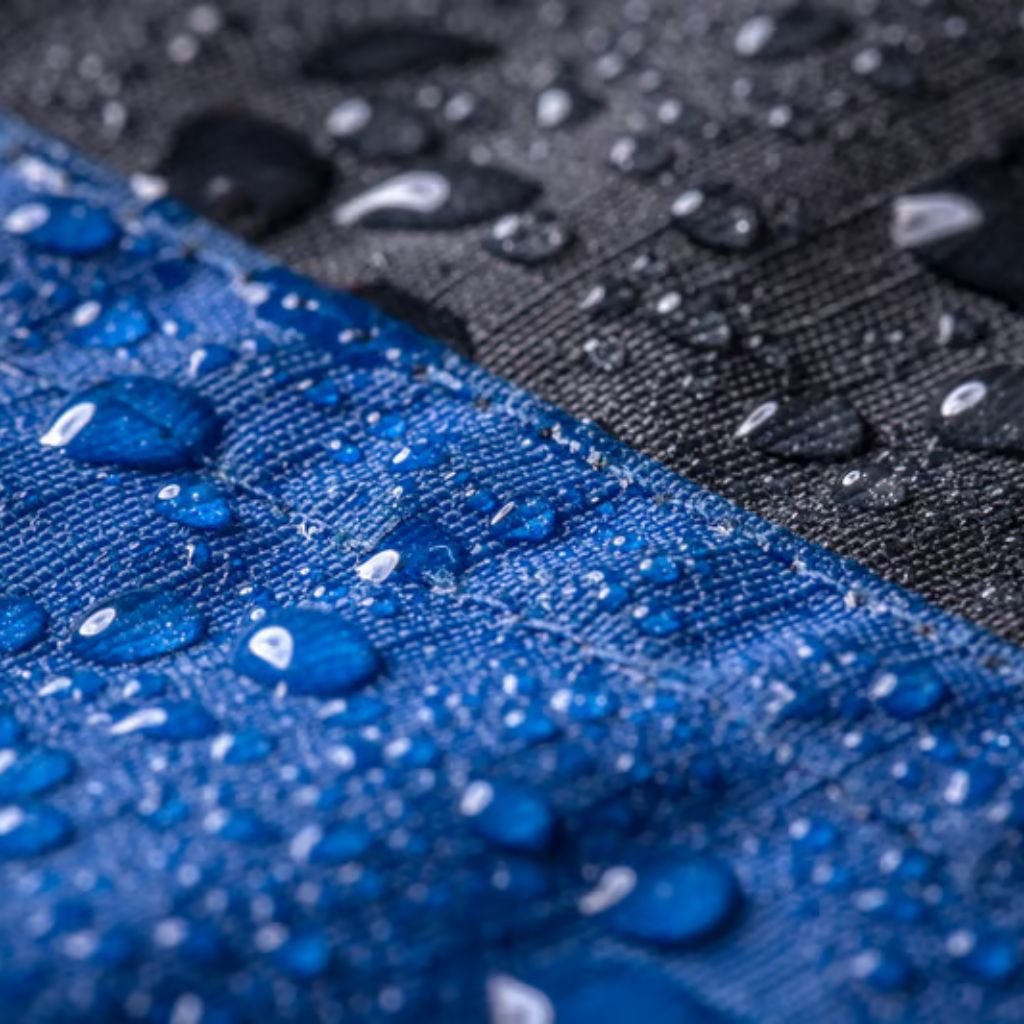
“Water-repellent texture in bold blue and black.”
How Gore-Tex Fabric Works
Understanding how Gore-Tex fabric works requires exploring the science behind its waterproofing, breathability, and wind resistance.
The Science Behind Waterproofing
Gore-Tex is waterproof due to its microporous membrane. Each pore is smaller than a water droplet, preventing liquid water from entering while still allowing air and water vapor to pass. Even in heavy rainfall, water beads up and rolls off the fabric. Seams are taped or bonded to eliminate weak points, ensuring complete protection against leaks.
How Gore-Tex Remains Breathable
Breathability is achieved because sweat molecules are smaller than rain droplets. Water vapor escapes through the pores, keeping the wearer dry and comfortable during physical activity.How Gore-Tex Fabric Works: How Gore-Tex Fabric Works:This allows the fabric to regulate temperature and prevent moisture buildup inside garments.
Waterproof, Windproof, and Breathable Explained
Gore-Tex provides triple protection: it repels water, blocks wind, and lets sweat escape. This combination ensures comfort in varying conditions. Whether hiking in rain or skiing in cold winds, the fabric adapts without compromising performance.
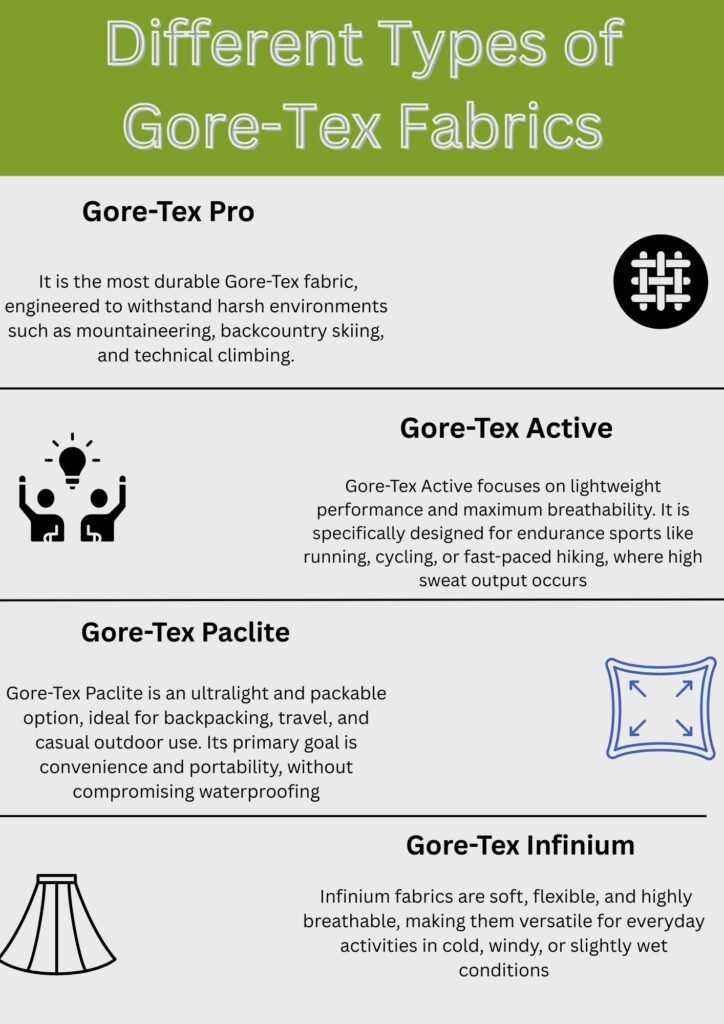
Different Types of Gore-Tex Fabrics
Gore-Tex has evolved over decades to meet the needs of various activities and weather conditions. The company has developed several fabric types, each engineered for specific performance goals. Understanding the differences helps users choose the right gear for their needs.
A quick guide to the main Gore-Tex fabric types: Pro, Active, Paclite, and Infinium, with concise descriptions and icons.
Gore-Tex Pro
Gore-Tex Pro is designed for extreme conditions and professional use.How Gore-Tex Fabric Works: It is the most durable Gore-Tex fabric, engineered to withstand harsh environments such as mountaineering, backcountry skiing, and technical climbing. The fabric combines a robust outer layer with a high-performance membrane to provide unmatched waterproofing, wind resistance, and breathability. Gore-Tex Pro is heavier than other types but offers superior long-term protection, making it ideal for heavy-duty outdoor adventures where reliability is critical.
Gore-Tex Active
Gore-Tex Active focuses on lightweight performance and maximum breathability. It is specifically designed for endurance sports like running, cycling, or fast-paced hiking, where high sweat output occurs. The fabric is thinner, lighter, and highly breathable while still maintaining full waterproofing. Gore-Tex Active is perfect for activities where mobility and ventilation are prioritized without sacrificing protection against rain or snow.
Gore-Tex Paclite
Gore-Tex Paclite is an ultralight and packable option, ideal for backpacking, travel, and casual outdoor use. Its primary goal is convenience and portability, without compromising waterproofing.How Gore-Tex Fabric Works: The fabric uses a simplified inner lining or sometimes none at all, which reduces weight and bulk. Paclite garments can be folded into a small space, making them a practical choice for travelers who need reliable protection on the go.
Gore-Tex Infinium
Unlike the other types, Gore-Tex Infinium is designed for comfort and wind protection rather than full waterproofing. It excels in urban wear, cycling jackets, and casual outdoor clothing where windproofing and thermal comfort are more important than heavy rain protection.How Gore-Tex Fabric Works: Infinium fabrics are soft, flexible, and highly breathable, making them versatile for everyday activities in cold, windy, or slightly wet conditions.
Gore-Tex Fabric Layer Construction
Gore-Tex garments are engineered using different layer constructions to provide varying levels of durability, weight, and comfort. The number of layers affects performance, mobility, and protection, making it important to understand the differences before choosing a jacket or other gear.
“A sea of blue: glittering ornaments rest on rich royal fabric.”
Layer Gore-Tex
Two-layer Gore-Tex garments feature a robust outer fabric bonded to the Gore-Tex membrane, with a separate removable lining for comfort. The outer fabric protects against abrasion, while the membrane ensures full waterproofing and breathability. How Gore-Tex Fabric Works:The removable lining allows for easier washing and adds comfort against the skin. Two-layer constructions are slightly heavier than 2.5-layer garments but provide excellent protection for casual hiking, city use, and moderate outdoor conditions.
Layer Gore-Tex
Two-and-a-half-layer Gore-Tex uses a printed inner layer instead of a full lining, which reduces weight and bulk. This construction maintains waterproofing and breathability while offering a lighter, more packable option. 2.5-layer garments are ideal for backpacking, travel, and activities where minimizing weight is critical. The printed inner layer protects the membrane from abrasion without adding extra material, making it perfect for lightweight jackets or shells.How Gore-Tex Fabric Works:
Layer Gore-Tex
Three-layer Gore-Tex garments bond the membrane directly to both the outer fabric and inner lining, creating a highly durable and long-lasting design. How Gore-Tex Fabric Works:This construction is ideal for professional and extreme outdoor activities such as mountaineering, technical climbing, and backcountry skiing. 3-layer garments provide maximum waterproofing, windproofing, and breathability, along with superior resistance to wear and tear. Although slightly heavier, the added durability makes it a preferred choice for harsh conditions and extended use.
Comparison Table of Gore-Tex Layer Constructions
Layer Type
Durability
Weight
Best Use
2-Layer
Moderate
Medium
Casual hiking, city wear
2.5-Layer
Moderate
Light
Backpacking, travel, ultralight activities
3-Layer
High
Medium
Professional use, mountaineering, extreme sports
Understanding the layer construction helps users choose the right Gore-Tex garment based on activity, weather, and personal comfort. Each layer type balances protection, breathability, and weight to meet specific outdoor demands.
Is Gore-Tex Truly Waterproof?
Gore-Tex has earned a reputation as one of the most reliable waterproof fabrics, but many people still ask, “Is Gore-Tex waterproof?” The answer is yes, but with some conditions. Its waterproof performance depends on the combination of its microporous membrane, seam sealing, and the Durable Water Repellent (DWR) coating applied to the outer fabric.How Gore-Tex Fabric Works: Understanding how these elements work together helps explain why Gore-Tex remains a premium choice for outdoor enthusiasts, athletes, and urban users alike.
Gore-Tex uses a microporous ePTFE membrane that contains billions of microscopic pores. Each pore is approximately 20,000 times smaller than a water droplet, making it impossible for liquid water to penetrate. Even during heavy rain, snow, or sleet, water beads up on the surface and rolls off naturally. At the same time, the membrane allows water vapor from sweat to escape, which prevents moisture buildup inside the garment. This combination of waterproofing and breathability is what separates Gore-Tex from other fabrics, which might repel water but trap sweat inside.How Gore-Tex Fabric Works:
Seam Sealing Technology
A critical part of waterproofing is seam sealing.How Gore-Tex Fabric Works: Even the strongest membrane can fail if water seeps in through stitched seams. Gore-Tex garments address this by taping or bonding all seams, ensuring there are no weak points for water to enter. Modern seam technology ensures that even areas with heavy stitching, such as under the arms or around zippers, remain fully waterproof. This is why Gore-Tex jackets can withstand hours of rain or snow without leaks, making them suitable for extreme outdoor conditions like mountaineering or long hikes.
Durable Water Repellent (DWR) Coating
While the membrane and seam sealing keep water from entering, the outer layer of Gore-Tex garments is treated with a Durable Water Repellent (DWR) coating. This coating causes water to bead up and roll off the fabric rather than soaking in. Over time, however, the DWR coating can wear off due to dirt, sweat, or friction. If this happens, water may start to soak into the outer fabric, giving the appearance that the garment is no longer waterproof. Reapplying DWR is essential to restore full performance and maintain the waterproof barrier.
Real-World Performance
In real-world conditions, Gore-Tex performs exceptionally well. Hikers trekking through heavy rain or snow, skiers in wet conditions, and cyclists riding in downpours benefit from its waterproofing. How Gore-Tex Fabric Works:Unlike cheaper alternatives, Gore-Tex does not saturate quickly, which prevents garments from becoming heavy and uncomfortable. The breathability ensures that users remain dry inside, even during high-intensity activities.
However, it’s important to note that Gore-Tex is not invincible. Extremely prolonged exposure to heavy rain without reproofing, or damage to the membrane, can reduce its waterproofing. Maintaining the DWR coating and avoiding heavy abrasion will ensure that the fabric remains highly effective for years.
How Long Does Gore-Tex Last?
Gore-Tex is known for its durability and long-term performance, but like any technical fabric, it has a finite lifespan. Understanding how long Gore-Tex lasts, what affects its durability, and when maintenance is needed is essential for maximizing the fabric’s performance.How Gore-Tex Fabric Works:Proper care and use can significantly extend the life of your Gore-Tex garments, keeping them waterproof, breathable, and comfortable for years.
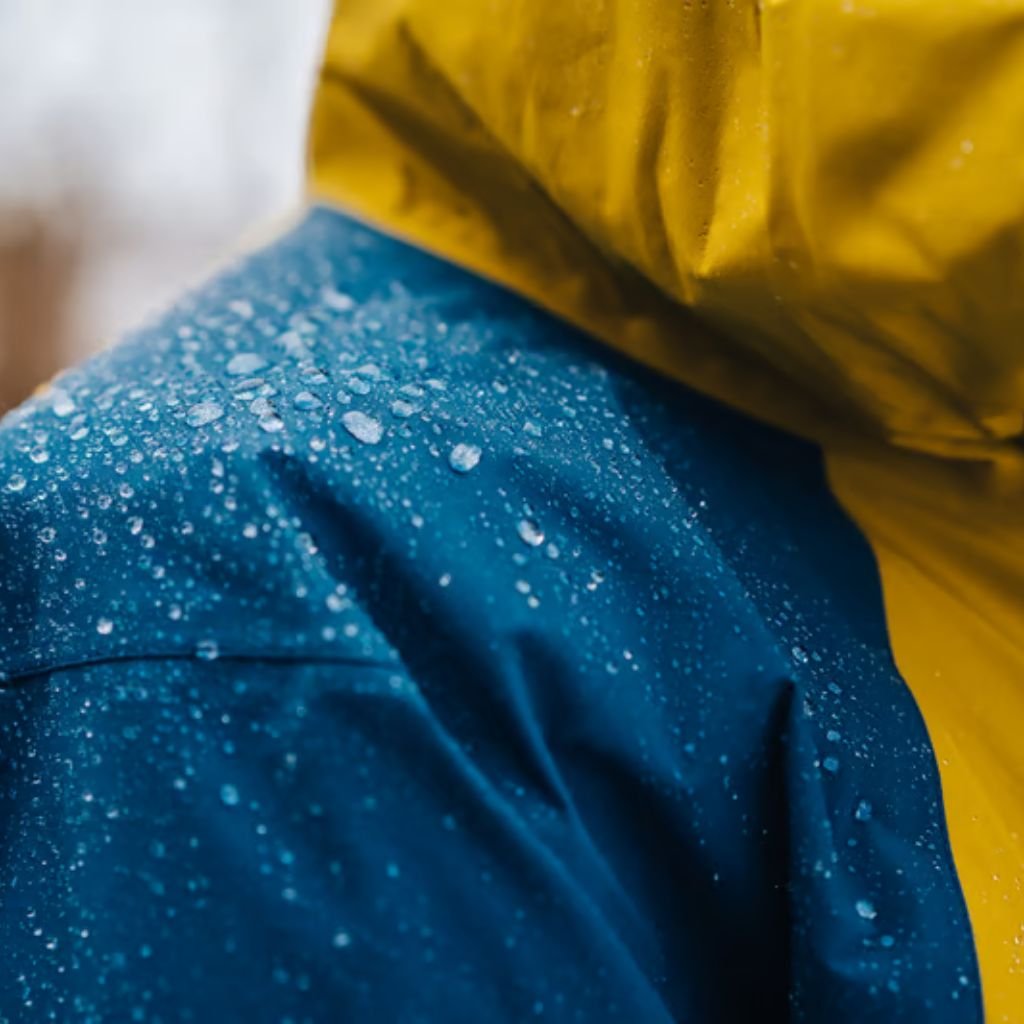
“Bold color block jacket standing up to the rain with water beading on the blue fabric.”
Durability of the Membrane
The heart of Gore-Tex is its ePTFE membrane, which provides both waterproofing and breathability. Under normal usage, the membrane itself can last several years, often up to a decade in some cases. It is designed to resist tearing, stretching, and general wear. However, extreme activities such as mountaineering, rock climbing, or repeated abrasion against rough surfaces can reduce its lifespan. How Gore-Tex Fabric Works:Frequent exposure to dirt, oils, and harsh detergents can also compromise the membrane over time. Despite this, Gore-Tex remains one of the most durable waterproof fabrics available on the market.
When Gore-Tex Stops Working
Even the most durable Gore-Tex garments may eventually show signs of reduced performance. The most common issues include leaks in seams, reduced breathability, or water soaking into the outer fabric rather than beading off. Often, the problem is not the membrane itself but the outer layer’s Durable Water Repellent (DWR) coating or compromised seam sealing. How Gore-Tex Fabric Works:When water no longer beads on the fabric surface or condensation builds up inside, it is a clear indication that reproofing or maintenance is needed.
Signs Your Gore-Tex Needs Reproofing
Knowing when to reproof your Gore-Tex is crucial to maintaining its waterproof and breathable properties. Some key signs include:
Water beads no longer form on the surface, and the fabric appears wet after rain.
Condensation builds up inside the garment during moderate activity.
Stains or dirt have accumulated, causing the DWR coating to degrade.
Reproofing restores the DWR coating and helps maintain the fabric’s natural water repellency. Simple maintenance, like washing with mild detergent and applying a spray-in or wash-in treatment, can significantly extend the lifespan of Gore-Tex garments.How Gore-Tex Fabric Works:
Factors Affecting Longevity
Several factors influence how long Gore-Tex lasts, including frequency of use, environmental conditions, and type of activity.How Gore-Tex Fabric Works: Jackets used for casual city wear may last longer than those exposed to frequent heavy rain, snow, or abrasion in outdoor adventures. Proper storage is also important; storing wet or dirty garments for extended periods can damage both the membrane and DWR coating.
Gore-Tex vs Other Waterproof Fabrics
Gore-Tex is often compared to other waterproof fabrics because its performance is considered the industry benchmark. Understanding the differences between Gore-Tex and alternative materials helps consumers make informed choices when selecting outdoor gear or technical clothing.
Gore-Tex vs eVent
Both Gore-Tex and eVent fabrics use microporous membranes to combine waterproofing and breathability. eVent is slightly more breathable in extremely active situations because it uses a Direct Venting technology that allows water vapor to escape faster. How Gore-Tex Fabric Works:However, Gore-Tex tends to be more durable and long-lasting, especially in harsh outdoor conditions. The membrane in Gore-Tex is also complemented by advanced seam sealing and a DWR coating, providing a reliable triple protection system. For activities requiring extreme durability and long-term weather resistance, Gore-Tex generally outperforms eVent, even though eVent may feel more ventilated during high-intensity workouts.
Gore-Tex vs Polyurethane-Coated Fabrics
Polyurethane-coated fabrics are often cheaper alternatives to Gore-Tex and are widely used in budget rain jackets and shells. While they provide initial waterproofing, they lack breathability, meaning sweat cannot escape efficiently. Over time, PU coatings tend to crack, peel, or degrade, reducing their waterproofing capabilities. Gore-Tex, on the other hand, maintains performance over years with proper care and reproofing, making it a more reliable long-term investment. The combination of a microporous membrane, DWR coating, and seam sealing ensures that Gore-Tex continues to keep users dry and comfortable even after extensive use.
Gore-Tex vs Softshell Fabrics
Softshell fabrics are designed for flexibility, comfort, and moderate weather protection rather than full waterproofing.How Gore-Tex Fabric Works: How Gore-Tex Fabric Works:They excel in wind resistance and breathability, but they cannot provide the same level of waterproofing as Gore-Tex. Softshells may be water-resistant, shedding light rain for a short time, but they will eventually saturate under heavy rain or prolonged exposure.How Gore-Tex Fabric Works: Gore-Tex, by contrast, combines waterproofing, windproofing, and breathability in one garment. For activities like mountaineering, hiking in wet climates, or skiing, Gore-Tex offers protection that softshell fabrics cannot match.
How to Care for Gore-Tex Fabric
Proper care is essential to maintain the waterproofing, breathability, and durability of Gore-Tex garments. While the fabric is built to last, neglecting washing, drying, or reproofing can reduce its performance over time. How Gore-Tex Fabric Works:Understanding the correct care techniques ensures that your Gore-Tex jackets, pants, or gloves continue to protect you from rain, wind, and snow for years.
How to care for Gore-Tex fabric: washing, re-application of DWR, drying, storage, and common mistakes.
Washing Gore-Tex
Washing Gore-Tex correctly is crucial because dirt, oils, and sweat can clog the micropores of the membrane, reducing breathability. To clean the garment effectively, it is best to use warm water and a mild liquid detergent specifically designed for technical fabrics. How Gore-Tex Fabric Works:Powdered detergents, bleach, and fabric softeners should always be avoided, as they can damage the membrane and diminish the Durable Water Repellent (DWR) coating.
Restoring the Durable Water Repellent (DWR) Coating
Over time, the DWR coating on the outer fabric may wear off due to friction, dirt, or repeated washing. The DWR is vital because it causes water to bead and roll off the surface instead of soaking into the fabric. Once this coating diminishes, the garment may appear wet on the outside while the membrane underneath still functions.
Drying and Storage
Proper drying and storage practices are equally important for maintaining Gore-Tex performance. Air-drying on a hanger is ideal, but low-temperature tumble drying can also be used when heat activation is needed for DWR restoration.How Gore-Tex Fabric Works: Ensuring that the garment is completely dry before storage prevents mildew growth and protects the membrane and coatings.
Avoiding Common Mistakes
Many users unintentionally reduce the lifespan of their Gore-Tex garments by using fabric softeners, bleach, ironing, dry cleaning, or storing wet and dirty garments for long periods. Neglecting to maintain the DWR coating can also lead to decreased water repellency and breathability.
Advantages and Disadvantages of Gore-Tex
Gore-Tex provides exceptional breathability, long-lasting waterproofing, and wind resistance. However, it comes with a higher cost, requires regular maintenance, and raises environmental concerns due to chemical treatments. Despite these drawbacks, the performance benefits often outweigh the negatives, making Gore-Tex a valuable investment.
Is Gore-Tex Environmentally Friendly?
Recent innovations in Gore-Tex include PFC-free membranes to reduce chemical impact. Sustainability programs focus on recycling old garments and minimizing waste. These initiativesdemonstrate Gore-Tex’s commitment to high-performance fabrics while addressing environmental concerns, making it a more eco-conscious choice than earlier versions.
“Braving the rain in a neon green jacket, eyes lifted toward the misty unknown.”
Common Myths About Gore-Tex Fabric
Several myths exist about Gore-Tex. It does breathe, contrary to popular belief. It is not maintenance-free, as washing and reproofing are essential. How Gore-Tex Fabric Works:Finally, not all Gore-Tex fabrics are identical; different types serve specific activities and environments. Understanding these facts helps users make better purchasing and care decisions.
Best Uses of Gore-Tex Fabric
Gore-Tex is widely used in outdoor jackets, hiking boots, gloves, pants, and urban winter wear. Its versatility makes it suitable for both extreme outdoor conditions and daily commuting. The fabric ensures comfort, dryness, and wind protection in nearly any scenario, making it a preferred choice for active and casual users alike.
Who Should Buy Gore-Tex Clothing?
Outdoor enthusiasts, hikers, skiers, travelers, and individuals in cold or wet climates benefit the most.How Gore-Tex Fabric Works: Casual users may choose lighter versions for urban wear, while professionals in demanding environments prefer heavier-duty models. Gore-Tex offers protection for a wide range of users and activities.
Conclusion
Gore-Tex combines waterproofing, breathability, and wind resistance, making it ideal for outdoor adventures and everyday use. Its higher cost is balanced by durability, comfort, and performance. Proper care ensures long-term effectiveness, confirming its status as a premium weather-protection fabric. Understanding how Gore-Tex fabric works highlights why it remains the top choice for millions of users worldwide.
FAQs
How does Gore-Tex keep water out?
Its microporous membrane blocks water droplets while allowing sweat to escape.
Does Gore-Tex stop wind?
Yes, the membrane is windproof, preventing heat loss.
Is Gore-Tex better than waterproof coating?
Yes, it is more durable, breathable, and long-lasting.
Can Gore-Tex fail over time?
Yes, the DWR coating and seams may wear down, but reproofing restores performance.
Cycling is not just a pastime, it is a way of life. To the most devoted cyclists, the weather is often the most difficult obstacle to overcome. Rain, wind, and sudden drops in temperature can make rides extremely uncomfortable and burdensome. Because of this, investing in a rain jacket is a smart decision. It keeps you dry, but more importantly, it enhances comfort, safety, and performance.
In this guide, you will learn everything there is to know about rain jackets, including materials, features, how to style them, and how to care for them. This guide will assist you in finding the ideal rain jacket for your cycling needs.
What is a Bicycle Rain Jacket?
City cyclist in a vibrant rain-ready jacket.
A bicycle rain jacket is a low weight, waterproof outer layer that is made specifically for cyclists. It is specifically made for the cycling position, unlike regular rain jackets. Because of this, it offers a greater range of movement and protection.
These jackets are designed to protect you against rain and wind. This is achieved through the use of specially designed fabrics that allow moisture to escape. Because of this, overheating will not be an issue, even on the most strenuous rides.
Why Cyclists Need a Dedicated Rain Jacket
Rainy conditions are unpredictable. While many riders rely on a routine jacket, it falls short. Bicycle rain jackets are designed with riding and cycling apparel in mind to function well in actual riding conditions.
Key Reasons to Invest in One
Weather protection is maximized while cycling
Increased breathability help body systems cope
Cooling effect with body re-aeration from the firm, fit sleeves
High visibility enhances safety on the road
For these reasons, even serious recreational riders or professional riders, using these practical features is making the jackets a good investment.
Rain Jacket Features
Choosing the correct jacket is often the most difficult part of the purchasing process. Some of the more practical features a rider can consider are designed to make cycling in the rain as easy as possible. Rain and cycling feature waterproof fabrics Advanced Waterproofing fabrics are used. If a rider is expecting riding will will make the experience less enjoyable due to less breathability, features like ventilation, paneling, zippered mesh linings, and even pit zips.Lightweight and packable design
Your ideal rain jacket is likely easy to carry and some models even fold into a small pocket or pouch. This is especially helpful for those who bike tour or are bike commuters.
Adjustable fit
Adjustable hems, drawstring hoods, and elastic cuffs work to give you a more custom fit. Additionally, a more snug fit helps keep the rain and wind from getting into the jacket.
Why fit matters for bicycle rain jackets
Fit is critical for optimal comfort and performance. If a jacket does not fit well, it will likely flap around in the wind or may restrict your movements.
This combination provides both comfort and efficiency for the rider.
Bicycle rain jackets
Not every cyclist has the same needs, so bike rain jackets come in different varieties.
Commuter rain jackets
These jackets have an even mix of style and purpose. They present a relaxed, casual style for office or city use and are often fitted with reflective elements for increased visibility in urban settings.
These are tailored for speed and distance. They have an aerodynamic and lightweight design. Even though the are intended to look minimal, their design is very technical.
Adventure and Touring Jackets
For long-distance rides, touring jackets made with reinforced fabrics, extra pockets, and all-day comfort are made to be durable.
The Meaning of a Jacket’s Waterproof Rating
A jacket’s waterproof rating is an important detail to help you choose a jacket that fits your needs.
5,000 mm – Protection from light rain
10,000 mm – Protection from moderate rain
20,000 mm – Protection from heavy rain
A rating of 10,000 mm and above is considered best for cycling in the rain.
What the Different Breathability Ratings Mean
Breathability is measured in grams (g/m²). This number indicates the amount of moisture that can evaporate the fabric.
5,000 g/m² – Low breathability
10,000 g/m² – Moderate breathability
20,000 g/m²+ – High breathability
For warm weather and rides, fabrics with high breathability are best.
Safety Features
The lack of visibility when it rains makes cycling less safe, so jackets with safety features are important.
Reflective Elements
Reflective strips on the back, sleeves, and piping help drivers see cyclists.
Bright Color Options
For road cycling, the bright colors preferred for visibility are yellow, neon green, and orange rather than the stylish black color.
Hood vs No Hood: Which Is Better?
This choice depends on riding style.
Hooded jackets offer extra protection from the rain, but might affect the helmet fitting.
Jackets without hoods tend to be more lightweight and offer better aerodynamics.
A lot of modern jackets offer removable hoods, or hoods that are designed to be compatible with helmets. This enhances versatility.
Seasonal Use of Bicycle Rain Jackets
A bicycle rain jacket can be used for more than just rain.
Jackets that are lightweight and offer high levels of breathability are the best choice. Lightweight and collapsible jackets are best to prepare for the sudden showers.
A layered or insulated jacket is better. Also, jackets that offer wind-blocking features are ideal.
How to Wear Your Bicycle Rain Jacket
City style: bold yellow and blue layered look with a bike-friendly rain jacket.
Style and performance can be achieved, and with the new bicycle rain jackets, modern designs are more sleek.
Casual Commuter Style
Pair your rain jacket with:
Slim cycling trousers
Waterproof footwear
Minimal accessories
This combination keeps you dry and looks great.
Sporty Performance Style
For athletic rides, match your jacket with fitted cycling shorts and performance shoes. This combination promotes maximum comfort and speed.
Factors to Consider When Selecting Your Bicycle Rain Jacket
Consider these factors before making a purchase:
The purpose for which you’ll be using your bicycle (touring, racing, commuting)
The most frequent weather conditions you face
The accuracy of the size and fit
Weight and how easily it packs
Safety features like reflectivity
Evaluating your needs helps you make the most out of your purchases.
Caring for Your Jacket
Proper care will prolong the life of your jacket.
Cleaning your jacket
The following measures can help maintain the waterproof coating.
Mild soap only
No fabric softener
Wash in gentle cycle
Reproofing your jacket
Waterproofing can always be restored with an application of a wash-in or spray waterproofing solution.
Consideration for the Environment
As sustainability has gained traction in the cycling world, fully utilizing recycled fabrics and bio-based coatings has become commonplace and minimizes environmental harm without affecting cycling performance.
What not to do
Choosing the wrong rain jackets is a trap many cyclists, even seasoned ones, fall into.
Choosing overly large jackets
Smiling rider getting ready for the trail in a bright orange jacket.
Not considering the breathability rating
Choosing visual appeal over practical features
Not considering reflective features
Avoiding these mistakes will improve your riding comfort immensely.
Investing in Quality Bicycle Rain Jackets
The main attribute of those higher quality jackets is the greater cost. Yet, the benefits are priceless.
Greater longevity
Greater comfort
Greater safety
Greater overall enjoyment
Thus, to be accurate, the cost is an investment, not an expense.
Conclusion
Every cyclist is accompanied by a rain bicycle jacket, designed to protect and enhance comfort. With the right features and fit with care, it can also last for years.
Regardless if you are an adventure cyclist, or a daily commuter, selecting an appropriate rain jacket, allows you to keep riding your bike, regardless of rain. So keep cycling, stay dry, and gear up.
FAQs
What makes a bicycle rain jacket different from a regular rain jacket?
It’s designed for cycling posture, with longer back panels, breathable fabrics, and a snug fit to block wind and rain.
Are bicycle rain jackets waterproof?
Yes, most feature waterproof membranes and sealed seams to keep you dry in rain.
Can I wear a bicycle rain jacket in summer?
Absolutely. Lightweight, breathable jackets are perfect for warm-weather rides and sudden showers.
While heading into the mountains, the environments can change rapidly and without warning. One moment there could be gorgeous views, and the next moment, the views can be obstructed by rain, wind, or fog. This makes having the right gear more than a comfort choice, it is a necessity. Outwear designed for mountain environments is designed to perform in these conditions. They are the best choice for keeping you dry, warm, and offering full range of motion.
In the following, you will learn the most valuable elements for making a mountain rain jacket worth it, how to determine the most mountain rain jacket, and the practical elements to paying for a mountain rain jacket for the outdoors. We will discuss things like the various materials, the different features, the different types of fits, and offer some tips for caring for your outdoors mountain rain jacket so you can get the most value for your money.
What Is a Mountain Rain Jacket?
The technical attributes of a mountain rain jacket make it different from the attributes of a rain coat. A technical rain coat is built to withstand the elements (i.e. rain, wind, extreme cold and high altitude conditions of the mountains). The regular rain coat attributes are not designed to withstand the conditions anywhere close to as well to these conditions.
Furthermore, mountain rain jackets are usually lightweight and durable. This combination enables freedom of movement and protection. They are often used as the outer shell in a layering system, giving them the flexibility to be used in different seasons.
Why Mountain Rain Jackets Are Important
Why Mountain Rain Jackets Are Important: stay protected from sudden mountain weather, keep warm to prevent hypothermia, and preserve comfort and energy for better performance.
Unpredictable Mountain Weather
Weather in the mountains can change rapidly. Storms can develop even on clear days, making reliable rain protection a necessity. Quality mountain rain jackets will keep rain and snow out, even in the heaviest of downpours.
Protection From Wind and Cold
In addition to rain, the mountains can be extremely windy and cold. Wind can rapidly increase the body’s rate of heat loss, and mountain rain jackets help to counteract this by lessening heat loss and therefore, the risk of hypothermia.
Comfort and Performance
An often overlooked but critical aspect of outdoor performance is comfort. When a person is dry and warm, they will conserve energy. This means they can hike and climb more and enjoy the experience even more.
Characteristics of Mountain Rain Jackets
Waterproof Technology
As rain is outjacket’s primary enemy, waterproofing is of main importance to an effective mountain rain jacket. Most high-performance jackets use high-end technology — waterproof membranes. These membranes use layers like Gore-Tex, eVent, or some unique brand proprietary layers. They block incoming water while letting water vapor out, creating a microclimate that allows sweat to evaporate onto the membrane. Most high-performance jackets have balanced moisture management, an essential feature for activities like trekking where maintaining a high comfort level while sweating is key.
Breathability
A jacket that is not breathable will not let moisture escape, making it very uncomfortable to wear. Mountain rain jackets use specially engineered fabrics that allow sweat and moisture to escape while keeping the water out.
Ventilation is an added feature many high-end jackets have that help to manage heat and moisture. These jackets have underarm zippers or panels that can be opened to allow moisture to escape.
Seam Sealing
Sealing ironed lines is often aesthetically pleasing, and can be considered high-end fashion. For mountain rain jackets, this is a critical feature. Taped or welded seams ensure that they will let no water through the stitching, keeping the waterproofing intact.
Outer Fabric
The mountains are tough. Rocks, branches, and even some gear can damage weak fabrics. Therefore, abrasion resistant tough outer layers are necessary. Outer layers are often made of rip stop nylon and extra reinforced panels.
Different Types of Mountain Rain Jackets
Hardshell jackets
Hardshell jackets provide the most protection. They are fully waterproof, fully windproof, and very durable. They provide the most protection but are very stiff and can be less breathable. They are very good in extreme conditions. They are good for alpine climbing and heavy storms.
Softshell Rain Jackets
Softshell jackets provide good protection and are somewhat flexible. They are water resistant, and are more breathable than hardshell jackets, but provide less protection. They are good in light rain and good for activities where a lot of movement and energy are involved. Softshell jackets are good for mild conditions in the mountains.
Lightweight Packable Jackets
These jackets are designed for weight and how much space they take up. They are good for fast travel and hiking even though they are not very durable and packable. They can be quickly put on when it rains and are very good to carry.
Mountain Rain Jacket Materials
Gore-Tex and Comparable Membranes
One of the most trustworthy technologies for waterproofing remains Gore-Tex. It has high waterproofness, breathability, and durability. For its reliability, it has become a common choice for premium mountainRain Jacket.
Competitors sell other membranes that offer similar performance for a variety of costs.
Nylon and Polyester Shell Materials
Most jackets have an outer shell made of nylon or polyester. Nylon is chosen for its strength and resistance to abrasion. Polyester is less expensive and offers a good durability and retains color well.
In a variety of instances, an outer fabric is coated with a durable water repellent or DWR. This coating causes water to bead and roll off rather than absorb into the fabric.
Design and Fit Factors
Design and Fit Factors: relaxed vs athletic fit, hood design, and length/coverage to optimize movement and protection in mountain rain jackets.
Relaxed vs Athletic Fit
Most mountain rain jackets have an athletic fit. This allows for unhindered movement and limits excess fabric that can flap around in high winds. Additionally, there should be enough room for layering.
Hood Design
A good hood is a necessity. Many mountain rain jackets have hoods that are adjustable, compatible with helmets, and can be pulled backwards for visibility. This provides unimpeded coverage while still allowing an unobstructed view.
In many models, stiffened brims are added to stop rain from running down the face.
Length and Coverage
Jackets that are longer offer more coverage, which is better in more extreme rain situations. But, shorter styles offer more range of motion. Striking the right balance is largely dependent on your activity and your personal preference.
How to Decide on the Best Mountain Rain Jacket
Consider Your Activity
Varied activity requires varied features. For example, for climbers, the focuses are on hoods that are compatible with a helmet and overall durability. While hiker, there is more of a preference for lightweight construction so that they can pack it.
Therefore, your dominant use is the most important factor that steers your decision.
Climate and Conditions
When hiking, the most important can be extreme rain and snow, so I recommend going for a fully waterproof hardshell. If the weather is more mild, a soft shell that is breathable is perfectly fine.
Weight vs Durability
When it comes to a jackets’ durability, lightweight can be a double edged sword. On one hand, it is easier to take with you when you undergo an expedition, but nothing is more frustrating than a jacket that wears out. Finding a good balance is key.
The Benefits of Quality Mountain Rain jackets
Long-Term Reliability
The best quality jackets are made to withstand severe weather for many years. For people who tend to weather many storms out in the mountains, investing in a quality rain jacket can help save money in the long run.
Ensured Safety
Keeping warm and dry while outdoors in exposed to the elements is critically important for safety. With the rapid drop in temperature in high altitudes while in the mountains, the exposed rain protection is a necessity for your safety.
Increased Enjoyment while Outdoors
Keeping warm and dry during your outdoor adventures increases their enjoyment by allowing the participants to focus on the hike or activity, rather than the discomfort. With discomfort comes increased risk for encounters with the elements.
How to Care for Your Mountain Rain Jacket
How to care for your mountain rain jacket: regular washing, restoring waterproofing, and proper storage to extend its life.
Regular Washing
Dirt and sweat can clog and make less effective the waterproof membranes. To preempt this, wash the jackets per the manufacturer’s instructions.
Washing instructions usually recommend mild detergents, and to use no fabric softener.
Restoring Waterproofing
When water starts to soak into the jacket, it is a sure sign that the DWR coating is depleted. Reapplying a waterproofing the jacket is warranted.
Proper Storage
When not in use, the jackets should be stored inside a dry space that has good air circulation. Do not compress jackets for prolonged periods to protect the fabric and meh membranes.
Eco-Friendly and Sustainable Options
Outdoor gear brands are increasingly becoming sustainably focused. Fabrics that are recycled, waterproof coatings that are free of PFCs, and ethical production are becoming the norm.
Choosing eco-friendly options when purchasing mountain rain jackets greatly reduces the negative environmental impacts without sacrificing jacket performance.
Mountain Rain Jackets Adapted for Every Season
Summer
When summer comes, rain jackets should be lightweight and have good ventilation to improve breathability and comfort, helping keep you cool while you’re working harder.
Winter
Winter comes, rain jackets often need to be worn as outer shells. Because you primarily will need rain jackets as outer shells, it is most important for outer shell jackets to be durable and weather resistant.
Versatile for All Seasons
Select jackets are specially designed to be worn year round. These selective jackets are specially designed to be worn year round by being adaptable to varying climates.
Pitfalls to Avoid
Overlooking breathability ratings
Not layering because the jacket is too small
Not seam sealed to be truly waterproof
Wearing selected jackets designed for year round use to avoid layering.
Final thoughts
Purchasing a mountain rain jacket involves a great deal of consideration. Proper care can keep them from being a nuisance to the user and help keep bad weather inviting. Knowing the features is important as bad weather won’t go away, age will.
No matter where you go, from hiking to dangerous mountains, a good mountain rain jacket will always be a wise choice.
FAQs
What is a mountain rain jacket used for?
A mountain rain jacket protects against rain, wind, and cold during hiking, trekking, and alpine adventures.
Are mountain rain jackets fully waterproof?
Yes, most mountain rain jackets use waterproof membranes and sealed seams for complete rain protection.
Are mountain rain jackets breathable?
High-quality jackets are breathable, allowing sweat to escape while keeping rain out.