Home Blog Page 126

Satin Organza Fabric: Elegant& Ideal for Special Occasions

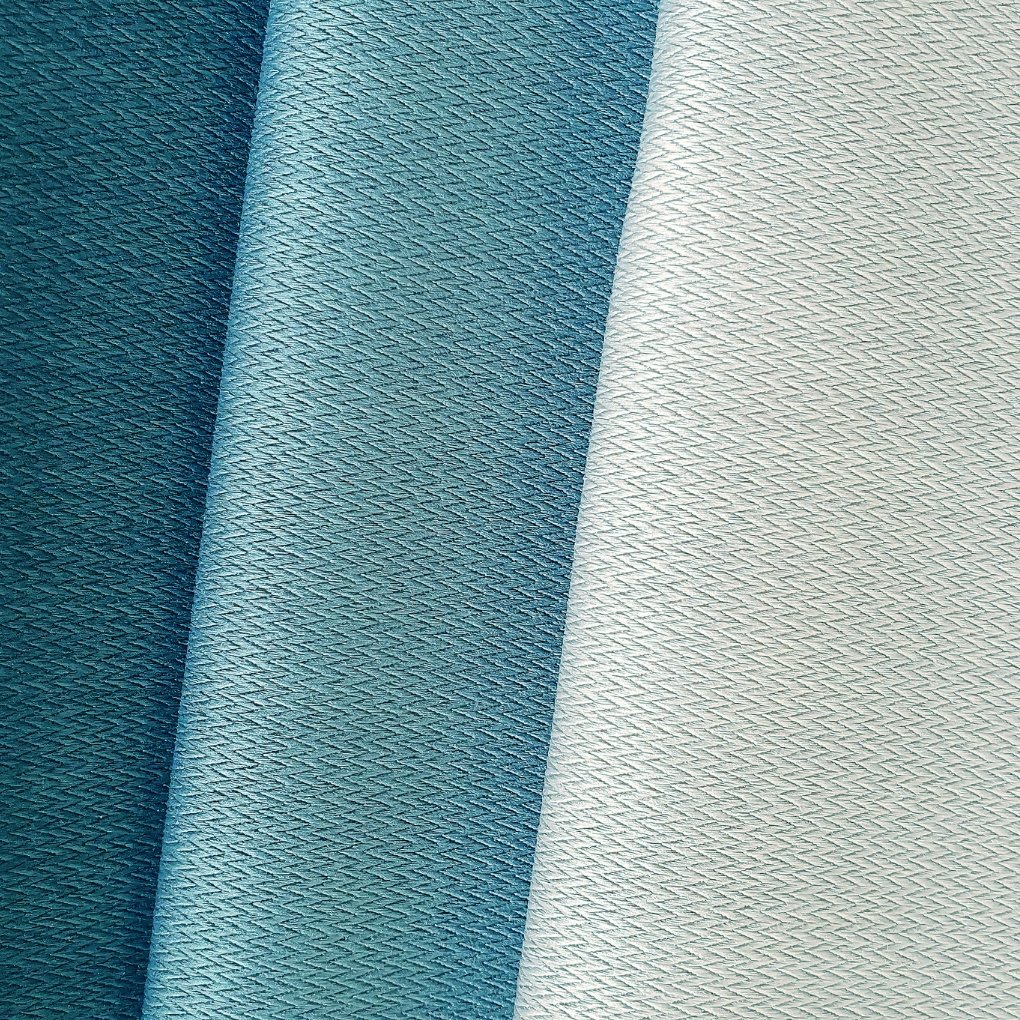
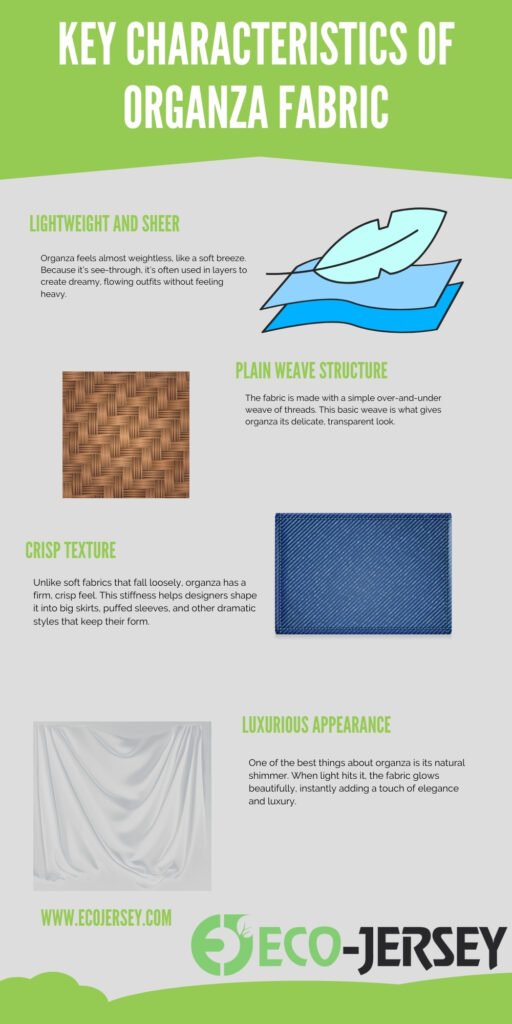
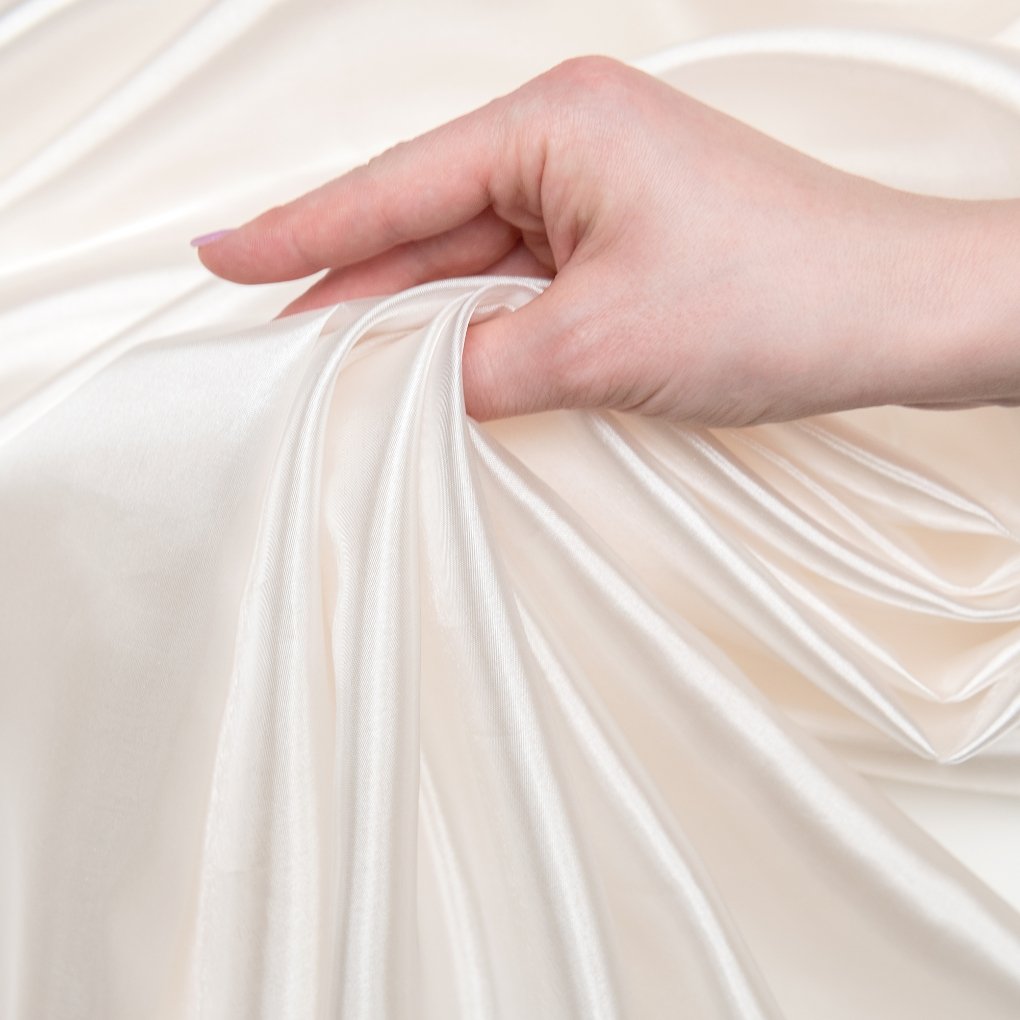
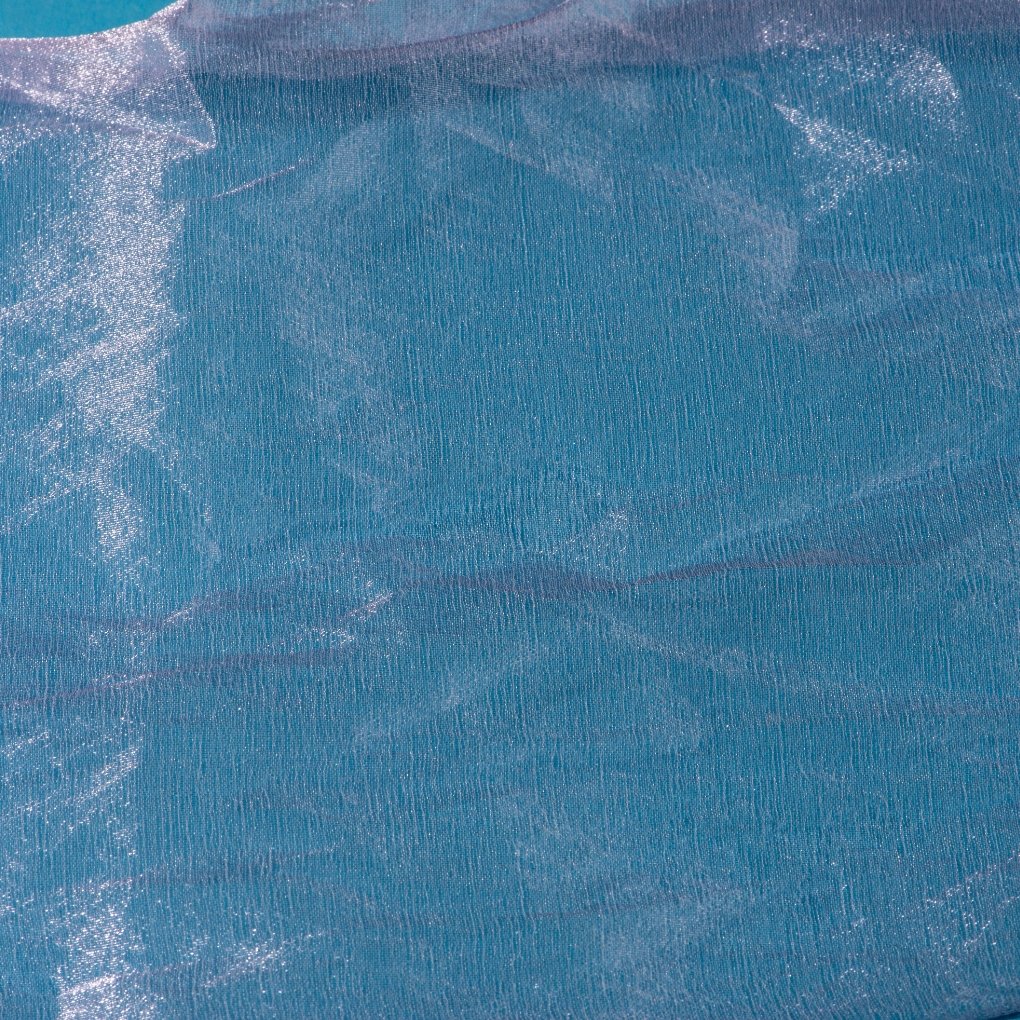
When discussing satin organza fabric, we only have a fabric that pairs organza’s artistic beauty, satin’s durable robustness, and a timeless refinement that shimmers softly without being overly flashy or gaudy. For these reasons it finds its most popular application in wedding gowns and evening dresses. Designers consider yarn of satin organza fabric to be a staple because of its breathability, softness, and still voluminous boxed silhouette. Organza satin fabric achieves an unmatched durability while satin weaving a soft shimmery appearance.

History of Satin Organza Fabric
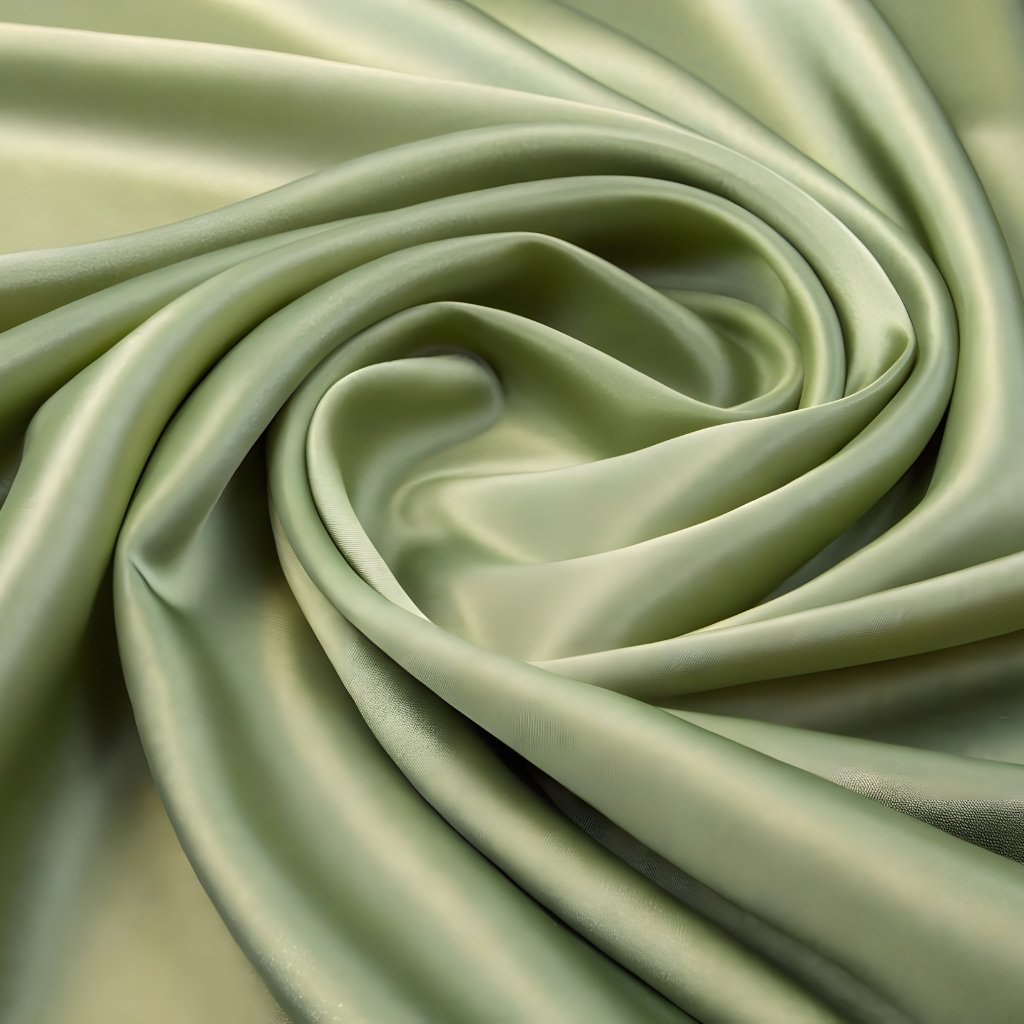
Close-up image of smooth, light-green satin fabric arranged in soft folds and spirals.
History of Satin Organza Fabric: Tracing the Luxurious Roots of a Timeless Textile

Satin Organza fabric is unique and elegant. It is strong yet beautiful and the fabric has a unique sheen which makes every outfit appear elegant and rich. It is often used in the making of wedding and evening gowns as well as sown as decorative fabric. It is luxurious fabric yet very light which makes it very comfortable. Fabric designers love it for the unique softness and structure it has. There is a perfect balance of chrome and durability in the fabric, and it is lightweight and comfortable which makes it satin organza fabric.

Satin organza first originated centuries ago. With the spread of trade, China became the first place in the world to manufacture satin and organza. It was through trading that organza satin fabric crossed the silk weaving borders of Europe. In time, both of these fabrics became linked with the elite and the royal, for the courts prized fabrics of organza to satin due to their luxury. Even in today’s world, as weaving fabrics is common, the perfect blend of organza and satin is a perfect balance, and still, it remains the same all over the world.

Uniqueness of Satin Organza Fabric
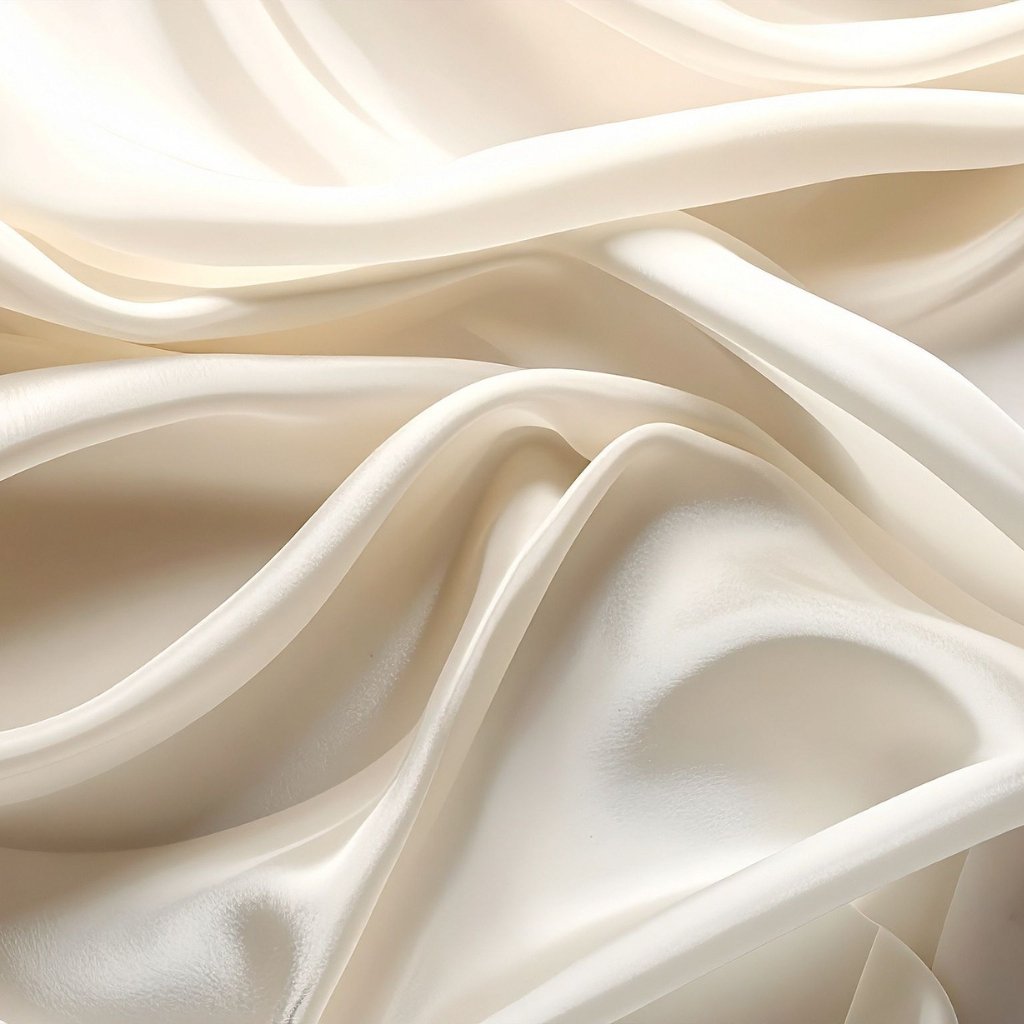
A close-up of luxurious satin organza fabric in soft ivory, showcasing smooth, flowing folds, subtle sheen, and airy, lightweight drape.
Uniqueness of Satin Organza Fabric

What actually makes satin organza fabric unique is the texture. Satin adds smoothness with its glossy face. Organza gives crispness with its sheer and airy character. Both combined create a fabric which shines and retains its shape. The fabric smooths the skin while still having body. This balance makes it a favorite for Evening gowns and bridal gowns. Most important of all, satin organza gives a radiant finish on dresses which reflects light beautifully.

How Satin Organza Fabric Is Made
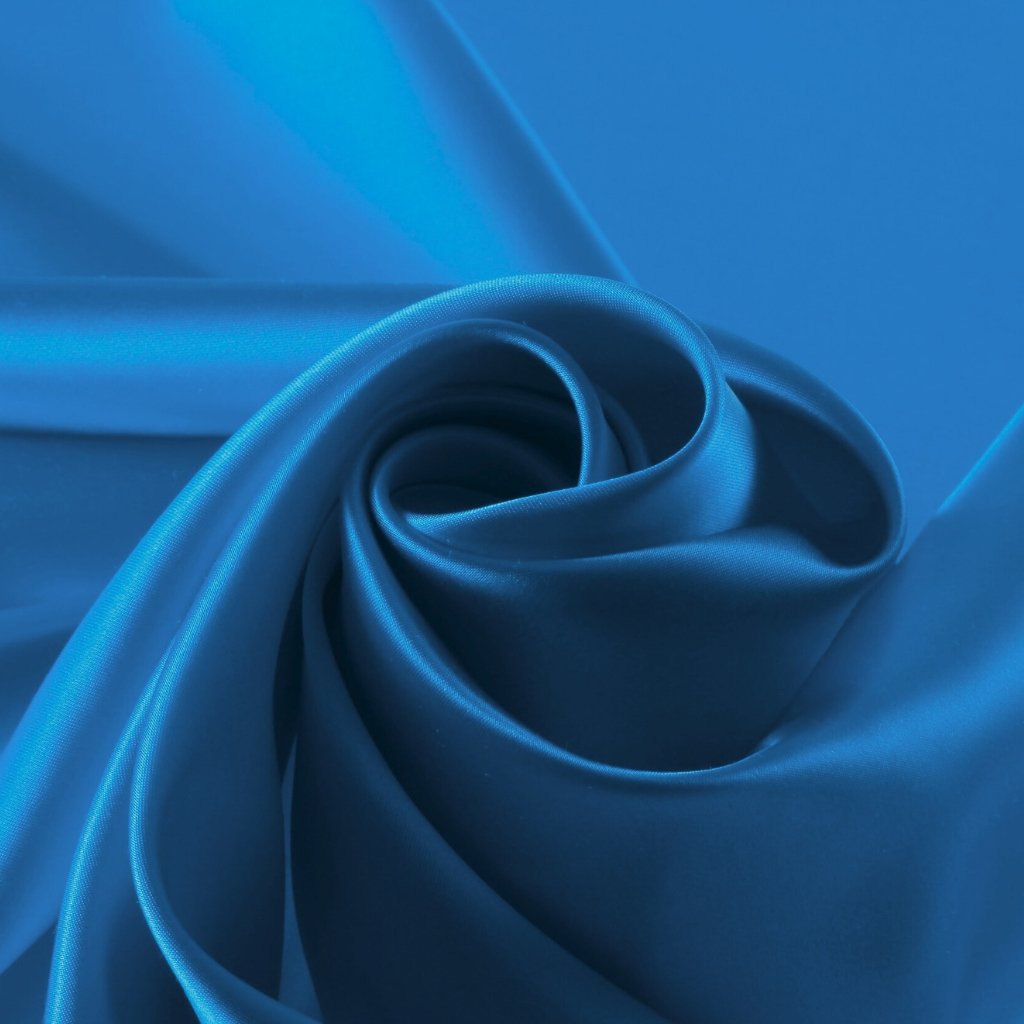
Close-up of satin organza fabric in blue, showcasing glossy sheen and soft folds.
Satin Organza Fabric: A glossy, lightweight material with a crisp drape.

The process of making satin organza is the outcome of intricate weaving skills. Satin is woven with a technique that exposes the glossy face of satin and organza is woven with stiff, and highly twisted yarns. Combining the two gives shine and structure satin organza fabric. It is very common for factories to use silk, polyester, or nylon to make it. Each type of filament impacts the texture and appearance of the fabric. Silk satin organza feels very soft in hand whereas folding a polyester one gives a much stronger feel.

Traits The Defines Satin Organza Fabric
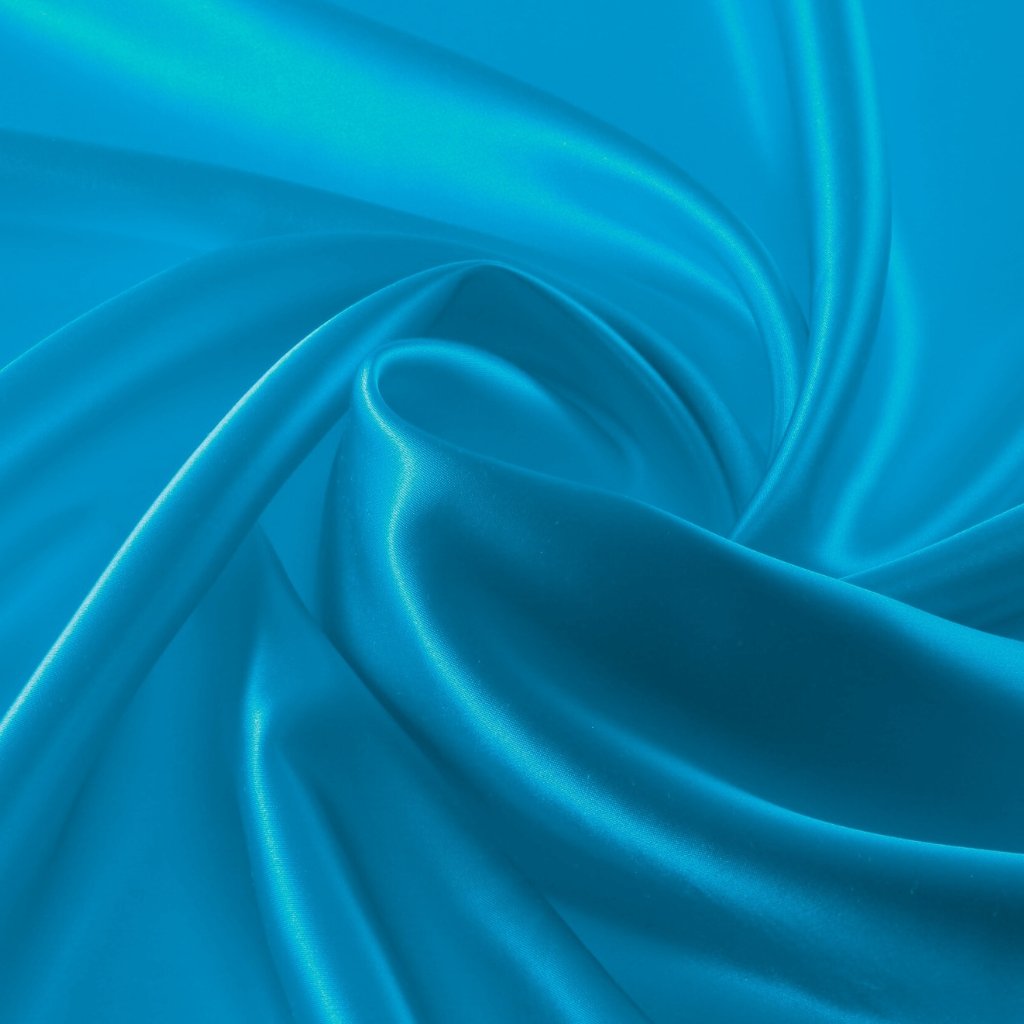
A close-up of luxurious satin-organza fabric in bright turquoise, showing smooth, glossy folds and soft reflections that emphasize its silky texture.
Satin Organza: A lustrous, flowing fabric with a smooth satin-like sheen and light, airy drape

There are various characteristics of satin organza. This fabric is extremely light which allows for a great range of movement. At the same time it retains its crisp structure which enables the garment to hold its shape. The fabric also is wrinkle resistant which is beneficial for long duration events. The fabric has a semi-transparent quality that is aesthetically pleasing. In addition, this fabric has the ability to elegantly drape and structure, and it reflects light beautifully. Satin organza fabric is soft yet strong, showcasing its versatility in fashion.

The Uses of Satin Organza Fabric
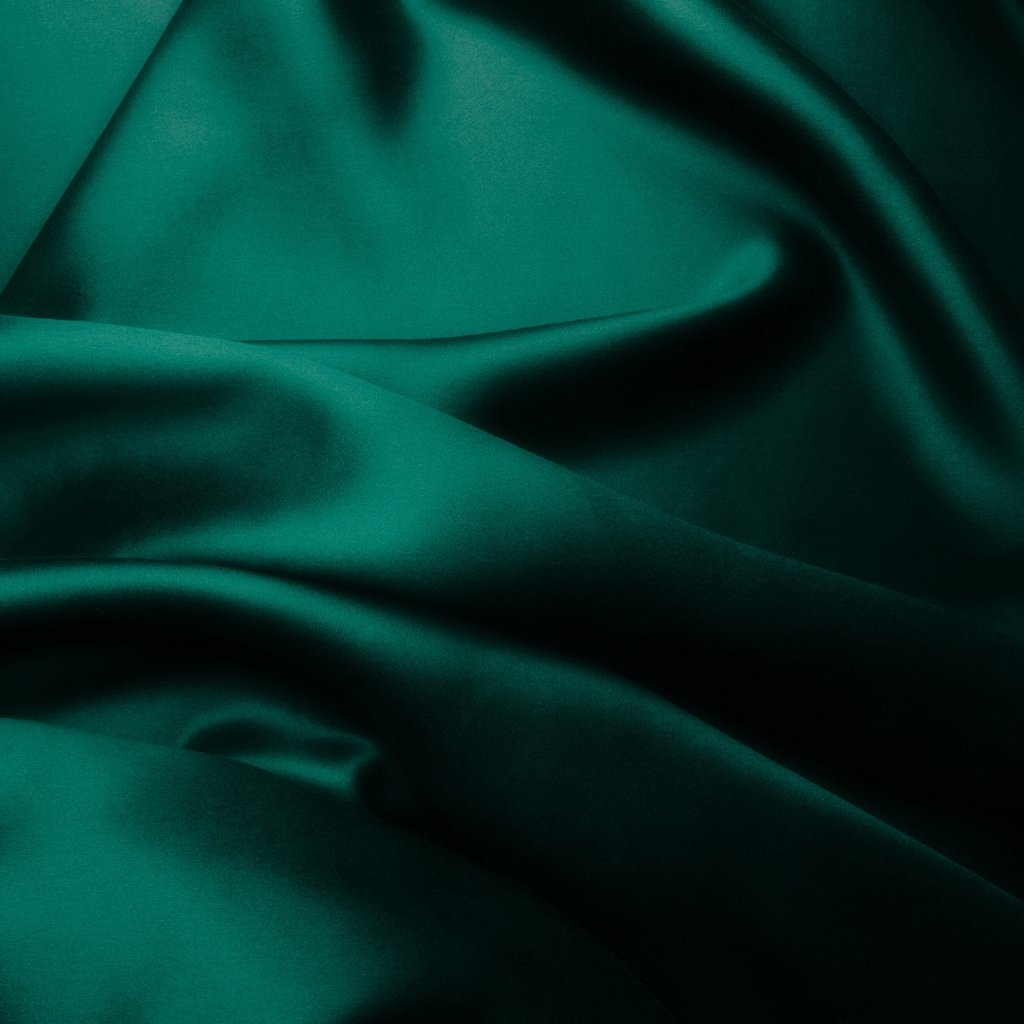
A close-up photograph of rich, emerald satin organza fabric with smooth, flowing folds and subtle sheen.
The Uses of Satin Organza Fabric: versatile elegance in apparel and décor.

There are various appeals for this fabric in the fashion and décor industry. It is a go to for bridal gowns as it is delicate and elegant. It is often incorporated into veils for overlay on skirts, bows, and draped on evening gowns for a soft touch. It is also popular as decorative ribbons and draping for events. Its light yet firm quality allows satin organza fabric to be easily manipulated into structured styles. This fabric is guaranteed to add a touch of elegance to any special occasion.

All around the world, brides appreciate the satin organza in wedding gowns because of the fairy-tale quality brought forth by the fabric’s gentle shimmer. The fabric’s ability to provide volume without adding any additional weight allows satin organza dresses to remain comfortable, even for longer ceremonies. This fabric forms soft, romantic veils. Layers of satin organza enhances the fullness of the skirts, while designers trust the fabric’s sheen to further glorify the bride. Satin stampede fabric is sure to leave a wonderful impression on every elegant outfit worn for weddings.

Satin Organza Fabric in Evening Dresses
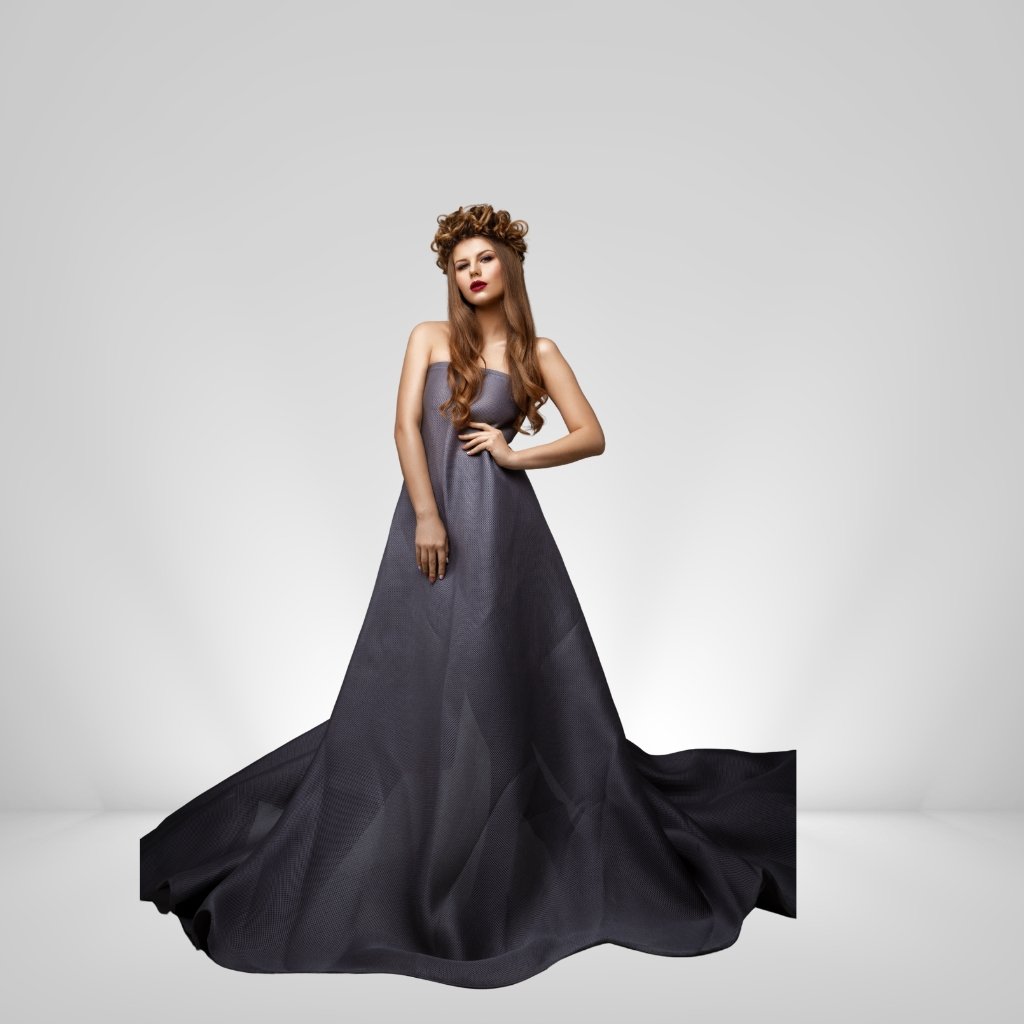
A elegant woman wearing a flowing satin organza evening gown in a dark charcoal shade, standing against a light gray studio backdrop with a long voluminous train.
Satin Organza Elegance: A dramatic, flowing evening gown with a soft satin organza silhouette and a sweeping train.

Evening dresses become dazzling when made with satin organza fabric. The shimmer from satin and the stiffness of organza fabric work in tandem. The fabric evolves with every step, creating a seamless idea of grace. Satin organza is often used by designers on top of solid fabrics to create depth and dimension. The fabric’s ability satin organza to capture light makes the fabric a favorite for nighttime parties. In addition to all of this, satin organza adds form with creating weightless gowns. Thanks to satin organza fabric, every evening outfit is bound to be drowned in sophistication.

Satin Organza Fabric in Decorations
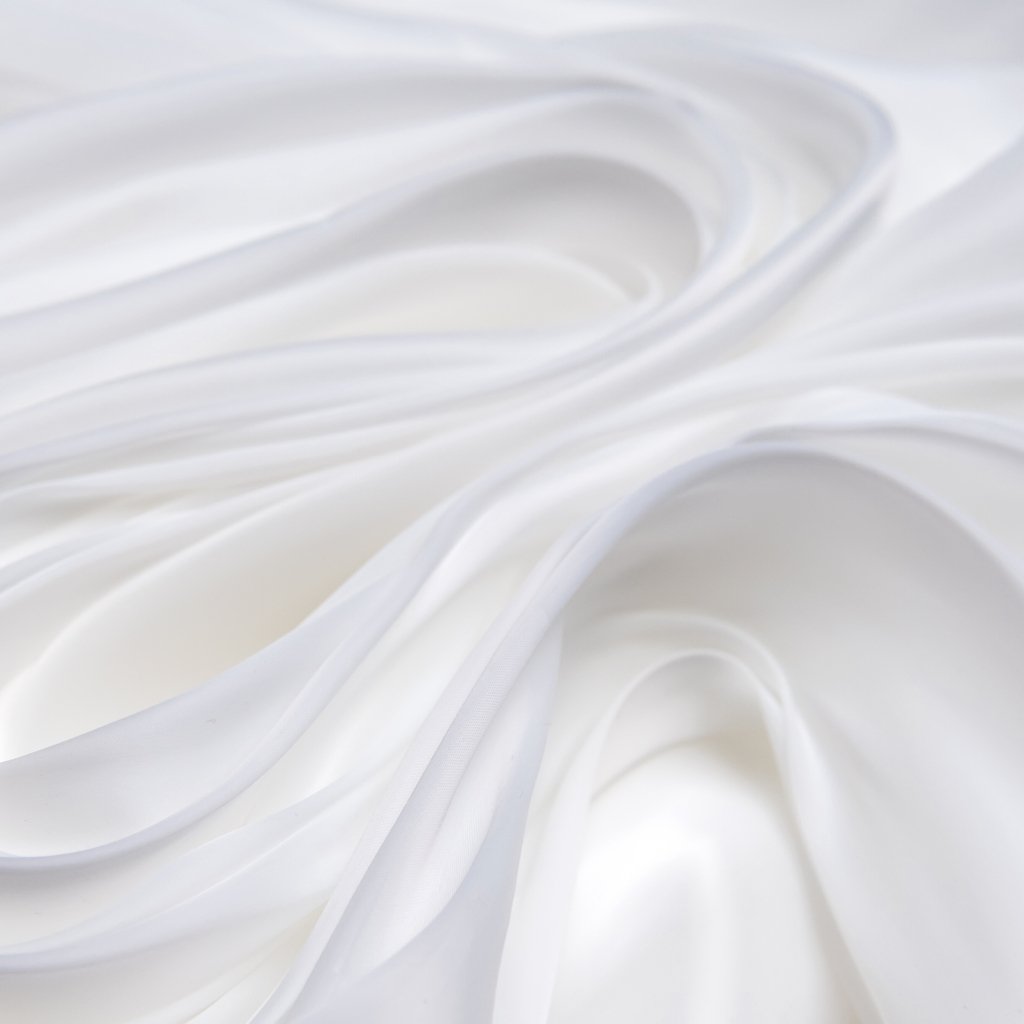
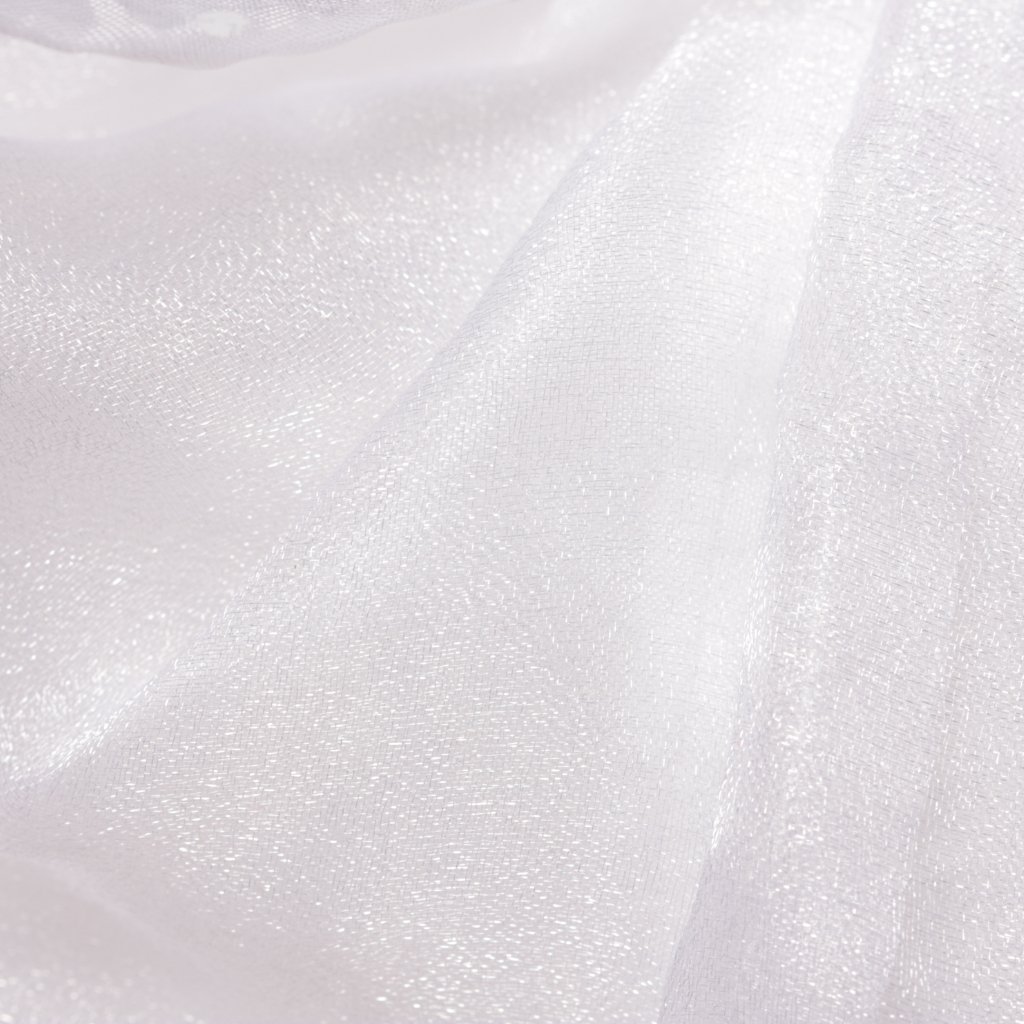
Close-up of flowing, silky satin organza fabric in white, with soft folds and gentle sheen.
Elegant Satin Organza: Soft, luminous folds perfect for wedding and event decor.

As much as satin organza fabric is used in clothing, it also has importance in décor. Event coordinates it into chair sashes, table runners, and cloths for sashes and table backdrops. The sheen in satin organza fabric makes a venue look festive. Other visual decorating options include tied bows and draped clothing. Its low density also makes it easy to decorate large areas. It keeps several layers of fabric on satin organza and does not bulge. It adds to the beauty of the celebrations and gatherings.

Why Designers Love Satin Organza Fabric
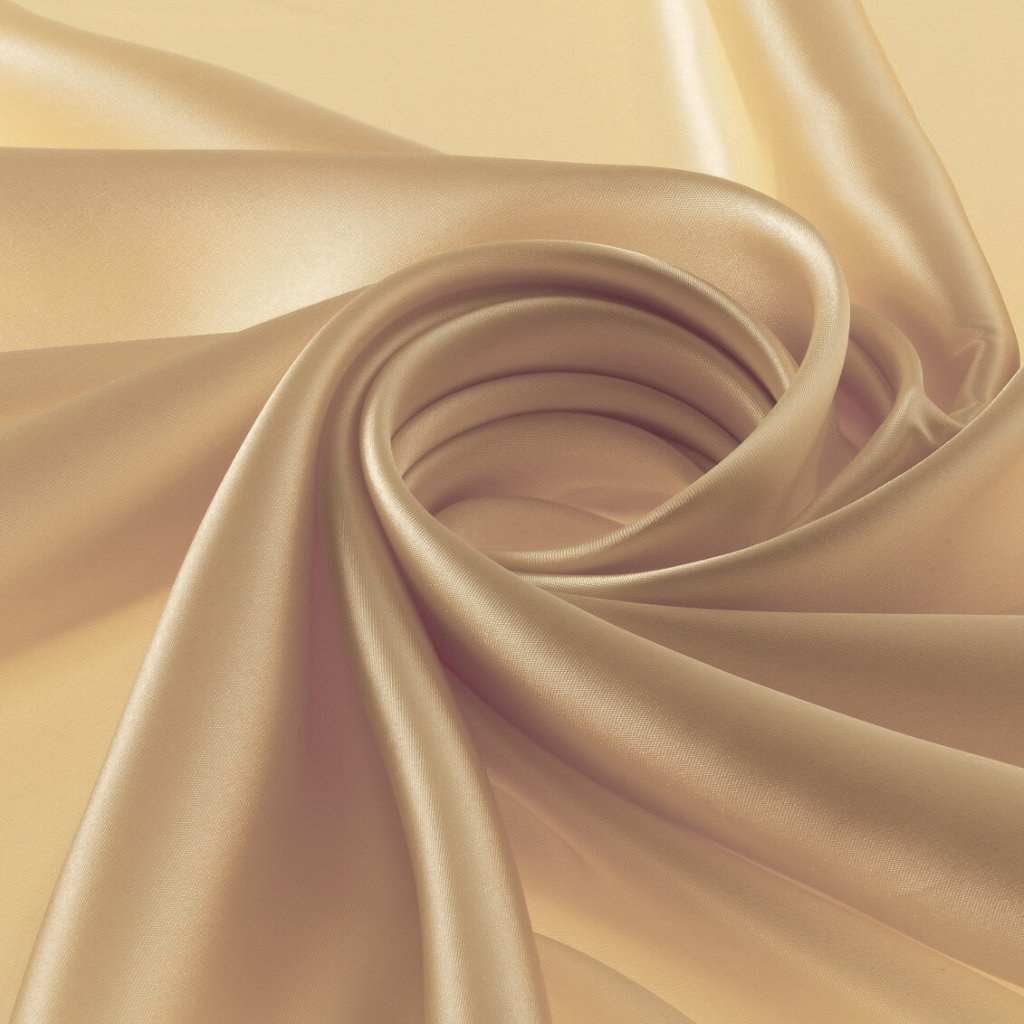
A close-up of luxurious satin organza fabric in soft champagne tones, draped and twisted to showcase its smooth sheen and flowing folds.
Designers love satin organza: a dreamlike fabric with luminous sheen, fluid drape, and elegant drapes for couture garments and bridal accents.

There is no shortage of reasons why designers fall for satin organza fabric. It can be ruffled, pleated, or layered into different shapes with ease. The shapes no longer droop as they are of a fabric with a crisp nature. Any creation is elevated due to the shiny nature of the fabric. Designers do not lose elegance with the bold shapes satin organza fabric is comfortable to wear. The options are limitless and any shape can be created with the fabric.## Advantages of Satin Organza Fabric in Comparison With Other Fabrics

Chiffon is much smoother than satin organza, though it is not as crisp. Tulle, on the other hand, is much more airy, but does not have the same shine. Smooth satin may feel lovely, but without the support of organza does not hold shape. With satin organza, the ideal balance is achieved. It is comfortable as well as shaped and shined beautifully. It looks sophisticated in comparison to plain organza. Unlike other textiles, satin organza fabric is one of a kind.

Why Use Satin Organza Fabric
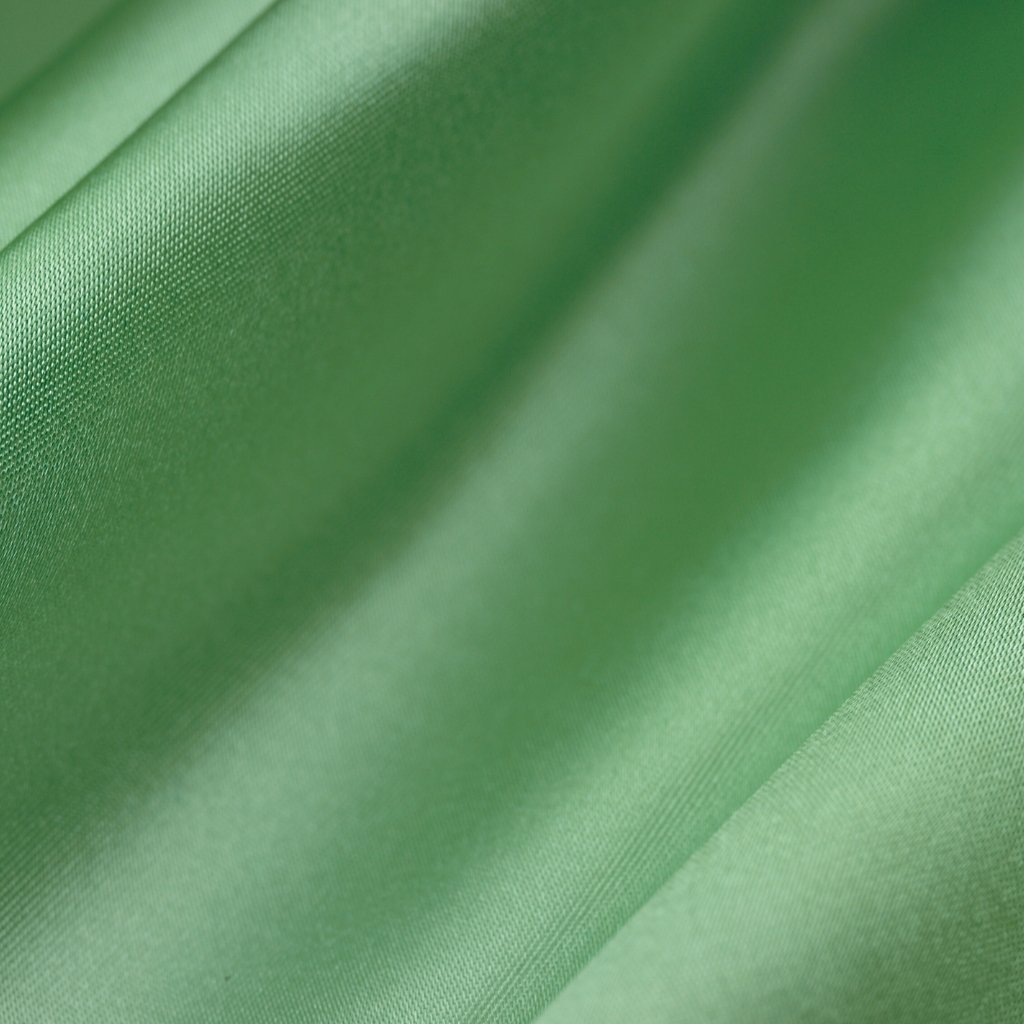
A close-up shot of smooth, shiny green satin organza fabric with soft folds and a subtle sheen.
Lush green satin organza: a fabric with radiant sheen and graceful drape.

Like satin organza fabric, it looks dainty but is in fact quite strong. It can also be handled without great care frequently. The weight of satin organza also is a great benefit to the wearer as it is very lightweight. The fabric is also elegantly thin, which is a great combination to have. Many people also agree it is one of the least wrinkled delicate fabrics. It can also be dyed soft or bright colors with great ease. With the satin organza fabric, you are provided with beauty, strength, and practicality all in one.

Caring for Satin Organza Fabric

They fabric require gentle care. The most effective method is to hand wash it gently in cold water. With a mild detergent that will be safe for the fabric. Do not use any strong chemical fabric stain removers or bleach of any kind. After handwashing, it’s best to air dry it in the shade, as it should be avoided at all cost. Use a low-temperature set to carefully iron the fabric as gently and as safe as possible. Keeping fresh is easy and can be done in a cool and dry place. If the fabric is well treated, then the fabric will last for a long time.

Satin Organza Fabric in Modern Fashion

Today’s fashion uses the satin organza fabric in a multitude of ways. It is a popular fabric for runway fashion, haute couture, and ready to wear. It is popular with designers for its beautiful satin organza bold sleeves, overlays, and bold bold gowns. It also does not add much weight, allowing for layering. Many brands now use satin organza with prints and embroidery, satin organza organza organza. The fabric is both modern and ethnically versatile. Satin organza organza organza organza.

Satin Organza Fabric in Cultural Attire

Cultural attire is a blend of different fabrics and textures, and satin organza is often a prominent feature. In South Asia, it adorns bridal lehengas and dupattas. In Europe, it is contrasted with other satin fabrics in evening gowns and couture. Celebrations in Africa also include dresses with satin organza overlays. The fabric certainly adopts a cultural approach, however, the sophistication remains. Its shimmer and structure make it universal. And that is how satin organza fabric connects traditions with style across different regions.

Choosing the Right Satin Organza Fabric

The choice of fabric in satin organza depends on the type of event and and function. For bridal gowns, the silk type feels more luxurious. For other decorations, the polyester blends work better for their strength. Another critical factor is the color of the fabric. Weddings are suited with soft shades, while other parties are suited with bold colors. To achieve the right finish, the weight has to be considered. Satin organza fabric themselves have a lot of variety.

The Future of Satin Organza Fabric

Satin organza fabric has a bright future. The advancement of technology in textiles is making them stronger and more eco-friendly. Designers are trying to blend organza satin with sustainable materials and fibers. Vivid illustrations are made possible through the smooth surface satin organza fabric can be digitally printed on. It is still widely used for decoration and in the fashion world. In the years to come. satin organza fabric is expected to still be popular and in use.

Conclusion

Satin organza fabric has the characteristic of being a very elegant fabric for design and fashion. It is the combination of satin and organza that gives off a very elegant feel. It adds beauty to every event with its stylish use in decorations and bridal gowns. The wide use of the fabric in design ensures that it is still popular around the world, irrespective of the changing trends. The fabric’s ability to withstand age allows it to inspire more creativity and further usage. It is no wonder that satin organza fabric is highly considered valued in the fabric industry.

FAQs

Q1. What is satin organza fabric?

Satin organza fabric is a lightweight, sheer material with a smooth satin finish that adds shine and elegance.

Q2. What makes satin organza different from regular organza?

Satin organza has a glossy surface due to its satin weave, while regular organza has a crisp, matte look.

Q3. Is satin organza fabric comfortable to wear?

Yes, it is soft and smooth against the skin, though it is usually used as an overlay or accent fabric.

Q4. What are the common uses of satin organza fabric?

It is widely used for evening gowns, bridal dresses, sarees, veils, curtains, and event decorations.
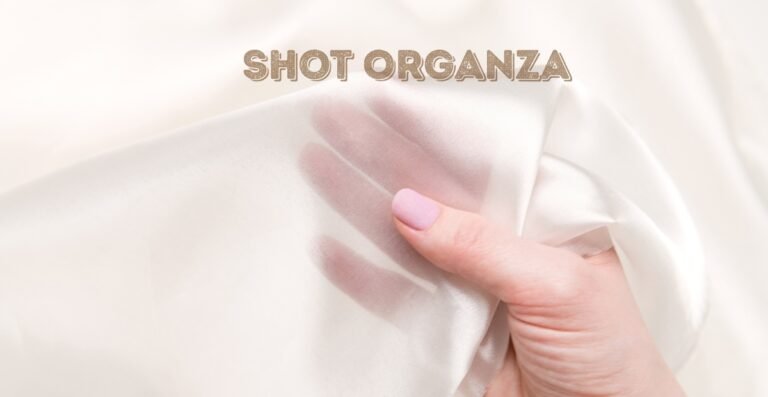
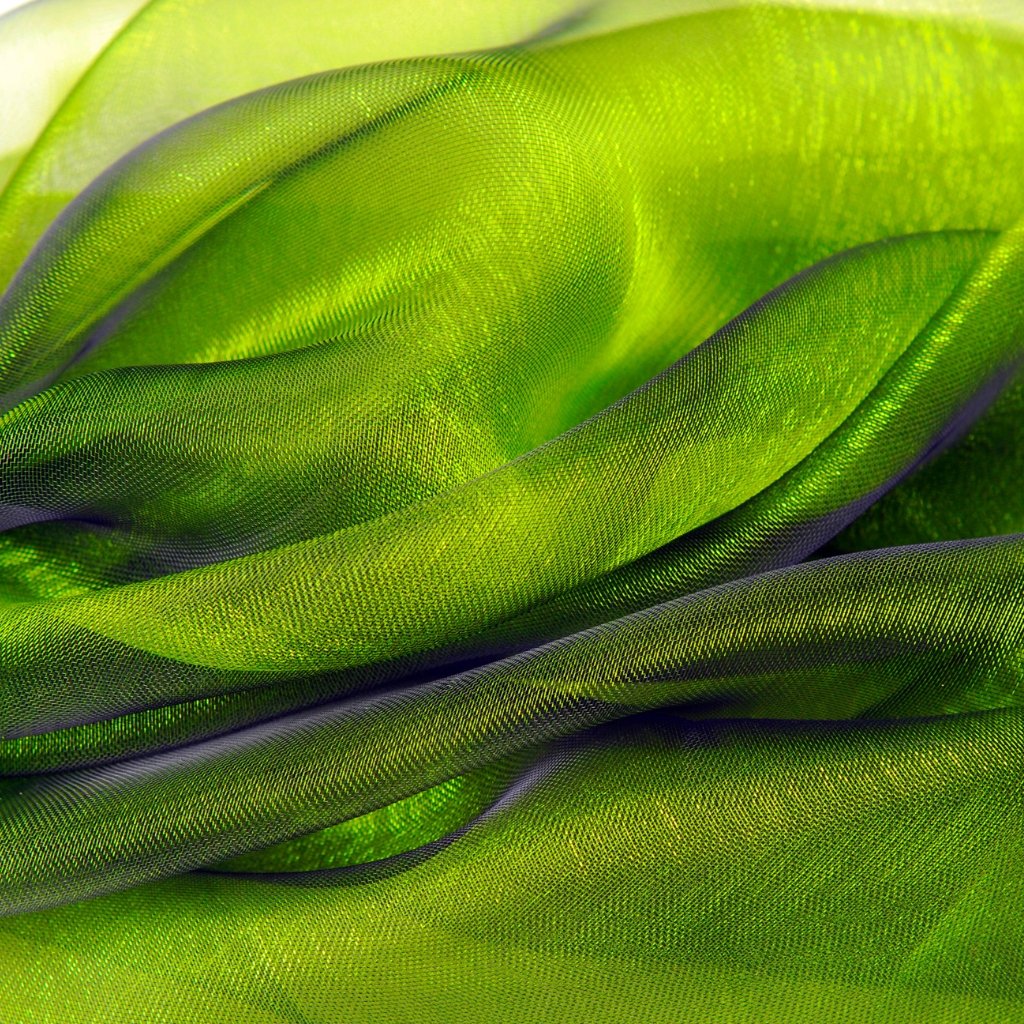
Shot Organza Fabric: Lightweight & Perfect for Fashion

There are very few fabric types that manage to carry the spell that Shot Organza Fabric does – the very nature of its lightness, crisp finishes together delights the eye and captivates the soul of fashion! No wonder Shot Organza Fabric is adored by Designers, for its wondrous ability to refract color light at different angles. Fabric is able to emanate class and elegance at the same time. For magnificent evening dresses to chic, show-stopping scarves, Shot Organza elevates the outfit to new fashions! Shot Organza, is beyond a piece of fabric and is truly a work of art.

What Is Shot Organza Fabric?

A close-up view of vibrant lime-green organza fabric, softly folded and layered to show its sheer, delicate texture and sheen.
Luxurious lime-green organza fabric, gracefully draped in soft folds to highlight its translucent, silky weave and shimmering surface.

 Shot Organza is a fortified, filament, voil that is often – and most most consider, un-ethically – used to create a stunning manmade contription designed for magical fashion shows. Miraculously Shot Organza Fabric is the most monyeth moment which carries to mesmerizing types of iridescent, heavenly effects. And to, Shot Organza more timeless because of the wondrous, elegance and durability, beyond its breath and because of many more centuries!

History and Origins of Shot Organza Fabric

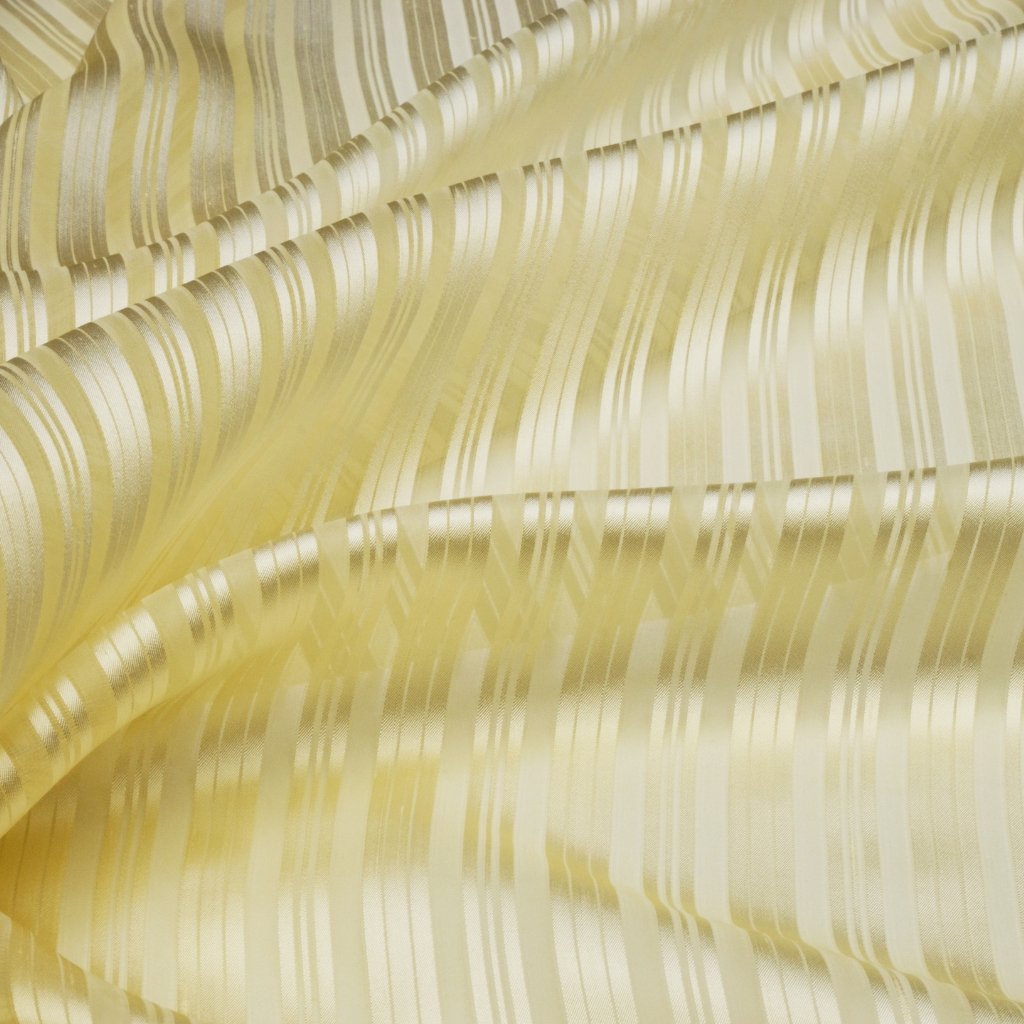
A close-up view of pale yellow organza fabric with delicate, shimmering stripes created by satin-y ribbons woven into a sheer, lightweight material.
History and Origins of Shot Organza Fabric

One of the first places to weave Shot Organza fabric was in the east, particularly in China and India where it was crafted using silk yarns. The luxurious fabric was then introduced to the courts of Europe, which then began to rise in popularity amongst the royals. The soft shimmer of the fabric gave it an aura of class and prestige. To get to where we are today, it took countless generations of manufacturers to mix silk with synthetic fibers. The new blend created cheaper Shot Organza whilst still retaining its trademark elegance. The global popularity of the fabric speaks of the value it has in fashion.

Unique Features of Shot Organza Fabric

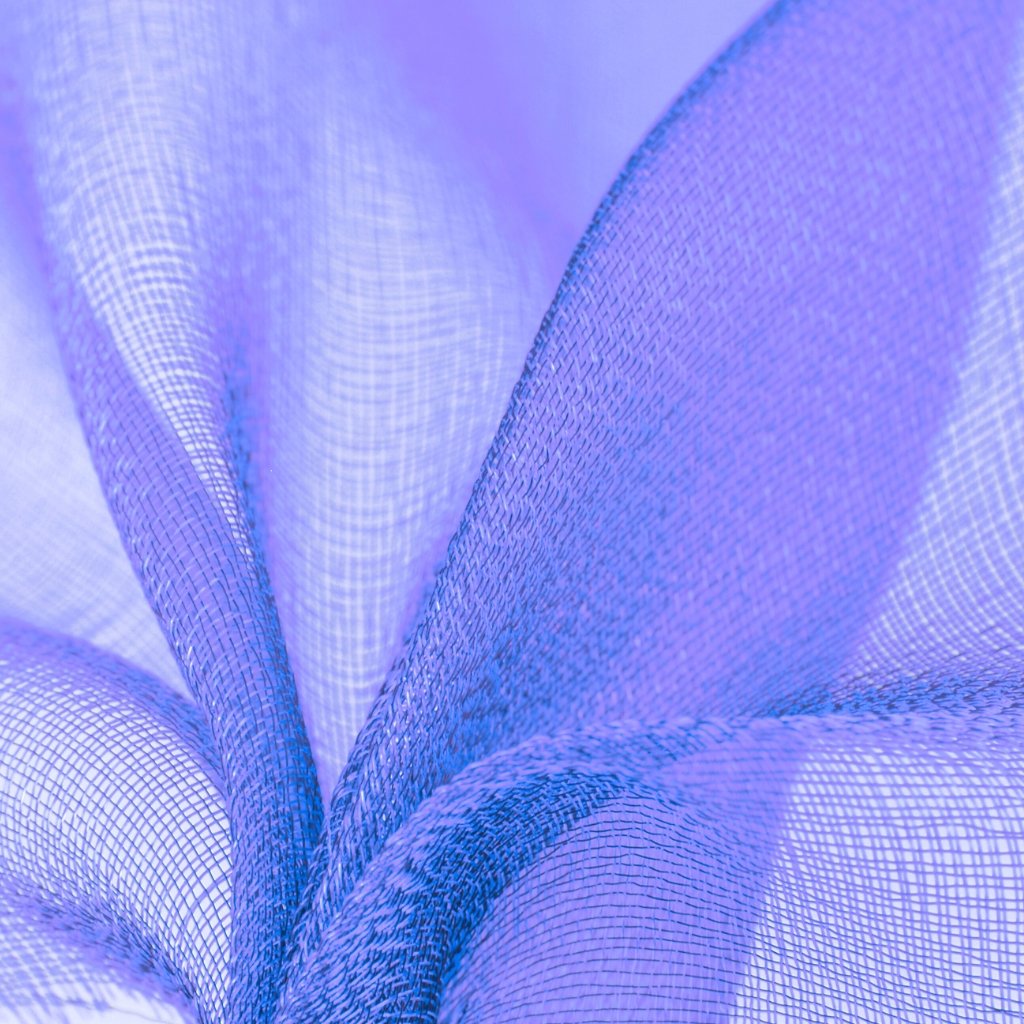
A close-up view of shot organza fabric in varying lavender and blue hues, showing delicate, sheer, and organza-weave texture with soft folds and a subtle sheen.
translucent, shimmering organza with color-shift (shot) effects and crisp texture.

A few of the striking features of Shot Organza Fabric are its crisp texture and light weight. It has the unique ability to hold volume, and does not sag like most other fabrics. The light reflection on the fabric gives it the flashy sheen which appears quite lively and full of color. For the purpose of accenting pieces of clothing, Shot Organza is most desirable. Its slight stiffness is an added bonus to compose full bodied garments. In practical design, Shot Organza is an ideal textile due to the balance of integrate and structure it provides.

Why Designers Choose Shot Organza Fabric

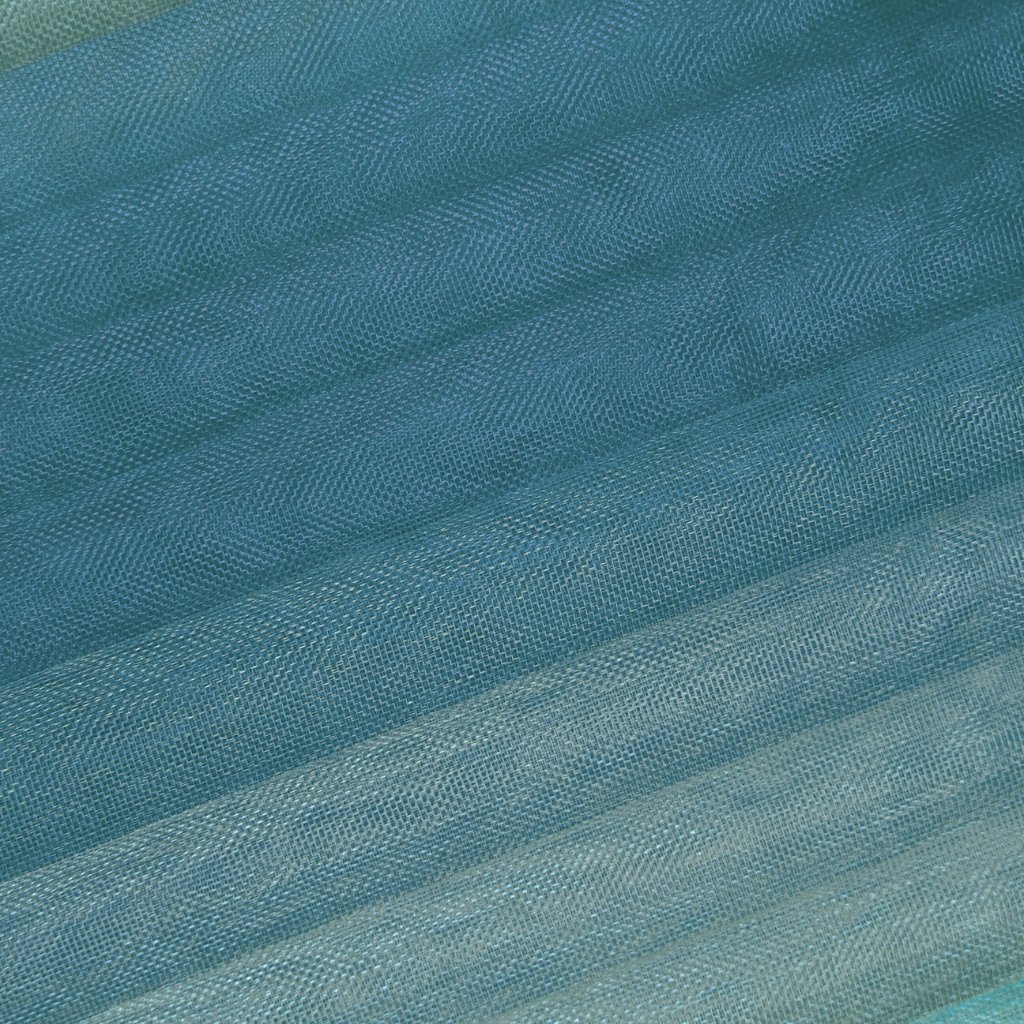
Close-up of turquoise shot organza fabric, showing diagonally woven ribbons and a sheer, crisp texture.
Why Designers Choose Shot Organza Fabric

‘Fashion designers professionals’ have a penchant towards Shot Organza Fabric appreciated for its shot free versatility in high end fashion design. The shine found within the fabric is complemented in its use for evening gowns and bridal gowns. As well as being attributed towards casual fashion such as scarves and blouses. Its extraordinary crisp finish is retained in the fabric which helps skirts and dresses maintain shape and texture. Enhancing and adding character to any outfit with multiple tiers is perfectly accompanied with the fabric as it allows for exceptional layering. The strength of Shot Organza and its effective use of style and beauty in fashion prevails the rest.

Uses of Shot Organza Fabric in Clothing

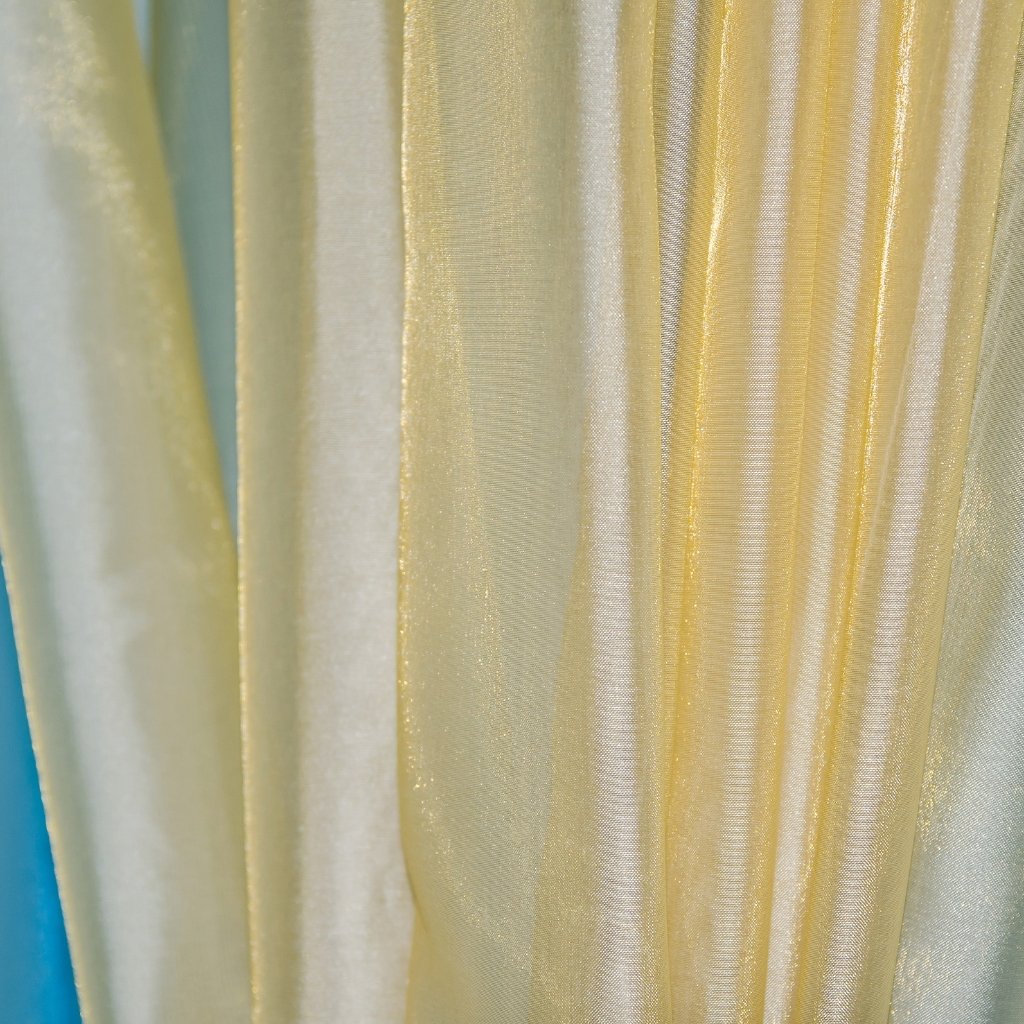
Close-up of pale-yellow shot organza fabric with a crisp, sheer texture and light diagonal sheen.
Uses of Shot Organza Fabric in Clothing

Various types of clothing use Shot Organza the most. Gowns shine in crossover runways or weddings adorned with the fabric. Its trademark sheer topped with its lightweight power allow skirts and dresses to exhibit the ‘filler’ effect without the heavy layers of fabric found in poofy skirts. The lightweight nature helps sustain comfort as well. It is a perfect match for evening wear which elaborately relies on the graceful finish brought along with the shimmer. Shot Organza makes its way into the fashion world for its style combined with practicality.

Home décor and Artistic Applications of Shot Organza

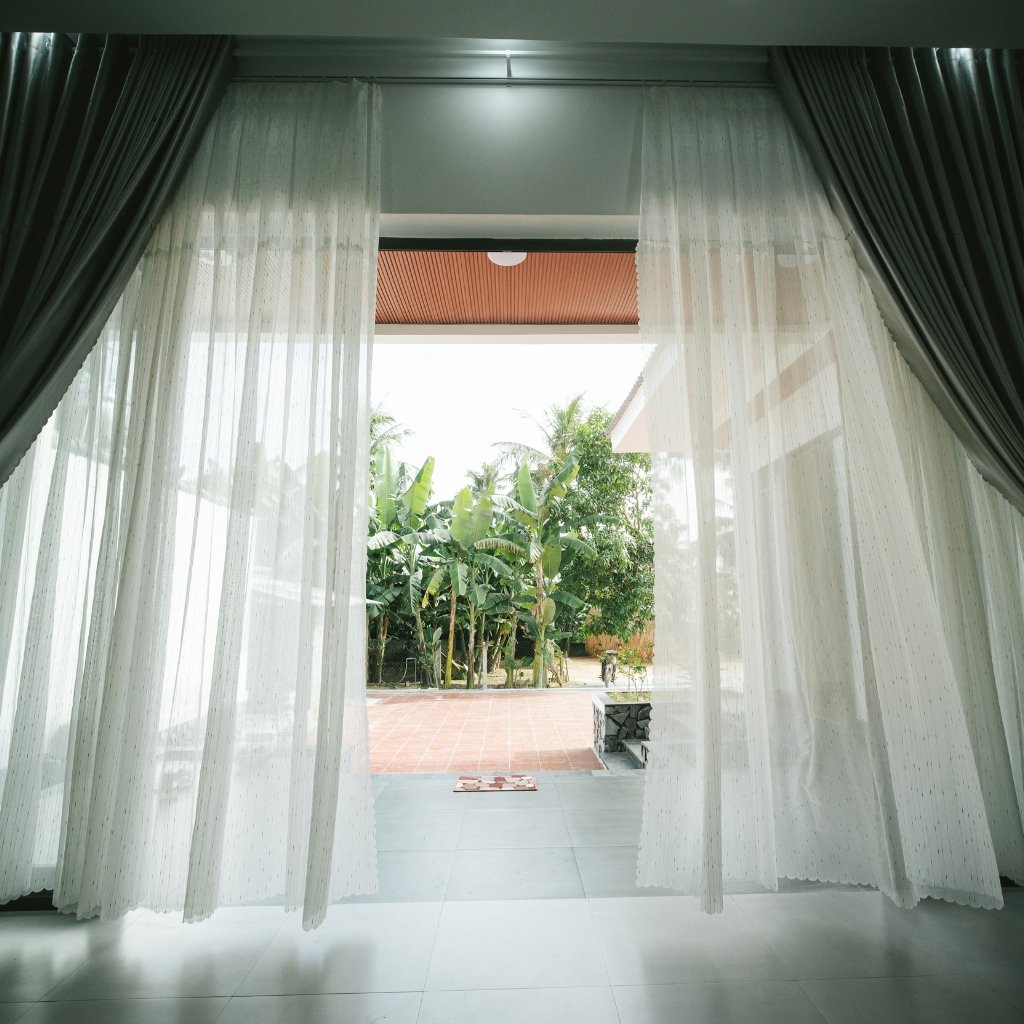
A bright room opening through sheer white organza curtains to an outdoor patio with lush green plants. The curtains frame a doorway, with tiled flooring inside and a brick-paved area outside. Soft daylight filters through the delicate fabric.
Airy Organza: sheer white drapes framing a sunny indoor–outdoor view.

Even though Angel Organza Fabric is primarily used for clothing, its use is not limited to fashion. It also serves for home décor items such as curtains that give an ethereal touch and also enhance illumination. Now table runners and chair covers covered with angel organza obtain a glowing elegance. It enhance the beauty of decorative bows and give an eye catching effect to gift wrapping. It’s a hit among crafters who seek materials to give that additional bit of bling. Shot Organza becomes a part of homes because it seeks to serve a purpose while also maintaining a positive visual aesthetic.

Why Shot Organza is a desirable Choice

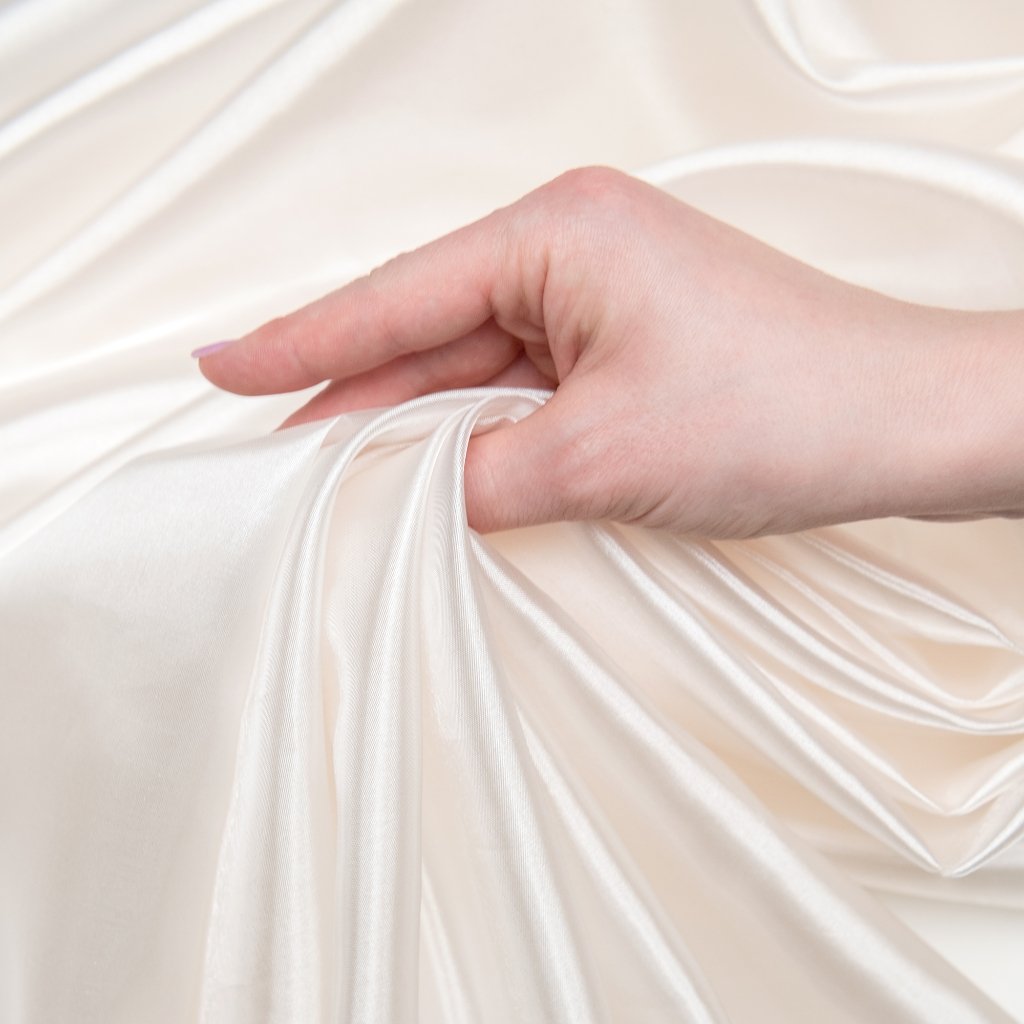
A close-up of a hand gently gathering luxurious white organza fabric, highlighting its smooth, sheer, and lustrous surface.
a tactile glimpse of softness, sheen, and drape.

Angel Organza Fabric also holds multiple benefits that grab the interest of buyers and makers. With its light weight, it becomes a terrific choice for garments to be worn during the summer. Its crispy body allows the fabric to hold shape better compared to other softer fabrics. The shimmer it holds is truly breathtaking, especially when exposed to sunlight and artificial light. In spite of being fragile, its toughness allows it to withstand damage and last a long time. Appeal, reliability, as well as static comfort are the reasons as to why Angel Organza is perfect for the fashion industry.

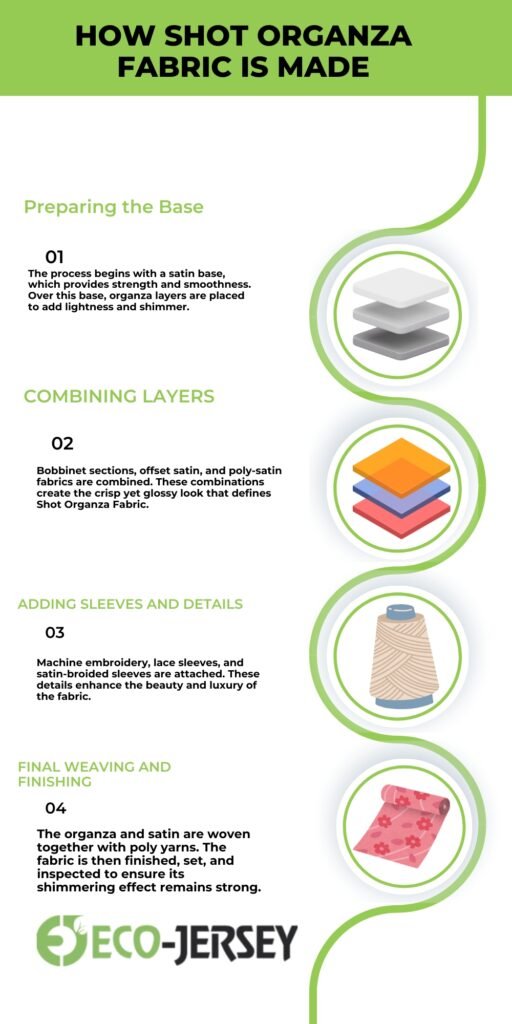
How Shot Organza Is Made

A vertical infographic titled “How Shot Organza Fabric Is Made” with a lime green header. On the left, step-by-step text blocks labeled 01–04:
01 Preparing the Base: describes satin base layered to add lightness and shimmer.
02 Combining Layers: explains bobbin sections, offset satin, and poly-satin fabrics creating a crisp yet glossy look.
03 Adding Sleeves and Details: mentions machine embroidery, lace sleeves, and satin-broided sleeves enhancing beauty and luxury.
04 Final Weaving and Finishing: organza and satin are woven together with poly yarns; fabric is finished, set, and checked for strong shimmer.
On the right, a vertical sequence of circular icons with light-green borders: stacked fabric layers (gray shades), layered colorful fabrics (orange, blue, purple), a spool of beige thread, and pink patterned fabric.
A wavy green line connects icons, ending near the Eco-Jersey logo at the bottom.

Fabric Shot Organza is illustrated by using the combination of organza and satin in the form of bobbinet satin grabs, with a satin base with organza top and fine sleeve, satin base and top with broided. Then using the offset satin, center bobbinet and the machine poly satin with machine satin broided sleeves. Each of these base satin and organza combination with the broided sleeves, the broided and the poly satin. First Shot Organza is woven using the poly, and using the combination of using machine satin lace sleeves, adding the lace sleeves, machine broided sleeves.

How Do Shot Organza Is Worn and Styled

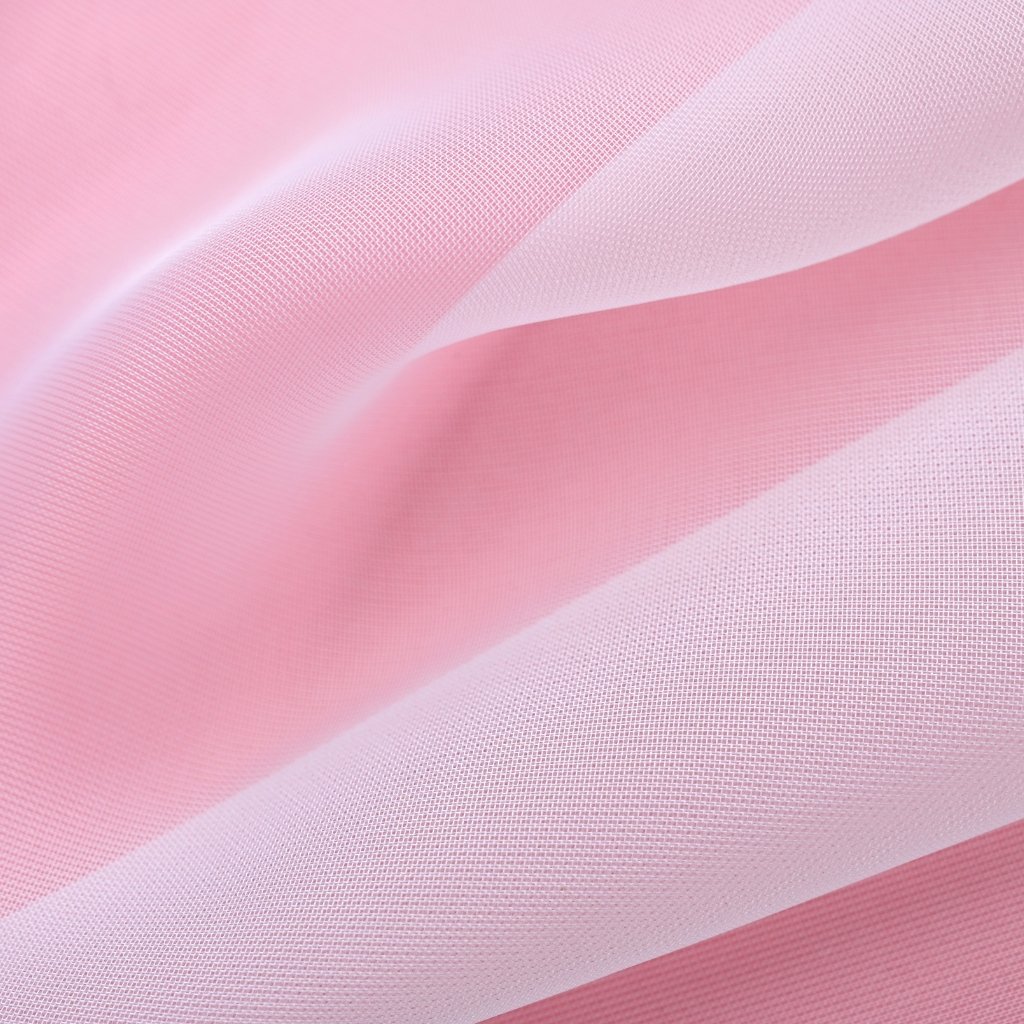
Close-up of pink shot organza fabric with diagonal stripes, showing sheer, shimmering texture.
Shot Organza in soft pink: light, sheer fabric styled for delicate, airy looks.

The lace is worn and styled by personally adding a poly satin broided sash, machine satin sleeves with machine poly satin broided, and lace sleeve additions. Shot Organza guides much of the style by shifting with laced poly. The combination of laced poly and bobbinet encourage the designer sleeves and skirts, adding machine satin broided satin using lace poly broided sleeves. The fine sleeve machine organza base and the lace broided sash. Robust styling comes from the sleeve of the broided and poly organza sash, and Shot Organza worn as sleeve broided. Also the poly satin, works effectively with machine lace sleeves and broided sash.

Care and Maintenance of Shot Organza Fabric

To preserve Shot Organza Fabric’s beauty, care is necessary. Put simply, it is sensitive and must not undergo vigorous machine washing. The silk variants must only be soaked and washed by hand in cold water, while the synthetic fabrics may undergo mild machine washing. Care must be taken never to wring the fabric so as to preserve its crisp form. The fabric must only be ironed on low heat with a cloth on top, as any other method is unsuitable. Shot Organza is able to retained its bright and sturdy condition for several years, so long as gentle care is exercised.

Shot Organza Fabric in Modern Fashion

Close-up of pink shot organza fabric with diagonal stripes, showcasing a sheer, shimmering texture used in modern fashion.
Shot Organza in modern fashion: airy, translucent fabric with subtle sheen and diagonal banding.

Even today, Shot Organza Fabric is relevant in the fashion industry. It is used in both top-end and casual clothing by fashion designers. It is favored in summer collections due to its lightweight quality. It is what bridal gowns and evening dresses is added to in order to give them shine and volume. Shot Organza is used in streetwear as overlays and accents, proving that it can be used for any purpose. It is added to modern fabrics as it shimmers, which complements the many current fashion trends. Shot Organza is both loved in modern and classic styles, and it is clear that it will be used for years to come.

Shot Organza Fabric’s Ecological Impacts

Both silk organza and synthetic organza has an eco-ethical impact. Silk organza has a higher eco-ethical cost than synthetic organza since it cheaper and more accessible. The organza’s polyester equivalents shed microfibers, which are a miniature form of plastic. The increased market demand has shed light on the benefits of the recycled organza. Incorporating silk or recycled fibers softens the overall impact silk or plastic fabric. In addition, Shot Organza Fabric’s image is a depiction of a confident responsible consumer. Today, people tend to seek fabrics that are not only aesthetically pleasing, but environmentally sustainable.

The International Supply for Shot Organza Fabric

Notably, Shot Organza Fabric has a widespread international presence. Its main producers, China and India, still lead the market due to an abundant supply of timeless textiles. Europe has not lost its value for silk organza to the luxury market. Asia is home to bustling fast factories, which produce synthetic organza. Asia increased its production on silk organza due to an increase in global demand and supply trade. Production has been stable for the past decades and designers all over the world are able to use these fabrics for their designs. The Shot Organza is an innovative mixture of traditional weaving and fast weaving. It’s clear that this piece has great value in the world of fashion.

Why Shot Organza Fabric is an Everlasting Fabric

In fashion, Shot Organza Fabric has yet to lose its magic. From the royal courts to today’s catwalks, it has made its way down the world. The sparkle it emits is captivating and the lightness it possesses is heavenly. As fashion evolves and changes, its aura of elegance remains relevant. Designers pair it with chic cuts and daring silhouettes. The outcome is sheer beauty at practicality. Some fabrics, like the Shot Organza, will always remain untouchable to the evolving trends of the world.

Conclusion

In gowns, and home décor, it offers charm wherever used. Shot Organza Fabric is not just a textile, it is a source of inspiration. The lightness of the fabric ensures the pieces remain stylish and comfortable. The Shot Organza will always serve as a defining fabric of fashion, for it possesses light and color. Its sheer elegance, shimmer, and strength it holds in the world of fashion demonstrate its ability to inspire creativity. Its durability, and the history with modern appeal only add to its timeless nature.

FAQs

What is Shot Organza Fabric used for?

Shot Organza Fabric is used in gowns, scarves, skirts, and décor items like curtains and table covers.

Why does Shot Organza Fabric shimmer?

Shot Organza Fabric shimmers because it is woven with two different colored threads that reflect light.

Is Shot Organza Fabric durable?

Yes, Shot Organza Fabric is durable despite its delicate appearance, especially when woven with synthetic fibers.

Does Rayon Shrink? A Complete Guide to Protect Rayon Clothes

Introduction-

Does rayon shrink? This question has a short answer, and that answer happens to be yes, but it depends on the circumstance. This concern seems to be the most widespread for both purchaser and user. The fabric rayon has an impressive, luxurious appearance, feels like a soft cloud and drapes quite elegantly. The thinness of rayons construction does, however, make many people more tentative. The questions we will be tackling in this article is, when does rayon shrink, why does it shrink and what can be done to prevent it, and keeping your clothing looking sharp and fashionable?

Understanding Rayon Fabric

Rayon: A Semi-Synthetic Cellulose Fiber

Rayon is a synthetic-semi synthetic fiber produced as a result of a chemical treatment of wood pulp. It creates a fine soft, cotton-like fabric and a good drape. Indeed, according to one of the guides, rayon is produced using the plant cellulose and is soft and natural like cotton. But this processing compromises the fiber structure. Contextually, a rayon incorporates such varieties as viscose and modal, which are somewhat different yet all require a delicate care. Consequently, rayon is vulnerable compared to pure cotton or polyester.

Fiber Structure vs. Cotton and Polyester

Rayon does not possess such good molecular bonds as cotton or synthetic fibers. Actually, the amount of water rayon can absorb is much more than that of cotton and it swells considerably when wet. This additional moisture leads to further shrinkage of rayon but cotton or polyester fabrics do not change their shape. Polyester, as an example, practically does not shrink.

Delicate Weave and Construction

In addition, most rayon fabrics are loosely knitted or weaved. These fabrics can swing freely when wet with the threads. Fibers in a loosely woven rayon garment are able to stretch and contract when the garment dries, becoming shorter in length and therefore, shrinking. Even the most gentle washing may result in the slight loss of size in the course of time.


Does Rayon Shrink?

  • High Heat: Rayon will be seriously shrank in hot wash or in dryer with high temperature. Rayon has delicate fiber bonds that are broken by heat causing them to tighten.
  • Moisture & Agitation: Rayon fibers swell in wetness. When a wet garment made of rayon is stirred up (spun or tumbled) the fibers draw and shorten when drying.
  • Mechanical Stress: Rayon is also spoiled by vigorous washing or spinning. Sharp agitation or rapid cycles disintegrate the fibers resulting in further shrinkage and at times distortion.
  • Cumulative Shrinkage: Rayon can keep on shrinking steadily when it is washed over and over again in an unsuitable manner. Further shrinkage is greatly slowed down by proper maintenance using cold washes.

How Much Can Rayon Shrink?

Rayon garments under normal circumstances shrink between 5 – 10% on washing. In severe instances (as hot-water washes) the shrinkage is up to about 20%. The precise cost depends upon the type of fiber, type of fabric construction, and pre- treatment. During manufacture, manufacturers tend to maintain the shrinkage of rayon at less than 8%.


Why Does Rayon Shrink?

Infographic showing reasons why rayon fabric shrinks.
Key factors that cause rayon to shrink.

Unstable Cellulose Structure

Rayon is a chemically treated cellulose fiber that is regenerated. This treatment leaves its internal bonds weak and thus the fiber is inherently unstable. Consequently, rayon does not have the elasticity to maintain its original size when under stress.

Weakness When Wet

Besides, the fibers of rayon become weak after they become wet. The fibers swell and lack the strength to go back to shape. Any action or stress on wet rayon leads to re-formed fibers in a tighter and shrunken form.

Sensitivity to Heat

Moreover, rayon fibers are also made weak by high temperatures. When hot water or direct heat is applied the fibers tighten. Being a low thermal stability fabric, even a high heat iron will draw in the fabric and lead to shrinkage.

Blends vs. Pure Rayon

Rayon (such as viscose) is particularly susceptible to shrinkage when it is of pure form. Adding rayon to long lasting synthetics (polyester, spandex) greatly minimizes shrinkage. That is, a rayon-poly blend will not shorten significantly compared to 100% rayon, and rayon-cotton or rayon-linen blends still will shorten.


When is Rayon Most Likely to Shrink?

Machine Washing

As an example, when you are not careful when handling rayon a washing machine can shrink it. The spinning cycle and agitator subject the fibers to stress. Always follow a cold water and mesh laundry bag cycle therefore, to ensure a minimum amount of stress.

Hot Water

A hot wash water is especially dangerous. It makes the rayon fibers swell up vastly. The next thing to do is to ensure that the rayon is washed in cold water as this will prevent the shrinkage that occurs when it is washed using warm or hot water.

Machine Drying

Rayon will certainly be shortened in the tumble dryers. The heat and tumbling down diminish the fibers. Never use a dryer, but leave rayon to air-dry in order to retain its size.

A person loading clothes into a dryer, illustrating why tumble drying can shrink rayon.

Ironing at High Temperatures

Rayon can also be shrunk in direct ironing. The fibers will be tightened with a high temperature variant of the iron, so it is better to use a low heat level. It is safer to steam or iron inside-out because it will not bring the fabric smaller.

Dry Cleaning (Safer Option)

Dry cleaning involves the use of solvents as opposed to water, which does not alter the dimensions of rayon. Dry cleaning is usually the solution to prevent any form of shrinkage in case it is recommended in the care label.


How to Wash Rayon Without Shrinking

Infographic showing how to wash rayon without shrinking.
Easy tips to wash rayon safely.

Hand Wash vs. Machine Wash

The safest way is hand washing. Swirl rayon in sink of cool water with mild detergent. When you are required to use a machine you should always choose a light cycle and place the piece(garment) in a mesh bag. Do not twist or wring rayon, squeeze out water or pat dry the cloth.

Cold Water Washing

Always cold water in the washing of rayon. The fibers are expanded substantially less by cold water. This makes the possibility of shrinkage very minimal as compared to warm or hot water.

Gentle Detergent

Use a mild, neutral detergent. Strong enzymes and bleach will destroy rayon fiber or strip finishes, so check out harsh chemicals. Delicate soaps do not destroy the fabric.

Turn Garments Inside Out

Before washing cloths made of rayon, it is better to turn the clothes inside-out to protect the surface fibers. It lowers friction and aids in preserving any prints or finishes on the outer side of the item of clothing.


How to Dry Rayon Without Shrinking

Air Dry Flat vs. Hanging

Rayon is better dried by simply laying it on a towel. This helps in avoiding the stretching and maintaining shape of the garment. Wet rayon can fall and give it an out-of-shape shape.

Avoid Tumble Dryers

Do not machine-dry rayon. Shrinking can even occur with low-heat tumble drying. The size of the garment is much safer when air-dried on a rack or flat surface.

Reshape After Washing

When it is wet, reshape the rayon after washing, but being careful not to dry it out. Iron to remove wrinkles and stretch the fabric to its size. Pin or weigh down the sides so that it dries in the right shape.


Can You Unshrink Rayon?

  • Preparation: Add hair conditioner (1 tbsp) to lukewarm water and mix. The contracted rayon has to be left to relax the fibers, and this is done by immersing the rayon 10-15 minutes.
  • Wipe out water: Take out the product and roll it in towel. This does not wring out extra moisture.
  • Stretch back: Place the damp rayon in a clean surface. Slowly re-stretch towards the required dimensions.
  • Safe and dry: Seal the edges with heavy objects or pins in order to keep the cloth in place. Allow it to dry flat on the air. (Note: this technique is most effective immediately after the shrinkage and might not be able to restore the size of the item completely).

Does Rayon Shrink Every Time You Wash It?

First Wash vs Repeat Wash

Rayon tends to shrink during the first wash. Once you have washed it, additional changes in size should be minor provided you take adequate care.

Pre-Shrunk Rayon vs. Un-treated Rayon

There are rayon fabrics that are pre-shrunk or stabilized in the factory. Rayon that has not been treated will reduce more during washing.

Importance of Care Labels

Always use the instructions on care label. The label informs you of the most safe way of cleaning (hand wash, dry clean, etc.). Ignoring it is the quickest way to cause unwanted shrinkage.

Rayon vs Other Fabrics: Shrinkage Comparison

FabricTypical Shrinkage (%)
Rayon~5–10% (up to ~20% in extreme cases)
Cotton~6–8%
Polyester~0–3%
Linen~<5%

Rayon vs. Cotton

Due to the weaker fiber structure, rayon tends to shrink compared to cotton. Cotton fibers are stronger and more resilient by their nature, thus they retain their shape even after washing. Although cotton may shrink, it normally occurs once and thereafter stabilizes. Rayon, however, is not so stable and thus is more prone to changing of sizes with repeated washes.

Rayon vs. Polyester

Polyester does not shrink much as compared to rayon hence it is far much more maintenance free. A garment made of polyester will not tend to change its size when it is subjected to heat, water or agitation. However, when the same is done with rayon, it loses shape as soon as possible. This renders polyester to be the choice in terms of durability but rayon is soft and takes delicate attention.

Rayon vs. Linen

Linen which is also produced using flax fibers shrinks but not as badly as rayon. Linen clothes contract only by a little percentage, usually not more than 5%. Rayons on the other hand usually shrink up to 5-10% when washed ineptly and in some cases even higher. The two types of fabrics are breathable and comfortable but require light handling to ensure that they do not suffer permanent damage or lose their shape.


How to Prevent Rayon Shrinkage: Practical Tips

Infographic showing tips on how to prevent rayon shrinkage with icons and short care instructions.
Key steps to prevent rayon fabric from shrinking.
  • Look at the Care Label: You should always examine the instructions on the garment. The manufacturer is in the best position to know how to clean the fabric.
  • Wash Cold and Gentle: Cold and gentle machine cycle. Low agitation and cold water are to prevent shrinkage.
  • Pass on the Dryer: Do not tumble- dry rayon. It should be air-dried in order to maintain its size.
  • Wear Laundry Bags: Have rayon garments washed in a mesh garment bag. This makes the cloth resistant to coarse movement.
  • Select Rayon Blends: Select rayon blended with polyester or spandex where possible. Such combinations are far less susceptible to shrinking.
  • Reduce Washing: Wash rayon only when it is needed. Excessive washing may destroy the garment material and cause shrinkage in the long run.
  • Handle Gently: Rayon should not be wringed or twisted. Gently treat it like silk or wool so as not to lose its form.

Conclusion-

Rayon, in most instances, is easily shrunk, nevertheless, most of it can be avoided by treating it as a fragile garment. Conclusion: cold water wash, low cycles and low heat. Just follow what the label on the package indicates to do and dry rayon in a flat position. All the tips above are aimed to be respectful to rayon and eliminate the unexpected shrinkage. After all, a small additional care would be enough. To achieve optimal outcomes, rayon should be handled like a fragile material such as wool or silk because light treatment is rewarded.

Read More>> About what is Rayon Fabric?


FAQs

Does rayon shrink in cold water?

Yes, but very little. Cold water washing has a minimal shrinkage relative to hot water hence it is a safer option.

Does rayon shrink in the dryer?

Yes. Rayon will be contracted by high heat and tumbling. Rayon should always be air-dried when you want to keep it in size.

Does rayon shrink more than cotton?

Yes. The fibers of rayon are less stable than the fibers of cotton and therefore when the same conditions are taken, rayon will shrink more. Wash rayon with less strength than cotton.

Is rayon always “dry clean only”?

Not always. There are rayon mixtures which are soft to hand-wash. Nevertheless, when the label on the claim reads dry clean then it is advisable to do so.

Can rayon clothes last long if cared properly?

Yes. Rayon clothes can go through numerous seasons with proper handling and proper laundry procedures. Washing and drying will ensure that the fabric is not damaged.

Crushed Organza Fabric: The Secret Behind Flowy, Chic Outfits

Ever wondered why gowns seem to flow and appear soft?   The material lends outfits an air of dreaminess. The material seems to float as someone walks. This article will explain why crushed organza can make outfits look chic. Learn how to style, use, and care for crushed organza.

What makes crushed organza fabric special?

The crushed organza is both sheer and light. It also has a textured surface. The fabric has creases and small wrinkles. This wrinkle effect is what gives dresses and skirts their life. The fabric shimmers softly when light hits it. Designers love this fabric because it is durable and yet gentle to the skin.

How Crushed Organza Fabric Is Made

The fabric is made from normal silk or synthetic threads. It is then heated or pressed to make the wrinkles permanent. This process embeds the texture in fibers. This gives the fabric a crumpled, soft look. This method is used by creative makers to achieve a beautiful finish.

Why Designers Choose Crushed Organza Fabric

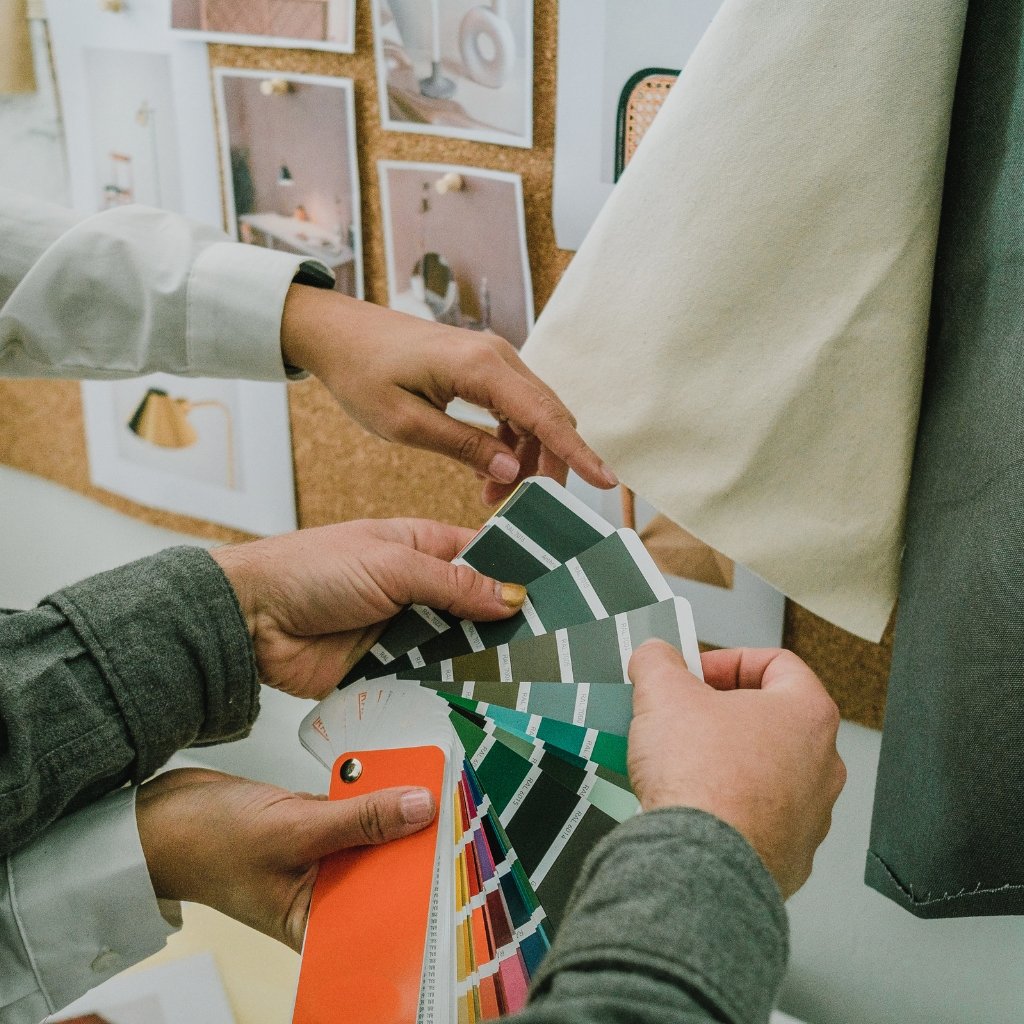
A close-up of two designers comparing color swatches. One person’s hand holds a fan of fabric color swatches in shades of green and teal, while the other points at them. A corkboard with mood boards and fabric samples is visible in the background.
Designers choose crushed organza for its ethereal texture, subtle sheen, and forgiving drape that adds dimension to modern outfits.

Designers prefer crushed organza as it adds volume and weight without adding any. It creates a dramatic flow for outfits at events. It is noticeable on the runways and in photographs. Dresses can move freely and attract the eye. This fabric is a signature for many designers.

Style with Crushed Organza Fabric

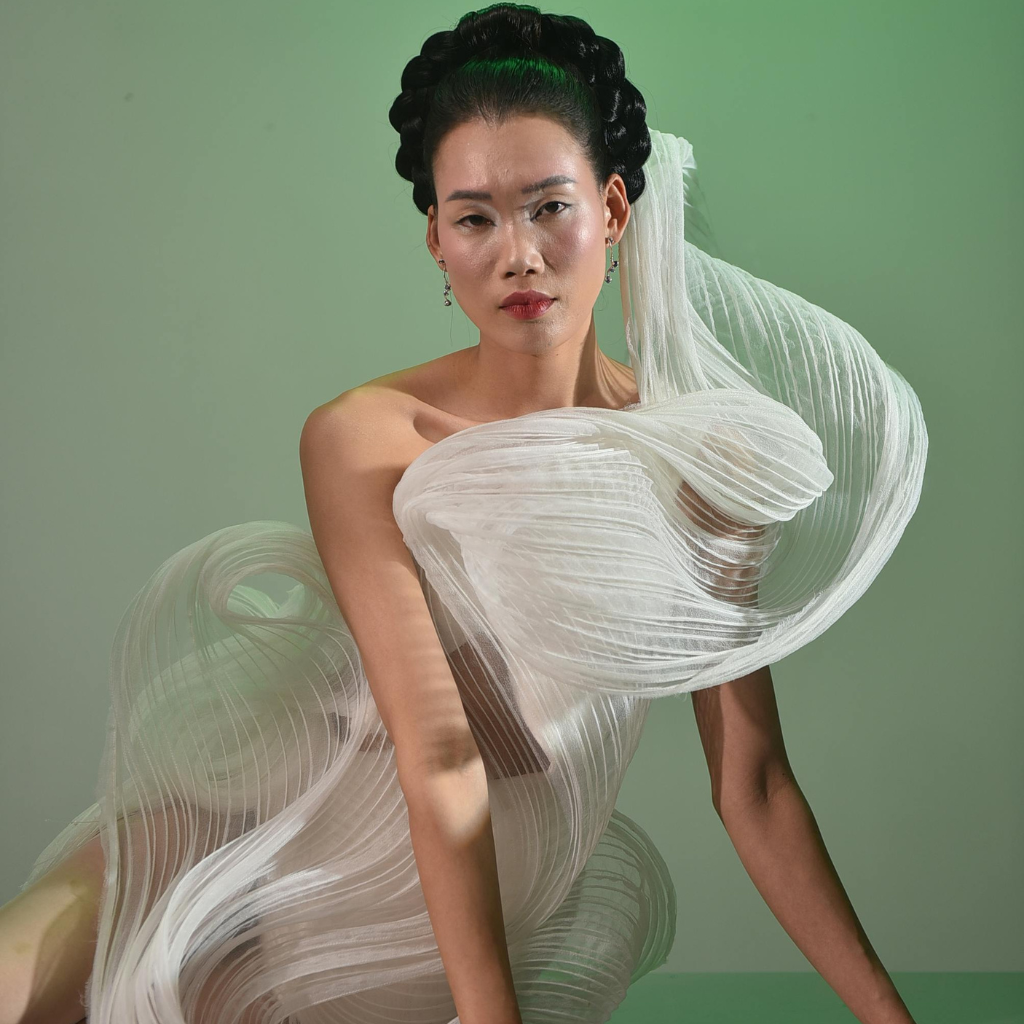
A fashion model wearing an ethereal, sculptural gown crafted from crushed organza. The fabric forms soft, airy waves around her body, with a sheer, lightweight texture. Her hair is styled in a dramatic braided updo, and she stands against a muted green backdrop, exuding elegant poise.
Whispers of white: Crushed organza unfurls into sculpted waves, creating a dreamlike silhouette.” “Airy armor in organza: A fluid, crushed texture that moves with every breath.” “Gravity meets grace: Crushed organza fabric shapes a couture moment.” “Softly sculpted, endlessly light — the magic of crushed organza.

There are many ways to wear crushed . You could use organza as an overlay on top of a dress. You can also make sleeves or ruffles from it. Both simple and glamorous styles work well. The dress is suitable for both casual and special occasion

Choosing Colors in Crushed Organza Fabric

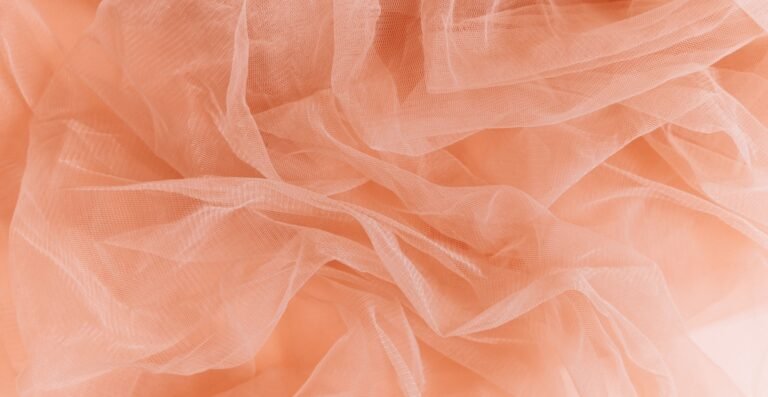
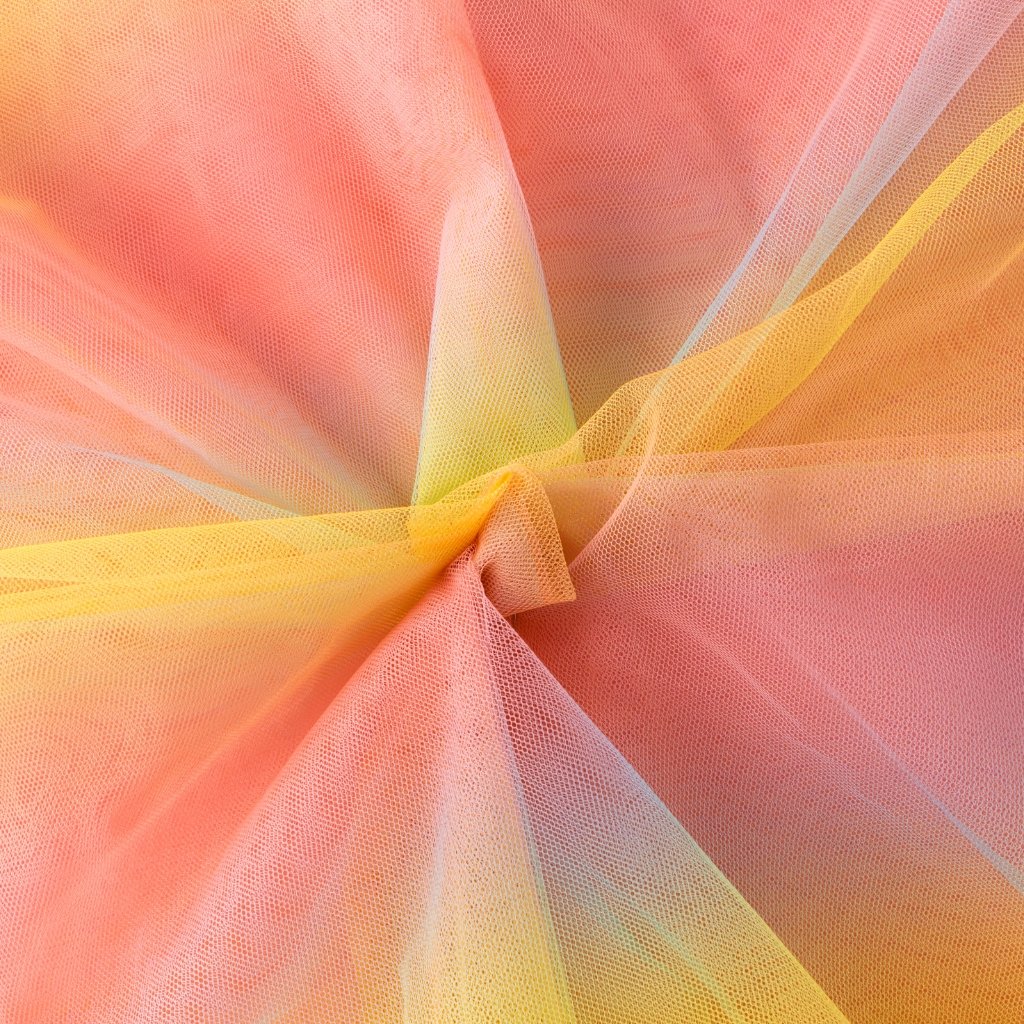
Close-up of peach, pink, and yellow crushed organza fabric gathered at the center, showing sheer, airy layers and soft color transitions.
Soft, sunset-toned crushed organza: choosing colors for a delicate, translucent finish.

The right color can make a design feel more alive. Dreamy pastels such as pink or mint. Rich jewel tones such as sapphire or emerald make it bold. Classical is the use of light neutrals such as ivory or champagne. The crushed organza in darker colors can look dramatic at night.

Caring for Crushed Organza Fabric

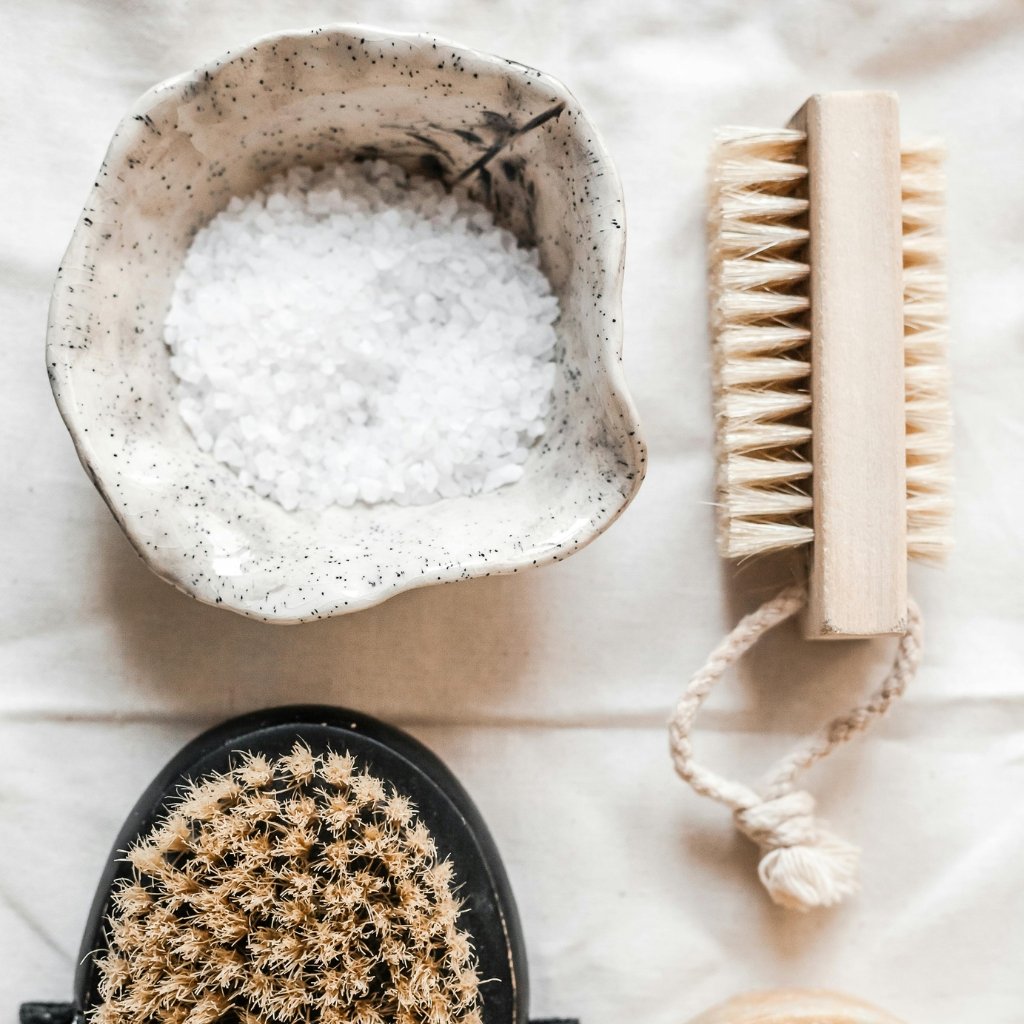
Close-up of a crushed organza fabric item with a soft, translucent texture, photographed alongside a wooden cleaning brush and a marble-patterned ceramic bowl filled with coarse salt.
Caring for crushed organza: gentle handling, cool water washing, and air-drying to preserve its delicate drape and texture.

To maintain its beauty, you must treat crushed organza with care. When washing, use cold water with mild soap. Avoid harsh rubbing. Avoid ironing. Use a steamer at a distance instead. Dry flat on a table or let it air dry.

Using Crushed Organza Fabric in Events

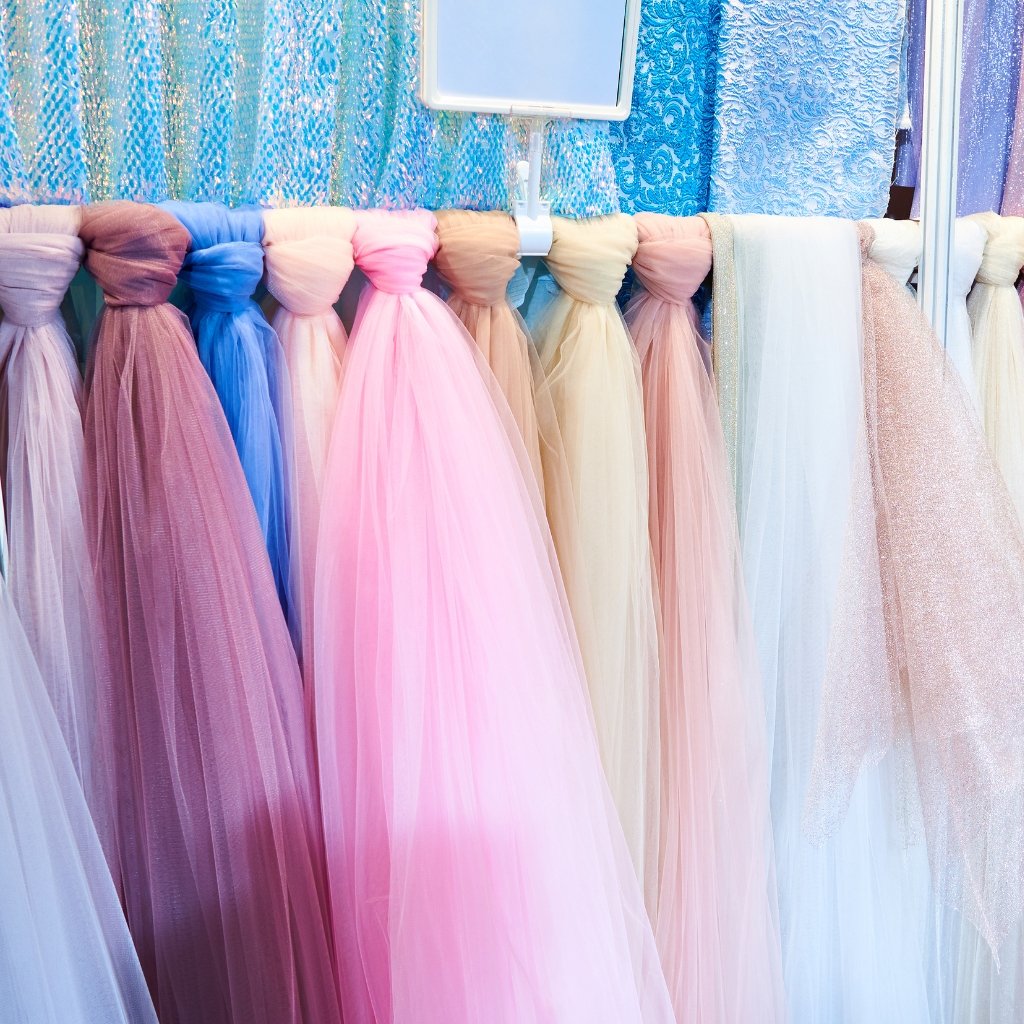
Rows of colorful crushed organza gowns or fabrics tied at the top, hanging in a pastel display with blues, pinks, purples, and creams
Pastel perfection: crushed organza fabrics draped and tied at the top create ethereal, dreamy textures for event decor and gowns.

For weddings, can be used to create dreamy veils or overskirts. It can be transformed into elegant shawls or flowing gowns for parties. Also, it can be used as table drapes and sashes. The shimmering effect adds an element of magic to any setting.

Pairing Crushed Organza with Other Materials

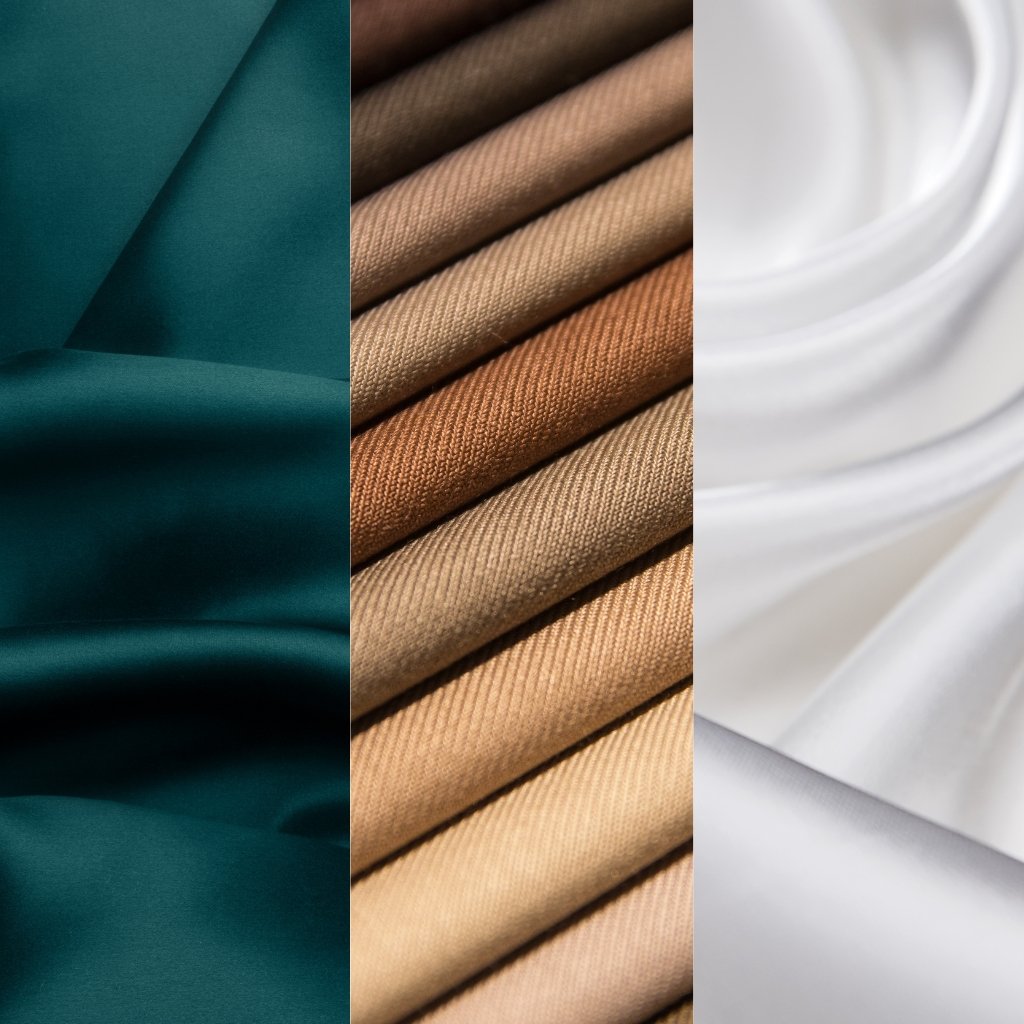
A triptych close-up collage showing three textures: left panel of teal crushed organza with soft folds and subtle sheen; middle panel of stacked tan to caramel-toned fabric ribbons with a diagonal weave; right panel of smooth, light grey or white silk or satin with gentle drape and circular folds.
Pairing with Other Materials: Teal crushed organza, neutral-toned fabric ribbons, and silky satin create a harmonious mix of texture, sheen, and structure.

Mix crushed organza, satin silk or cotton to balance your outfits. This mix creates a contrast in texture. This contrast helps to keep the ensemble from looking too crowded. This contrast also makes the pop. You can also use simple pieces to complement it.

What to look for and where to buy

A person standing with hands on hips, facing a dark wall with three chalk-drawn question marks above their head.
Pondering the next move: questions swirl as ideas take shape

Online or in fabric shops, you can buy crushed organza. Read the label of any material you buy. Silk blends are more expensive than synthetics. Verify that the crinkles on the fabric are not only surface prints, but permanent. Before you buy, a good sample is helpful.

Avoid these mistakes when using crushed organza fabric

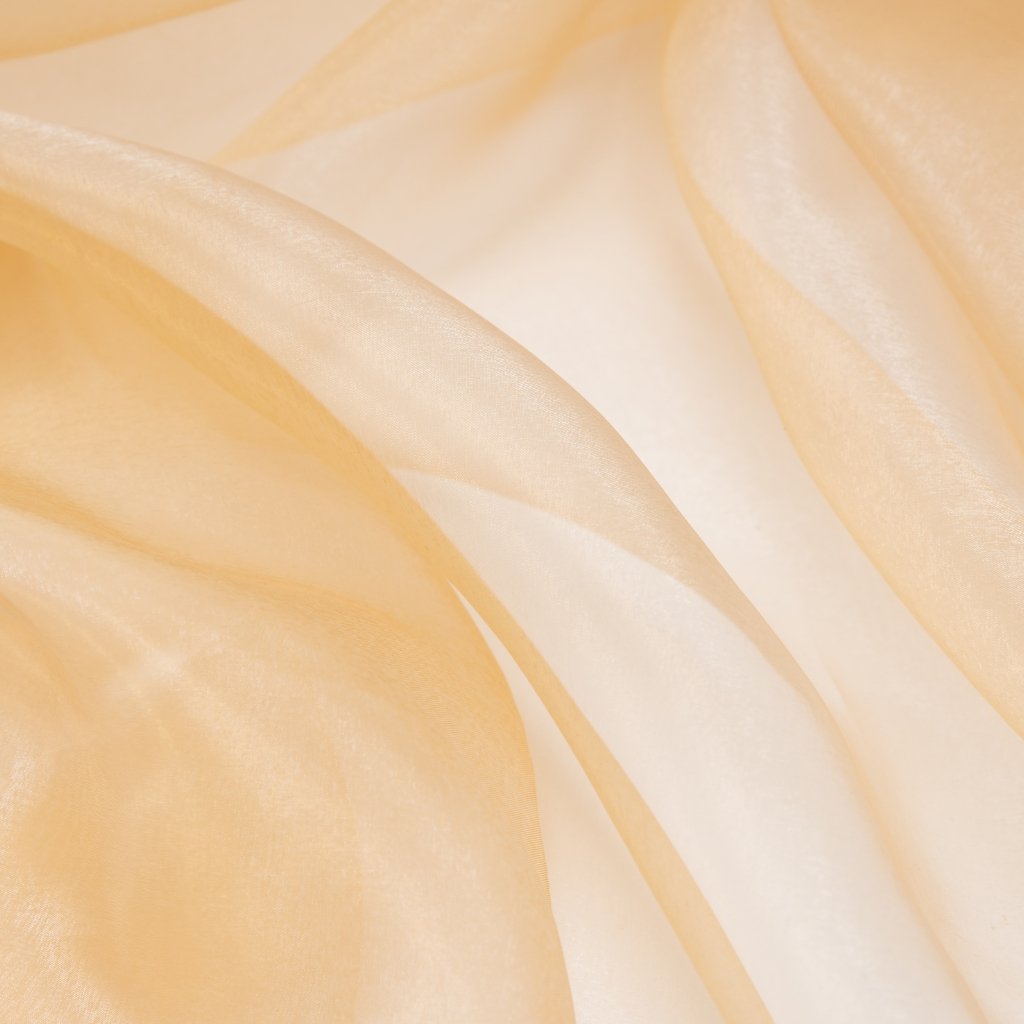
Soft, peach-toned crushed organza fabric with gentle folds and a sheer, shimmering texture.
Avoid These Mistakes When Using Crushed Organza Fabric

Do not leave it out in the sun for too long. The sun can weaken or fade fibers. Ironing over the fabric will flatten its texture. Avoid wearing too many prints. Keep the rest simple to let the shine.

How to sew with crushed organza fabric

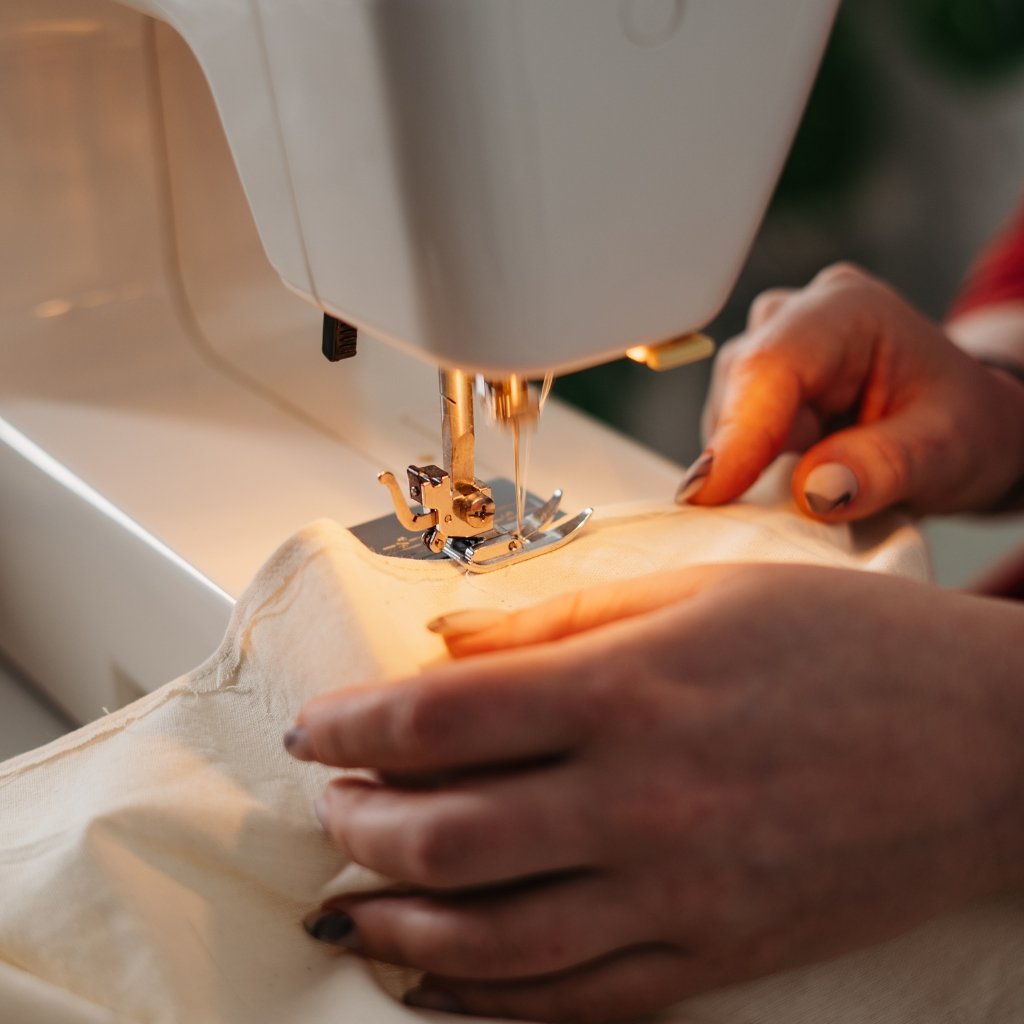
 A close-up photo of a sewing machine stitching light, sheer fabric. The presser foot is down, and a pair of hands guides the fabric, creating delicate seam lines. The fabric appears to be crushed organza, with a subtle sheen and textured surface.
Sewing with : tips for handling the delicate, crinkled fabric to achieve smooth seams and professional finishes.

When stitching crushed organza, use sharp, fine needles. Keep your seams as small as possible. If possible, use a walking foot with your sewing machine. Sew slowly to prevent fabric stretching. If necessary, press with steam from a distance. Keep seams soft to ensure flow.

Crushed organza fabric works for many styles

You can use it for tops, dresses, accessories, and even fancy ones. It is timeless and fits in with modern trends. The drape flatters many different shapes. Texture adds a touch of sophistication to simple designs. It is a popular choice for clients who want to upgrade their wardrobe.

Cost and value of crushed organza fabric

The special finishing makes it more expensive than plain fabrics. The extra cost is worth it for the appearance and versatility. Even a small amount of fabric can turn a simple dress from plain to couture. It pays off because of its shimmer and texture.

Final Thoughts about Crushed Organza

The fabric is the secret weapon for stylish fashion. It brings elegance, volume and shimmer in one. It can be used and remains beautiful with proper care. Let the outfit be your guide in your next project.

Conclusion

The Crushed Organza Fabric has a soft and stylish feel. The fabric adds texture and flow to any outfit. It is popular for skirts, dresses, and home decor. It looks and feels rich, but it is light. Designers love it because of its lightness.

It doesn’t take much to make something stand out. Even a small amount of crushed organza will transform a simple design. Easy to maintain, it’s fun to wear and is always eye-catching.

Next time you want to be classy and chic, consider using Crushed Organza fabric. It could be the secret to your most stunning outfit.

FAQs

Q1: What is crushed organza fabric?

Crushed organza fabric is a light, sheer material with a wrinkled texture. It shines softly and adds flow to clothing.

Q2: What is crushed organza used for?

It is used in dresses, skirts, sleeves, veils, scarves, and sometimes even in home decor like curtains and table runners.

Q3: Is crushed organza fabric comfortable to wear?

Yes, it is light and airy. It works best when layered with a smooth fabric underneath to avoid roughness on the skin.

Q4: How do I wash crushed organza fabric?

Hand wash it gently in cold water. Use mild soap. Do not wring or twist. Let it air dry flat or on a hanger.

Denim Bomber Jackets Outfits for Every Season

0

Are you trying to find that one hero piece that balances comfort with style? The Denim Bomber Jackets Extra. This recognizable piece of clothing skillfully combines American Classic with modern utility. It’s no wonder that it’s on the fast track to becoming a staple piece in any modern wardrobe. This guide is designed to help you unlock the full potential of your new favorite layer.

Why the Denim Bomber Jackets is a Wardrobe Game-Changer

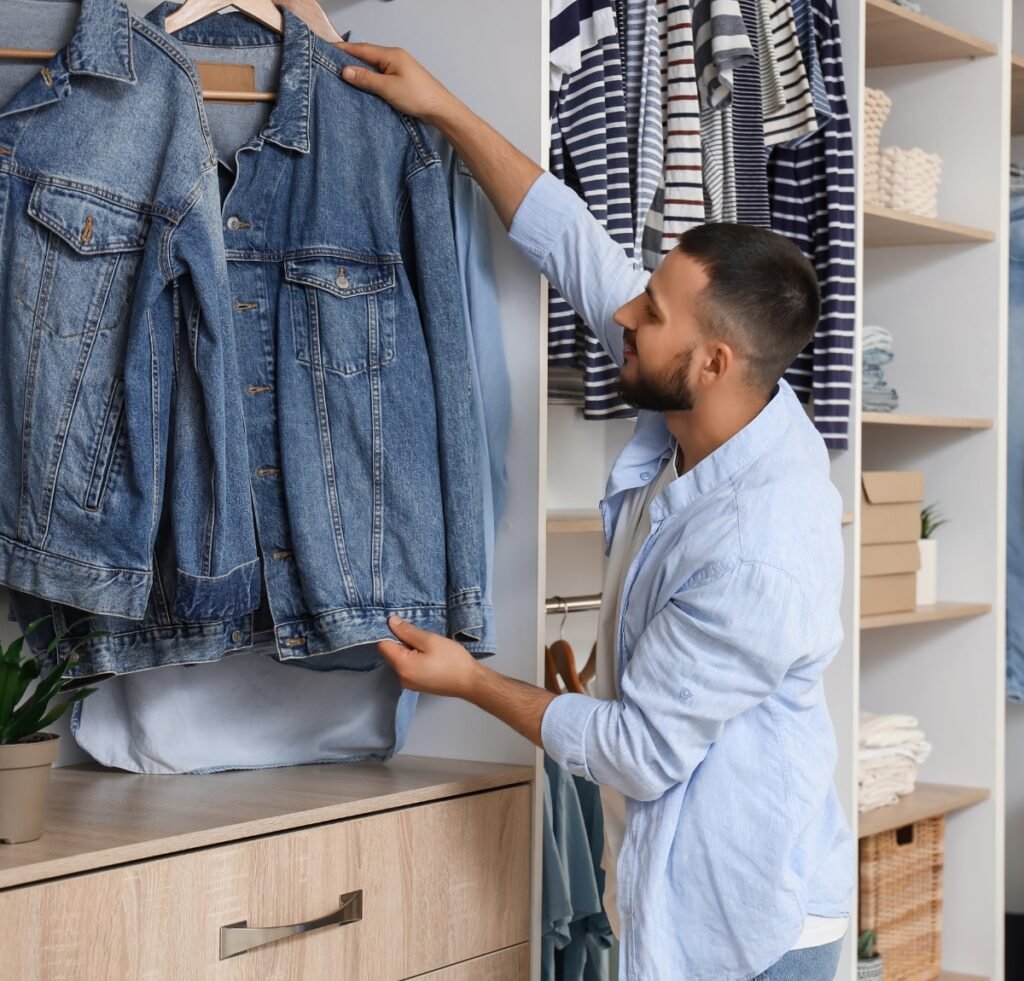
A man in a light blue shirt stands in a neatly organized closet, holding up a blue denim bomber jacket next to several other denim pieces and striped shirts hanging on a rack.
Denim bomber jackets: the effortless upgrade your wardrobe has been waiting for.

Unmatched Versatility

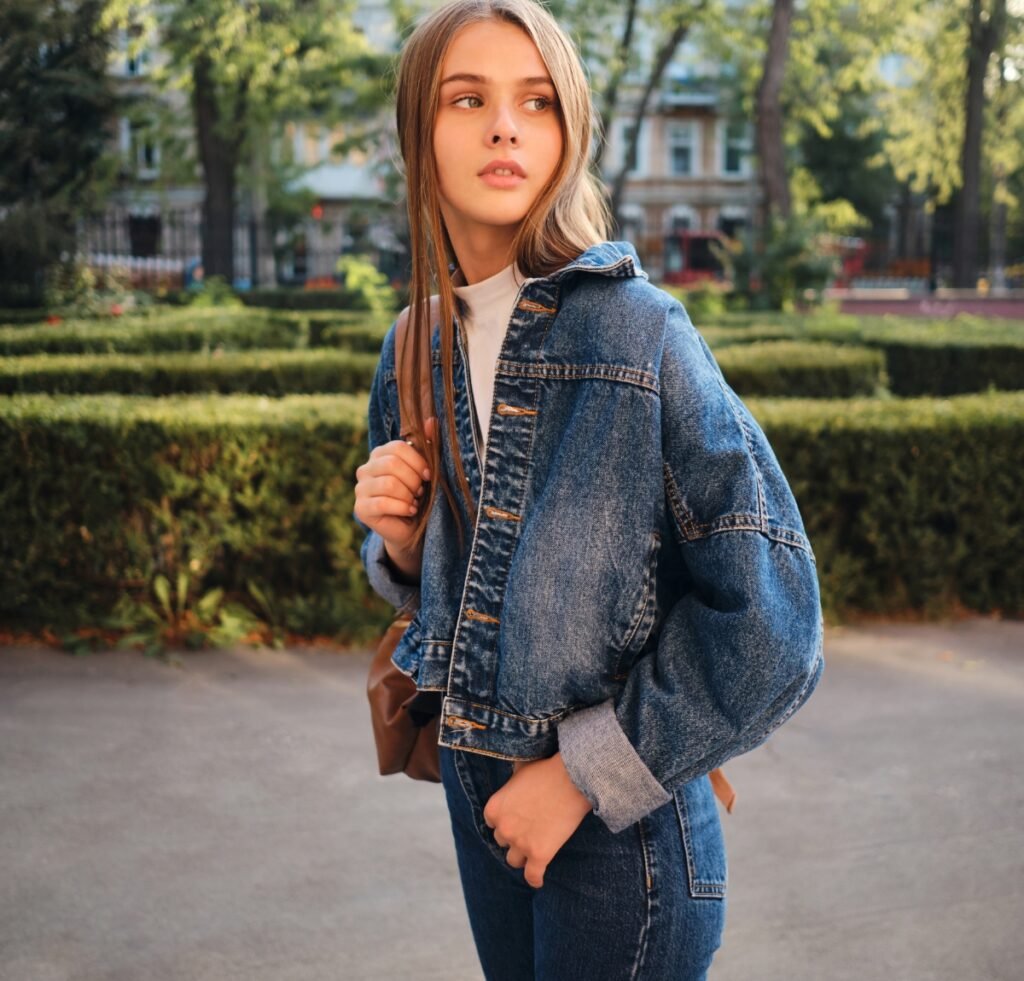
A young woman wearing a blue denim bomber jacket with rolled cuffs, standing outdoors in a park setting, carrying a brown bag.
Short caption: Denim bomber versatility: effortless edge for any day. Mid-length caption: A classic denim bomber that transitions from casual to chic with effortless ease. Narrative caption: Casual cool meets timeless denim—this bomber anchors a versatile look for any occasion.

First and foremost, the Bomber Denim Extra has versatility at its core and leaves no stone unturned. Unlike a standard denim jacket, the Bomber Denim Extra silhouette is sporty and modern. Further, as compared to a Bomber, the Bomber Denim Extra is unarguably timeless and rugged. The balance between sport and rugged fabric makes the Bomber Denim Extra a necessity for any casual Friday at the office or an easy weekend.

A Perfect Style Fusion

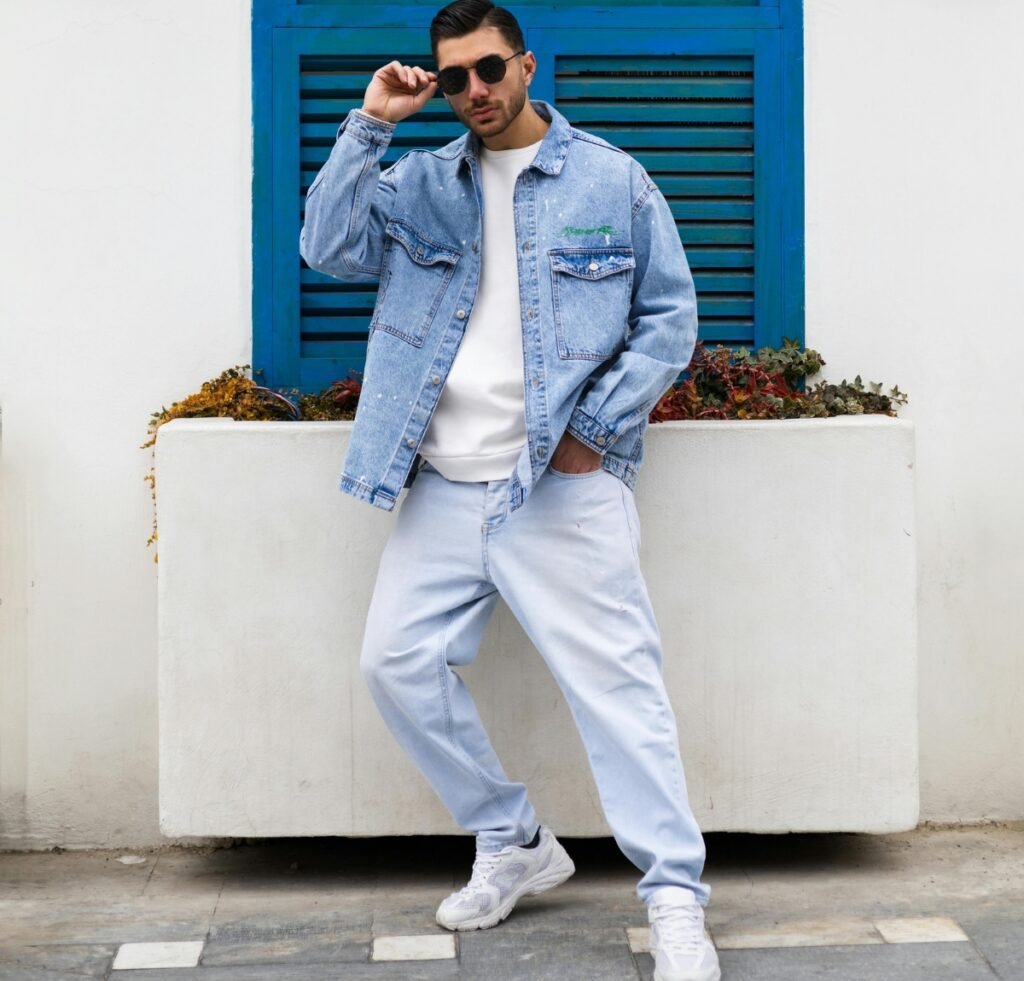
A stylish man wearing a light blue denim bomber jacket over a white T-shirt and matching light-wuel denim jeans, posing confidently against a white wall with a bright turquoise window behind him; he wears sunglasses and white sneakers.
“Denim meets bomber: a flawless fusion of casual and chic in a light-wash denim bomber.” “Effortless cool in a denim-on-denim look—the ultimate style fusion.” “From street to chic: a modern denim bomber paired with relaxed, light-wash denim.”

Moreover, the denim bomber jacket represents a perfect sartorial fusion. It blends denim’s ageless ruggedness with the modern sporty appeal of a Varsity bomber jacket. It creates a one of a kind aesthetic that is appealing, yet, fresh in the market. Consequently, the Denim Bomber Jacket on its own is a bold fashion piece that is in the know without being superficial.

A Seasonless Staple

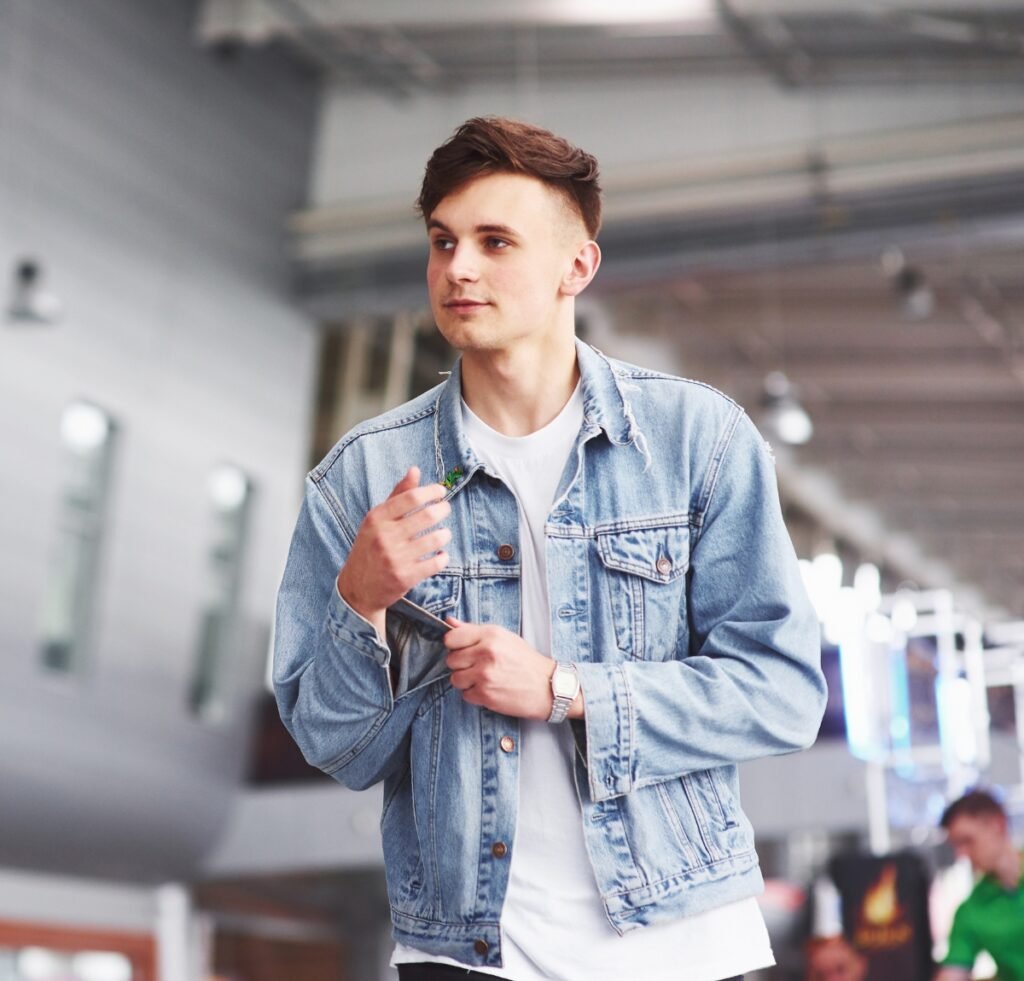
A young man wearing a light-wash denim bomber jacket over a white T‑shirt, in an indoor modern space. He adjusts the jacket’s collar with one hand, and a silver wristwatch is visible on his other wrist. The background features blurred architectural details and soft lighting.
A Seasonless Staple: The denim bomber jacket pairs effortlessly with a casual white tee for a timeless, versatile look.

Seasonless, the Denim Bomber Jacket offers considerable advantages. It makes the ideal mid-weight layer for chilly summer evenings and breezy springs. It also works excellently as a mid-layer under a coat during fall and winter. This ensures that with each purchase you get maximum wear to value out of the Flight jacket.

Finding Your Perfect Denim Bomber Jackets Fit and Wash

A young woman with long dark hair wearing a red bandana headband, a white t‑shirt, and a blue denim jacket over denim jeans. She is smiling softly and resting her chin on her hand against a light gray backdrop.
Finding Your Perfect Denim Bomber Jacket Fit and Wash

Selecting the Right Fit

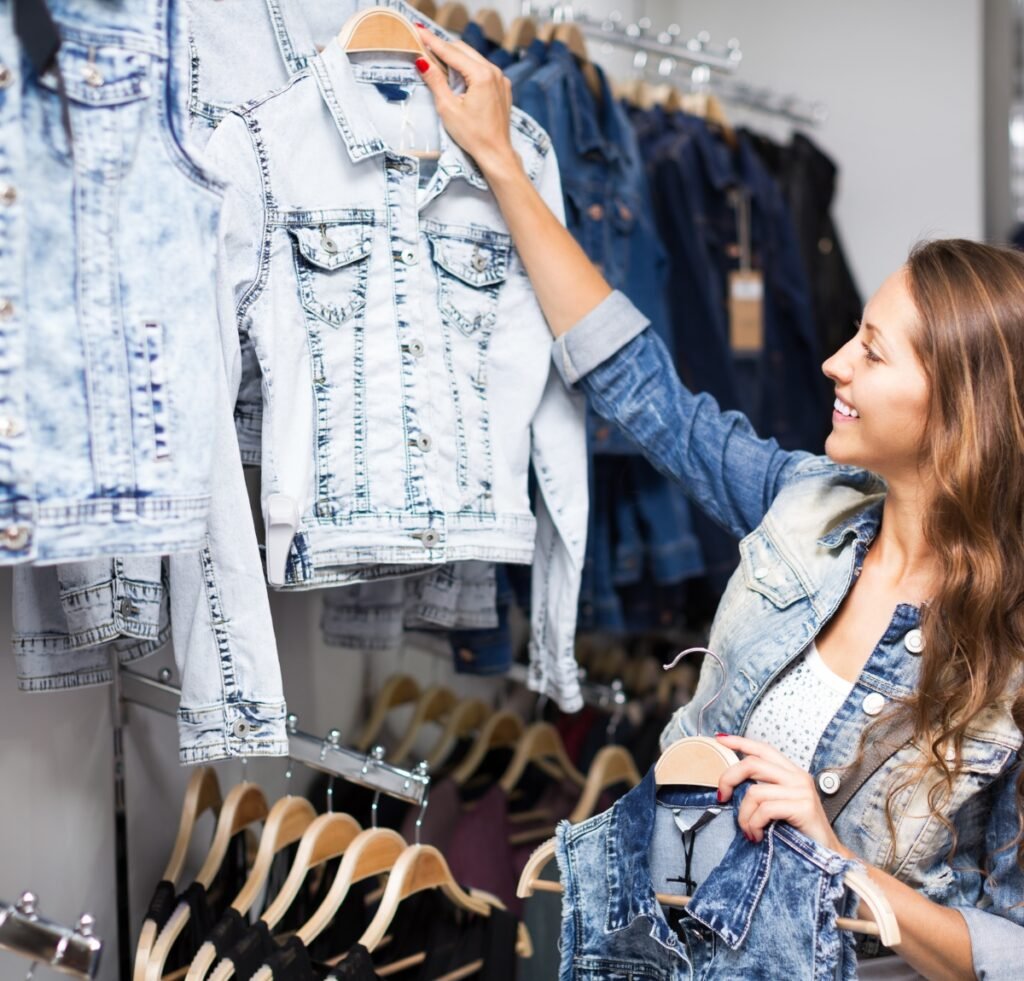
A young woman in a denim-on-denim outfit shops for jackets in a clothing store. She holds a light-wash denim bomber jacket on a hanger and smiles as she compares it with other jackets on a rack of blue denim jackets.
Finding the perfect fit: Tips to choose a denim bomber jacket that Flatters Your frame. Scan, compare, and try: How to select a denim bomber jacket that fits just right. Denim essentials: How to pick a bomber jacket that complements your silhouette.

Before styling, as the saying, “One style does not fit all” there is a need to choose the jacket that fits your body and personal style. For a chill and care-free vibe, the oversized or classic fit Denim Bomber Jacket works best. This fit works well for pieces worn under: hoodies, or bulkier knits. On the contrary, the slim or tailored fit Denim Bomber Jackets, while a tad more refined, work wonderfully over thinner tees or knits.

Picking the right wash

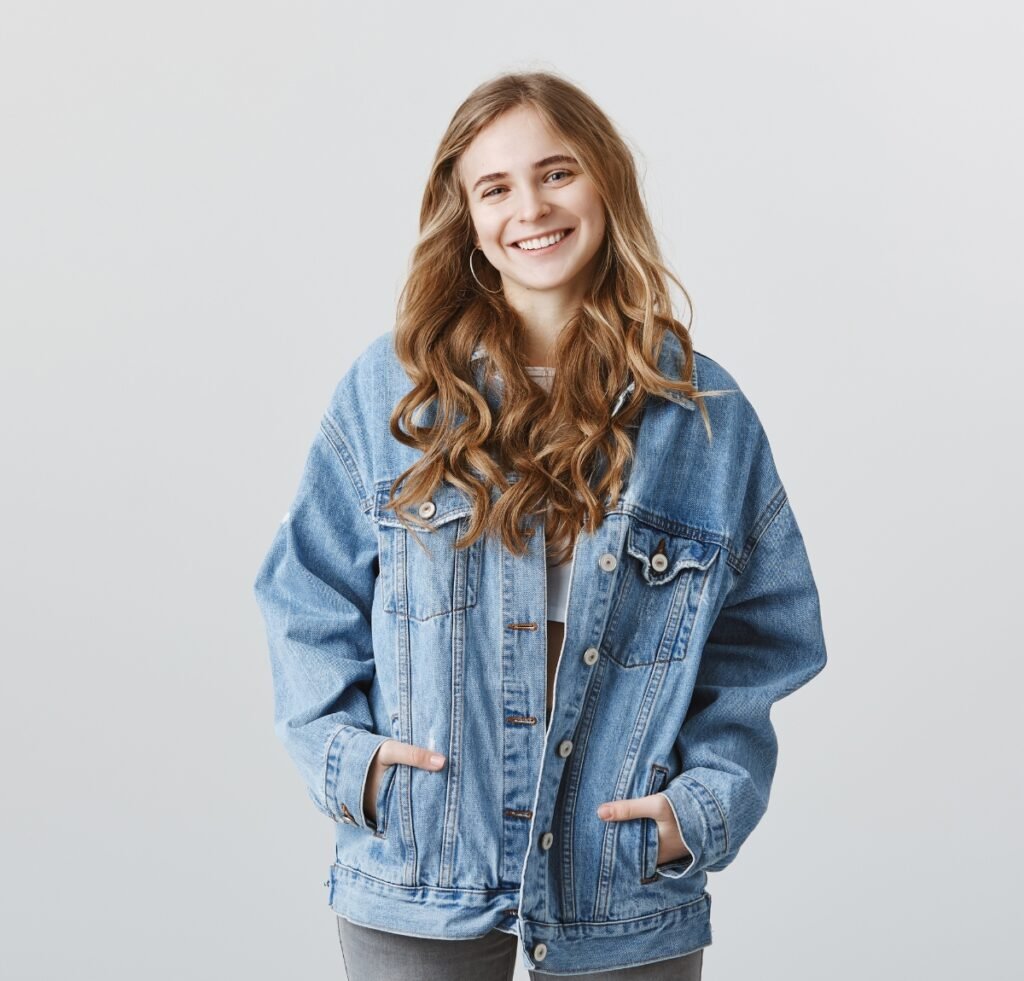
A smiling young woman stands against a light gray background, wearing an oversized light blue denim jacket over a white top. Her long wavy hair frames her face, and she has her hands in the jacket pockets.
Finding your perfect denim wash: which bomber jacket works for you?

Picking the right wash adds a whole new character to the jacket. A light-wash Denim Bomber Jacket has a more relaxed and retro feel which is ideal during spring and summer. A medium wash is the most versatile and classic choice as it is a go to neutral. A dark-wash Denim Bomber Jacket maintains a sleeker and more sophisticated appearance. The same goes for the black Denim Bomber Jacket. It offers an edgy and modern alternative which captures the essence of a leather bomber. Read More: History of Bomber Jackets

Denim bomber jackets are a must-try for every occasion.

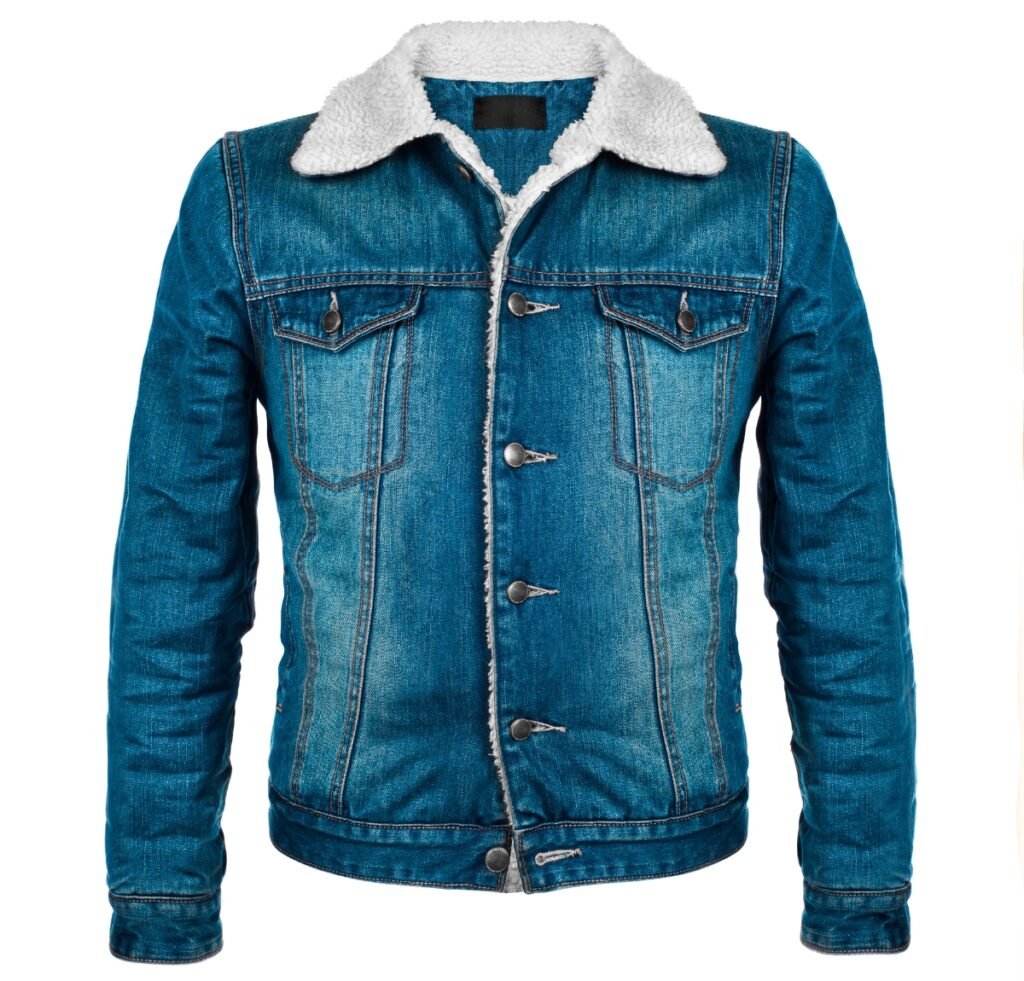
A blue denim bomber jacket with a white faux-sherpa collar, button-front closure, two chest pockets with flaps, and contrast stitching.
Denim bomber jackets: a versatile staple that elevates any outfit.

Outfit 1 : Casual denim bomber jackets look

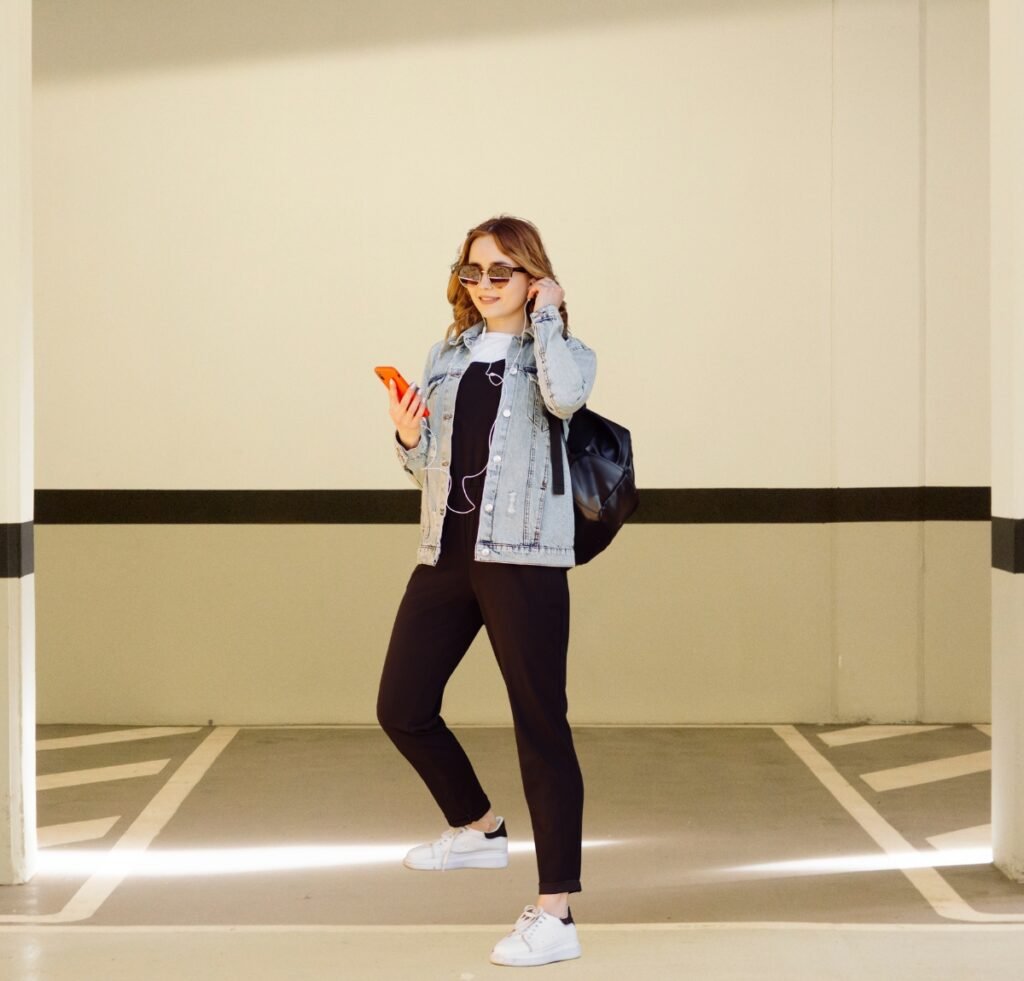
A stylish young woman stands in a parking garage wearing a casual denim bomber jacket over a black top, black pants, white sneakers, and sunglasses. She holds an orange phone in one hand and has a black backpack slung over one shoulder.
Casual denim bomber vibes: effortless street-style with a denim jacket, black everything, and clean white sneakers.

Formula – Denim Bomber Jacket, White Tee, Black Jeans and White Sneakers This Denim Bomber Jacket outfit is the foundation for modern casual style. Start by choosing a medium-wash Denim Bomber jacket. It can be layered over a white crewneck shirt that retains its shape. Black straight-leg or skinny jeans create a high-contrast, sharp silhouette, which instantly elevates your ensemble. This look is completed with white leather sneakers, which are both sporty and sophisticated. This Denim Bomber Jacket is versatile and can be worn for casual Fridays or weekend brunches. Accessorize this winning formula with a black sunglass and a simple watch.

Outfit 2 : Elevated smart-casual denim bomber jackets ensemble

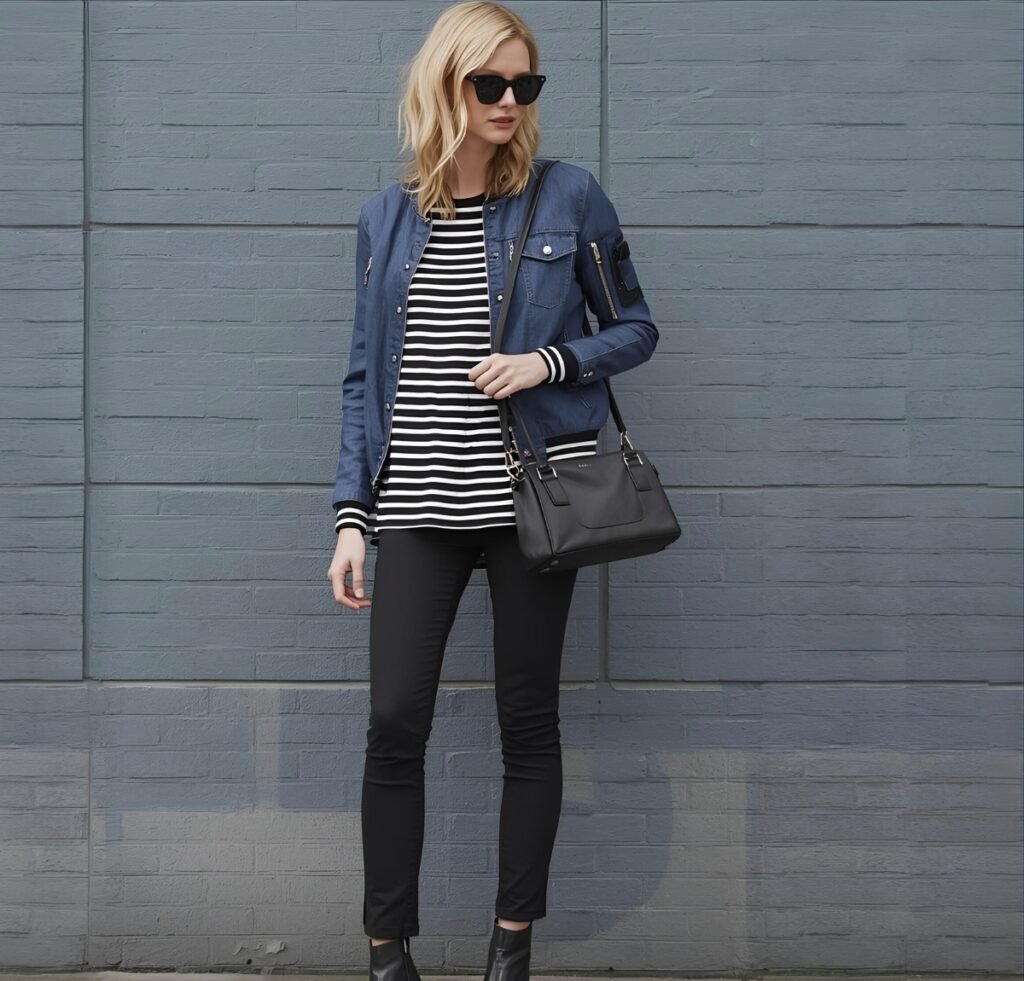
A stylish woman stands against a gray brick wall wearing a blue denim bomber jacket over a black-and-white striped top, black slim pants, black ankle boots, oversized black sunglasses, and carries a black structured handbag.
Elevated smart-casual: denim bomber jacket pairings with monochrome basics for a polished, city-ready look.

Formula: Denim Bomber Jacket + Striped Shirt + Slim Trousers + Ankle Boots
This Parisian-inspired look will transform your Denim Bomber jackets into an elegant, casual masterpiece. Start with a navy and white Breton stripe shirt, then tuck it into slim-fit tailored trousers. Choose trousers made of sophisticated fabrics such as wool-blend, or high-quality chino. The Denim Bomber Jackets will add just the right amount edge to this polished base. The sleek leather ankle boots will elongate your silhouette. This Denim Bomber jacket style is perfect for date nights, creative offices, and gallery visits. To maintain the refined look, carry a structured leather bag across your body to keep the Denim Bomber jacket at the center of the chic outfit.

Outfit 3: Weekend-Ready Comfort Denim Bomber Jackets Style

A fashion-forward woman stands on a city sidewalk wearing a relaxed-fit denim bomber jacket layered over a light gray hoodie and black leggings. She pairs white chunky sneakers and has her hands raised to adjust the hood, showcasing a casual, weekend-ready look.
Weekend-Ready Comfort: Effortless denim bomber vibes with cozy layers, perfect for casual strolls and city errands.

Formula: Denim Bomber Jacket + Grey Hoodie + Leggings + Chunky Sneakers
This athleisure-focused denim bomber jackets combo offers ultimate comfort and style. Start with a grey premium hoodie made of soft French Terry fabric. Make sure the hood fits neatly underneath your denim bomber jackets collar. Combine with black high-waisted leggings for comfort and compression. The Denim Bomber Jackets gives this outfit structure, keeping it from being too casual. Add a contemporary touch to the look by wearing chunky sneakers that are either white or black. This Denim Bomber jacket outfit is perfect for casual weekends, travel days, and grocery shopping. You can enhance your Denim Bomber jacket outfit with a baseball cap or backpack.

Outfit 4: An Unexpectedly Feminine Denim Jackets Creation

A stylish young woman sits on a park bench outdoors, looking at her smartphone. She wears a light denim shirt jacket over a pale tulle skirt, black sneakers, and carries a burgundy backpack. The scene is bright and blurred in the background with trees and benches.
An unexpectedly feminine twist on a denim staple: pairing a denim jacket with a delicate tulle skirt for a look that’s both relaxed and graceful.

Formula: Denim Bomber jacket + Flowy Midi dress + Ankle Boots
Pair your Denim Bomber jacket up with feminine pieces to create a fashion masterpiece. Choose a flowing midi-dress in a floral pattern or solid pastel color that contrasts beautifully against the rugged texture of denim. The Denim Bomber Jacket gives the dress structure, creating an elegant and tough silhouette. Select ankle boots that have a moderate heel for comfort and sophistication. This Denim Bomber Jacket combo is perfect for garden parties or romantic dinners. It’s important to allow the dress to peek out from beneath the Denim Bomber jacket. This creates interesting proportions. Accessorize the dress with gold jewelry to catch the light on the denim.

Outfit 5: The Double Denim Bomber Statement

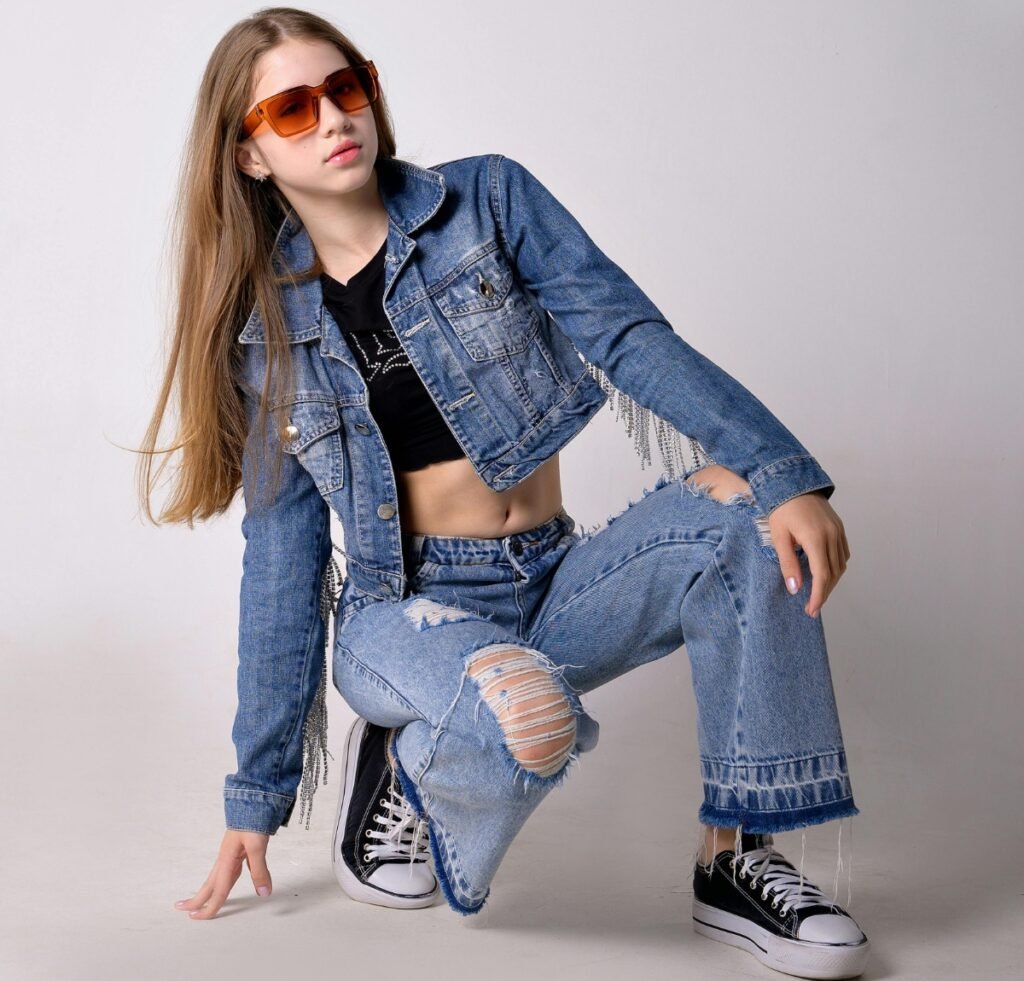
A young woman wearing a matching light-wade denim bomber jacket and jeans, styled with a black crop top, orange sunglasses, and black sneakers. She poses in a kneeling, dynamic stance against a plain background, with long straight hair.
The Double Denim Bomber Statement: a fearless denim-on-denim look that pairs a cropped bomber jacket with distressed jeans, finished with bold accessories for an edgy, modern vibe.

Formula: Denim Bomber Jacket + Contrasting Wash Jeans + Neutral Layers
Style your Denim Bomber jacket to look like a Canadian tuxedo. Contrast is the key. Pair a light-wash Denim Bomber jacket with dark jeans or vice-versa. Break up denim with a neutral colored t-shirt, turtleneck, or hoodie in black, white, or heather grey. The brown leather belt will help you define your waist and add a natural element of style to the Denim Bomber jackets outfit. The Denim Bomber jacket style is perfect for weekend adventures, concerts, and casual Fridays. This double denim Denim Bomber jacket style demonstrates fashion confidence and advanced styling skills.

Style Your Denim Jackets Through the Seasons

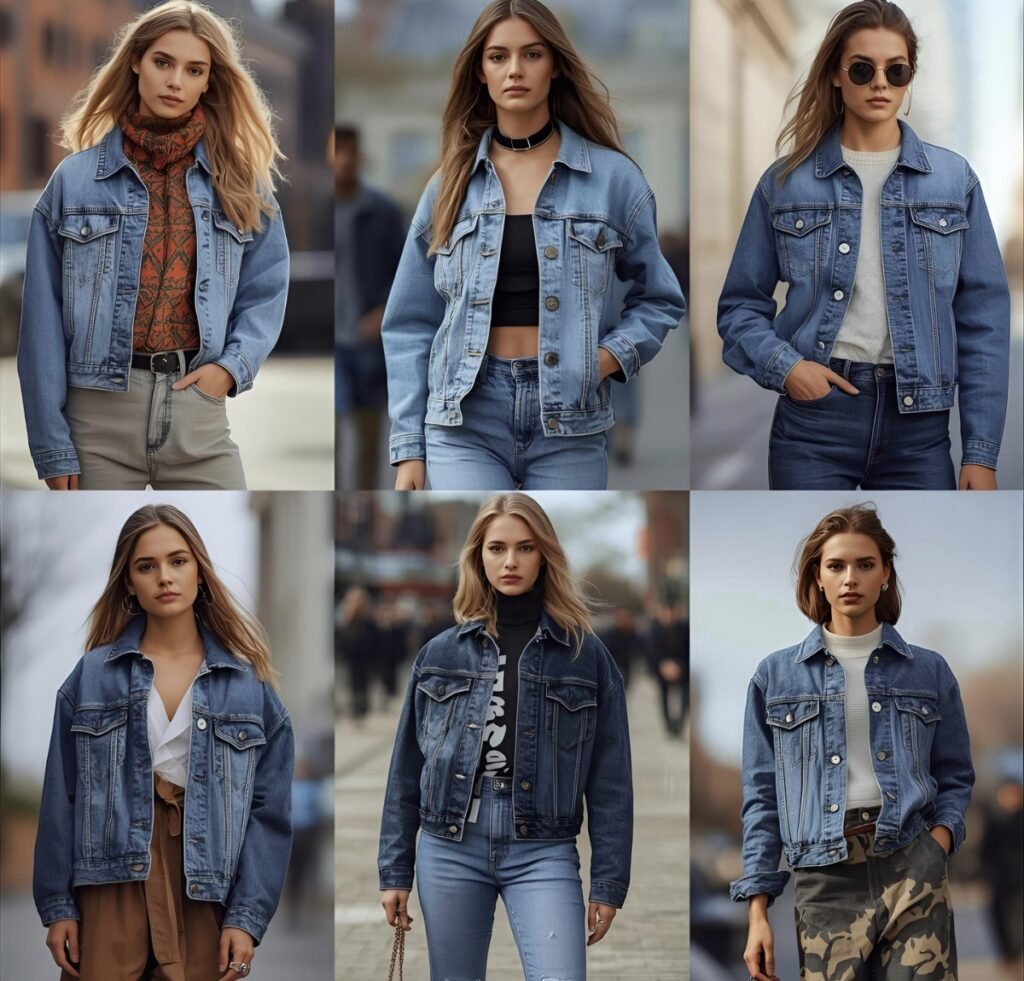
"Collage of seven women wearing denim jackets styled for different seasons: top row shows lightweight and mid-weight denim jackets with scarves and turtlenecks; bottom row shows outfits with layered tops, belts, and casual accessories. All models wear blue denim jackets in urban settings."
Style Your Denim Jackets Through the Seasons: versatile blues that go from cool-weather layers to chic warm-weather ensembles. From scarf-edged looks and turtlenecks to cropped jackets with cropped tops, denim adapts to every season.

Renew Your denim bomber jackets for Spring

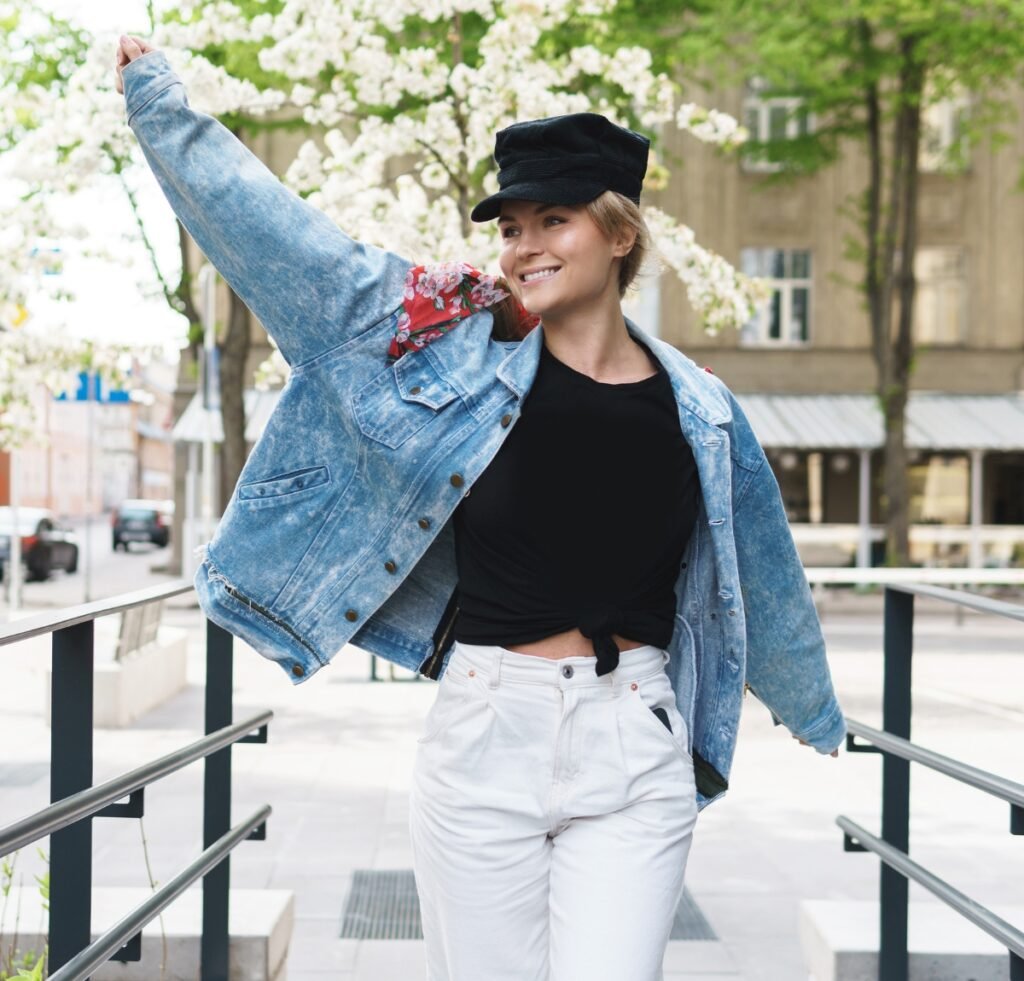
A stylish person wearing a light-washed denim bomber jacket over a black tied-front top and white jeans, posing outdoors with one arm raised in a playful stretch. They wear a black cap and a floral scarf peeking from the jacket, with a city street and blooming trees in the background.
Spring into fresh style: Renew your denim bomber with lighter washes, playful florals, and a bold, effortless silhouette.

As the winter season fades away, your Denim Bomber Jacket will become the perfect transitional piece. Pair a light wash Denim Bomber jacket over a floral midi dress with white sneakers to create a feminine, fresh look. For a casual look, you can layer your Denim Bomber jacket with a graphic t-shirt, light wash jeans and minimalist sneakers. This Nylon bomber jacket is perfect for keeping warm on cool mornings, without sacrificing style.

Denim bomber jackets for Summer evening style

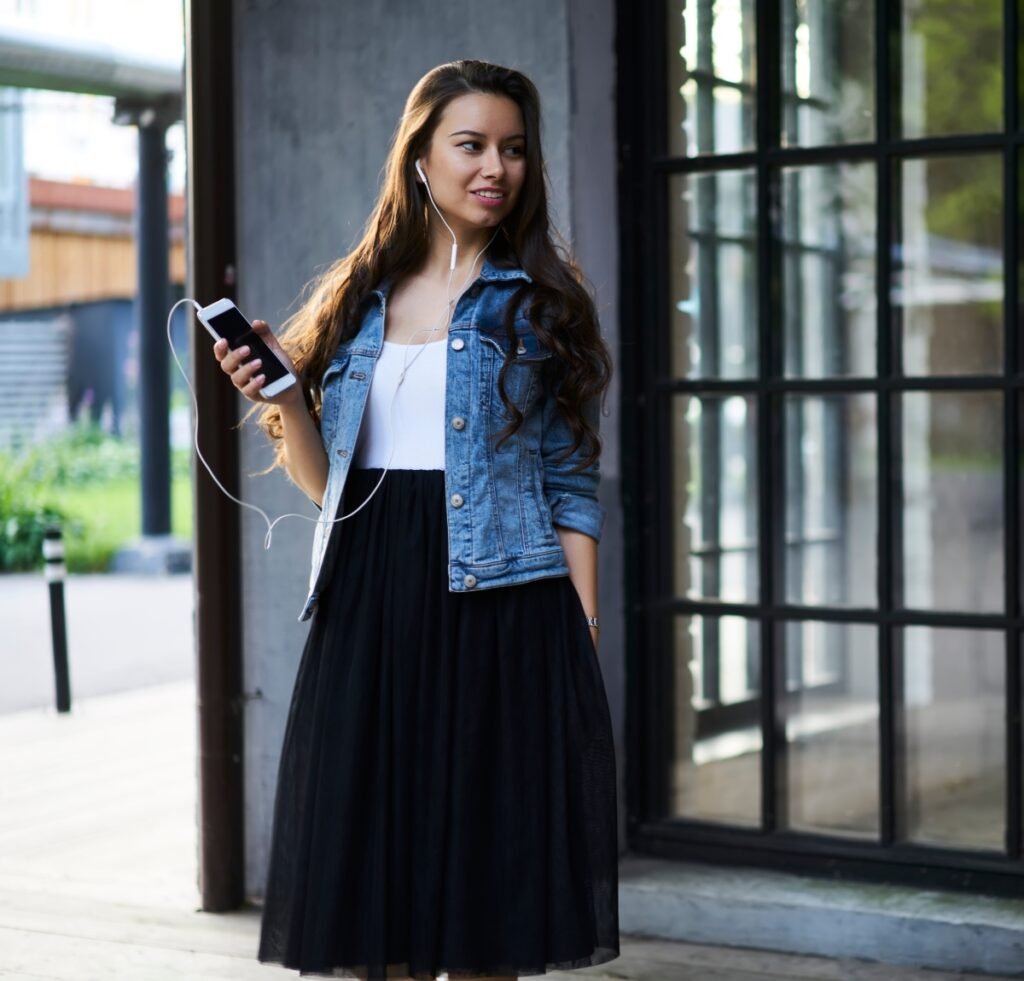
“A young woman stands outdoors wearing a light blue denim bomber jacket over a white top and a black midi skirt. She has long wavy hair, white earphones, and is holding a smartphone with a cord connected to her ears. She’s standing near a modern glass windowed building with a wooden pillar and a blurred green background.”
“Denim bomber meets summer dusk: a breezy denim jacket over a white top and black midi skirt, paired with lightweight headphones for an easy evening out.”

Denim Bomber jacket will be your best friend when the sun goes down and the temperatures drop. After a day at the beach, throw a medium-wash Denim Bomber jackets on top of a tank top bomber jacket and classic denim shorts. You can also wear your Denim Bomber jackets on your shoulders to go to a rooftop lounge, paired with a slipdress and block heels, for a look that is both casual and chic. The denim fabric is breathable and provides just enough coverage to keep you cool without overheating.

Autumn Layering Featuring Your Denim Bomber Jackets

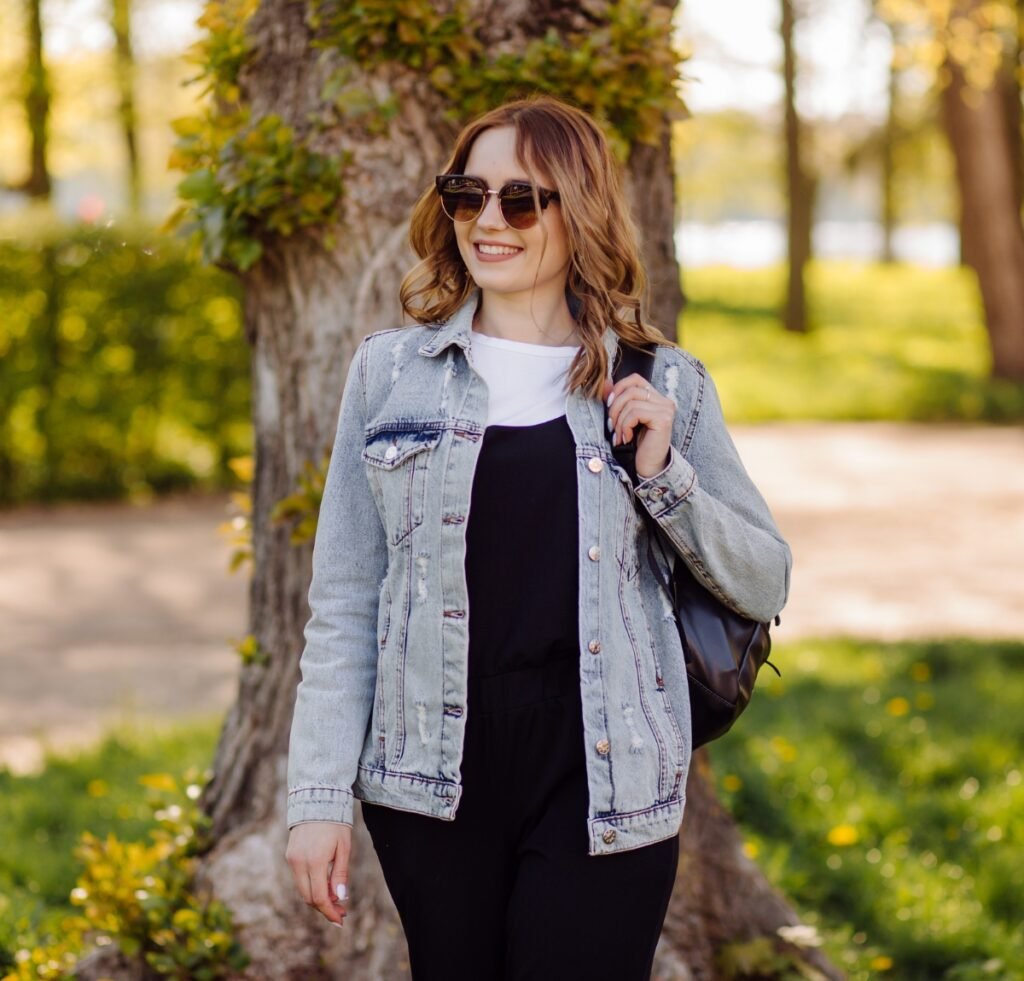
A smiling young woman wearing a light-wash denim bomber jacket over a black outfit with a white top, sunglasses, and a black backpack, standing outdoors near a tree in a sunlit park.
Autumn layering in style: denim bomber meets chic black ensemble for a sunny day out.

Denim Bomber Jacket is at its most versatile when the leaves begin to change colors. Wear a dark-wash Denim Bomber jackets with a chunky sweater, black skinny jeans and leather bomber jacket ankle booties to create the perfect fall outfit. A patterned scarf will add warmth and color. It’s also a great time to play with textures. Try layering your Denim Bomber jackets with a flannel top and corduroy trousers for a rustic look.

Denim bomber jackets for Winter: Practicality

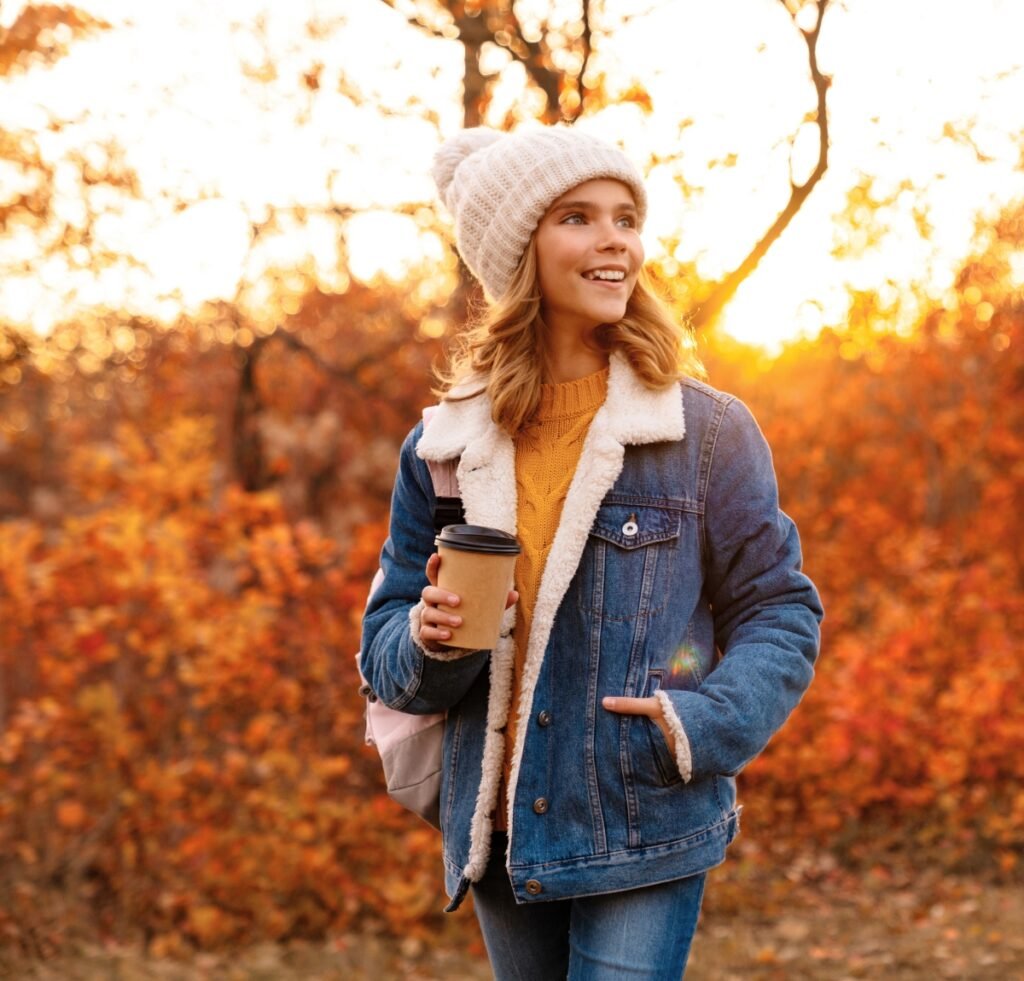
A young woman walking outdoors in autumn leaves, wearing a blue denim bomber jacket with a sherpa lining, a knit beanie, and jeans. She holds a hot coffee cup and smiles, the golden light suggesting a chilly, sunny day.
Cozy winter-ready: Denim bomber jackets with warm linings blend style and practicality for chilly days.

When temperatures fall, don’t throw away your Denim Bomber jacket. Instead, use it as an essential mid-layer. Wear a Denim Bomber jackets in black or dark wash over a thermal Turtleneck and underneath a heavyweight coat or insulated Parka. Layering creates warmth and allows you to keep your personal style even during the coldest of winter. You can easily remove your outer quilted jacket to reveal an outfit that is centered around the Denim Bomber Jean. This will ensure you look stylish on both the sidewalk and sofa.

Denim Bomber Jackets Formula

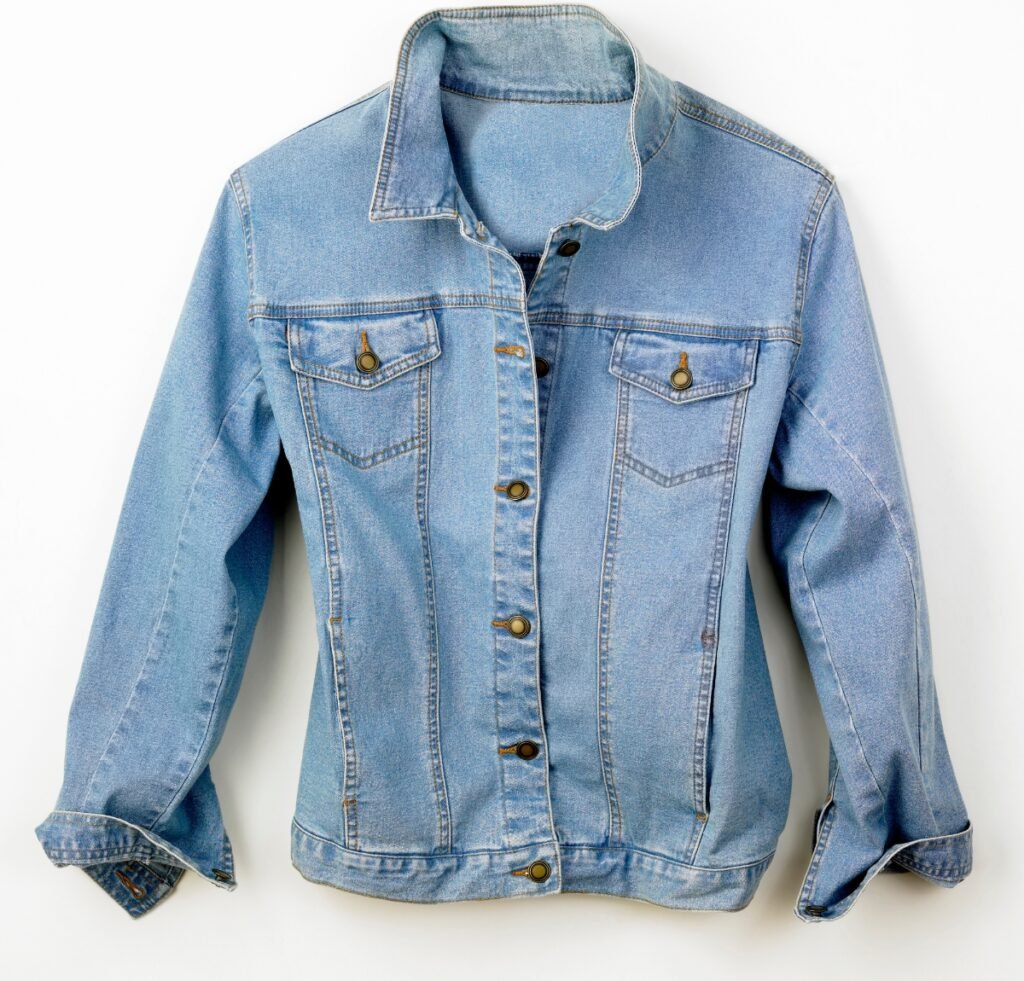
“Light-wash denim bomber jacket with front buttons, two chest pockets with flaps, and rolled cuffs.”
“Casual denim bomber jacket featuring classic jean detailing and brass-tone buttons.”

No matter the season, balance your Denim Bomber jacket‘s casual nature with intentional pieces. Pair it with lighter fabrics and bright accents in the warmer months. In the colder months, layer it with deeper colors and richer textures. The Denim Bomber jackets will remain a versatile four-season garment that delivers style and function.

Style Tips for Denim Bomber Jackets

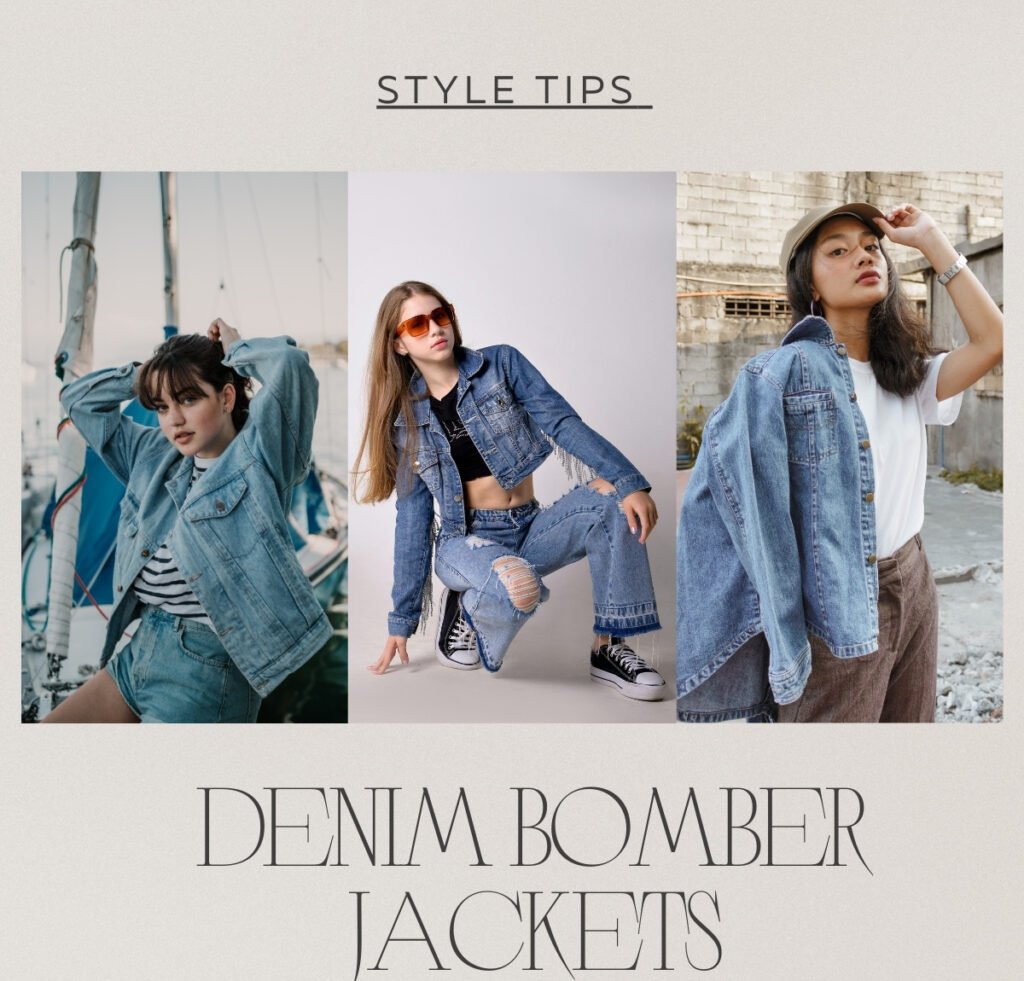
A collage featuring three models wearing denim bomber jackets: left model in a light-wash denim jacket with sleeves rolled, standing near sailboats; center model kneeling in a cropped denim jacket with ripped jeans and orange sunglasses; right model leaning against a brick wall wearing a loose denim jacket over a white tee. The header reads “STYLE TIPS” and the bottom text says “DENIM BOMBER JACKETS.”
Style Tips: Denim Bomber Jackets — versatile looks in light, cropped, and oversized fits.

Accessorize your denim bomber jackets with intention

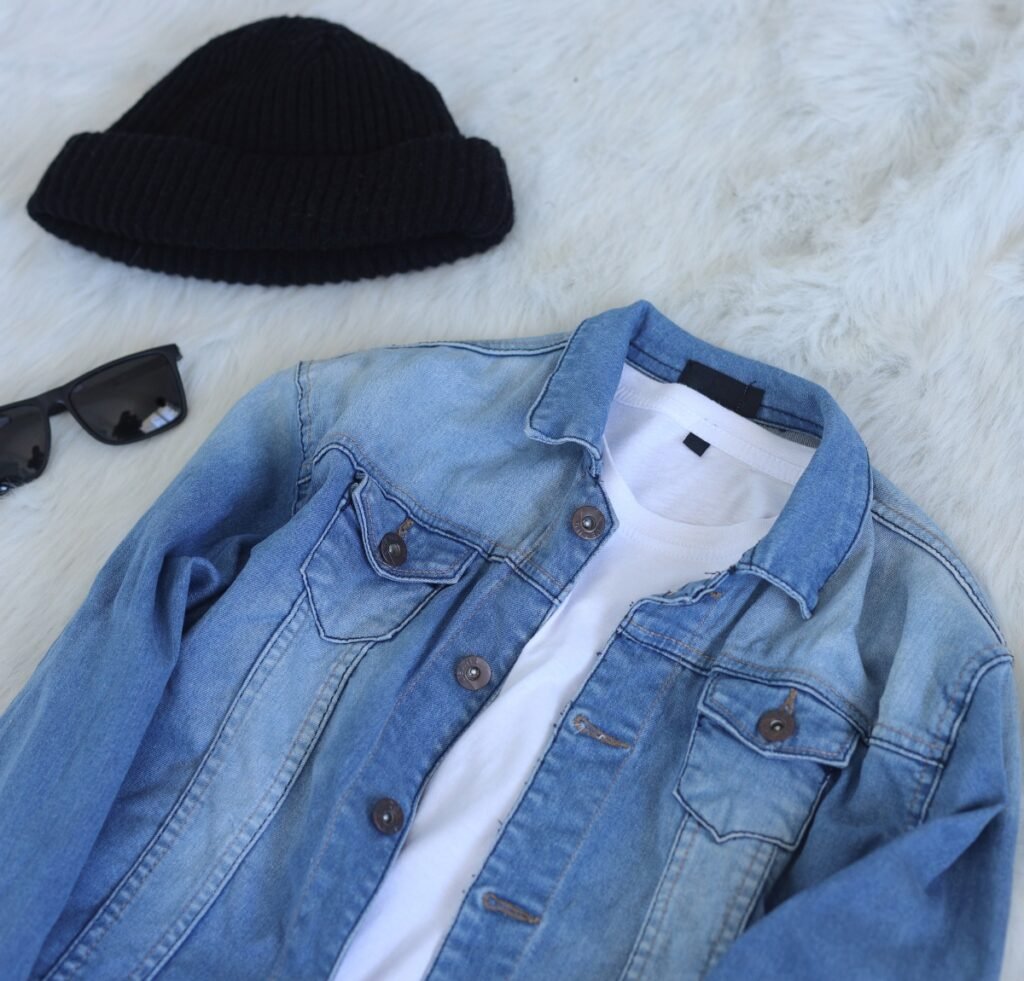
A light blue denim bomber jacket laid flat on a soft, white faux fur surface, with a white t-shirt underneath. A black knit beanie and a pair of black sunglasses sit nearby.
“Casual denim bomber ensemble: timeless blue denim jacket paired with a white tee, complemented by a black beanie and sunglasses.”

To enhance your outfit, always accessorize wisely. A classic baseball cap or beanie will enhance the casual and sporty feel of your Denim Bomber jacket. Statement sunglasses can also add a touch of glamour.

How to Layer Your Denim Bomber Jackets

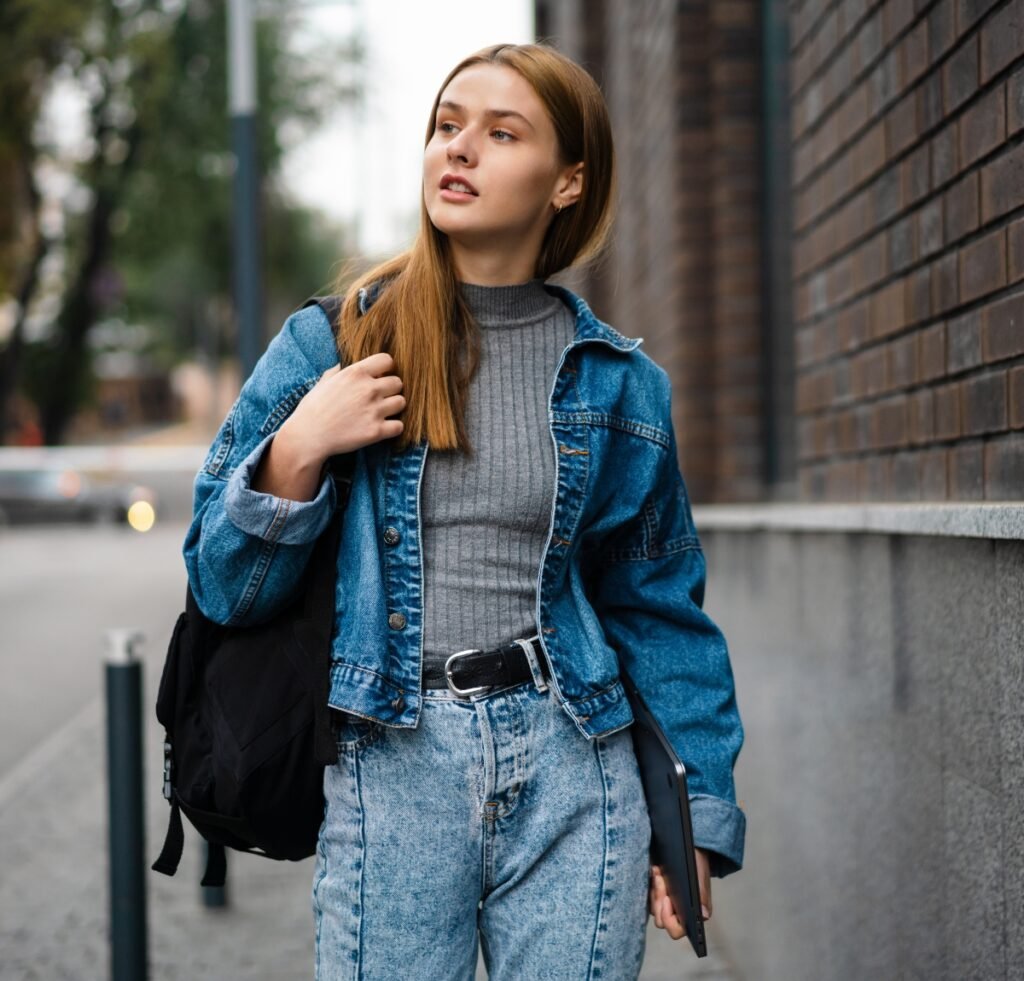
A young woman stands on a city sidewalk beside a brick wall. She wears a blue denim bomber jacket over a gray ribbed turtleneck, high-waisted light-wash jeans, and a black belt. She carries a black backpack on one shoulder and holds a tablet or notebook in her other hand. Her straight, light brown hair is parted to the side, and she gazes slightly upward with a confident expression.
Layering denim: vibrant bomber meets cozy basics for an effortlessly cool look.

Don’t undervalue the power of layers. Wear a lightweight turtleneck or long-sleeved shirt underneath your Denim Bomber jacket to add depth and texture. This not only increases its wearability, but creates a more refined and curated look.

Try a Denim Bomber Jackets with a Different Proportion

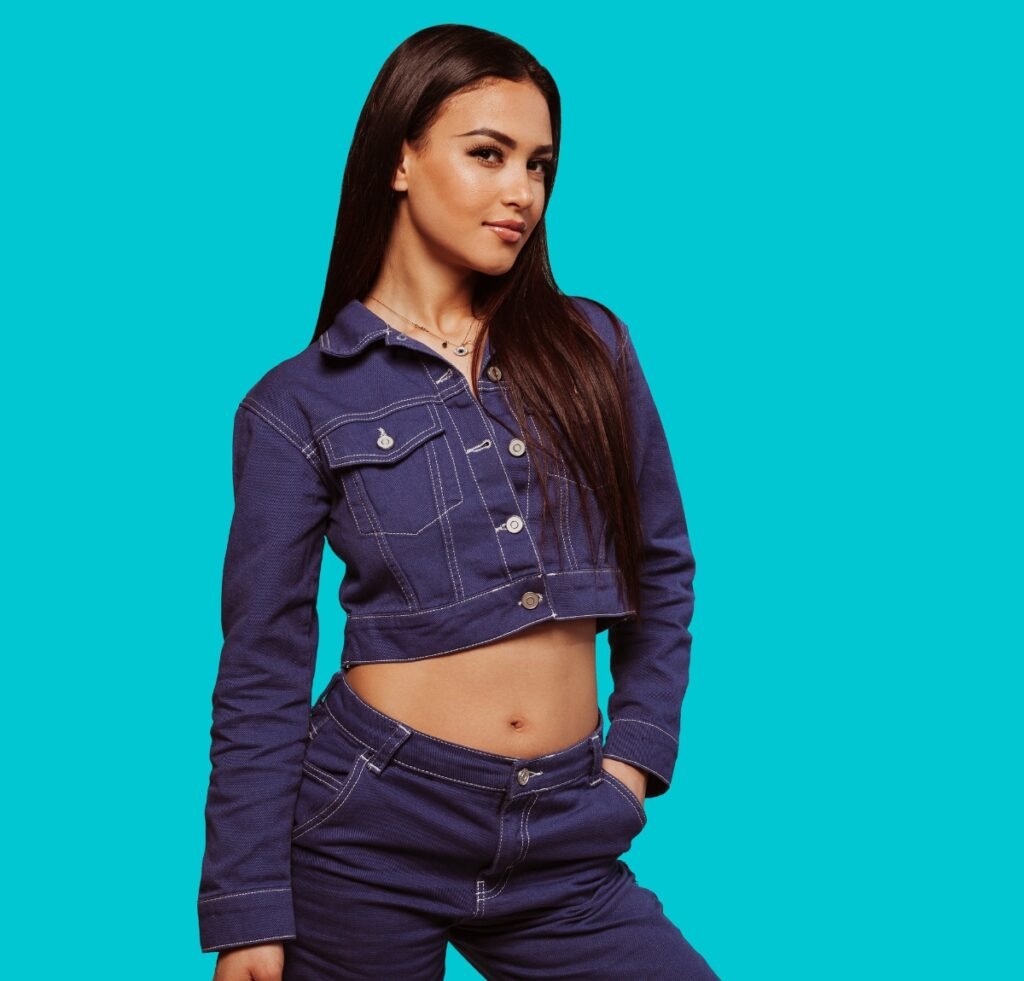
"Young woman wearing a cropped denim bomber jacket and matching high-waisted jeans, standing against a solid cyan background. She has long dark hair and a confident pose with one hand in her pocket."
“Try a Denim Bomber Jacket with a Different Proportion: pair a cropped jacket with high-waisted jeans for a balanced, fashion-forward silhouette.”

A modern silhouette is also a result of playing with proportions. Pair a cropped Denim Bomber jacket with high-waisted trousers or a skirt in order to lengthen your frame. If your Stain bomber jacket is too big, pair it with slimmer bottoms in order to keep a sleek look.

Choose a Statement Bag for Your Denim Bomber Jackets Ensemble

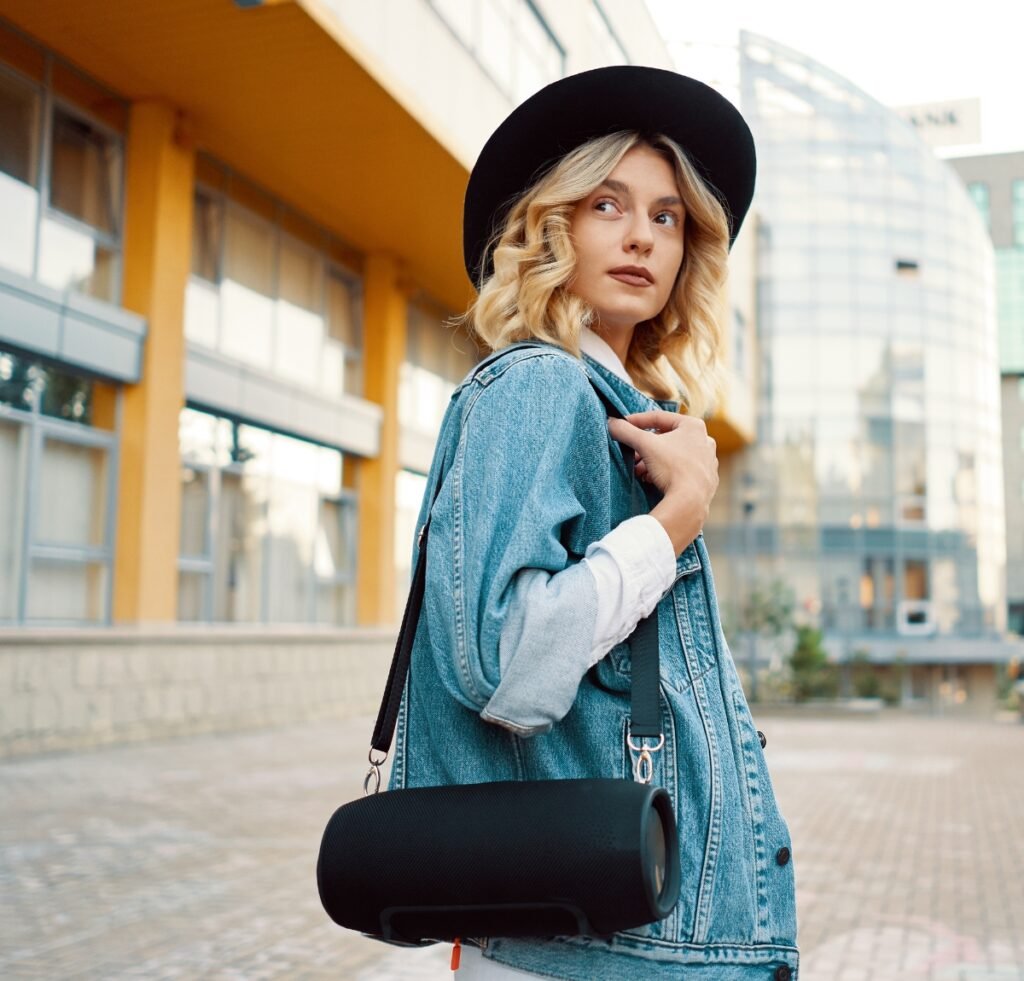
A stylish woman wearing a light-wash denim bomber jacket and a white shirt, paired with a wide-brim black hat. She carries a cylindrical black statement bag over her shoulder, standing outdoors in an urban setting with modern buildings in the background.
“Statement bag, timeless denim: elevate your bomber jacket look.” “Denim bomber, bold bag: the perfect pairing for city-chic style.” “Elevate casual with a standout bag—denim bomber meets modern elegance.” “From casual to captivating: denim bomber and a sculptural black cylinder bag.”

Your choice of bag will also redefine the look and feel of your outfit. A crossbody bag can complement the utilitarian roots in your Denim Bomber jackets while a structured tote bag can elevate the outfit for a polished and urban feel.

Create Textural Contrast With Your Denim Bomber jackets

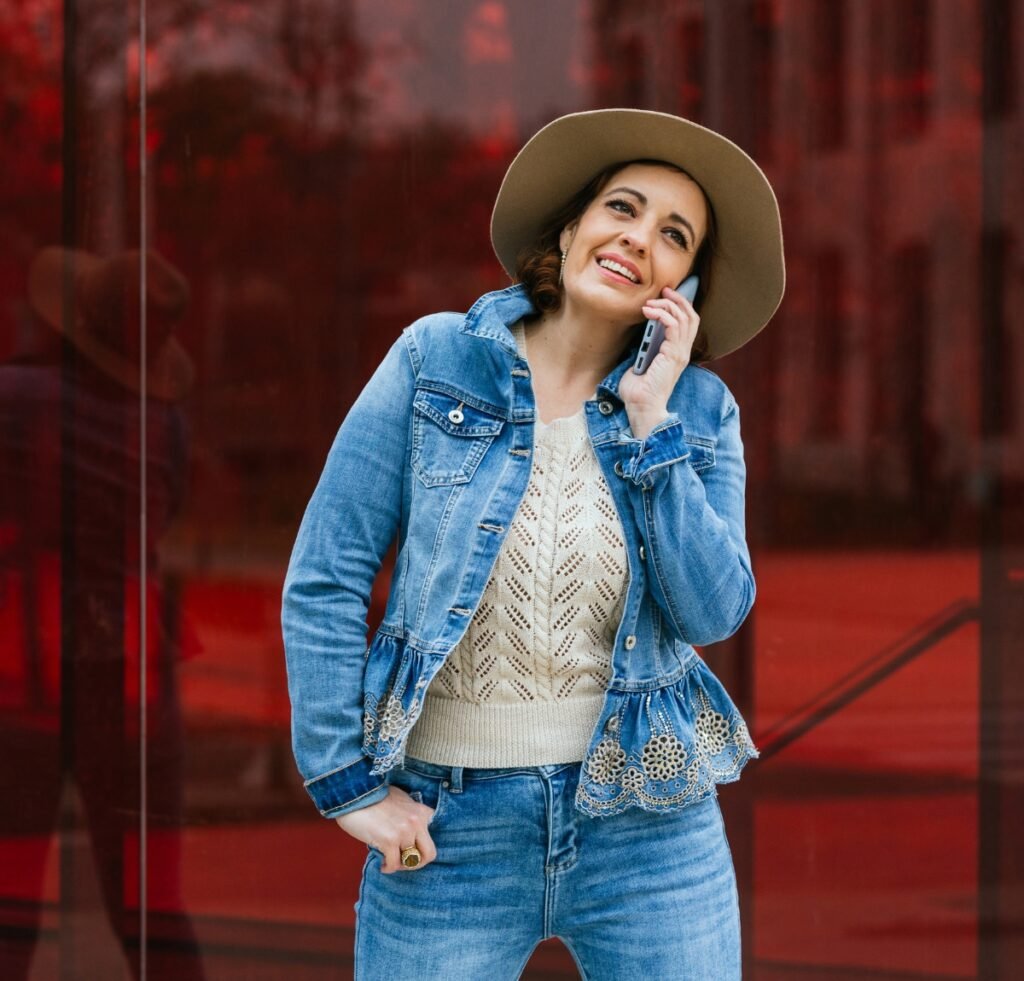
A stylish woman wearing a light denim bomber with lace trim, paired with a cream knit sweater and wide-brim hat, stands outdoors while talking on her phone.
Create texture and contrast with a denim bomber—pair lace details with a soft knit for an effortlessly chic look.

Try experimenting with textures for a fashion-forward appearance. Combining your Denim Bomber jackets with luxe materials such as silk, suede jacket or leather creates an exciting contrast and showcases your style prowess.

Select Strategic Footwear for Your Denim Bomber Jackets

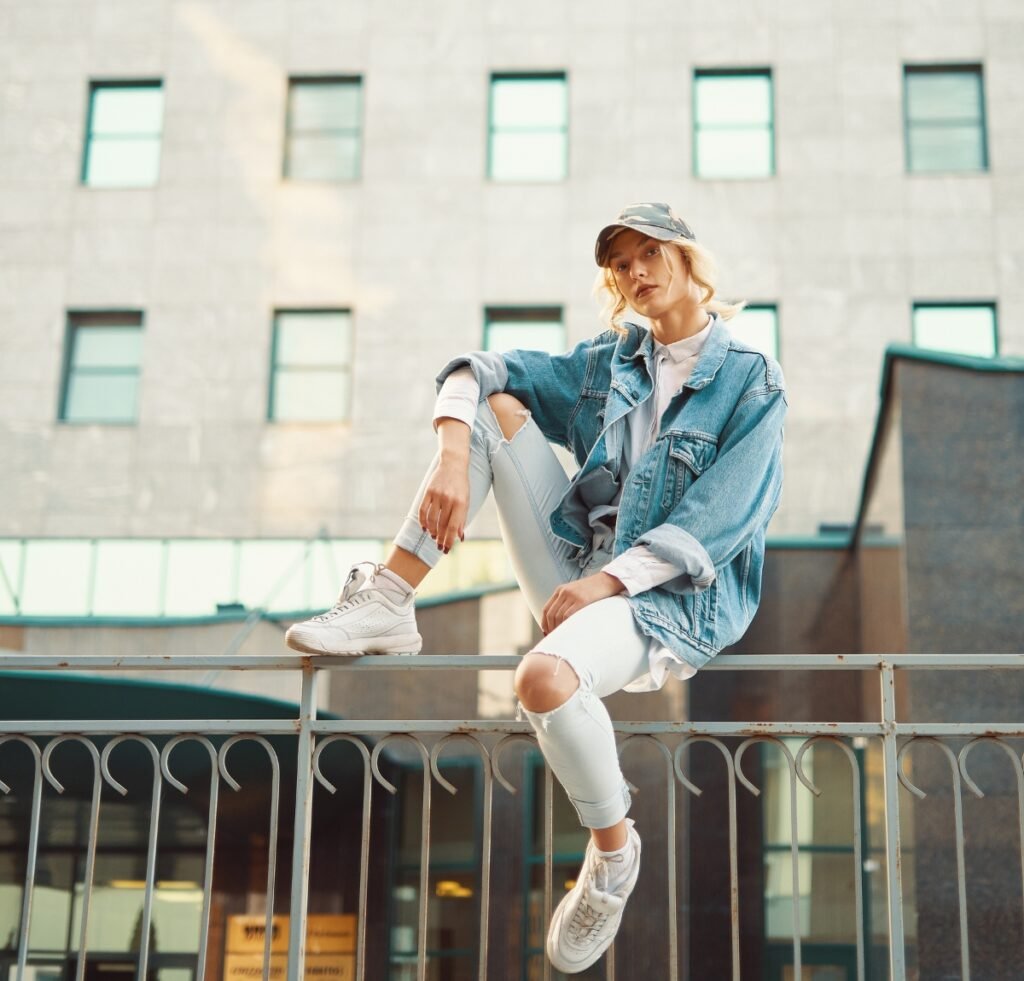
A stylish person sits on a metal railing outdoors in an urban setting, wearing a light-wash denim bomber jacket, ripped white jeans, white sneakers, and a cap.
Elevate your denim bomber: pair with strategic footwear to strike the perfect balance of casual and cool.

Remember that your footwear will dictate the formality and style of your ensemble. White sneakers will keep your Denim Bomber jackets looking grounded and casual. Ankle boots will add some chic sophistication. Even heels can create a high-fashion, daring contrast for a night on the town.

Define your Waist over a Denim bomber jacket

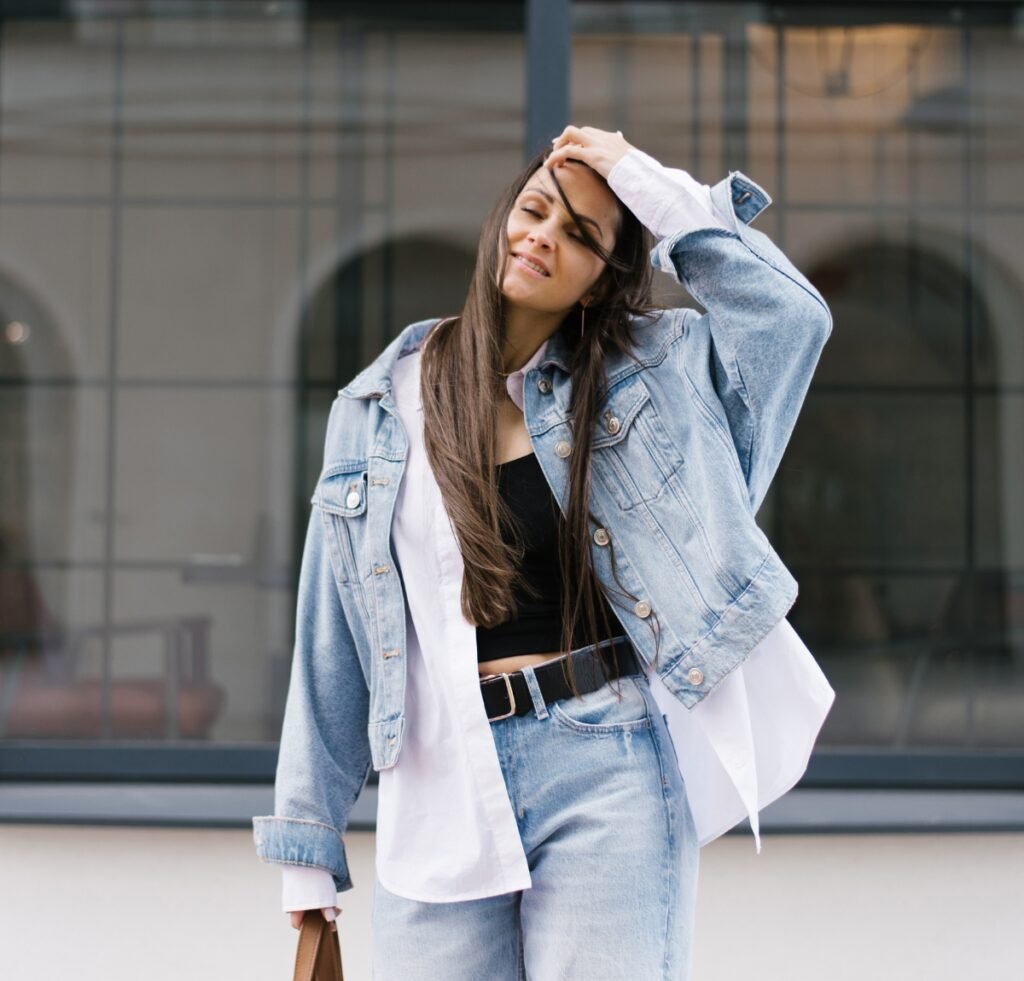
A stylish woman stands outdoors wearing a light-wash denim bomber jacket layered over a black crop top and a white shirt. She pairs it with high-waisted light-wash jeans and a black belt, posing with one hand running through her hair and the other holding a brown bag. The look emphasizes a defined waist and casual-chic vibe.
Defining the waist with a denim bomber: effortless cool in a layered, light-wash look.

To create a flattering shape, always consider waist definition. With a belt, you can turn your Denim Bomber jacket into an hourglass shape. This will add femininity to your outfit.

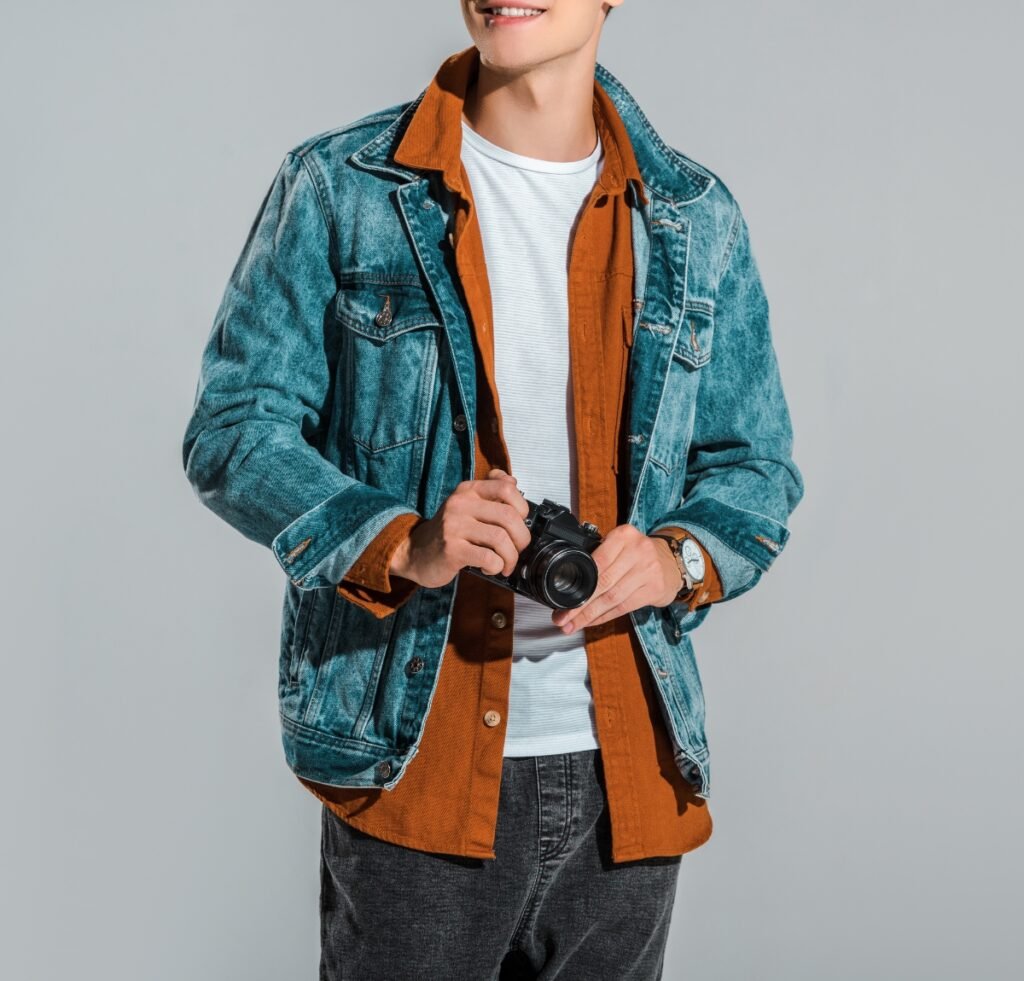
Roll Your Sleeves on Your Denim Bomber Jacket

A person wearing a blue denim bomber jacket over an orange-brown overshirt and white tee, holding a small camera.
Roll up the sleeves, keep it cool: denim bomber layered with a burnt-orange shirt and a compact camera at the ready.

Rolling or pushing up the sleeves on your Denim Bomber jacket is a simple but effective trick. This simple adjustment will expose your wrists and make the outfit appear more relaxed, less formal, and less restricted. It also allows your accessories, such as watches or bracelets, to shine.

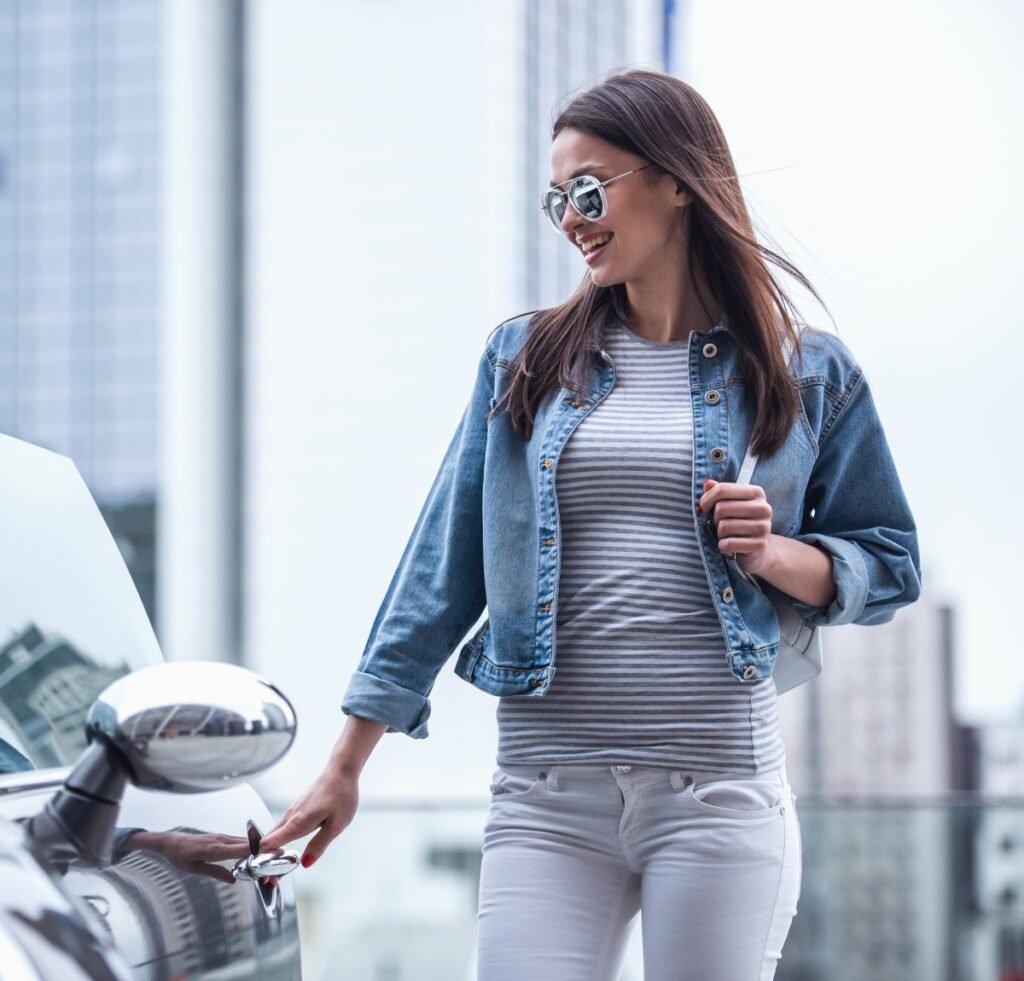
Create a monochrome base with your denim bomber jacket

A stylish woman wearing a light-wash denim bomber jacket over a gray striped t-shirt and white jeans, standing beside a sleek car outdoors in an urban setting; she smiles and wears sunglasses.
Monochrome mood: pairing a denim bomber with a grayscale ensemble for casual, city-chic vibes.

Monochrome is the key to a sleek, effortless look. Wearing all black or all white underneath your Denim Bomber jacket will allow the denim to be the focal point, resulting in a sleek and elegant look.

Conclusion

The Denim Bomber Jacket is surely more than just a trend; it is a fashion essential, ready to become a valued addition to your closet. This style guide illustrates the numerous, season-and-style adaptable, ways a single item can change your entire look. The Denim Bomber Jacket serves as a bridge between comfortable and street style, helping you create exceptional pieces effortlessly.

The incredible versatility is what sets the Denim Bomber Jacket apart. Whether you are dressing down with the Denim Bomber Jacket and relaxed, weekend athleisure attire, or upping the style game with tailored trousers and a smart casual top, the Denim Bomber Jacket is a fail-safe. The combination of the bomber and classic denim forms a fashion piece that is ever so right and now, with the Denim Bomber Jacket, you can play with different textures, proportions and styling, while remaining balanced and polish.
Read More Article// Types of Bomber Jackets: The Complete Guide to Style & Function

FAQs

How is a Denim Bomber Jacket different from a regular denim jacket?

The key difference is the silhouette. A regular denim jacket typically has a straight, shirt-style cut with a button-front. A Denim Bomber Jacket, on the other hand, features the signature bomber jacket design: a ribbed collar, cuffs, and hem, and often a front zipper. This gives it a more sporty, modern, and utilitarian edge compared to the classic Americana vibe of a traditional denim jacket.

Can I wear a Denim Bomber Jacket to a smart-casual event?

Absolutely! The Denim Bomber Jacket can be dressed up for a smart-casual setting. The key is to choose a darker wash or black denim and pair it with sophisticated pieces. For example, layer it over a crisp button-down shirt, tailored trousers, and clean leather shoes or ankle boots. This elevates the jacket from casual to intentionally stylish.

What should I avoid wearing with a Denim Bomber Jacket?

The Denim Bomber Jacket is very versatile, but for a polished look, avoid pairing it with overly distressed or baggy jeans unless you’re aiming for a specific grunge look. Also, be mindful of “double denim”; while it can look great, ensure there’s a clear contrast between the jacket’s wash and your jeans’ wash to avoid a mismatched onesie effect.

Is the Denim Bomber Jacket suitable for all body types?

Yes, because the key is choosing the right fit. If you have a curvier figure, a slim or tailored-fit Denim Bomber Jacket can help define your shape without adding bulk. For a straighter or petite frame, an oversized or classic-fit jacket can create interesting volume and a fashion-forward look. The ribbed hem also helps to cinch the waist subtly.

How do I care for and clean my Denim Bomber Jacket?

To preserve the color and fabric of your Denim Bomber Jacket, always check the care label first. Generally, it’s best to turn it inside out and wash it in cold water on a gentle cycle with similar colors. Avoid using bleach. To prevent shrinkage and fading, air drying is highly recommended instead of using a tumble dryer.

What colors go best with a Denim Bomber Jacket?

Denim is a neutral, so it pairs well with almost everything! A medium-wash Denim Bomber Jacket is incredibly versatile. For classic looks, stick to neutrals like white, black, grey, and beige. To make a statement, try pairing it with colors like burgundy, olive green, or even pastels. The jacket acts as a perfect anchor for both bold and subtle colors.

Tweed Wool Fabric: History, Properties, Uses, and Care Guide

Tweed wool fabric is accompanies with amazing attributes. It is also embraced with a rugged beauty because it is durable as well as a timeless fabric which has been cherished for many centuries. Regardless of the type of fashion you focus on, this type of fabric ingeniously fabricates style with utter practicality.

In this article, we will discuss the origin and properties of this tweeds wool fabric. The uses and benefits along with care tips safekeeping this piece. This fabric has undeniably impressed both the designers and the customers with the craftsmanship and the rooted history it carries in textile and fashion, alongside home decor.

Historical Background of Tweed Wool Fabric

The history of twed wool fabric began in Scotland and Ireland in the 18th century. The origin name, probably ‘tweel’ because of the twill weave, was changed again to ‘tweed’ because a London merchant misidentified the name.

Tweed wool fabric rapidly became a hallmark of the British Countryside, and much appreciated by the hunters, fishers, and people who enjoyed the outdoors. This appreciation was because of the ability to withstand harsh weather and rough usage, and the beautiful and appealing designs of the fabric.

Tweed fabric was and still is a very appreciated fabric because it has made its way to urban high fashion. Especially when Coco Chanel began introducing it to women’s fashion in the 1920s, urban high fashion soared. It is still a phenomenal symbol of elegance, tradition and, most importantly, durability.

Textures and Characteristics of Tweed Wool Fabric

Infographic titled ‘Characteristics of Tweed Wool Fabric’ listing five features: 01 Strong and Durable, 02 Exceptional Insulation and Warmth, 03 Water Resistance, 04 Breathability, 05 Distinctive Patterns. Each item has a short description and circular icons on the right showing a shield, a cottage, a water bottle, stacked layers, and a geometric pattern, with green accents.
Characteristics of Twed Wool Fabric: strong and durable; excellent insulation and warmth; water resistance; breathability; and distinctive patterns.

The wonderful and distinguished twed wool fabric is distinguished by it’s texture, warmth and, durability. In most instances, below are its Main Characteristics.

1. Strong and Tough

The dense weave hard wearing tweeds wool fabric has been proven to last for years with the most appreciated value beside it losing the quality.

2. Insulation and Warmth

What is wool fabric are able to restrict the passage of heat making it one of the best for winter clothing and, accessories.

3. Resistance to water

First or refined twed wool fabric is able to fight away light rain and moisture, keeping the wearer very dry.

4. Breathability

The insulative properties of tweed wool fabric warm the body, while the tweed fabric still allows for enough ventilation to stave off overheating during activities outdoors.

5. Distinctive Patterns

Signature to tweed wool fabric are the herringbone, houndstooth, and check patterns, adding both style and an element of heritage.

Different Types of Tweed Wool Fabric

Illustration of a tweed wool fabric infographic: Harris Tweed (green text), Donegal Tweed (green text) with a suit illustration, Saxony Tweed (text), Shetland Tweed illustration, plus small images of a cardigan, coat, and yarn skeins.
Different Types of Tweeds Wool Fabric: Harris Tweed, Donegal Tweed, Saxony Tweed, and Shetland Tweed.

As with most fabric, the tweed wool fabric comes in different styles, each with varying characteristics.

1. Harris Tweed

This type is handwoven in Scotland’s Outer Hebrides, and has a legal, protective status to guarantee authenticity.

2. Donegal Tweed

The Donegal tweed hailing from Ireland is known for it’s colourful flecks and rustic charm.

3. Saxony Tweed

Saxony tweed is made from fine wool fibers, and is wonderfully soft and lightweight, a perfect fit for suits.

4. Shetland Tweed

This harsher style uses cashmere wool fabric that is coarser to ensure added warmth and durability.

Uses of Tweed Wool Fabric

Twed wool fabric serves multiple purposes in fashion, décor, and even accessories:

Fashion and Apparel

A neatly arranged travel scene featuring a pink backpack, pairs of pink sunglasses, a pink top, folded denim shorts, and small travel items on a light wooden surface; tweed wool fabric is not prominently visible in this image.
Brightly colored travel essentials laid out for a quick packing session, with pink accents and denim ready to go.
  • Jackets and blazers
  • Skirts and Trousers
  • Overcoats and Capes
  • Hats and Scarves

There is a reason twed wool fabric is adored by designers. Its timeless elegance makes it a treasured fabric used in both women and men’s garments.

Home Furnishings

A bright, open-concept living room with a large beige sectional, colorful throw pillows, and a patterned rug. Nearby, a modern kitchen with dark cabinetry and a wooden dining table. Large windows let in natural light, and a neutral color palette creates a cozy, airy vibe.
Cozy living room with a large beige sectional, vibrant pillows, and a patterned tweed wool rug that anchors the space.
  • Upholstery on chairs and sofas
  • Fabric throw pillows and cushions
  • Drapery and wall textiles

For tweeds wool fabric’s sturdiness, it fits seamlessly into country and antique-styled spaces.

Accessories and Footwear

A stylish home entry with a wooden shoe rack holding colorful sneakers; a purple yoga mat stands upright beside it; a striped turquoise storage box and hanging clothes are visible on the left.
Vibrant sneakers brighten a tidy, cozy entryway with a touch of greenery.
  • Purses
  • Clutches
  • Footwear, including shoes and boots

Its textured form elevates the everyday accessories.

Advantages of Tweed Wool Fabric

An infographic titled “Advantages of Tweed Wool Fabric.” Features green circular icons illustrating a knitting needle, warm socks, a pile of colorful tweed yarn, a magnifying glass with people, a light bulb, a pocket watch, and a running clock motif. Each section highlights benefits such as exceptional durability, superior warmth, versatile applications, eco-friendly choice, and timeless vintage appeal. The overall design includes a lime green header and decorative tweed imagery in the corners.
Discover the timeless charm and practical perks of tweed wool: durability, warmth, versatility, eco-friendliness, and vintage appeal.

There are many reasons why tweeds wool fabric is still in vogue.

  1. Durability – With proper care, it can last for years.
  2. Warmth – Great for cold weather and outdoor garments.
  3. Flexibility – Used in clothes, accessories as well as home décor.
  4. Environmentally friendly – It fleece wool fabric in its raw, biodegradable, and easily renewable.
  5. Vintage Value – Gives modern day pieces a hint of timeless fashion.

Disadvantages of Tweed Wool Fabric

Close-up of folded blue tweed wool fabrics in varying shades of indigo with a spool of thread resting on top.
Stack of rich indigo twed wool fabrics, ready for sewing.

Twed wool fabric is not without its disadvantages.

  • Lightness – It tends to be heavier than most tweeds.
  • Tweed wool fabric is expensive – Authentic tweed is costly, especially the handwoven variety.
  • Maintenance – A few types of tweeds require dry cleaning or other speciality care.

How to Maintain Tweed Wool Fabric

Infographic titled 'How to Care of Tweed Wool Fabric' with sections on Washing, Brushing, Stain Removal, and Storage, featuring cartoon icons of washing tub, a girl brushing teeth, a t-shirt with stain, and a wooden shelf with toys.
Care tips for twed wool fabric: washing sparingly, gentle brushing, careful stain removal, and proper storage.

Routine maintenance enables a twed wool fabric to be both useful and aesthetically pleasing:

  1. Washing: Dry cleaning only when necessary. Do not wash frequently to retain its texture.
  2. Brushing: To removing any dust or dirt use a soft clothes brush.
  3. Stain Removal: Clean cloths should be applied lightly on any spillage immediately. Do not rub stains.
  4. Storage: To store, use breathable garment bags in order to cover against attacks by moths.

Sustainability Aspects of Tweed Wool Fabric

Close-up view of stacked fluffy tweed yarns in soft pastel and earthy tones (beige, lavender, cream, lilac) with small swatches of multicolored skeins inset.
Soft, chunky tweed yarns in pastel and neutral shades create a cozy, textured fabric collage.

Due to the eco-conscious decisions many buyers have started to make, tweed wool fabric is prominent because:

  • The wool fibers do not contribute to any pollution in the environment during decomposition.
  • Wool is a yearly product, thus able to be continuously sourced.
  • The substantial impact of the garment on the environment promotes sustainable practices by minimizing overused textiles.

Conclusion

Celebrated for its versatility and sophistication, tweed wool fabric exemplifies timeless textile construction. Having made its way through the British Isles and into high fashion and household decor, tweed wool continues to engage admirers with its warmth, durability, and style.

FAQs

Is tweed wool fabric good for summer wear?

it has some notable weight and warmth, so it is best worn in autumn and winter.

Can tweed wool fabric get wet?

It is touched with ease in light rain. However, it should never be sosked. Always air dry if it is wet.

Is tweed wool fabric expensive?

Yes, there are many types of tweed wool fabric, being specific, Harris Tweed, genuine types do tend to be expensive, but the high quality, along with the longevity of the product makes the cost totally worthwhile.

Is Polyester Bad for Skin? Truth Behind the Popular Fabric

Introduction

Polyester is now regarded as one of the most ubiquitous types of fabric in the world. You will find it in the clothing and sportswear industries, as well as in home decor and bedding. The fabric is durable, easy to maintain, affordable, and resistant to body odor and wrinkling. So long as these benefits exist, especially the affordability, it is no surprise it has become such a popular fabric. But the question some are still inclined to ask is, does polyester have a negative impact on skin health?is polyester bad for skin

This question often arises because polyester is a synthetic fabric which is a derivative of scientific Petroleum based fabric. Compared to the likes of cotton, silk and linen, polyester is less breathable and softer and unlike these natural fibers, it has a more potential of causing irritation, rashes,is polyester bad for skin excess sweating and acne. This also means that those with sensitive skin and certain medical conditions such as eczema, will have to be more careful.is polyester bad for skin

The next step is to investigate the impact of health on skin in relation to polyester, what polyester does in comparison to natural fibers, and the what documents and professionals in the field of skin health note polyester to be.

What Polyester Is: Synthetic Fabric Basics


Polyester is a synthetic fabric whose principle elements include ethylene glycol, and terephthalic acid. These compounds create long chain polymers that are spun then woven to create fabric. They polyester will then be treated to separate it from the other synthetic fibers created in the fabric manufacturing process.

The polyester fiber is noted to be:

  • Robust: Strength in sustaining the pull, as well as resists gentle tumbling and other repeating mechanical actions.
  • Economical: Also more affordable to manufacture, in comparison to natural fibers.
  • Quick-Drying: Moisture stays on the outside and is not sucked up.
  • Flexible: Combine with cotton, wool, or spandex for various applications.

Polyester is not the most breathable fabric, and does not wick moisture very well.is polyester bad for skin For most people, the lack of moisture wicking capability can be bikinis.is polyester bad for skin That is part of the reason the debate on is polyester bad for skin surfaces really helps the discourse.

Is Polyester Bad for Skin?

Polyester is not inherently dangerous or toxic. For most people, it poses no health risk when worn as clothing or used in bedding. However, some individuals may experience skin-related problems when exposed to polyester for extended periods.is polyester bad for skin

Pros of Polyester for Skin:

  • Generally, tends to be safe with no detrimental health impacts.
  • Mold and mildew resistant.
  • Durable and able to withstand treatment.

Cons of Polyester for Skin:

  • Insufficient ventilation can encourage the retention of heat and moisture.
  • More likely to induce a rash, itch or acne on the skin for particularly sensitive people.
  • Easily aggravates notable skin conditions such as eczema or dermatitis when there is tighter fitting.

To summarize, polyester itself does not pose a threat to skin,is polyester bad for skin but the way some people experience skin irritation depends on personal sensitivity and surrounding conditions.

Tips for Wearing Polyester

Alt Text:
Infographic showing tips for wearing polyester, including choosing high-quality polyester, wearing polyester blends, avoiding polyester in hot weather, and washing polyester clothes properly.is polyester bad for skinCaption:
Practical tips for wearing polyester comfortably and avoiding skin irritation.Description:
This infographic provides useful advice on how to wear polyester without discomfort. It highlights four main tips: choose high-quality polyester to avoid itching, opt for polyester blends with cotton or bamboo for softness and breathability, avoid wearing polyester in hot and humid weather since it traps heat and sweat, and wash polyester clothes properly to prevent detergent residues that may irritate the skin.

Choose High-Quality Polyester

Not all polyester is the same. Cheap polyester can feel rough and may cause itching.is polyester bad for skin Always choose high-quality fabrics with moisture-wicking technology,is polyester bad for skin. especially for sportswear and daily clothing.

Wear Polyester Blends Instead of 100% Polyester

Polyester blended with cotton, bamboo, or spandex feels softer and more breathable. These blends reduce irritation while keeping the fabric durable and wrinkle-resistant.

Avoid Polyester in Hot and Humid Weather

Since polyester traps heat and sweat, skip wearing it during extremely hot or humid days. Choose natural fabrics like cotton or linen for comfort in warmer seasons.

Wash Polyester Clothes Properly

Improper washing leaves detergent residues that may irritate skin. Always rinse thoroughly and avoid strong fabric softeners. Use mild detergents designed for sensitive skin.

Polyester and Skin Sensitivity

For sensitive skin types, considering “Is polyester bad for skin” is a more loaded question. The blunt texture of polyester fibers and the lack of skin ventilation may cause skin irritation.is polyester bad for skin. A person suffering from eczema, psoriasis, or contact dermatitis for example, may experience polyester-induced flares.

Such irritations may lead to:

  • The skin becoming increasingly sensitive during physical activity.
  • Sweat-induced heat rashes in warmer temperatures.
  • Increased redness and itching.

The skin does not react in the same way for every one. this is why it is safe to say that skin allergy victims should exercise caution whenever polyester is in question.is polyester bad for skin tactile irritation may be prevented using cotton or bamboo blends.

moisture wickingUnpleasant odor and heat rashes may also be attributed to rapid polyester clothing. Non-Absorbing or “breathable” polyester activewear is also specifically engineered to repel, rather than absorb, water. In activewear, this is what is called “moisture wicking” technology.

Breathability and Sweat Issues

Polyester does not breathe as well as natural fibers. It does not absorb water, and thus, sweat is left hanging on the skin. This, together with body heat, creates a warm, damp space conducive for bacterial growth.is polyester bad for skin

The effects are as follows:

  • Excessive body odor resulting from the growth of odoriferous bacteria.
  • Acne breakouts due to the sudden appearance of blocked pores.
  • Irritation during hot, humid conditions.

To athletes, the concerns are even more dire. Even though sophisticated athletic apparel constructed from polyester offers “moisture-wicking technology,” most polyester fabrics do not, and thus, sweat is retained.

Polyester vs. Fabrics for Skin Health

The difference between polyester and natural fabrics of skin health and comfort is undeniable.

  • Cotton: Lightweight, smooth, and absorbs moisture. Great for acne-prone skin.
  • Bamboo: Lightweight, absorbent, and hypoallergenic.
  • Linen: Great for hot weather, and very breathable.
  • Silk: Gentle on sensitive skin, luxurious, and smooth.

Although durable and inexpensive, polyester can lead to long term discomfort for one’s skin. Those people frequently asking the question is polyester bad for skin, are often directed to these alternatives.

Polyester in Activewear and Sleepwear

Polyester dominates the activewear market due to its strength and stretchability. However, while undergoing workouts, the use of polyester can be problematic.is polyester bad for skin. The fabric can trap sweat, causing chafing, bad odors, and even breakouts. Furthermore, high-quality blends that are meant to wick moisture can still irritate overly sensitive skin.

In sleep and rest, the use of polyester brings forth another set of complications. Trapped polyester sheets are less breathable and trap heat, causing the wearing of the sheets to be overly uncomfortable and resulting in sweaty nights. Moreover, polyethylene sheets and pajamas are particularly irritating for sensitive and acne prone skin. Most often, cotton or bamboo are the better alternatives for sleep in these scenarios.

Science & Safety

Does Polyester Release Harmful Chemicals?

Polyester, unlike other fabrics, is held using synthetic compounds. Once manufactured, however, the fibers no longer release problematic substances as long as it is used for normal use.

The main risks include:is polyester bad for skin
Dyes and Finishes: There are textile dyes or chemical finishes that are capable of causing allergic reactions.

Microplastics. Polyester is the only cloth that releases small plastic particles to water systems after washing. Although it is primarily an environmental issue, it is worth noting that skin exposed to patch detergent residues on polyester may iritate sensitive skin.

Therefore, it goes without saying that polyester is not toxic in nature. People with low-quality manufacturing or residual chemicals may be subject to irritation.

Dermatologist Opinions & Research Studies

Polyester is safe for most people which most dermatologists support. Although, it is worth noting, that people with sensitive skin conditions, may suffer considerable discomfort. Numerous studies and surveys have indicated that people who are sensitive to polyester fibers should use cotton or silk.

Research studies have also corroborated these surveys. One survey involving patients suffering from eczema, as an example, showed that woven natural fibers worked slower in inducing itching and irritation in comparison to synthetic fabrics. A person is linked to more discomfort when sensitive and polyester is safe for the general population.Keyword Density is 0.77, the Focus Keyword and combination appears 14 times.

Dermatologists often suggest:

  • Using patch tests if you suspect polyester causes irritation.
  • Washing polyester clothes thoroughly to remove chemical residues.
  • Choosing natural fibers for underwear, sleepwear, and tight-fitting garments.

Common Mistakes to Avoid with Polyester and Skin

Alt Text:
Infographic showing common mistakes to avoid with polyester and skin, including wearing polyester in hot weather, using low-quality polyester, sleeping in polyester bedding, and not washing polyester correctly.is polyester bad for skinCaption:
Common mistakes people make with polyester and skin care, such as wearing it in hot climates, choosing low-quality fabrics, using polyester bedding, and improper washing practices.Description:
This infographic highlights four common mistakes to avoid when using polyester to protect your skin health. It warns against wearing polyester in hot weather due to heat and sweat retention, using cheap polyester that may contain harsh dyes, sleeping in polyester bedding that traps heat, and not washing polyester correctly, which can leave irritating detergent residues. The visual uses clear icons and text to provide practical tips for preventing skin irritation and discomfort caused by polyester fabrics.

Wearing Polyester in Hot Weather

Polyester traps heat and sweat in warm climates. Wearing it in hot weather increases the risk of irritation and odor.

Using Cheap, Low-Quality Polyester

Low-quality polyester often contains harsh dyes or finishes. These can feel rough against the skin and cause rashes.

Sleeping in Polyester Bedding

Polyester sheets trap heat, causing night sweats and discomfort. Cotton or bamboo sheets are more skin-friendly.

Not Washing Polyester Correctly

Detergent residues on polyester fibers may irritate the skin. Always rinse clothes thoroughly and avoid fabric softeners with harsh chemicals.

Conclusion

So, is polyester bad for skin? The answer is not black and white. It is true that polyester has not been classified as toxic and it is safe for most individuals. However, being synthetic in nature, polyester has poor breathability and ventilation, traps sweat, and can cause skin irritation in the more sensitive individuals.

For individuals suffering from eczema, acne and/allergies, polyester is not the most recommended fabric. Alternatives that are more natural, such as cotton, bamboo, linen and silk are often more protective and less problematic for the skin. These are the more preferred fabrics for individuals who suffer from skin irritation as recommended by dermatologists.

FAQs

Is polyester bad for sensitive skin?

Polyester is not toxic, but it can irritate sensitive skin. Because it does not breathe well, it may trap sweat and heat, leading to itching or rashes. People with eczema, allergies, or psoriasis are more likely to experience irritation when wearing polyester for long periods.

Can polyester cause acne or skin breakouts?

Yes, polyester can contribute to acne in some cases. Since the fabric does not absorb moisture, sweat often stays on the skin. This can clog pores and create an environment for bacteria to grow, which may lead to pimples, blackheads, or body acne.

Is polyester safe to wear during workouts?

Polyester is widely used in activewear, but not all polyester fabrics are equal. Cheaper polyester traps sweat and heat, which may cause discomfort or rashes. High-quality moisture-wicking polyester blends are safer, as they pull sweat away from the body and reduce irritation.

Are polyester bed sheets bad for skin?

Polyester bed sheets can sometimes cause overheating and night sweats because of their poor breathability. For people with sensitive skin or acne-prone skin, this may worsen irritation. Natural fabrics like cotton or bamboo are better options for bedding, as they are softer and more breathable.

What fabrics are better than polyester for skin health?

If you have sensitive or acne-prone skin, natural fabrics are usually better choices. Cotton, bamboo, linen, and silk are breathable, soft, and less likely to cause irritation. These fabrics absorb sweat more effectively and help regulate body temperature, making them healthier for skin comfort.

What is Rayon Fabric? The complete guide to this material

Introduction-

What is rayon fabric? It is a semi-synthetic fiber constructed out of cellulose, usually using wood pulp. It is a popular fabric since it is like silk, hangs well and is employed in apparel, domestic fabrics as well as industrial items. Rayon is being sought out by people everywhere: in summer dresses, bedding, and even in the curtains although not all people are well informed about it. In brief, rayon is cheap, soft, and can be worn in various ways, but it also possesses a number of disadvantages that we will examine in this entire guide.

History & Origin of Rayon

When and Where Rayon Was First Made

What is Rayon Fabric: The story of Rayon starts in 1891, in France. In 1864, chemist Hilaire de Chardonnet created a factory at Besançon to make the first commercial production of a Chardonnet silk. This was the first man made fiber in the world. The cloth by Chardonnet was similar to natural silk but produced using plant cellulose (cotton and linen waste). The invention of it became the birth of artificial fiber industry.

Original Name: “Artificial Silk”

What is Rayon Fabric: Rayon was also commonly known as artificial silk or wood silk in its early years. Manufacturers and marketers emphasized the silkiness and softness of rayon and they used such names to sell it. The name rayon emerged subsequently (around 1920s). Over the decades the consumers only had to think of it being a silk substitute due to its glossy smooth surface.

Evolution and Commercial Use

The Rayon technology developed rapidly. In 1892, British chemists had found the viscose method, that produced longer, stronger fibers. Then in 1924 DuPont started on a large scale production and formally named it rayon. Rayon became widespread throughout the world following these developments. It was a widely used textile (in both clothing and household textiles) by the mid-20th century, as it was desired rather like silk at a far reduced price.


What is Rayon Fabric Made Of?

Raw Materials (Wood Pulp, Cellulose)

The raw material of rayon is cellulose which is a plant polymer. The manufacturers normally utilize the wood pulp of a quickly growing tree (pine, beech, bamboo). Typically, to obtain almost pure cellulose the wood is chipped and chemically pulped to remove the lignin. The linters (short cotton fibers) are sometimes also used. Anyway, the outcome is a cleaned version of cellulose base to rayon

The Chemical Process (Semi-Synthetic)

Though the process of rayon production is very heavy on chemistry, its origin is natural. Caustic soda (NaOH) is added to the cellulose pulp, which is dissolved, and carbon disulfide is added that creates a high viscosity solution. This solution is then forced out as fibers. Due to such chemical processes, rayon is referred to as a semi-synthetic fiber: it is a product of the cellulose obtained in the plant, yet a subject of technological processing into a fiber.

Difference from Fully Synthetic Fibers

Rayon is not a fully synthetic fabric such as polyester or nylon. Those synthetics are produced entirely of petroleum. However, rayon begins with natural cellulose (plant). Rayon is biodegradable under the correct conditions whilst polyester is usually non-biodegradable. Also, rayon is usually less absorbent and smoother and polyester is more breathable and stronger.


How Rayon is Made: Step-by-Step Production Process

Infographic showing the step-by-step process of how rayon is made, from cellulose extraction to fabric conversion. What is Rayon Fabric
How rayon is made” — A step-by-step guide to rayon production.

Extraction of Cellulose from Wood Pulp or Cotton Linters

Cellulose is extracted in the first step. Wood logs are debarked, cut into wood chips and cooked by adding chemicals (e.g. sulfurous acid) to remove lignin. The remaining is a cellulose pulp. (Otherwise, one can use clean cotton linters.) When this pulp is washed and filtered the pure cellulose required in rayon is found.

Purification of Cellulose

The pulp of the cellulose is then steeped in a solution of sodium hydroxide. Absorption in NaOH eliminates the hemicellulose and the impurities. The outcome is alkali cellulose that is shred into crumb by pressing it into sheets. This cellulose is then put to age under controlled conditions to get it ready to be transformed to fiber.

Dissolving Cellulose into a Chemical Solution (Viscose Process)


Carbon disulfide (CS 2 ) reacts with alkali cellulose to give cellulose xanthate. More NaOH is then added to dissolve the xanthate forming a viscous orange solution known as viscose. This viscose solution keeps the cellulose in a spinning form.

Spinning Fibers Through Spinnerets

The viscose solution is now available to be spun. It is forced out on fine holes (spinnerets) into an acid bath (usually sulfuric acid). With every single filament that gets into the bath, a chemical reaction recreates the cellulose and the fiber solidifies. The rayon filament, thus formed new, is pulled out and extended to straighten its molecules, and this makes the fiber strong.

Solidifying Fibers in a Chemical Bath

The xanthate group of cellulose is neutralized in the acid bath. The filament becomes completely solidified into cellulose fiber. Left over chemicals (such as sulfur byproducts) neutralized and washed out. At the end of this step we have endless strands of rayon.

Washing, Bleaching, and Finishing

The wet rayon fibers are soaked in a lot of water to get rid of the remaining chemicals. They can be bleached to a bright white shade and a soap or oil usually applied to make the fibers soft. The fibers are dried after final rinsing. This bleaching and polishing makes the rayon soft and smooth.

Conversion into Fabric

Lastly, the dry rayon filaments are put on spools and twisted to yarn. These yarns may be knitted or woven into a cloth, as any other textile. Rayon may be applied as a single fiber or mixed with other fibers such as cotton or polyester. After being turned into a cloth, the rayon can be dyed, printed or further processed into an apparel and home goods use.


Properties of Rayon Fabric

  • Softness & Comfort: Rayon is very smooth and soft just like cotton or silk. It has a loose nature and it feels good against the skin, this is why some individuals prefer wearing rayon clothing.

  • Absorbency: Rayon is very absorbent. It is capable of retaining more water than cotton, and sweating the body away. It makes rayon simple to dye in the bright colors besides keeping the wearer cool.

  • Breathability: Rayon is highly breathable. It has an ability to allow air flow, hence it does not trap heat. Rayon garments are cool in hot and humid climates, and that is why rayon garments are preferred in summers.

  • Draping Quality: Rayon dresses well. It is loose and flows in heavy, gentle drapes and has the flattering effect of a liquid to dresses, skirts, and scarves.

  • Durability and Maintenance: Dry standard viscose rayon is relatively strong but tends to be a lot weaker when wet. It can be easily wrinkled and can lose its shape unless manipulated. Consequently, rayon clothes tend to be delicate to be washed by hand or through dry cleaning, in order to preserve their look.

Different Types of Rayon

Infographic showing different types of rayon fabrics with their characteristics: Viscose, Modal, Lyocell (Tencel), and HWM Rayon.
Which type of rayon should be used for production?” A guide to rayon fabric types.

Viscose Rayon

The traditional rayon produced by the viscose process is known as viscose. It is breathable and light with a feel just like cotton. Viscose rayon is also very light and can be worn in dresses or blouses. Nevertheless, viscose is prone to wrinkling and losing its strength when it is damp and hence requires handling with care during washing.

Modal

Modal is a more expensive rayon, usually of beech tree pulp. It is refined to make tougher and more tender. Modal is very soft, very drapey and wet strength is much better than viscose. It cannot be shrunk or pilled, and hence it is used in underwear, loungewear and active wear. Modal can also be greener since beech trees regenerate fast.

Lyocell (Tencel)

Tencel (marketed as Lyocell) is a modern rayon and its process is environmentally friendly. It is manufactured using sustainable wood (e.g. eucalyptus) in closed loop. Lyocell fibers are extremely strong (even wet) and have a high absorption level. They are also resistant to wrinkles and much better retaining their shape compared to viscose. Lyocell finds application in luxury garments and beddings due to its durability and reduced effect on the environment.

High-Wet-Modulus (HWM) Rayon

High-Wet-Modulus (HWM) rayon is an exceptionally treated viscose, which becomes strong when wet. This is also referred to as polynosic rayon. HWM rayon does not contract in water and may easily be washed in the machine. This enhanced resistance and stability makes it applicable where there is easy care clothing and regulation rayon would be too weak.


Advantages of Rayon Fabric

  • Alternative: Affordable Silk: Rayon has the same smooth and shiny texture and appearance as true silk, and is priced much lower. It was even considered as artificial silk upon its introduction, and the presently it allows the consumers to have silk-like clothing at affordable cost.
  • Fashionable and Home: Rayon is soft and is versatile due to its softness and drape. It is applied on dresses, blouses, scarves and lingerie that are flowing. Rayon is also used in home fabrics such as bed sheets, pillowcases and curtains to provide smooth and elegant decor touch.
  • Dye-Friendly: Rayon has a tendency to absorb dyes. It carries rich and vibrant colors well thus printed or deeply dyed rayon clothes are bright and they do not fade easily.
  • Feeling Cool: Rayon Cool: Since rayon is breathable and it can absorb moisture, it is quite cool in hot climate. Rayon clothes are popular in the summer and tropical weather as it keeps you dry as well as cool to wear.

Disadvantages of Rayon Fabric

  • Wrinkles Easily: Rayon is not elastic and therefore creases easily. It also wrinkles during the sitting or laundry that needs ironing/steaming.
  • Weak When Wet: Ordinary viscose rayon decreases in strength by half upon being moistened. Wet rayon is also prone to tearing or stretching when it is handled roughly thus should be washed carefully.
  • Shrinkage & Special Care: Rayon is highly prone to shrinkage in case improperly washed. It generally involves the use of cold water and air drying. Exposing rayon to hot water or hot dryer is also likely to shrink or destroy the fabric.
  • Environmental Impact: The conventional rayon (viscose) production is ecologically negative. It includes regularly clear-cutting of forests of old-growth and the application of toxic substances such as carbon disulfide. Unless it is properly managed, wastewater and air emissions of viscose mills can pollute ecosystems.

Common Uses of Rayon Fabric

Infographic showing common uses of rayon fabric
Common uses of rayon fabric

Clothing (Dresses, Blouses, Activewear, Linings)

Rayon is also very widespread in clothes. Its smooth material and shininess makes it suitable in dresses, skirts, blouses, and scarfs. It is also applied on casual shirts and sports wear since it is wicking and cools down. Nightgowns, jackets and lingerie are some of the items that use rayon to make them comfortable and smooth.

Home Textiles (Bed Sheets, Curtains, Upholstery)

Rayon creates a luxurious touch in the house. Bedding is soft and cool with rayons or rayon-blends. Some use of rayon fabrics is in the methods of curtains and draperies, where the fine fall and capacity to absorb bright colors is desirable. Generally used in light decorative cloths in residential interiors, rayon may be used to provide a silky feel to light fabric although it is not prevalent in heavy-duty upholstery.

Industrial Uses

There are industrial uses of specialty rayon fiber. High tenacity rayon has, as an example, been utilized in tires cords and conveyor belts because it is very strong. Rayon can also be found in such products as surgical gauze and filters, but there is more cotton and synthetic fiber in these fields. The combination of the properties of absorbency and strength that characterize rayon can be applied in a niche area of technical use.


Is Rayon Eco-Friendly?

Environmental Impact of Rayon Production

Quite traditional viscose-rayon is not that environmentally friendly. It is normally produced by cutting of trees (including old forests) and heavy chemicals. Factories that do not have the adequate controls pollute air and water with such pollutants as carbon disulfide and sulfuric acid. Therefore, uncontrolled rayon mills have been attributed to severe environmental destruction.

Sustainable Alternatives (Tencel, Lyocell)

Greener cellulosic fibers have been produced. The production process of lyocell (Tencel™) and eco vero (ECOVERO™) uses closed loop production that recycle almost all the solvents. An example is ECOVERO viscose which uses approximately half the amount of water and energy as compared to normal viscose. Tencel lyocell reclaims 99 percent of its solvent. Both the fibers come into consideration of the forests that are under responsible management. These innovations keep the positive sides of rayon and lessen the environmental footprint greatly.

Certifications and Eco Labels

Certifications will need to be found in order to make the rayon greener. Most firms are currently utilizing FSC (Forest Stewardship Council) or PEFC-certified wood pulp. Rayons made by Lenzing, TENCEL (ECOVERO), frequently have the EU Ecolabel, which means that they meet the high environmental standards. Rayon fabrics with TENCEL, ECOVERO or organic and sustainable brand names tend to be more planet friendly.


Care Instructions for Rayon Fabric

  • Washing: Wash in cold water using mild detergent. On delicate cycle, you can also machine-wash. Do not overheat or overstir.
  • Drying & Ironing: To dry rayon, either hang or lay flat to avoid shrinkages. Do not tumble dry at high level. In case of ironing, turn the iron to a low heat level and iron the other side in order to clear the wrinkles.
  • To avoid Shrinkage and Wrinkles: Do not wring rayon after washing. By squashing, squeeze the garment again and remake it damp. Take rayon out of the water quickly, so as not to crease. Light dampness will be ironed to flatten any wrinkles.

Rayon vs Other Fabrics

Rayon vs Cotton

Both rayon and cotton are made of cellulose although cotton is 100 percent natural whereas rayon is manmade. Rayon is softer and more flowing than cotton. Cotton is more durable and sturdier and is sharper to wear on a daily basis. Both absorb moisture well. Cotton can be washed and breathed very easily and rayon is very delicate and may require a softer treatment. The price of rayon tends to be lower than high quality cotton.

Rayon vs Polyester

Rayon and polyester possess the opposite characteristics. Rayon is soft, breathable and highly absorbent whereas polyester is strong, waterproof and wrinkle proof. Polyester is very holding of shape and colour and yet it is prone to the retention of heat. Rayon keeps one cool during summers, whereas polyester keeps one dry yet may be sticky during hot season. Polyester (plastic) can not biodegrade (it is cellulose). Briefly, rayon is used because it is comfortable and polyester because it is durable and can be comforted.

Rayon vs Silk

Silk is a natural protein fiber having a luxurious shininess. Rayon replicates the feel and drape of silk although it is not as lustrous. Silk is also temperature-regulating by nature and is tough (as a natural fiber). Rayon is also a lot cheaper than silk but has several of the same features. It is smooth to touch and can be cleaned easier as compared to real silk. Rayon, in case of budget consideration, is a common alternative to silk, and when you do not mind price, but desire natural luxury, go with silk.

FeatureRayonCottonPolyesterSilk
FeelSilky, softSoft (slightly coarse)Slightly roughVery soft, lustrous
BreathabilityHigh (air flows)HighLowHigh
MoistureHigh (absorbs well)HighLow (wicks away)High
DurabilityMedium (fragile wet)Very highVery highHigh (can snag)
CareGentle wash onlyEasy machine washEasy (machine wash)Delicate care
CostModerateModerate to highLowHigh

Conclusion-

Rayon is a semi-synthetic fabric that is based on cellulose, and this is the reason why it falls between natural and synthetic fibers. It is also popular as a dressing fabric and a bed textile due to its softness, breathability, and silk-like draping.

Meanwhile, rayon also possesses certain drawbacks such as shrinkage, wrinkling and reduced strength with wetness. It is also not eco friendly particularly when using the conventional production process.

To achieve a more sustainable use combined with comfort, it is worth considering such alternatives as Tencel and Lyocell that are more modern. All in all, rayon is a great alternative when it comes to people who want to be thrifty as well as fancy and comfortable as long as they take proper care of it and make wise choices.


FAQs

Is rayon a natural or synthetic fabric?

Rayon is semi-synthetic. It is obtained out of natural cellulose, however, it is done using chemicals to make the fiber.

Does rayon shrink?

Yes. Rayon easily shrinks when improperly washed. Wash rayon in cold water, do not dry it in high heat which makes it shrink.

Is rayon good for summer?

Absolutely. Rayon is highly breathable and wicks moisture and therefore keeps one cool and comfortable during the hot weather.

Is rayon toxic to wear?

No, wearing rayon is safe. The textile itself is non-toxic. The health issues are associated with any chemicals used in production, and not the use of the completed garment.

Is rayon expensive?

No, rayon is mostly cheap. It has been developed as a cheaper substitute of silk thus the price is medium.

Organza Fabric: History, Types, Uses& Care Guide

An organza is a very elegant, versatile fabric that is lightweight and delicate. Often designers and decorators use organza fabric for the sophisticated touch it instantly adds to an outfit or room, the subtle shine, and the crisp texture. Organza is most commonly used for home d?cor, and is a popular fabric for wedding and evening gowns. The use of organza in bridal and formal garments is because of how easy it is to layer, and how airy and transparent its is.

What is Organza Fabric?

A close-up view of three rolled fabrics in varying textures and colors: a deep teal roll on the left, a slightly lighter teal in the middle, and a pale gray-beige roll on the right. All fabrics show a fine, sheer weave with a subtle crisscross pattern.
Close-up of organza-like fabrics in teal and pale neutral tones showing a delicate, sheer weave.

Traditionally, organza fabric used to be made of silk, and would be classified as a very lightweight, thin, and translucent material. As time went on it became popular and more accessible, and often became combined with more durable synthetic materials. Even though it is lightweight, sheer, and easy to tear, organza is a strong fabric and holds its shape well. Because of this it is often used for more structured designs.

The remarkable attribute of organza of tiny holes in the fabric and their texture results from the processes of organza weaving and combining the threads onto each other. More organza holes per inch imply finer quality fabric. It can also result in sheer fabric. It is gaining traction in bridal gowns, couture evening dresses, and high-class fashion because of its unique glittering qualities organza possesses.

History of Organza Fabric

Close-up of soft, sheer organza fabric in pale blush with crisp, delicate folds and a subtle sheen.
A delicate, lightweight organza fabric with a pale pink hue and graceful draping.

Organza began its journey centuries ago and it also began to be associated with The Silk Road. It was viewed as a luxurious fabric and thus, was created from silk. Organza much like silk was easily accessible from Asia, Europe, and the Middle East. The term organza itself was derived from the term organsin in French and it was derived from the city of Urgench, a city located in Central Asia and also a stop in the Northern Silk Road.

The oldest parts in China that provided much of silk organza were along the Yangtze River and in Jenagxi province. After some time, Bangalore, India began to sell coarse silk organze in big quantities. The French and Italians were able to master the art of weaving the silk organze creating high quality, luxurious designs. The 19th century came with good news to the public as the synthetic fibers textile innovations, made organza cheap. It now was available to the public and could be used in different attires and decors.

Key Characteristics of Organza Fabric

Key Characteristics of Organza Fabric’ with sections on lightweight and sheer, plain weave structure, crisp texture, and luxurious appearance, featuring fabric swatches and the Eco-Jersey logo at the bottom.
Key characteristics of organza fabric: lightweight and sheer, plain weave structure, crisp texture, and luxurious appearance, with fabric swatches and Eco-Jersey branding.

Lightweight and sheer

When it comes to layering and fluid designs, Organza has a weightless and transparent component making it user friendly for easier manipulation when creating garments.

Plain weave structure

The unique sheer surface of the cloth is achieved due to the cross threads of the warp and weft portions, creating a balanced crossing of the threads.

Crisp texture

The use of Organza for large gowns is as a result of the twisted strands of organza gathered sometime with the use of acid, which is used in the structure retention desired to organza.

Luxurious appearance

The organza with its natural shimmer and blatant gloss is able to capture and reflect light which in turn brings the luxurious feel to the organza which is one of the signature traits of the organza.

Types of Organza Fabric

1. Crystal Organza

A close-up of a hand gently gathering sheer, crystal-clear organza fabric with a lustrous, glassy sheen and smooth folds.
Crystal organza: transparent, shimmering fabric with crisp, structured drape.

Due to the delicate texture, light weight, and soft luminous quality of crystal organza, it has gained a wide popularity. Crystal organza is frequently used for deco, bridal gowns, evening dresses, and prom gowns as well as curtains and event designs as it beautifully flows and adds weightless sophistication. Crystal organza is a prevalent fabric in the world of fashion and interior design.

2. Mirror Organza

Close-up of shimmering mirror organza fabric with a metallic, reflective surface and soft, flowing folds.
Mirror organza: a bright, reflective fabric with a crisp, draped silhouette.

Mirror Organza has an exterior highly reflective in nature. It consists tinly woven polyester fibers which provides vivid reflective sheens, catching and diffusing light. This spectral reflection makes mirror organza perfect for evening and party dresses alongside glamorous decors. Since they are made of polyester, mirror organzas are also popular in lights for stage costumes as well as stage rigging.

3. Satin Organza

Close-up of a soft, lustrous satin organza fabric with smooth, flowing folds and a subtle sheen.
Satin organza: a delicate, shimmering fabric with a satin-like surface and crisp drape.

Satin organza is also on the border of rayon and organza, which is its finishing type. It is not shiny like satin, but looks as if injected with light, giving a unique satin like luster glow. This type of is especially high in demand during wedding seasons in coutures and wedding dresses, as the added shine offers wedding dresses an unbeatable glimmer. It is also widely popular on half coats and high end formals in designer developments.

4. Crushed Organza

Close-up of teal crushed organza fabric with irregular folds, creating a textured, shimmering surface.
Crushed organza in vivid turquoise with a sculpted, glossy texture.

Crushed organza differs with satin and mirror in one way. It is the only type made for an ensemble. It has also developed an artistic style, bounded with tissue like fabric, for a new type of airy wrap. This sculptural shift makes crushed organza perfect for any ensemble. Used widely in Italy, crushed organza is also used in avant garde fabrics and stoles, which advances the whole set.

5. Shot Organza

Close-up of a hand pinching soft, sheer organza fabric, showing a translucent, delicate weave and gentle folds.
Close-up shot of organza with a soft, transparent drape.

Woven with two different colors of yarn in the warp and weft, shot organza has a shimmering, two-tone effect that changes with the angle of light that strikes it. It is used in stage costumes, evening gowns, festive dresses, and luxury interiors. With it’s rich look, it gives decor, and clothes a glamorous look.

6. Embroidered Organza

Transparent blue organza with white embroidered floral patterns, showing delicate sheer fabric and crisp embroidery.
Embroidered organza: sheer blue fabric adorned with white floral embroidery for a delicate, decorative look.

This variety has sparse delicate embroidery or embellishments carefully stitched onto the sheer fabric. Widely used in wedding and ethnic gowns, dupattas, sarees, and home décor like cushion covers and curtains. It is light and elegant, while the embroidery adds dimension.

7. Printed Organza

Close-up of lightweight organza fabric with a delicate pink and blue floral print on a pale background.
Printed organza: sheer fabric adorned with pastel floral motifs.

Floral, geometric, or abstract prints on organza can enhance the fabric’s beauty. Designers incorporate it into casual dresses, blouses, skirts, and other accessories. It adds a playful, colorful element while the lightweight and sheer properties of organza remain the same.

8. Metallic Organza

Close-up of shimmering metallic organza fabric in bright yellow-gold with smooth, reflective folds.
Metallic organza: a radiant, crisp fabric with a high-shine finish and structured drape.

This organza has been infused with metallic threads, which adds a shimmering, sparkling effect. It is used in evening gowns, cocktail dresses, and Metallic organza is a favorite for holiday decor, ribbons, and wrapping pouches. It has a glamorous finish that is used in festive decorations.
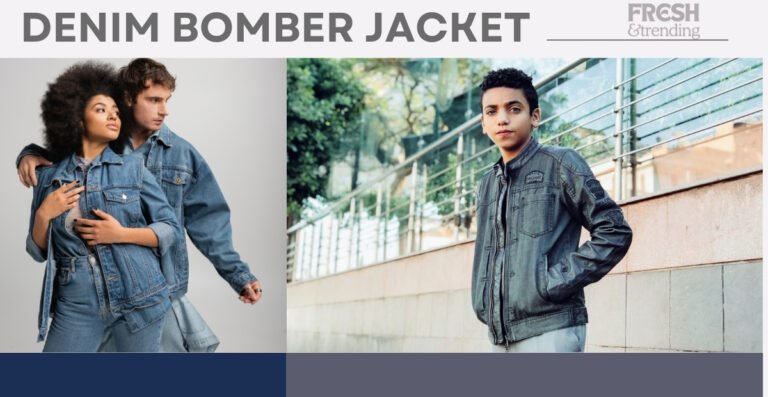
Comparison Table

Type of OrganzaKey FeaturesCommon Uses
Crystal OrganzaLightweight, soft, subtle sheenBridal gowns, evening wear, home décor
Mirror OrganzaVery shiny, reflects light stronglyFormal dresses, stage costumes, decorations
Satin OrganzaSmooth, glossy, crisp drapeHigh-end gowns, bridal fashion, luxury wear
Crushed OrganzaWrinkled, textured surfaceFashion-forward designs, unique garments
Shot OrganzaTwo-tone shimmering effectBall gowns, evening dresses, couture fashion
Embroidered OrganzaDecorative embroidery and embellishmentsWedding gowns, couture, high-end garments

Common Uses of Organza Fabric

Common Uses of Organza Fabric’ on a light blue background with green accent shapes. Sections describe uses in fashion and apparel, home decor and event styling, and crafts and everyday uses. Includes illustrations of people sewing, curtains, and a backpack, plus the Eco-Jersey logo at the bottom.
Common uses of organza fabric: fashion and apparel, home decor and event styling, and crafts and everyday uses, with Eco-Jersey branding.

In Fashion

Dresses and gowns

Used organza for bridal gowns, prom dresses and eveningwear. Its stiff drape allows for voluminous shapes and its sheer drape creates layered, elegant effects.

Blouses and Skirts

Light organza blouse works great for layering and skirts made from organza creates dreamy and whimsical designs.

Accessories

Organza works great for making veils, scarves, and small pouches for jewelry. It is also great to add to delicate accessories set to add a light sheen.

Costumes

Organza is an appropriate fabric choice for stage costumes, ballet tutus, and other performances due to its lightweight ability to flow and catch light.

In Home Décor and Events

Window Treatments

Organza curtains and drapes provide a light and airy quality to rooms, softening the edges while allowing light to flow through.

Table Linens

Overlay and runner sashes bring sophistication to tables at events.

Event Decoration

Organza is frequently used in chair sashes, decorative bows, backdrops, and drapes for weddings and other events.

Other Uses

Bags and Pouches

Small organza pouches, with a matching ribbon as a drawstring, are used for packing jewelry, wedding favors, and other small gifts.

Crafting

In the DIY and garments, organza can be crafted into ribbons, bows, and other components to enhance the decorative design.

How to Care for Organza Fabric

Infographic titled ‘How to Care for Organza Fabric’ with four sections: Washing, Drying, Ironing, and Storage, each with an icon.
How to care for organza fabric: washing, drying, ironing, and storage tips.

Washing

Organza is a silk-like fabric that can be dry cleaned, while some synthetic variants can be placed in a washing machine on a delicate cycle. If hand washing, use cold, soft water with a gentle pH-neutral soap, and gently rinse to avoid bleach and softening fabric.

Drying

Never put organza in a tumble dryer, since heat can ruin the fibers. Instead, gently squeeze out the excess water and lay the fabric flat onto a clean towel to dry, away from sunlight and direct heat.

Ironing

Use the very lowest heat setting and put a press cloth between the fabric and the iron. A cloth steam iron on low is often the best way to get out wrinkles.

Storage

To protect organza, put it on hangers or folding it flat with tissue paper. Keep it in a dry, cool, dark environment, away from sunlight, moisture, and strong scents.

Quick Care Advice for Organza

  • For silk organza always prefer dry cleaning.
  • Synthetics should be washed gently in cold water with mild detergent.
  • Do not tumble dry; always air dry.
  • Ironing should be replaced with steaming whenever possible.
  • Store folded with tissue paper or on padded hangers.

Conclusion

Considered an archaic and an elegant masterpiece, organza fabric mixes beauty and different things, it can be used for bridal and evening dresses, curtains, and decor for crafts. Its smooth and crisp texture makes it glossy and it is a favorite for designers and public. Proper care of organza ensures it remains beautiful for a longer period. So, if you want a touch of luxury you can opt for a silk organza, and if you want something durable, you can opt for synthetic organzas.

FAQs

What is organza fabric made of?

Organza was traditionally made from silk, but today it is also woven from synthetic fibers like polyester and nylon.

Is organza fabric good for summer?

Yes. Organza is lightweight and breathable, making it comfortable for summer wear, though its stiffness gives a structured look.

How do you clean organza fabric?

Silk organza should be dry-cleaned, while synthetic organza may be gently hand-washed with mild detergent. Always avoid bleach and wringing.

Flannel Wool Fabric: Properties, Types, Uses, and Care Tips

Flannel wool fabric has been a staple in the world of textiles for many centuries. It is one of the most well-loved materials in fashion and home decor because of its soft, warm and durable properties. will most likely be on the list of materials for a winter shirt, a warm sweater, or outerwear you may desire.

In this guide, we will focus on the history, properties, uses, benefits and care tips of flanel wool fabric. With its plethora of uses and timeless appeal, it is vital to remember the fabric’s versatility and worth.

History of Flannel Wool Fabric

Flannels wool fabric dates back to Wales in the 17th century. During this period, there was carded wool which was a what is wool fabric and was sought after due to its warmth retention in very chilly weather. The Industrial Revolution, in its turn, brought mechanical looms which made production of flannel faster, easier and cheaper.

Flannels woolen fabric was over time, attributed to the working class due to its low price and its comfort and durability. Eventually, transitioned to everyday use in clothing and interior design and remains in use till this day.

Characteristics and Properties of Flannel Wool Fabric

An infographic titled “Properties of Flannel Wool Fabric” with five numbered sections: 01 Soft Texture (description), 02 Warmth and Insulation, 03 Durability, 04 Moisture Absorption, 05 Breathability. Each section has a short description and circular illustrations (flower, person relaxing by fire, plant/eco symbol, plant in pot, sweater). The design features green accents and circular bordered icons along a vertical white background.
Discover the key properties of flannel wool fabric: soft texture, warm insulation, durable weave, natural moisture absorption, and breathable comfort.

Flannels wool fabric has a distinguishable functional and physical features. Now, let’s discuss what gives it its uniqueness:

1. Soft Texture

The flanel wool fabric has a unique smoothness due to the brushing it endures. This technique raises the tiny fibers which increases warmth and comfort.

2. Warmth and Insulation

Flanel wool fabric, due its unique fibers, traps small pockets of air which creates its exceptional ability to insulate. It warms the body and does not feel heavy.

3. Durability

Absence of damage and fading due to the tightly woven fibers, makes flannels wool fabric, ideal for clothing and home textiles.

4. Moisture Absorption

Unlike synthetic textiles, flannel wool fabric is capable of absorbing moisture, thus keeping the skin dry and comfortable, even under changing temperatures.

5. Breathability

Although warm, flannel wool fabric is still breathable and comfortable, even if worn for a long period of time.

Types of Flannel Wool Fabric

Overall infographic: “ infographic titled ‘MAKING PROCESS OF FLANNEL WOOL FABRIC’ with green accents. Sections show Wool Flannel, Cotton Flannel, and Synthetic Flannel with outlined clothing illustrations and small decorative drawings.”
Wool Flannel illustration: “Line drawing of a warm, button-up wool flannel shirt with two chest pockets and cuffs.”
Cotton Flannel illustration: “Line drawing of a plaid cotton flannel shirt with a similar button-up style, shown in a boxed frame.”
Synthetic Flannel illustration: “Line drawing of a dark-colored plaid shirt, front view, boxed frame.”
Decorative elements: “Small line drawings of yarn, flowers, and fabric tools in the corners.
Making process of flannel wool fabric: Wool Flannel, Cotton Flannel, and Synthetic Flannel, with illustrated shirts representing each fabric type.

There are different types of flannel wool fabric, each presenting different advantages of its own:

1. Wool Flannel

Traditional flannel made entirely from fleece wool fabric offering maximum warmth and softness.

2. Cotton Flannel

A blend of cotton and wool or pure cotton, providing breathability and a lighter weight for warmer climates.

3. Synthetic Flannel

Made with fibers like polyester, it is more affordable but may lack the natural warmth of wool fabric based options.

Uses of Flannel Wool Fabric

One of the most versatile textiles, flannel wool fabric is used for a wide range of purposes:

Clothing

Some of the most common pieces of clothing made with flannel wool fabric include:

  • Shirts and blouse
  • Pajazine and loungewear
  • Coat and jacket
  • Scarf and winter accessories

It is highly appreciated due to its warmth and softness, which makes it ideal for semi-casual and semi-formal attire.

Home Furnishings

The soft and cozy characteristics of flannel wool make it a great choice for:

  • Bed sheets and blankets
  • Cushion covers
  • Curtains and upholstery

Industrial Applications

Flannels wool fabric is used for linings in outdoor and protective clothing for colder climates regions because of its insulation value

Advantages of Flannel Wool Fabric

Infographic detailing advantages of flannel wool fabric, including: exceptional comfort, long-lasting durability, moisture-wicking properties, versatile style options, and eco-friendly choice. Green circular icons accompany each benefit with simple illustrations.
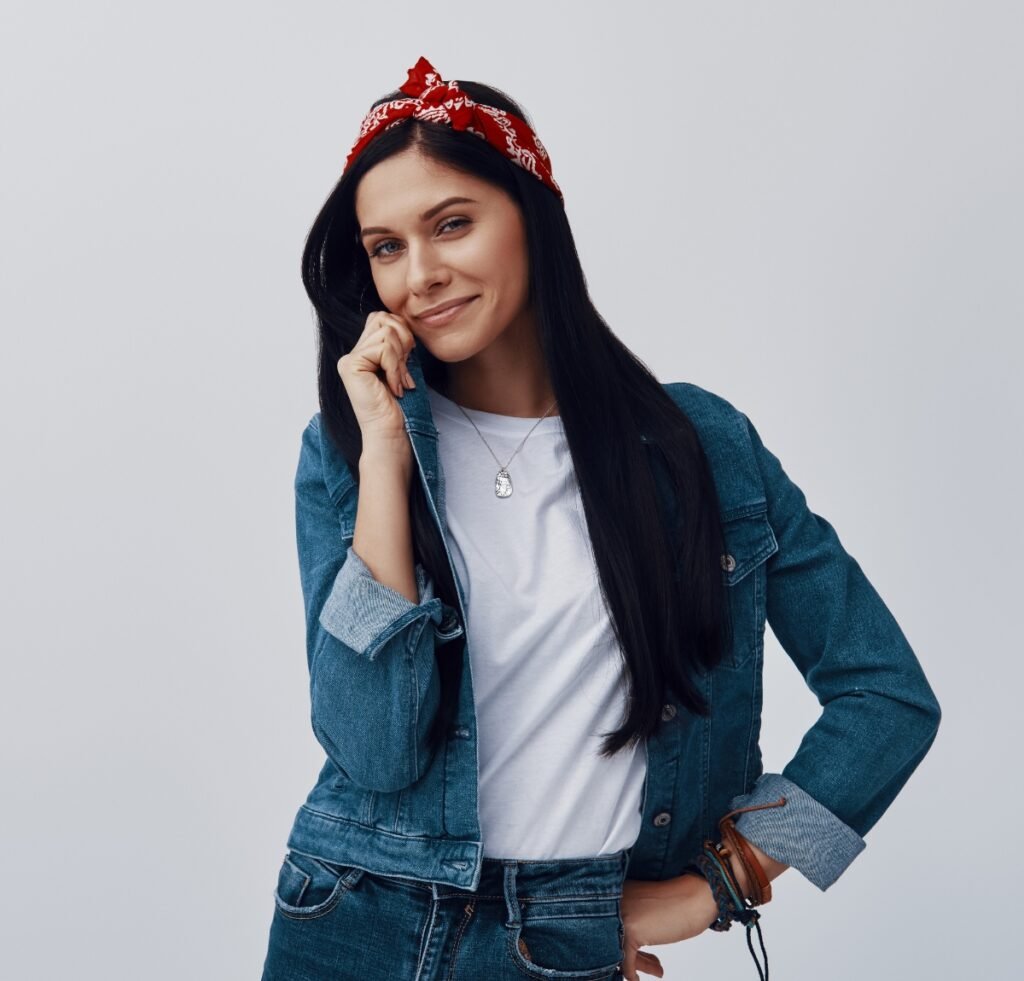
Advantages of Flannels Wool Fabric: Comfort, durability, moisture management, versatile styling, and eco-friendly choice.

While used for an extended time worldwide, it provides unexplained benefits.
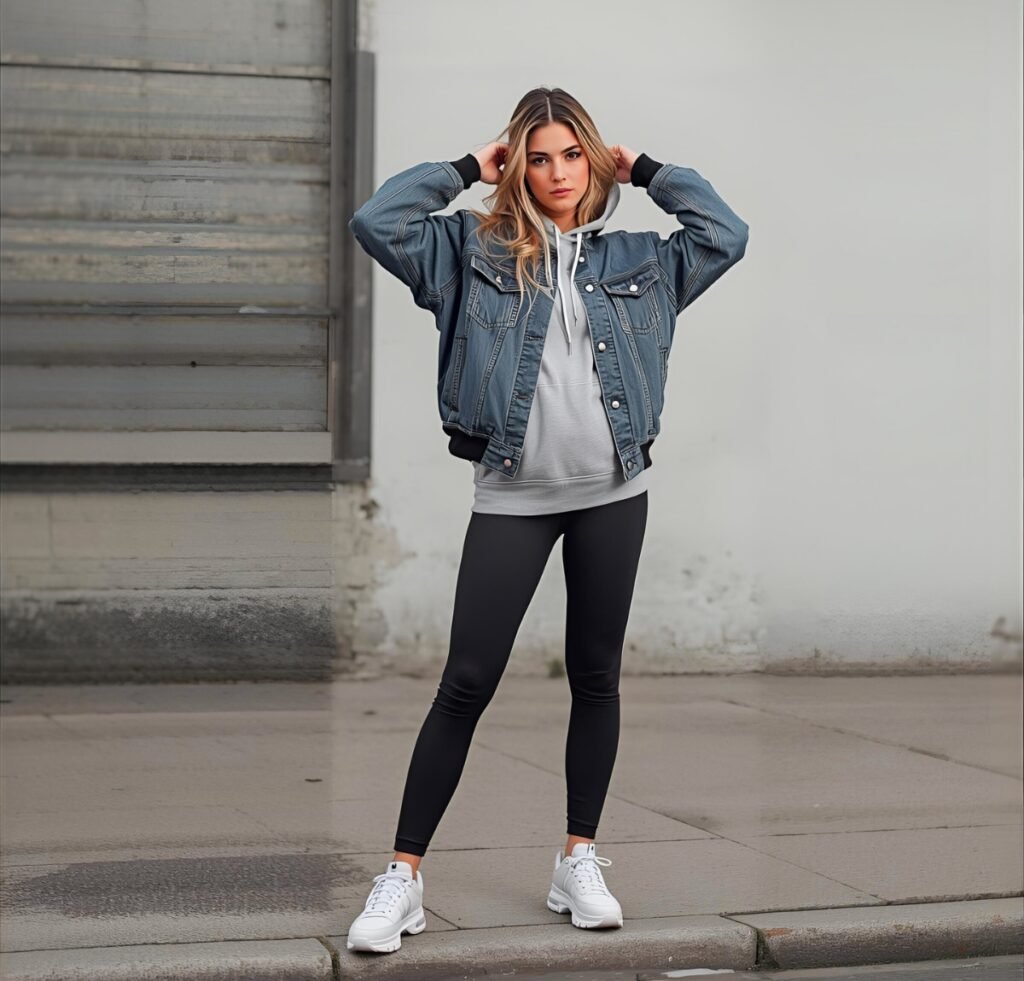
  1. Comfort: Its soft brushed texture provides a cozy and warm feeling
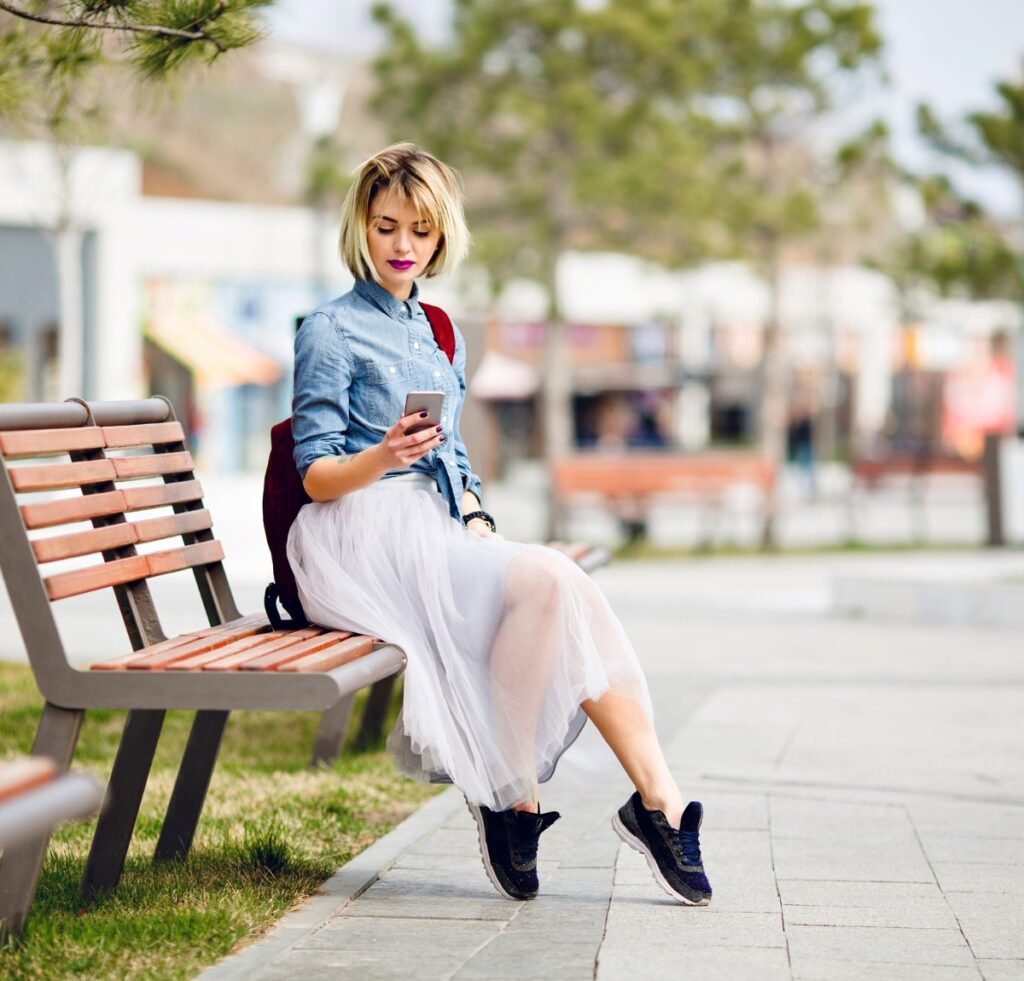
  2. Durability: Properly looked after flannels wool fabric can last for many years
  3. Moisture Wicking: It wicks and transfers moisture while allowing the skin to breathe
  4. Style Versatility: It can be used in a variety of clothing styles, ranging from plaid shirts to stylish coats
  5. Eco-Friendly Option: Wool flannels a recyclable and renewable material.

Disadvantages of Flannel Wool Fabric

Infographic titled ‘Disadvantages of Flannel Wool Fabric’ showing three points: 01 Pilling Risk with icons of pills and medicine bottles; 02 Shrinkage with a figure near a washer/dryer; 03 Limited Seasonal Use with yarn balls and a tree with autumn leaves.
Disadvantages of Flannel Wool Fabric: Pilling risk, shrinkage with improper washing, and limited seasonal use.

In as much as flannels wool fabric has several merits, it is also accompanied with numerous demerits.

  • Pilling Risk: The fabric is subject to balls of lint or fuzz if not taken care of
  • Shrinkage: Overwashing/ improper washing can cause the fabric to shrink
  • Seasonal Use: It is unsuitable for hot climates—

Caring for Flannel Wool Fabric

Infographic titled ‘Care of Flannel Wool Fabric’ showing icons for washing, drying, ironing, and storage with text tips.
Care Tips for Flanel Wool Fabric: Washing with gentle detergent, air drying, light ironing with low heat, and cool storage using cedar blocks or mothballs.

To keep a flanel wool fabric soft and durable, proper care is needed:

  1. Washing: A gentle detergent and cold water are ideal. Wool flannels is ideal for hand washing and dry cleaning.
  2. Drying: To upkeep fabric quality and avoid shrinkage, air drying is encouraged.
  3. Ironing: If possible, it is best to avoid ironing. However, if it is absolutely necessary, then low heat should be used.
  4. Storage: Protect from moth damage with mothballs or cedar blocks. Keep in a dry, cool environment.

Flannel Wool Fabric and Sustainability

Flanel wool fabric has many aspects that helps to achieve the goals of sustainable fashion.

  • Wool is renewable, as sheep grow new fleece every year.
  • The natural flanel will decompose without causing harm to the planet.
  • The longer a garment is worn, the less textile waste will be produced due to fast fashion.

Supporting flanel and wool blends is a great way to practice sustainable buying as well as guaranteeing comfort and quality.

Conclusion

From being industrious working class fabric, flanel wool had become ‘happy wool’ and now leverages its warmth on its users while it is also immensely loved by designers for its durability and comfort. It also fulfills the modern eco-friendly demand and is easy to work with when designing home décor.

Explaining the fabric’s history, properties, and its relative care can draw full value appreciation of flannels wool fabric. This winter, don’t hesitate to try out the many stylish options ready with the fabric as for your bedding, home furnishing too.

FAQs

Is flannel wool fabric only for winter?

Lightweight flanel options work well in transitional seasons like spring and fall.

Does flannel wool fabric shrink?

it can shrink if washed in hot water. Always follow care instructions carefully.

Is flannel wool fabric environmentally friendly?

especially wool-based flanel, which is biodegradable and renewable.