Home Blog Page 119

Rayon Silk Fabric: The Perfect Blend of Shine & Softness

Among many fabrics, Rayon Silk Fabric is beautiful and comfortable. Luxurious looking, crying, and expensive, many people love it. The fabric costs a lot but it is people love it. This just shines. The. Cloning, home accents, and additions, everything softens and is graced when this is modified and used.

What Is Rayon Silk Fabric?
A close-up of a light, airy fabric in soft ivory and champagne tones with delicate draping and a sprig of white dried flowers.
Subtle elegance: rayon silk fabric with a gentle sheen and fluid drape.

Rayon Silk fabric is a combination of pieces of mini threads and twisted serials pieces of infusion of threads. Silk is produced from silkworms and wood is purely cellulose. It’s a shin fabric that equals breathing cotton and giving comfort. Many designers decide it because it adapts and drapes to all seasons.

The fabric offers a rich silk appearance while remaining economically gentle because of the silk and rayon blend. It is lightweight, versatile, and is neat for both everyday and more formal uses. It is a highly sought-after fabric for individuals who appreciate fine silk softness because of the combination of attributes and affordability.

The Story of Rayon Silk Fabric
Close-up of rich brown, flowing rayon silk fabric with smooth, glossy folds."
The Story of Rayon Silk Fabric: a luxurious blend of rayon’s drape with silk’s luster, captured in warm, chocolate-brown folds.

The origins of Rayon Silk Fabric Date back to the beginning of the 20th century. It was during then that scientists sought out a substitute that was cheaper to produce and replicated the beauty of silk. Rayon was discovered as a semi-synthetic fiber made from wood pulp. The combination of semi-synthetic rayon with silk created a perfect balance of shine, strength and comfort. This fabric gained popularity among weavers, designers and buyers worldwide.

The fabric was acclaimed because it bodied the luxury and glow of silk while staying less delicate. It became more comfortable and then more accessible. The combination of the smooth finish and soft touch of the fabric was and still is highly sought after, placing it firmly within both Eastern and Western fashion sticks. It remains a highly regarded material within the fabric and textile industry to this day.

The Feel of Rayon Silk Fabric
A rich red rayon-silk fabric draped in soft folds, showing a smooth, lustrous surface with subtle sheen and deep shadows.
The luxurious sheen and drape of rayon silk: vivid red, luxuriously soft, and beautifully fluid.

The soft, cool touch of Rayon Silk Fabric is loved by many. The beginning fibers in a blend are so well smoothed that they attain a glossy and even surface. The movement of the fabric is flowing and graceful and the combination of these qualities allows a soft premium appearance. This is why it is preferable in dresses, sarees, scarves, and blouses.

Each contact of tissue with the surface is a dense touch that cools and relaxes the body. It is for these reasons that many people wear it during the warm summer months. The texture and relaxation of the fabric even allows performance in festive occasions.

Rayon Silk Fabric for Designers
"Dual-tone fabric with teal-blue satin on the left and peach-pink satin on the right, split down the center with a bold blue-red 'VS' emblem in the middle."
“Radiant Rayon-Silk: a luxe, drapey blend that transitions from cool teal-blue to warm peach-pink.

There are many different reasons that fashion specialists admire Rayon Silk Fabric. It is a luxurious finish without a costly pure silk price. The beautiful draping of the vertical and horizontal seams allows for elegant shapes, folds and designs. The fabric is characterized by a soft and luscious natural shine.It also absorbs dyes very well, which means it can hold bright and rich colors. Because of this quality, the fabric looks stunning in every shade—from soft pastels to deep jewel tones. Many designers use it for gowns, sarees, and evening wear. Its easy handling and comfort make it a perfect choice for both traditional and modern styles.

The Versatility of Rayon Silk Fabric
A close-up, soft-focus image showcasing flowing, silky fabric in pastel pinks and creams. The fabric appears light, draping in graceful folds with a subtle sheen, highlighting the fabric’s fluid texture and luxurious drape.
The Versatility of Rayon Silk: A silky, drapable fabric that blends rayon’s softness with silk-like luster for endless styling possibilities.

In clothing, it works perfectly for every age and occasion. From festive sarees to casual tops, it adds charm to every piece. Because it’s light and breathable, people enjoy wearing it in every season. Its ability to blend comfort with beauty makes it a timeless fabric in fashion.

The Comfort Factor in Rayon Silk Fabric
A close-up of a luxurious rayon-silk fabric with a rich green base, red-orange embroidery of delicate flowers along a curved border, and decorative red beads and gems adding texture and elegance.
The Comfort Factor in Rayon Silk: Luxurious feel, breathable weave, and intricate floral embroidery with bead accents that elevate everyday elegance.

Every wearer appreciates the comfort that Rayon Silk Fabric provides. It’s soft, non-irritating, and smooth on the skin. Unlike some heavy materials, it doesn’t trap heat or cause sweating. The fabric allows air circulation, making it great for daily wear.

When worn, it feels light but strong. The smooth texture doesn’t cling tightly, allowing free movement. Even after hours of use, the comfort remains the same. That’s why people prefer it for long celebrations and events. The mix of style and comfort is what makes this fabric special.


Caring for Rayon Silk Fabric
"Close-up of soft, pleated rayon silk fabric in ivory, with light folds and gentle shadows."
Caring for Rayon Silk Fabric: gentle handling, avoid high heat, and use delicate wash methods to preserve softness and sheen.

Taking care of Rayon Silk Fabric is easy if done properly. Gentle hand washing with mild detergent helps keep the fabric fresh. Harsh scrubbing can harm its smooth texture, so soft handling is best. Avoid soaking it for long, and always dry it in the shade.

Ironing at low temperature keeps the shine alive without burning the threads. Proper care ensures the fabric lasts longer and keeps its glow. With simple attention, it can stay as beautiful as new for years. Many people appreciate that this blend offers easy maintenance compared to pure silk.

The Durability of Rayon Silk Fabric

When it comes to longevity, Rayon Silk Fabric strikes the appropriate balance. While silk gives it strength, rayon gives it flexibility. This combination makes it robust enough to withstand everyday use. The fabric is also easy to clean and store, increasing longevity.

It is also less fragile than pure silk and, therefore, can withstand more movement and stress, which is why it is such a popular everyday fabric. Even after repeated washing, it holds its elegant appearance.

The Shine That Defines Rayon Silk Fabric

What stands out most is the Rayon Silk Fabric shine. The silk fibers gently reflect light to give a glowing effect. If washed gently, this effect remains even after washing. This gentle glowing effect captures the beauty of the ensemble and is pleasing to the eye.

It glows even in the warm light of lamps and is especially pleasing to the eye when in natural light, increasing the color depth, and adding a royal look to the outfit. This soft shine enhances the look of festive and formal outfits, which is why it is one of the most loved fabrics.-

Modern Day Fashion with Rayon Silk Fabric

Rayon Silk Fabric has a place of its own in modern day fashion. Designers create affordable fashionable clothes with it. It lets the designers go wild with with creativity because it can fit into any design. It can be printed on, and embroidered, and it looks good on it.

High-street fashion and design boutiques It Works in both. It can work on embroidered western wear and traditional wear. Also easy to dye and print, it helps in making trendy print the catch the eye of the publ

There are some chemical processes, but manufactures are now more responsible and find greener ways. It is better to blend silk with rayon, because it saves more resources. This keeps it eco-friendly unlike some fully SYNTHETIC fabrics.

How Rayon Silk Fabric Stands Against Pure Silk

Rayon silk fabric has the same appearance of silk fabric but is cheaper. Although pure silk is luxurious, expensive, and delicate, rayon is softer, glow, easy to manage.

It can be worn every day with little care. Its lightweight offers comfort as it can be worn for long hours. For silk buyers, it practical and beautiful as it offers a cheaper alternative.

Rayon Silk Fabric Around the World

Rayon silk fabric has gained love for its charm and flexibility. From Asia to Europe, people use it in different ways. In India, it is popular in sarees and ethnic dresses. In Western gowns and blouses, it is common in evening gowns and home.

This wide use shows how adaptable fabric is. It can fit traditional and modern looks. It glows and is soft to the touch. It is a thin fabric which bridges cultures through comfort.

Why Rayon Silk Fabric Feels Luxurious

The richness of Rayon Silk Fabric comes from careful merging of silk and rayon. As silk adds gloss and rayon contributes lightness to the fabric, every fold of the rayon silk fabric permits the wearer to exude elegance.

Having evenly distributed fabric thickness means for a balanced weave, which contributes to durability and an overall shine. When purchasing from a seller, fabric quality is exceptionally important in determining the overall elegance of an outfit.


Rayon Silk Fabric in Everyday Life

It’s easy to overlook the practicality of Rayon Silk Fabric in a person’s everyday life. A lot of homes use it in curtains, bed covers, and cushion cases. It brightens and styles a person’s home. It’s soft, smooth, and shiny, adds a touch of class, and is comforting to the person using it.

For sewing enthusiasts, this fabric is enjoyable and simple to use. It is easy to cut and beautifully drapes. It enlivens and beautifies a person home beautifully, whether it is for a dress or home décor. Each year, the fabric’s versatility adds to a person’s sewing projects.


The Future of Rayon Silk Fabric

The future of Rayon Silk Fabric will continue to shine for years to come. With the growing demand for comfortable, elegant fabrics, this is a perfect match. With affordable luxury on the rise, this fabric adds to its popularity. It is a wonder what designers will come up with next.

Advancing technology for textile production means advancements to come for fabric in the future. Improved quality, stronger fibers, and richer colors are exciting to think about. With a perfect balance of comfort, beauty, and price, this fabric will always be in demand and admired for years to come.

Conclusion

The ‘Rayon Silk Fabric’ lives up to its reputation as the best of both worlds – soft and shiny. It is widely preferred because it combines the beauty of silk and the comfort of rayon. Whether it is a saree, gown, or blouse, it always has that touch of grace.

The versatility, durability, and affordability of the ‘Rayon Silk Fabric’ marks it for every generation. It has that smooth touch and luxurious glow that always feels great and never fades. It is a ‘Rayon Silk Fabric’ time and again, and for good reason.

FAQs

Q1. What is Rayon Silk Fabric made of?

Rayon Silk Fabric is made from a mix of rayon and natural silk fibers. This blend gives it a shiny look and soft touch.

Q2. Is Rayon Silk Fabric real silk?

Rayon Silk Fabric is not pure silk, but it feels and looks very similar. It combines rayon’s comfort with silk’s elegance.

Q4. Is Rayon Silk Fabric good for summer?

Rayon Silk Fabric is perfect for summer because it is light, smooth, and breathable. It feels soft even in warm weather.
100% Wool Military Blanket: The Ultimate Guide to Warmth and Durability

0

100% wool military blanket has been and still is a popular blanket that provides warmth, protection, and durability to the user. Originally designed for outdoor use in extreme conditions, as of today, blankets are being used in homes, as part of camping equipment, and in emergency preparedness. Even today, it is versatile enough to still be used as a decorative blanket as well. The industrial value of the blanket has made it to the top. The military wool blankets are still one of the favorites to use.

A Brief History of the 100% Wool Military Blankets

The history of the 100% wool military blanket details wool. It includes wool military uniforms and bedding as military issued. It details the blankets creation in the military to provide shelter and keep the soldiers warm, as well as, protected from the cold weather in extreme conditions. Wool fabric and uniforms provided warmth and strength.

These blankets were engineered to be durable, moisture-wicking, and naturally flame-resistant, which means they provided warmth without the weight and without losing quality. Over time, civilians used them for outdoor activities, camping trips, and for use around the home.

Even to this day, these blankets still evoke strength, tradition, and dependability, and for good reason. Their design continues to motivate and capture the interest of vintage and modern minimalists alike.

Key Properties of a 100% Wool Military Blanket

100% wool military blanket has numerous and notable attributes as well. These attributes allow for multiple use and the blanket to be used year after year.

  1. Natural WarmthWool fibers capture and hold air, and therefore, provide insulation to retain body heat. This makes blankets warm, even in extreme temperatures.
  2. Moisture-Wicking AbilityWool can absorb 30% of its weight in moisture without feeling wet, and therefore, stays dry even in humid or wet conditions.
  3. Flame ResistanceWool also has the natural and very much valued attribute of flame resistance. This makes wool safer to use outdoors, as it doesn’t easily catch fire and wool blankets provide additional safety.
  4. Durability and Strength

These blankets are tightly woven, and that is what extends their longevity. This, then, accounts for their ideal performance in tough environments.

  1. Breathability

Wool is not a synthetic fiber, so it permits airflow. This is the reason you stay warm and do not overheat.

Popular Uses of the 100% Wool Military Blanket

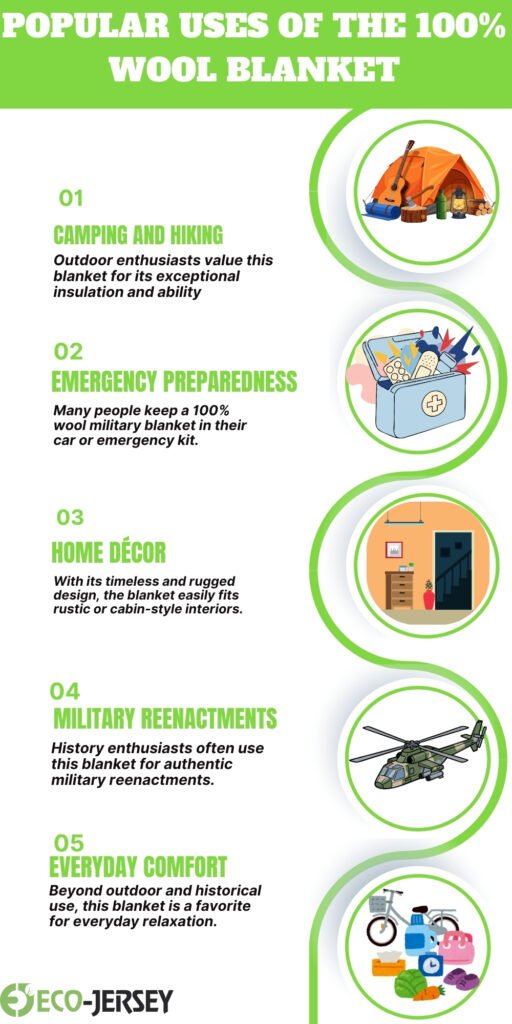
Infographic titled “Popular Uses of the 100% Wool Blanket” with five circular illustrations on the right and corresponding numbered sections on the left. Sections:
Camping and Hiking: outdoor gear illustration.
Emergency Preparedness: first aid kit illustration.
Home Décor: rustic interior illustration.
Military Reenactments: military helicopter illustration.
Everyday Comfort: cozy items and slippers illustration.
Five versatile uses for a 100% wool blanket: camping, emergency prep, home décor, military reenactments, and everyday comfort.

The 100% wool military blanket is multifunctional. Even though it was first intended for soldiers, it is now used in a variety of situations.

  • Camping and Hiking: It is loved by outdoor enthusiasts for its warmth and ability to protect against the elements.
  • Emergency Preparedness: It is also a popular choice for those in cars or emergency packs for unexpected cold weather.
  • Home Décor: Its classic, rugged look is well suited for living areas and cabins, as well as rustic interiors.
  • Military Reenactments: It is used by history enthusiasts to perform accurate recreations.
  • Everyday Comfort: It is also popular for casual use on blankets, couches, and beds, where its weight and warmth are appreciated.

This blanket is both functional and stylish, proving that some designs are timeless.

Benefits of Owning a 100% Wool Military Blanket

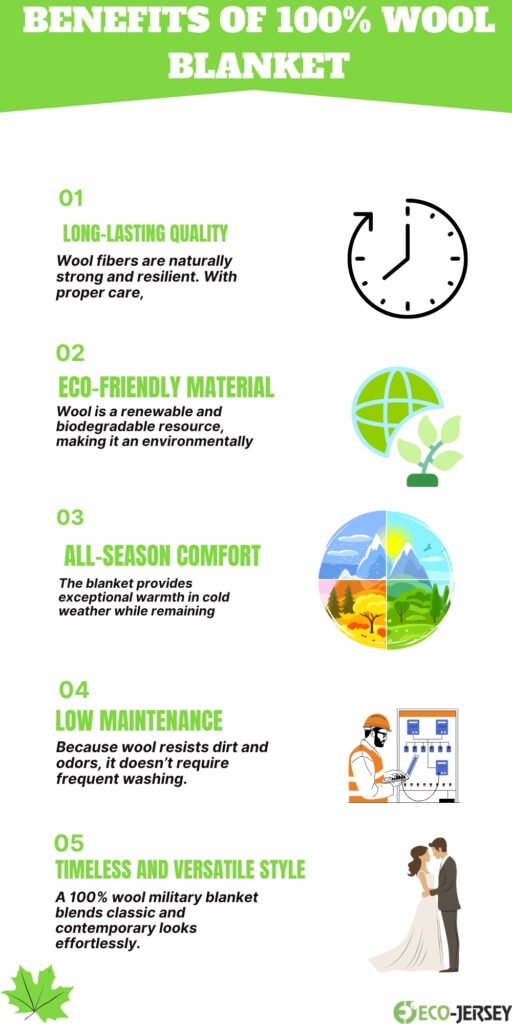
Infographic titled 'Benefits of 100% Wool Blanket' in green and white. Five sections listed with icons on the right: 01 Long-Lasting Quality with a clock icon; 02 Eco-Friendly Material with a globe and sprouting leaf; 03 All-Season Comfort with a circular landscape diagram; 04 Low Maintenance with a technician at a control panel; 05 Timeless and Versatile Style with a bride and groom. Each section includes a bold green heading and a short descriptive sentence. Small decorative elements include a green leaf at bottom left and eco-jersey logo at bottom right.
Discover the enduring benefits of a 100% wool blanket: long-lasting quality, eco-friendly materials, all-season comfort, low maintenance, and timeless style.

There are many reasons to choose a 100% wool military blanket.

  • Long-Lasting Quality: With the right care, wool fibers will show resilience for decades.
  • Eco-Friendly Material: It is renewable, biodegradable, and biodegradable which is useful too.
  • Easily Comfortable: It is warm and cozy in the winter while keeping the blanket light and breathable on clear days.
  • Low Maintenance: It does not smell and is dirt resistant, so the blanket is saved from too frequent cleaning.
  • Everlasting Charm: The blanket matches different looks, as it is contemporary and classic, cozy and warm, friendly while still protecting.

These characteristics make it useful for the home and for outdoor use.

How To Care for a 100% Wool Military Blanket.

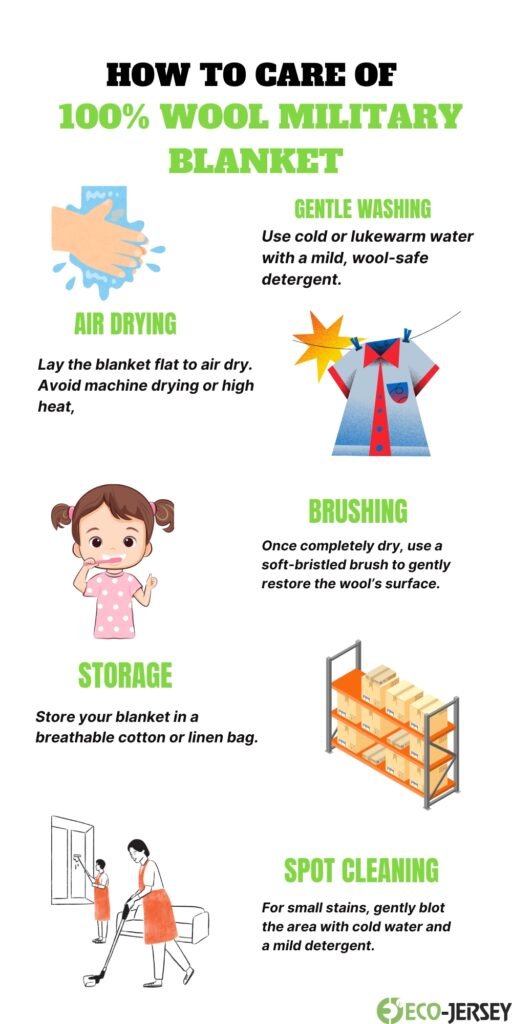
Infographic titled ‘How to Care of 100% Wool Military Blanket’ with illustrated sections: Air Drying, Gentle Washing, Brushing, Storage, Spot Cleaning, and a child icon. Each section includes small descriptive tips and simple visuals.
How to Care for a 100% Wool Military Blanket: step-by-step care tips for air drying, gentle washing, brushing, storage, and spot cleaning.

Your 100% wool military blanket will remain soft and durable for years if it is taken care of properly. Wool does not trap dirt and regular cleaning is not required, but it does need cleaning.

  1. Gentle WashingWool does best with cold or lukewarm water and raw mild detergent. Stay away from harsh chemicals and fabric softeners.
  2. Air DryingWool blankets should be laid flat for tumble drying is not recommended.
  3. BrushingLight brushing after drying helps restore the surface and softness of the wool.
  4. StorageSoft, breathable material bags can be used to store it to protect against moths and to preserve its freshness.
  5. Spot Cleaning

For small stains, gently blot the area with cold water instead of rubbing. This helps keep the fibers intact.

Following these, the blanket should maintain its quality for years.

Why the 100% Wool Military Blanket Stands Out

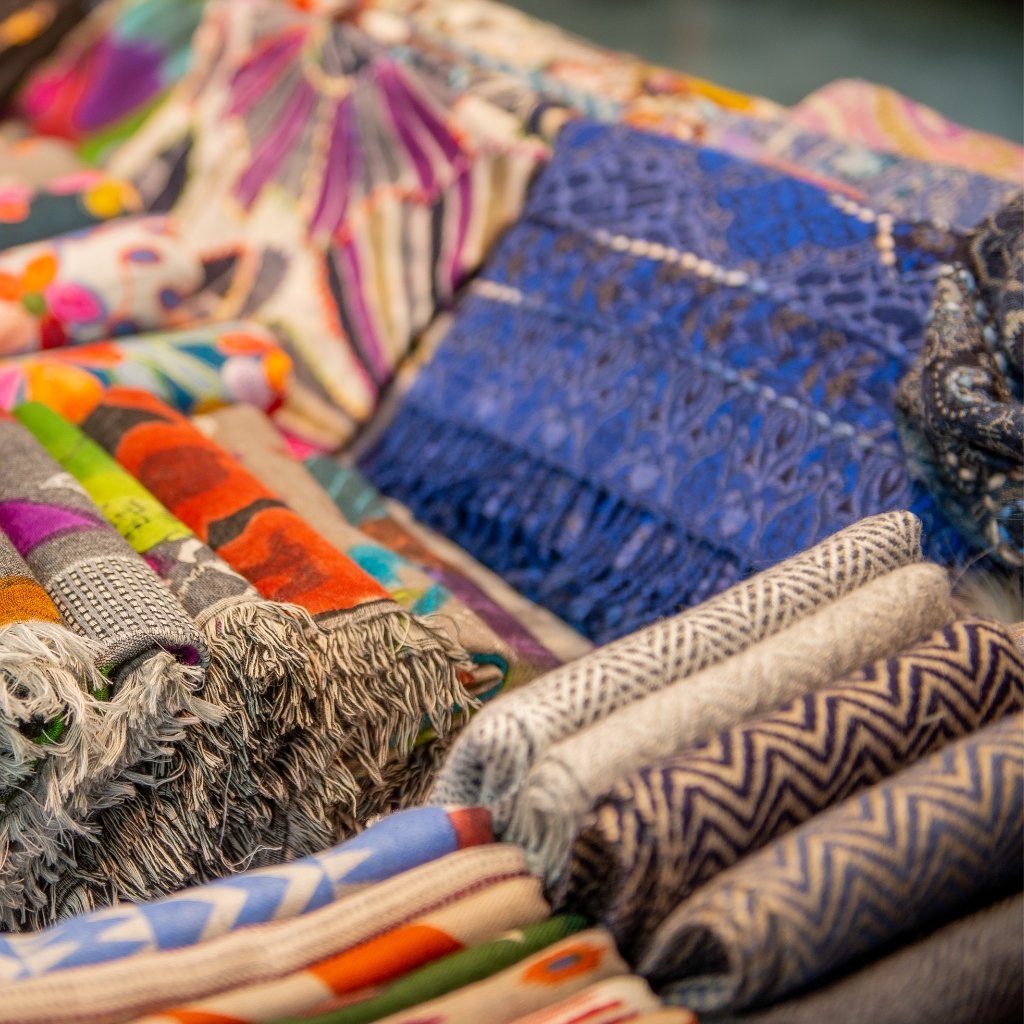
Close-up view of rolled and folded wool blankets in various colors and patterns, including camouflage-inspired earth tones, bright stripes, and intricate weaves, with a fringed edge on one roll.
A collection of 100% military wool blankets in diverse colors and patterns, neatly rolled and stacked.

Among all the different kinds of blankets available, the 100% wool military blanket is the most unmatched for durability and comfort. It provides reliable warmth and will not lose its shape and texture over time. It will stay warm and shape over time. Also, it is a nice environment due to its natural materials.

Unlike manmade fabrics, wool will not lose harmful microplastics. Also, its design and style of the blanket will not go out of fashion. It can be used in a camping trip or as a decorative throw. It adds a sense of tradition and quality.

How to Style a Wool Military Blanket at Home

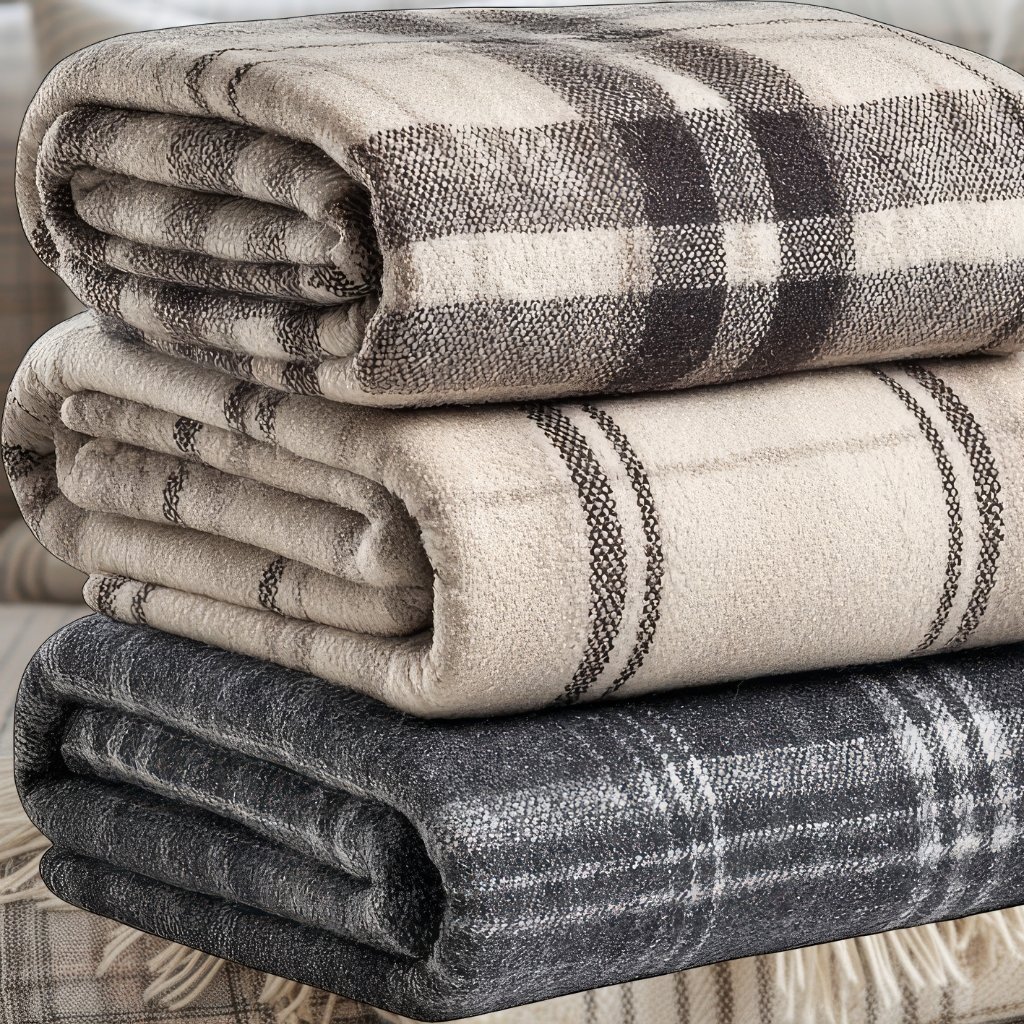
A stack of three thick wool military blankets in neutral tones: top is light beige with dark brown plaid accents, middle is cream with subtle brown stripes, and bottom is dark charcoal with lighter stripes. The blankets appear soft, woven, and folded neatly.
100% Wool Military Blanket — rugged warmth in a timeless, neutral plaid.

You can use a 100% wool military blanket to add value to your living space with style. For instance, you can throw it over a sofa. That will add a cozy feeling, and you can keep it on the bed for extra warmth and a design pattern.

Interior designers regularly comment on the neutral colors and sturdy weave. They point out it works with rustic modern decors. It works nicely with wood and leather furniture and even industrial style pieces.

Eco-Friendly and Sustainable Choice

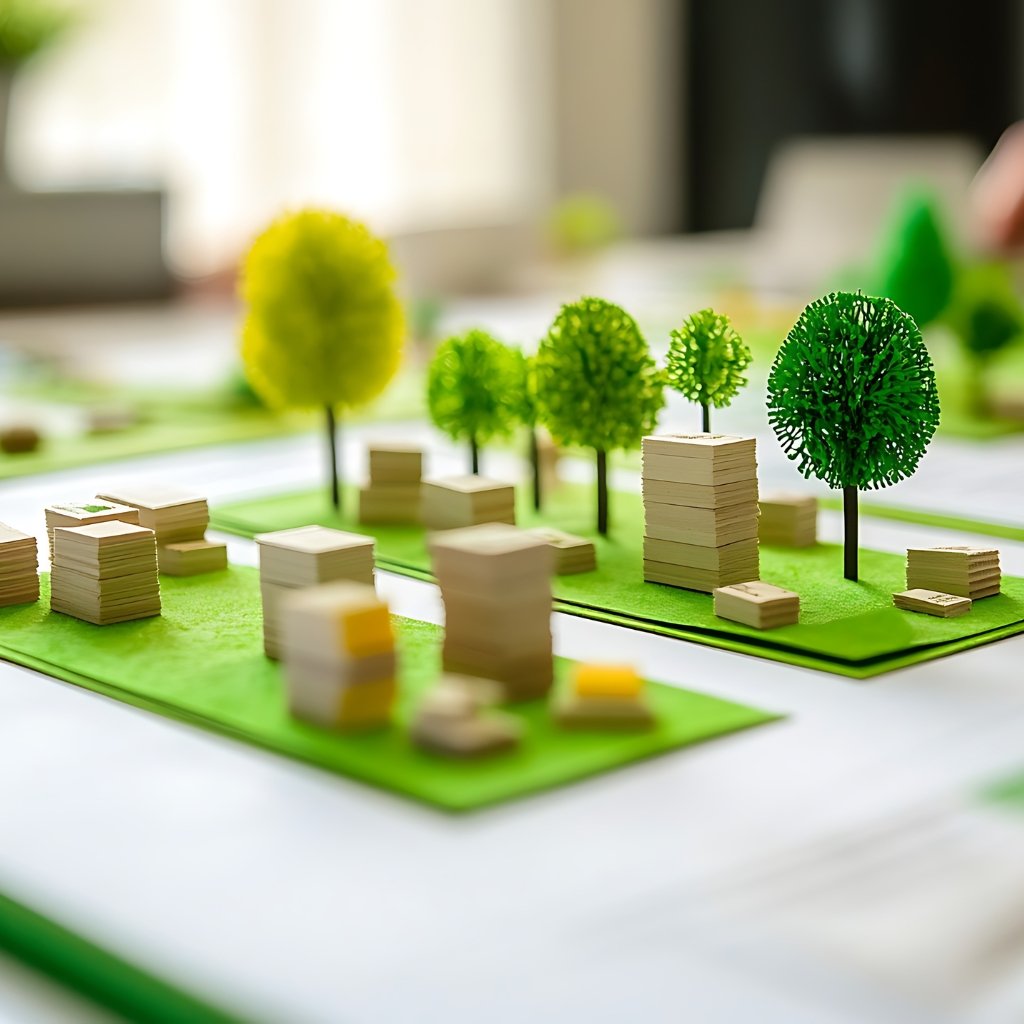
A miniature diorama showing small wooden blocks representing houses and trees on a green base, with several stacks of wood and yellow-highlighted pieces. The scene resembles a tiny, stylized village layout.
Tiny village model built with wooden blocks and miniature trees on a bright green base.

Wool is renewable because sheep regenerate fleece and the fiber is biodegradable. So when you buy a 100% wool military blanket, you are buying something that encourages sustainability.

Wool holds its value and lasts a long time, meaning decreases waste. So, you are also being practical and being eco-friendly.

Conclusion

100% wool military blanket serves you warmth and is a reminder of the history, durability, and craftsmanship of the fabric. It has been trusted to provide comfort by soldiers, campers, and families all through the years.

It is still a smart and stylish choice because of its insulating power and moisture control. It can be used or stored indoors and its value lasts for generations.

FAQs

Is a 100% wool military blanket warm enough for winter?

Yes, wool provides excellent insulation, making it perfect for cold winter months.

Can I wash a wool military blanket in the machine?

It is best to hand wash, but if you need to, you can use a gentle cycle with cold water to wash it in the machine.

 Does wool shrink?

Yes, it can, especially if you put it in hot water or a hot dryer. Always use cold water and air dry.

Is Rayon Natural or Synthetic? Truth Behind the Fabric

Introduction

Rayon has been described as semi-synthetic- but what exactly does this mean? The question is whether rayon is a natural or synthetic fiber, as its origin is a gray area. This article will cover the definition of rayon, how it is formed and whether it can be classified as natural or manmade. I want to sort out this misunderstanding, determine the composition of rayon and its effects on the environment and its derivation regarding fully natural and fully synthetic fabrics. At the conclusion, readers will consequently know well “Is Rayon Natural or Synthetic”

What Is Rayon?

Definition and Early Development.

Rayon is a name of a bunch of fibers manufactured using recycled cellulose. It was discovered at the end of the 19th and the beginning of the 20th centuries when manufacturers tried to find substitutes of silk.is rayon a natural or synthetic fiber. The viscose rayon was initially developed by the scientists who dissolved the wood pulp cellulose and then re-wove the fibers. This process brought rayon cheap and versatile so that silky drapey fabrics could be produced on a mass scale. Is Rayon Natural or Synthetic

Composition: Cellulose Derived from Wood Pulp

The fibers of rayon are derived out of cellulose that is mainly composed of the tree pulp of wood or at times bamboo. Manufacturers remove the cellulose and subject it to chemicals.is rayon a natural or synthetic fiber. They then squeeze it through spinerets to create fiber strands again. The regenerated cellulose acts in most ways like the natural fiber. But there are chemical processes which alter its form, its rigidity, etc.

Semi-Synthetic Nature: Natural Source + Chemical Process.

The fact that rayon is made of natural cellulose, which is then chemically converted makes it semi-synthetic. It is not grown as a fiber as cotton is, or is fully synthetic as polyester. Instead, it bridges that gap. So, whether rayon is a natural or synthetic fiber is an interesting question.is rayon a natural or synthetic fiber. The solution is that it is semi-synthetic. Rayon is natural and modified in process of manufacturing. Is Rayon Natural or Synthetic

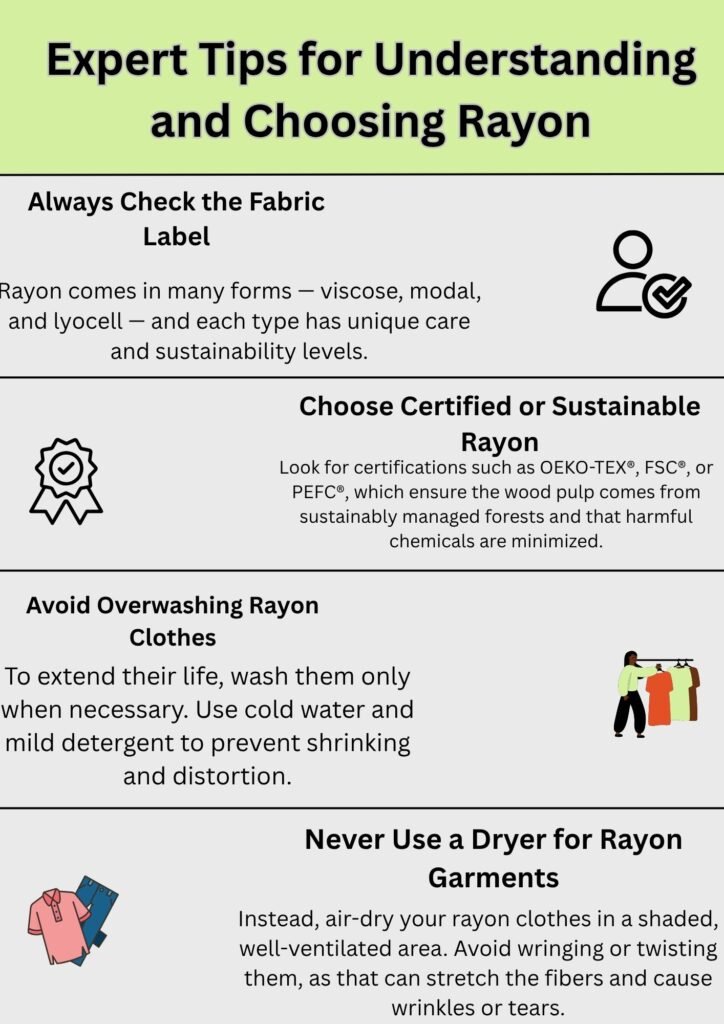
Expert Tips for Understanding and Choosing Rayon

Add a subheading 11

Always Check the Fabric Label

Rayon comes in many forms — viscose, modal, and lyocell — and each type has unique care and sustainability levels.
Before buying, look at the clothing tag. If it says “Tencel™” or “Lyocell,” it’s usually a more eco-friendly version of rayon. Labels also reveal whether the fiber is blended with polyester or cotton, which affects breathability and texture. Is Rayon Natural or Synthetic

Choose Certified or Sustainable Rayon

Not all rayon is made responsibly.
Look for certifications such as OEKO-TEX®, FSC®, or PEFC®, which ensure the wood pulp comes from sustainably managed forests and that harmful chemicals are minimized.
Choosing certified rayon helps reduce deforestation and chemical pollution while supporting responsible manufacturing. Is Rayon Natural or Synthetic

Avoid Overwashing Rayon Clothes

Rayon fibers weaken when wet.
To extend their life, wash them only when necessary. Use cold water and mild detergent to prevent shrinking and distortion.is rayon a natural or synthetic fiber.
Gentle hand washing or using a delicate machine cycle inside a mesh bag is ideal. Always reshape while damp and lay flat to dry. Is Rayon Natural or Synthetic

Never Use a Dryer for Rayon Garments

High heat can shrink, distort, or even harden rayon fibers.
Instead, air-dry your rayon clothes in a shaded, well-ventilated area. Avoid wringing or twisting them, as that can stretch the fibers and cause wrinkles or tears. Is Rayon Natural or Synthetic

Is Rayon a Natural Fiber?

Natural Source: Natural Cellulose Plant.

Plants give rise to rayon. Cellulose is commonly provided by trees, bamboo or cotton linters. Plants produce a polymer, the cellulose.is rayon a natural or synthetic fiber. Manufacturers cut wood or bamboo, mill their pulp and separate the cellulose molecules. In that regard, rayon has natural origin, and is a plant-based fabric. It has the same base material as cotton, linen or hemp. Is Rayon Natural or Synthetic

Comparison to Other Natural FibersSuch as Cotton or Linen.

Cotton and linen fibers grow on plants; their fibers are fewer to be transformed with chemicals.is rayon a natural or synthetic fiber. By contrast, the cellulose of rayon has to be extracted, dissolved, re-grown.is rayon a natural or synthetic fiber. Thus though rayon and cotton and flax have the same natural origin, they begin to diverge in their path to becoming fabric. The process is almost a direct spin of natural fibers such as cotton, but rayon needs to undergo some sort of chemical change. Is Rayon Natural or Synthetic

Connotation: Is Rayon Natural?

Most people think that since rayon is made out of wood pulp it is natural.is rayon a natural or synthetic fiber. But, because manufacturers do not leave out chemical processes, it is not a natural fiber in its entirety. So, when a person poses a question whether rayon is a natural fiber the correct answer will be: not quite. It is organic in origin, artificial in manufacture.is rayon a natural or synthetic fiber. Is Rayon Natural or Synthetic

Is Rayon a Synthetic Fiber?

Chemical Processing in Rayon Production

The production of rayon involves the use of chemicals such as sodium hydroxide and carbon disulfide in order to degrade cellulose. Wood pulp is treated, washed, spun, regenerated through forced extrusion and precipitation by workers.is rayon a natural or synthetic fiber.is rayon a natural or synthetic fiber. These processes convert the raw wood pulp to long fibres or staples fibres. Rayon has synthetic properties, since the change of structure of natural cellulose in the process of chemical reaction is carried out. Is Rayon Natural or Synthetic

Comparison and Fully Synthetic Fibers such as Polyester or Nylon.

Polyester and nylon are produced by the polymerization of petrochemicals that are not plant-based. These are completely synthetic fibers.is rayon a natural or synthetic fiber. By contrast, Rayon gets started with plant cellulose. Accordingly it is not all synthetic.is rayon a natural or synthetic fiber. It lies somewhere in the middle between polyester and more natural: it is not as natural as cotton or silk. Is Rayon Natural or Synthetic

Use of Chemicals: Sodium Hydroxide, Carbon Disulfide, etc.

Carbon disulfide is commonly used in the manufacture of viscose rayons. It breaks down the cellulose to create a sticky liquid known as viscose, and this will be hardened into fibres.is rayon a natural or synthetic fiber. Sodium hydroxide is used to pulp and bleach. These products have environmental and health issues. Due to their usage, rayon can not be called entirely natural; chemicals are significant contributors. Is Rayon Natural or Synthetic

Why Rayon Is A Semi-Synthetic Fiber.

Term Semi-Synthetic or Regenerated Cellulose Fiber.

Semi-synthetic fiber refers to something that is part natural, part artificial. Rayon is an ideal term to use, in that the original material, cellulose, is converted into a fiber by a chemical process. Rayon, or regenerated cellulose fiber, is a disrupted cellulose regenerated and then re-fibered. is rayon a natural or synthetic fiber.In this way, regenerated cellulose is commonly referred to by scientists and textile labels as rayon. Is Rayon Natural or Synthetic

Nature + Artificial Change.

Rayon fills the divide between the natural and the chemical world. It has natural origin since it is wood or bamboo cellulose. In the meantime, it is processed to include chemical additions.is rayon a natural or synthetic fiber. Effectively, it is a blend of the two. So in answer to the question: is rayon a natural or a synthetic fiber, I would say semi-synthetic, as both are present. Is Rayon Natural or Synthetic

Why “Bridges the Gap” Makes Sense

Rayon is soft, flowy, breathable as natural fibers. But it also permits consistency and multiplicity as well as cost savings such as synthetics.is rayon a natural or synthetic fiber. Due to its behavior that resembles that of silk or cotton in various situations, people confuse it with a completely natural material. But it also has care requirements, manufacturing issues in common with synthetic fibers. Thus, the term semi-synthetic is used to describe rayon because it is both.is rayon a natural or synthetic fiber. Is Rayon Natural or Synthetic

Why “Bridges the Gap” Makes Sense

Below are major types of rayon. Each type varies in softness, sustainability, and feel.

TypeDescriptionSoftness & Sustainability
Viscose RayonThe original form. Produced via viscose process involving carbon disulfide and sodium hydroxide.Soft and drapey. Affordable. But less durable when wet. Environmental concerns high.
Modal RayonA type of rayon made with similar base but higher quality processes. Derived from beech trees often.Softer and more durable than viscose. Less shrinkage. Better moisture wicking. More eco-friendlier depending on producer.
Lyocell (Tencel)Manufactured in closed-loop processes where most solvents are recycled. Often labeled “Tencel”.Very soft, strong when wet, less harmful chemicals, better eco profile. More expensive but more sustainable.

Viscose Rayon: Feel and Issues

Viscose feels silky and smooth. It breathes well. However, viscose weakens when wet. It wrinkles easily. Also, viscose production may release toxic chemicals into air or water unless well controlled. Is Rayon Natural or Synthetic

Modal improves viscose by using more sustainable source and gentler chemicals. It tends to hold shape better. Also less prone to shrinkage. It still uses chemical processing, so it remains semi-synthetic, but better in eco-friendliness. Is Rayon Natural or Synthetic

Lyocell (Tencel): A More Sustainable Rayon

Lyocell uses solvent spinning in closed-loop systems. Most of the chemicals are recovered. Less pollutant discharge. is rayon a natural or synthetic fiber.Stronger fiber even when wet. Higher cost but better environmental impact. Many brands now label fabric “lyocell” or “Tencel” to signal sustainability. Is Rayon Natural or Synthetic

Pros and Cons of Rayon Fabrib


Here are the advantages and disadvantages of rayon.

Pros (Advantages of Rayon)Cons (Disadvantages of Rayon)
Soft, smooth feel; gives silk-like drapeWeak when wet; less durable than some synthetics
Highly breathable; comfortable in warm weatherMay wrinkle easily; tends to shrink if washed incorrectly
Absorbs moisture well; dyes easilyOften requires delicate care; may bleed dyes
Affordable; versatile; used in many clothing typesEnvironmental concerns; possible chemical residues
Feels luxurious without high cost of silkCan lose shape over time; may pilling on rubbing areas

Rayon vs Other Fibers: Rayon better?

Rayon vs Cotton

Cotton is entirely natural, harvested and woven with the least amount of chemical intervention. It is generally more powerful when damp.is rayon a natural or synthetic fiber. In environmentally-friendly textile markets, cotton is more accepted. The rayon is more prone to sheen and fall than cotton. Cotton can however be more expensive depending on the quality. Rayon is softer and cotton is more resilient and also easier to maintain. Is Rayon Natural or Synthetic

Rayon vs Polyester

Polyester is entirely artificial: produced of petroleum, not of plant cellulose. It does not wrinkle, it keeps its shape, dry quickly. But it does not breathe freely, and it can stuffiness in. Rayon is a good breathable, moisture retaining, and weakened wet fabric. Polyester can be a source of microplastics; rayon cannot be said to be a similar problem since it is a cellulose fabric. Nevertheless, poorly produced rayon can be harmful due to chemical residues. Is Rayon Natural or Synthetic

Rayon vs Silk and Linen

Silk is natural protein fiber of silkworms. Linen comes from flax plants. They are both natural and have little chemical processing.is rayon a natural or synthetic fiber. Linen particularly is tough and airy; silk is sumptuous and sensitive. Rayon apes part of these attributes, in particular drape and softness. However, silk and linen tend to be more expensive and are also different in their feel. Rayon occupies fancy appearance at reduced cost. Is Rayon Natural or Synthetic

Effects of Rayon on the Environment, Fashion, and Consumers

Rayon’s unique composition — part natural, part synthetic — brings both positive and negative effects. is rayon a natural or synthetic fiber.These effects influence not only our wardrobe choices but also the environment, global manufacturing, and even workers’ health. Understanding these impacts helps answer the question: is rayon a natural or synthetic fiber, and how does it truly affect our world? Is Rayon Natural or Synthetic

Alt Text:
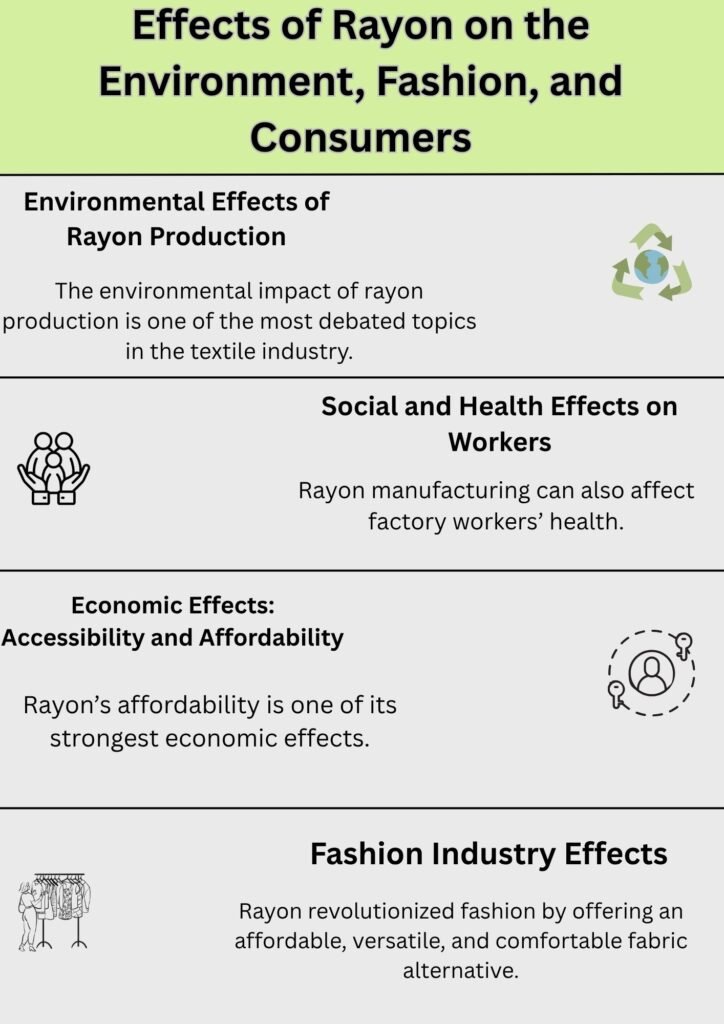
Infographic explaining the effects of rayon on the environment, fashion, and consumers, highlighting environmental, social, economic, and fashion-related impacts.Caption:
Infographic showing how rayon production impacts the environment, workers, economy, and fashion industry.Description:
This infographic titled “Effects of Rayon on the Environment, Fashion, and Consumers” outlines four main impacts of rayon production. It discusses environmental effects, noting rayon’s debated ecological impact; social and health effects on workers due to factory conditions; economic advantages like affordability and accessibility; and fashion industry effects, emphasizing rayon’s role as a versatile, comfortable, and affordable fabric option. Simple icons and clean sections visually separate each topic.

Environmental Effects of Rayon Production

The environmental impact of rayon production is one of the most debated topics in the textile industry.
Since rayon originates from wood pulp, its demand contributes to deforestation in areas where trees are cut down without proper replanting. This leads to habitat loss, reduced biodiversity, and higher carbon emissions.

Social and Health Effects on Workers

Rayon manufacturing can also affect factory workers’ health.
During the viscose process, exposure to carbon disulfide fumes can cause serious issues, such as headaches, nerve damage, or long-term respiratory problems. In areas without strict safety standards, workers face greater risk.
Thankfully, modern eco-certified facilities have improved safety measures, better ventilation, and stricter chemical handling. Consumers can support worker welfare by choosing fabrics from transparent, ethically certified brands.
This awareness reminds us that our fabric choices influence not just the planet but also the people who produce what we wear.

Economic Effects: Accessibility and Affordability

Rayon’s affordability is one of its strongest economic effects.
Because rayon mimics luxury fabrics like silk or linen at a fraction of the cost, it allows fashion brands to produce stylish, comfortable clothing for a broad audience.

Fashion Industry Effects

Rayon revolutionized fashion by offering an affordable, versatile, and comfortable fabric alternative.
Designers appreciate rayon’s silky drape, moisture absorption, and vibrant dyeing ability. These qualities make it ideal for dresses, blouses, and summer wear. Because it imitates silk, rayon opened doors for accessible luxury in the mid-20th century.

How to Identify Rayon Fabric

Texture and Appearance

Rayon may appear to be smooth and drapey. It is flowing, slightly shiny, smooth. Not stiff, but inclined to hang and flutter. It can be slightly reflected in the light.is rayon a natural or synthetic fiber. Viscose rayon also wrinkles more and lyocell retains shape better. When the cloth is cool and silky, then probably a rayon or a mixture.

Burn Test

When you burn rayon it normally smells like burning paper or wood since it is made of cellulose. The ash is not plastic, but usually soft and light, the same as wood ash. Artificial fibers such as polyester melt and have a stench of chemicals. Therefore, a tiny piece of a burn can be used to make out whether a fabric is cellulose or not. Always do burn test carefully, in a safe place.

Label Checking

Check the fabric label. Seek such words as viscose rayon, modal, lycella cellulose and regenerated cellulose. Care symbols: also see care symbols, should hand wash cold, avoid tumble dry, probably viscose. Where brand mentions refer to closed-loop production or eco certificated, improved confidence. Chemical treatment level is commonly displayed on labels.is rayon a natural or synthetic fiber.

Conclusion

Rayon is a semi-synthetic fiber: natural in its essence, but chemically modified. Rayon has natural roots since it is a by-product of plant cellulose. However, it is not entirely natural or entirely synthetic due to the processing of it chemically. When you pose what is the nature of rayon, a natural fiber or synthetic fiber, the answer is: both and slightly, more natural than pure synthetics, and more processed than pure natural fibers.

Rayon fabrics such as lyocell or certified viscose are more sustainable and should be your choice if you are concerned about sustainability. Seek responsible sourcing. Consider too, how to handle rayon clothing: delicate laundry, no heat. Next guides I will demonstrate you how to find really sustainable clothes. Get to know more about sustainable fabric in our following guide.

Read More>> Rayon denim Fabrics: Soft stylish & comfortable ,everyday wear.

FAQs

Is rayon biodegradable?

Yes. Since rayon is a product of cellulose it is biodegradable given the right conditions. Chemical treatments or finishings can, however, retard degradation. Biodegradability decreases in the case of fabric with plastic coating or synthetic blends.

Is rayon good for summer?

Definitely. Rayon is breathable, moisture absorbing and cool to the touch. It helps wick sweat. Hence, rayon clothing tends to be cooler like cotton or linen in hot weather.

Is rayon sustainable?

It depends. Sustainability is dependent on type and process of production. The use of chemistry and deforestation can make viscose rayon less sustainable. Certified viscose and lyocell may be far superior. Therefore, the sustainability of rayon is not standardized.

What is the difference between viscose and rayon?

Viscose is one type of rayon. The original process in which carbon disulfide is used is called viscose rayon. Viscose is a rayon and not everything that is a rayon is viscose. There are also modal and lyocell. They vary in softness, durability and chemical reactions.


Hemp vs Cotton: Which is Softer, Stronger, and More Eco-Friendly?

Introduction-

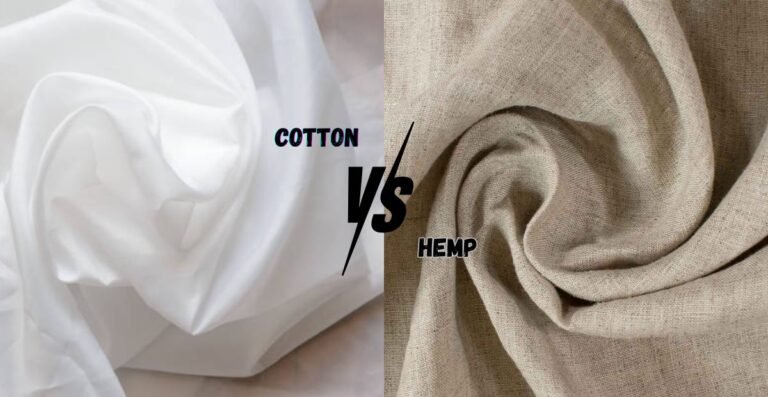
The debate between hemp and cotton has emerged as one of the most talked about issues of sustainable fashion. The two materials are natural and breathable and are common in the wearing of clothes and domestic textile. However, they vary in the way they are cultivated, processed and even worn.

Comfort, durability, and environment are some of the aspects of the current consumer that are of concern. With individuals trying to find sustainable alternatives, hemp has returned to be a worthy competitor to cotton. In this article, we will see the performance of both the fabrics in the softness, strength and sustainability. The idea is to make you be informed in an environmentally-conscious decision.

What is Hemp Fabric?

Hemp Fibers

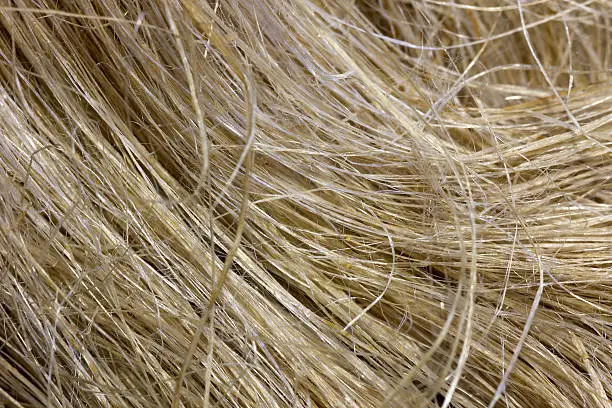
hemp fibers
Hemp Fibers

Hemp Plant

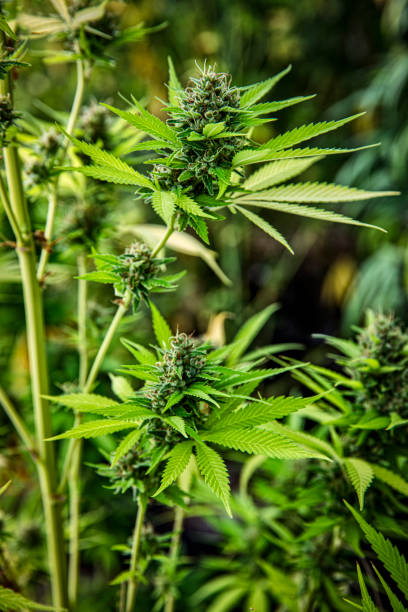
hemp plant
Hemp Plant

Origin

The hemp cloth is made of Cannabis sativa. It is a bast fiber, i.e. that the textile fibers are located in the bark of the stalk. The thick fibers of the stem are pulled off and woven into a fiber. Hemp is fast growing and has naturally resistant fibers, hence it does not require pesticides or fertilizers. In a nutshell, hemp fabric is made out of the outer stalk fiber of the hemp plant, not the leaves and flowers.

Key Properties

  • Strength: Hemp is very powerful. Its fibers are up to five times stronger as compared to cotton. Consequently, hemp fabric has high resistance against wear and tear, moulds and mildew, which gives the garments a very extended life cycle.
  • Breathability: Hemp has a good breath. It has porous hollow fibers that wick the moisture and allow airflow. This implies that hemp clothing remains cool during the summer seasons and warm during the winter seasons and it dries fast.
  • Antimicrobial: Hemp has natural antimicrobial and antifungal. It is also bacteria and odor resistant which makes it suitable in sensitive skin and activewear.

History of Use

Hemp has a rich history. It was nurtured in ancient China several millennia ago to produce textiles, paper and ropes. Sailors also now had to rely on hemp fiber which was used to provide powerful ropes and sailcloth to ships. In the past centuries, hemp was a common crop, which was widely used and cultivated in Asia, Europe and the Americas. Hemp textiles are having a resurgence today as people reevaluate this miracle fiber that is said to be strong and environmentally friendly. The history of hemp as a durable fabric manufacturer is an additional factor that supports the idea of hemp as a sustainable material.

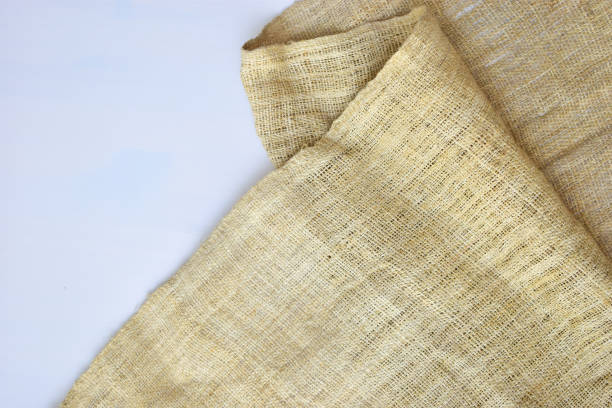
hemp fabric
Hemp Fabric

What is Cotton Fabric?

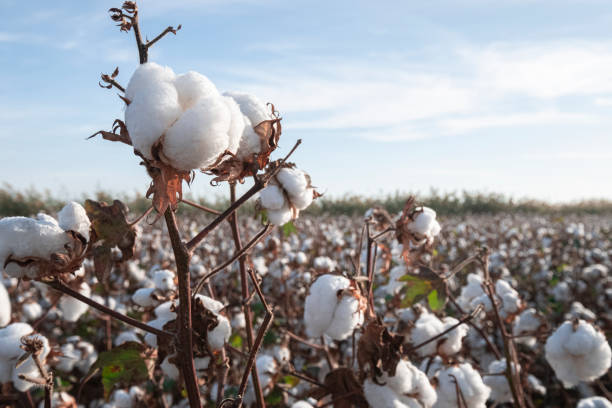
cotton plants
cotton plants

Origin

The fluffy fibers of cotton plant seeds are cut into cotton fabric. Cotton plant (genus Gossypium) is a plant that is grown with soft and white fibers in protective seed pods known as bolls. The bolls are harvested and processed by farmers to extract the fiber and the seeds. Cotton fibers are cellulose practically pure and have been spun into yarn thousands of years. Concisely, cotton does not grow out of the wood or the leaves of the cotton plant but out of the seed hairs.

Key Properties

  • Softness: Cotton is also known as naturally soft and comfortable. It is soft on the skin and is commonly applied on clothing that comes in direct contact with the skin.
  • Breathability: Cotton is very breathable and it lets the air circulate around the body. Its fibers are easy to absorb moisture and that is why cotton clothes feel cool and comfortable during warm weather.
  • Absorbency: Cotton is a material that is excellent at absorbing liquids. It evaporates sweat and moisture very easily and this keeps the skin dry. This high absorbency however implies that cotton is able to retain dampness when it is unable to dry off.

Global Dominance

Cotton is the natural fiber that has the broadest applications on earth. Every year millions of tons of cotton are cultivated. The fashion and textile industries around the globe are run by it, driving the goods as T-shirts and jeans as well as bedding and towels. The scale of production of cotton makes it very cheap and accessible in virtually any market. Due to its hegemonic position around the world, cotton vs hemp tends to turn into a matter of expediency vs sustainability.


Hemp vs Cotton: Key Differences

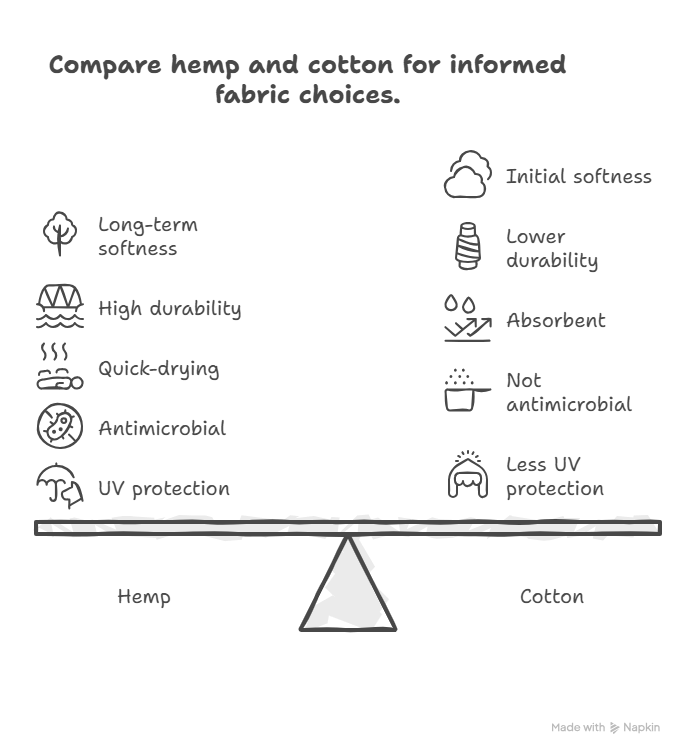
Comparison infographic highlighting key differences between hemp and cotton fabrics
Compare hemp vs cotton for informed fabric choices based on softness, durability, and more

Softness & Comfort

Cotton is softer initially. Its small fibers are smooth and comfortable on the first day. On the contrary, hemp fabric begins rougher. But hemp grows soft as time and use. Its long fibers rupture gradually, and they grow malleable without diminishing their power. Finally, cotton prevails on short term softness, but hemp keeps up in the long term with repeated use. Hemp might be hard at the beginning, but becomes as comfortable after a few washes.

Durability

Hemp is much more resistant compared to cotton. A hemp garment has high tensile strength and this allows it to sustain many years compared to a cotton garment. Hemp is tear resistant, abrasive and pilling resistant. Hemp clothing does not lose its shape and strength after numerous washes. Conversely, the cotton fibers are very much likely to weaken with time. Fabrics made out of cotton become skinny when used and washed severally. To recap it all, hemp is far more durable than cotton: a T-shirt made of hemp could easily be twice as long as the cotton T-shirt.

Moisture & Breathability

These two fabrics are breathable and ensure that you are comfortable in the warm weather. Cotton is absorbent and may get wet due to sweat and thus in humid weather make the cloth sticky. Hemp also pulls moisture off and it dries much quicker. The hollow fibers of Hemp permit better airflow and rapid evaporation. Consequently, hemp garments are more likely to be drier and cooler when you sweat as compared to cotton. Simply put, the two are breathable, however, the hemp has a slight advantage when it comes to remaining dry and maintaining temperature.

Hypoallergenic/Antimicrobial

Hemp possesses an inherent antimicrobial attribute. The specialized substances of hemp fibers prevent bacteria, fungi, and smell. This renders the hemp fabric hypoallergenic and suitable to sensitive skin. Cotton on the other hand, is not microbe-resistant in nature. Generally, it is deemed as being mild on the skin, however, it does not give the same type of antibacterial protection that hemp provides. This, in reality, implies that hemp clothing has a longer shelf life, whereas in hot weather, cotton can be used more often.

UV Protection

Hemp is far better in blocking ultraviolet (UV) rays as compared to cotton. Growing hemp fibers naturally block the sun and therefore makes a great fabric to be worn in the outdoors. As a matter of fact, the hemp has the ability to block above 99% of UVB rays and UVA rays. Cotton is more permeable to UV and it fades faster in the sun. Hemp has significantly greater sun protection and color retention, particularly in the hottest climates, and when used as an outdoor garment, than cotton.

FeatureHemp FabricCotton Fabric
Softness & ComfortStarts rough but softens over time; durable, breathableNaturally soft from the start; very comfortable initially
DurabilityExtremely strong and long-lasting; resists wear, tearing, mildewModerate; good quality cotton is strong, but fibers wear thin faster
Moisture & BreathabilityVery breathable with excellent moisture-wicking; stays dry and coolVery breathable with high absorbency; absorbs sweat but can feel damp
AntimicrobialNaturally antibacterial and odor-resistantLacks natural antimicrobial properties; absorbs bacteria and odors
(No inherent protection)
UV ProtectionExcellent UV resistance; blocks ~99% of harmful raysGood, but more prone to UV fading

Environmental Impact: Hemp vs Cotton

Water Use

Cotton is highly water consuming. Farmers require a very large quantity of irrigation to cultivate and process cotton. To take a scenario, it takes approximately 10,000 liters of water to produce 1 kg of cotton, and that is equivalent to around 2,500 liters to produce one T-shirt. In comparison, hemp requires a lot less water. Hemp can grow with rain but as little as 300500 liters of water are required to produce 1 kg of fiber. Realistically, the water footprint of hemp is much smaller than that of cotton by at least 1/3 in certain research. This enormous gap is what renders hemp a more environment-friendly option in the areas where there is a shortage of water.

Pesticides & Chemicals

Traditional cotton cultivation is dependent on chemicals. It uses approximately 16 percent of the insecticides and 7 percent of all pesticides in the world. The chemicals may contaminate waterways and destroy ecosystems. Hemp, on the contrary, is resistant to pests. It needs minimal or no pesticides and herbicides in its production. Hemp farmers have decades of experience of growing hemp with virtually no uses of chemicals. In general, the low-chemical profile of hemp compared to the extensive use of pesticides in cotton provides hemp with an obvious environmental benefit.

Land Use & Yield

Hemp also utilizes less land. One acre of hemp has the potential to produce approximately 2,500-3,000 pounds of the dry fiber. An acre of cotton yields, comparatively, but 1,200 to 1,500 pounds of cotton lint. That is, hemp usually yields almost two times the amount of fiber per acre compared to cotton. Such increased output implies that a smaller amount of land is required to make the same fabric. The deep-rooted hemp also enhances the soil structure and prevents soil erosion as compared to cotton which can drain the soil of its nutrients.

Sustainability Score

Collectively, hemp usually comes out as more sustainable than cotton. Hemp is a very friendly crop as it requires low water, minimal pesticides, it yields a lot, and it improves soil. The environmental effect of cotton is greater because of the resource consumption and the usage of chemicals. Overall, the majority of the analysis indicates that hemp was considered to be the greener option in the production of fabric.


Cost & Availability

Cotton

Cotton is still one of the cheapest natural fabrics in the world textile sector. It is highly cultivated in large scopes and has well-developed supply chains which make it easily available everywhere. Cotton products can be found in almost all price ranges, starting with simple T-shirts and ending with the luxurious bedding.

Hemp

The cost of hemp fabric is now priced higher because there is a lack of large-scale manufacture as well as processing requirements. It is still under regulation in certain countries and this limits supply and increases the cost. Nevertheless, due to the emergence of sustainable fashion, an increasing number of brands invest in hemp, which reduces its price.

Blended Fabrics

In order to achieve a balance between the comfort, strength and affordability many companies are currently using hemp mixed with cotton fibers. Such mixed fabrics are soft, durable and have less environmental impact as opposed to pure cotton. They are an effective alternative to sustainable, yet affordable textiles to the consumers.


Best Uses for Hemp vs Cotton

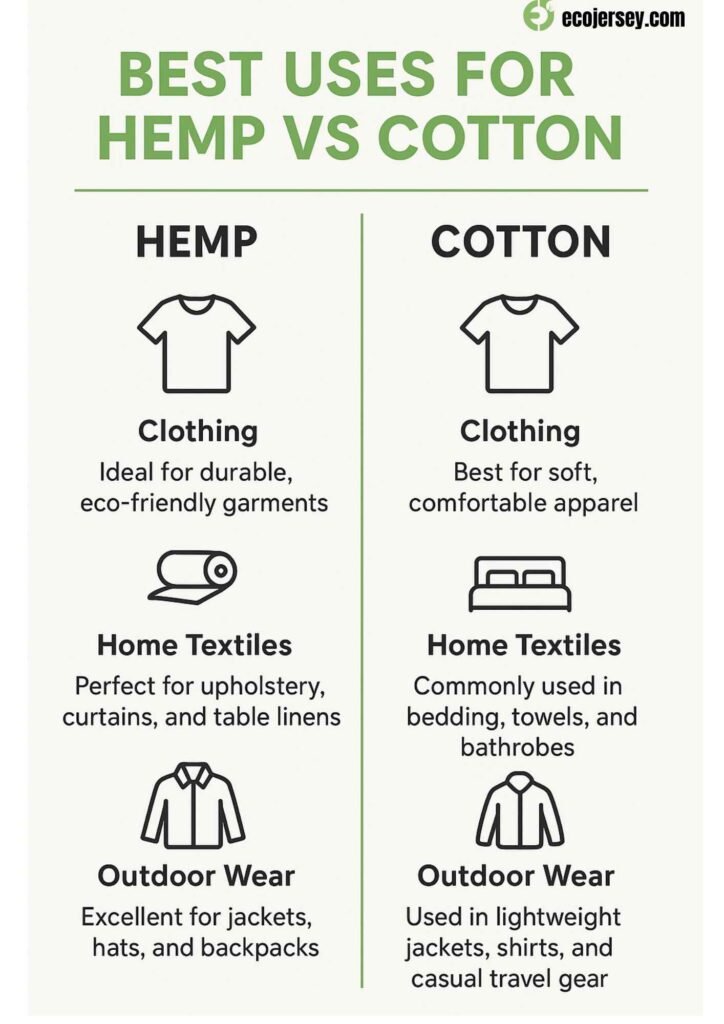
Infographic comparing best uses for hemp vs cotton
Best uses for hemp vs cotton in clothing, home textiles, and outdoor gear

Clothing

Mainstream clothing is dominated by cotton. It is available in T-shirts and underwear as well as dresses and casual wear as it feels soft and is cheap. Hemp fiber clothes are generally found in small-scale eco-fashion. Sustainable brands tend to use hemp to make clothing such as casual clothes, jeans, and jackets. The breathability and strength of hemp render it an activewear and a comfortable everyday wear particularly when blended with other softer fibers.

Home Textiles

Cotton is king when it comes to bedding and towels to be used at home. A majority of sheets, pillow cases, towels and washcloths are comprised of cotton which is highly valued because of its softness and absorbency. Home use of hemp is also possible: the high level of absorbency, antimicrobial properties turn the hemp into the perfect cotton towel, table cloth, and dish cloth. This is also being utilized in heavy-duty household fabrics such as canvas, rugs and upholstery where its strength and resistance to the UV is beneficial.

Outdoor Wear

Hemp is very strong and excellent in outdoor wear due to its water wicking capacity, UV protection and durability. In the case of hiking clothes, sun hats, and camping attire, hemp apparel will not be subject to sun rays and they will be quick drying. On the contrary, cotton outdoor garments have the ability to absorb water and become damp and loose. Thus, hemp will be better at gear that is used under harsh conditions and in the sun.


Pros & Cons of Hemp vs Cotton

  • Hemp Advantages: Environmentally friendly and sustainable (uses less water/pesticides); exceptionally tough and strong; naturally antimicrobial and waterproof.
  • Hemp Cons: roughness (however, it becomes soft after washing); its price is higher because of scarce supply; is not as widespread as cotton.
  • Cotton Advantages: Soft, breathable, comfortable; highly versatile and popular, cheap and readily available in all types of outlets.
  • Cotton Cons: Water consumption is very high and pesticides are also very heavily relied on; the cotton is highly dependent on intensive chemical applications; the fibers deteriorate much faster and this means that the cotton garments would have a shorter life span.

Organic Cotton vs Hemp – A Fairer Comparison?

Less Pesticides and Less Water.

Organic cotton gets rid of the majority of pesticides that are harmful and consumes much less water as compared to conventional cotton. It is morally sounder and more environmentally friendly.

Durability Factor

Hemp is long lasting even though organic cotton is sustainable. The fibres of hemp still beat the cotton in the durability tests.

Eco-Conscious and Ethical Choice.

Organic cotton and hemp both are in favor of sustainable fashion. Selecting one or the other one would be like encouraging responsible agriculture and minimizing your ecological footprint.


Conclusion-

The hemp vs cotton comparison indicates that the two fabrics have their own strengths. Cotton is immediately soft, cheap, and versatile. Hemp is unique in the sense that it is strong, sustainable, and comfortable in the long run.

Hemp is the choice in case you want to be sustainable. Cotton is also an excellent option in case the budget and immediate softness are the most important. The combination of the two materials is the best compromise, soft, durable, and eco-friendly.

Whether you prefer hemp or cotton is now a question of priorities, comfort now or a green world tomorrow.


FAQs

Is hemp fabric softer than cotton?

Cotton is softer to the touch. However, as time passes, hemp becomes softer with each wash and the disparity becomes smaller.

Which lasts longer, hemp or cotton?

Hemp lasts longer. High strength and durability make a hemp garment very easy to extend the life of a similar garment made of cotton.

Is hemp better than cotton for the environment?

Yes. Hemp normally consumes much less water, almost no pesticides, and enhances health of the soil. In general, the ecological footprint of hemp farming is less than that of traditional cotton.

Does hemp clothing shrink?

On the initial run, hemp may shrink like linen. Once hemp fabric shrinks, it becomes stable and cannot shrink any more. Any shrinkage is reduced by using cold water.

Why is hemp fabric more expensive than cotton?

Hemp is more expensive as it is grown on a considerably smaller scale and it needs special processions. The limited number of suppliers and the history of legal limitations continue to make the prices of hemp high. Hemp will potentially become cheaper with the increase of demand and the loosening of regulations.

1. What is Percale Cotton? The Crisp, Cool Fabric Explained

Introduction: Why Percale Cotton Matters

Mostly, you will find the word percale on the labels of bedding next to cotton sheets. However, it is not clearly comprehended by many shoppers. Percale has nothing to do with any kind of cotton: in fact, it is a particular weave, and it gives a smooth, crisp feel.

Knowing the percale cotton will help the buyers make better decisions. It particularly applies to people who appreciate to breath and have a cool, hotel-like feel of sleep. This guide will reveal all about the question “what is percale cotton”, the favorite type of cotton weave – its definition and properties, its most successful applications and maintenance.

What is Percale Cotton?

Definition

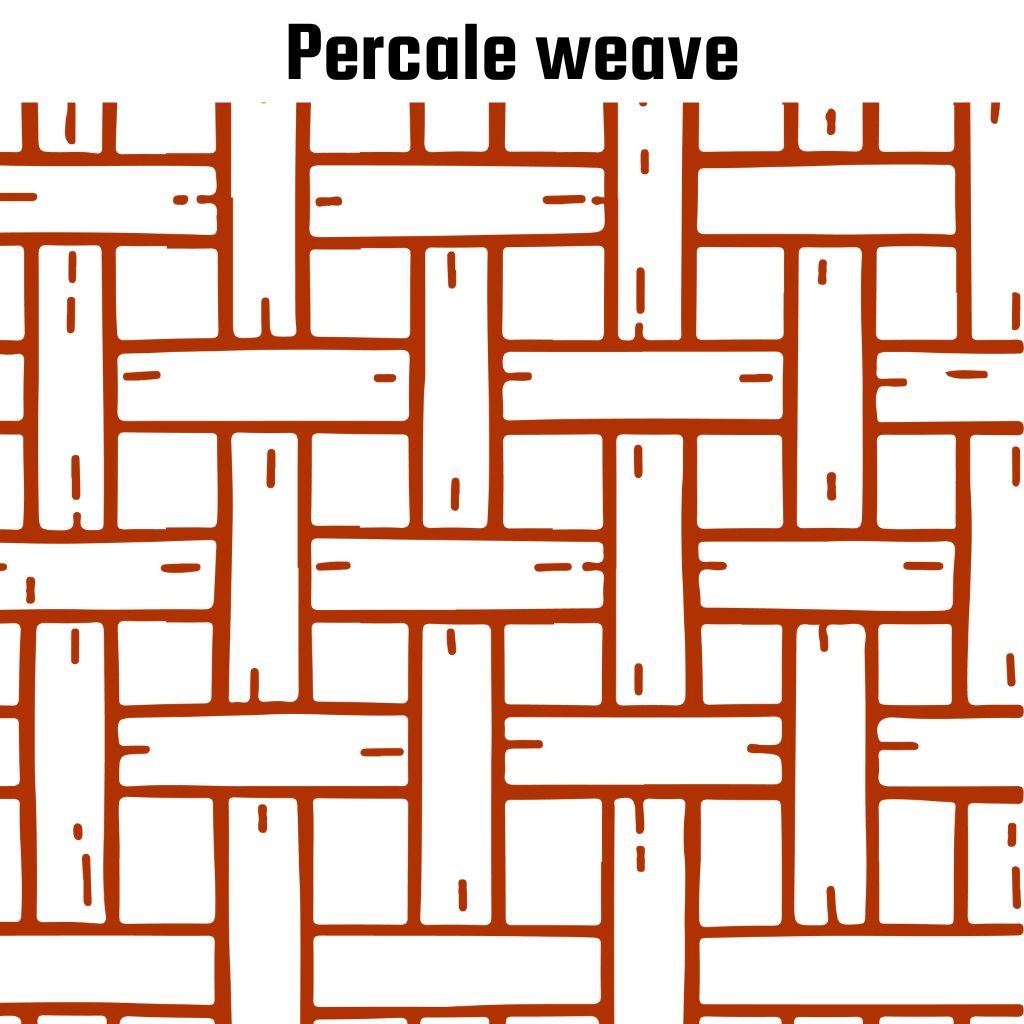
Percale is an un-patterned fabric that is usually used as bedding. It is characterized by an alternate one-over, one-under simple weave. This is a classical pattern, which provides percale with its smooth and matte surface. Notably, percale is the type of weave pattern and not a particular type of cotton or brand.

Weave Pattern

percale weave

Percale is woven with a one:one (1:1) pattern. In this technique, every weft thread identically overtakes a warp thread, and then switches direction. Consequently, percale cloth is highly woven in a tight and even manner. This is a plain weave that renders the fabric strong and durable.

Thread Count

The thread count of percales ranges at 200-400 threads per square inch. This is the desired range of percale: it has a hand-feel that is crisp and breathable. Below 200 counts may be considered too coarse and above 400 may lose breathability. It is observed by many professionals that quality cotton and weave are more important than the thread counts which are extremely high.

Materials

Bedding, mostly of percale, is mostly 100% cotton, usually of high-quality long-staple fibers. Another example is Egyptian or Pima cotton percale which is particularly smooth and tough. Other fibers (such as polyester or silk) are mixed with some percale to become less expensive or include wrinkle resistance. Nevertheless, the standard in the way of luxurious feel is pure long-staple cotton percale.


Characteristics of Percale Cotton

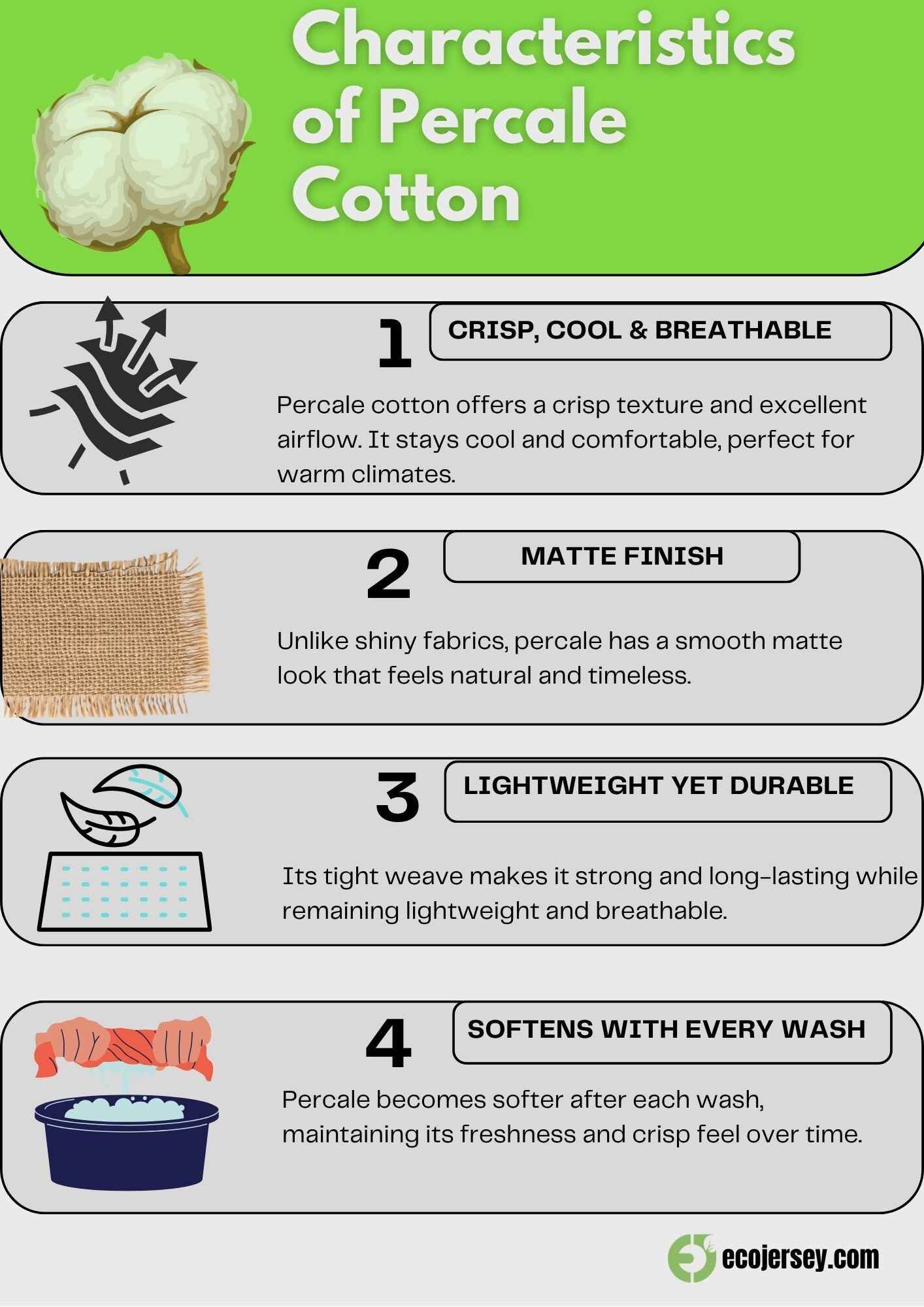
Infographic highlighting the characteristics of percale cotton
Characteristics of percale cotton: cool, breathable, durable, and softens with each wash

Crisp, Cool, and Breathable Feel

Percale is renowned to have a crisp and cool touch on the skin. It has a narrow but loose weave to allow air to pass freely and thus, the sheets remain cool, which is a blessing to hot sleepers. Percale loses some of its stiffness with time, yet it still manages to keep its fresh, crisp feel. Percale, in a word, is not heavy or clingy.

Matte Finish

In comparison to shiny sateen, percale is of matte or low sheen. This un-glamour is due to its plain weave, which conceals the majority of intersections of threads. The outcome is a sophisticated, restrained appearance of percale sheets and pillowcases. Percale can be said to be more classic or timeless than lustrous weaves due to the matte finish.

Lightweight Yet Durable

The percale is strong yet long-lasting even though it is lightweight. It has a one-over one-under weave that makes it a very strong fabric and wear and tear resistant. Indeed, the plain weave of percale makes it more durable than other complicated weaves. Within years of use and washing, the good percale sheet will not tear or pill.

Gets Softer with Washes

New percale may have a squeaky feel, and the firmness of the fabric will immediately disappear. Percale fibers are softened each time they pass through a wash and dry cycle. The more the sheets are used the more they become tactile and yet cool touch. This lightness is also included in the charm: percale sheets begin hard but become softer as days pass.


Percale Cotton vs Other Weaves

CategoryPercaleSateenEgyptian CottonLinen
Weave/MaterialPlain weave (1-over-1-under)Satin weave (3–4 over, 1 under)Type of cotton (long-staple)Flax fiber (loose, textured weave)
Feel/FinishCrisp, matteSilky, lustrousSoft and smooth with qualityAiry and textured
BreathabilityVery breathable, stays coolLess breathable (retains more heat)Varies by sheetExtremely breathable and cool
Wrinkle ResistanceProne to wrinklesMore wrinkle-resistantDepends on finishingWrinkles easily, softens over time
Thread Count~200–400 recommendedOften 300–500N/A (varies by sheet)Lower (looser weave)

Percale vs Sateen

Percale and sateen have their differences primarily in the weave and feel. The one-over-one-under pattern of percale gives a crisp look, matte surface and the pattern of sateen (a few threads over, one under) gives a smooth and shiny surface. Practically, a sheet of percale is cool and light, and sateen is warmer than percale, which is more wrapped-in and therefore, good in hot weather. Sateen is heavier and shinier, retains body heat and prevents wrinkles slightly longer. Percale vs sateen cotton is a matter to do with your preference between crisp and cool material or soft and glossy.

Percale vs Egyptian Cotton

It should be known that the Egyptian cotton is all about the fiber, not the weave. Egyptian cotton sheets are the ones prepared using extra long staple cotton produced in Egypt. There is Egyptian percale or Egyptian sateen. Comparatively, percale informs you of the manner of weaving the fabric. That is, Egyptian cotton + percale weave = Egyptian percale and Egyptian sateen is Egyptian cotton satin woven. So percale vs Egyptian is even, as the process of weaving is to the quality of cotton: they are not alike. The two terms are frequently found in high-end sheets, that is, they employ fine cotton in a percale weave.

Percale vs Linen

Linen (constructed out of flax fibers) and cotton percale have similar appearance but differ in touch. The texture of linen is more open and loosely woven and a bit irregular and slubby. It is quite chilly and breezy, particularly during hot seasons. Percale is less rocky and smooth. Practically, linen is rather heavy and textured whereas percale is light and more acute. Both of them are breathable, the hollow fibers of linen are natural that is why it is highly moisture-wicking. In case you are an extremely hot sleeper both are good, but percale is very crisp; linen is much softer, more of a lived-in feel.


Pros and Cons of Percale Cotton

Pros of Percale Cotton

  • Cool and breathable: The tight, simple weave of percale allows air to pass through keeping you comfortable and dry. Percale is a favorite of the hot sleepers due to its cooling properties.
  • Hardy: Percale is extremely strong as it is plain 1-over-1 weave. Percale sheets of high quality can take many years to thin and pill.
  • Grows better with age: Percale is stiff at the beginning but becomes soft. With every wash it becomes more supple and cool.
  • Inexpensive: Since percale is a simple welling and medium thread counts, it is sometimes less costly than high thread sateen yet still has the luxurious feel.

Cons of Percale Cotton

  • Easily wrinkles: Crisp weave will easily crease, therefore percale sheets will have to be ironed or smoothed after drying.
  • New percale can initially be stiff: New percale may come a slightly sweaty out of the package. Breaking in and getting warm also requires a couple of washes.
  • Less silky: Percale is firm and not so slippery on the skin compared to sateen. Others like the calmness of a satin weave.
  • Cool feel not for everyone: Because it stays cool, percale may feel too crisp for those who get cold easily or want extra warmth in winter.

Best Uses of Percale Cotton

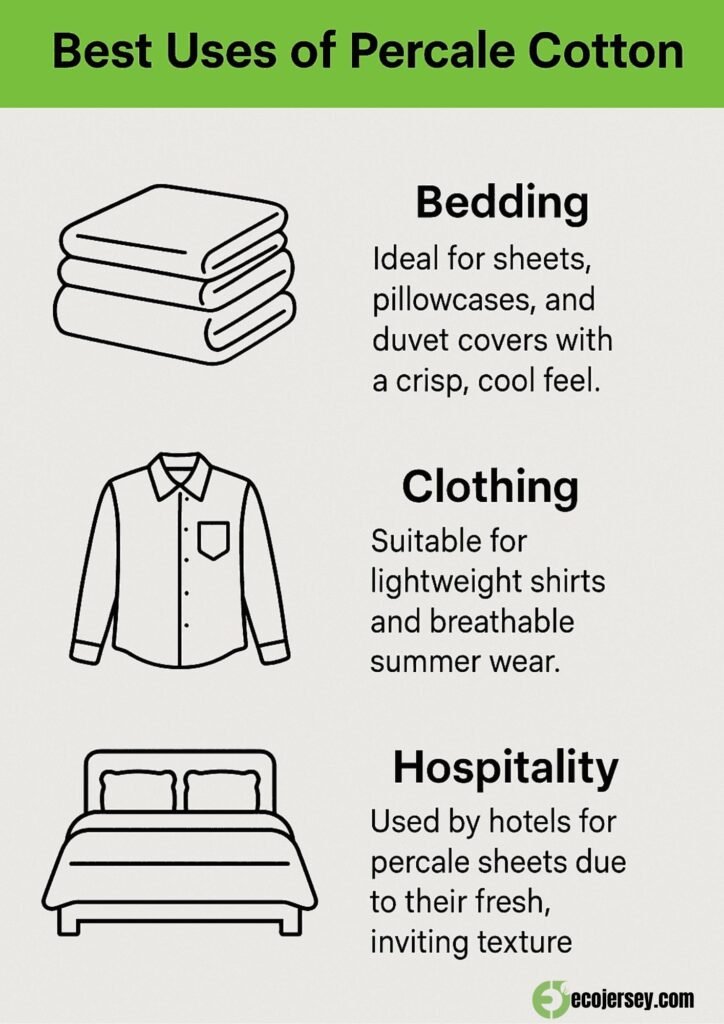
Infographic showing the best uses of percale cotton
Best uses of percale cotton in bedding, clothing, and hospitality

Bedding: Sheets and Duvet Covers

Percale cotton is best to use in bedding, especially pillowcases, duvet covers, sheets, etc. Its breathable quality is crisp and keeps the sleepers comfortable during the nighttime. There are a lot of bedding brands that sell percale sheets that are similar to hotel linens. Actually, crisp percale sheets are particularly good when it is hot, or in air conditioned bedrooms.

Clothing: Lightweight Garments

Percale is a lightweight and breathable garment, which is a good option to wear in warm weather. As an example, one can single out summer shirts, sleepwear, and casual button-downs, which commonly have percale-style weaves. The piece of clothing is loose-fitting and free against the skin. Nevertheless, it is more wrinkly than mixed fabrics hence, it is mostly preferred in fashion whereby crispiness is an attribute.

Hospitality: Hotel Linens

Percale is common in hotels and resorts of the high-end category. Percale sheets are common in five-star bedding since they are durable, easy to wash and have that crisp feel and look. Percale, actually, is what you will have definitely in most of the up-scale hotels. Its cool feel and fresh classic appearance make the guests feel spoiled.


Who Should Choose Percale Cotton?

Hot Sleepers and Warm Climates

Percale is your thing, whether you are a hot sleeper or reside in a warm land. It is open weave and has natural breathability, which prevents the trapping of heat keeping you cool. According to many experts, percale sheets have the ideal attribute of allowing individuals to use them throughout the year as they prefer cool bedding.

Fans of Crisp, Hotel-Style Sheets

Percale must be selected by any person who enjoys the sensation of crisp hotel bedding. It has a similar touch to a cotton shirt or tailor-made linens. Actually, the cool and crisp feel of percale is the reason why several luxury hotels prefer it. Want that clean, fresh feeling every morning, percale gives it to you.

Value-Conscious Shoppers

Percale is frequently chosen by buyers who want sheets that are durable but at a reasonable price. The weave of Percale allows you to receive high-quality bedding at a low cost without spending high money on premium sateen or silk counterparts. Meanwhile, percale does not lose in terms of durability: it can withstand frequent washing. Simply put, percale is a good option in case you want quality in the long run and you can afford it.


Caring for Percale Cotton

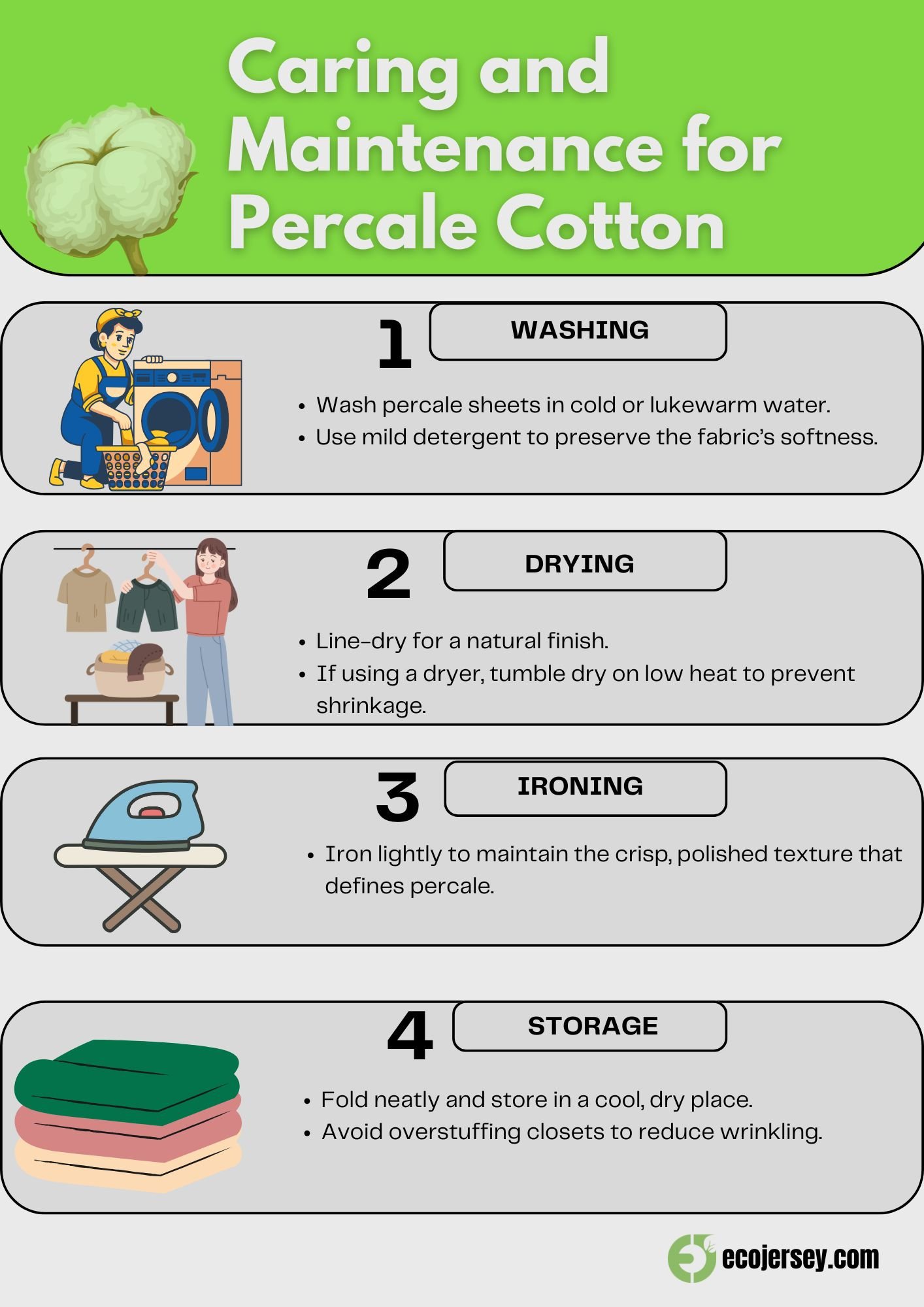
Infographic on caring and maintenance tips for percale cotton
Caring for percale cotton: wash, dry, iron, and store properly for long-lasting use.
  • Machine Wash: Wash percale in cold or lukewarm water in gentle cycle. Wash with a light detergent and do not use bleach or fabric softener because rough chemicals may destroy the fibers. Color and fabric cling to cold or moderate water.
  • Dry: Tumble dry on low heat or best on the line. Do not overload the dryer. Take out the sheets as soon as they are fairly dry without being completely dry to avoid wrinkles. The low heat preserves the fabric of cotton against shrinking or brittle nature.
  • Iron: To have an ideal smooth sheet, iron percale on a low level when damp. Percale is easier to iron when wet, and will not scald. This will give this place its crisp hotel appearance again.
  • Store: Wash percale bedding, fold it and store in a cool and dry area out of direct light. White sheets may turn yellow with the passage of time under sunlight. Plastic bags should be avoided (they keep moisture in) and breathable fabric bags or drawers should be used instead.

Buying Guide: What to Look for in Percale Cotton

  • Thread Count: Aim for about 200–400. The range provides a sharp hand and breathability. Extremely high thread counts are bulky in percale.
  • Material: Find 100 percent long-staple cotton (Egyptian, Supima/Pima) in the percale weave. There are better cotton fibers that produce smoother and stronger sheets.
  • Organic vs Conventional: Organic percale cotton does not use chemical pesticides. Check certification markings GOTS or Oeko-Tex to ensure your bedding is sensitive or environmentally friendly.
  • Price: Percale sheets are available at a variety of prices. Mediocre-priced sets are usually made of cotton of good quality. Polyester blends (though not as natural) may be used in very cheap percale.
  • Feel First: Ideally, touch a swatch. Percale is to be smooth but hard. A sample may serve to confirm such pleasant crispness.

Conclusion-

Percale cotton is distinguished by its crisp feel, cooling comfort and durability. Percale is also cool and breathable in contrast to sateen which is silky and warm hence suitable to people who like a clean and hotel experience in their sleep.

Percale cotton would be a perfect match to lightweight and naturally cool bedding which grows softer with time. But when you want more of a smooth and silky feel, sateen may work. Finally, you should be choosing based on your comfort preference and climatic conditions.

This is because you can now trust in a comfortable and cozy bedclothes that you can invest in and still not feel out of place when you sleep at night by knowing what is percale cotton.


FAQs

Is percale cotton good quality?

Yes. Percale cotton may refer to high quality bedding, particularly bedding of long-staple fibers. It is a strong weave that can withstand. It is the quality of cotton that is used after all: Egyptian or Pima percale is regarded as a high-quality one.

Is percale cotton soft?

First, percale is not soft but rather crisp. It however softens considerably after a couple of washes. Several sleepers have claimed that percale is softened with age, and yet does not lose its coolness.

Does percale cotton wrinkle?

Yes, percale wrinkles easier as compared to sateen. The plain weave is not crease resistant hence will wrinkle up to some extent after drying. Nonetheless, most wrinkles will be eliminated in a short time by ironing or smoothing damp sheets.

What thread count is best for percale cotton sheets?

Percale is normally at its best at 200-400 threads per inch. The sheets in this range are breathable and are strong. In the case of percale, a thread count of 300 is usually mentioned as the optimal range: it is high enough to be smooth, and not too dense.

Lace Cotton Fabric Guide: Soft, Stylish, and Timeless

Lace cotton fabric has always held a special place in the world of textiles. Known for its delicate patterns, soft texture, and timeless appeal, this fabric combines the luxury of lace with the comfort of cotton. Whether it’s used for clothing, home décor, or special occasions, lace cotton never goes out of style. In this comprehensive guide, we’ll explore everything about lace cotton fabric—its origins, properties, uses, care tips, and why it continues to captivate designers and customers alike.

What Is Lace Cotton Fabric?

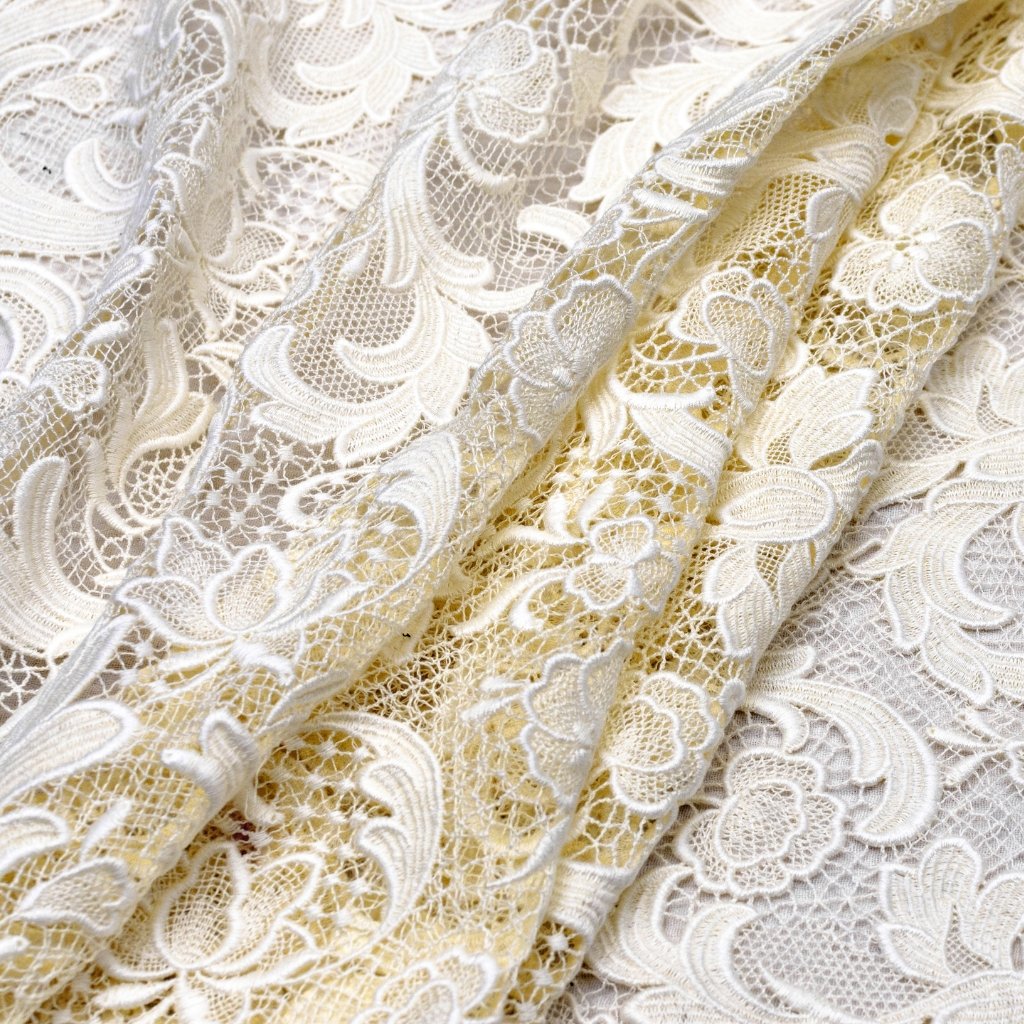
Close-up view of delicate ivory lace fabric with intricate floral patterns and soft folds.
Ivory lace draped in gentle folds, showcasing exquisite floral detailing.

Lace cotton fabric is a beautiful textile made by blending the classic look of lace with the natural comfort of cotton fibers. The result is a material that feels soft on the skin, allows excellent breathability, and looks stunningly elegant.

Traditional lace was often made from silk or linen. However, modern advancements in textile technology have allowed cotton to be used in creating lace patterns, giving it a soft and versatile quality that suits both fashion and home décor applications.

A Short History of Lace and Cotton

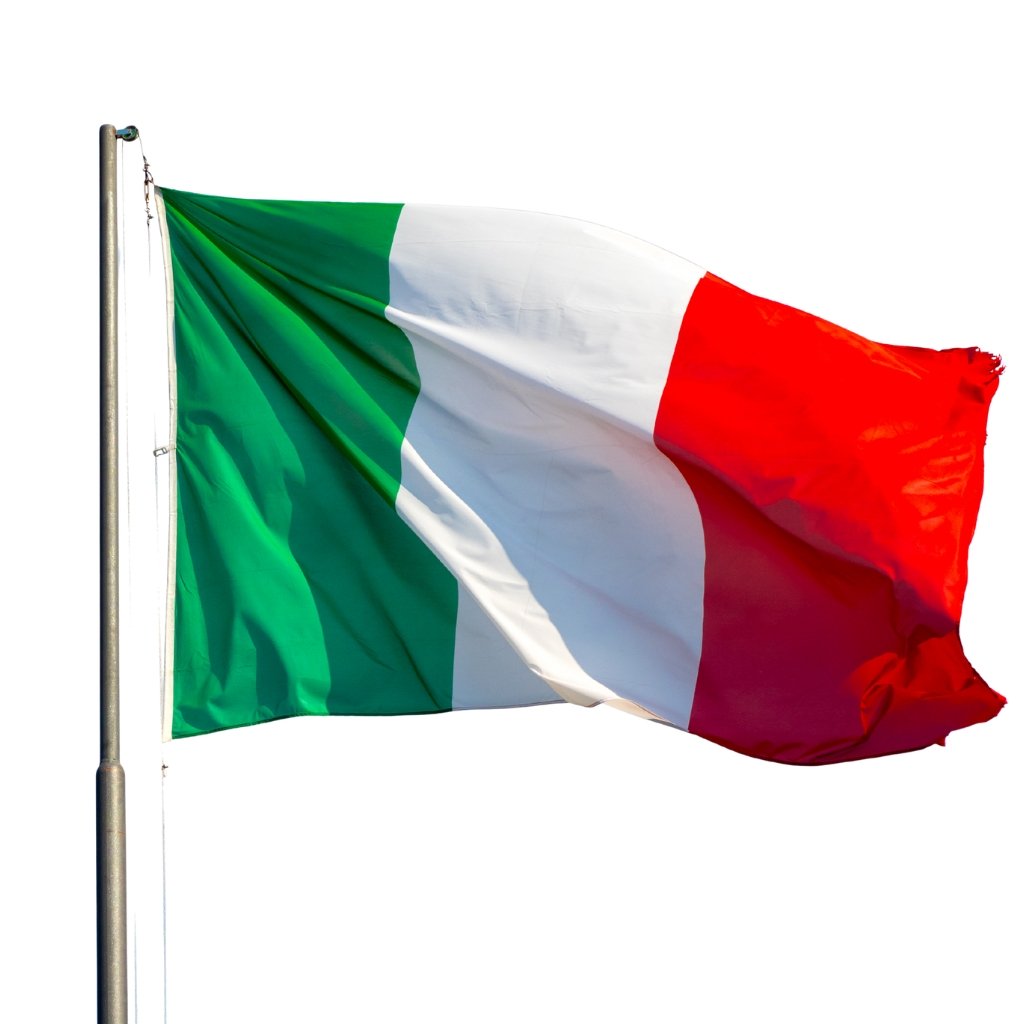
Flag of Italy waving on a flagpole against a white background.
Italy’s tricolor: green, white, and red waving in the breeze.

To understand lace cotton better, you have to trace its history. Lace started showing up in 15th and 16th century Italy, France, and Belgium. Lace was created by hand, and it took a lot of time to produce and was exclusive to the wealthy elite. Read more…..French Terry Fabric

On the other hand, cotton is an ancient, versatile, and absorbent fabric that has always been appreciated. When artisans wove lace patterns into cotton fabric, it was a game changer. Cotton lace became more affordable, versatile, and practical for everyday use while still pretty.

This innovation gradually spread all over Europe and Asia, and cotton lace became a mark of effortless charm and grace.

What Lace Cotton Fabric Is Like

Infographic titled 'What Lace Cotton Fabric Is Like' with six sections: Soft and Comfortable, Breathable and Lightweight, Elegant Appearance, Versatile, Durable, Easy to Dye. Each section has a small icon or illustration and a short description.
A visual overview of lace cotton fabric characteristics: soft and comfortable, breathable and lightweight, elegant appearance, versatile, durable, and easy to dye.

People admire lace cotton fabric for more than just its look. Here are a few of its remarkable qualities:

Soft and Comfortable

Since lace cotton fabric is made from cotton, it feels soft on the skin, which is pleasant for daily use, even in hot weather.

Breathable and Lightweight

Having lace materials made of cotton rather than synthetics helps to get the best of breathable materials and enjoy the comfort all day.

Elegant Appearance

All lacework is complex and sophisticated, providing a romantic feel to clothing or decor. See more….Corduroy Cotton Fabric

Versatile

From bridal gowns to curtains, lace cotton fits a wide range of applications. Its adaptability makes it a favorite among designers.

Durable

With the use of cotton, the lace can get a durable and strong texture. This will help to withstand abrasion and wear.

Easy to Dye

Because of the dyeable cotton, lace cotton comes in a wide range of colors, patterns, and designs.

Types of Lace Cotton Fabric

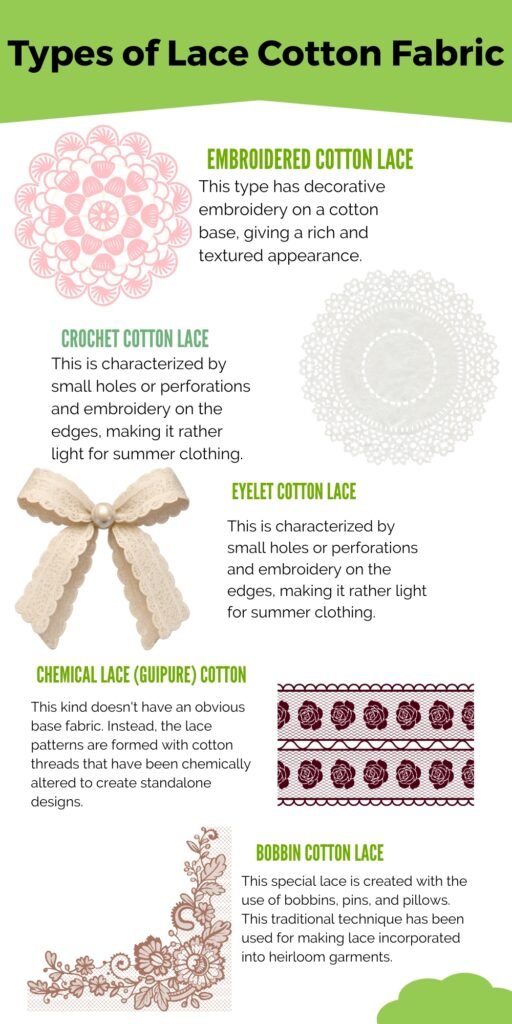
Infographic titled ‘Types of Lace Cotton Fabric’ with six sections. Top green banner. Left column: Embroidered Cotton Lace (pink floral lace), Crochet Cotton Lace (cream bow image and text), Chemical Lace (guipure) with lace swatch. Right column: Eyelet Cotton Lace (cream circular lace), Bobbin Cotton Lace (floral border swatch). Each section has a short description of the lace type and decorative imagery.
Types of Lace Cotton Fabric: Embroidered, Crochet, Eyelet, Chemical (Guipure), Bobbin, and their distinctive textures.” Alternate caption: “A visual guide to six lace cotton fabrics and their unique characteristics, patterns, and uses.

Each lace cotton fabric can have differing designs and styles. The most common are listed below.

1.Embroidered Cotton Lace

This type has decorative embroidery on a cotton base, giving a rich and textured appearance.

2.Crochet Cotton Lace

Crochet lace can be device made or created by hand and is formed from chaining and looping with interlock patterns and delicate open lace. Read more…..Scrim Cotton Fabric

3.Eyelet Cotton Lace

This is characterized by small holes or perforations and embroidery on the edges, making it rather light for summer clothing.

  1. Chemical Lace (Guipure) Cotton

This kind doesn’t have an obvious base fabric. Instead, the lace patterns are formed with cotton threads that have been chemically altered to create standalone designs.

  1. Bobbin Cotton Lace

This special lace is created with the use of bobbins, pins, and pillows. This traditional technique has been used for making lace incorporated into heirloom garments.

Production Process of Lace Cotton Fabric

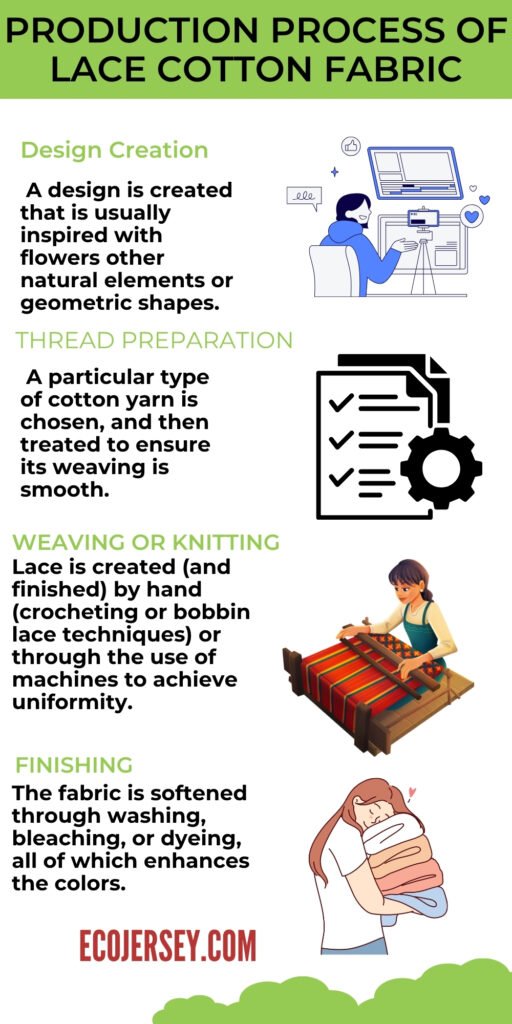
Infographic titled ‘Production Process of Lace Cotton Fabric’ with sections: Design Creation, Thread Preparation, Weaving or Knitting, Finishing, each with accompanying icons and illustrations depicting design work, a check-list/gear, loom weaving, and a person hugging fabric; Eco Jersey logo at bottom.
Overview of the lace cotton fabric production process: design creation, thread preparation, weaving or knitting, and finishing.

Precision and artistry are required for the making process of lace cotton fabric. While production can vary based on the lace type, the process generally includes the following:

Design Creation – A design is created that is usually inspired with flowers other natural elements or geometric shapes.

Thread Preparation – A particular type of cotton yarn is chosen, and then treated to ensure its weaving is smooth.

Weaving or Knitting – Lace is created (and finished) by hand (crocheting or bobbin lace techniques) or through the use of machines to achieve uniformity.

Finishing – The fabric is softened through washing, bleaching, or dyeing, all of which enhances the colors.

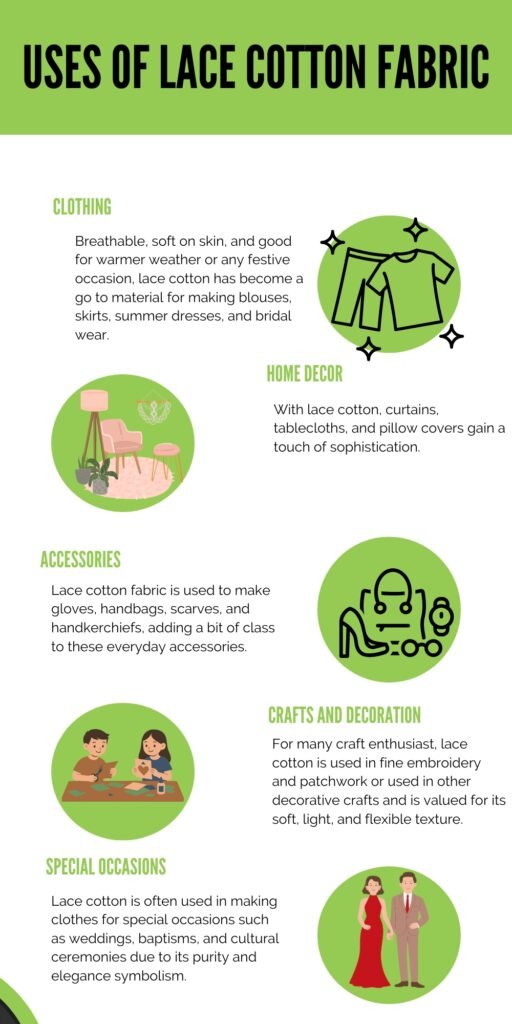
Uses of Lace Cotton Fabric

An infographic titled “Advantages of Sherpa Cotton Fabric” with two columns of green-topped sections. Left column highlights: 1) Outstanding Warmth with a brown puffy jacket icon; 2) Long-Lasting and Doesn’t Endure Easily with a clock and hand icon; 3) Hypoallergenic with a hand holding a circle icon; 4) Eco-Friendly with a row of clothes hanging on a rack. Right column highlights: 1) Feels Super Soft and Cozy with a feather-like illustration over a textured surface; 2) Skin Breathing and Mild-Sweating with a fabric and a shirtless person; 3) It is Eco-Friendly emphasized with a world and hand icon.
Advantages of Sherpa Cotton Fabric” infographic showing the warmth, softness, hypoallergenic qualities, and eco-friendliness of Sherpa cotton with accompanying icons and brief descriptions.

The uses of lace cotton fabric are truly endless and vary widely from fashion to interior design.

  1. Clothing

Breathable, soft on skin, and good for warmer weather or any festive occasion, lace cotton has become a go to material for making blouses, skirts, summer dresses, and bridal wear.

  1. Home Decor

With lace cotton, curtains, tablecloths, and pillow covers gain a touch of sophistication. Its soft texture and design help create a vintage or romantic vibe in the home. See more…..Canvas Cotton Fabric

  1. Accessories

Lace cotton fabric is used to make gloves, handbags, scarves, and handkerchiefs, adding a bit of class to these everyday accessories.

  1. Crafts and Decoration

For many craft enthusiast, lace cotton is used in fine embroidery and patchwork or used in other decorative crafts and is valued for its soft, light, and flexible texture.

  1. Special Occasions

Lace cotton is often used in making clothes for special occasions such as weddings, baptisms, and cultural ceremonies due to its purity and elegance symbolism.

Advantages of Lace Cotton Fabric

 A close-up photo of delicate white lace fabric with floral embroidery and soft mesh, layered and folded.
Delicate white lace fabric with floral embroidery.

With lace cotton fabric, practicality and beauty still coexist, and for good reasons:

Breathable and Stylish: Lace cotton is a trendy fabric and is also breathable.

Eco-Friendly: Lace cotton is made of cotton which is biodegradable.

For any weather: Cotton lace offers light coverage in warmer weather and can be layered in the colder months making it perfect for any weather.

Timeless Appeal: Lace never goes out of style, and cotton is comfortable all year around.

How to Care for Lace Cotton Fabric

A close-up of a hand pulling a bright pink towel from a basket filled with colorful towels (pink, blue, green) woven from natural fibers.
Sorting colorful towels in a woven basket.

Lace cotton fabric is gernerally easy tokeep, even if it looks delicate. In fact, it will last for many years with proper care.

Hand Wash Recommended: Always wash lace cotton garments by hand, in cool or lukewarm water. Use mild detergent.

Avoid Bleach: Bleach and strong detergents will destroy lace.

Dry Flat: Don’t wring or twist the fabric. It will dry naturally if you lay it flat.

Iron Gently: If you must, use low heat. Always put a thin cloth between the lace and the iron.

Store Carefuly: In a cool, dry place. Don’t hang lace for long stretches of time, it will stretch.

Environmental Impact and Sustainability

Organic cotton lace is especially eco-friendly and is a sustainable choice. Unlike pollution causing, non-biodegradable synthetic lace, cotton lace will decompose. Also, lace production is a sustainable livelihood for many artisans and small-scale producers.

Choosing lace cotton, you are helping to support ethical fashion, and traditional craftsmanship, and lace weaving.

Lace Cotton Now and Again

Lace cotton has a notable adaptation by many designers today. From casual styles to high fashion, lace cotton fits. By sampling lace cotton, one can find it:

  • Used in layering pieces like jackets or shrugs.
  • As detailing on jeans and skirts.
  • In bridal collections and festive ensembles.
  • Blended with linen or silk for luxury wear.

Additionally, lace cotton has an ability to go with ensembles spanning fashion history. It compliments bohemian pieces and vintage lace dresses, alongside sophisticated evening wear and smart casual outfits.

“`html
AspectAdvantagesDisadvantages
TextureSoft, smooth, and breathableCan snag easily if not handled carefully
AppearanceElegant and timelessMay require extra care during washing
DurabilityStronger than synthetic laceSlight shrinkage if not pre-washed
ComfortSkin-friendly and lightweightLimited stretch
VersatilitySuitable for fashion and décorSlightly higher price for quality versions
“`

Summary

Lace cotton fabric embodies the best of both worlds, combining historical elements with modern-day comforts. With its beauty, breathability, and versatility, it’s a favorite of designers, tailors, and fashion lovers alike. From wedding dresses to home decor and crafts, lace cotton leaves a world of options.

With the right care, it keeps its beautify for years, centering it value as an investment. Take note of it for your next project. Lace cotton fabric is an exceptionally elegant blend offering luxe, sustainable, comfort, and suitability for everyday use.

FAQs

What makes lace cotton fabric unique?

Lace cotton fabric stands out because it combines the softness and breathability of cotton with the intricate beauty of lace, offering both comfort and elegance.

Is lace cotton fabric suitable for everyday wear?

Yes, it’s perfect for everyday clothing like tops, dresses, and skirts. Its breathable nature makes it comfortable even in warm weather.
How should I wash lace cotton fabric?

Hand washing in cold water with a mild detergent is best. Avoid wringing or twisting the fabric to preserve its delicate lace structure.

Polar Fleece Wool Fabric: Properties, Uses, and Care Guide

Polar Fleece Wool Fabric has become a popular and versatile soft-textile fleece cardi. It is the most versatile fleece-Polar Wools Fabric has become a popular and versatile soft-textile fleece cardi. It is most Polar Fleeces Wool Fabric is one of the most popular and versatile fleece fabrics used in fashion and outdoor apparel. It is appreciated for its softness and warm lightweight polar fleec wool fabrics provide. They provide a great deal of insulation, all the while being lightweight. As the temperature drops, the fleece Polar Fabrics becomes a popular choice for jackets, fleece active and leisure wear. As the temperature drops fleece Polar Apparel and warm blankets. Cozy and polar fleece wol fabrics provide soft insulation, all the while being lightweight.

When the temperatures drops the fleece of Polar fabrics used in For outdoor wear and warm blankets. Cozy and polar fleeces wool fabrics provide soft insulation, all the while being lightweight. As the temperature drops, warm blankets and fleece active and leisure wear become the most versatile fleece fabrics. As the temperatures drops, polar fleece wol fabr—

History of Polar Fleece Wool Fabric

The history of Polar Fleece Wool Fabric began in the late 20th century when pioneers in textiles looked for alternatives to wool that could provide equivalent warmth for a fraction of the weight. In the 1970s, engineers crafted a synthetic wool version made entirely of polyester fibers. With time, most polyester manufacturers began to blend the fibers with wool to soften and increase the fabric’s breathability, giving birth to what is now known as Fleece Wool Fabric.

Since then, the fabric has never looked back. The variety of textiles that could be manufactured increased remarkably. Its warm, affordable, and easy to care for attributes made it a staple for most designers and consumers. In addition, the fabric’s unique ability to retain warmth shifted the fabric’s focus to performance outdoor apparel.

Properties of Polar Fleece Wool Fabric

Infographic titled ‘Properties of Polar Fleece Fabric’ with icons and illustrations highlighting warmth, breathability, softness, moisture repellence, longevity, easy maintenance, insulation, and elasticity.
Key properties of polar fleece: warmth and insulation, breathability, moisture repellence, softness, longevity, ease of maintenance—illustrated with icons and captions.

Polar Fleece Wool Fabric has a variety of unique attributes that set it apart from the rest. Here are its most important attributes.

1. Warmth and Insulation

Impressive insulating what is wool fabric captures and holds warmth in the air trapped in its fibers. This lightweight wool fabric will keep the body warm when the temperature is extremely cold.

2. Snuggly Yet Functional

This fabric is very warm, yet light! This permits active movement and comfort, making it ideal for activewear and clothing for layering.

3. Breathable

This breathable fabric allows for body heat to escape, preventing overheating. This means it is great for wearing both inside and outside.

4. Moisture Repellent

The Polar Fleece Wool Fabric’s quick drying rate and moisture repelling properties increases its functionality in wet conditions.

5. Fabric Longevity

This fabric is built to last! It holds its shape and texture wonderfully through washes and wears.

6. Softness

The fabric’s velvet surface is pleasing to the touch and keeps the user warm and comfy.

7. Maintenance Free

Polar Fleece Wool Fabric is very different to true wool fabric since it is easy to care for. It is wrinkle free and can be washed in a machine!

Advantages of Polar Fleece Wool Fabric

Infographic about advantages of polar fleece fabric showing icons and sections on warmth, quick-drying, hypoallergenic, affordable alternative to wool, long-lasting durability, versatility, and eco-friendly branding.
Advantages of polar fleece fabric: excellent warmth-to-weight, quick-drying, hypoallergenic, affordable alternative to wool, durable and versatile for a wide range of garments and home textiles.

Polar Fleece Wool Fabric has many benefits that make it more desirable. Below are the top two reasons.

  • Amazing Warmth-to-Weight Ratio: It warms you up without added weight.
  • Fast Drying: Great for outdoor activities and traveling!
  • Cheap Substitute for Wool: Keeps you just as warm for a fraction of the cost.
  • Free of Allergens: A great choice for those who have allergies.
  • Resistance to Time: Holds its texture and color for years to come.
  • Different Uses: For both garments and home, it works great.

These traits make Polar Fleece Wool Fabric one of the most dependable materials for warm clothing and soft home essentials.

Applications of Polar Fleece Wool Fabric

Due to its versatility, Polar Fleece Wool Fabric is applicable in a number of sectors. Its warmth, stretch, and comfort make it suitable for insulation in the following areas:

1. Apparel and Fashion

A flat lay of a black-and-white patterned sports bra, black athletic shorts, and surrounding gear including a smartwatch, water bottle, sneakers, and a smartphone.
Athletic essentials arranged for a workout: breathable fleece and performance fabric ready for action.

Designers use the Polar Fleece Wool Fabric for making jackets, vests, comfortable sweaters, and warm winter accessories like scarves and hats. It is also used as a soft, warm lining in winter coats.

2. Gear for the Outdoors

A top-down shot of a well-organized camping gear setup spread on a wooden floor. Items include a blue backpack, hiking boots, a red/pink jacket, a sleeping bag, a foam sleeping pad, a metal box, a yellow water container, a blue stuff sack, red headphones, a cap, a small camera, a blue lunch box, and various colorful bags and clothing. The scene suggests someone packing for a hiking or camping trip.
Packing essentials for a weekend camping trip: layers, shelter, and gear laid out and ready to go.

People who participate in outdoor activities and sportsgon for clothing items like sleeping bags, warm gloves, and fleece sportswear, all of which are lightweight and warm.

3. Home Furnishings

A bright, modern living room with a tall stone fireplace, white sectional sofa, large windows revealing greenery, wooden ceiling, and a large patterned area rug. A wooden coffee table sits in front of the sofa, with a framed artwork above the fireplace.
Sunlit modern living room with a grand stone fireplace, expansive windows, and a warm, cozy rug—featuring polar fleece wool fabrics for soft, inviting comfort.

This fabric is used in a lot of home furnishings to provide comfort and warmth which include bed blankets, throw blankets, cushion covers, and upholstery.

4. Children’s Apparel

A flat lay of a denim outfit laid out on a light gray surface, including a light pink tee under a blue denim shirt, matching blue denim jeans, pink polka-dot stuffed animal, soft pink slip-on shoes, and no visible wool fabric.
Casual denim-ready kids’ outfit with a pink top, cozy accessories, and a playful plush—perfect for a chilly day.

The fabric is perfect for children’s outerwear and sleepwear due to its soft, warm, and non-irritating qualities.

5. Pet Products

A still-life dairy spread on a light striped cloth, including a glass pitcher of milk, a small pitcher of milk, a bowl of white cheese balls, various cheeses on plates, a wheel of soft cheese wrapped in white rind, and small bowls with cut vegetables. The scene sits on a wooden surface.
A cozy dairy display: milk in a glass jug and assorted cheeses on a warm, rustic backdrop.

Many pet owners also choose Polar Fleece Wool Fabric for pet beds and coats because it is warm and easy to clean.

Disadvantages of Polar Fleece Wool Fabric

In addition to its advantages, Polar Fleece Wool Fabric also has a few downsides:

  • It can make and hold static.
  • Its synthetic nature can collect lint or hair.
  • It will not be as eco-friendly as pure wool is, unless it is recycled.

Choosing high-quality and eco-conscious alternatives can minimally impact these concerns.

How to Care for Polar Fleece Wool Fabric

Graphic showing care tips for polar fleece wool fabric: washing in cold or lukewarm water with mild detergent, air-drying, ironing not required, and storage ideas with shelves and plants.
Care of Polar Fleece Wool Fabric

Taking care of Polar Fleece Wool Fabric will maintain its softness and extend its life. These are the care steps to follow:

  1. Washing: Wash in cold or lukewarm water with mild detergent. Do not use bleach or fabric softeners.
  2. Drying: Air drying is best, or use a low-heat tumble dryer. It is best to use high heat.
  3. Ironing: Generally, it does not need ironing. If you must, use low heat.
  4. Storage: Store it folded, in a cool, dry area, away from sunlight, and use a dust cover.

Following these easy care practices will ensure your Polar Fleece Wool Fabric items will continue to remain soft, durable, and fresh for years to come.

Sustainability and Innovation

Manufacturers these days have been coming out with eco-friendly Polar Fleece Wool Fabric made with recycled materials. This is great for eco-friendly practices, and recycled materials will not affect the comfort or quality of the fabric. Moreover, the environmental impact will be reduced even more by combining natural wool with recycled polyester.

New Polar Fleece Wool Fabric is environmentally friendly and meets the modern eco-friendly, sustainable, and fashionable living styles!

Conclusion

Polarfleece wool fabric gives warmth, comfort, and easas of use. It is still one of the most popular fabric choices for home decor and clothing because of its incredible insulating properties keep moisture, low maintenance. It versatility is unmatched, ranging from fashionable jackets to blankets for all weather, it have to be in every season.

Polar fleece wool fabric will advance textile technologies while still being eco-friendly, stylish, and reliable for the aogin.

FAQs

Is Polar Fleece Wool Fabric made from real wool?

Typically, it is a blend of synthetic fibers and wool, made to mimic the warmth and feel of pure wool.

Is this fabric suitable for sensitive skin?

For those with sensitive skin, Polar Fleece Wool Fabric is safe, soft, and hypoallergenic.

Does Polar Fleece Wool Fabric shrink after washing?

No, it will not shrink if you wash it in cold or lukewarm water.

Terry Wool Fabric: Properties, Uses, Benefits, and Care Guide

Terry wool fabric is a unique combination of the softness of wool and the absorbent quality of the terry. The fabric is used in both clothing and home textiles and is valued for its comfort and warmth, as well as its unique terry looped covering. Appreciating why terry wool fabric is used in a variety of products is the first step to understanding its versatile nature.

This guide is sure to give you a sense of its importance in contemporary textiles through its historypropertiesbenefitsuses, and care instructions.

History of Terry Wool Fabric

Terry fabric has its origins in ancient times with the advent of terry weaving meant for towels. The combination of wool’s warmth with the looped textures of terry cotton was a later innovation that gave rise to terry wool fabric. This blend of textiles was perfect for designing products used in colder regions.

Eventually, terry wool gained popularity for its comfort and absorbency. Designers expanded the use of terry wool from bathrobes and loungewear to outerwear and even upholstery, combining fashion and home interiors.

Terry Wool Fabric Qualities and Features

Infographic about Terry Wool fabric qualities with green accents: soft textured surface, moisture absorption, heat retention, breathability, endurance and shape retention, wrinkle resistance, odor resistance, luxurious feel; includes small illustrations of yarn, fabric, people, and icons.
Qualities of Terry Wool Fabric: soft, textured surface with excellent moisture absorption, heat retention, breathability, durability, wrinkle and odor resistance, and a luxurious feel.

Terry wool offers performance and uniqueness. Below are core qualities and features of terry wool:

  1. Soft and Textured SurfaceTerry wool has a looped pile surface which is plush and insulates the body. It traps enough air to provide a warm cover.
  2. Moisture AbsorptionTerry wool absorbs moisture to keep the body dry and comfortable.
  3. Heat Retention and BreathabilityTerry wool is breathable due to the wool fibers which trap warm body heat making it ideal for cold seasons.
  4. EnduranceTerry wool is tightly woven to withstand use and maintain its shape after many washes.
  5. Non Wrinkling and Odor PerceptionTerry wool has natural properties which help it resist wrinkling and odor for long periods.
  6. Luxury FeelThe texture and natural shine of wool provide elegance making it ideal for home and clothing.

Benefits of Terry Wool Fabric

Colorful infographic titled 'Benefits of Terry Wool Fabric' with illustrations of a dancing star, a teddy bear, stacked fabric tubes, a gear and hand, a sewing machine, a plant sprouting from leaves, and green headings describing benefits such as insulation, softness, absorbency, low maintenance, versatile applications, and eco-friendliness.
Benefits of Terry Wool Fabric: Outstanding insulation, softness and comfort, excellent absorbency, low maintenance, versatile applications, and eco-friendly sustainability.

There are many reasons why Terry wool fabric is preferred in clothes and home textiles.

  1. Outstanding InsulationWool fibers trap heat. Even in the coldest climates wools provide great insulation.
  2. Softness and ComfortWool is so soft and gentle against the skin. This is the reason we use it for cozy clothing like robes and overcoats and even for scarves.
  3. AbsorbentTerry wool fabric focuses on the fresh and comfortable feeling. Absorbency of water moisture is one of the many attributes of fabric.
  4. Less Care RequiredTerry wool is more easy to maintain than angora wool fabric. It can also be done at home with proper washing.
  5. Wide Range of ApplicationsIt can be used in clothing, upholstery, and even in various accessories.
  6. Sustainable and Environment FriendlyWool is a natural fiber comparably to synthetics. This makes it more sustainable which is a great benefit to the environment.

Uses of Terry Wool Fabric

Since terry wool is warm and absorbent, there is a wide variety of uses for it, including:

1. Clothing and Fashion

Set of baby boy clothes laid out on a light woven surface. Two polo shirts in pastel stripes (one blue, one mint green) with buttons, a pair of small denim shorts, and a pair of black-and-white sneakers. The fabrics appear soft and plush with a terry-wool-like texture in the clothing pieces.
Cozy terry-wool-inspired kid outfit: striped polo tees, denim shorts, and tiny sneakers.

Terry wool is a common component in:

  • Winter coats
  • Jackets
  • Robes
  • Sweaters
  • Loungewear and resort wear

The soothing and breathable texture of terry wool makes it a perfect candidate for use in everyday and high-end outfits.

2. Home Textiles

A cozy, neutral-toned living room decorated in a rustic-warm style with knitted, terry-wool textiles. A white knitted throw and plush cushions rest on a mauve sofa, with wooden stump tables and decorative seasonal accents around.
Cozy winter retreat: terry-wool textures and soft neutrals create a warm, inviting seating nook.

In home decor and design, terry wool works especially well for:

  • Throws and blankets
  • Upholstery
  • Cushions
  • Decorative fabrics

Terry wool enhances the ease of use and overall comfort of home textiles.

3. Accessories

A display of fashion handbags, including a light beige tote with gold hardware and a matching small pouch, set against vibrant red and dark blue bags in a store window.
Chic terry wool bags on display: a soft beige tote with gold accents, paired with bold red and black accessories.

Terry wool is used to design:

  • Scarves
  • Gloves
  • Hats
  • Socks

The wool’s gentle and warm properties ensure comfort in cold and warm weather.
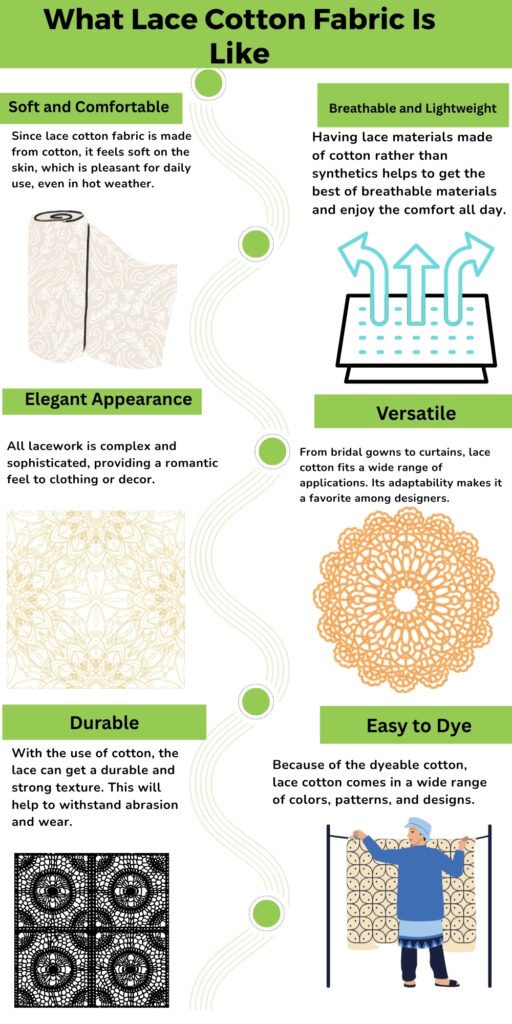
How to Care for Terry Wool Fabric

Proper care keeps terry wool fabric looking new and soft for a long time. Follow these simple maintenance steps:

  1. Gentle Washing
    Hand wash in cold water using a mild detergent. Avoid hot water as it may shrink the fabric.
  2. Avoid Harsh Chemicals
    Do not use bleach or strong detergents that can damage wool fabric.
  3. Drying
    Lay flat to air dry. Avoid direct sunlight and do not tumble dry to preserve the fabric’s shape.
  4. Ironing
    Use a low heat setting with a pressing cloth if needed.
  5. Storage
    Store in a cool, dry place and use moth repellents to prevent damage.

By following these easy to do steps, your what is wool fabric won’t lose its softness or beauty in the years to come.

Why Terry Wool Fabric Is Popular

Terry wool combines comfortdurability, and luxurious texture. It gives the warmth without the restriction. Therefore, it is used in many things like cloths and home items. It not only performs well but is also visually appealing. Therefore, it has a position in the fabric industry.

Conclusion

Terry wool fabric is a perfect example of functionality and luxury. It attracts designers with ease of care, warmth, and soft fabric. It is used in many items from home to cloths and is known to provide great value.

When looking for items with everyday practicality as well as elegance, terry wool fabric is among the best fabrics out there.

FAQs

Is terry wool fabric suitable for winter wear?

Yes, it has a soft warm texture and amazing insulation making it perfect for winter.

Can you machine wash terry wool?

To keep its softness and avoid shrinkage, it’s best to wash terry wool by hand in cold water.

How is terry wool different than regular wool?

Unlike regular wool, terry wool has looped fibers which contributes to its softness and its ability to absorb water.

Rayon Nylon Fabric: Smooth, Strong, and Stylish Choice

Some materials may lose charm over the years, but the world of fabric is always evolving. The Rayon Nylon Fabric still shows it’s smooth touch, lasting strength, and is stylist. Jacket, and more recently, dresses are made of this fabric because it is a preferred fabric. Customer appreciation is increased to the recognition of how this fabric feels.

Fashion is always changing, but some materials never go out of style. rayon-nylon fabric is the perfect example. It ins soft as garment and tough as nylon. It does not lose elegance.

Combining the two makes something special. rayon-nylon fabric combines the smoothness of silk and the strength of nylon This makes it valuable. It is gentle but robust and that’s why it is loved by tailors, designers and wearers.

The first thing here is the softness. It is smooth and feels like natural silk. It glides under your fingers, providing a nice feeling. This is why it is perfect for shirts, skirts and other clothes that touch the skin.

Rayon Nylon Fabric is also softer than some materials and doesn’t aggravate the skin. It is also breathable which prevents overheating and keeps skin irritation at bay. Since body temperature is regulated, the rayon component during the warm seasons helps the body and moisture is absorbed. Furthermore, the nylon helps the fabric retain its shape and flexibility. Thus, it becomes a fabric that moves and stretches with the body, allowing for a wider range of motion.

Because of this comfort, Rayon Nylon Fabric is sought after by individuals who cherish softness coupled with personal strength. It is used for both informal and formal attires by designers, as it is especially suited for all-day wear. It is also lightweight which makes it a top choice for comfort.


Core Fundamental strength that Lasts for Years

A row of colorful nylon sports uniforms hanging on white hangers along a metal rack, displaying textures and a variety of colors from white and black to blue, green, yellow, and red.
Vibrant nylon sports uniforms ready for game day.”

Rayon Nylon Fabric scoring highly on comfort and showing it can be durable as well provides another layer of value. Nylon fibers makes the fabric strong and resistant to abrasion which is key to its long lifespan. It also helps ease of care as it maintains its shape after multiple washes. This is appealing to those with a sense of style who want long lasting durable clothes.

Rayon Nylon Fabric is one of the strongest types of fabric. The combination of rayon and nylon gives the fabric softness and strength. The fabric is able to withstand the daily stress of uv use and is less likely to tear or stretch compared to other blends.

Because of the strength of Rayon Nylon Fabric, it is also used for sports uniforms and outerwear. The fabric’s strength and long lasting quality gives the wearer confidence that the clothes will always look fresh. The fabric also looks newly made no matter how many times it is worn.


The Beautiful Look That Remains Beautiful

A close-up macro photograph of black nylon fabric showing a tight, interwoven weave pattern with a slight sheen.
Close-up of black nylon fabric: a tight, glossy weave that highlights the material’s durability and sleek texture.

In clothing, the look is very important. With Rayon Nylon Fabric, beauty is easy to get. The fabric gleams with a natural shine, flowing with every gentle movement and draping beautifully. This makes it perfect for high end clothing.

Rayon Nylon Fabric is celebrated in the fashion industry for how it captures dye. The fabric holds bright and rich hues that last through many washes. The combination of the fabrics allows for the material to maintain vibrant colors whether they are soft pastels or dark shades.

With its silky appearance and firm structure, Rayon Nylon Fabric is used to make and design daily outfits, party wear, and even formal dresses. The Timeless Flow Fabric balances both form and style.


Feeling Great, Anytime

Rayon Nylon Fabric is designed for use in all seasons. The Rayon component will keep you cool while the nylon will keep you warm. This is what makes it comfortable for use in the summer and winter. The fabric adjusts to the body temperature, making it comfortable all year round.

In the summer Rayon Nylon Fabric absorbs moisture, and keeps the body cool and dry. In the winter it protects you from cool air and provides a lightweight barrier. The fabric manage the temperature very well, so you don’t have to put on multiple layers. Cozing and lightweight, it will warm you in the winter and cool you in the summer.

This is the reason why sport wear and a lot of other clothing has Rayon Nylon Fabric. Travelers love this fabric because it offers a lot of versatility without the extra clothing. They are comfortable in any climate with only a few clothing.


Super Easy Care

People really love Rayon Nylon Fabric because it’s super easy to take care of. A lot of fabrics need special care, but not this one! It doesn’t wrinkle, and it dries quicker than pure rayon. For people who want to put on clothes, that’s low-effort. This fabric is perfect for them.

Cleaning Rayon Nylon Fabric is easy too! Just a gentle wash with mild detergent, and it’s good! It doesn’t shrink and it does keep its smooth texture after it dries. Clothes stay neat for a long time because nylon prevents it from sagging.

Even after washing it many times, Rayon Nylon Fabric still shines and looks really good. It’s not easy to fade and it remains soft, meaning you won’t need to replace it and will save money. For busy lifestyles, it’s perfect.


For Function and Fashion

Designers love fabrics that serve for both beauty and purpose. Rayon Nylon Fabric meets both needs gracefully. It’s versatile. It can be used for skirts, trousers, jackets, or even handbags.

Rayon Nylon Fabric spots the balance between ease and SOPHISTICATION It’s used multiple times for office and evening wear as it gives the needed mobility and body control. It provides a premium feel, yet, is quite inexpensive.

Rayon Nylon Fabric gives a classy and expensive look without the actual expense. The shine and soft feel give the impression of luxury, which is perfect for anyone trying to look stylish while purchasing long-lasting quality. Designers frequently label it the “smart fabric” for new-age living.


Plenty of fabrics look fantastic but don’t feel fabulous, and it is one of the few fabrics that work. It may be rough. It is tough against daily drudgery and still manages to be gentle against the skin and strong. Its outer covering maintains a fresh look and calm disposition, while the soft nature promotes the overall comfort of the fabric. Nylon is the fabric’s workhorse.

Rayon Nylon Fabric is the best of both worlds. The fabric bends and moves naturally with the user’s body while still providing the illusion of restriction and class. It is strong enough for activity, and light enough for long wear.

Everyone loves Rayon Nylon Fabric, including those passionate about fashion and those who just want something nice to wear. Comfort and style is something fabric cannot capture. Once you use it, it is hard to use something else.


A Smart and Eco-Friendly Future Ahead

Most materials out there are not eco friendly and are useless. Rayon Nylon Fabric is not one of them. Most of rayon is made from wood pulp, so it is semi-natural. This is not a fully synthetic fabric. For better durability, most rayon blends contain nylon as well. This means a fabric will help in reducing waste.

Rayon Nylon Fabric can last for a very long time. When you do not have to replace something frequently, you are helping in reducing waste. This is why many brands are choosing this blend for smart eco collections.

The blend of Rayon Nylon Fabric helps in eco-friendly designs. This is multifunctional and can be used for different designs, patterns, and styles. This means you do not need to use as many materials. The blend is very strong and comfortable; this makes it last and keeps it sustainable.


Final Thoughts

Looking at comfort, style, and durability, Rayon Nylon Fabric earns top marks. The surface is smooth and feels gentle, while the core is firm and the surface maintains an elegant appearance. The softness of rayon and the durability of nylon blend synergistically.

Rayon Nylon Fabric answers the call for good looking and long-lasting clothing. It retains its beauty over time, and accommodates an active and comfortable lifestyle. The increasing appreciation of the designers and end users, reveals the bright prospects of this fabric.

FAQs

1. What is Rayon Nylon Fabric?

Rayon Nylon Fabric is a blended textile made by combining rayon and nylon fibers. It offers a smooth texture, high strength, and elegant appearance.

2. What are the main features of Rayon Nylon Fabric?

This fabric is soft like rayon, strong like nylon, wrinkle-resistant, and has a luxurious drape. It also holds color very well.

3. Is Rayon Nylon Fabric comfortable to wear?

Yes, it is breathable, smooth on the skin, and comfortable for long hours of wear, making it ideal for clothing.


Chenille Wool Fabric: Properties, Uses, and Care Guide.

Fabrics, especially Chenille Wool, is among the most luxurious and comfy materials. The softness of the fabric and the warmth of the fabric make it versatile, something that can be used for both home decor and for wear. Below is the fascinating story of this particular fabric, from its history, benefits, care tips, and uses, to understand the need for this timeless fabric that has endless uses.

A Brief History of Chenille Wool Fabric

Chenille in French means caterpillar, and describing it this way is simply because of the fabric’s fuzzy and soft surfaces. Chenille started getting recognition in the 18th century in France. The first chenille fabric was made of silk and later developed into using wool, cotton and synthetic material.

In the 20th tweed wool fabric used for chenille became popular because of its strength and warmth. It became used for sweaters, scarves, and blankets. The rich texture and timelessness of the fabric is the reason designers still prefer it to this day.

Unique Properties of Chenille Wool Fabric

An infographic titled “Properties of Chenille Fabric” listing five features with green headings, small descriptive text, and corresponding illustrations (soft and velvety texture, warmth and insulation, durability, luxurious appearance, flexibility and drapability).
Properties of Chenille Wools Fabric: Soft texture, warmth, durability, luxurious appearance, and graceful drape.

There are a few defining traits of Chenille wool that add functionality and add luxury:

  1. Soft and Velvety TextureChenille fabrics have a wonderful soft pile texture surface due to twisting short lengths of yarn between two core yarns. This construction provides a plush and fuzzy texture that is soft to the hand and provides a wonderful tactile sensation.
  2. Warmth and InsulationWool fibers provide the best natural insulation making Chenille wool fabrics perfect to wear in cold environments. Fabrics trap air between fibers which keeps the body warm and is still breathable.
  3. DurabilityChenille wool fabrics are soft but also have a high durability. This is attributed to the twisted yarn that provides strength and reserves the fabric shape and texture after multiple uses.
  4. Luxurious AppearanceFabrics have a subtle sheen and richness to Chenille which also increases its value. Used in either fashion or interiors, it provides sophistication in comfort.
  5. Flexibility and DrapabilityChenille wool fabrics medium weight and flexible weave which allows it to beautifully drape. This allows it to be used for tailored garments and also decorative home items.

Uses of Chenille Wool Fabric

The different industries appreciate the adaptive nature of chenille wool fabric.

1. Fashion Industry

Industrial embroidery/overlock sewing machine with multiple spools of chenille wool threads in bright colors (silver, green, pink, yellow, blue, orange) on a quilting or embroidery setup.
Colorful chenille wool threads fed into a high-capacity embroidery machine, ready for plush, textured fabric creation.

Chenille wool becomes winter apparel fabric. Designers create sweaters, winter jackets, cardigans, and scarves using chenille wool fabric. While outerwear is made, the softness and warmth of the fabric becomes handy.

2. Home Décor

A rustic barn wedding setup with long wooden tables, neutral runners, and floral centerpieces. Warm string lights and disco balls hang from the ceiling, while wooden chairs line both sides of the tables.
Rustic barn wedding reception with long wooden tables, soft gray runners, and delicate floral accents under warm string lights.

In home designing, the chenille wool fabric is used for cushions, throws, curtains, and drapery. It creates an inviting and sumptuous environment. Its softness and shiny texture enhance the beauty of the home.

3. Accessories

A black quilted Chanel handbag filled with beauty items and a pair of white gloves; various bottles (perfume, cosmetics) protrude from the open bag, with scattered white and yellow pills on the surface.
Luxurious chaos: a quilted black Chanel bag spilling beauty essentials and gloves, with pills scattered nearby.

Chenille wool is used to make many warm accessories, including shawls, hats, and gloves. It adds comfort and elegance to all of these accessories.

4. Upholstery and Furniture

A vintage-inspired living room with yellow patterned walls, gold-framed portraits, and cream-upholstered seating. A wooden table sits in the center, surrounded by matching chairs and a sofa, all trimmed with gold accents. Soft sunlight streams across the polished wooden floor.
A sunlit, vintage sitting room adorned with chenille-wool upholstered chairs and sofa, gold-framed art, and classic mid-century styling.

Sofas and chairs made of chenille wool are stunning and long-lasting. Its texture masks surface damages, and the fabric lasts for many years.

Benefits of Chenille Wool Fabric

Infographic titled ‘Benefits of Chenille Wool Fabric’ with colorful icons: yarn balls, a green scarf, a peach chair, a campfire, cartoon devils, an elderly man with a goose, and two blue gears. Sections labeled: Comfort and Softness, Warmth, Visual Appeal, Longevity, Versatility, each with descriptive captions about chenille wool fabric.
Benefits of Chenille Wol Fabric: warmth, comfort, visual appeal, longevity, and versatility.

The reasons for the continued high demand for chenille wool fabric are:

  1. Comfort and Softness – It is a joy to touch and wear chenille wool fabric, because it gives a plush texture.
  2. Warmth – It is very breathable material, which is ideal for chilling cold weather.
  3.  Visual Appeal – It has a decorative quality because of the rich sheen and texture.
  4. Longevity – Chenille wool items, with the right maintenance, will last you a lifetime.
  5. Versatility – It easily fits both casual and formal designs.

Moreover, wool is a renewable and sustainable fiber, so and is eco-friendly.

Care and Maintenance Tips

Infographic titled 'Care Tips Chenille Wool Fabric' with five circular icons and green step headings: 01 Dry Cleaning Recommended, 02 Gentle Hand Washing, 03 Air Drying, 04 Avoid Direct Heat, 05 Brushing. Each step has a short description and small illustration icons.
Care tips for chenille wools fabric: dry clean, gentle hand wash, air dry, avoid direct heat, and light brushing to restore fluff.

With proper maintenance, the lifespan of what is wool fabric can be prolonged.

  • Dry Cleaning Recommended: To prevent the wool fabric from shrinking and folding, dry cleaning is the best option.
  • Gentle Hand Washing: Be sure to use cold water and a gentle detergent. Do not twist, wring or scrunch the fabric.
  • Air Drying: Lay the fabric on a clean towel to dry. It will dry best on a horizontal axis.
  • Avoid Direct Heat: Direct sunlight and other high heat appliances will ruin the fibers.
  • Brushing: You can use a soft, gentle brush to fluff the wool fabric and release the matted pile.

With the above practices, duck wool fabric will remain soft and feel luxurious.

Why Chenille Wool Fabric is Still Loved

Combining traditional craftsmanship with contemporary design, Chenille wool fabric is a versatile option for many products in the fashion and home décor industries. Its fabric’s warmth, versatility, and texture make any piece, from stylish coats and cozy blankets to fine-stitched upholstery, a statement of comfort.

In addition, the resourceful designs and eco-friendly, sustainably appreciated materials for quality, fashionable, modern sustainable designs to be creatively appreciated for resourceful by sustainable resource design for quality craftsmanship. With quality craftsmanship, worn for sustaining on a personal or professional level, the fabric value the presence of any resource.

Conclusion

In the world of textiles, Chenille wool fabric is unmatched. Its texture, warmth, and durability make it a constant for clothing and home décor. As fashion changes, the versatility of chenille wool remains constant, promising a unique mix of elegance, comfort, and functionality. No matter the season, chenille wool fabric is a reliable for warmth, softness, and sophistication.
FAQs

What makes chenille wool fabric unique?

It is differentiating value texture with warmth for comfort in various items, for different warmth and comfort.

Can chenille wool be machine washed?

It is resourceful to avoid machine washing and dry clean instead.

Is chenille wool fabric suitable for upholstery?

Definitely, because of its soft texture, it’s commonly upholstered on furniture.